Home Blog Page 260

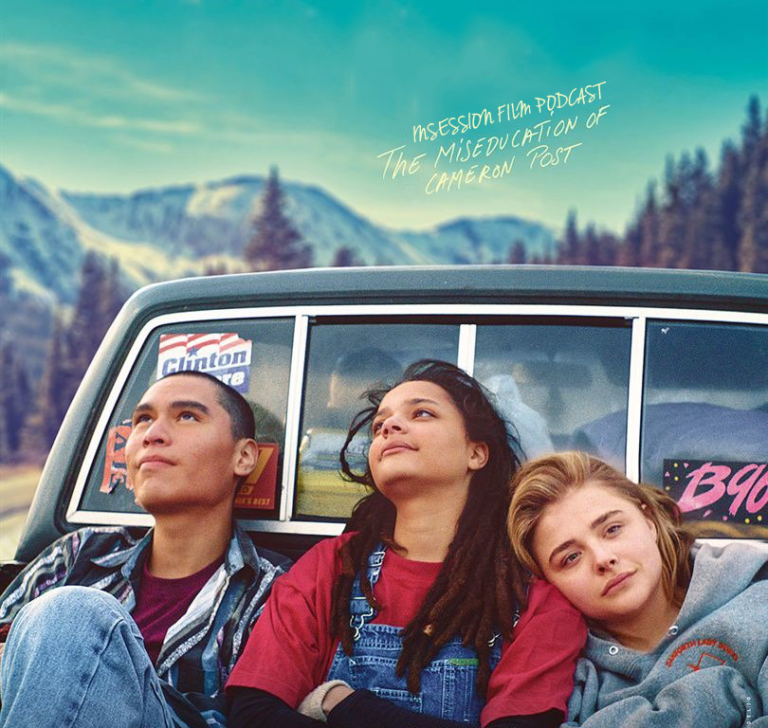
Podcast: The Miseducation of Cameron Post / Minding the Gap – Extra Film

This week on the InSession Film Podcast: Extra Film segment, we have a *huge* announcement upfront before we review The Miseducation of Cameron Post and the documentary Minding the Gap!

No Brendan this week, but JD is back to join Ryan and Jay as we celebrate new beginnings and look forward to a brighter future. We cannot wait to see where this collaboration goes and we hope you (our awesome listeners) enjoy it as much as we will.

Have fun with this week’s Extra Film segment and as always let us know what you think in the comment section below. Thanks for listening!

– Movie Review: The Miseducation of Cameron Post (8:47)
Director: Desiree Akhavan
Writer: Desiree Akhavan, Cecilia Frugiuele
Stars: Chloë Grace Moretz, Sasha Lane, Forrest Goodluck

– Movie Review: Minding the Gap (43:02)
Director: Bing Liu

– Music

Don’t Wait For Us – BLOW
Minding the Gap Theme – Nathan Halpern, Chris Ruggiero
The Return of the Eagle – Atli Örvarsson

We try to make this the best movie podcast we possibly can and we hope you enjoy them. Subscribe today on iTunes and Stitcher and please leave us a review on iTunes. You can also find us on Soundcloud, PlayerFM and TuneIn Radio as well. We really appreciate all your support of the InSession Film Podcast.

Subscribe to our Podcasts RSS
Subscribe to our Podcasts on iTunes
Listen on Spotify
Listen on Stitcher
The Miseducation of Cameron Post / Minding the Gap – Extra Film

[divider]

Mobile App

To hear this Extra Film episode and everything else we do, download our apps on the Amazon Market for Android and the Podcast Box app on IOS devices. The mobile app covers all of our main shows, bonus podcast’s and everything else relating to the InSession Film Podcast. Thanks for your wonderful support and listening to our show. It means the world to us!

[divider]

Help Support The InSession Film Podcast

If you want to help support us, we would greatly appreciate it! For more info, CLICK HERE.

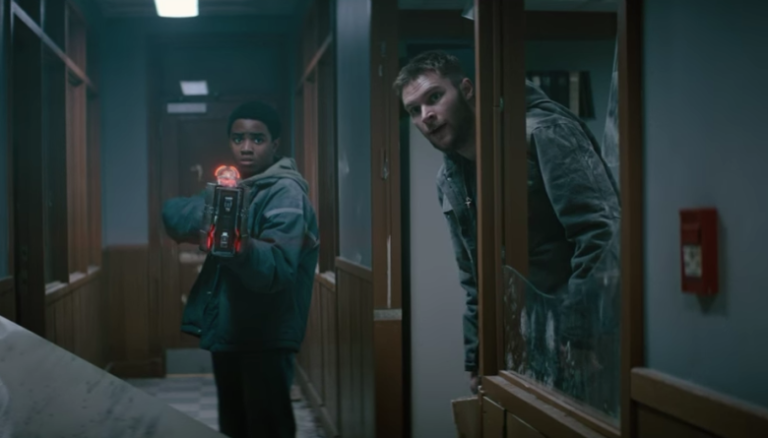
Movie Review: ‘Kin’ is truly a confounding experience


Directors: Jonathan Baker, Josh Baker
Writer: Jonathan Baker (based on the short film “Bag Man” by), Josh Baker (based on the short film “Bag Man” by)
Stars: Myles Truitt, Jack Reynor, Dennis Quaid

Synopsis: Chased by a vengeful criminal, the feds and a gang of otherworldly soldiers, a recently released ex-con and his adopted teenage brother are forced to go on the run with a weapon of mysterious origin as their only protection.

[/info]

Johnathan and Josh Baker’s Kin suffers from a cinematic identity crisis. The film itself plods along for one hour and forty minutes attempting to morph into various types of film, none of which it does successfully. Is it a melodrama? Is it an action flick? Is it science fiction? The only thing which appears evident watching Kin is the Baker’s brothers (who wrote the film as well) don’t have a clue either. The end result is a storyline is equal parts meandering and contrived. Why would anyone willfully subject themselves to this?

Kin is based on the short film Bag Man. Eli (Myles Truitt) is a lonely African American child who while pulling copper wire from abandoned buildings stumbles upon a weapon which turns him into basically a superhero. His adoptive dad Hal (played by Dennis Quaid) works long hours at the construction site to put food on the plate for his son. Eli’s adoptive brother Jimmy (Jack Reynor) comes home after being in lockup for six years. From the moment he shows up on Hal’s doorstep, trouble has already begun. Jimmy is in deep with local crime boss Taylor Balik (James Franco) for protection services provided while in jail. If he doesn’t find $60,000 fast, he risks his whole family being killed. Faced with no options, he decides that the safest route is to rob his dad’s construction business (eye-roll). Tragedy strikes and the brothers are forced to go on the run. While hiding out in a local adult establishment, they manage to befriend Milly (Zoë Kravitz) who plays a stripper with a conscience. When trouble erupts at the bar (mainly because Jimmy is a hot-head), rather than hide out with the other dancers in the back, Milly decides that these brothers who she just met are trustworthy to run off as they make their way towards to Lake Tahoe. Meanwhile, Balik’s crew is in the midst of tracking down Jimmy so they can exact some revenge after what took place at Hal’s construction site. Oh! Did I mention two space soldiers are also attempting to track them down as well so that they can recover their weapon?

The Baker brothers have developed a tale which is chock full tropes which really have no rhyme or reason to them. Instead of going with the “less is more” approach, the writing team decided to throw in so much into the film that Kin just fell apart. As someone who actually sat through this film, I should be able to make at least some sense of what the film wanted to be, but it is still a mystery. Mark Day’s film editing was atrocious. There were actual moments where Hal and Jimmy were having a family moment and then inexplicably we’d cut to a part of the film which had little connection to what we had just seen. What were they hoping to accomplish with this?

The performances in the film Kin matched the source material which was lackluster at best. Zoë Kravitz’s character Milly didn’t have a real purpose in the film. Jack Reynor’s character Jimmy was supposed to be the most the most conflicted, and he came across as more spoiled than conflicted. The depth in Myles Truitt’s performance as Eli was superficial (and that’s being nice). The score was overmodulated, and the overabundance of synthesizer sounds was so irritating that it almost caused me just to leave the theater.

Overall, I can’t imagine a worse choice this weekend than having to sit through Kin. If anyone feels the burning desire to see this train wreck, then I urge you to follow these simple steps

– Open up a web browser

– Type in your local theater’s name and click on the showtimes
– Close your eyes
– Point at your screen without looking and slightly move your arm and down for 5 seconds
– Open your eyes and see which movie that you pointed at and go to that one instead of Kin 
– If by some unfortunate circumstance you’ve picked Kin then repeat steps 1-5 until you haven’t
– Thank me later

Why subject yourself to a movie that undoubtedly will be on Red Box in a few weeks and in the dollar bin at Walmart in about a month.

Overall Grade: D

[divider]

Podcast: And the Winner Is… Vol 8 – Ep. 288 Bonus Content

Listen!

This week for our Episode 288 InSession Film Podcast: Bonus Content, Matt Neglia from Next Best Picture joins us to discuss the awards season for the films of 2006, as we tie in this discussion to our 2006 Retrospective. It was a lot of fun, check it out!

Listen to Episode 288 by clicking here.

[divider]

HELP SUPPORT THE SHOW

We offer our bonus content for free, but we do encourage and appreciate a small donation of $0.99 as a way to help support the show. Click on the PayPal button below to donate and thanks so much for your support. You can also hear all of our Bonus Content via our mobile apps. See the information at the bottom of the post for more details.


One-Time Donation


[divider]

Mobile Apps!

Listen to all of our bonus content on our apps for just a one-time fee! Whether you have an iPhone, Android or Windows phone, our apps are available in many different ways that is convenient for you. With our mobile app, not only can you listen to all of our bonus content, but our main shows and our Extra Film podcasts as well. Click here for more info!

If you don’t want to purchase our bonus content, but still want to support us, there are other you can help us out. Click here for more info.

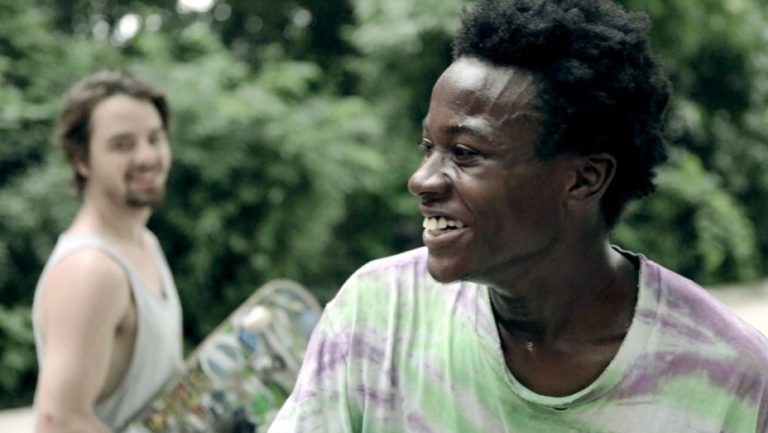
Movie Review: In a year packed with great documentaries, ‘Minding The Gap’ is the best of the bunch


Director: Bing Liu
Synopsis: Three young men bond together to escape volatile families in their Rust-Belt hometown. As they face adult responsibilities, unexpected revelations threaten their decade-long friendship.

[/info]

I grew up playing team sports. Baseball, football, and basketball were the sports I participated in, competitively. Each of these sports require a player to be dependent on his or her teammates. I had no problem doing this because I had no problem relying on others in any facet of my life. For some, that is not the case. People who are afraid to give themselves to others, Minding the Gap posits, are geared more towards individual sports. Golf is expensive. It can be tough to find a place to play tennis (and even that requires another person). Skateboarding, however, is cheap and offers more individual freedom than any other sport. The world is your skatepark. The only thing restricting your tricks is your imagination (and the occasional security guard). In the industrial town of Rockford, Illinois, a small group of young men have found an escape from their abusive past and/or present in the form of kick flips and frontside grinds. But Minding the Gap is less a skateboarding film than a film about the modern state of masculinity, class, and race in modern America. What Bing Liu is able to accomplish in his directorial debut is astonishing. The scale of the commentary he is able to squeeze out of a story about him and his skateboarding buddies makes Liu a force to be reckoned with in the art of documentary filmmaking.

The subjects in the film are people Liu grew up with in Rockford. Zack is a constant drinker and soon-to-be father at the beginning of the film, resentful of the fact that the world wants him to fit into some broad mold. Between the drugs, the drinking, and the skating, it is clear that he wants to avoid the realities of adult life however he can. With a kid on the way, though, he is trying to get his act together (or as together as his act can get) for the sake of his son and girlfriend, Nina. Nina plays an increasingly important role as the film goes on, her arc embodying so many of the ideas brought forth in the film. There is also Keire, a slightly younger black man, who is the glue of the film. He is affable and goofy, a young man who wants more from his life but fundamentally isn’t sure how he can make that happen. He is the most talented skater and the only one that lives at home. The last major subject of the film is Bing Liu, himself. Liu was never the most talented skater of the bunch and he ended up becoming the videographer for the group’s skate sessions. This inspired him to become a filmmaker and that is the way he got out of Rockford, which very few do. It is clear that making this him was a very personal and often awkward experience for him. It is anything but fun for him to talk about his friends’ histories of abuse, but it is an endeavor that yields heartbreaking results that will move any viewer to their core.

Much of the brilliance of Minding the Gap stems from its structure. Like so many great docs, it begins as a smaller, more straightforward story before using that base to comment on larger issues. Rarely has this style been used more deftly than Liu uses it here. As the film carries on, more and more facts about the abusive histories of the film’s subjects come to light. As we find out more about the families the subjects grew up with and the city they grew up in, it is impossible to not feel sympathy for everyone involved. The film rides a steady incline of emotional resonance, leading to a crescendo at the end of the film that completely overwhelmed me. Minding the Gap was the first film of 2018 that made me cry, and that was just from viewing it at home on Hulu.

Zack and Keire veer in very directions over time. They treat trauma, the unifying element of the subjects’ lives, in remarkably different ways. There is almost no scene in the film where Zack doesn’t have either a beer or blunt in his hand. His business venture falls through and he blames everyone but himself. He can’t maintain a consistent relationship with his girlfriend and, by proxy, his son. There is even implied abuse (that becomes much less implied later in the film, during an interview with Zack) against his girlfriend. Meanwhile, Keire rolls his sleeves up and gets a job washing dishes at a restaurant, the first job he has ever had. He consistently talks about how badly he wants to get out of Rockford and steadily climbs the ladder at the restaurant, working his way to the front of the establishment.

Keire is the one who learns to rely on others. He is willing to give himself up to the process of the documentary and it is hard to deny that the film had an overwhelmingly positive influence on his life. Even as he continues to suffer heartbreak in the film (at the hands of his family, especially), he manages to maintain a positive attitude. Skateboarding is still an escape for him, but it is no longer his entire life. He begins to accept himself and his past from every perspective. The only major African-American subject in the film, Keire has an extra layer of identity-grappling to do, which comes to a head in a brilliant scene encapsulating the awkward racial situation modern pop culture is presenting in today’s environment. Meanwhile, Zack is unable to find any sort of center. His charisma is greatly outweighed by the increasingly questionable ideals he brings to the table.

One of the Minding the Gaps’s producers was acclaimed documentarian Steve James. Knowing that, it is hard not to compare James’ Hoop Dreams with Liu’s film. On a smaller scale, Minding the Gap captures a perfect snapshot of a certain slice of America (the Rust Belt in Minding the Gap and the inner city in Hoop Dreams), much like James’ magnum opus. Both films teem with life and flesh out the subjects with nuance and respect, no matter how despicable the characters may become in a given moment. Liu is thoughtful enough to approach every issue from all angles. This may be because Liu, himself, suffered a great deal of abuse as a child. He even interviews his own mother about why she was willing to turn a blind eye, to a certain extent, to the horrible violence being committed by Liu’s stepfather. Her response is all the more heartbreaking because her less-than-perfect English makes it doubly hard for her to articulate what is, probably, the greatest regret of her life.

There is a bravery to Minding the Gap that has not been matched by any film in 2018. The personal nature of the story for 24-year-old director (24!) Bing Liu makes it one of the most impactful films in recent memory. Can we escape our pasts? How do we rid ourselves of the tragedies we have experienced? Skateboarding certainly supplies a temporary reprieve but there is nothing stronger than the support of others and a willingness to accept love. It seems like Steve James is one of the people that has supported Liu and I think the future of documentary filmmaking is in good hands because of it.

Overall Grade: A

[divider]

Featured: Most Anticipated Films for Fall 2018

0

Last week I wrote a (at least for me) lengthy piece about how great summer 2018 was for film. At this point, we may be on a collision course for this being the best cinematic year of the decade, but we’ll have to see how the fall plays out before we can hand it any sort of crown. It, undoubtedly, will have some disappointments but the lineup on paper looks very, very good. The fall/winter season will include new films from Steve McQueen (his first since his Oscar winning 12 Years A Slave), Barry Jenkins, Damien Chazelle, Alfonso Cuarón, Yorgos Lanthimos, Bradley Cooper, Paul Dano, Jonah Hill, Joel Edgerton, David Lowery, Pawel Pawlikoswki, Luca Guadagnino, David Gordon Green, Claire Denis, the Coen bros (hopefully), Hirokazu Kore-eda, Jason Reitman, Jean-Luc Godard, and even Orson Welles. Yes, you read that correctly. We are getting a new film from the legendary Orson Welles, and I cannot wait. There are, of course, many more filmmakers I could list here that have potentially great films coming out in the next few months as well. We’ll see what happens, but the fall and winter could be equally as special as what the summer had to offer.

With that said, here are the films that I’m most anticipating as we lead into the fall movie season. (these are in no particular order)

Widows
From director Steve McQueen, Widows tells the story of four women who have seemingly nothing in common except a debt left behind by their dead husbands’ criminal activities. The film stars Viola Davis, Elizabeth Debicki, Carrie Coon, Michelle Rodriguez, Liam Neeson, Jon Bernthal, Colin Farrell and Robert Duvall among others. That’s one hell of a lineup. This may be McQueen’s most commercial film yet, but so far each of his other outings have made my Top 10 for their respective years, and I’m excited to see if Widows continues that trend.

First Man
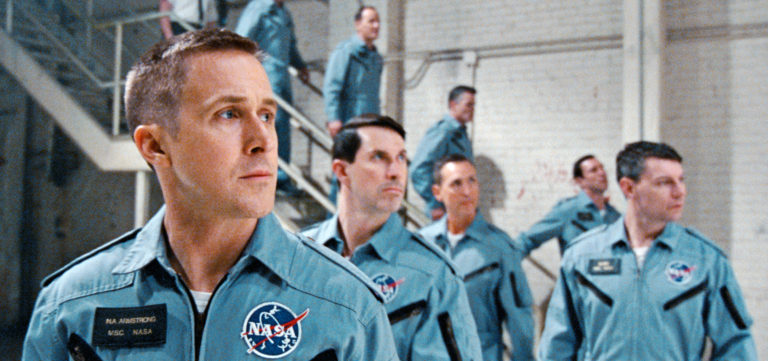
If the reports from Venice are true, First Man seems to be another hit from Damien Chazelle. Given his work on Whiplash and La La Land, I am not surprised at all to hear those initial reactions. Chazelle has supplanted himself as the next great director that could end up having a Hall of Fame career, and it sounds as if First Man makes him a robust 3-for-3. It tells the story of Niel Armstrong and his mission to the moon in 2969, and stars Ryan Gosling, Claire Foy and Jason Clarke.

If Beale Street Could Talk
Barry Jenkins is back coming off the heels from his Oscar-winning Moonlight. If Beale Street Could Talk is about a women in Harlem who desperately scrambles to prove her fiance is innocent of a crime. It is inspired from a book by James Baldwin, which I haven’t read, but knowing Baldwin’s works this sounds very enticing. It starts KiKi Layne, Stephan James and Regina King. The trailer looks great and I’m very eager to see what Jenkins does with this material – despite some of the initial test screenings reportedly not going very well. I have faith in Jenkins though, and I think in the end this will be a satisfying experience.

Roma
Alfonso Cuarón is back and I could not be more excited! Gravity seems like ages ago and Children of Men feels like a lifetime. To be fair, while Cuarón takes his time in between projects, the results are usually spectacular. Both Gravity and Children of Men made my Top 10 for their respective years, and Harry Potter and the Prisoner of Azkaban is easily one of the best Potter films. Let’s also not forget Y Tu Mamá También, which was also great when it came out in 2001. That is to say, I’m very excited for Roma purely because it’s Alfonso Cuarón. I’m also eager because it’s a black and white film that takes Cuarón back to his Mexican roots as it takes place in Mexico City in the 1970’s.

A Star is Born
I cannot get enough of this trailer. A Star is Born could falter and become a trite musician struggle story, but there’s something about the heart of that trailer that keeps me optimistic. This is, of course, Bradley Cooper’s directorial debut so it’s hard to fully gauge where it’s going to go. But if the film is at all what the trailer suggests, I think it’s going to be something special – regardless of its Oscar play. Bradley Cooper looks great as always (and if that is indeed his singing voice, kudos), but like most people I’m more intrigued by Lady Gaga. She looks so normal, and ironically that’s very strange to see. But there’s something about her normality that is striking to me in terms of the films ideas – as presented in the trailer anyway – on insecurity.

The Favourite
Yorgos Lanthimos may not be for everyone, but he is a (ahem) favorite director of mine. Dogtooth, Alps, The Lobster and The Killing of a Sacred Deer are all good films that I at the very least enjoy. Dogtooth and The Lobster I absolutely adore despite their dark underbellies. The Favourite is interesting though because it’s garnered some Oscar buzz, and I don’t usually equate Lanthimos with the Academy Awards. His films tend to be black comedies that aren’t exactly in the Academy’s wheelhouse, so this has an extra level of excitement to it. It stars Olivia Colman, Rachel Weisz, Emma Delves and Emma Stone. Sign me up!

Ralph Breaks the Internet
How about a change of pace? I *loved* Wreck-It Ralph when it came out in 2012 and was severely disappointed when it lost the Oscar to a rather mediocre Brave. Ralph was funny, clever, warming and surprisingly thematically rich. To say that I’m excited for this sequel is putting it mildly. And that trailer, wow, taking these characters to the internet seems like it’s going to be a lot of fun. The gags relating to parenthood and young children are all too relatable, the Disney princesses is brilliant and the digital aesthetics look spot-on.

The Old Man and the Gun
The Old Man and the Gun is compelling to me for a couple of reasons. One, David Lowery is a director that is quietly creating a very strong resume. Pete’s Dragon was well reviewed, but mostly went under the radar. A Ghost Story and Ain’t Them Body Saints were two great indies that absolutely went under the radar for most people – cinephiles excluded (but even among cinephiles there were certain sects that overlooked them). The Old Man and the Gun very well could be his most commercial yet and hopefully it launches Lowery more into the mainstream. Beyond that though, this is one of Robert Redford’s last performances since he announced his retirement. So enjoy this people. It very well may be the last time you see this legend on the big screen. The film also stars Sissy Spacek, who hasn’t done any film acting since Deadfall in 2012.

Beautiful Boy
I cannot watch this trailer without becoming a waterfall. Maybe it’s subjective since I’m a relatively new father (my son is two), but every time I see this trailer I can’t help but sympathize heavily with wanting to “save” your son. Steve Carrell looks great and his chemistry with Timothée Chalamet seems palpable. Felix Van Groeningen isn’t a director that most people will know, but The Broken Circle Breakdown is really good and deserved its Oscar-nomination back in 2013. So, I’m excited to see what he does with an American setting and American actors. It could be schmaltzy, but it gives me all the feels and that’s what I’m here for.

Under the Silver Lake
Despite what my co-host says, It Follows is a great horror film that ambiguously asks some profound questions – both within the context of the film’s premise but also the humanities at the center of that film. It doesn’t matter what David Robert Mitchell was going to do next, I was going to be on board regardless. Under the Silver Lake is about a young man who discovers a mysterious woman in his pool one night, only for her to disappear without a trace. So, as a young man would, he sets off to find out what happened to her. It stars Topher Grace, Sydney Sweeney and Riley Keough.

Wildlife
Here’s another directorial debut, this time from Paul Dano, who also co-wrote the screenplay with Zoe Kazan (who starred in last year’s The Big Sick). Wildlife tells the story of a young boy who witnesses the falling out of his parents’ marriage. It stars Jake Gyllenhaal, Carey Mulligan and Ed Oxenbould among others. From all accounts, Gyllenhaal and Mulligan will be major Oscar contenders for their respective categories. Beyond that though, I’m just thrilled to see great performances from these two actors that I love. I’m perhaps more eager for Mulligan, as we haven’t seen her as much lately and I’m dying for more Carey Mulligan in my life. Reviews from earlier in the year suggest that Dano’s direction is very good as well.

Shoplifters
I noted above that these are in no particular order, but if I was ranking these, Shoplifters is probably my #1 most anticipated film of the fall/winter season. Hirokazu Koreeda is one of my favorite filmmakers working today and this Palm d’Or winner sounds like a film tailor-made just for me. It’s about a family who takes in a child they find on the street. This has pathos written all over it. If you’re not familiar with Koreeda, he’s a filmmaker that loves to relish in emotion and subtlety, lingering on the small ticks that make humans human. If this moved David Ehrlich in extreme ways (and I say that as a fan of David, but he tends to be a harsher critic than me), I am screwed. But I look forward to being emotionally destroyed by Koreeda.

Cold War
Granted, I haven’t seen everything from Pawel Pawilkowski, but Ida was sooooo good that I can’t help but be excited for Cold War. It’s about a passionate love story between two people of different backgrounds and temperaments, set against the backdrop of the Cold War in 1950s Poland. So, there’s some clear symbolism going on there, but it still sounds enticing. The reviews from the festival circuits are excellent as well, amplifying my anticipation.

The Other Side of the Wind
Guys, we are getting a *new* film from Orsen Welles this fall. In 2018. A new film from the master himself. How is this a reality? Originally filmed between 1970-1976, The Other Side of the Wind had reportedly finished its principal photography, but couldn’t finish its post-production and editing due to financial problems. Eventually Netflix purchased the rights and worked feverishly to finish the film, and here we are. It tells the story of a Hollywood director who emerges from semi-exile with plans to complete a new innovative feature. It stars John Huston (you know, one of the best directors of his time, so that’s appropriate), Peter Bogdanovich, Susan Strasberg and others.

No doubt I could write about another dozen films or so that I’m looking forward to this fall season. There is so much to look forward too as we come down the stretch in 2018. Drew Goddard’s Bad Times at the El Royale looks great. David Gordon Green’s Halloween looks to be a great revival for that franchise. The Jacques Audiard films The Sisters Brothers looks really funny, especially when you pair John C. Reilly and Joaquin Phoenix. Speaking of Phoenix, it’d be nice if we get Garth Davis’ Mary Magdalene, also starring Rooney Mara. Steven Knight is back in the director’s chair with Serenity after making my favorite film from 2014 in Locke. Marielle Heller is back with Can You Ever Forgive Me? starring Melissa McCarthy, who looks really good in that role.

We’re also getting The Little Stranger from Room director Lenny Abrahamson. We’ll get another directorial debut in Mid 90’s from Jonah Hill, and I dug that initial trailer quite a bit. High Life from Claire Denis looks appealing as well. Luca Guadagnino’s Suspiria looks to be the year’s best “wtf” experience, and I can’t wait for that. Speaking of, films such as Mandy and Madeline’s Madeline will give Suspira a run for its money if the reviews are to be trusted.

Lastly, a few mainstream honorable mentions for me. Aquaman could end up being the funnest film in the DCEU thus far. I’m looking forward to Mary Poppins Returns as a big fan of Emily Blunt and I’m curious what music Lin Manuel-Miranda brings to the film. But more than any other mainstream fall film, Bumblebee has my attention. Travis Knight directed one of the best animated films of the decade so far in Kubo and the Two Strings, and Bumblebee looks like a great continuation of what I loved about Kubo. Hopefully it works as a great reboot for that franchise.

What about you though? What films are you most anticipating this fall season?

Featured: The Perks Of Being Weird And Living With A Mild (Or Wild) Heart

“Somebody told me that what I do is good because it tells people that it’s okay to be weird. I’ve been weird my entire life. I tried to be normal and it doesn’t work. I tried to be anything that I’m not and it doesn’t work.” – Sawyer Matheny

The person who I just quoted is a YouTuber I casually check on for his videos because I like what he says as he and his best friend ooze confidence and charisma and are more open about their lives. I’m not because I’m a coward and never been forthcoming and just camera shy. I also associate as myself as someone who is weird personally with because of various little knacks and this neuroticism I feature for the most random things. My mind does not think like others and my style and personality is not compatible with certain places and things and I always feel out of place with other people.

What does any of that have to with Chaplin and Tati, or Fellini and Hitchcock? Well…nothing. But, at least in my mind, everything. Why and how?

Well, the quote was said this year but these films were made decades ago, yet the quote might as well give some theme to the stories and its main characters. In an era of the jerk where people feel the need to be flagrantly rude instead of being there each other, to me, rewatching films about what it is like to be alone and be taken advantage of because you’re not “normal” is a reminder of what it means to really be human. It can be utilized as a tragedy or as a comedy. Social media did not exist back then and the best way to inspire life was through stories like this to stir human emotions and bring sparks of madness. My liking for various movies is because it filled a void in my life and had a relationship with me that being eccentric is okay.

As I write this stream-of-consciousness piece of something rather different within my personal/cinema psychology, I go back to the past with the first iconic characters we have seen. Chaplin’s The Tramp and Harold Lloyd’s “Glasses” qualify as weird figures, one who rebels against the norms of society and another who takes himself too seriously in order to succeed in life. Conformity is not part of their ideology and neither have I been part of conformity but it has come at a social price. Movies, along with the creativity that comes out of it, is collected from the weird, the non-conforming, the livers of mild/wild hearts.

I will start with the eccentric Jacques Tati who also created the famous, memorable Monsieur Hulot. He is probably my favorite slapstick, oddball character because of his throwback to a more silent stance in comedy made in a closely more contemporary style. Hulot is a tall, lumbering figure with his large overcoat, trousers too short, striped socks, and old-school pipe who uses physicality and modernity to showcase the singularity and the ridiculousness of a changing world. The expansive use of technology for every little thing and its malfunctions are played out so extensively that it requires a long stare to capture everything. He’s a man with no formal job (he is a car designer in Trafic but what did he do before that), no formal home (he lives in an old stone building in old Paris in Mon Oncle), and no specific origin or first name – just Hulot. He rarely speaks and when he does it is distant and he gets into conflict with the new world on holiday or on the job.

https://www.youtube.com/watch?v=mUTY0QrKJSQ

I relate personally because I am usually behind the curb on social media; I have a vacated Instagram account from 4 years ago because it’s too much social media and I reluctantly joined Facebook and Twitter. And the YouTube personality was not known to me until late 2016 when they’ve been around since YouTube inception. Music? It’s through one ear and out the other for me because my tastes are old-fashioned and the news of upcoming movies is a little late to me because I’m focused on the classics. Plus, I like physical Blu-Rays than digital films (because of my growing eye strain) and champion celluloid over digital film. Hulot is a man still trying to adjust in the consumerist life after the war from the 50s through the 70s and I’m a millennial who prefers some traditional things.

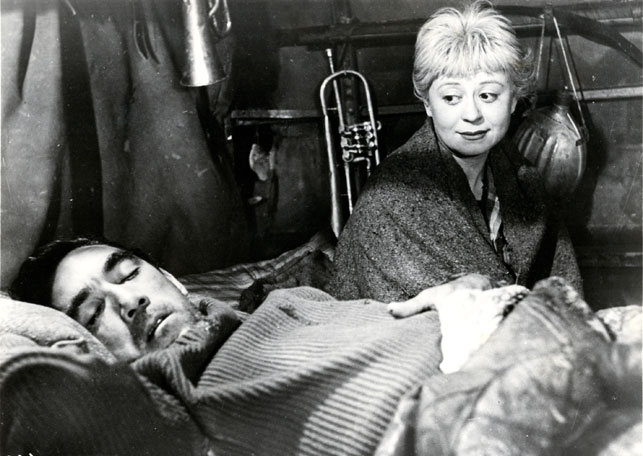
Let me use another character but from a single movie as an example; La Strada from the great Federico Fellini featuring his wife, Giulietta Masina, as the credulous, naive woman, Gelsomina, who is sold by her mother to be the clown for a street performer, Zampano. Zampano previously had Gelsomina’s sister as the clown who has died; we don’t know of what. But Gelsomina goes into the job with enthusiasm and soon finds Zampano as cruel and abusive who demands his playful new clown to be obedient and perfect in performing the way she should. After taking the abuse, she runs away and finds another performer, the Fool, a man with the same zest for life as Gelsomina who interferes with Zampano’s business. The final result is two deaths: one of a person, and the other of the spirit. It is a downer of an ending and a fable to what can happen when the brute comes out on top, then realize the damage he has done.

Gelsomina is still young at heart and can only question the difficulties he is having with such a credulous woman. “Why do you want me?” Gelsomina asks Zampano. She is not musically talented even though she plays the drum and trumpet for the audience and she is not necessarily attractive. Zampano is a jerk, like many that are out there, who use their time to intimidate the more lively but vulnerable Gelsomina. But Gelsomina is not one who will fall in line and is not intimidated very much. But for her to witness tragedy after hearing it about her sister, it is a double death that emotionally blunts her. Her weirdness (and the Fool’s) was worth to enforce emotional and physical blunt force trauma. You hate Zampano, but you do feel emotional about the final scene of him on the beach, drunk, and realizing how his actions are cowardly and explanatory of him being worthless and alone. And to Fellini, it was his world starting to leak from his mind, one that led to a breakdown mentally during the shoot and almost never finished it.

Here’s another example but with a more upbeat manner and ending. Peter Sellers was known for his colorful, strange characters and may have given his best performance towards the end of his life with Being There. It is a dramedy about chance and a man named Chance, a simple-minded, one-dimensional figure who is forced out into the open from his bubbled home in middle age. His old-fashioned, courtly behavior is not fitted with 1979, but chance has him a run into a wealthy businessman and advisor to the President of the United States. Chance, or “Chauncey” as they misheard him, gives his own advice though gardening tips, which is interpreted as legitimate and metaphorical. The miscommunication of his personality and ways leads to funny gags that make things more human and, in the end, gives us a simple explanation of what is life: “Life is a state of mind.”

This movie is a satire on the politics of the times and the anxieties the country fashed with our culture, “innocence, cynicism, and limitless credulity,” as written by Mark Harris. It is very much like today thanks to social media, just like the expansion of the television image that beams into homes all over. “I like to watch,” Chance says in a noted scene with Shirley MacLaine, and we like to watch the walking car crashes people can on TV and social media. There is no tone in his voice at all and voice means everything now in a presentation. Chance’s chance encounter is like real life where all you need to move onward with the gracious support of others. By the end, the viewer may take a piece from it and find ourselves more enlightened and care for those who we may encounter.

So, back to the quote that I started this piece with Sawyer, the YouTuber: what does that have to do with these characters and films referenced? Again, nothing, yet, as it was important to him and his feelings of being weird, it can relate to others who watch just like how these films related to me and inspired me to live, to keep going, take risks, and never change your ways. It’s okay to be weird and different because that is what life is about, especially when it comes to self-expression and helping others in our own way. It is one of the reasons I adored The Shape of Water and why it was my favorite film of 2017 (I will defend its honor and not let be the “fish banging movie”). Amelie is an enriching tale about helping others through astonishing ways, even with the odd curiosities of the titular character, while directors like Alfred Hitchcock and Orson Welles were larger than life men who created fluid stories and colorful, real characters to perfection and added flair in their self-promotion within the filmography.

With all of this, it examines life as beautiful even in scenes of ugliness and, even in black & white and in another language, these movies are influential in the heart and soul of being a human in general regardless of age, setting, and personality. Being weird is living in a positive state of mind.

Follow me on Twitter: @BrianSusbielles (Cine-A-Man)

Movie Review: ‘Puzzle’ is a charming remake but has some missing pieces


Director: Marc Turtletaub
Writers: Polly Mann, Oren Moverman
Stars: Kelly Macdonald, Irrfan Khan, David Denman

Synopsis: Agnes, taken for granted as a suburban mother, discovers a passion for solving jigsaw puzzles which unexpectedly draws her into a new world – where her life unfolds in ways she could never have imagined.

[/info]

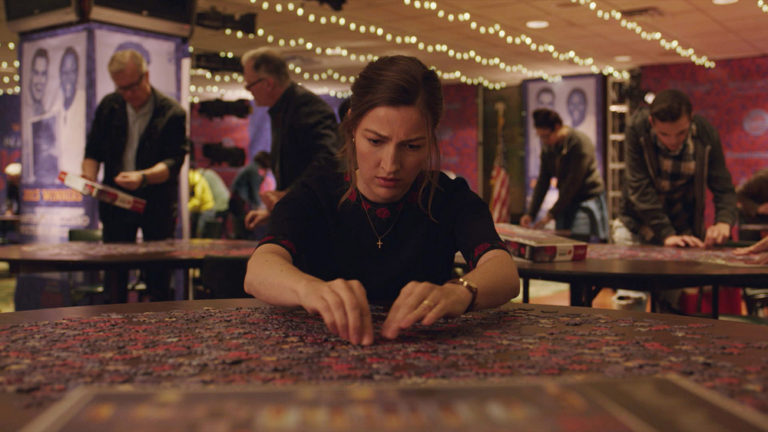
Puzzle is a 2018 remake of an Argentine film titled Rompecabezas (or translated from Spanish to English: Puzzle) originally directed by Natalia Smirnoff and released in 2010. Unfortunately the original I have not had the opportunity to watch yet so currently I am unable to draw comparisons between the two pieces of work. This newer version is directed by Marc Turtletaub, a new name for me, and essentially keeps the same story as the original. The plot centers around Agnes (Kelly MacDonald) a conventional stay at home mom who takes care of her family, attends church on a regular basis and is fixed in her daily routine and leading a very simple life. After receiving a jigsaw puzzle as a birthday gift she discovers something she both enjoys and has a talent for. This leads to a journey that has her redefining herself in new ways and having to cope with how her family reacts to the person she has become.

First off I am new to MacDonald’s work so I have no baseline but as far her performance in Puzzle she is magnificent. She is captivating as Agnes and is quite convincing as a woman who has simply fallen into the roles of dutiful wife and loving mother and even more convincing as one who goes through a powerful transformation. The film also provides adequate context for Agnes to make her character believable and allow the audience to connect with her plight in some way. But unfortunately this is where most of the praise for Puzzle ends. MacDonald has a quality supporting cast with Agnes’s husband Louie played well by David Denman and Irffan Khan as Robert a fellow lover of puzzles and a catalyst for the changes she goes through. Both men play important roles in Agnes’s life and Denman and Khan, in general, do a decent job in their roles but the writing for their characters is lacking. As the story unravels there is an expectation on the audience to accept certain aspects of their disposition but not enough complexity is provided to reach these conclusions. Although Agnes is the protagonist to fully accept her transition requires a certain amount of acceptance of how those around Agnes connect and respond to her. This proves difficult with Puzzle as the peripheral characters haven’t been properly fleshed out.

Additionally I found myself unable to buy into the relationship between Robert and Agnes. On paper I can see how these individuals could form a connection as they both feel a certain absence in their lives and the time the spend together can in ways feel intimate, but on-screen the chemistry between Khan and MacDonald is almost absent. After each encounter I questioned the direction that the film was going and based on the culmination of certain events it seemed apparent but I just didn’t buy it and frankly it felt forced. This may have something to do with the writing but Khan’s performance when interacting with Agnes was also off the mark. As the character of Robert I found him interesting and somewhat quirky yet gentlemanly, but the conversations with Agnes felt awkward and each encounter was so brief it was difficult to believe an intense connection could develop out of them. There is a moment in the film where Robert asks Agnes if he could kiss her and instead of it feeling sweet and endearing it came off clumsy and creepy. When it occurred I had no clue how Agnes felt about it and was confused on how the scene even lead into it.

Watching Puzzle can be a bit of a strange experience. The story is interesting and I wanted to follow along Agnes’s journey to see how it all played out. The messiness of the script aside I did feel for her character as Agnes is a person I am sure we all know in our lives. It is difficult to watch someone we care about float through their life unfulfilled especially when you can see they long for something more. Even more so a film like Puzzle makes you question your own life and look back at the decision you made and how they led you to where you are now. In this way Puzzle has something compelling to say and can be appreciated for the attempt. And again MacDonald’s performance is superb and she has such a powerful onscreen presence. Agnes can appear timid yet you can still sense this reservoir of strength under the surface. But aside from Agnes I spent most of the film confused regarding the remaining character intentions and actions. This is the case primarily with Louie and Robert, we get bits and pieces of their identities and but not enough depth. Their characters feel very hollow and play out on-screen like cliché’s placed there purely to tell Agnes’ story. By the film’s end I had no sense of who they were and didn’t buy into their actions. It’s disappointing because beneath it all I can see there is a good story to tell about how those around us fit into our lives and about self-discovery and the hidden possibilities we all harbor inside. But as it is Puzzle is too messy and patchy in its storytelling to recommend. On a positive note however it was a pleasure watching MacDonald perform and I do look forward to seeing her onscreen again.

Overall Grade: C-

[divider]

Poll: What is your favorite Stanley Kubrick film?

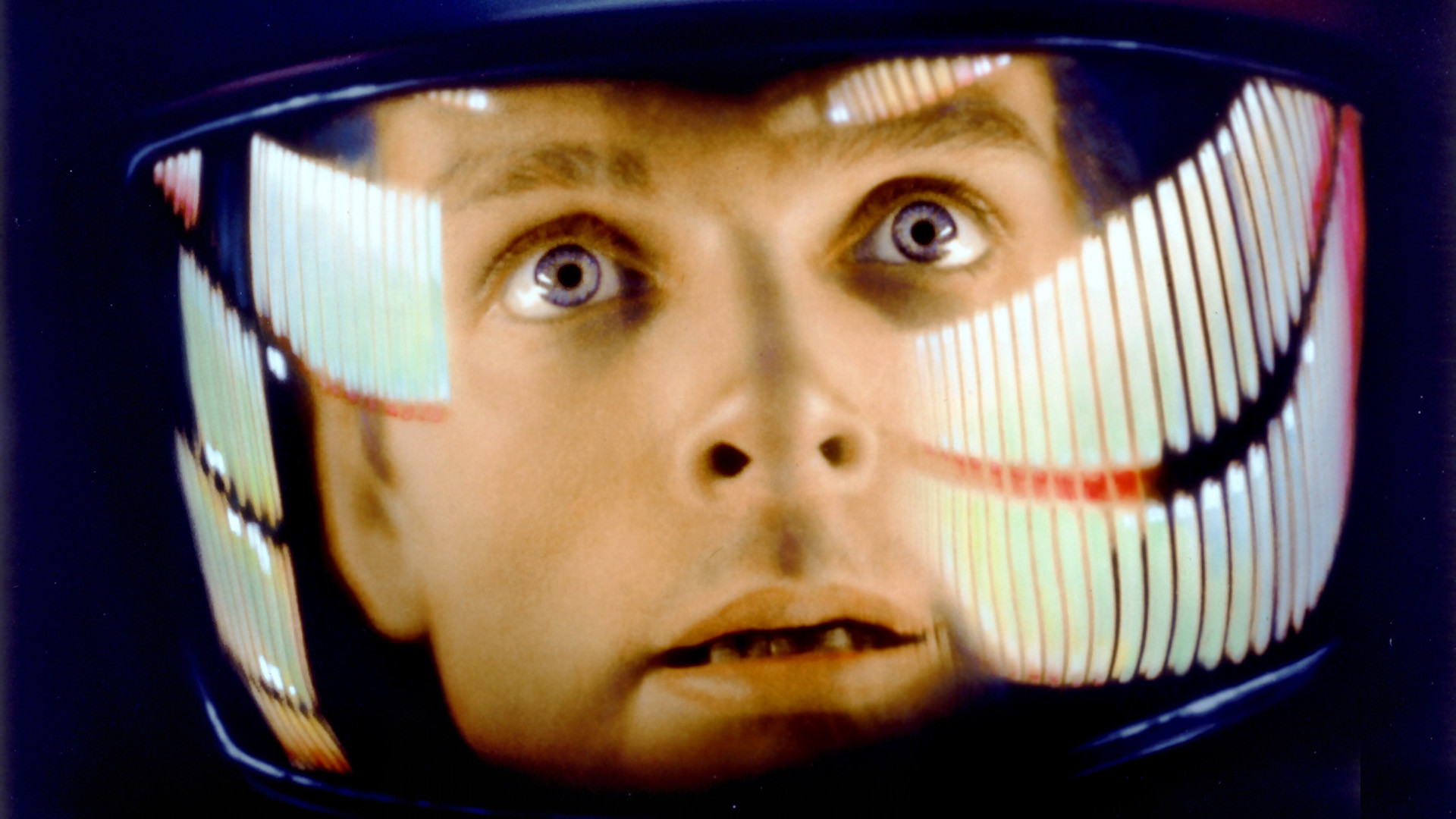
This week for our poll, inspired by the re-release of 2001: A Space Odyssey in theaters as it celebrates its 50th anniversary, we thought it would be appropriate to talk about its creator. Stanley Kubrick is a legend in the world of cinema, and for good reason. His canon is among the best of all-time, many consider 2001 to be his very best. But…we’re going to let you have your say on the matter.

What is your favorite Kubrick film? Vote now!


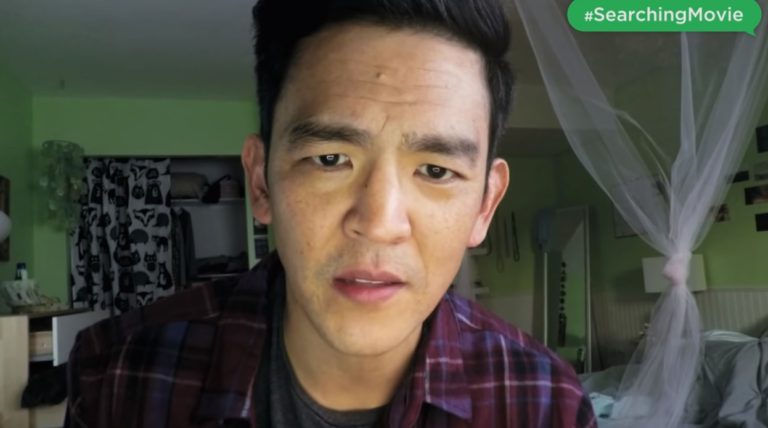
Movie Review: ‘Searching’ weaves in the best of Hitchcock with scintillating writing


Director: Aneesh Chaganty
Writers: Aneesh Chaganty, Sev Ohanian
Stars: John Cho, Debra Messing, Joseph Lee

Synopsis: After his 16-year-old daughter goes missing, a desperate father breaks into her laptop to look for clues to find her.

[/info]

Aneesh Chaganty’s Searching is a deftly constructed thriller which is cleverly written, contains strong performances, and contains a Hitchcockian twist which will blow your mind.

Now, this might seem like a bit of an oversell for a film released in late August but let’s examine the facts. First off, Searching is framed entirely on electronic screens (laptops, cell phones, and even security cameras). Now for some, this might seem like a bit of a gimmick, but in the context of this narrative, it’s certainly reflective of our society. What’s remarkable is how seamless it felt watching the story unfold through various devices. Chaganty indeed took a risk, and it resulted in one the more relatable thrillers in quite some time. What parent isn’t always telling their children to stay off their phone or tablet? We are continually monitoring whom our children chat with, but what happens when our worst fears come true?

The narrative centers around David Kim (John Cho) who is desperately searching for his daughter, Margot (Michelle La), who disappeared after a night of studying with friends. Using clues acquired by hacking into every social media account his daughter has, he tracks down false lead after false lead resulting in escalating frustration. Friends suggest that Kim should reach out to his daughter’s friends, but he doesn’t even know where to start. How can a father and daughter appear to be so close but no little about one another? Searching certainly makes a massive statement about social media. While Kim indeed uses social media to get the word out about his daughter, Chaganty’s film showcases the evils associated with the services. In the midst of his search, he encounters dead end after dead end (because people tend to hide who they are online).

What stood out to me most in Searching was the use of quick edits. Chaganty quickly cuts in out of various mediums allowing not a single moment in the film to feel wasteful and for the audience to not get sucked into the novelty of how the film is framed. The pacing of the film is fantastic allowing the tension to reach a fever pitch. Cho is outstanding as the father desperate for answers and the man who regrets not being involved with his daughter. Debra Messing plays Detective Vick (the officer assigned to their case) and delivers a nuanced performance as well. Cho and Messing are dynamite on screen. Each seems hell-bent on bringing a resolution to this case. Overall, the cast is strong, but Cho and Messing certainly stand out.

The lesson to be learned in Searching is no one should ever sacrifice good storytelling for the sake of a gimmick or a unique narrative device. Whether the film is framed on a computer screen or FaceTime, nothing should ever supersede the action. It was that commitment which allowed Searching to reach its full potential. Overall, I can’t imagine a more creative and pulse-pounding time at the movies than Searching.

Overall Grade: B+

[divider]

Hear our podcast review, coming soon on Extra Film.

[divider]

List: Top 10 Movies of 2006

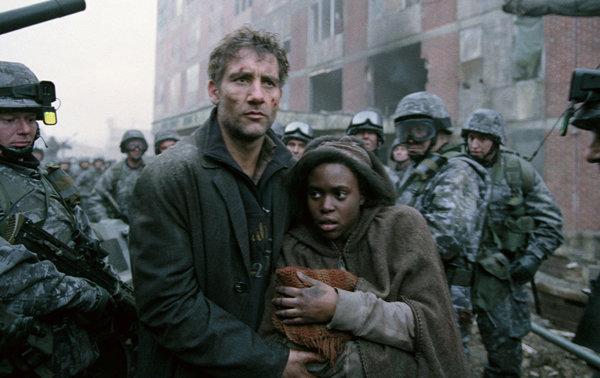
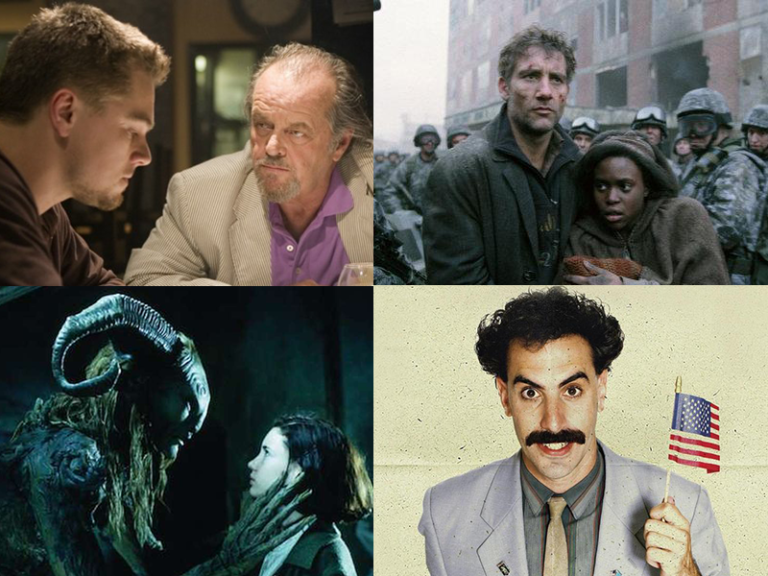
This week on Episode 288 of the InSession Film Podcast, we continued our year-by-year retrospective series by taking a look at 2006, a pretty great year for film despite a lack of consistency. It may have been slightly top heavy with films such as Children of Men, Pan’s Labyrinth, and Letters from Iwo Jima – films that will go down as some of the very best of all-time in their respective genres – but there were also some great hidden gems. So, this exercise was still a great challenge. However we were ultimately very satisfied with our selections and we hope you enjoy them as well.

NOTE: On #288 we only discussed our Top 5 movies of 2006, so be sure to listen to the show to hear us discuss why these particular films were the very best of that year. However, as you’ll see below, we have listed our full Top 20 lists from 2006.

JD

1) Pan’s Labyrinth
2) Children of Men
3) United 93
4) Man Push Cart
5) Letters from Iwo Jima
6) Brick
7) Half Nelson
8) L’Enfant
9) The Proposition
10) Stranger Than Fiction

11) Old Joy
12) The Prestige
13) Mission: Impossible III
14) Babel
15) The Devil and Daniel Johnston
16) Casino Royale
17) A Scanner Darkly
18) Shortbus
19) Little Miss Sunshine
20) Volver

Brendan

1) Brick
2) Children of Men
3) Volver
4) The Proposition
5) Letters from Iwo Jima
6) Pan’s Labyrinth
7) The Fountain
8) The Descent
9) The Science of Sleep
10) Bug

11) United 93
12) L’Enfant
13) Man Push Cart
14) Half Nelson
15) Stranger Than Fiction
16) Little Miss Sunshine
17) The Prestige
18) Casino Royale
19) Marie Antoinette
20) Old Joy

Hopefully you guys enjoyed our lists and if you agree or disagree with us, let us know in the comment section below. Clearly there are a lot of other contenders from 2006 that battled for our lists, that just missed the cut. That being said, what would be your Top 10? Leave a comment in the comment section or email us at [email protected].

For the entire podcast, click here or listen below.

For more lists done by the InSession Film crew and other guests, be sure see our Top 3 Movie Lists page.

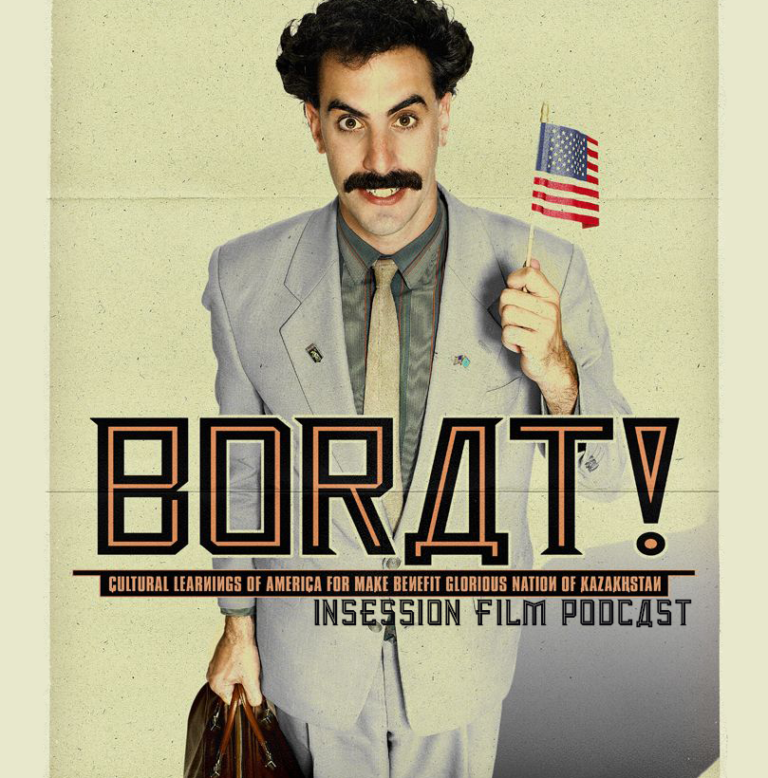
Podcast: Borat / Top 5 Movies of 2006 – Episode 288

This week’s episode is brought to you by Patreon and our awesome listener’s like you. Sign up today and get some awesome rewards!

This week on the InSession Film Podcast, we continue our year-by-year retrospective series by reviewing Borat: Cultural Learnings of America for Make Benefit Glorious Nation of Kazakhstan and discussing our Top 5 movies of 2006!

While 2006 had arguably more defining films such as The Departed, Children of Men and Pan’s Labyrinth, we wanted to steer away from those for reasons we talk about on the show. Sacha Baron Cohen is a unique figure and Borat is arguably still his best work to date, and it’s a film that in many ways helps characterize 2006. At any rate, we hope you enjoy our reminiscing and the discussion we had on these great films.

On that note, check out this week’s show and let us know what you think in the comment section. Thanks for listening and for supporting the InSession Film Podcast!

– Movie Review: Borat (3:57)
Director: Larry Charles
Writer: Sacha Baron Cohen, Anthony Hines
Stars: Sacha Baron Cohen, Ken Davitian

Top 5 Movies of 2006 – Picks #5 / #4 / #3 (37:11)
2006 may have been slightly top heavy, but overall it was still a very good year. In fact, some of these films will go down as some of the very best of all-time in their respective genres. It may not have been a consistent year, but it was anything but lacking so this exercise was still a great challenge. However we were ultimately very satisfied with our selections and we hope you enjoy them as well.

Top 5 Sponsor: First Time Watchers Podcast

[divider]

RELATED: Listen to Episode 236 of the InSession Film Podcast where we discussed There Will Be Blood and our Top 5 Movies of 2007!

[divider]

– Top 5 Movies of 2006 – Picks #2 / #1 (1:28:36)

To finish our 2006 retrospective, we discussed our favorite films films of that year in this last segment. We also discussed our 6-20 selections, rounding out our Top 20.

On that note, what would be your top 10 movies of 2006?

– Music

Kazakhstan You Very Nice Place – Borat Soundtrack
The Winner Is – DeVotchKa
Pan’s Labyrinth Lulliby – Javier Navarrete
The Return of the Eagle – Atli Örvarsson

Subscribe to our Podcasts RSS
Subscribe to our Podcasts on iTunes
Listen on Stitcher
InSession Film Podcast – Episode 288

[divider]

Next week on the show:

Main Review: 2001: A Space Odyssey
2018 Fall Movie Preview

2001 - A Space Odyssey

[divider]

Help Support The InSession Film Podcast

If you want to help support us, there are several ways you can help us and we’d absolutely appreciate it. Every penny goes directly back into supporting the show and we are truly honored and grateful. Thanks for your support and for listening to the InSession Film Podcast!

VISIT OUR DONATE PAGE HERE

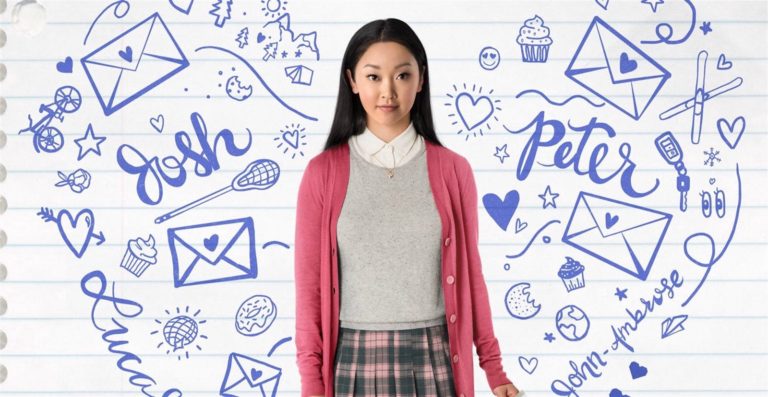
Movie Review: To All the Boys I’ve Loved Before is more than just a teen comedy


Director: Susan Johnson
Writers: Sofia Alvarez (screenplay by), Jenny Han (based on the novel by)
Stars: Lana Condor, Noah Centineo, Janel Parrish

Synopsis: A teenage girl’s secret love letters are exposed and wreak havoc on her love life.

[/info]

No matter how hard we try as moviegoers, I think it’s impossible to keep from sizing up a movie before you see it. Whether it’s from a trailer, a poster, or simply word-of-mouth, I think we all come in with preconceived notions when we go to watch a film for the first time. That’s why I enjoy when a movie understands this, and tries to keep us guessing. I think Netflix’s new film To All the Boys I’ve Loved Before does exactly that.

Lana Condor plays lead character, Lara Jean. She is in high school, and she is very close to her two sisters – the younger Kitty (Anna Cathcart) and the older Margot (Janel Parrish). Margot is about to head off to college in Scotland. Before she leaves, she breaks up with her boyfriend Josh (Israel Broussard) who also happens to be the family’s neighbor. Josh and Lara Jean were friends even before he began dating her sister, so the new development throws a wrench into their relationship as well. But Lara Jean is about to (accidentally) throw an even bigger wrench into things.

The film does a wonderful job of setting up Lara Jean’s character. Like so many high school students, she is struggling to find her voice. She feels like an outsider, something her quiet, innocent nature exacerbates in the competitive nature of the high school hallways. She also loves to write, and it is there where she pours out her heart and soul. Both have been injured by heartbreak, romantic and familial. You see, Lara Jean’s mother is not in the picture.

One pet peeve I have with movies is the constant need to tell us everything about our main character. I think characters should be allowed to have lives outside of what we see on the screen. If we don’t know everything about them, they feel more fully-realized. This film does just that with the storyline surrounding Lara Jean’s mother. At first, we aren’t really sure what happened. We may even assume that her father (played by John Corbett) and mother divorced, or that she simply left. But, as the film progresses, it is clear that Lara Jean’s mother has died. But we never really learn what happened, only the effects it has had on the family left behind. You see, it was their mother who told Margot that she shouldn’t go to college with a boyfriend, and that’s what pushed her to break up with Josh. And Lara Jean keeps her letters in the hatbox her mother gave her, the place where she pours out her heart and soul.

These letters are extremely personal to Lara Jean. They are written and addressed to the five boys she’s ever had a crush on. One of them happens to be Josh, something she would never dare tell Josh or Margot. Another is Peter (Noah Centineo), who is dating Lara Jean’s former best friend, Gen (Emilija Baranac) at the time the movie begins.

After Margot leaves for college, Kitty realizes that Lara Jean is depressed. And so, without Lara Jean’s knowledge, she sends out each letter. The boys, thinking the letters to be the outpouring of Lara Jean’s current feelings for them, begin coming up to her. She is mortified, but an opportunity arises from the initial embarrassment. Even though her feelings for Josh are real, she certainly cannot let him or Margot find out. But, at the same time that the letters are released, Peter and Gen break up. He wants to win her back, and Lara Jean wants to keep part of her secret still secret. So they devise a plan to fake a dating relationship together, and the foundation for the film’s plot is set.

Now, even that initial plot summary may sound like one thing to you. But if you think this is your average teen comedy, think again. First of all, there are technical components here that you probably aren’t used to seeing from a film like this. The cinematography by Michael Fimognari bears mentioning here at the outset. He has an eye for striking visual setups in the high school hallways and adjoining athletic fields. One shot, for instance, of Lara Jean and Peter standing in a doorway each in their own separate “box” is a fantastic example of how the film uses visual cues to support its narrative. The camerawork here is impressive as well. There are even a few Scorsesian touches of overhead shots and active camera movement that take the film to another level.

Also, one must mention the performance by Condor. Her comedic timing is perfect, but more than that, she really embodies this character who is coming into her own and starting to find her voice. As the film begins, Lara Jean never really speaks up for herself. Her only outlet for her own feelings are these letters, and those aren’t even released on her terms. But, as the film progresses, she does begin to speak on her own terms, and the transformation is embodied wonderfully by Condor.

My main gripe with this film is with the script and its use of exposition. Especially in the beginning of the film, so much of the plot is told to us by Lara Jean through voice-over. Now, this strategy can work beautifully if there is a reason given to us later on for Lara Jean to be telling us all these things. This film had a unique opportunity to do just that. For instance, it could have had Lara Jean writing letters to her mother later on in the film telling her about everything that had happened. But nothing of the sort occurs, and we are simply left with being spoon-fed many important plot points. Especially in the beginning when Lara Jean is more quiet and reserved, there is no reason to think her character would do such a thing. It certainly pulled me out of the film a bit, but not to the point where I was unable to appreciate what the film had to offer the rest of the way.

I won’t spoil the rest of the plot, except to reiterate that this is a film that keeps you on your toes. For all the script’s overuse of exposition, it really does a nice job of setting us up to think one thing then taking a turn to keep us guessing. The performances are incredibly charming, especially Condor in the lead role. This film is available for streaming now on Netflix, and if you’re looking for a teen comedy that is more than just a teen comedy, don’t hesitate to pick this one.

Overall Grade: B

[divider]

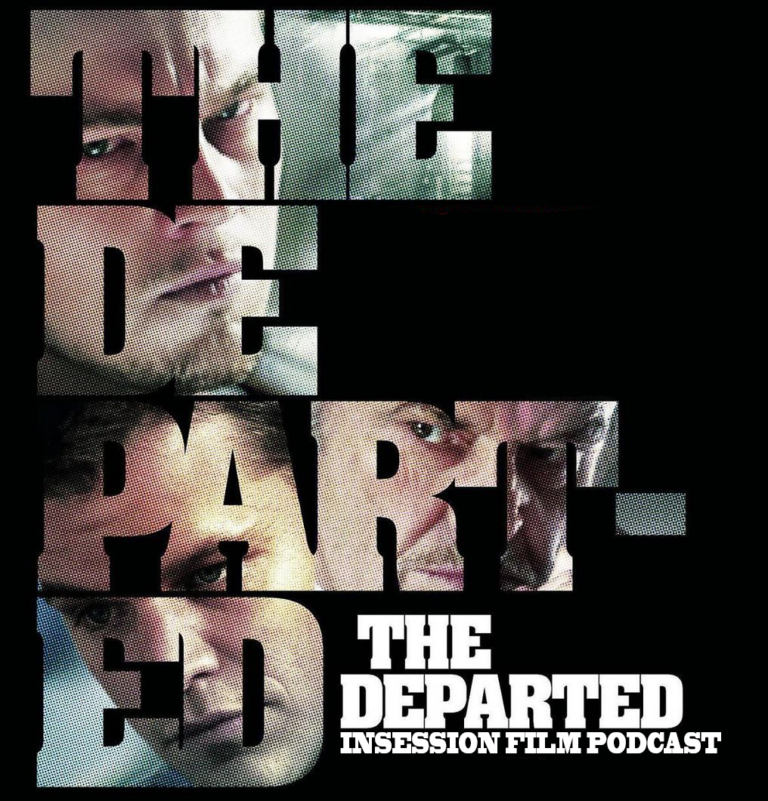
Podcast: The Departed / A Prairie Home Companion – Extra Film

This week on the InSession Film Podcast: Extra Film segment, guest hosts Ryan McQuade and Jay Ledbetter tackle a pair of 2006 films in Martin Scorsese’s Best Picture Winner The Departed and Robert Altman’s last film A Prairie Home Companion!

For the first time in show history, neither Brendan or JD was a part of Extra Film in any way. They let Ryan and Jay hold down the fort and the results were not disappointing in any way. The conversation on this week’s is a lot of fun as we prep for our 2006 retrospective this weekend on Episode 288.

Have fun with this week’s Extra Film segment and as always let us know what you think in the comment section below. Thanks for listening!

– Movie Review: The Departed (4:08)
Director: Martin Scorsese
Writer: William Monahan, Alan Mak
Stars: Leonardo DiCaprio, Matt Damon, Jack Nicholson, Mark Wahlberg

– Movie Review: A Prairie Home Companion (40:33)
Director: Robert Altman
Writer: Garrison Keillo
Stars: Lily Tomlin, Meryl Streep, Woody Harrelson, John C. Reilly

This week’s episode is brought to you by our great friends at the Subject Cinema and Next Best Picture.

– Music

I’m Shipping Up To Boston – Dropkick Murphys
Whoop-I-Ti-Yi-Yo – John C. Reilly, Woody Harrelson
The Return of the Eagle – Atli Örvarsson

We try to make this the best movie podcast we possibly can and we hope you enjoy them. Subscribe today on iTunes and Stitcher and please leave us a review on iTunes. You can also find us on Soundcloud, PlayerFM and TuneIn Radio as well. We really appreciate all your support of the InSession Film Podcast.

Subscribe to our Podcasts RSS
Subscribe to our Podcasts on iTunes
Listen on Spotify
Listen on Stitcher
The Departed / A Prairie Home Companion – Extra Film

[divider]

Mobile App

To hear this Extra Film episode and everything else we do, download our apps on the Amazon Market for Android and the Podcast Box app on IOS devices. The mobile app covers all of our main shows, bonus podcast’s and everything else relating to the InSession Film Podcast. Thanks for your wonderful support and listening to our show. It means the world to us!

[divider]

Help Support The InSession Film Podcast

If you want to help support us, we would greatly appreciate it! For more info, CLICK HERE.

Featured: Summer 2018 was fantastic for film

The summer movie season is usually – in my experience anyway – a mixed bag of big popcorn films with a few great indie films trickled in there somewhere. Last summer seemed to have more to offer than most, but nothing has come close to the quality that 2018 gave us. In fact, I can say with confidence that this has been the best year for film in the InSession Film era, at least thus far. Of course, we’ll have to see how the fall plays out before we make any final conclusions.

Before I get into the best films of the summer, as a little caveat, I didn’t see *everything* that came out the last few months. Perhaps your experience overall is slightly lesser than mine because you took a chance on Breaking In and The Equalizer 2. I did not. And even if I did, I don’t the bad films of this summer come close to negating the great things we did get. At any rate, here are some of the best films of, not just the summer, but of the entire year in all honestly. For me, all of these films are great or very satisfying in one way or another. (these are in no particular order)

**Note: I’m defining “summer” from Avengers: Infinity War through the end of August**

JD’s Favorite 2018 Summer Films

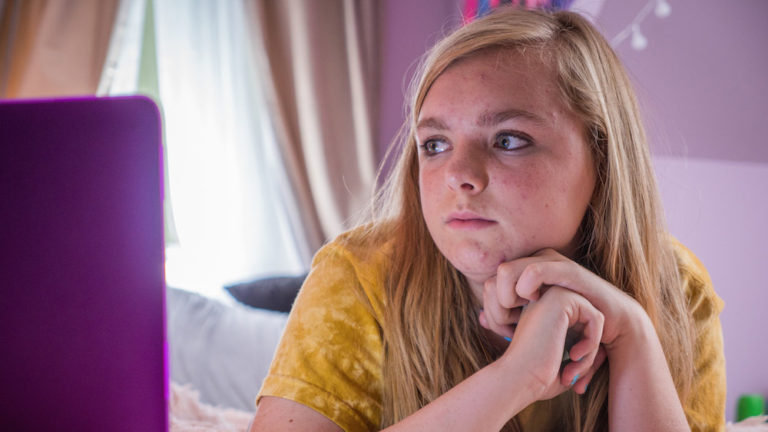
Eighth Grade
Bo Burhnam’s directorial debut is nothing short of masterful. His direction is simply some of the best of 2018 and it’s hard to imagine it came from a first-timer at the helm. His vision and passion for Eighth Grade is palpable and it comes through in every frame. Elsie Fisher’s performance will most likely go unrecognized by The Academy, but that doesn’t mean it’s not as deserving. It’s one of the most authentic middle school performances I’ve seen in quite some time. She’s endearing at every level, but it’s so much more than just charm. There’s true uncertainty and eagerness in her performance that resonates viscerally. Anna Meridith’s score is also mezermizing.

Blindspotting
Blindspotting is directed by another first-timer in Carlos López Estrada, and it’s quite the debut as well. There is a bite to this film that is as poignant as it is funny. I was very surprised at how entertaining this film is given its subject matter and thematic pertinence. Daveed Diggs and Rafael Casal have a chemistry that is unmatched. Their friendship off-screen is very much felt on-screen, and in their writing (they both co-wrote the film as well). The performances are great, the music is wonderful and it has some of the best scenes of the the year. The ending confrontation and the “gun” scene are no doubt great contenders.

Sorry to Bother You
Speaking of first-time directors, here’s another one in Boots Riley. Sorry to Bother You isn’t subtle, but in this instance that’s okay. Sometimes you need to bang on the drums loud for people to hear you. The noise also gets your attention when it’s weird, and boy, is this film bizarre near the end. Yet the chaos of this film never felt disorderly, there is a rhythm and a fluidity that makes sense of everything. Lakeith Standfield gives a stellar performance as well. Hopefully this propels him to more lead roles, he’s certainly earned it. The rest of the cast – Tessa Thompson, Jermaine Fowler, Terry Crews, Danny Glover, Steven Yeun, Armie Hammer – all great in complimenting the Riley’s overall vision.

BlackKklansman
Spike Lee is doing this thing again. I’m glad to hear that people are loving this film, although let’s not forget that this is *not* his comeback. Chi-Raq is maybe Lee’s best films since Do the Right Thing, and the second-best of his career overall. That said, consistency isn’t something we haven’t seen from Lee in a long time, and BlackKklansman makes it 2-for-2 in recent years. And like Blindspotting and Sorry to Bother You, this is a really funny film for as poignant as it gets in places. This story is wild, and it’s told through a farce lens that makes it even more ironic and crazy. John David Washington and Adam Driver are great, I would love to see them work together again.

Leave No Trace
Debra Granik is a female voice that we need to hear more often than once every eight years. Her last film, Winter’s Bone, earned great recognition and launched the career of Jennifer Lawrence. Leave No Trace may not get awards love at the end of the year, but it’s equally as good, if not better. And it could similarly launch the career Thomasine McKeenzie, who is mesmerizing in this film. Her subtle performance is remarkable in emulating a daughter’s love for her father, but also the need for independence. Ben Foster is, well, Ben Foster. He’s great. His performance here may be forgotten by December, but it’s as good as you’ll find in 2018.

Hearts Beat Loud
Brett Haley’s screenplay is by far one of my favorites of the year. Where most films get trapped in exposition, Haley avoids it all cost. We simply find these characters where they are at in their lives right now. The details that come about are offered through natural dialogue or visualization. This allows the story to be more nuanced and fluid in its rhythms, which I completely ate up. I dare you to find a more charming duo in 2018 than Nick Offerman and Kiersey Clemons. I didn’t know much about Clemons going into this film, but she’s heavily on my radar now. The music for Hearts Beat Loud – including its title song – is endlessly enjoyable.

First Reformed
First Reformed is simply one of the best films of the year. It’s one of the best films about faith we’ve seen this decade, and it might feature Ethan Hawke’s best performance of his career. I know that’s a lot of “best’s” and maybe it’s hyperbole, but I’m sticking with my convictions. Paul Schrader poses questions about faith in the modern age that very much worth asking, and watching Hawke’s Toller grapple with them is fascinating on every level. This film goes to some interesting places in the third act, and while jarring, it was profoundly necessary. Amanda Seyfried and Cedric Kyles are also very good.

The Miseductation of Cameron Post
We haven’t talked about this film on the show yet, but this is another film that tackles faith and raises heartfelt questions of its own. And like some of these other films I’ve mentioned, Cameron Post balances humor and drama while exploring the fundamental truths that Desiree Akhavan explores here. There is an earnest attempt at trying to understand what the process of a gay-conversion camp is like, only to have the epiphany that you are who you are. It’s an open-minded, yet stern look at hypocrisy and humanity. Chloë Grace Moretz gives arguably the best performance of her career. Absolutely stunning in her subtlety and uncertainty.

Won’t You Be My Neighbor?
If you watch this, and don’t find any new appreciation for Fred Rogers, you may need to check your pulse. This is a captivating documentary – which will win the Oscar – that taps into notions that we as a country desperately need right now. People called him soft and blamed him for “weakening” a generation, but there’s something overpowering about love that changes lives. And the is severe earnestness of that idea in Rogers comes alive in this powerful film.

Three Identical Strangers
This story is as wild as any we’ve seen in recent years. The fact that three brothers found each other – through random circumstances – after 19 years is insane on its own. But as this story unfolds, it gets even crazier and crazier. Eventually it becomes a thrilling ride about nature vs nurture, the ethics of science and fallout of human indecency.

The Tale
Here’s another film we didn’t get to talk about on the show, and I wish we would have. Jennifer Fox’s autobiography of sorts is a fervent depiction of sexual abuse and how brazen some men are in their manipulation of women. The story here is heartbreaking on every level. Yet, I respect Fox’s admittance of her own ignorance, and how that got her in some shady circumstances. She’s not afraid to explore her own failings, but it doesn’t overwhelm the fact that she was a victim of something heinous. The results of that in the film are very powerful.

American Animals
American Animals is Bart Layton’s first narrative film, sort of, after his great documentary The Imposter in 2012. I say “sort of” because this film does feature genuine documentary-style interviews that couple with the narrative storytelling we do get. It’s a brilliant move that allows us to question what’s really going on this film. Who is telling the truth? Who isn’t? But none of it is manipulated, the guys behind this story just have their version of events and Layton allows the audience to figure it out along with him. The “heist” scene is one of the more gripping I’ve seen in recent years too.

Hereditary
Here’s another directorial debut that will go down as one of the best we’ve seen this decade. Ari Aster injects this film with a subtle horror that lingers acutely before it goes extreme in its last 15 minutes. This is one of the scariest films I’ve maybe ever seen. It doesn’t rely on jump scares, but instead in relies on storytelling and characterization to build suspend and question reality. Understandably, Toni Collette is getting a lot of praise for her performance, but I don’t think Hereditary is as effective without Alex Wolff’s performance. He’s a key figure that amplifies much of the disbelief we experience in the third act. Regardless of how you feel about the ending, you have to admit this is one hell of a film.

Beast
Beast may go down as the most underrated film of the year. Very few people are talking about it, but it’s really great and Jessie Buckley gives one of the best performances of the year. Her transformation from timidity to being a formidable presence is astounding and visceral. Michael Pearce’s direction is also great in complimenting her performance with how he stages and paces the film. Johnny Flynn is a partner-in-crime, so to speak, that also has a lot to offer with his performance. If you like dark dramas that tap into deep human truths, this film is for you.

Avengers: Infnity War
Marvel had been building up to this point for 18 years, and for my money, it lived up to the bill in every way. Mainly, it wasn’t really an Avengers film. The title is a red herring. Infinity War is a Thanos film through and through, and they made him as emotionally grounded as they did physically intimidating. By allowing us to understand his motives, it gives weight to what we see at the end. Not because the “heroes” will return, but because Thanos succeeds in his goals and for him it meant everything given the sacrifices he made – sacrifices he did not enjoy. I find that brilliant for a film that had every right to make him a one-note villain who wants nothing but death and carnage. But it’s anything but that, and I loved it.

Mission: Impossible – Fallout
I know many of you will disagree with me when I say that Fallout fixed the problems I had with Ghost Protocol and Rogue Nation. I do like both of those films overall, but Fallout is by far the best of those three for me. It takes what we love about those films – the action, the energy, the characters – and couples it with a storyline that finally makes sense of Ethan’s emotional progression as established in M:I 3. We finally get to crystallize the relationship between Ethan and Julia, and it was beautiful in every way. The cast is great as always and Tom Cruise flying a helicopter is going to go down as one of the most breathtaking stunts of the series.

Deadpool 2
I understand that these Deadpool films aren’t for everyone, but I love them and I think Deadpool 2 was better than the first one. It’s more emotionally grounded – that opening with “Ashes” by Celine Dion is so great – and it felt like this film was more wide open with its playbook. It didn’t have to worry about its origin story, it could just have fun and I think Ryan Reynolds delivered on that big time. I’m not sure I had a more entertaining experience in the theaters this summer. The scenes between Deadpool and Colossus are pure comedic gold.

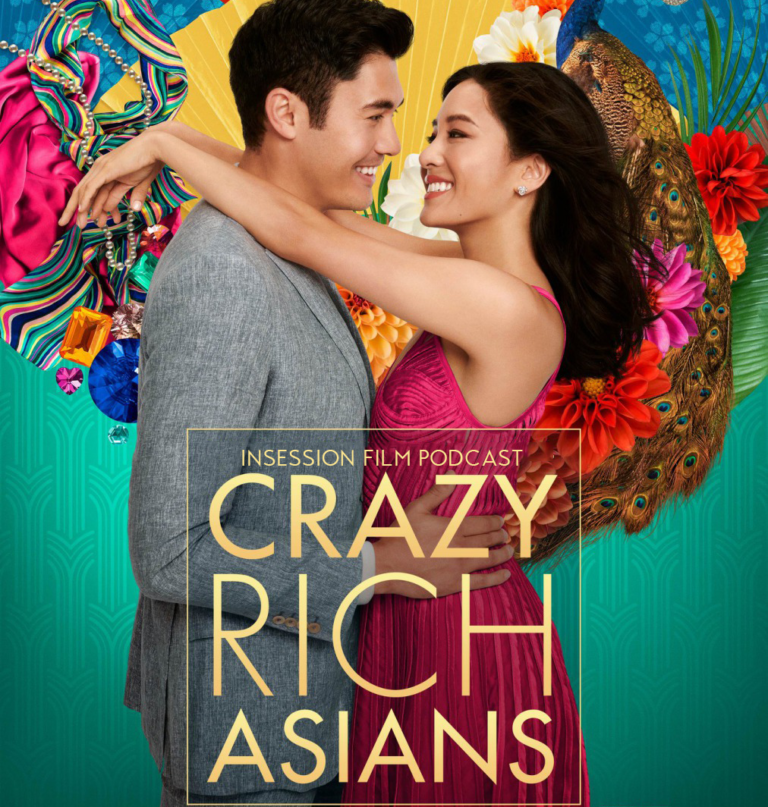
Crazy Rich Asians
Crazy Rich Asians is not only a great film for Asian representation in mainstream Hollywood, it’s legitimately a great rom-com. On its face, the story will have familiar beats, but its screenplay actually has a lot more on its mind. In fact, it’s somewhat of a sleight of hand in that the film is equally (if not more) interested in how it builds these characters through interesting parallels and juxtapositions, while diving into ideas of class, culture and tradition. Constance Wu is a star, or at least she better become one after this film. She is wonderful, as is Henry Golding, who is also great. Their chemistry together is magnetic. Gemma Chan is arguably the unsung hero, and I wouldn’t mind seeing a spin-off with the Awkwafine and Nico Santos characters.

Here are some other films I saw this summer that I wanted to highlight real fast. Not all of them were actually released between May and August, but that’s when I saw them and it does make the overall experience that much better for me. The romantic-comedy Set It Up is really good for its type. It’s on Netflix, I urge you to see it. The Russian film Loveless is easily one of the best films of 2018, but it’s devastating. Absolutely heartbreaking on every level. Foxtrot is another very good film that I saw and in many just as affecting as Loveless. I finally caught up with Sebastián Lelio’s Disobedience, and really liked it a lot too. Rachel McAdams steals the film and is by far one of the great contenders for Best Supporting Actress this year.

On the mainstream side of things, I also really enjoyed Ant-Man and the Wasp too. In fact, it’s secretly one of the smarter films in the MCU in that its stakes are somewhat “small scale” while simultaneously massive in where things are going to go next. The Incredibles 2 proved that Pixar can do sequels well when they have the right filmmaker and story in place. It’s not quite as good as the original, but still refreshing and progresses its characters in great ways overall. I know it was only mildly well received, but I freakin loved Ocean’s 8. Yes, it’s decidedly more simple than its predecessors, but it has so much fun with its characters and isn’t interested in contriving drama. The film simply lays out what it wants to do and goes for it with charm and energy.

My only major disappointments are with Jurassic World: Fallen Kingdom (and even that film had things I appreciated) and Sicario: Day of the Soldado (worst film of 2018 for me). Most everything I saw was satisfying in some way. Even Solo, a film I didn’t love, had things I could get on board with overall. Same could also be said for Revenge and How to Talk to Girls at Parties.

As noted above, I didn’t see everything this summer, but I saw most of the notable offerings and I could not believe the consistency in the quality. For awhile there in July, my Top 5 was constantly changing and becoming harder to decipher. If the fall continues this trend, 2018 will truly go down in the record books as one of the best this century. Fingers crossed that it also delivers.

What did you think of the summer movie season for 2018?

Poll: What is the best film of 2006?

It’s that time again? Our next retrospective, tackling the year 2006, will be this weekend on Episode 288 and we are very excited. As we do with these polls each time, we like to gauge where everyone else stands as far as what defines the year the most. At least broadly speaking – of course it may be different for you individually. It was a pretty good year for film and we are curious which of these stand out to you the most.

That said, what is the best film of 2006? Vote now!


Featured: Riding The Wave In The Outback – Australia’s Cinematic Resurrection

Until the 1970s, the film industry in Australia was virtually nil. Everything was imported from Britain or America and Australian actor went to either place to make their name known. Then, the government stepped in to invest in bringing up a culture of art, investing in multiple film boards that pushed the wave for 20 years and beyond. The Australian Film, Television and Radio School followed the model of the American film school that birthed out gifted storytellers and promoted unflinching tales of violence and subtle sensuality, a push for a more socially progressive Australia. The results were many great films and notable actors and directors that would make their mark internationally in future works. Here are some of those masterpieces.

Walkabout (1971)

Nicholas Roeg is British but came to Australia to film Walkabout, the story of two white children who are stranded in the Outback after their father kills himself. In the scorching heat, they encounter an Aborigine boy on his ritual walkabout where he has to survive on his own for six months on his ability to hunt and find water in such a place. Despite not sharing a language, the boy helps the two children in making it through alive. Roeg, who served as his own cinematographer, captures the beauty yet dryness of the desert and the how the environment can alter anybody’s view of life, especially when coming from the cities. It also was a watershed moment for the portrayal of Aborigines; the Australian government had just ended their policy of forced removal of children from the land, the “Stolen Generations.”

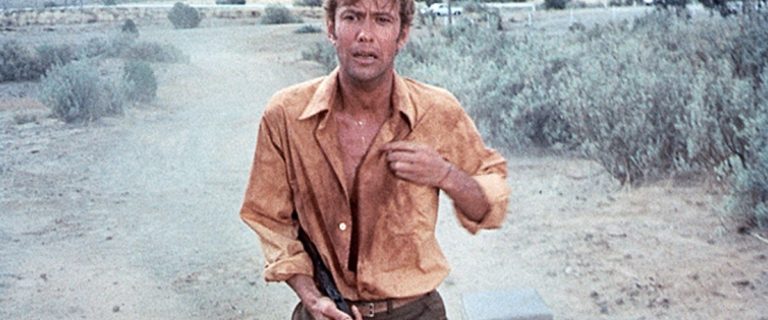
Wake In Fright (1971)

That same year, another Outback adventure tale came out, but in a more shocking fashion. A schoolteacher is stuck in a town and slowly begins to lose his grip on reality with drinking binges, kangaroo shootings (this was not fake) and random sexual encounters, creating the unsettling realism that some were not too thrilled when released. Many thought the original negative was lost, put pieces of it were found and reconstructed for a special Cannes Film Festival showing in 2009. The director, Ted Kotcheff, would go on to the States to make First Blood, bringing the character John Rambo to life in its bloody original form, a lot like Wake In Fright. 

Picnic At Hanging Rock (1975)

Amazon has just released a mini-series based on Joan Lindsay’s novel, but it was Peter Weir who would get to direct the formal adaptation for the screen in its dreamy yet unsettling state. The story about a group of girls who go missing in the 1900s was quite provocative and that noted ending still left many wondering. And yet, within its mystery, Weir showcases the taboo of sexual ideas amongst girls who are all virgins and then the spookiness of leaving without a trace and without any resolution to the missing girls. It becomes less about what happened to three girls and their teacher and more about how the rock is somewhat of a magical setting where daydreams go to be fulfilled – or be killed.

Mad Max (1979)

George Miller lit up the screen and gave us Mel Gibson in the first of his four installments regarding the collapse of society and a thirst for revenge from Max Rockatansky, a highway patrol officer. The apocalyptic setting, the strong violence, the basic themes of war for water and oil start from here. Miller made it all on a low budget and did some guerrilla filmmaking by shooting some scenes with a permit, as well as hire actual bikers as extras. But they were still able to modify vehicles to their radical look that evolved over time with each film. This rugged movie led to its two sequels in the 80s and then the acclaimed Fury Road in 2015.

Breaker Morant (1980)

Bruce Beresford struck it hard with the true story of a controversial court-marshall and execution of three soldiers who have entered folklore as scapegoats to cover the war crimes of the Boer War in 1901 South Africa. It is their ultimate courtroom drama, where we intercut between the passionate scenes of defense to save the men from the firing squad, raising the moral question of capital punishment, and the tragic events that unfolded before. These are men who were doing their job in fighting the enemy and told to do so with extreme prejudice and then given a blindfold, a rope, and a chair as their “reward.” It is A Few Good Men but tried and true with pride and guilt in the name of the Empire.

Gallipoli (1981)

Staying with Mel Gibson, he and Peter Weir worked on telling a story within the confines of the Australian’s army trial by fire: the ill-fated Gallipoli campaign during World War I. Two men, both runners, start a friendship that takes them across to Egypt and then Turkey into the horrors of war. The result is a spirited scene of life for a new country (Australia was given self-government in 1901), the enthusiasm they had to join the war and prove themselves, and the brutal truth of war when they arrive on the peninsula, which was run by Winston Churchill 25 years before the events of Darkest Hour took place. It should be noted that Weir got rejected for public funding and it came via a new production company co-founded by Rupert Murdoch.

The most notable figure of this is Peter Weir, who went on to Hollywood to make Witness, Dead Poets Society, and The Truman ShowBeresford directed Robert Duvall’s Oscar-winning performance in Tender Mercies 3 years after Morant, followed by his Best Picture-winning Driving Miss Daisy. We know about Gibson; other actors that came about in this period included Sam Neill (Jurassic Park), Jackie Weaver (Silver Linings Playbook), and Paul Hogan (Crocodile Dundee). It also produced two Oscar-winning cinematographers in John Seale (The English Patient) and Russell Boyd (Master and Commander, also a Peter Weir-directed picture). A post-Wave group of works then came in the 90s, solidifying Australia’s reputation as a center of dynamic filmmaking that could transcend its boundaries.

Follow me on Twitter: @BrianSusbielles

List: Top 3 Films of Asian Cinema in 21st Century so far

This week on Episode 287 of the InSession Film Podcast, inspired by Crazy Rich Asians, we thought it would be appropriate to honor the greatness of Asian Cinema. Asian Cinema is often a rich sect of cinema that we typically enjoy quite a bit. Some of our favorite films in any given year come from that region of the world. So, narrowing it down to three films from the last 18 years was nearly an impossible challenge, but that’s exactly why we wanted to do it. Also – some of these films we mentioned will be all-timers when it’s all said and done, and that’s worth celebrating. On that note, what movies would make your list? Here are the one’s that made ours:

(Note: Please keep in mind that we each had different criteria for our selections)

JD:

1) In the Mood for Love
2) The Handmaiden
3) Like Father, Like Son

Brendan:

1) The Handmaiden
2) In the Mood for Love
3) House of Flying Daggers

Nguyen:

1) Pulse
2) Spirited Awaay
3) The Handmaiden

Honorable Mentions (Combined)

Crouching Tiger Hidden Dragon, The Raid, The Raid 2, The Tale of Two Sisters, Hero, The Golden Flower, I Saw the Devil, The Ring, Departures, Mother, The Host, Memories of Murder, The Assassin, Oldboy, Internal Affairs, After the Storm, Still Walking, Knowbody Knows, Our Little Sister, Train to Busan, Kung Fu Hustle, A Separation

Hopefully you guys enjoyed our lists and if you agree or disagree with us, let us know in the comment section below. As noted above, narrowing 18 years was a huge challenge and clearly we skipped out on a ton of other great films that could have (should have?) mentioned. That being said, what would be your Top 3? Leave a comment in the comment section or email us at [email protected].

For the entire podcast, click here or listen below.

For more lists done by the InSession Film crew and other guests, be sure see our Top 3 Movie Lists page.

Podcast: Crazy Rich Asians / Top 3 Films of Asian Cinema in 21st Century so far – Episode 287

This week’s episode is brought to you by Gamefly. Sign up today and get a 30-day free trial!

This week on the InSession Film Podcast, our very own Nguyen Le joins to discuss Jon M. Chu’s latest film Crazy Rich Asians and our Top 3 films of Asian Cinema in the 21st Century so far. We also recap the Summer movie season and talk about Michelle Yeoh for our poll.

This show was an absolute blast. It was great to celebrate Asian representation in film, and having Nguyen as part of that celebration was wonderful. Hearing his passion for Crazy Rich Asians and Asian Cinema was everything to make us get through our week. We hope you feel the same. Also, Constance Wu better become the next big star y’all!

On that note, let us know what you think in the comment section and thanks for listening to the InSession Film Podcast!

Movie Review: Crazy Rich Asians (3:56)
Director: Jon M. Chu
Writer: Peter Chiarelli, Adele Lim
Stars: Constance Wu, Henry Golding, Michelle Yeoh

– Notes / 2018 Summer Recap (50:28)

This year’s summer movie season was absurd in its high quality, at least if you ask us. Back on Episode 272 we talked about our expectations for the summer, so we thought it would be fun to reflect back on those expectations and talk about how they played out for us.

[divider]

RELATED: Listen to Episode 286 of the InSession Film Podcast where we discussed BlackKklansman!

[divider]

Top 3 Films of Asian Cinema in 21st Century so far (1:05:02)
Asian Cinema is often a rich sect of cinema that we typically enjoy quite a bit. Some of our favorite films in any given year come from that region of the world. So, narrowing down three films from the last 18 years was nearly an impossible challenge, but that’s exactly why we wanted to do it. Also – some of these films we mentioned will be all-timers when it’s all said and done, and that’s worth celebrating. That said, what would be your Top 3?

– Music

Yellow – Katherine Ho
Money – Cheryl K, Awkwafina
Crouching Tiger, Hidden Dragon – Yo Yo Ma
The Return of the Eagle – Atli Örvarsson

Subscribe to our Podcasts RSS
Subscribe to our Podcasts on iTunes
Listen on Spotify
Listen on Stitcher
InSession Film Podcast – Episode 287

[divider]

Next week on the show:

Review: Borat
Top 5: Films of 2006

[divider]

Help Support The InSession Film Podcast

If you want to help support us, there are several ways you can help us and we’d absolutely appreciate it. Every penny goes directly back into supporting the show and we are truly honored and grateful. Thanks for your support and for listening to the InSession Film Podcast!

VISIT OUR DONATE PAGE HERE

Podcast: Hot Summer Nights / A Prayer Before Dawn – Extra Film

This week on the InSession Film Podcast: Extra Film segment, we discuss Hot Summer Nights starring Timothée Chalamet and the A24 Thai-prison film A Prayer Before Dawn!

JD is off once again, but filling in is the great Ryan McQuade, who is wonderful as always. One of these two films gets much more praise than the other, and the conversation gets quite interesting in reflecting those disparities.

Have fun with this week’s Extra Film segment and as always let us know what you think in the comment section below. Thanks for listening!

– Movie Review: Hot Summer Nights (4:48)
Director: Elijah Bynum
Writer: Elijah Bynum
Stars: Timothée Chalamet, Maika Monroe, Alex Roe

– Movie Review: A Prayer Before Dawn (28:47)
Director: Jean-Stéphane Sauvaire
Writer: Jonathan Hirschbein (screenplay), Nick Saltrese (screenwriter)
Stars: Joe Cole, Pornchanok Mabklang, Panya Yimmumphai

This week’s episode is brought to you by our great friends at the Subject Cinema and Next Best Picture.

– Music

I’m So Free – Beck
Loscil – Biced
The Return of the Eagle – Atli Örvarsson

We try to make this the best movie podcast we possibly can and we hope you enjoy them. Subscribe today on iTunes and Stitcher and please leave us a review on iTunes. You can also find us on Soundcloud, PlayerFM and TuneIn Radio as well. We really appreciate all your support of the InSession Film Podcast.

Subscribe to our Podcasts RSS
Subscribe to our Podcasts on iTunes
Listen on Spotify
Listen on Stitcher
Hot Summer Nights / A Prayer Before Dawn – Extra Film

[divider]

Mobile App

To hear this Extra Film episode and everything else we do, download our apps on the Amazon Market for Android and the Podcast Box app on IOS devices. The mobile app covers all of our main shows, bonus podcast’s and everything else relating to the InSession Film Podcast. Thanks for your wonderful support and listening to our show. It means the world to us!

[divider]

Help Support The InSession Film Podcast

If you want to help support us, we would greatly appreciate it! For more info, CLICK HERE.

Movie Review: ‘The Night Eats The World’ is a standard offering to the Zombie genre


Director: Dominique Rocher
Writers: Pit Agarmen (novel), Jérémie Guez (screenplay
Stars: Anders Danielsen Lie, Golshifteh Farahani, Denis Lavant

Synopsis: The morning after a party, a young man wakes up to find Paris invaded by zombies.

[/info]

The zombie film sub-genre has had a bit of a lull recently. Aside from AMC’s The Walking Dead one might find it difficult to find good quality zombie cinema, although some may argue that even The Walking Dead has lost its appeal. However, there is hope on the horizon with trailers recently released for some new upcoming films such as I Think Were Alone Now which will star Game of Thrones‘ Peter Dinklage and the zombie musical Anna and the Apocalypse, both set to release later this year. Until then though there are a few random scattering of films that flew under the radar but can still satiate your appetite. The other night I finally got a chance to watch The Night Eats The World, a French film original titled La Nuit a Dévoré le Monde and director Dominique Rocher’s first feature-length film.

I will start by saying I was really looking forward to watching The Night Eats The World, I was very excited. The most recent zombie films I had seen were Cargo and Ravenous or Les Affamés, both films recently released on Netflix (I guess Netflix didn’t get the memo on the lull) and decent films but nothing compelling and both lacked that quality of dread and terror you might normally find in the genre. And with a World War Z sequel far out of sight and Zombieland 2 constantly stalled I knew there was going to be a long wait for anything from a major studio, so when I heard about this new French film and finally caught the trailer I couldn’t wait. Footage from the trailer reminded me a lot of the 2010 German film Rammbock with a similar setting and gritty feel, a film I greatly enjoyed so my hopes were high.

The film has a very familiar start. It begins by introducing our protagonist Sam played by Anders Danielsen Lie and offers us a bit of character development as we follow him around a house party thrown by his ex Fanny (Sigrid Bouaziz). There’s a history there with moments of tension and additionally it becomes clear that Sam is not fond of crowds, an element that takes shape later in the film. After more tension Fanny directs Sam to wait in a room far off in the house where he will be more comfortable alone and they can later have a chat. Sam makes his way there and soon falls asleep in a chair. Cut to the following morning. This storytelling technique is used often in zombie films and allows the audience to experience the new world at the same pace as the lead character who, as audience surrogate, wakes with no concept of what has occurred and is thrown unprepared into this chaotic world. When done properly this can make for a great start for a film and Rocher handles it fairly well. Sam steps out of the room and seeing the house a wreck and blood spattered about is immediately overcome with panic and fear and slowly learns the fate of Fanny and her house guests along with the rest of the outside world. The one complaint I would have about this opening is I found Sam adapting to the situation almost too quickly which is ironic because most zombie films have the opposite problem. Usually the characters require quite a bit of time to adjust and between this period make very simple mistakes and irrational decisions which can be frustrating at times to watch. Sam however encounters numerous threats right away and manages to narrowly escape each time with quick but accurate judgment. It is not jarring in any way but noticeable however I accepted this minor fault for the sake of getting the story in motion.

The next hour or so of the film is mainly spent watching Sam simply survive. The action on-screen ranges from Sam cleaning the complex he is stuck in clear of zombies to him scavenging for food and supplies and often to just him walking/sitting around in his own thoughts and emotions. With the exception of a few incidents the best description for a bulk of the film is ‘mundane’. Some films can fill the quiet and routine nature of everyday tasks with atmospheric emotion. Like watching a spider spin a web on some random BBC documentary, an ordinary and routine event but somehow witnessing it becomes almost a meditative experience. Some films can capture these moments in this way, instead the day-to-day survival of Sam feels basic and absolutely dull which in turn complicates making meaningful connections with his character. It is not totally uneventful however, there are some scenes that although short are brilliant and left my jaw on the floor. One scene early in the film involves a zombie swarm outside Sam’s window and the other is a gruesome attack that is very raw and brutal and is quite terrifying to watch. Again these are brief but Rocher captured them remarkably well and I wished there were more of them in the film. And though Sam is quite alone through most of the film he does encounter one other survivor, a young girl named Sarah played by Golshifteh Farahani. I will say without getting into details I did not particularly like her role in the film and felt her character could, and should, have been kept out of the final cut.

Of course with The Night Eats The World being a zombie film there is going to be the typical study on the nature of solitude and what loneliness and the lack of emotional feedback can do to the human psyche. Lie does well emoting how lonesome Sam is and just how heavy the seclusion and feelings of abandonment weigh him. There is a moment in the film where it is clear that Sam’s isolation has taken its toll and he acts out in a very dramatic fashion. The climax of this scene is meant to be juxtapose to Sam’s persona at the beginning of the film where its implied that he is a more solitary individual as he intentionally avoid contact with others at the party. It is definitely an interesting scene and one that will most stand out in the film.

The Night Eats The World has a few moments that will astonish and have you asking why you haven’t seen more of that in other zombie films. It also does a decent job of capturing Sam’s loneliness as well as his precarious mental state. But aside from those moments the going is very slow and unlike other films that manage to have a single character carry the film while keeping the audience engaged it becomes tedious not too far in. Additionally due to some ambiguity surrounding the passage of time and some scenes that seem to stretch out a bit too long the film makes it very difficult to keep your attention on the screen. I often found my mind wandering and more unfortunate when my attention would snap back to the film I got the impression there wasn’t much I missed. Still for zombie fans I would recommend it as a film worth watching, it may not wow you but it will at least prime you for what is coming down the line.

Overall Grade: C+

[divider]