


Home Blog Page 150

Podcast: Marcel the Shell with Shoes On / Top 3 Movies About Finding Family – Episode 491

This week’s episode is brought to you by Athletic Greens. Get a FREE one year supply of Vitamin D and 5 travel packs today!

This week on the InSession Film Podcast, we discuss A24’s latest in Marcel the Shell with Shoes On and our Top 3 movies about finding family! Plus, we reveal our new Movie Series that we’ll be starting next week.

Jenny Slate’s history with Marcel is well known, and the shorts are incredibly endearing, but Marcel the Shell with Shoes On isn’t reliant on you seeing or being familiar with them. So even if you go in fresh, there is much to enjoy about the film and we have a lot of fun delving into what makes it one of the better movies of the year so far.

On that note, check out this week’s show and let us know what you think in the comment section. Thanks for listening and for supporting the InSession Film Podcast!

– Movie Review: Marcel the Shell with Shoes On (7:33)
Director: Dean Fleischer Camp
Writers: Dean Fleischer Camp, Jenny Slate, Nick Paley
Stars: Jenny Slate, Isabella Rossellini, Dean Fleischer Camp

– Notes / Discussion (49:57)

This week for our break segment, as mentioned above, we reveal our newest Movie Series that will be starting next week on the podcast. It’s a studio that many of you are very familiar with and love. They’ve rendered some of the best animated movies of all-time. We are confident you’re going to enjoy this journey with us and we cannot wait to get started. As you’ll hear on the show, we break down the lineup and how the series will play out.

[divider]

RELATED: Listen to this episode of our Extra Film Podcast where we discussed Spring Breakers!

[divider]

Top 3 Movies About Finding Family (1:13:41)
Okay, so this is a pretty broad topic and it could go any number of ways depending on your criteria. However, we mostly settled on the idea of discvery and reconnection. Certainly there’s an element of literally finding family that many films do examine, but sometimes “finding” family is closer to home and discovering something new that completely changes your perspective on the world. For our lists, and much of the conversation, we equally considered the films that have done that remarkably. Either way, there’s a ton to mine out of this subject and it made for a fun, albeit challenging, exercise. That said, what would be your top 3?

Show Sponsor: First Time Watchers Podcast

– Music

Marcel – Disasterpiece
August Rush – Mark Mancina
The Return of the Eagle – Atli Örvarsson

Subscribe to our Podcasts RSS
Subscribe to our Podcasts on iTunes
Listen on Spotify
Listen on Stitcher
InSession Film Podcast – Episode 491

[divider]

Next week on the show:

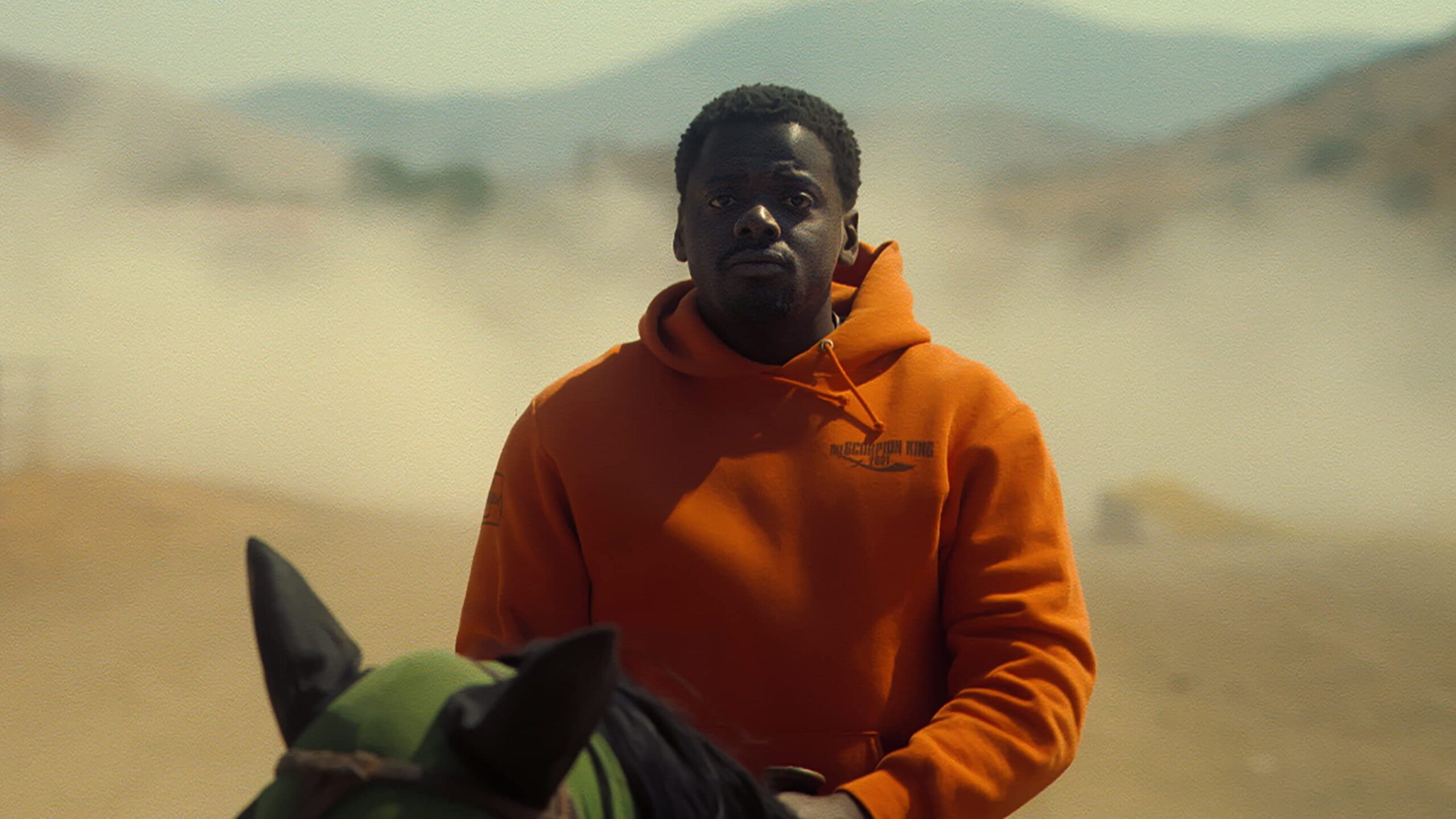
Review: Nope
Top 3: N/A
Ghibli Movie Series: Nausicaä of the Valley of the Wind
[divider]

Help Support The InSession Film Podcast

If you want to help support us, there are several ways you can help us and we’d absolutely appreciate it. Every penny goes directly back into supporting the show and we are truly honored and grateful. Thanks for your support and for listening to the InSession Film Podcast!

VISIT OUR DONATE PAGE HERE

Movie Review: ‘Persuasion’ Shouldn’t Have to Try So Hard


Director: Carrie Cracknell

Writers: Ron Bass, Alice Victoria Winslow

Stars: Dakota Johnson, Cosmo Jarvis, Henry Golding

Synopsis: Eight years after Anne Elliot was persuaded not to marry a dashing man of humble origins, they meet again. Will she seize her second chance at true love?


There’s nothing so universal than that icky feeling of running into an ex. It’s compounded exponentially when that ex still makes your heart beat faster and your face flush. Not to mention that you dumped them because they weren’t all that and now they’re on the come up, while you are less than thriving in spite of what your countenance shows the world. This pain and ache is universal so it boggles the mind at why writers Ron Bass and Alice Victoria Winslow thought we wouldn’t get it, if it were traditionally presented.

This adaptation of Persuasion has all of the regency trappings of a traditional period romance. However, we as the audience are burdened with the references to many 21st century ideas, slang, and snark. A modern Austen adaptation can be done and done well, see last month’s Fire Island, but it’s strange to have everything all at once. It’s jarring, to say the least, to see a letter arrive written in the clipped form of a text with accompanying emoji. It’s even more tiresome when the writers don’t believe we can suss out information ourselves. While Dakota Johnson is charming and really sells the breaking of the fourth wall, it’s truly unnecessary to our understanding. It’s as unnecessary as the very Marvel-esque title cards that block out the screen with large white text for each house and town visited.

Persuasion isn’t entirely without merit, though. It has its moments of being genuinely funny. There’s a perfectly terrific dinner scene just after Anne (Dakota Johnson) and Wentworth (Cosmo Jarvis) have been reunited. Anne is about to be seated next to Wentworth and instead tries to find a different place. It becomes a game of musical chairs as she tries to avoid Wentworth’s gaze. As the dinner goes on, Anne’s only contribution to the conversation is to entirely embarrass herself and her hosts as she blurts out that she was the first choice of her younger sister’s now husband, then tries to dig herself out of the hole. Director Carrie Cracknell builds this scene perfectly with editor Pani Scott as each cut of the scene lands another perfect reaction or quip.

With this editing style, Cracknell makes some of Anne’s looks to the camera bearable. Some are even perfectly timed. They’re certainly not a thing that would be what most of us would want in an adaptation like this, but without the expository bits bogging them down, some of the looks are quite funny. When Anne is interacting with her younger sister Mary (Mia McKenna-Bruce) these looks actually add to the already funny, lopsided, and narcissistic viewpoint of Mary. In fact, a lot of the side characters are an utter delight, which makes up for the lackluster central couple.

The main romantic pair is a bit one sided. Cosmo Jarvis is excellent at the smoldering end of his character, but it’s hard to believe that his smolder alone could ever rekindle into a fire. Especially as he has to play opposite Dakota Johnson whose smize and direct eye contact are utterly charming. If Henry Golding’s Mr. Elliot wasn’t made into such an obvious cad, our allegiance would have been turned upside down because of his effortless charm. It’s all a bit conflicting.

If you want to make a modern adaptation, make that modern adaptation. Mixing modern thought into period drama doesn’t always work, especially when the conceit is that the only way to survive is marrying for money and station and that partner potentially being a cousin. This version of Persuasion has a few terrific things about it, but the overall package is… less than persuasive.


Grade: C

Yellow Fever: The Enduring Series Of Gru And His Minions

Minions: The Rise of Gru marks the fifth film in the Despicable Me franchise, becoming the leading staple for NBC Universal and Illumination Entertainment. Having become a 21st-century icon, the franchise has been highly profitable on budgets less than what Pixar/Disney gives for their animated films. They are memorable characters and the movies are not high in running length, not dragging out the exposition which is unnecessary for a kids’ film. In contrast to other animated franchises, it’s a series that is rooted in the 21st century rather than a carryover from decades before. 

A Group Of Minions To Make Minions

The source of this is Sergio Pablos, who would go on to be a character designer for Rio and Ferdinand before making his directorial debut with Klaus. Prior to all of this, the Barcelona-born Pablos worked for rival studio Disney on the latter half of Disney’s Renaissance including The Hunchback of Notre Dame, Hercules, and Tarzan, plus Treasure Planet. After leaving Disney, Pablos went to Universal to pitch what was then called Evil Me and his early drawings of the characters. They bought the rights and he was credited with a “Story by” and executive producer credit.

The main key figure in this series is Pierre Coffin, the French animator who was hired to give the minions a voice as well as share directing duties with Chris Renaud for the first two films. Coffin’s studio, the Paris-based Mac Guff, was brought in by Universal and renamed Illumination Mac Guff and was given the job of animation and special effects for the series. Writing partners Cinco Paul and Ken Daurio scripted the first three films, Chris Meledandri is the CEO of Illumination, as well as the series producer, Kyle Balda has co-directed both Minions features, and Brian Lynch recently joined as co-writer in the same two prequels. 

An Evolution In Right-Hand Helpers

What makes this such a consistently funny and popular series comes down to one element: an adorable, unforgettable character. Or in this case, characters, in the form of yellow, unicell figures called minions. A minion is someone who follows a single person’s orders, in this case, Gru, or Felonius Gru. In the shape of pill-wearing overalls and goggles, the mischief Minions play a role in Gru’s creative evil plans for some sort of world domination. The leading trio is Stuart, Kevin, and Bob, while a fourth, Otto, comes into play in Rise of Gru. Then, when it comes to giving the series a heart, the first installation’s plot of Gru adopting three sisters (Margo, Edith, and Agnes) puts a bow on being a family-friendly affair.

The gobblygook they speak is actually a mix of multiple languages, according to Coffin. English, Spanish, French, and Italian are blended in together. Listening to the dialogue closely, it is easy to pick out words from all these languages based on how they pronounce them, but they say them rapidly to where it’s not easily heard. To kids, they don’t care. It’s cute. Minions are living, breathing dolls who like to follow an evil leader and who, with their childlike demeanor, fit into the class of attractable figures which keep the kids coming back to them. They are virtually indestructible, as seen in Minions surviving the torture chambers. Plus, it’s not just a few of them, but dozens. 

A Dastardly Plan Of Charming Rude Humor

The execution in all five films, including the newly released Minions: The Rise of Gru, is about the anarchy they bring. It is all about the silliness and one-liners (“It’s so fluffy!!!”) which don’t require much thinking or intelligence to follow, even with random gags and references only the adults would know. The Rise of Gru is a 70s throwback with a barrel of the decade’s noteworthy cultural moments from a character based on kung fu to a Linda Ronstadt song being a code phrase to a Sanford and Son gag line. A rewatch of the first Despicable Me film has a Lehman Brothers joke and this was two years after the company’s collapse. Again, it successfully humors adults and children simultaneously with two sets of gags. 

When it comes to voice casting, getting those golden accents right stamps the character’s personality. Steve Carell is perfect as the Russian-Esque Gru who is a villain since when he was a child. Carell has shown to be a master in funny voices such as his multi-faceted persona as Michael Scott in The Office and in various films from The 40-Year-Old Virgin to his Oscar-nominated performance in Foxcatcher, a darker piece in his repertoire. The Q-inspired Dr. Nefario with his deep British accent features Russell Brand, Gru’s mother features the glorious Julie Andrews, Lucy Wilde is voiced by Kristen Wiig, and Steve Coogan is both the butler Fritz and leader of the Anti-Villan League, Silas Ramsbottom. (“Bottom. Ha, ha, ha,” giggles the Minions.) 

The villains in the series are based on cliched throwbacks of various backgrounds with plans to take over the world. Yes, they are not so original, but we don’t care. The first film involves the Bank of Evil (formerly known as Lehman Brothers) and the recent Minions sequel plays up the 1970s pop culture trends with villains coming from those timelines. Noted voice actors in these roles include Jason Segal, Benjamin Bratt, Sandra Bullock, Taraji P. Henson, and Alan Arkin. Like the Pixar films, this series has developed its own side series of short films, 15 in total, six books, and an amusement ride at Universal Studios in both Hollywood and Orlando called Minion Mayhem. Being able to move outside to other mediums really publicizes the characters and puts in a very family-friendly attraction up front. 

The series has recently eclipsed $4 billion in box office total and future releases suggest it can reach $5 billion. As of now, it is the highest-grossing animated franchise, in front of Shrek and Toy Story, and is in the Top 15 highest-grossing franchises overall. This, plus the success of the live-action Fast & Furious franchise, is a major boost to Universal as they remain in competition which the much more powerful Disney and their large stream of franchises. For now, and hopefully, for the next decade, the series maintains its momentum for the upcoming fourth Despicable Me film that is to be scripted by Mike White of School of Rock and The White Lotus fame. 

Follow me on Twitter: @brian_cine (Cine-A-Man)

Movie Review: Vincent Lindon and Juliette Binoche Save ‘Both Sides of the Blade’


Director: Claire Denis
Writers: Christine Angot and Claire Denis
Stars: Vincent Lindon, Juliette Binoche, Grégoire Colin, Bulle Ogier, and Mati Diop

Synopsis: A love triangle story about a woman caught between two men, her long-time partner, and his best friend, her former lover.


After the success of 2018’s English-language High Life, Claire Denis returns to French cinema with Both Sides of the Blade. Adapted from Christine Angot’s Un tournant de la vie, the film sees frequent Denis collaborator Juliette Binoche and Vincent Lindon as Sara and Jean, a married couple madly in love with one another. Jean is an ex-con looking to rebuild his life by working at a sports agency with his friend François (Grégoire Colin). However, Sara used to love François before meeting Jean, which challenges the relationship he has with Sara, while she starts to see François in secret. 

Denis isn’t exploring new territory here. And even if she’s adapting a book and co-writing the screenplay with the author, it’s a story we’ve all seen before in a thousand movies. A woman (or man) rekindles an old flame and threatens their marriage. What makes Both Sides of the Blade stand out amongst a sea of love triangle films is the central performances from Vincent Lindon and Juliette Binoche. Lindon blew our socks off last year by starring in Julia Ducournau’s Titane in a role that was surprisingly more emotionally restrained than the film’s electric aesthetic and pace. In Both Sides of the Blade, Lindon not only channels the same amount of restraint he held in Titane, especially in how he interacts with his son, Marcus (Issa Perica), with whom he shares a distant relationship but also manages to amp up the intensity when he believes his wife is lying to him. 

The confrontation scenes are by far the most riveting sequences in the entire movie because they’re the perfect showcase for Lindon and Binoche’s acting skills. Lindon channels massive amounts of pain as Jean, because he genuinely loves Sara, while Binoche’s disbelief turns into anger when she believes her side of the story isn’t getting heard from her husband. Moments of intimate and tender love during the film’s first act turn into a fiery bout of passion in the movie’s final scenes as both of them try to salvage their love, and prove to themselves that they’re made for each other, even if they don’t want to listen to what they have to say. Without Lindon and Binoche in front of the camera at all times, the movie wouldn’t have been as enthralling as it is, especially without Lindon as Jean. Had someone else played the role, the movie certainly wouldn’t have had the same emotional impact as it did.

The way Lindon is able to play with despair, through his facial expressions, is astounding and further proves why he’s one of French cinema’s most powerful forces. As soon as he is on screen, drinking coffee and looking from his balcony, we already know that Denis is trying to establish that his character will be full of despair, whether it’s trying to reconnect with his son, or keeping his marriage alive while Sara is off having sex with François. Lindon packs so much anguish and emotional baggage in the role that it’s hard not to feel bad for him. After everything he’s lived through in his life, Jean deserves to be happy and thrive, but it doesn’t seem like it’s going to happen. 

These elements kept me engaged during Both Sides of the Blade, even if most of the film is tonally inconsistent. For starters, Sara’s relationship with François is barely developed, with Colin giving an incredibly ridiculous performance as Sara’s other lover. There’s some passion in the way they look at each other when they meet again for the first time, sure, but it wasn’t enough for me to have been sold on their relationship as a whole. But the movie spends its first fifty-six minutes with Lindon and Binoche, as they go about their day, during the COVID-19 pandemic. 

I obviously do not mind a movie that takes its time to establish the core relationship before delving deep into the drama, but most of the plot threads Denis and Angot introduce during its first two acts lead nowhere. It also doesn’t help that most of the dialogue written during the film’s first half feels terribly corny and robotic, particularly the material given to Perica (Bulle Ogier), playing Jean’s mother, and Mati Diop as a pharmacist. Diop and Ogier are pitifully wasted in their roles and add nothing of note to the overall movie when their screentime could’ve been compensated by a deeper exploration of Sara’s rekindling with François, who reunite as if no time has passed. 

Because of this, Both Sides of the Blade isn’t as impactful as it should be. Still, the film is an impeccable showcase of how terrific Vincent Lindon and Juliette Binoche are as actors, and are able to chew up the screen and make the most of their time together in the most cathartic way possible. Without them, the movie would’ve likely been one of Claire Denis’ worst projects. However, their acting mastery keeps our eyes glued to the screen, never knowing where their journey as a couple will go next. It’s a shame that most of the movie feels unfocused, but once the drama starts to intensify, the film gradually improves and culminates in an impeccable finale. 

Grade: B-

List: Top 3 Movies About Lost Faith

This week on Episode 490 of the InSession Film Podcast, inspired by our review of Thor: Love and Thunder, we discuss our favorite movies about lost faith. One of the more fascinating aspects about Love and Thunder is Gorr the God Butcher, played wonderfully by Christian Bale. At the beginning of the film we see he’s a devout man begging for help from his god, but things change for him when he and his daughter are abandoned. Faith and doubt have coexisted in film in some rather profound ways throughout the years. This exercise was a daunting task given the amount of films apt to this topic, and the extreme quality that exists among them. However, it also sparked one of our favorite lists we’ve done in quite awhile. This was a lot of fun and we loved diving into the films that made our lists. That said, here are our lists:

(Note: Please keep in mind that we each had different criteria for our selections)

JD

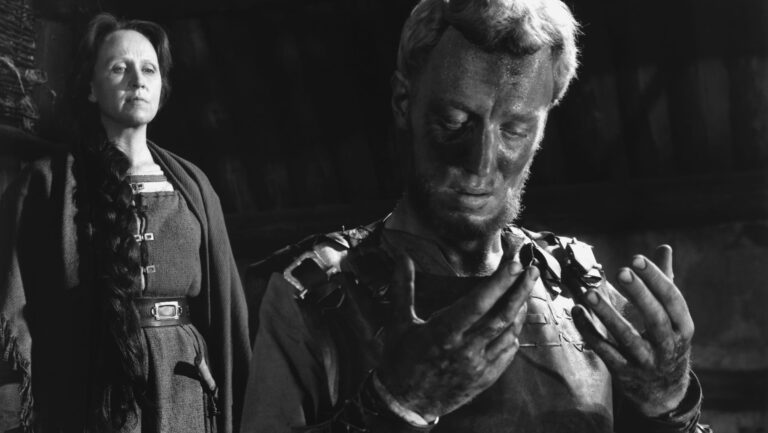
1) The Virgin Spring
2) Silence
3) Signs

Brendan

1) The Exorcist
2) Rashômon
3) Stalker

Honorable Mentions (Combined)

A Serious Man, Magnolia, First Reformed, Calvary, The Seventh Seal, Winter Light, The Last Temptation of Christ, Taxi Driver, Life of Pi, The Tree of Life, Knight of Cups, The Elephant Man, Kingdom of Heaven, Prometheus, The Master, mother!, Born of the Fourth of July, The Water Diviner, The Grey, Doubt, Spotlight

Hopefully you guys enjoyed our lists and if you agree or disagree with us, let us know in the comment section below. There are certainly many more movies about faith that are eligible for your lists. That being said, what would be your Top 3? Leave a comment in the comment section or email us at [email protected].

For the entire podcast, click here or listen below.

For more lists done by the InSession Film crew and other guests, be sure see our Top 3 Movie Lists page.

The Politics And Morality Of High Noon: A Retrospective

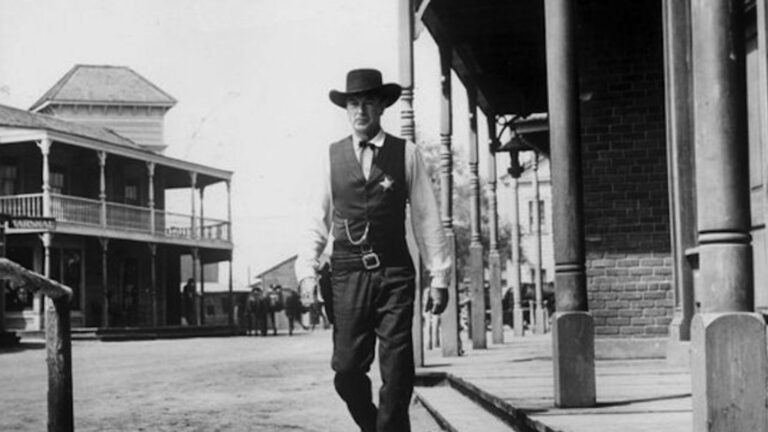
July 24th marks the 70th anniversary of one of Western’s greatest tales, Fred Zinnemann’s High Noon starring Gary Cooper, Grace Kelly, Thomas Mitchell, and Lloyd Bridges. Set in a New Mexico town on one morning, Cooper plays Marshall Will Kane, retiring and recently married to a beautiful Quaker named Amy (Kelly) who is against all forms of violence due to her religious beliefs. Prior to leaving, Marshall Kane is told of a criminal he sent to prison once is coming back into town today on the noon train to seek revenge on Kane. The townspeople are scared and others tell the Marshall to run away before the outlaw arrives. Out of a sense of duty, Kane will stay to challenge him.

It’s about following what is right even when everyone is against you or is too afraid to stand up for their beliefs. Kane cleaned the town of the corruption and lawlessness because it was his job, yet people are resentful of Kane for that. It’s a very enduring theme and changed the way Western stories are told and even grabbed the attention of Dwight Eisenhower, then a candidate for President of the United States, and future Presidents Ronald Reagan and Bill Clinton. Clinton remarked that politicians saw themselves as Cooper’s character because politicians could be, “alone and you feel you’re not getting the support you need,” when they are doing something they know is right. 

At the time of its release, some commented on the political allegory of the Red Scare. In fact, in an ironic twist of bipartisanship, the Soviet Union called it the “glorification of the individual,” an insult to its collectivist politics, while many right-wing figures, including Western star John Wayne, condemned the movie as being “the most un-American thing” produced. Odd bedfellows, indeed. How this belief came to be started in the midst of McCarthyism, the political witch-hunt to out anybody with communist sympathies, one of which was its screenwriter, Carl Foreman. 

Foreman dabbled in the Communist Party in the 1930s and 40s before becoming disillusioned and leaving the party. In the Second World War, he worked with Frank Capra on scripting training films for the military and propaganda for the public in the Know Your Enemy series. After the war, Foreman forged a partnership deal with producer (and future director) Stanley Kramer and scripted critically acclaimed films including The Clay Pigeon, Champion, The Men, and Cyrano de Bergerac. Foreman was one of Hollywood’s best screenwriters and was adapting the short story “The Tin Star” when he got an unwelcome subpoena. 

When Foreman’s previous association with the Communist Party was learned of, the House Un-American Activities Committee brought him to testify. Although he acknowledged his past and that he was no longer part of the party, Foreman still refused to name names and was immediately blacklisted like his fellow writers Dalton Trumbo and Ring Laudner Jr. He was forced to sell his stake in his partnership with Stanley Kramer and moved to England but remained credited for the screenplay. When he co-wrote The Bridge On The River Kwai five years later, he and Michael Wilson, also blacklisted, were not credited and only were given it – plus the Oscar that was won – after the two writers had died in 1984. 

John Wayne was offered the role but turned it down because he believed it was an attack on the blacklist which he supported, but his friend and fellow conservative actor Cooper took on the role because he opposed the blacklist. Gary Cooper was out of the country when he won the Best Actor Oscar and it was Wayne who accepted the award on his behalf. Thirty years later, the poster to High Noon was adopted by Poland’s Solidarity movement for the country’s first free elections as the communist regime was falling. As future President Lech Walesa stated about the poster, “Cowboys fight for justice, fight against evil, and fight for freedom, both physical and spiritual.”

Although the film lost Best Picture to The Greatest Show On Earth, it has received the long-lasting legacy it has very much deserved. It was one of the first films selected for the National Film Industry in 1989, considered to be “culturally, historically, or aesthetically significant.” It challenged traditional Western elements for something not as thrilling and fun, but more serious and morally challenging. The hidden politics remain there, once scoffed and derided, now well-liked across political spectrums. 


Follow me on Twitter: @brian_cine (Cine-A-Man)

List: Top 5 Movies of 2022 (so far)

UPDATE: We’ve now added Ryan and Jay’s lists as they discussed on Extra Film

This week on Episode 489 of the InSession Film Podcast, as we do every year at this time, we discussed our Top 5 movies of the year so far. After the last two years, it’s been exciting to just to see things get back to normal with theaters back at 100% and audiences throwing popcorn everywhere. That, in and of itself, has made for a fun year at the movies so far. But there’s also been some phenomenal movies in 2022 to this point. There is no doubt that a few of them will be heavy contenders at the end of the year. However, the year has also seen its fair shar of let downs as well. It may not be the strongest first-half on the whole, but there’s plenty to choose from for this exercise and we had a blast talking about our favorites of 2022 so far. That said, what would be your Top 5?

NOTE: In this segment we only discussed our Top 5 movies of the year so far, however, as you’ll see below, we have listed our full Top 10 as it stands right now.

JD:

1) Everything Everywhere All at Once
2) Top Gun: Maverick
3) After Yang
4) The Northman
5) Fire of Love

6) The Batman
7) Cha Cha Real Smooth
8) Pleasure
9) Kimi
10) Living

Brendan:

1) The Northman
2) Everything Everywhere All at Once
3) Turning Red
4) Apollo 10 1/2: A Space Age Adventure
5) X

6) Top Gun: Maverick
7) The Batman
8) After Yang
9) Hustle
10) Nitram

Honorable Mentions (Combined)

The Dog, Crimes of the Future, The Unbearable Weight of Massive Talent, A Love Song

[divider]

Coming off the heels of the Main Show doing this exercise, Ryan and Jay decided to offer up their picks for the best films of the year so far. The conversation is passionate and features a few compelling distinctions as well.

Ryan:

1) After Yang
2) Fire of Love
3) The Batman
4) Marcel the Shell with Shoes On
5) Great Freedom

6) Cha Cha Real Smooth
7) Everything Everywhere All at Once
8) Top Gun: Maverick
9) Good Luck to You, Leo Grande
10) Crimes of the Future

Jay:

1) RRR
2) Top Gun: Maverick
3) Everything Everywhere All at Once
4) The Northman
5) The Batman

6) Apollo 10 1/2: A Space Age Adventure
7) Mad God
8) Nitram
9) Kimi
10) Hustle

[divider]

Hopefully you guys enjoyed our lists and if you agree or disagree with us, let us know in the comment section below. This list is obviously going to differ based on your own personal taste and what you’re looking for in these films. That being said, what would be your Top 5? Leave a comment in the comment section or email us at [email protected].

For the entire podcast, click here or listen below.

For more lists done by the InSession Film crew and other guests, be sure see our Top 3 Movie Lists page.

Poll: What is the best film based on a short film?

Inspiration for any movie has to start somewhere. It can be a novel, a television show, a graphic novel, or even an original idea. And sometimes, it can be based on another film entirely, in most cases as an expansion of a short films. Such is the case with this weekend’s Marcel the Shell with Shoes On, which first saw life in 2010 as a stop-motion animated short film of the same name, and looking at those that had similar upbringings, it’s in very good company.

With that said, what is the best film based on a short film?


Podcast: Thor: Love and Thunder / Top 3 Movies About Lost Faith – Episode 490

This week’s episode is brought to you by Libsyn. Start your podcast today and get your first two months free when you use the code FRIEND at checkout!

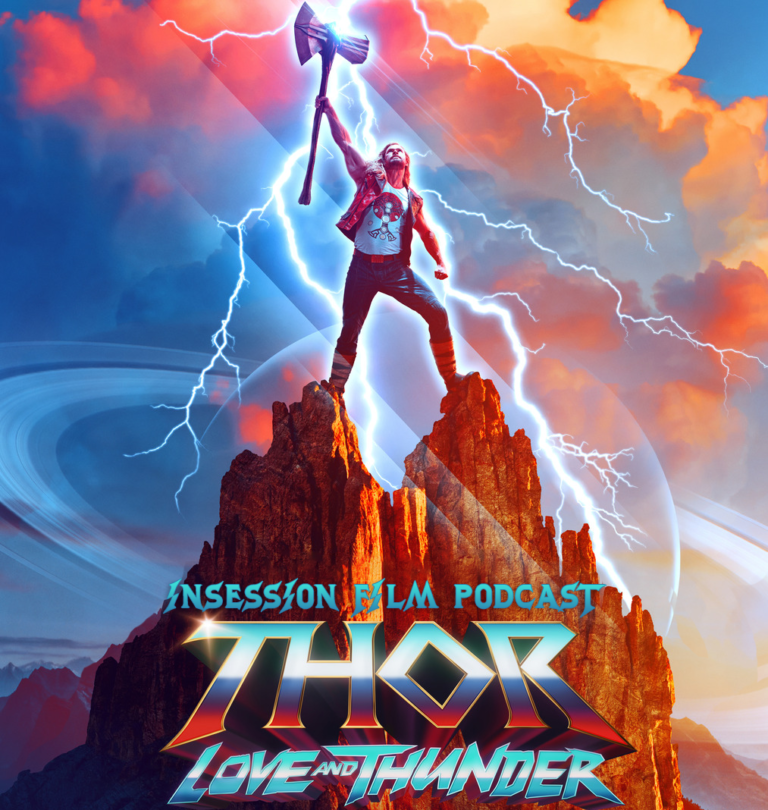
This week on the InSession Film Podcast, we are joined by Billy from We Watched A Thing to discuss the latest Marvel entry Thor: Love and Thunder and our Top 3 movies about lost faith! Plus, a little discuss on Phase 4 of the MCU and why it’s been so divisive.

A big thanks to Billy for joining us on the show this week. He’s really wonderful to talk to and it was a pleasure to finally get him on the show. Thor: Love and Thunder may not be the best that the MCU has to offer, but it had incredible potential and we spent a fair amount of time combing through it. Despite how you feel about Marvel’s new film, it inspired one of our favorite Top 3 discussions we’ve had in some time.

On that note, check out this week’s show and let us know what you think in the comment section. Thanks for listening and for supporting the InSession Film Podcast!

– Movie Review: Thor: Love and Thunder (6:50)
Director: Taika Waititi
Writers: Taika Waititi, Jennifer Kaytin Robinson
Stars: Chris Hemsworth, Natalie Portman,, Christian Bale, Tessa Thompson

– Notes / Discussion (58:13)

This week for our break segment, as mentioned above, we decided to dive further into Phase 4 of the MCU given the discourse that surrounds it. Marvel hasn’t been, ahem, secret about the wars its planning, so we know where it’s going despite click-baity articles that suggest otherwise. The question is more around quality and has Marvel dipped slightly coming off the heels of Phase 3?

[divider]

RELATED: Listen to Episode 246 of the InSession Film Podcast where we discussed Thor: Ragnarok!

[divider]

Top 3 Movies About Lost Faith (1:33:55)
One of the more fascinating aspects about Thor: Love and Thunder is Gorr the God Butcher, played wonderfully by Christian Bale. At the beginning of the film we see he’s a devout man begging for help from his god, but things change for him when he and his daughter are abandoned. Faith and doubt have coexisted in film in some rather profound ways throughout the years. This exercise was a daunting task given the amount of films apt to this topic, and the extreme quality that exists among them. However, it also sparked one of our favorite lists we’ve done in quite awhile. This was a lot of fun and we loved diving into the films that made our lists. That said, what would be your top 3?

Show Sponsor: First Time Watchers Podcast

– Music

Sweet Child O’ Mine – Guns N Roses
Calvary – Patrick Cassidy
The Return of the Eagle – Atli Örvarsson

Subscribe to our Podcasts RSS
Subscribe to our Podcasts on iTunes
Listen on Spotify
Listen on Stitcher
InSession Film Podcast – Episode 490

[divider]

Next week on the show:

Review: Marcel the Shell with Shoes On
Top 3: TBD

[divider]

Help Support The InSession Film Podcast

If you want to help support us, there are several ways you can help us and we’d absolutely appreciate it. Every penny goes directly back into supporting the show and we are truly honored and grateful. Thanks for your support and for listening to the InSession Film Podcast!

VISIT OUR DONATE PAGE HERE
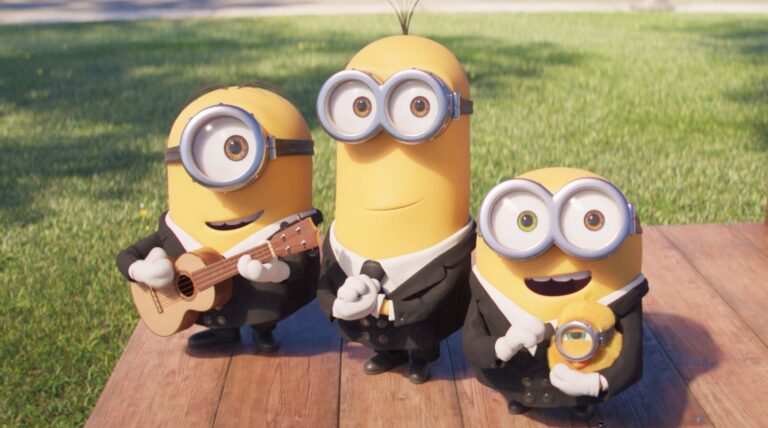
Movie Review: ‘The Man from Toronto’ Is The Worst Action Film of the Year


Director: Patrick Hughes 

Writers: Robbie Fox and Chris Bremner 

Starring: Kevin Hart, Woody Harrelson, Kaley Cuoco, Jasmine Matthews, and Ellen Barkin. 

Synopsis: The world’s deadliest assassin and New York’s biggest screw-up are mistaken for each other at an Airbnb rental.


Kevin Hart has reshaped his film career as a decent actor doing entertaining enough projects after the disastrous Ride Along, and Get Hard. Since, he’s made enjoyable films like Jumanji: Welcome to the Jungle, Jumanji: The Next Level, and Fatherhood, and the level of maturity he brought to his respective roles were not only very funny, but contained a tremendous amount of heart in his performances. His latest movie, The Man From Toronto, brings back the old version of Hart and sticks him in a painfully annoying (and dull) buddy comedy featuring the worst action sequences you’ll see all year. 

Initially slated to release in theaters, the film’s rights were acquired by Netflix due to the lingering effects of the COVID-19 pandemic. One perfectly understands why Sony decided to sell the movie to a streaming service as soon as the first action scene appears—a poorly shot and edited fight inside an airplane that culminates with, hands down, the most atrocious CGI I’ve seen in a major motion picture all year. I had to rewind to see if what I witnessed was real, but the visual effects are as bad as a SyFy original film…with a $75 million budget. It had a bigger budget than Todd Phillips’ Joker and yet looks like it was made for $5. Every action sequence is edited to shreds, which seems to be a recurring motif in Patrick Hughes’ films, even his R-rated The Hitman’s Bodyguard films. 

Of course, there seem to be lots of restraint in wanting the movie to be rated R to fully display The Man from Toronto’s (Woody Harrelson) abilities through hard R-rated action scenes, but the PG-13 rating prevents any large-scale action scene from being memorable in any way, especially considering how shoddy looking the VFX and cinematography are. Hughes likely faced some studio pushback from Sony to tamper down the brutality, because editor Craig Alpert cuts at almost every opportunity to hide the blood and any type of gruesome effect that would make the action feel cathartic and raw. And the editing isn’t solely a problem in the action scenes–the camera speeds up every time it changes a location while cutting in the middle of that specific moment. It’s hard to explain what visually occurs without seeing it, but it’s horrible. It wouldn’t be as bad if it happened only once, but it happens all the time. Without fail. 

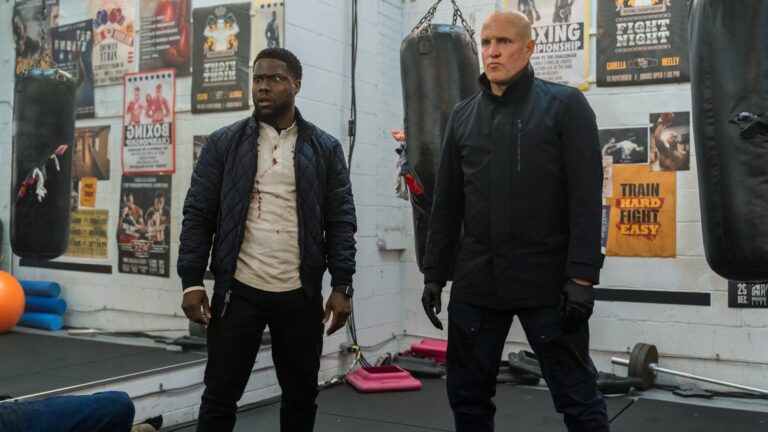
And I’d be more forgiving of the film’s technical aspects if the rest of it was enjoyable, but very little of it made me laugh, or feel anything. Hart is back in his old self as Teddy, an aspiring salesperson trying to convince the world that non-contact boxing will revolutionize fitness, and gets mixed up while on holiday with an assassin, The Man from Toronto, and the schtick gets tiresome real fast. The jokes are either terribly unfunny or go on for too long. There’s a legitimate five-minute bit involving Ellen Barkin’s Handler who tries to convince the main antagonist that Teddy is an impostor, and Hart mumbles on and on for five straight minutes, without pause, and without bringing any ounce of laughter to anyone watching. I don’t even believe Hart (or Harrelson) found the material funny, even if their chemistry kept me moderately engaged. 

But the best part of The Man from Toronto comes in a minor supporting role from Pierson Fodé as The Man from Miami, the assassin The Handler tasks to kill The Man from Toronto and Teddy, as being around Teddy has made Toronto go soft. Fodé owns every aspect of his ultra-caricatural performance, nailing the fight moves (they’re truly the only times where the action sequences produce something exciting) of a martial arts expert, and always arrives “in the nick of time” to spice things up a bit. It’s a shame his role wasn’t expanded as the film’s main antagonist, because he absolutely rules in every single scene he’s in. 

Aside from that, The Man from Toronto is a largely unimpressive bore, even if Hart and Harrelson try to keep their chemistry as engaging as possible. But the both of them just aren’t funny together as they work with some of the most uninspired material for a buddy comedy involving two of the biggest stars working today. We’ve seen the story before, and the movie does nothing to reinvent the wheel, on top of delivering the very worst action scenes of any film released this year so far. I’d like to think that COVID will now be used as an excuse for major studios to get rid of some of their most embarrassing films to streaming services, even if audiences have come back to cinemas multiple times. The Man from Toronto may very well begin that trend. 


Grade: D


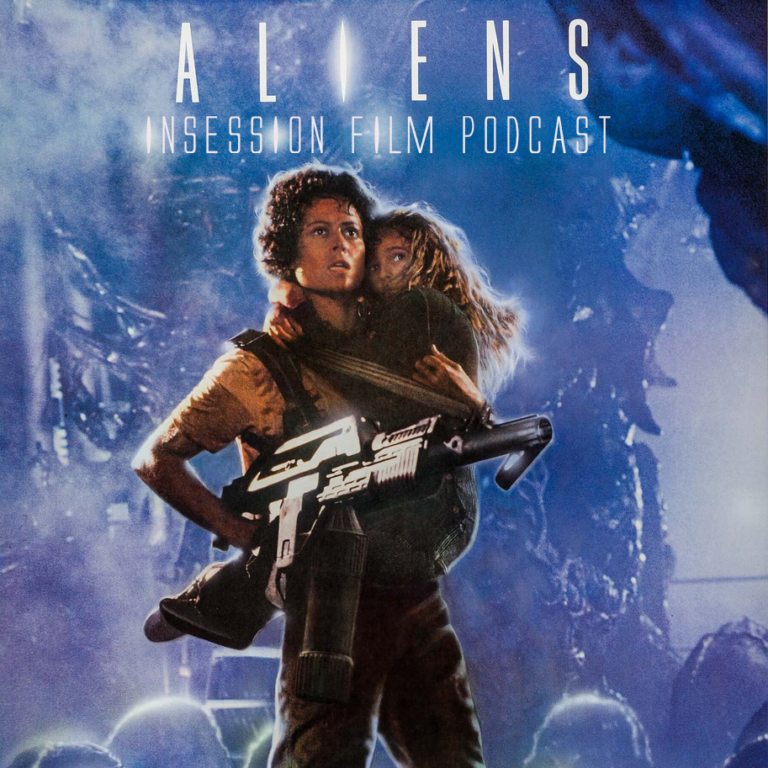
Podcast: Aliens (Revisited) / Top 5 Movies of 2022 So Far – Extra Film

This week on the Extra Film Podcast, Nathaniel Rogers of The Film Experience joins Ryan and Jay as they continue their James Cameron Movie Series with Aliens and they also offer up their Top 5 movies of 2022 so far!

Big thanks to Nathaniel for joining us on the show this week. He was absolutely wonderful and his passion for Cameron made for a really fun conversation. Enhancing that even further was Ryan’s reaction to Aliens this time around. If you’ve listened to any previous show where the film was mentioned, you’ll know that Ryan has never been a fan of Cameron’s take on the franchise. Well, it’s time to buckle up as things go in a very different direction in this review.

For anyone that wants to hear JD and Brendan’s review of Aliens on Episode 221, click here.

On that note, check out this week’s show and let us know what you think in the comment section. Thanks for listening and for supporting the InSession Film Podcast!

– Movie Review: Aliens (6:31)
Director: James Cameron
Writers: James Cameron
Stars: Sigourney Weaver, Michael Biehn, Carrie Henn

– Top 5 Movies of 2022 (so far) (1:06:36)
Coming off the heels of the Main Show doing this exercise on Episode 489, Ryan and Jay decided to offer up their picks for the best films of the year so far. It’s been an up-and-down year, but as you’ll hear, there’s been some incredible contenders that will likley still be in play at the end of 2022. That said, what would be your top 5?

– Music

Ripley’s Rescue – James Horner
Komuram Bheemudo – NTR, Ram Charan, Kaala Bhairava
The Return of the Eagle – Atli Örvarsson

Subscribe to our Podcasts RSS
Subscribe to our Podcasts on iTunes
Listen on Spotify
Listen on Stitcher
Extra Film – Aliens / Top 5 Movies of 2022 (so far)

[divider]

To hear this Extra Film episode and everything else we do, download our apps on the Amazon Market for Android and the Podcast Source app on IOS devices. The mobile app covers all of our main shows, bonus podcasts and everything else relating to the InSession Film Podcast. Thanks for your wonderful support and for listening to our show. It means the world to us.

Welcome To Miami: The Magic City’s Hottest Shooting Locations

I was born and raised in Miami, Florida, and still live there despite political grifting, never-ending road rage, and constant invasion of newbies who want to come in to avoid state income tax. It’s still expensive in Florida wherever you go, but there is sun all year round, and who doesn’t like a condo on the bay for $1.5 million? This city makes a great place to shoot any film, X-rated or not. Of course, the Bad Boys trilogy, Ace Ventura: Pet Detective, There’s Something About Mary, Miami Vice, and Pain & Gain are among the many notable films which have been shot in my hometown; along with TV shows like The Golden Girls, CSI: Miami, and Burn Notice. There are other noted films (and one place) that soaked up Miami’s sun for the screen to make their movie shine wonderfully. 


Deep Throat (1972)

This is such a cheap paragraph to write because this is a porno film rather than an actual narrative film, but when a groundbreaking movie is shot on the streets you know, you have to write about it. Before the allegations from Linda Lovelace stating that she was forced to do those scenes surfaced, it attracted film directors, actors, singers, politicians, and even Jackie Kennedy Onassis. The beginning of “porno chic” had the opening credits sequence on Collins Avenue alongside the canal and slowly passing by apartment buildings and hotels that remain standing today. A motel with the interior scenes, including the explicit sex, was turned into a dormitory for the now-closed Johnson & Wales University on Biscayne Boulevard. Only in Miami, this could happen. 


Absence Of Malice (1981)

Sydney Pollack’s Oscar-nominated drama featured Paul Newman as a man who becomes front-page news as he is suspected of a man’s death although he has never been questioned about it and is innocent. He confronts the reporter who wrote the article, played by Sally Field, but she will not disclose her source, even though it is defaming the innocent man. The film was shot throughout Miami, most notably the actual building of the Miami Herald (in the film, it is the Miami Standard), although the building has since been demolished.


Any Given Sunday (1999)

Oliver Stone’s football drama was not able to use the NFL and their teams, so he made up a league and the team, the Miami Sharks. Luckily for Miami natives, he used the now-demolished Orange Bowl as the team’s home stadium, as well as Hard Rock Stadium for a road game. Real-life players, former and current at the time, took part in the production in which sometimes the acting actually turned into a fight, such as the one seen with LL Cool J and Jamie Foxx, which was an actual altercation. Following the mantra, “War by day, party by night,” they shot in Miami Beach every night in all the clubs possible, providing the nightly magic in the Magic City.


Moonlight (2016)

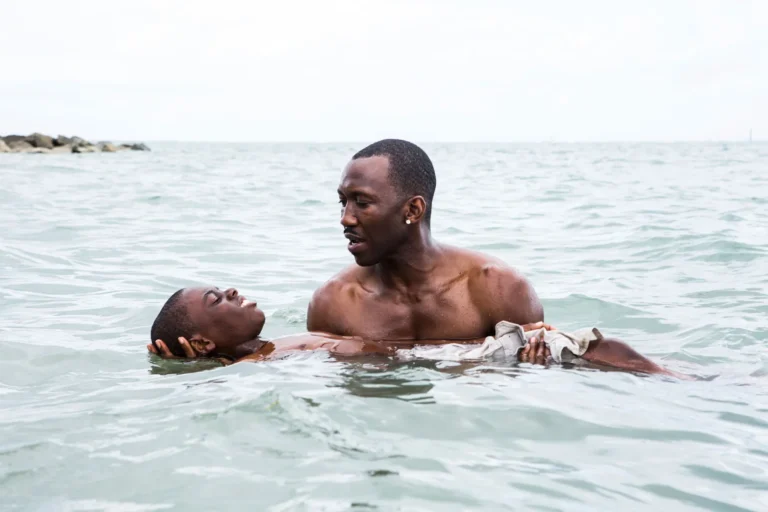
Miami was made proud when native Barry Jenkins directed the Best Picture winner on a $1.5 million budget in locations very familiar to him. The film was set and shot in the neighborhood of Liberty City where he and co-writer Tarell Alvin McCraney were raised; as well as in Miami Beach and Key Biscayne. For me personally, the scene that grabbed me the most was when Chiron (Trevante Rhodes) and Kevin (Andre Holland) as adults reunited at a diner Kevin works at. The location is called Jimmy’s Diner and it doesn’t have a jukebox nor is it open in the evening. However, I’ve been there many times for a cheap, delicious breakfast and the restaurant proudly has Jenkins’ autograph behind the cashier’s desk.


Fontainebleau Hotel

This isn’t a movie itself, but a location used many times over in films. This is a major setting for a lot of films because of the hotel’s historical longevity in South Florida. First opened in 1954, the opening shot of Goldfinger was over the Fontainbleu, but its formal scenes were not shot on location. What was shot on location included the Frank Sinatra comedy A Hole In The Head, Jerry Lewis’s The Bellboy (which used video playback for the first time), The Bodyguard, and the third season of The Marvelous Mrs. Maisel. While a new tower was constructed alongside the original building, what hasn’t changed much is the hotel’s lobby and the “floating staircase” which has been preserved to this day. 


Follow me on Twitter: @brian_cine (Cine-A-Man)

Coming to Shudder: July 2022 – Undead Gems

Shudder’s collection is incredibly vast and varied. They curate classics, new releases, and cult favorites. I can always find something to watch, no matter which subgenre I’m in the mood for.

Here are a few of the under-seen gems that Shudder will be resurrecting in July 2022:


July 1:


Lifeforce (1985)

Director: Tobe Hooper

Starring: Peter Firth, Frank Finlay, Steve Railsback, Patrick Stewart & Mathilda May

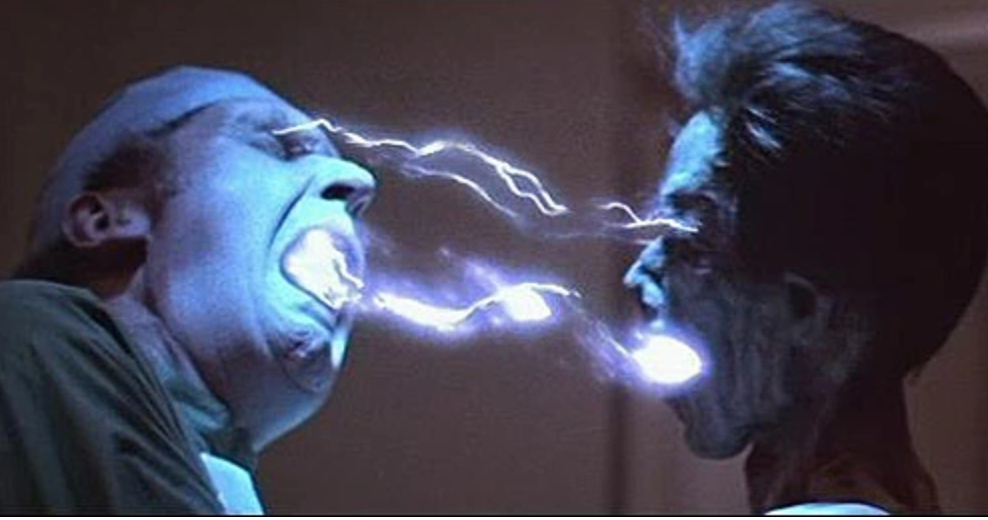
Tobe Hooper’s follow-up to Poltergeist is a helluva trip. I mean, how could a film about naked space vampires coming to Earth to seduce and drain the lifeforce out of everyone they encounter not be?! Lifeforce seems to be one of the most divisive entries in Hooper’s oeuvre. There are critics who cite this as one of the director’s best, while there are just as many who find it to be one of his absolute worst efforts. Regardless, it’s a sexy and horrific feast for the eyes; the spectacle of it all cannot be denied.


Invaders from Mars (1986)

Director: Tobe Hooper

Starring: Karen Black, Timothy Bottoms, Louise Fletcher, Bud Cort & James Karen

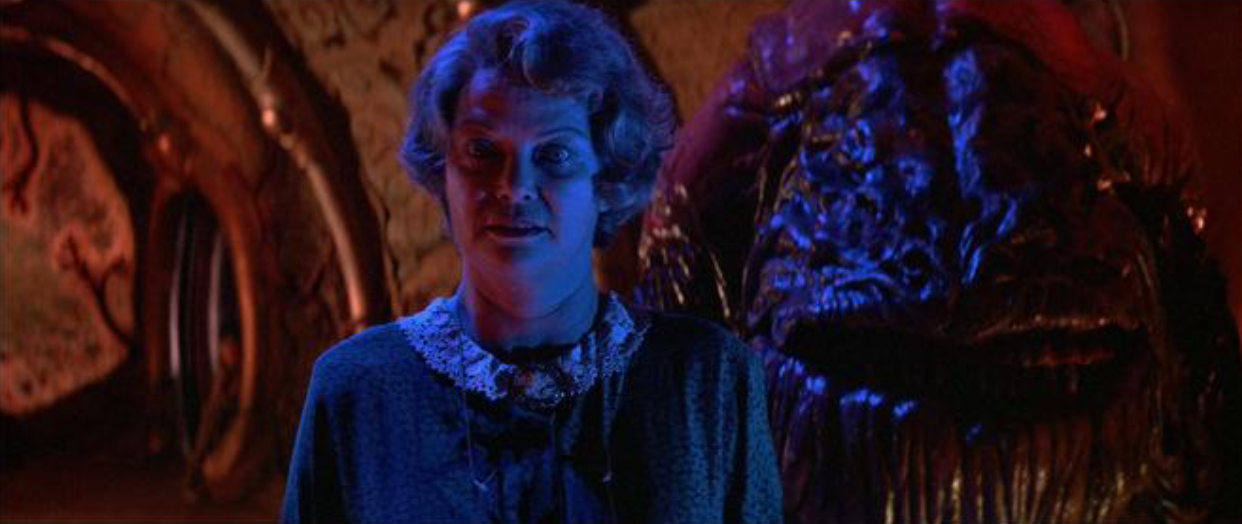
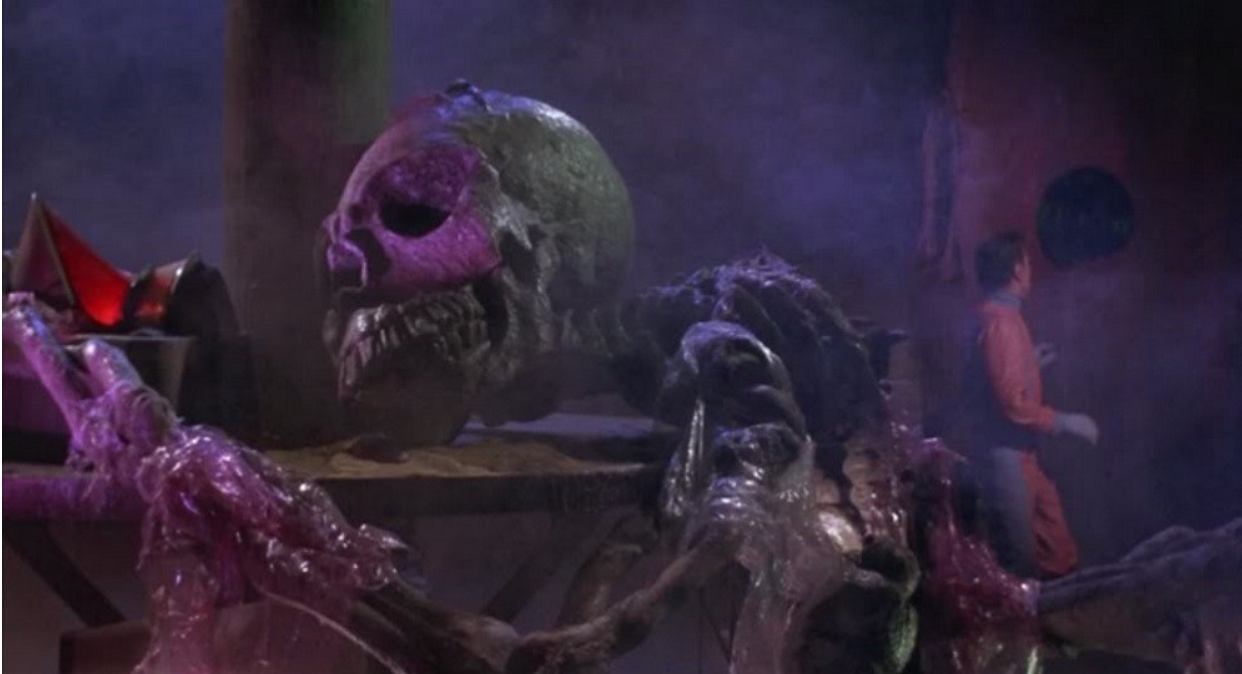
Hooper stuck with aliens for his subsequent project. In this remake of a 1953 film, a young boy tries to prevent Martians from taking over his small town. Their plan is to turn the entire human race into mind-controlled zombies. I love when a B-movie stars the prestige actors of the previous decade, and this is how Invaders from Mars is assembled. And that’s not a diss. If you’ve never seen the likes of Karen Black or Louise Fletcher give a top-tier performance in a mid-tier film, you are missing out.


Planet of the Vampires (1965)

Director: Mario Bava 

Starring: Barry Sullivan, Norma Bengell, Ángel Aranda, Evi Marandi & Ivan Rassimov 

Mario Bava, the godfather of giallo, pivoted from masked murderers stalking beautiful women to his own version of space vampires—twenty years before Hooper did it. In Planet of the Vampires, a team of astronauts land on a mysterious planet called Aura. Soon afterward, the explorers fall under the nefarious influence of Aura’s strange vampiric inhabitants who are trying to reach Earth.


God Told Me To (1976)

Director: Larry Cohen 

Starring: Tony Lo Bianco, Sandy Dennis, Sylvia Sidney, Deborah Raffin & Richard Lynch

A detective investigates a series of violent murders committed by strangers who say they are killing for no reason other than God told them to. The detective’s journey leads him to a depraved Christ-like figure with psychic powers who is seemingly coercing innocent people into completing his perverse plan for mankind’s soul. Although it was initially panned (Roger Ebert gave it 1 star), time has breathed new life into God Told Me To, with Rolling Stone magazine naming it one of the 20 Scariest Horror Movies You’ve Never Seen in 2014.


July 11:


Who Saw Her Die? (1972)

Director: Aldo Lado

Starring: George Lazenby, Anita Strindberg, Adolfo Celi, Peter Chatel & Piero Vida

Although he isn’t quite the household name that Mario Bava and Dario Argento are, Aldo Lado also directed a few of the more notable giallo films of the 1970s. Who Saw Her Die?, his sophomore feature, is about a killer of children terrorizing Venice. The latest victim is the daughter of a well-regarded artist, who decides to launch an investigation of his own when the police prove useless. His search for answers eventually uncovers a high-level web of perversion and violence… This film was one of George Lazenby’s follow-ups to his sole outing as James Bond.


July 18:


Phantom of the Mall: Eric’s Revenge (1989)

Director: Richard Friedman

Starring: Derek Rydall, Kari Whitman, Rob Estes, Pauly Shore & Morgan Fairchild

This is, as the title suggests, a riff on the classic work of literature and film in which a man survives life-threatening burns, then emerges from the shadows years later for revenge. In this version, the masked killer was set ablaze in a fire deliberately lit by a commercial real estate developer trying to obtain land for the site of a future shopping mall. Once the mall is built and open for business, the phantom chooses a waitress who works there as the object of his obsession while he murders the people she comes into contact with. 


Santa Sangre (1989)

Director: Alejandro Jodorowsky 

Starring: Axel Jodorowsky, Blanca Guerra, Guy Stockwell, Thelma Tixou & Sabrina Dennison

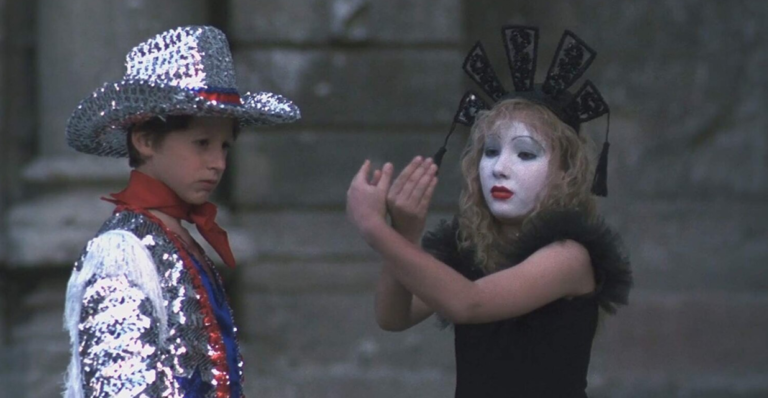
There is no other filmmaker quite like Alejandro Jodorowsky, whose avant-garde films are in many ways a genre unto themselves. In Santa Sangre, a former circus performer escapes from a mental hospital in order to reunite with his armless mother, who happens to be a cult leader. She drives him to kill in her name so as to satisfy her insatiable thirst for “holy blood.” Santa Sangre is one of Letterboxd’s Top 250 Horror Films and in 2008, Empire magazine listed it as one of the 500 Greatest Movies of All Time. 


July 25:


The Toolbox Murders (1978)

Director: Dennis Donnelly

Starring: Cameron Mitchell, Pamelyn Ferdin, Wesley Eure, Aneta Corsaut & Nicolas Beauvy

Savaged by critics at the time of its release and briefly banned in the UK for being a “video nasty,” The Toolbox Murders has steadily developed a cult following over the years. Cameron Mitchell, a Mario Bava alum and considered a founding member of The Actor’s Studio in New York, plays the owner of a Los Angeles apartment complex being terrorized by a masked assailant armed with a toolbox of deadly instruments. Stephen King has cited this film, one of the most notorious grindhouse pictures from the era, as a personal favorite.


Poll: What is Natalie Portman’s best performance?

Natalie Portman now yields Mjölnir as Mighty Thor, prompting us to look back at her mighty career. The Israeli-born actress made her acting debut in Leon: The Professional at age twelve, and has since become one of Hollywood’s most crucial voices both on and offscreen, from any one of her magnetic performances to shedding light on important social and political issues. Regarding her best work as an actress, we asked this same question back in 2016, at a time when everyone still had Black Swan on the brain. But since then, we’ve had time to marinate on her work over the past decade, such as Jackie and Vox Lux, and it’s possible a question like this would be more competitive now.

So nowadays, what do you think is Natalie Portman’s best performance?


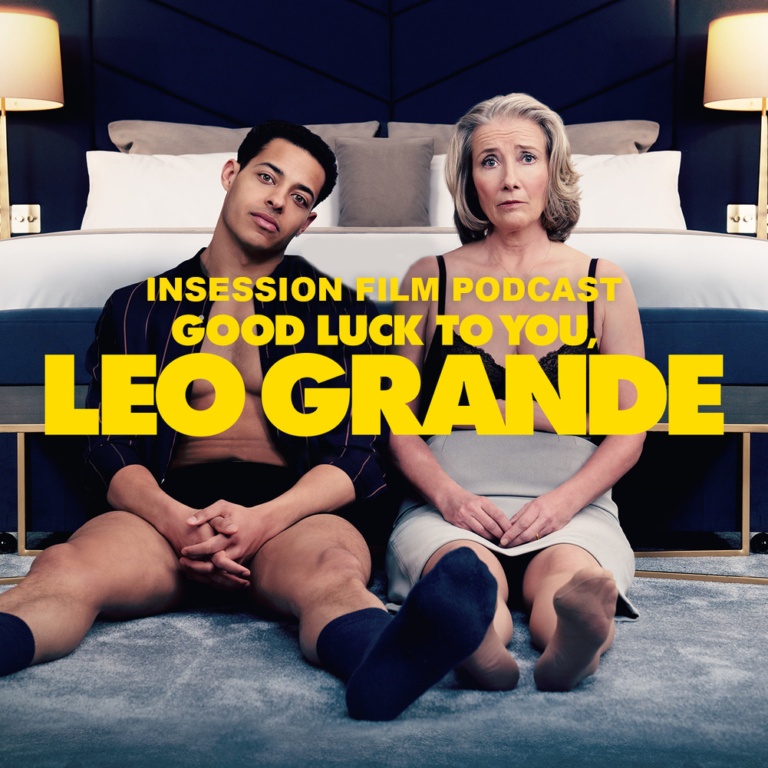
Podcast: Good Luck to You, Leo Grande / Top 5 Movies of 2022 (so far) – Episode 489

This week’s episode is brought to you by Athletic Greens. Get a FREE one year supply of Vitamin D and 5 travel packs today!

This week on the InSession Film Podcast, we discuss Sophie Hyde’s film Good Luck to You, Leo Grande and our Top 5 movies of the year so far! Plus, a few thoughts on Minions: The Rise of Gru and the documentary Unrivaled.

It’s hard to believe that it’s that we’re halfway through the year already. The year has some its fair share of great films, but it’s also had plenty of disappointments as well. On the whole, it’s been an up and down year, but my god has it been fantastic for immersive theatrical experiences. After the last few years especially, it’s been heavenly to go back to the theater and see these movies that have been so remarkably cinematic.

On that note, check out this week’s show and let us know what you think in the comment section. Thanks for listening and for supporting the InSession Film Podcast!

– Movie Review: Good Luck to You, Leo Grande (6:50)
Director: Sophie Hyde
Writers: Katy Brand
Stars: Emma Thompson, Daryl McCormack

– Notes / Discussion (58:13)

This week for our break segment, we had a lot of fun discussing the Extra Film boys as they started their James Cameron Movie Series. Given Ryan’s history with Cameron, we’ve already seen some great surprises. JD also gives us his thoughts on Minions: The Ruse of Gru, Morbius and the hockey documentary Unrivaled.

[divider]

RELATED: Listen to Episode 12 of the InSession Film Podcast where we discussed The Great Gatsby!

[divider]

Top 5 Movies of 2022 (so far) (1:33:55)
After the last two years, it’s been exciting to just to see things get back to normal with theaters back at 100% and audiences throwing popcorn everywhere. That, in and of itself, has made for a fun year at the movies so far. But there’s also been some phenomenal movies in 2022 to this point. There is no doubt that a few of them will be heavy contenders at the end of the year. However, the year has also seen its fair shar of let downs as well. It may not be the strongest first-half on the whole, but there’s plenty to choose from for this exercise and we had a blast talking about our favorites of 2022 so far. That said, what would be your top 5?

Show Sponsor: First Time Watchers Podcast

– Music

Always Alright – Alabama Shakes
Top Gun: Maverick – Hans Zimmer, Harold Faltermeyer
The Return of the Eagle – Atli Örvarsson

Subscribe to our Podcasts RSS
Subscribe to our Podcasts on iTunes
Listen on Spotify
Listen on Stitcher
InSession Film Podcast – Episode 489

[divider]

Next week on the show:

Review: Thor: Love and Thunder
Top 3: TBD

[divider]

Help Support The InSession Film Podcast

If you want to help support us, there are several ways you can help us and we’d absolutely appreciate it. Every penny goes directly back into supporting the show and we are truly honored and grateful. Thanks for your support and for listening to the InSession Film Podcast!

VISIT OUR DONATE PAGE HERE
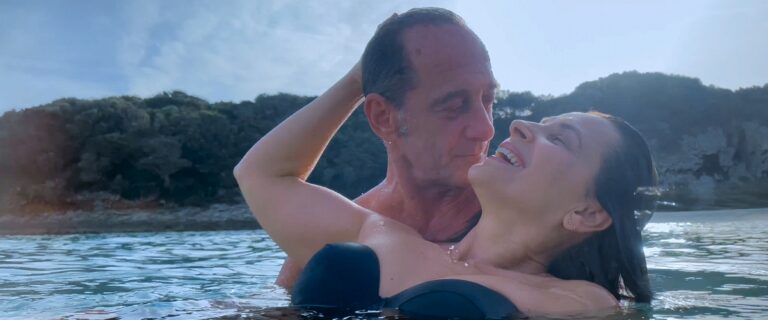
Movie Review: ‘Mr. Malcolm’s List’ Checks All The Boxes


Director: Emma Holly Jones

Writer: Suzanne Allain

Stars: Freida Pinto, Sope Dìrísù, Zawe Ashton

Synopsis: A young woman courts a mysterious wealthy suitor in 19th century England.


The modern movie theater experience seems to have little room for romance. If it’s not got a man on a mission or a tough woman, because she can’t be in any way vulnerable, on a mission, a film will be drowned out by the sea of capes and ‘quels (se, pre, legacy, and otherwise). Yet, bubbling underneath is the growing, diversifying market of romance books. Most of the biggest series, Virgin River, Firefly Lane, and Bridgerton have been adapted and absorbed into the streamer content mills, but a small amount are beginning to appear again on the big screen like The Hating Game and, now, Mr. Malcolm’s List..

Like a handful of period pieces of the last few years that are based on fictional works, Mr. Malcolm’s List eschews the narrow minded thinking that a film set in the past has to have a homogenous cast. Mr. Malcolm’s List‘s diversity of actors is one of its biggest strengths. Sope Dìrísù smolders with the best of them. He is able to pull off the titular Mr. Malcolm’s introspective brooding with ease, but when he lets Malcolm’s veil drop it’s like a charm bomb has exploded. His million watt smile makes you melt and his heartbreak comes right off the screen to clutch at your chest.

Though Freida Pinto’s no slouch either. Always cast as the love interest and rarely the romantic lead, Pinto is an actress who is best when she can show her range. In Mr. Malcolm’s List, she deftly balances comedy, romance, and drama with the slightest of looks and gestures. Her chemistry with everyone is palpable and keeps you guessing as to whom she might lavish her affections on. Pinto’s performance makes you yearn for the happiness of Selina.

The two of them together are a force of radiant desire. One particular scene, at a masquerade ball encompasses this perfectly. The whispers start both positive and negative about the pair. They dance, only having eyes for each other, and as they come closer together, the other voices, the other people drift away. The music takes over the soundtrack and accents the scene beautifully. It melts you to watch as Selina and Malcolm steal glances at each other, smile, linger on each touch, and get so close to a kiss; it’s agony.

Director Emma Holly Jones builds these moments perfectly. She and editor Kate Hickey know how long to let the shots linger. She and cinematographer Tony Miller know just what to show us. There’s even a terrific melding of the three creatives in a lovely long take. As John (played by Divian Ladwa), footman to Miss Julia Thistlewaite (played by Zawe Ashton), delivers a note to Lord Cassidy (played by Oliver Jackson-Cohen), the message of the note traverses the room. It’s a complicated shot with a lot of moving pieces that all work so well in complement to one another.

Suzanne Allain’s script makesroom for more than just the main story. The secondary romance for Julia evolves as beautifully as the one between Mr. Malcolm and Selina. Though, what is most heartening to observe is as John and Molly (played by Sianad Gregory) create a sort of Rosencrantz and Guildenstern comedy duo in the background. John obviously seeks a life beyond his current station and Molly is content. Yet, Molly’s not above giving John pointers by the end. The two of them even share a dance at the close of the masquerade ball that’s sweet and charming. Mr. Malcolm’s List will lull you into familiarity while surprising you with inventive subplots.

The story beats are very familiar and there are parts that can drag, yet Mr. Malcolm’s List is a delightful film. It’s comforting to escape to a world of decadence and uncomplicated living. It’s comforting to watch as two charming, attractive people fall in love. Mr. Malcolm’s List is a comfort and well worth the big screen experience.


Grade: B


Movie Review: ‘Clara Sola is a Carrie-like Coming-of-Age Tale with Magical Realism Attached


Director: Nathalie Álvarez Mesén

Writer: Nathalie Álvarez Mesén and Maria Camila Arias

Stars: Wendy Chinchilla Araya, Ana Julia Porras Espinoza, and Daniel Castañeda Rincón

Synopsis: In a remote village in Costa Rica, Clara, a withdrawn 40-year-old woman, experiences a sexual and mystical awakening as she begins a journey to free herself from the repressive religious and social conventions which have dominated her life.


I think it is fair to say that Brian de Palma’s adaptation of the beloved Stephen King novel, Carrie, changed the horror landscape for good. Since its release back in 1976, many filmmakers have been inspired by that film. That inspiration may arrive not only from its coming-of-age and horror elements, but its take on religion, femininity, and the sin that develops through that mystical and horrifying tale of a woman experiencing extreme amounts of torment. Like the stories that derive from this classic, its strongest of horrors do not come from a supernatural form or act; it’s developed by the suspicions and contempt for women. Hence, the fear for the feminine prowess in the respective films. The debut feature of Costa Rican-Swedish director Nathalie Álvarez Mesén, Clara Sola, projects these same ideas with a different style, while also implementing small dashes of mythicism and magical realism into its naturalistic atmosphere. Clara Sola does not indulge too much in the horror side of things; it is mainly implied or subdued, with no scenes of pure violent rage. 

It’s a stripped-down version of the familiar tale to reflect the atmosphere and locations it is presenting on-screen. Set in a remote village in Costa Rica, the film follows the titular Clara (Wendy Chinchilla Araya), a 40-year-old woman whose life is about to change entirely in the next couple of days its narrative transgresses through. Clara is off on a journey that will break her free from all of the permanent religious conventions in her small village. From the initial moments, the viewer sees there is some magical realism being smeared slowly onto the screen, and Clara is going to be the host of what happens with those elements in the narrative through her exploration of her sexuality and the confinement created by the religious traditions. Like Margaret White in Carrie, Clara’s mother, Fresia (Flor María Vargas Chavez), is very religious and overprotective. She must protect her daughter from these dangers that arise outside of the repressive religious conventions and doesn’t allow her space for self-discovery. 

The only times where Clara expresses herself the most are with her white horse, Yuca, and its caretaker, Santiago (Daniel Castañeda Rincón). Santiago is the equivalent of Billy Nolan, the only person who gives her the light of day. There are various parallels between the De Palma picture and Clara Sola. Still, both develop pretty differently from each other, yet, in some manner, end up with some of the same concluding ideals. Unfortunately, the audience is one step ahead in this one and knows what is about to come. Hence, losing its sense of tension and the interest along the way – slowly developing toward a culminating scene of rage and a presentation of violence of some sorts (as well as some arson amidst its blossoming). But what’s most interesting about Clara Sola is its balancing act of religion and culture. The film doesn’t indulge much in its representation of both aspects, so there could be a more significant effect on the lead character by both ends. However, this same decision causes the final product to feel less effective. Clara Sola is distant. Although thematically relevant, it is to a fault. 

Not so much cold in demeanor, but instead departed in some manner that doesn’t help the viewer be entranced or appropriately connected to the story being told. At least, on a relatively positive note, there’s a soothing atmosphere in the Costa Rican village, primarily thanks to cinematographer Sophie Winqvist (Pleasure, Aniara). The fog, the various plants and trees, and even the spiderwebs feel tactile; you can sense the multiple elements (rain, sunlight, mountain breeze) while watching. The scenes where the camera lingers on and carefully watches Clara connecting with the earth are the film’s best and most reflective. The movie contains its heftier thesis in those quick, yet fascinating sequences. There’s one specific scene where Clara just lays down on the mud while it is still raining outside, showcasing how deeply in sync Clara is with nature. It reminded me a bit of a scene in Lars von Trier’s Antichrist in which Charlotte Gainsbourg’s character blends with the earth as a coping mechanism for her lost child and repressed desires. 

Nathalie Álvarez Mesén’s depiction of the said connection in Clara Sola between womanhood and nature is truly fascinating. It is the most exciting and engaging concept that Clara Sola has to offer. This is even further explored with the representation of how her sexual awakening resembles a flower blooming and the connection of her experiences with the mimosa pudica (known as the touch-me-not or shame plants). The film doesn’t go beyond the lead character’s experience, as it studies her progress through femininity and desires. However, it did have a moment where it could have expressed a broader depiction. Perhaps, it could have shown the various reflections in her household (sister, mother, neighbors). It shines when it focuses on nature, both literally (the beauty of it all) and figuratively (its connection with the various forms of expression and lusts). Unfortunately, Clara Sola’s connections to Carrie bring it down a notch as it heads toward a familiar conclusion. Still, there’s great potential for the director’s future career, Nathalie Álvarez Mesén, for what it is, especially in that realm between naturalism and magical realism. 


Grade – C+

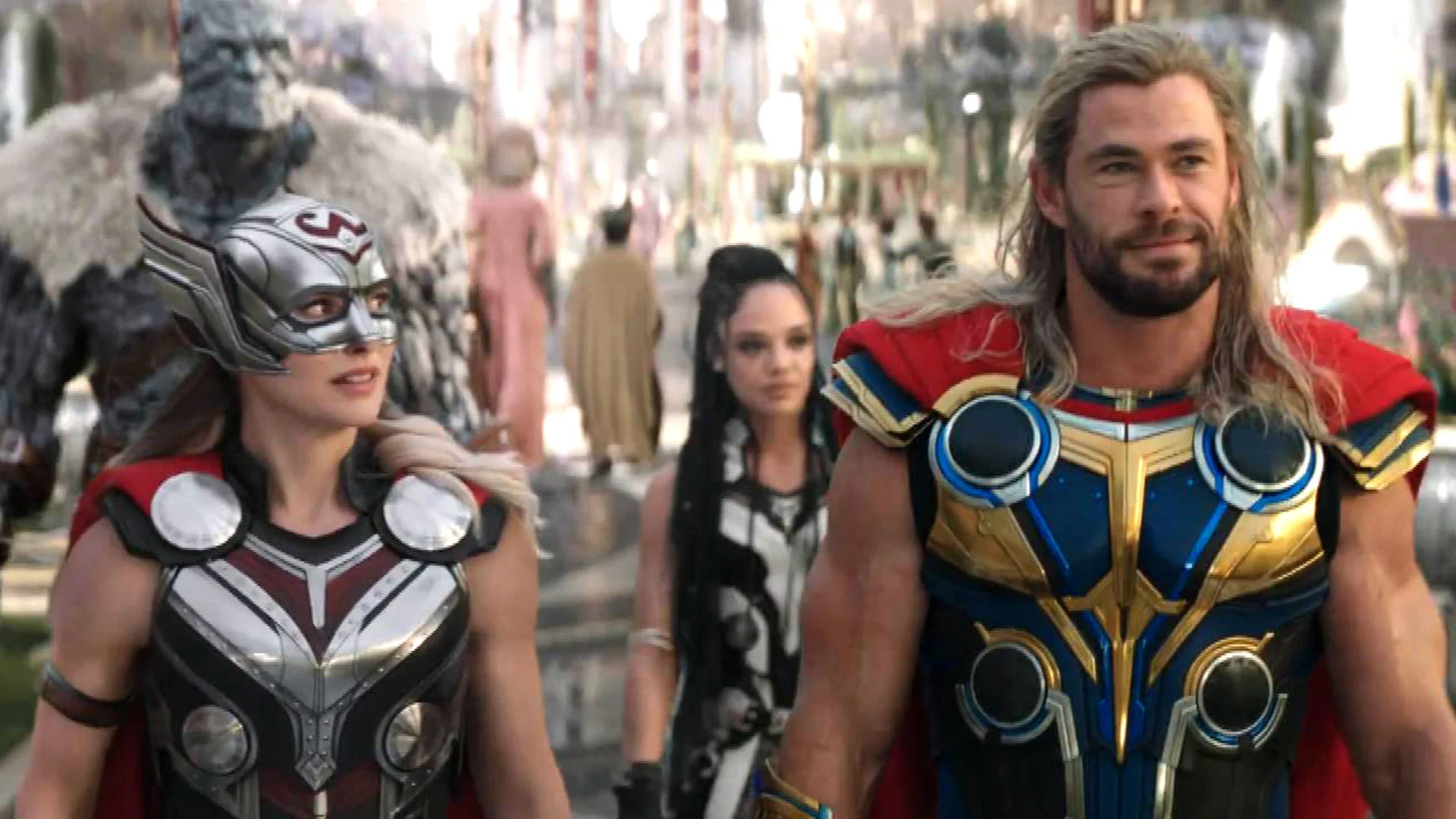
Movie Review: ‘Thor: Love and Thunder’ Brings The Thunder From Down Under


Director: Taika Waititi

Writers: Taika Waititi, Jennifer Kaytin Robinson

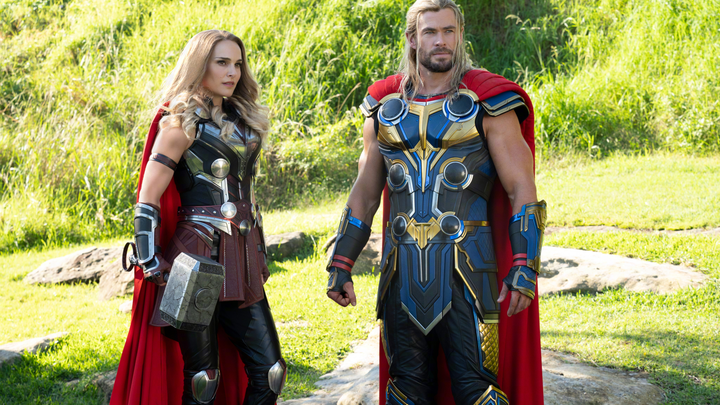
Stars: Chris Hemsworth, Natalie Portman, Christian Bale

Synopsis: Thor enlists the help of Valkyrie, Korg, and ex-girlfriend Jane Foster to fight Gorr the God Butcher, who intends to make the gods extinct.


During the inception of the Marvel Cinematic Universe, Thor was the one hero who didn’t seem to have much depth in his character arc. In his first film Thor (2011), we were introduced to what seemed like the Marvel equivalent to Superman. He was the almighty Thor, god of thunder. We were shown how powerful he could be. We knew his strengths, weaknesses, and what made him tick. No matter how powerful he became, I felt no empathy for his character. By the time that Avengers: Age of Ultron came to theaters, it felt like his character was drowning and being thrown to the wayside. That all changed when Thor Ragnarok came into my life. Thor became relatable and humanized by director Taika Waititi. He gave Thor a fresh start, not only for the character but for the fans, and Taika Waititi has done it again. Thor: Love and Thunder has graced us with its presence, and it’s a story to remember.

With a runtime of 2 hours and 5 minutes, Thor: Love and Thunder has impressed me on multiple levels. This is easily one of the best Marvel films that we’ve received since the start of phase four of the marvel cinematic universe. It’s extravagant, witty, and has almost the same emotional barriers as Spider-Man: No Way Home. Thor’s humanity is continually shown by Taika Waititi from start to finish. This film opens with a hilarious voice over monologue that explains what Thor (Chris Hemsworth) has been up to since the events of Avengers: Endgame. The last time we saw our hero, he was traveling with the Guardians of the Galaxy who make a small appearance to kickstart Thor’s latest journey, which was something that I appreciated. I was afraid going into this film that Thor’s journey would be sidelined by the Guardians, but thankfully this is not the case. This film focuses on Thor maintaining his current and past relationships with his countrymen, the Asgardians, and his former lover Jane Foster (Natalie Portman) whose portrayal as The Mighty Thor was brilliant and inspiring. Her character has been mentioned a few times throughout Thor’s adventures with the Avengers but I adore how Taika Waititi was able to bring her back into Thor’s life, as she is one of the main reasons why Thor becomes the hero he is today. 

A superhero film is only as good as its villain and Christian Bale (The God Butcher) gives us one hell of a performance. This film gives us a respectable amount of backstory as to how he came to be. His motives are simple, to kill all gods, deities, and supreme beings. Christian Bale does a phenomenal job with getting the audience to resonate and empathize with his character much like we have seen in past Marvel films. Such as Black Panther with Killmonger (Michael B. Jordan), Thanos (Josh Brolin) from Avengers: Infinity War and Avengers Endgame, and Wenwu (Tony Leung) from Shang-Chi and the Legend of the Ten Rings. The God Butcher leaves a ominous presence throughout the film as the tension builds as to where he will strike next, which is why he is one of the best villians in the Marvel Cinematic Universe. 

The music of Michael Giacchino nicely complements the movie’s soundtrack. Anyone who hears his song Mama’s Got a Brand New Hammer will notice how it gradually intensifies.I also appreciate Taika Waititi’s taste in music. It seems as if he creates soundtracks based around specific decades. Thor: Ragnarok;s  soundtrack was heavily 70s rock based with tracks like Led Zeppelin’s “Immigrant Song” and now moving on to 80s rock with Guns N’ Roses “Sweet Child O’ Mine being the driving song for the film. I have officially associated this classic 80s rock tune to this film and have declared Taika Waititi as the master of needle drops.

Thor: Love and Thunder is an emotional rollercoaster with the perfect amount of humor, as you would expect from a Taika Waititi movie. I will always be grateful that the character of Thor has been given a new life. The story does a fantastic job of giving us new aspects to explore with Thor; not as a god, but as a hero. The movie provides us a cause to empathize with Christian Bale’s and Natalie Portman’s characters, which pay off in the most beautiful way possible. Both actors deliver standout performances. I strongly advise staying for both post credit scenes because they are both worthwhile.


Score: A+


Podcast: Ridley Scott Movie Series

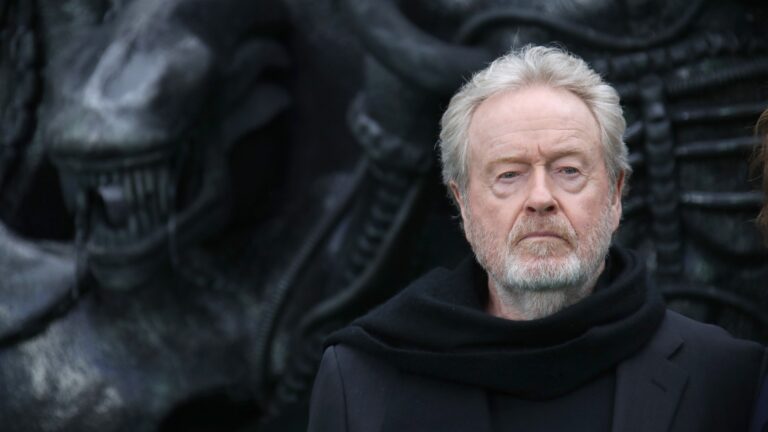
After a year of what seem to be studio directors with their own flair that get enough credibility to do whatever they want, Ryan and Jay tackle the modern master of this directorial genre, Ridley Scott, aka The Riddler. Known for making some of the best films of all time, and some of the worst films in the modern era, the boys set out to discover just how good Scott is and if he is an auteur director like many of his generation, a journeyman, or somewhere in between.

Alien, 1979

Listen to our review below as heard on Extra Film.

Blade Runner, 1982

Listen to our review below as heard on Extra Film.

Legend, 1985

Listen to our review below as heard on Extra Film.

Thelma and Louise, 1991

Listen to our review below as heard on Extra Film.

Gladiator, 2000

Listen to our review below as heard on Extra Film.

Black Hawk Down, 2001

Listen to our review below as heard on Extra Film.

Kingdom of Heaven, 2005

Listen to our review below as heard on Extra Film.

American Gangster, 2007

Listen to our review below as heard on Extra Film.

The Counselor, 2013

Listen to our review below as heard on Extra Film.

Be Gay, Do Crime: A look back at ‘Swoon’, ‘The Living End’, and ‘Bound’

Queerness has always been a part of motion pictures, only the ways in which it has historically been portrayed has varied from decade-to-decade over the past 130 years. Those with insight to the pre-1927 silent film era will know that queer characters, be that homosexuals or “cross-dressers” served as subjects of amusement in American cinema, while being given actual dramatic stories across the pond in Europe. For a few years in the late 1920s and early 1930s, gay male characters were a constant presence on screen in the form of the “Sissy” archetype, that is: effeminate, non-sexual, and non-threatening. Soon, even this meager representation would go the way of the Silents. Once the Hays Code, a series of rules set to establish “upstanding moral values” in American cinema, banned any instance of overtly homosexual characters, queers on screen were offered one alternative: a life of crime.

The Hays code could not ban the actions of queer people behind the scenes, and many writers, directors, and even actors, would devise ways to present a queer sensibility on film, whether through aesthetics or characters. Unfortunately, those characters were forced into the dark corners of society, threatening our clean-cut heroes and the heteronormative way of life, as the only way they were allowed to exist on screen is if they were portrayed as outright villains, destined for retribution by the film’s end. Queer-coded characters of this sort were often portrayed as social cast-outs, overly concerned with their appearance, and tricky in their actions and dialogue. Male queer characters often had an air of snobbery, and would sometimes obsess over a female character as if to covet their unattainable femininity (Waldo Lydecker, Laura; Joel Cairo, The Maltese Falcon; Addison DeWitt, All About Eve). Lesbian coded characters would similarly desire to “obtain” a female protagonist in an almost psychosexual manner, and would dress and present themselves completely outside the norm of female sexuality (Mrs. Danvers, Rebecca; Eve Harrington, All About Eve; Miss Holloway, The Uninvited).

Once the Hays Code lost most of its power by the early 1960s, film directors were able to make direct allusions to homosexuality, though still in reflection of audience’s ignorance and fear. While some underground queer filmmakers explored the complexities of gay living in the latter half of the 20th century, the mainstream still presented gay, lesbian, or transgender characters either continued being social deviants, or were subject to immense tragedy (The Crying Game, Cruising, The Boys in the Band, Dressed to Kill, Midnight Cowboy). 

By the late 1980s, when the AIDS crisis was gripping America and setting hostility towards gay people at an all-time high, queer filmmakers decided to take their own stories into their own hands. Film critics B. Ruby Rich first coined the term “New Queer Cinema” in Sight & Sound in 1992, referring to a newfound trend of independent gay cinema sweeping American film festivals. Many of these films existed in conversation with the past century of queer portrayals on film, turning the last century of gay-villainy on its head by directly linking their character’s sexuality to their criminal behaviour as a sort of meta-commentary on Hollywood’s complicated relationship with its gay characters and audiences. In her article, Rich refers to two films, Swoon and The Living End, which represent a central tenet of New Queer Cinema: be gay, do crime.

Both Swoon and The Living End have obvious historic cinematic influence. In 1924, the murder trial of Nathan Leopold and Richard Loeb gripped the nation for its depravity and intrigue. While the basis in 1948 for Alfred Hitchcock’s Rope (based on the 1929 play of the same name), the true story of the grisly murder of a young boy in Chicago is far more gruesome (though I’ll spare you the details). Filmed in black and white, director Tom Kalin blends the aesthetics of the 1920s with an atemporal feeling of modernity. In addition to the obsession of planning “the perfect murder” Halin focuses on the boys’ obsession with one another, which took the form of a bizarre master/servant relationship that allowed the two men to egg each other on into this horrific crime. The real life, highly publicized trial exposed much of America to a type of psychological criminality, and sexuality, that they had never before witnessed. This would only contribute to the false, widely-held notion that queer people are inherently villainous, containing overt parallels to the AIDS crisis during which the film was made, when queer persons, especially gay men, were made villains by their mere existence.  

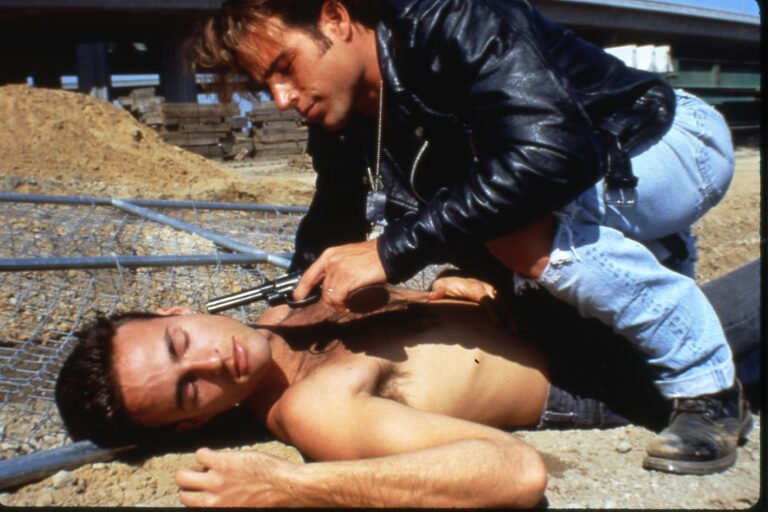
Departing from the world of the aesthete, the educated, the refined, we have Gregg Araki’s gay criminal road trip movie: The Living End, starring Mike Dytri and Craig Gilmore as two very different men, one law-abiding and one a rebel, each with a recent HIV diagnosis, and both with their own societal frustrations. The third feature film from Araki, it contains heavy influence from 1960s exploitation films with the directors signature nihilistic touch. Like Swoon, it recognizes the type casting of queer persons as villains, and turns it up to eleven. Frustrated by their lot in life, the two men decide if society is going to see them as a pair of villains, then they might as well become one. The film, and the characters, disregard the natural order of things, leading to eighty minutes of chaos, anger, and raising hell.

Four years after Rich’s original article, the Wachowski sisters became a part of the NQC trend (although with decidedly more mainstream distribution) with the neo-noir Bound, starring Jennifer Tilly as Violet, a mob moll and Gina Gershon as Corky, a tough ex-convict, who team up to scam Violet’s boyfriend out of a couple million dollars. Taking a hint from film noirs of the 1940s and 1950s, the film is shadowy, sexy, messy, and intentionally confusing. Violet and Corky see one another as an escape from their less than stellar situations. In this case, like Thelma & Louise flying off of a cliff to escape the grips of the patriarchy, Violet and Corky’s queerness is their liberation. 

These three films, as well as a great deal of other queer cinema titles, demonstrate through self-awareness and unconventional cinematic techniques the paradoxical queer desire to acclimate to normative society while being systematically eliminated by it.  Given that during Hollywood’s heyday, being gay was a crime in itself, the conscious portrayal of queer criminality by queer directors the opportunity to reconstruct a narrative of oppression and invited audiences to reconsider a century of nostalgia.