Director: Peter Farrelly Writers: Nick Vallelonga, Brian Hayes Currie Stars: Viggo Mortensen, Mahershala Ali, Linda Cardellini
Synopsis: A working-class Italian-American bouncer becomes the driver of an African-American classical pianist on a tour of venues through the 1960s American South.
[/info]
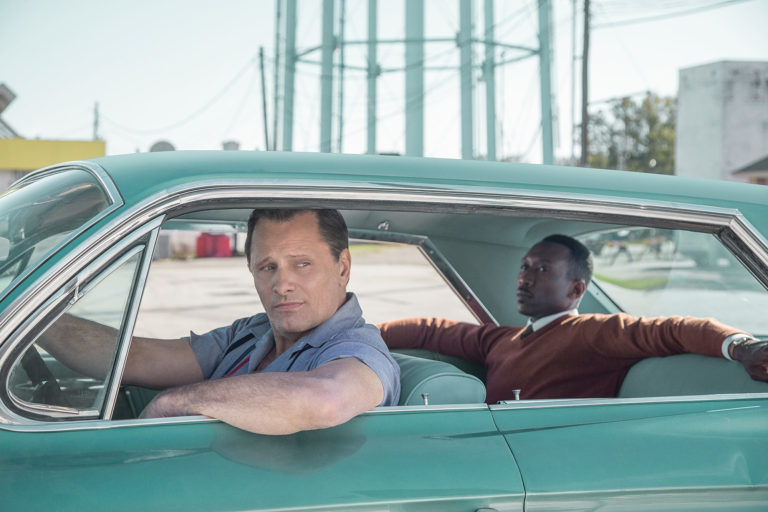
The word crowd-pleaser is used almost every single Oscar season to describe films that work more with audiences than critics and thus could become a contender on word of mouth, box office, and audiences falling in love with a movie “moving story. Films like Darkest Hour, Hidden Figures, The Help are examples of films from this modern era along with films like Forrest Gump and Driving Ms. Daisy being examples of films that were mainly crowd-pleasers that went on to win Best Picture. And since its win of the Audience Award at the Toronto International Film Festival, Peter Farrelly’s Green Book has become that crowd-pleaser in the awards seasons for being a light, entertaining film that takes its audience back not only to a different time on screen but a different time in film history when films like Green Book were made. Now some may find crowd-pleasers or lighter films to be enjoyable and fun and I do too but they also have to serve a purpose. And while there is a hand full of moments in Green Book that I enjoyed, there are a lot of things with this film that made me question in 2018 how it made the final script, let alone the final cut.
The film, set in the 1960’s, follows Tony Vallelonga (Viggo Mortensen), an Italian-American who lives with his family in New York City as a bouncer for various nightclubs in the city. When the nightclub he is working at closes for repairs, he inquiries about taking a job being a driver for a world renowned classical pianist Doctor Don Shirley (Mahershala Ali) while he is embarking on a concert tour through the Deep South. Tony is given the job but the only reason Shirley hires Tony is because of the word of mouth that he hears about him around town. But Shirley doesn’t trust him because Tony is, much like most of his friends and family in their life, is a prejudice man and does have a problem with African Americans. So, as you can expect, they are opposites at the beginning of the film, with each can’t standing each other and thus leads me to wonder why Doc Shirley didn’t hire someone else to drive him. And as the films plays on, and the deeper they go into the South, the more they become closer as human beings and by the end become friends.
Green Books problems do not lie on the performances of Mortensen and Ali, who give charming and engaging performances within a weak script. Mortensen’s Tony is not a likeable guy and doesn’t say likeable things throughout the film but there are moments throughout the film where he does show moments of true care for Ali’s Shirley and we can see somewhat of a change within his character, though it comes and go because doesn’t understand how to actually build up a friendship. And while his accent is a thick over the top, stereotypical Italian accent and takes some adjusting to get used to it, it starts to grow on you just like he grows on Shirley. But while Viggo is good, it is Ali that gives the best performance of the film as Shirley, whose shell is cracked open by Tony and he lets this unlikeable character into his life. Shirley has problems with loneliness, perfectionism and drinking that are vaguely explained throughout the film, but what we can gather is that he is someone that doesn’t know where he belongs, and Ali is able to take all of those emotions and things that aren’t given to him by Farrelly and the other writers and makes this character sympathetic and lovable at the same time. The only other performance that is in this film that makes true impact is Linda Cardellini, who plays Tony’s wife Dolores but we only ever see her at the beginning for a short amount of time and then in flashbacks of the letters that Shirley helps Tony right throughout the film to send back home, which are charming scenes.
But beyond the performances, the rest of the film is a bit of a mess. The direction of Peter Farrelly is safe and sophomoric at times, with scenes looking nice at times to Hallmark movie of the week at other times. The editing and tone of the film is all over the place, and the film can’t seem to figure out whether it wants to be a film about race in America or about these two men and their friendship. What we are given is a half-ass attempt of both and neither are fully examined thoroughly enough, leaving the actors to have to carry a lot of the burden of filling in wholes and bringing charm to characters that are thinly written and directed. The script by Farrelly, Nick Vallelonga (Tony’s son) and Brian Hayes Currie feels like a script that could have used a significant rewrite, and tried to give more of balanced look at these two men, giving Doc Shirley the same amount of respect in tell his like they did with telling Tony’s story. Doc Shirley is the more interesting character but we are given very little into his story at times that its hard to tell just how famous or how much of a genius he is given that this film is devoted to Tony’s perspective of their memorable trip.
The score and editing are not memorable at all, with some scenes just feeling out of place, and a soundtrack that feels too on the nose at times. Like said before, Mortensen and Ali carry this film heavily but that is not surprising considering that they are veteran actors that I like a lot and have carried films much better than this before. But two solid performances can’t save a film that is messy, unfocused, one sided and doesn’t really know what it wants to say about anything.
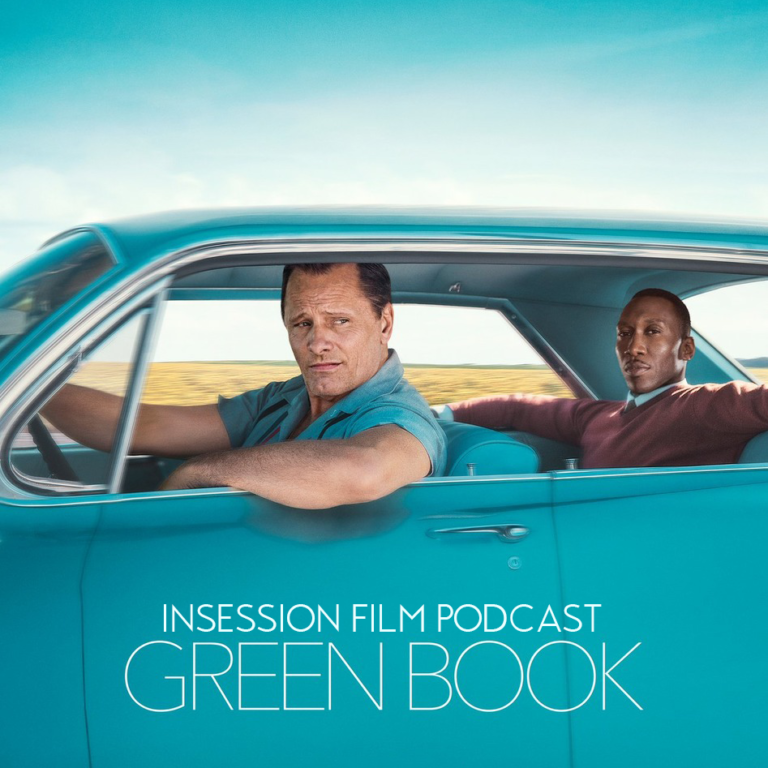
This week on the InSession Film Podcast: Extra Film segment, Jay and Ryan talk about the winner of the People’s Choice Award at the 2018 Toronto International Film Festival, Green Book. Unexpectedly, Peter Farrelly finds himself in the Oscar conversation, but is the film worthy of such praise? Let’s just say that Ryan and Jay have some different opinions.
In the second half of the show, Brendan joins Ryan to discuss A Private War, the Rosamund Pike showcase that has whispers of Oscar, in its own right. Pike has probably been one of the more underused actresses in the business since her breakout role in Gone Girl, and it is great to see her headlining an acclaimed film, again. Can the rest of the film live up to the performance of its lead?
Listen to the show and let us know what you think about both films in the comment section below. Thanks for listening!
– Movie Review: Green Book (4:46) Director: Peter Farrelly Writer: Peter Farrelly, Brian Hayes Currie, Nick Vallelonga Stars: Viggo Mortensen, Mahershala Ali, Linda Cardellini
– Movie Review: A Private War (39:50) Director: Matthew Heineman Writer: Arash Amel (Based on the article by Marie Brenner) Stars: Rosamund Pike, Jamie Dornan, Tom Hollander, Stanley Tucci
We try to make this the best movie podcast we possibly can and we hope you enjoy them. Subscribe today on iTunes, Spotfiy or Stitcher, and please leave us a review on iTunes. You can also find us on Soundcloud, PlayerFM and TuneIn Radio as well. We really appreciate all your support of the InSession Film Podcast.
To hear this Extra Film episode and everything else we do, download our apps on the Amazon Market for Android and the Podcast Box app on IOS devices. The mobile app covers all of our main shows, bonus podcast’s and everything else relating to the InSession Film Podcast. Thanks for your wonderful support and listening to our show. It means the world to us!
Director: Steven Caple Jr. Writers: Cheo Hodari Coker (story by), Sascha Penn (story by), Sylvester Stallone (screenplay by), Juel Taylor (screenplay by) Stars: Michael B. Jordan, Sylvester Stallone, Tessa Thompson
Synopsis: Under the tutelage of Rocky Balboa, light heavyweight contender Adonis Creed faces off against Viktor Drago, son of Ivan Drago.
[/info]
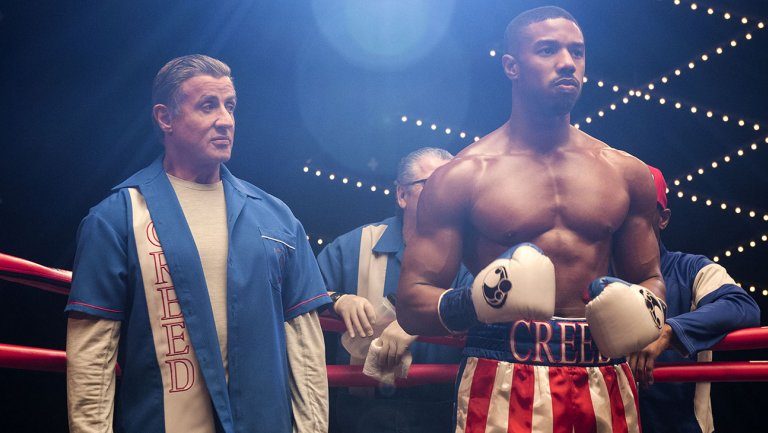
Creed II, a herculean task brilliantly and masterfully crafted by Steven Caple Jr. and an incredible cast, is as much a sequel to Creed as it is to Rocky IV. The difficulty here is not the alienation of Creed fans, although Ryan Coogler’s surprise 2015 hit left a new generation wanting and expecting the same heart, soul, and fight; the real challenge comes when trying to satisfy entrenched Rocky franchise fans. Not only must the filmmakers add to Adonis Johnson’s (Michael B. Jordan) own legacy as set forth in Creed, they also decided to bear the weight of one of the most popular installments of the Rocky series, Rocky IV. This compounds the drama and increases the stakes as personal and professional adversity stalks every character that graces the screen. How will it all play out? The answer is blatantly obvious, as this is after all a Rocky-styled formula. However, Mr. Caple Jr. manages to sneak in a few surprises that hit the audience in all the soft spots, thus creating a deeper, more intriguing look into the hearts and souls of characters both young and old.
Adonis Johnson has embraced the Creed name. He has accepted his father, the late Apollo Creed’s, legacy and is hellbent on igniting his own. After a brief but defining fight, Adonis becomes the new Light-Heavyweight Champion of the World and does so on his own terms. However, a new opponent emerges, the raw and stoic Viktor Drago (Florian Munteanu) who is trained by his father, Ivan Drago (Dolph Lundgren). The name Drago should instill both nostalgia and fear in the minds of Rocky fans, as Ivan Drago is responsible for the death of Adonis’ father, Apollo, as seen in Rocky IV. So, caught between continuing his own story and fighting for his father’s legacy, Adonis steps into the ring with Viktor and the results are catastrophic. His journey back is littered with ups and downs that try his soul and push him to be a better person, not just a better man. Aiding him along the way is his mentor, Rocky Balboa (Sylvester Stallone), whose character continues to grow, despite being introduced over forty years ago. Rocky, speaking from experience and tragedy, pleads with Adonis not to take the bait and fight Viktor. Having held Apollo in his arms as he passed has always been a burden of guilt that Rocky has had to carry for decades. Creed II delicately pulls the curtain back on the events that followed the over-the-top 80s-era Rocky IV. We see the broken man that Ivan Drago has become and understand that his loss was greater than the results of a boxing match three decades ago. Having seen that fight through star-spangled glasses, American audiences were treated to a perceived winning of the cold war, but in the fictional filmic world of the Rocky franchise, Ivan Drago lost everything. Now, his son is the heir-apparent to Russian boxing, and Ivan selfishly sees Viktor as his ticket back to the table.
Adonis, newly engaged to Bianca (Tessa Thompson) as well as being a new father, must step out of the shadow of his own father and decide how he wants his legacy to play out. With the help of Rocky, his mother, and Bianca can he summon the heart, soul, and fight required to vanquish his enemy? Well, if you’ve seen a Rocky movie before, I assume you know the answer. And herein lies the trouble with Creed II. We’ve seen this story play out numerous times. If you are a fan of this franchise, you expect certain results. I believe that the filmmakers gleefully play with this assumption. This allows them a bit of slack when molding the characters and building on their development. Granted, on the surface Creed II is another boxing film where the title character must face his own adversity to win in the ring. But I would argue that Creed II is slightly more than that. It is a film about legacy and redemption. It is a film about fathers and sons. It is a film about soul and spirit overcoming hate and revenge. Adonis’ decisions become his own, whereas Viktor’s decisions are those of his father. The dynamic between the two father and son duos mirror one another. Apollo’s hubris is what got him killed, and if Adonis does not wish to follow his father to the grave, he must fight for himself and not his father’s legacy. On the other side, Viktor must realize that his father is using him to regain his own legacy, even if it means Viktor might have his legacy ended before it begins. This leads the audience to a third father-son relationship, that of Rocky and his son Robert. As Rocky witnesses the power struggle between fathers and sons in the film, he steps back and wonders what he can do to repair his relationship with his estranged son.
Yes, Creed II is a boxing film. Yes, it is a story that we have seen played out at least seven previous times. But there is so much more under the surface, and that is where Creed II shines. It shines in the brilliant development of flawed characters. It shines in the performances of talented actors (Jordan and Thompson are immensely charismatic). It shines a light into that which is dark and exposes these characters as human beings who struggle with the challenges set forth before them. Overall, Creed II is a more than adequate follow-up to 2015’s Creed, but even more than that it works extremely well as a compendium to Rocky IV. Navigating the nostalgia and reverence for Rocky IV, Creed II walks the tightrope and rarely falters.
On Episode 4 of Chasing the Gold, Ryan is joined by Matt Neglia from Next Best Picture and Ian Boolocklock to discuss the 34th Independent Spirit Awards nominations that came out last week. The guys also discuss who they would like to see host this year’s Oscars.
This was a really fun show. Matt and Ian were great guests who added some great insight into the Independent Spirit Awards and what this year’s nominations mean for the Oscars.
On that note, have fun with this week’s Chasing the Gold and let us know what you think in the comment section below. Thanks for listening!
We try to make this the best movie podcast we possibly can and we hope you enjoy them. Subscribe today on iTunes, Spotfiy or Stitcher, and please leave us a review on iTunes. You can also find us on Soundcloud, PlayerFM and TuneIn Radio as well. We really appreciate all your support of the InSession Film Podcast.
To hear this Extra Film episode and everything else we do, download our apps on the Amazon Market for Android and the Podcast Box app on IOS devices. The mobile app covers all of our main shows, bonus podcast’s and everything else relating to the InSession Film Podcast. Thanks for your wonderful support and listening to our show. It means the world to us!
[divider]
Help Support The InSession Film Podcast
If you want to help support us, we would greatly appreciate it! For more info, CLICK HERE.
Happy Coen brothers week everyone! If don’t know already, we are big fans of the Coen brothers and their latest film, The Ballad of Buster Scruggs, hit Netflix over the weekend. So, we are excited and we’ll be diving into that film on Episode 301 before we get into our celebration shenanigans. If you’ve seen the film, you’ll know that it’s not your typical narrative feature, but rather an anthology made up of six different segments.
Using that as inspiration for our poll this week, which segment is your favorite? Vote now!
This week for our Episode 300 Bonus Content, JD and Brendan offer their thoughts on Orson Welles’ The Other Side of the Wind after missing out on Extra Film this last week.
[divider]
HELP SUPPORT THE SHOW
We offer our bonus content for free, but we do encourage and appreciate a small donation of $0.99 as a way to help support the show. Click on the PayPal button below to donate and thanks so much for your support. You can also hear all of our Bonus Content via our mobile apps. See the information at the bottom of the post for more details.
[divider]
Mobile Apps!
Listen to all of our bonus content on our apps for just a one-time fee! Whether you have an iPhone, Android or Windows phone, our apps are available in many different ways that is convenient for you. With our mobile app, not only can you listen to all of our bonus content, but our main shows and our Extra Film podcasts as well. Click here for more info!
If you don’t want to purchase our bonus content, but still want to support us, there are other you can help us out. Click here for more info.
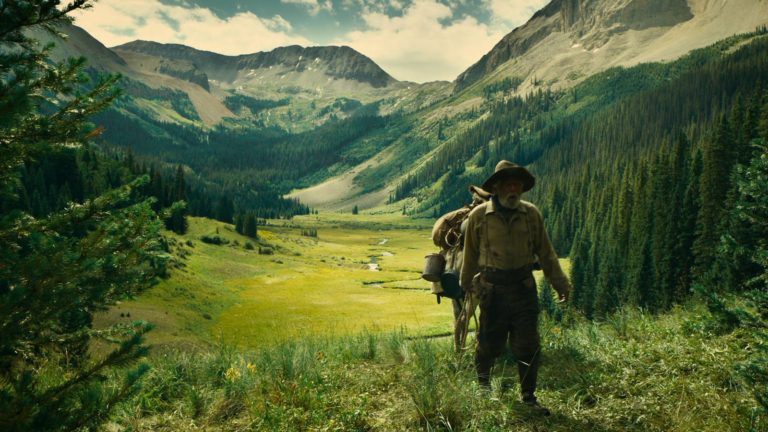
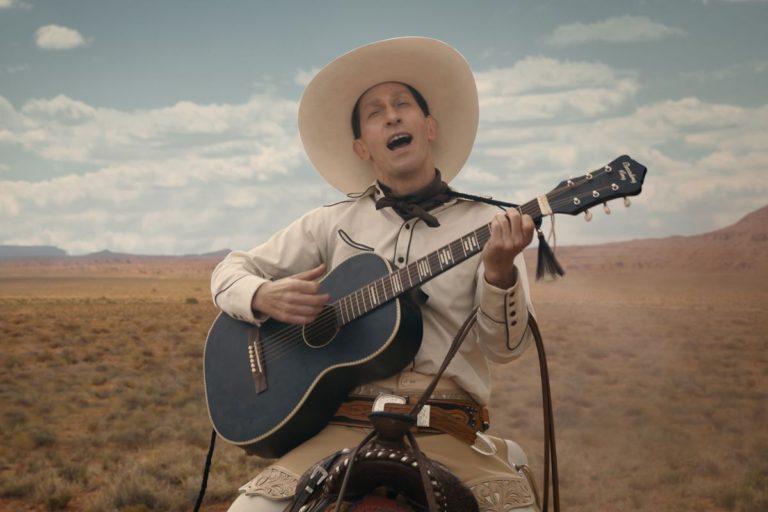
Director: Ethan Coen, Joel Coen Writers: Ethan Coen, Joel Coen Stars: Tim Blake Nelson, James Franco, Tom Waits, Liam Neeson, Zoe Kazan
Synopsis: An anthology film comprised of six stories, each dealing with a different aspect of life in the Old West.
[/info]
Life is uncertain. Bad things happen that cannot be explained. Our lives are not always fair. In fact, they rarely ever are.
These are pillars of the Coen Brothers’ artistic expressions and they have found the perfect canvas in the new film from the dynamic duo on Netflix, The Ballad of Buster Scruggs.
That’s not to say that this is the best Coen Brothers film or even in their top tier. Their filmography is so legendary that they’ve made it hard on themselves to even crack their own Top Ten. I ultimately think it will hold up quite well, but now is not the time to argue on where this film lands compared to their others. Now is the time to relish in the fact that this film even exists.
There have been some broad conversations on Film Twitter and among cinephiles lately about the rightful place that Netflix holds. On the one hand, the streaming giant is putting out films (like Buster Scruggs) that might never have seen the light of day otherwise. On the other hand, these films are routinely given just a token theatrical release, meaning that most fans will never see them on the big screen.
While I will agree with the notion that the theatrical experience is premium and should be protected and preserved, I also understand that not everyone is able to go to the theater to see every movie that comes out. For that reason, I’m thankful that Netflix is releasing films like Buster Scruggs so that they will at least be seen.
And this is certainly a film that demands to be seen.
The Coens are famous for their ability to create memorable characters. In fact, I think they are the best writer/directors we have working today in that regard (sorry, Quentin Tarantino). They find ingenious ways to infuse their dialogue with folksy wisdom and quotable proverbs. It makes their particular brand of moviemaking the perfect companion for an anthology film such as this – one that invites character after character before quickly dispatching them.
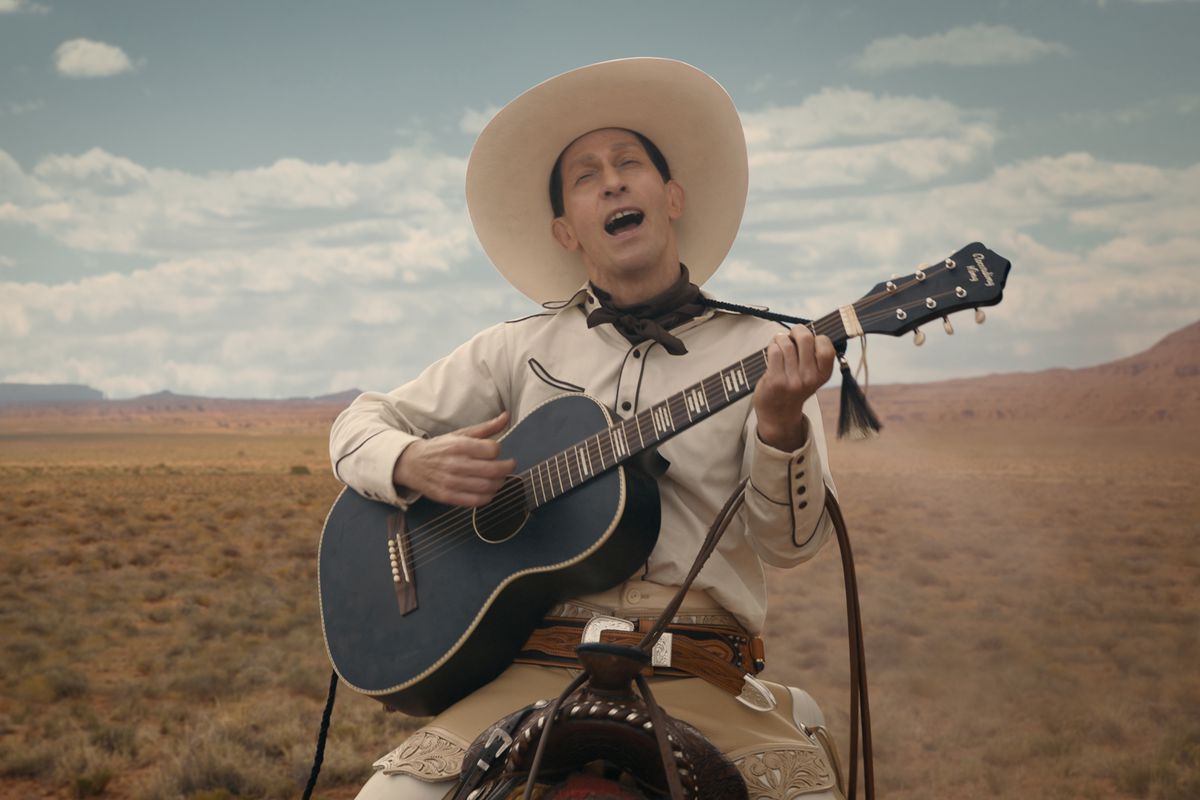
There are six stories within this film – a singing sharpshooter, a thief, an impresario and his young artist, a prospector, a young woman traveling with a group on the Oregon Trail, and five members of varying societal classes in a stagecoach. Each story is told through a storybook with the title The Ballad of Buster Scruggs and Other Tales of the American Frontier. We see a hand turning the pages of the book and opening up to each section with a color plate illustration of the story we are about to watch.
Each story shows a different side of the American western frontier. The Coens have routinely turned to The West for their yarns and tall tales, and they have had great success doing so. Maybe that is because The Wild West offers the necessary expanse of opportunity to match their seemingly endless amounts of creativity.
While the film’s writing is certainly at the level of excellence you’d expect from Joel and Ethan Coen (it won the Golden Osella Award for Best Screenplay at the Venice Film Festival where it premiered), its other technical elements are not far behind, if at all. This is a beautiful film, with gorgeous vistas of the American Frontier. Bruno Delbonnel (who worked with the Coens on Inside Llewyn Davis) worked as the DP on the film, and he finds striking ways to visually support the narratives that the Coens weave in and out of.
Each one of the six stories in this anthology collection has its own merits. I was struck in various ways by each of them. If I had to choose a favorite, I would probably go with the film’s final story, The Mortal Remains, which puts us in a stagecoach with five people from different classes and backgrounds. There are others that I found very nearly as good (All Gold Canyon and The Gal Who Got Rattled are close behind). First off, this is basically a writer’s dream – put a group of people together in a small space and have them captivate the audience with their words and actions. They’re all bunched together in a stagecoach. They can’t go anywhere. Yet their conversations are riveting and filled with the folksy wisdom we’ve come to love from the Coens. It also contains a quote that will go in the annals of Coen Brothers history right up there with “The Dude abides.” and all the “Darn tootin’s” from Fargo. One character repeatedly exclaims that “People are like ferrets!” and I knew the Coens had me wrapped around their fingers once more.
With each movie they release, the Coens continue to show their incredible gift for entertaining and conveying truth at the same time. Their characters are darkly funny and remind us of ourselves even if we’ve never been within 1,000 miles of Fort Laramie. We all know what it’s like to feel that life has given us a raw deal – that we’ve worked hard for nothing. We all know what it’s like to feel pain and regret. And we all know what it’s like to have doubts in the face of life’s cruel uncertainties. The Coens continually find new ways to unearth these universal truths through their wonderful characters. The Ballad of Buster Scruggs is a great example of this, and I look forward to watching it many more times.
This week on the InSession Film Podcast, comedian Brent Allen joins us to discuss Steve McQueen’s Widows and the latest installment from the Wizarding World in Fantastic Beasts: The Crimes of Grindelwald!
Big thanks to Brent for joining on the show once again. He’s one of our favorite guests and it’s always a pleasure to talk to him about movies. He’s especially a big Harry Potter fan, so this week’s show was particularly interesting for Brent to be here with us. Also note that we were supposed to review The Other Side of the Wind on this episode as well, but stay tuned for Bonus Content this week where we talk about that movie.
On that note, check out this week’s show and let us know what you think in the comment section. Thanks for listening and for supporting the InSession Film Podcast!
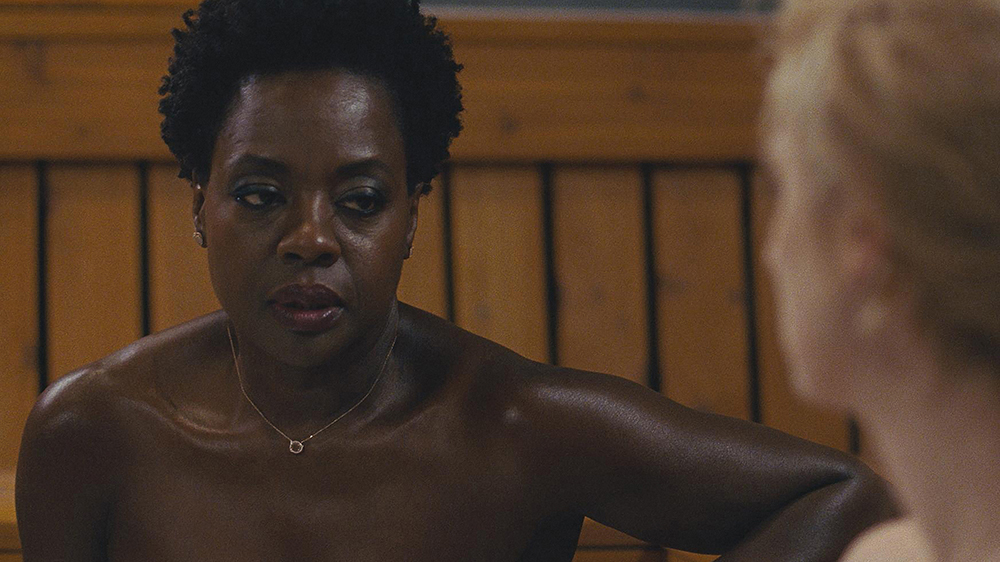
– Movie Review: Widows (6:33) Director: Steve McQueen Writer: Gillian Flynn, Steve McQueen Stars: Viola Davis, Michelle Rodriguez, Elizabeth Debicki, Liam Neeson
– Notes / The Other Side of the Wind (1:01:56)
As mentioned above, we had planned to discuss Orson Welles’ The Other Side of the Wind, but given the length of our two featured reviews this week, we needed to push it back to Bonus Content. So be on the lookout for that soon. We also mention here that we’ll be celebrating 300 episodes on Episode 301 next week, as there was just too much to get into this week.
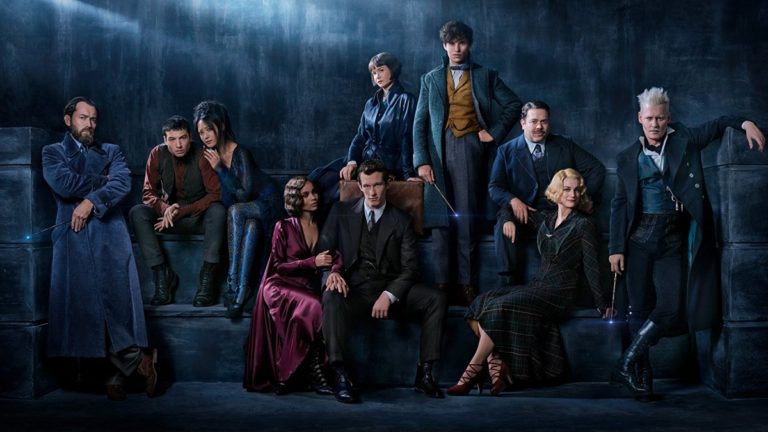
– Movie Review: Fantastic Beasts: The Crimes of Grindelwald (1:09:16) Director: David Yates Writer: J.K. Rowling Stars: Eddie Redmayne, Katherine Waterston, Dan Fogler, Johnny Depp, Jude Law
Main Review: The Ballad of Buster Scruggs
Top 3: Best Films of All-Time
[divider]
Help Support The InSession Film Podcast
If you want to help support us, there are several ways you can help us and we’d absolutely appreciate it. Every penny goes directly back into supporting the show and we are truly honored and grateful. Thanks for your support and for listening to the InSession Film Podcast!
Director: David Yates Writers: J.K. Rowling Stars: Eddie Redmayne, Katherine Waterston, Dan Fogler, Johnny Depp
Synopsis: The second installment of the “Fantastic Beasts” series set in J.K. Rowling’s Wizarding World featuring the adventures of magizoologist Newt Scamander.
[/info]
J.K. Rowling has been entertaining millions with her magical world of books and movies for twenty years. Her newest addition, The Fantastic Beasts series, is a more mature and widespread counterpart to the original Harry Potter stories, something that the first film established very well. I’ve always liked the Harry Potter universe but prefer this prequel and its characters more than the first series. I think it does a good job keeping the adult fans, who grew up with Harry Potter, enthralled with the wizarding world.
There’s so much to say about this movie that I don’t know where to begin. It picks up a few months after the end of the first one, set in Europe, lots of new adorable creatures, it’s less of a family film, J.K. Rowling changed things up a bit (probably to make you angry), and it may take a few viewings before you fully understand what’s going on.
The main antagonist, known from the first film, is Gellert Grindelwald (Johnny Depp). I thought Depp was amazing in this film. He doesn’t play an outright villain in a lot of films so I was interested to see what he’d do with Grindelwald’s character. He did not disappoint. He was charismatic and creepy and a perfect bad guy. Depp’s recent “current events” only add to his character’s creep factor, so I’m happy he wasn’t recast.
The returning characters were mostly good. Newt (Eddie Redmayne) is still his loveable, awkward self, and Joshua Shea is a perfect young Newt. It took me a few minutes to realize it was a different actor and not a CG’d younger Eddie Redmayne. Ezra Miller (Credence Barebone) is one of my new favorite actors. I’m very excited to see the combination of Miller and Depp in future films. (They have a total of five planned). I also loved the casting choice of Jude Law, who portrayed an excellent “Youngledore”. The rest of the cast was okay, I was disappointed at the lack of development with Tina, Jacob, and Queenie, and the plethora of random, confusing side characters.
The feel of the movie is dark and foreboding and that is solidified within the first two minutes of the film. The rise of Grindelwald’s character is eerily similar to historical events. The movie has its comedic relief moments (mostly Kowalski) but that dark cloud is always there. Also, I don’t know what version of Ancestry.com J.K. Rowling uses to keep these characters and family histories straight, someone with an advanced degree in genealogy must be involved. This film also includes subtle (and not so subtle) nods to things from the Harry Potter series, so be on the lookout for those.
Side note: Can we talk about how fabulous James Newton Howard’s score is? He took advantage of the addition of Dumbledore and Hogwarts to weave in hints of John Williams score from the original Harry Potter films. Colleen Atwood also does an awesome job with the costumes (I need ALL the shoes), but she has been dressing Johnny Depp for about 30 years so this probably wasn’t a challenge for her.
The movie isn’t perfect. It does throw a ton of information at you in a short time span. It took me an hour or two of deliberation to fully grasp what had happened in the movie. It’s also NOT A KIDS MOVIE. It drives me nuts to see five or six year olds in movies with mature themes or copious amounts of murder. It also had lots of fan-pandering (baby nifflers, I’m not mad) and obvious “meant for 3D” moments. I don’t like it when films have scenes that are awkward unless you’re seeing them in 3D, not everyone likes to see 3D movies. There’s also a huge moment at the end that is upsetting many die hard Potter fans. I won’t give it away, but I am among the people who are not happy about this plot development. I am hoping J.K. Rowling fixes this in later films.
Overall, Fantastic Beasts: Crimes of Grindelwald is a decent addition to J.K. Rowling’s universe. I think I still like the first one more. It’s obviously a bit of a filler film, which some people may not like, but I don’t have a problem with. Definitely will see it again and I’m excited to see how this series plays out and will be impatiently waiting for film number three. I suggest seeing it soon, I don’t know how long the internet can keep its mouth shut on some bombshell spoilers
This week on the InSession Film Podcast: Extra Film segment, Jay and Ryan talk about a 2018 release that started filming in the 1970’s from a director who died almost 35 years ago. That’s right, Netflix has given us a new film from acclaimed auteur Orson Welles! His film, The Other Side of the Wind, is an experimental look at the world of Hollywood. The film’s accompanying documentary, They’ll Love Me When I’m Dead (from director Morgan Neville), is also discussed, as it shines a light on Welles and the intentions of The Other Side of the Wind. Jay and Ryan’s opinions on the film differ, but the conversation brings out some interesting points about the film, itself, and what the film means to the film world, at large.
The guys then discuss Joel Edgerton’s Boy Erased, one of the major players leading up to the awards season. Do Jay and Ryan believe it deserves to be in the running for the big awards this year? Listen to the show and let us know what you htink about both films in the comment section below. Thanks for listening!
– Movie Review: The Other Side of the Wind () Director: Orson Welles Writer: Orson Welles, Oja Kodar Stars: John Huston, Oja Kodar, Peter Bogdanovich, Susan Strasberg
– Movie Review: Boy Erased () Director: Joel Edgerton Writer: Joel Edgerton (Based on the memoir by Garrard Conley) Stars: Lucas Hedges, Nicole Kidman, Russell Crowe, Joel Edgerton, Flea
We try to make this the best movie podcast we possibly can and we hope you enjoy them. Subscribe today on iTunes, Spotfiy or Stitcher, and please leave us a review on iTunes. You can also find us on Soundcloud, PlayerFM and TuneIn Radio as well. We really appreciate all your support of the InSession Film Podcast.
To hear this Extra Film episode and everything else we do, download our apps on the Amazon Market for Android and the Podcast Box app on IOS devices. The mobile app covers all of our main shows, bonus podcast’s and everything else relating to the InSession Film Podcast. Thanks for your wonderful support and listening to our show. It means the world to us!
Director: Julius Avery Writers: Billy Ray, Mark L. Smith Stars: Jovan Adepo, Wyatt Russell, Mathilde Ollivier
Synopsis: A small group of American soldiers find horror behind enemy lines on the eve of D-Day.
[/info]
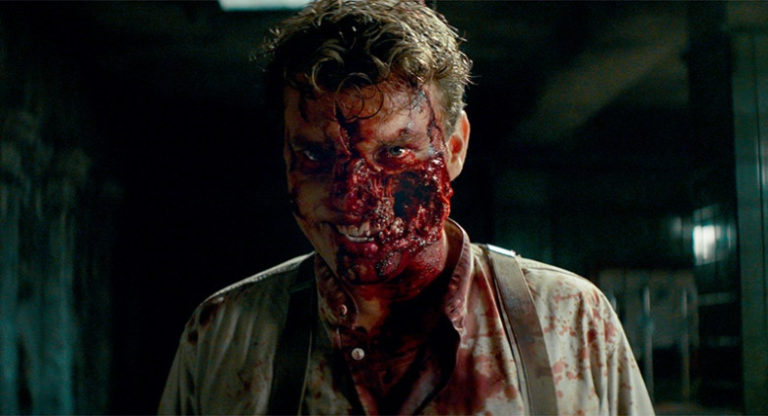
When I first heard rumors about Overlord, a new film from Julius Avery and produced by JJ Abrams, I was fairly excited. The film was initially rumored as a new piece to the Cloverfield universe which gave it a lot of attention. However, later a statement was released quelling those rumors and confirming that Overlord would indeed be a standalone film in no way be connected to Cloverfield. But by then the film had already captured my interest and I was still looking forward to a late night viewing. Mid-2018 the first trailer released and like most others, it heightened my excitement. The trailer looked like a wild chaotic ride of horror and fast-paced action. Unfortunately, though the film failed to capture the adrenaline rush I felt the trailer promised.
Overlord jumps off just how I imagined, a build-up of pulse-pounding tension that just explodes off the screen. It was a great start and I buckled up for the next 90 minutes. But immediately after this fast-paced opening, the film comes to a crawl and pretty much remains this way until the last 20 minutes. There is still some tension but very little action. This is my biggest gripe with Overlord, the pacing. Again referencing back to the trailer I had an expectation that this movie would be go-go-go with a lull here and there but instead, we got the opposite. This wouldn’t be a bad thing as there are plenty of great films that fit this profile, however, what Overlord doesn’t do well is fill in the gaps where the action is now void. If we are going to spend a lot more time alone with the characters I would expect a certain amount of backstory and character development. But aside from a few exceptions, we are given very little in regards to who these people are.
Don’t get me wrong, Overlord is not a bad film, the story is interesting and it will keep you engaged. The film does a good job of creating connections between the characters, there is an adorable bond between Tibbet (John Magaro) and a young boy Paul (Gianny Taufer), and enough is given for us to make sense of their actions. And outside of the science fiction aspect nothing in the film feels far-fetched, there are no “Why is he/she doing that?” moments that we find all too often in horror films. As a warning, there is a short scene involving a sexual assault that felt awkward and misplaced in the film. I felt like the scene could have been omitted or handled differently, as its only purpose is to move the story along and create tension between our heroes and the main antagonist. Aside from this though the film is an enjoyable experience with some decent performances.
I wasn’t familiar with any of Jovan Adepo’s work prior to Overlord but I found his performance as Boyce, the main character and audience surrogate, very satisfying however it is Mathilde Ollivier stole the spotlight. Her war-hardened no bullshit taking Chloe was a pleasure to watch and was the only character to really pop on-screen. In a film where character outlines really remained as sketches, Chloe is the only one we truly get a real feel for. We get a quick 30-second monologue from Boyce about his life prior to the war but that’s it, the remaining bulk of his time is spent scrambling about and appearing lost in the chaos going on around him. With Chloe through storytelling and some of her actions, we learn a little more about what is important to her and her place in the war. As a side note, Ollivier’s face seemed incredibly familiar but I couldn’t place from where and when. I browsed through her IMDB and was surprised to find Overlord was only her second full-length film. However, there are three other pending projects one titled “Untitled Female Driven WW II Spy Thriller” which just sounds exhilarating and I am looking forward to seeing more from her.
Overlord is a good movie but had potential to be much better and definitely more fun. If the film had better-implemented action and more monsters/mutants I would have probably been able to see past its shortcomings and just enjoy it as a popcorn flick. However, with the approach taken, we should have seen more in-depth characters and a stronger script. The final act although containing most of the meat also veered off towards campy sci-fi with a tacky and quite predictable villain. Overall ‘predictable’ is the best description for Overlord. Although it kept me entertained there was no point in time where the film really wowed me. The film is too safe in its execution and I feel like it could have really brought something to the screen we hadn’t seen in a long time. Instead, I spent the hour and a half just watching everything play out and by the time the credits were rolling I thought, “Cool.” and then left the theater. The film is worth the price of admission but if you can catch it at matinée pricing that would be ideal, just be sure to ignore the tone of the trailer going in or you might find yourself a little disappointed.
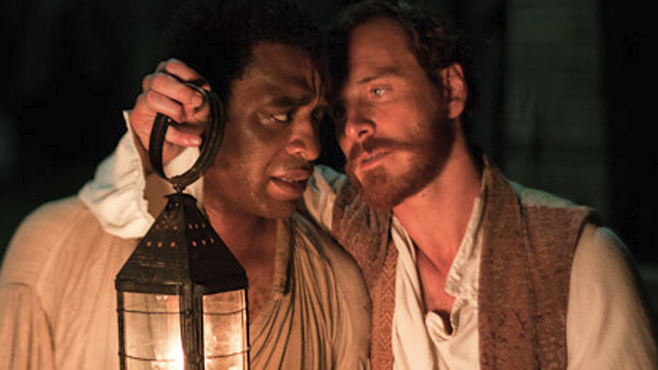
In honor of Steve McQueen’s upcoming Widows, his first feature since his Best Picture-winning 12 Years A Slave, it is time I’d write something a little more contemporary. It has been 10 years since he debuted his first full-length feature and, despite the power and brutality of his last two films, his first one, Hunger, is what struck me the hardest in terms of him as a visual filmmaker. The same goes for his lead actor, Michael Fassbinder, his editor, Joe Walker (Sicario, Arrival), and director of photography, Sean Bobbit (The Place Beyond The Pines, On Chesil Beach). What striking power we saw in his last two and we can expect in Widows all started 10 years ago and even beyond there.
Background
Hunger is set around the 1981 H-Block Maze Prison dirty protest, where members of the Irish Republican Army (IRA) imprisoned began a no-wash protest, refusing to bathe and shave, wear no clothes rather than prison clothes, and smeared the entire cells with their own human waste. They demand to get back their status as a political prisoner which was revoked five years earlier and new UK Prime Minister, Margret Thatcher, took the hardline against the IRA. (“Crime is crime is crime, it is not political,” she said.) Bobby Sands, serving prison time for possession of firearms, was the commanding IRA officer in H-Block and decided to lead a hunger strike, willing to even die for his cause.
For the British and Irish, it is an event that is always remembered, mainly by those who were alive and haunted by images of the protest and reactions, as McQueen was. It made reverberations even in the US with the Irish-American population and murals of the protesters (spoiler alert: 10, including Sands, died; Thatcher responded by saying, “He chose to take his own life. It was a choice that his organization did not allow to many of its victims.”) It also started a push for the nationalist Sinn Fein party to rely on elections rather than have their paramilitary faction take over.
The Image Of A Shithole
McQueen came from a visual art background, mainly using still photography and avant-garde short films in his work. The techniques he utilized transferred over into his full movie making, keeping dialogue at a minimum, with the exception of the turning point in the second half where Sands decides to go on the fateful hunger strike. First, you see the extent of the resistance by the strikers and how harshly the guards and riot police go in to break it up. When a new prisoner enters his cell naked and with only a blanket to cover himself, he sees his cellmate already smearing the walls with his shit. Later, when everyone is taken out so the cells can be cleaned, one cleaner is bemused to see on the wall a rendition of a maze, making a symbolic path to how the prisoners need to escape but can’t find their way out.
The brutality of the guards is obvious. Nothing is said; they grab them one-by-one, hold them down in a tub while cleaning and shaving them. Later, McQueen goes 360 with his camera as the prisoners are beaten and probed grotesquely without cutting away. But the shots are not always making the guards vicious and barbarous in their sadist ways; one guard leaves and starts crying from the constant roughs of the job and another is seen at the very start exiting his home and looking under his car for a possible bomb, reinforcing the viewers of the paranoia the British faced by the IRA at the time this was happening. (The Troubles, as it was called, lasted from 1968 to 1998, ending with the signing of the Good Friday Agreement.)
Philosophy Of Dying
The IRA was a predominately Catholic group fighting against the authoritarianism of a distrustful Protestant-based government. Murdering is not moral, but it is the only way they could make a statement in resisting the pressure by the British military. Killing one’s self is also not permitted, but when the backs are against the wall and one dares to challenge an authority like the new Prime Minister, the “Iron Lady,” as she was nicknamed, martyrdom by any means is the answer. The leads us to the most powerful, direct, and most talkative scene in the film. It is also one where nothing moves, yet it is the hardest scene a director could possibly film and challenges how long a take can be. With visual exposition comes Sands and a Catholic priest (played by Liam Cunningham) discussing, like a scene from an existential play, the value of human life.
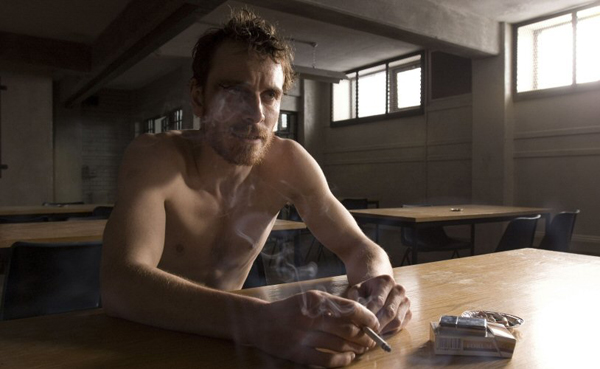
It is 17 minutes long to be exact on a medium-shot of Sands and the priest talking at a table smoking cigarettes and building up to the most highly political moment in the film. It only breaks when Sands gives a fable of a story from his childhood to justify his decision to gamble his entire life for the sake of a free, united Ireland. The discussion of what life means is as strong as any of Robert Bresson’s fables, or the monologue by Michael Stuhlberg to his son in Call Me By Your Name, and even the deeply philosophical voiceovers said in The Thin Red Line. The pain Fassbinder has to physically show then courtesy of a 900 calorie diet he followed for months to get to same malnourished state as Sands in his last two months is explicit on the screen. Naked, weak, and covered with body sores, it becomes an excruciating reminder that this was a true story and that, as rough as political protests may get, this form is among the harshest in such a dismal chapter of The Troubles.
A Cinematic Portrait Of A Consequential History
This is McQueen’s masterful stroke of work of what he’s done so far and I can hope to see again this November with Widows. Moving from the biographically graphic to the suspenseful is quite the transition, but I suspect McQueen, based on the trailer has already invoked the dark, ominous tone that has been present from Hunger. It is more dialogue-based, but McQueen has not strayed away from the visually rich he prides himself in doing with long takes. Having seen Hunger at least half a dozen times, it is impossible not to notice how McQueen makes every inch of the frame his own canvas in coloring the bleakness of the cells and the violence that ripped thousands of citizens in the conflict. The pain feels real and the final shots, the final breaths of someone was willing to take, drive in Hunger and the meaning of it all.
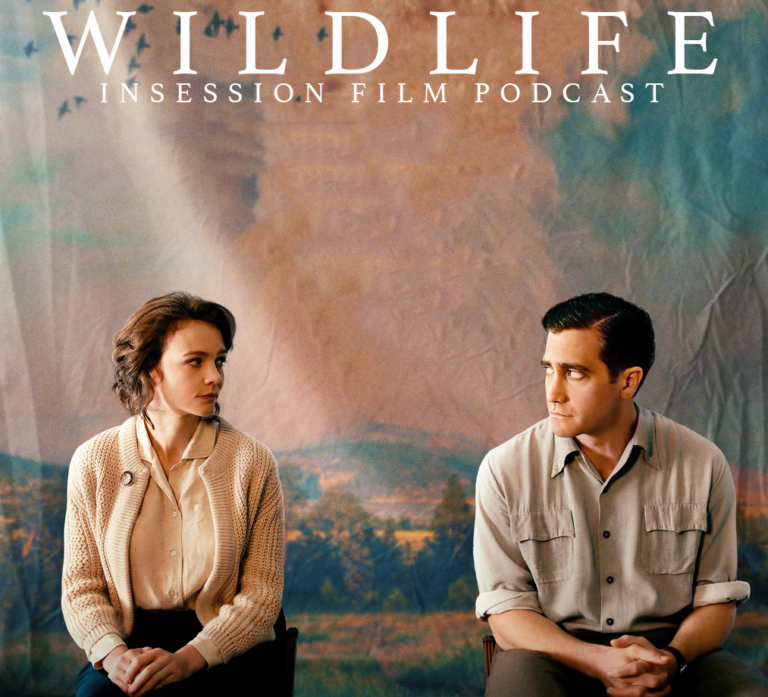
Director: Paul Dano Writers: Paul Dano, Zoe Kazan Stars: Jake Gyllenhaal, Carey Mulligan, Ed Oxenbould
Synopsis: A teenage boy must deal with his mother’s complicated responses after his father temporarily abandons them to take a menial and dangerous job.
[/info]
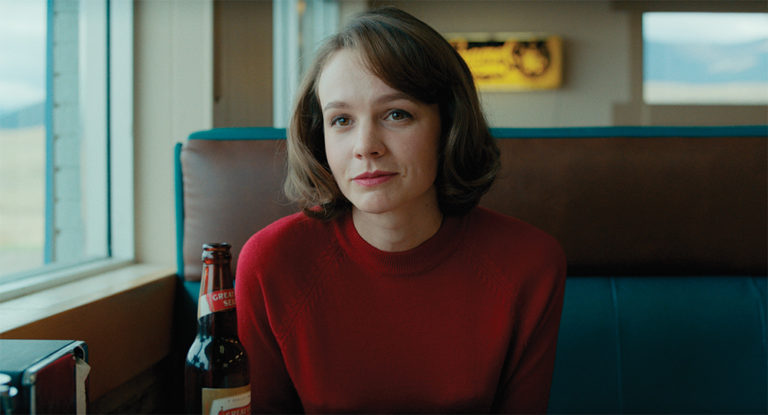
Paul Dano’s Wildlife is one of the most confident and efficiently told directorial debuts of the last few years. His craftsmanship is robustly perspicacious and intuitive, demonstrating just how much he learned from working with the likes of Paul Thomas Anderson, Denis Villeneuve, Steve McQueen and other notable directors in his career as an actor. He paces Wildlife deliberately, and perhaps that slow burn approach will be too serene for some, but everything as its place. Every line of dialogue, every edit, every frame, every camera movement has a specific purpose and it makes for a concise experience that never lacks in dramatic tension. At every turn, whether it be the conversations, the ambiguity of the performances, or even the film’s cinematography, every scene is essential to the story of this film and their unraveling. Wildlife may have all the bearings of a 1950’s melodrama, but thanks to Dano’s incisive control over every component, it’s anything but melodramatic.
Jerry (Jake Gyllenhall) and Jeanette (Carey Mulligan) live with their son Joe (Ed Exenbould) in Montana, after having just moved from Idaho. Jerry works at a Golf Club as an assistant. Jeanette doesn’t work at all despite being qualified for a few jobs. However, one day Jerry loses his job and it ignites a feud between the two as to what they were going to do next. Eventually Jerry finds a job working with the local firefighters to help stifle burning wildfires that pose a threat to their hometown. This does not go over well with Jeanette or Joe. Jerry feels, though, that this is something he needs to do and leaves until “winter” arrives.
Working in parallel with Dano’s direction is an understated, but powerful, script written by Dano and Zoe Kazan. It heavily leans into subtlety while also providing great detail and insight into the decisions made by these characters. In particular, there is a lot of nuance poured into Jerry and Jeanette’s actions as it relates to pride and the heavy consequences that come about when you’re unable to control it. This is especially pertinent because their marriage isn’t consumed with riches or materialism, in many ways their dignity is all that they have. Their home is modest, they don’t have a well-functioning TV, just an old-timey radio they listen to in the evenings after dinner, even their car is old-fashioned by 1960s standards (which is when this story takes place). So when their pride, especially Jerry’s, comes into question after he loses his gig at the Golf Club, he becomes distant and longs for something better, even if that takes him to dangerous places. “Why didn’t dad take his job back?” Joe asks at one point. Jeanette’s response? “Well, maybe his pride got hurt, that happens sometimes.” Dano and Kazan’s script has much to say about the uncertainty of masculine pride and its (perhaps unintended) consequences. Jeanette was an unassuming wife who did what her husband asked of her. She didn’t have a job despite being qualified, she made dinner, cleaned up while the boys listened to the radio, and supported Jerry when he lost his job. Jerry’s decision to leave forced her into a compromising circumstance, compelling her to make questionable choices in order to take care of her son. In the end, both of them do things that are arguably immoral, but Dano and Kazan do a great job of making them empathetic. There are affable reasons behind the dubiousness of their actions.
It’s in those ideas where the performances of this film shine. Jake Gyllenhaal does a great job of rendering a man whose pride is at stake. If he doesn’t do something extreme, he may lose his family, something Gyllenaal taps into that very well. Carey Mulligan is next level though. Her performance here may be the best of her career. Jeanette becomes a side effect of masculine pride and her detour into selfishness is poignant despite being questionable, something Mulligan emulates with diligent care and credence. For those same reasons, the sudden shift in mood in Jeanette is believable after Jerry leaves them. Ed Oxenbould is the concrete that stables everything though. He’s reserved through most of the film, but it’s mesmerizing how he quietly reverberates a vulnerable adolescent who simply longs for famliial togetherness. The tenderness of that final shot is evocative and very affecting, a moment that thrives on the shoulders of Oxenbould’s warm presence in the film.
That moment also works because of Dano’s direction. What’s perhaps the most striking about Wildlife is how he uses the camera to tell this story and elevate the themes underneath. For as much as he relies those captivating performances and subtle ambiguity, the visual storytelling within Diego Garcia’s cinematography beautifully compliments the work of his actors. The bus stop scene, the moment where Joe learns the truth about his mother, the stationary shot outside the Brinson’s home, the hillside view of the wildfires – all great scenes that use visual imagery to voice the concerns of our characters and develop the boiling emotions surrounding the story of this family. As far as directorial debuts go, this is up there with Bo Burnham, Trey Edward Shultz, Alex Garland, Greta Gerwig, Jordan Peele, and Robert Eggers as one of the best we’ve seen in recent years.
Wildlife may not be for everyone due to its patient approach, but if you’re willing to embrace its energy, it’s a rich experience that heartbreakingly looks at the costs of pride, the lengths parents are willing to go for financial stability and ultimately the longing for familial togetherness from the perspective of adolescence.
Episode 300 is going to be a big show this weekend. And no, not because it’s our 300th episode (although that’s worth celebrating), but rather we are talking about one of the best films of the year in Steve McQueen’s Widows. McQueen is a filmmaker we love here at InSession Film and his latest does nothing to upend that tradition. That said, we thought it would be fun to use him as inspiration for our poll this week.
This week on the InSession Film Podcast, we buckle down with three reviews as we discuss Wildlife, Can You Ever Forgive Me? and Bohemian Rhapsody!
It’s that time of year. Awards season is ramping up, great movies are being released in bunches and that means we have a lot to talk about. So, there is no Top 3 this week but we hope you enjoy the many thoughts we have on the aforementioned films above. Bohemian Rhapsody is especially interesting given Brendan’s passionate fandom of Queen and what the film does in reflecting their history – you don’t want to miss that on this week’s episode.
On that note, check out this week’s show and let us know what you think in the comment section. Thanks for listening and for supporting the InSession Film Podcast!
– Movie Review: Wildlife (4:04) Director: Paul Dano Writer: Paul Dano, Zoe Kazan Stars: Jake Gyllenhaal, Carey Mulligan, Ed Oxenbould
– Notes / Bohemian Rhapsody (40:47)
As mentioned above, while Bohemian Rhapsody lacks in quality compared to the other films talked about on this episode, we still had some ardent thoughts on the film that we needed to purge. It was a catharsis for us and we hope it’s fun to listen to as a result. We also give a few brief thoughts on how we’ll celebrate Episode 300.
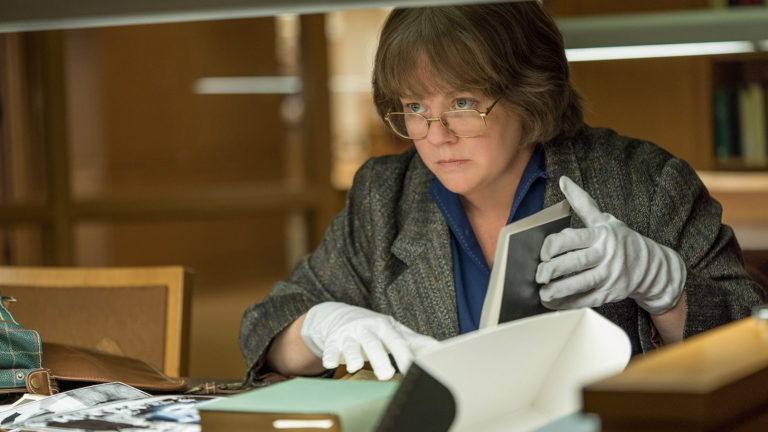
– Movie Review: Can You Ever Forgive Me? (1:00:10) Director: Marielle Heller Writer: Nicole Holofcener, Jeff Whitty Stars: Melissa McCarthy, Richard E. Grant, Dolly Wells
Main Review: Widows / Fantastic Beasts: The Crimes of Grindelwald
Top 3: N/A
[divider]
Help Support The InSession Film Podcast
If you want to help support us, there are several ways you can help us and we’d absolutely appreciate it. Every penny goes directly back into supporting the show and we are truly honored and grateful. Thanks for your support and for listening to the InSession Film Podcast!
Director: Marielle Heller Writers: Nicole Holofcener, Jeff Whitty Stars: Melissa McCarthy, Richard E. Grant, Dolly Wells
Synopsis: When Lee Israel falls out of step with current tastes, she turns her art form to deception. An adaptation of the memoir Can You Ever Forgive Me?, the true story of best-selling celebrity biographer Lee Israel.
[/info]
Can You Ever Forgive Me? is a movie I knew very little about before going into, other than it starred Melissa McCarthy in a serious role and that it was based on a true story, so it was a pretty easy sell. And, for the most part, this movie doesn’t disappoint. Despite being a period piece set within my lifetime, which is a relatively new experience and one that gives me mixed feels, I found this movie to be the perfect blend of enjoyable, relatable, interesting, and, at times, darkly humorous.
If I had to pick a weak spot for this movie, I would have to point to the script. I should be clear up front that just because it’s one of the weaker points of the movie overall does not mean that the script, in general, is bad. I thought the characters, particularly Melissa McCarthy’s Lee Israel, were very well developed and showed a well-crafted balance between extremes flaws and extreme relatability and likability and the characters had clear arcs and growth without being preachy. I also appreciate that Israel’s sexual orientation was apparent but was not a defining characteristic or a major plot point throughout the film. All that said, it did feel as if a few of the plot points were somewhat rushed and, at times, predictable and the script seemed to expect the majority of audiences to know more about literary history than is perhaps realistic. I also felt like the emotional journey of the characters involved could have been explored in much greater depth. Still, I would rate the script overall as a solid B, easily.
As for the positives, I’m always a sucker for comedians playing serious roles – even if the movie isn’t the greatest, the performance pretty much always is. And this movie is a great example of a comedian signing on to a pretty good script and elevating that script into something phenomenal. McCarthy’s performance is incredibly genuine and she truly gets lost in the part – there were several times throughout the movie that I forgot I was watching McCarthy. Appearance-wise, she was an interesting choice to portray Israel, but she disappears so thoroughly in the role and is easily the biggest reason why the character becomes so likeable despite her significant flaws. Richard E. Grant also gives an outstanding performance as Jack Hock, and the cast is full of fantastic actors giving knockout performances as secondary characters, as well. Personally, I think McCarthy is a shoe-in for the Oscars race and I’m rooting for her over some of the other more obvious frontrunners, though 2018 is proving to be a tight race in this regard.
Can You Ever Forgive Me? isn’t a perfect movie, by far, and it’s likely it will get lost in the Oscars race shuffle and quickly forgotten, but I hope that’s not the case. The acting is phenomenal, but it’s also an interesting, fresh, and, at times, grim take on the feel-good biopic genre and I thoroughly enjoyed it. Maybe it’s just that creative bone in my body that often feels broken relating to the script or maybe it’s just McCarthy doing her McCarthy thing and making this character so much more interesting and likeable than the script presents her, or maybe it’s just a gem of a movie that everyone should see. I guess you need to make that call for yourself, but regardless of the reason, I think there’s something here for most people to enjoy.
Director: Orson Welles Writers: Oja Kodar, Orson Welles Stars: John Huston, Oja Kodar, Peter Bogdanovich
Synopsis: A Hollywood director emerges from semi-exile with plans to complete work on an innovative motion picture.
[/info]
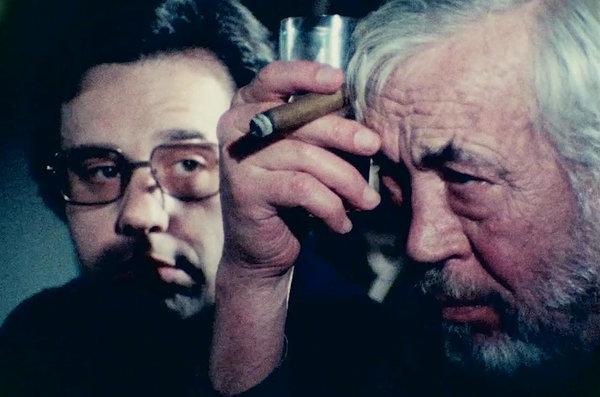
It is to be expected that a film which took over 40 years to make and was completed by multiple collaborators after the director’s death would be somewhat jumbled. But The Other Side of the Wind takes the word “jumbled” and goes far beyond. Were it not for the name of the fabled director, I might have written the film off early on. But the director of this film is of course the late Orson Welles and, as such, I can’t help but wonder if the jumbled mess is somehow intentional.
The film’s plot focuses on a fictional director named Jake Hannaford (played by John Huston – arguably the only person from film history who embodied the phrase “larger than life” more than Welles). Hannaford is a legendary relic from Hollywood history who has left America and now returned to create his masterpiece. If that sounds blatantly self-referential to Welles’s own life…well, that’s because it clearly is. Despite the fact that Welles denied this (his response to claims that the film was autobiographical can be seen in Netlix’s companion documentary They’ll Love Me When I’m Dead), one simply cannot deny the clear parallels between Welles and Hannaford. Welles, too, saw massive success before and during Hollywood’s Golden Age, only to be ground down by the studio system leaving us all to wonder what might have been. Welles himself left America to make some of his most critically-acclaimed post-Citizen Kane films. He then returned and painstakingly tried to finish his final film. Production began on The Other Side of the Wind in 1970, but Welles was never able to complete the film in his lifetime. He died in 1985.
The hype surrounding this film for cinephiles is almost too much to express. How often do you get the chance to see a new film from one of the greatest directors in movie history more than 30 years after his death? The fact that this film was finally completed and released is an astronomical achievement, and we should all thank Netflix for making such an incredible movie going experience a reality (even if they should release their films in theaters – but that’s a discussion for another time).
Having said all that, judging the film on its own merits, I don’t think The Other Side of the Wind really works.
The “movie within a movie” conceit is one that gives unique opportunities to consider the art of moviemaking itself. Think of Singin’ in the Rain, for instance. Here, I didn’t find the film to be in awe of the moviemaking experience, however. It seemed to be much more pessimistic in tone – focusing on all the people involved in making a film that can detract and damage it in some way. This is why I ultimately wonder whether the jumbled nature of the film was an artistic choice. Is this Welles’s way of showing us what the studio system did to his creative star power?
Even if that is the case, there simply aren’t enough character elements here for us to buy in to such a convoluted plot. I am of the mind that character comes before plot every time, so I’m willing to accept a film that is light on plot if the character elements still allow me a way into the story (I think Terrence Malick’s The Tree of Life is a good example of that). Here, I never really felt like I knew what was going on. I was confused and, ultimately, disinterested for much of the film. The technical components and visual elements are obviously well done. This is an Orson Welles film. But it left me wishing that things could have been different. Again, maybe that’s the point.
Hannaford repeatedly attempts to show his uncompleted film (also titled The Other Side of the Wind) to an audience, though technical issues continually thwart these attempts. There’s some really interesting commentary in there about the process of filmmaking and the physical components of films themselves. It reminded me of the sequences in Ingmar Bergman’s Persona where the film begins to burn and break apart. Though people put all their creative force into these films, they are fallible and temporary. Films can convey so much, and yet they are fleeting in some sense. Almost like a gust of wind.
It is clear to me that this film is the work of a man who had been beaten down creatively. He had given his whole life to the film industry, and I wonder how he felt about what he received in return. Many say that he created the greatest film ever made. It was his very first film. After that, his life amounted to living within his own shadow. Again, it is impossible not to draw parallels to this film.
I think this is a film that is worth seeing, even if only for its historical importance. (Though you should know that this is surely not a film for young audiences, with its large amounts of graphic nudity.) But the experience of watching it left me with a palpable sense of sadness. Sadness about the film itself, but an even deeper sadness about what became of Orson Welles.
This week on the InSession Film Podcast: Extra Film segment, JD and Ryan dish it out over Felix van Groeningen’s Beautiful Boy, starring Steve Carell and Timothée Chalamet, followed by a discussion by Jay and Ryan on David Mackenzie’s Outlaw King, starring Chris Pine.
Despite coming to the same conclusion on Beautiful Boy, JD and Ryan still find a way to squeeze an argument into their discussion, fueled with passion and frustration in equal measure. And with David Mackenzie now releasing Outlaw King in a tighter and more condensed cut (after its longer cut garnered some mixed to negative responses among the festival circuit), Jay and Ryan discuss whether it was even worth it in the first place.
Have fun with this week’s Extra Film segment and let us know what you think in the comment section below. Thanks for listening!
– Movie Review: Beautiful Boy (7:09) Director: Felix van Groeningen Writer: Luke Davies, Felix van Groeningen Stars: Steve Carell, Timothée Chalamet, Maura Tierney, Kaitlyn Dever, Amy Ryan
– Movie Review: Outlaw King (55:14) Director: David Mackenzie Writer: Bathsheba Doran, David Mackenzie, James MacInnes Stars: Chris Pine, Stephen Dillane, Rebecca Robin, Florence Pugh, Aaron Taylor-Johnson
We try to make this the best movie podcast we possibly can and we hope you enjoy them. Subscribe today on iTunes, Spotfiy or Stitcher, and please leave us a review on iTunes. You can also find us on Soundcloud, PlayerFM and TuneIn Radio as well. We really appreciate all your support of the InSession Film Podcast.
To hear this Extra Film episode and everything else we do, download our apps on the Amazon Market for Android and the Podcast Box app on IOS devices. The mobile app covers all of our main shows, bonus podcast’s and everything else relating to the InSession Film Podcast. Thanks for your wonderful support and listening to our show. It means the world to us!
[divider]
Help Support The InSession Film Podcast
If you want to help support us, we would greatly appreciate it! For more info, CLICK HERE.
I realize that you’re currently reading a music-themed article on a movie site, but don’t drowse off just yet. As the token musician of InSession Film, writing about music as it relates to film is out of personal necessity, and with the release of Bohemian Rhapsody, a kind of magic has aligned. Call it an excuse if you must, but this grants me permission to give in under pressure and play the game of dissecting one of my favorite bands and their stone cold crazy career. How many (killer) Queen references were you able to decipher in that opening paragraph? Don’t judge, just let me entertain you.
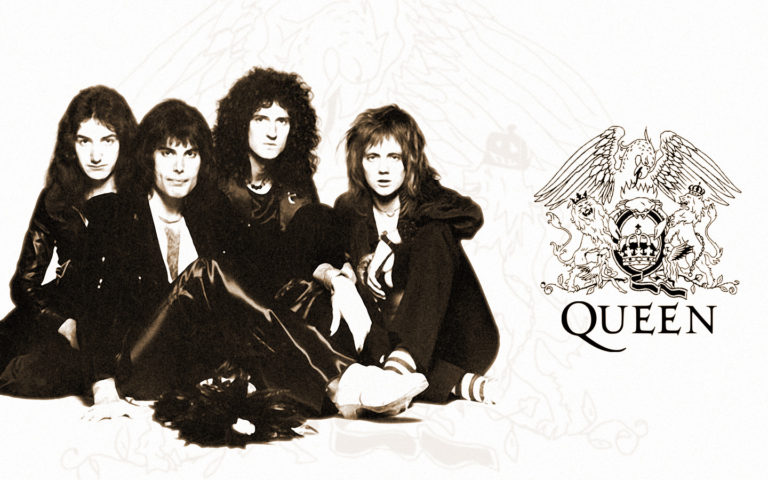
Queen were innovators in genre and production, and they deliberately made that known; sometimes forcibly so, tagging each of their 1970’s albums with a “No Synthesizers” gag, queuing listeners in on what sounds and styles they were able to conjure with only piano, guitar, bass, and drums. Each of the band’s four members (who remained unchanged throughout their career) possessed a masterful and unique bond with their respective instrument; Brian May on guitar, Roger Taylor on drums, John Deacon on bass, and of course Freddie Mercury himself, perhaps the greatest front man and rock singer of all time. They are one of our greatest rock bands, but they didn’t start out that way, and similar to how we talk about audiences not being ready for certain films, Queen were certainly ahead of their time. Despite individual songs being written and credited by individual members of the band (some folks may not even know that Brian May and Roger Taylor were also talented lead vocalists in their own right), they only worked because of a special musical bond they shared with one other; they kept each other alive, for over 30 years.
As a massive Queen fan, a biopic like Bohemian Rhapsody is one I didn’t have much interest in seeing, and despite a few pleasing attributes (the music, Rami Malek’s portrayal, and the pathos behind 1985’s Live Aid performance) the film isn’t very good at all (part of me still dreams of the Sacha Baron Cohen cut). This will not be an in-depth review of the film, and will instead be an honoring of what that film sets out to achieve; a celebration of the great music of Queen, and a respect for their incredibly diverse and experimental career. Each one of their fifteen studio albums was its own journey with a mind of its own, many being better than others (yes, there are some duds). And as a music fan who considers the album as that artist’s singular musical statement, let’s take a look at all fifteen of Queen’s artistic statements from worst to first, from operas to races, from magic to miracles, even from immortal Scottish swordsman to Flash Gordon.
[divider]
15. Made in Heaven (1995)
I honestly considered not even including Made in Heaven, it feels unfair to rank among Queen’s studio output. It’s also quite terrible. Released four years after Mercury’s passing, Made in Heaven is comprised of Mercury’s unreleased vocal and piano parts with added instrumentation by surviving members May, Taylor, and Deacon, creating new compositions from those initial ideas. But without Freddie Mercury’s presence in each song’s finalization, the album simply comes off as passionless and reeking of financial obligation. Some of the best songs here (specifically the title track and “I Was Born to Love You”) already existed in prior form on Mercury’s 1985 solo album Mr. Bad Guy, only adding to the album’s overall lack of purpose. But aside from that, and aside from very good tracks like “Let Me Live” and “You Don’t Fool Me”, Made in Heaven feels overly schmaltzy, saccharine, and downright corny; I personally have a hard time just getting through a song like “Too Much Love Will Kill You”.
This soundtrack and score composition (Queen’s first) of Mike Hodges cult sci-fi flick also feels a little unfair to rank. Flash Gordon is barely an album, if at all; it is primarily comprised of short interlude tracks and effects written for the film, even featuring some of the film’s actual audio and dialogue. This makes for a fine release within the context of the film, and the album can be enjoyed on those merits, but as an individual album it lacks musical fluidity; this may seem like unfair criticism, but I am ranking Queen’s “albums” after all. The opening single “Flash’s Theme” and closing track “The Hero” are the only two lyrical tracks, and are coincidentally the only two that feel like “songs”. They are great tunes for sure, and the soundtrack features many enjoyable interludes (“Football Fight” is a riot), but they aren’t enough to give this album its own functionality outside of the film. It’s a fine soundtrack, but not so much an album.
Some Queen fans may have this playful release ranked higher, especially for yielding some of the band’s most notable hits (“Fat Bottomed Girls”, “Bicycle Race”, and the quintessential “Don’t Stop Me Now”). But Jazz always felt too little too late, and a bit of a dull recreation of what the band had already done before. Reteaming with producer Roy Thomas Baker, who helped provide the technical marvels behind Sheer Heart Attack and A Night at the Opera, sounded good on paper, but ironically Jazz just sounds paper thin and musically weak. When it needs to rock out with songs like “Let Me Entertain You” and “Dead on Time”, it lacks energy, and when it needs to provide beauty and melancholy with songs like “Jealousy” and “In Only Seven Days”, it lacks pathos. And at a length of thirteen songs, which actually isn’t that dense by Queen’s standards, the album still feels too long. Many of these tracks, while perhaps stylistically regressive for Queen, are not bad in the slightest, but Jazz is sadly one of those albums where its production and overall sound fails it. It does, however, feature one of Queen’s most amusing openers with “Mustapha”, Freddie’s tribute to his own heritage.
Like Flash Gordon, A Kind of Magic too is a soundtrack album of sorts (for Russell Mulcahy’s fantasy epic Highlander). However, unlike Flash Gordon, A Kind of Magic feels more like an album, probably because it only partially serves as a movie soundtrack. Instead of instrumental interludes, A Kind of Magic is composed of nine lyrical songs, all of which range in musical diversity like the best Queen albums do. With such strong hit songs like opening rocker “One Vision” (initially for the movie Iron Eagle), the anthemic title track, and the achingly gorgeous and orchestral “Who Wants to Live Forever” (one of the band’s best), A Kind of Magic should have been more magical. But by functioning as only a “partial” soundtrack, the album feels incomplete, with the album’s remaining cuts functioning as mere filler to make up space, such as the uninspired repetition of “Pain Is So Close to Pleasure” and “Don’t Lose Your Head”. There are some epic movie-themed tracks here (“Princes of the Universe” and “Gimme the Prize (Kurgan’s Theme)” specifically), but sadly, and similarly to Flash Gordon, most of the album is best enjoyed in conjunction with its respective film, and not as well on its own.
In many ways, The Works was Queen’s 1980’s “debut”, the album that would form the overall sound and style of Queen in the 80’s. Many fans also considered this album a return to form for Queen, having experimented with disco and R&B on 1982’s Hot Space two years prior, and while The Works still carries on with the more pop-flavored stylings Queen would explore throughout this decade, the album reemphasizes their rock-and-roll backbone, with Brian May’s signature guitar tone all over heavy tracks like “Hammer to Fall” and “Tear It Up”. The album is at its best when it sticks to this raw sound (mirrored in its colorless album cover), not just on those two aforementioned rockers but also on songs like “It’s a Hard Life”, “Keep Passing the Open Windows”, and the incredible closer “Is This the World We Created…?”. Aside from these great tracks, the overall album sounds a bit at war with itself stylistically, which is surprising given how musically diverse Queen were known to be. Perhaps it’s mostly due to synth-pop anthems like “Radio Ga Ga” and “I Want to Break Free” which (call me crazy) I don’t think have aged all that well, and only contribute to the album’s struggle for self-identity. The Works may be a mixed bag, but still not without its strengths.
I realize that on any other Queen fan’s list, 1982’s Hot Space is bottom of the barrel (or at least damn near close); I happen to think it’s pretty good. What was it I said earlier about Queen? They were innovators in genre, looking at the musical past while also predicting its future. During this time, disco, funk, and R&B were still top of mind, but the way Queen married the dance genre’s typical synth sounds with authentic rock instrumentation was somewhat unique. Queen didn’t just make another disco album with Hot Space, they made a statement of how instrumentally diverse pop music can be, to the point that Michael Jackson even cited the album as a big influence on his 1982 classic Thriller (I bet you didn’t know that). Brian May’s tasteful guitar licks compliment the synth grooves of “Staying Power”, “Dancer”, the incredible “Back Chat”, and Taylor’s “Action This Day” beautifully, to the point that I wish there was more of it. It’s strange that Hot Space often gets criticized for being Queen’s “disco” album, when its disco-influenced songs are actually the album’s highlights (yes, I even like “Body Language”). Instead, the album’s back half offers more musical variety, sometimes for better and for worse; Deacon’s “Cool Cat” is a groovy reggae number featuring a stunning vocal performance by Freddie, but Taylor’s “Calling All Girls” and May’s respective contributions “Put Out the Fire” and “Las Palabras De Amor” sound excruciatingly out of place. However, Hot Space is perhaps most known for its closer, a collaboration with David Bowie on the classic “Under Pressure”; and rightfully so; this song soars.
From the beyond silly album cover, The Miracle is perhaps Queen’s most playful album of the 1980’s, and all the better for it. Still dabbling in their blend of synth-pop and heavy rock as heard on The Works and A Kind of Magic, the results on The Miracle sound more consistent and self-aware in its absurdity, as if the band had finally found a way to mesh these tonal extremes. It’s heard on the pop rock anthem “Breakthru” (one of my favorite Queen songs from the 80’s), the electronic romp of “The Invisible Man”, as well as the dual openers “Party” and “Khashoggi’s Ship”, but when the album rocks, especially on great anthems like “I Want It All” and the phenomenal closer “Was It All Worth It” (a reflection on the band’s career up until that point), things still feel of a piece and never too tonally jarring. Not every song nails that tonal balance though, as many of John Deacon’s co-contributions (specifically “Rain Must Fall” and “My Baby Does Me”) come very close to self-parody, but Brian May’s guitar playing has never been more tasteful during this era (just listen to “Scandal” to hear why), giving The Miracle more personality than its two 80’s predecessors.
The opener “Play the Game” may be its own anthem of love, but so is the entirety of 1980’s The Game, where Queen paid loving homage to their influences (the greaser-themed cover should give that away, where Freddie bears a striking resemblance to Elvis Presley) while simultaneously embracing where pop music was going. On The Game, Queen opened up their minds, stared inside, and played the musical game, to the point that this became their first album to finally use a synthesizer (an Oberheim OB-X), musical commonplace at the time. The Game relishes in textures of power pop, rockabilly, and funk, yielding some of the bands most danceable hits; Deacon’s “Another One Bites the Dust”, Mercury’s country/rockabilly hit “Crazy Little Thing Called Love”, and the heavy funk of May’s “Dragon Attack”, one of their greatest live staples (and a personal favorite of mine). The Game mostly succeeds in accomplishing a very tricky thing, nostalgically looking back to the musical past while never forgetting the future (Queen had always been foreshadowing where rock music was going, even if it wasn’t intentional). The album does, however, have a few moments where things sound more regressive and reactionary of the times, such as the power pop stylings of “Need Your Loving Tonight”, “Rock It (Prime Jive)”, and “Coming Soon”, all of which sound like they could’ve been hit songs by any new wave act only a few short years prior. But these few moments of near mimicry can be easily forgiven by the time we reach Brian May’s gorgeous closer “Save Me”, a Queen ballad for the books.
News of the World was seen as Queen’s response to the punk rock scene, after being criticized by bands like The Sex Pistols for being too “progressive”. But aside from the obvious punk rebuttal with Roger Taylor’s “Sheer Heart Attack” (and a successful one at that) News of the World is not a punk album. It is, however, Queen at their most stripped down, raw, and organic, substituting the symphonic for the anthemic. This becomes clear less than five seconds in, when the classic pairing of “We Will Rock You” and “We Are the Champions” comes right out swinging without any warning. But News of the World has more raw diversity up its sleeve than simply the two greatest sports anthems ever written, including John Deacon’s tender ballad “Spread Your Wings”, Brian May’s melodic rocker “It’s Late” (one of his greatest contributions), Roger Taylor’s funk metal masterpiece “Fight from the Inside” (perhaps my favorite Taylor song), all concluding with Mercury’s jazz crooner “My Melancholy Blues”. Despite its versatility, News of the World never loses its grit and stays rather unpolished, reigning as one of Queen’s most consistent albums. I’m singing a lot of praise here, and yet I can’t bring myself to rank News of the World any higher due to one simple reason; I can’t be the only person who thinks “Get Down, Make Love” is one of the worst songs of the 1970’s.
Queen fans may disown me for putting A Night at the Opera outside my top 5. With a title inspired by the Marx Brothers, A Night at the Opera is perhaps Queen’s best and most important album; an operatic, playful, and expensive journey in musical variety and studio trickery (at the time it was the most expensive album ever recorded). Mixing genres of heavy rock (the cynical opener “Death On Two Legs”), delicate pop (Deacon’s tribute to his wife “You’re My Best Friend”), bluesy rock (Taylor’s most popular tune “I’m In Love with My Car”), gorgeous balladry (Mercury’s dedication to Mary Austin “Love of My Life”, and a reoccurring theme in the biopic), folk music (May’s sci-fi themed “’39”), Dixieland jazz (“Good Company” – I mean, just listen to Brian May’s guitar mimic a clarinet!), and Music Hall (“Lazing On a Sunday Afternoon”), A Night at the Opera is musically all over the place but never feels like much of a mess due to the strength in its songwriting, a strength we can’t mention without acknowledging the greatness that is “Bohemian Rhapsody”, a six-minute summation of everything A Night at the Opera represents, and one of the greatest musical journeys of the 1970’s. But as someone who prefers the raw heaviness of Queen’s earlier works, the album sometimes sounds a little too polished, stripping away the grit of its heavier tunes. It also, on a few occasions, trips over its own ambitions; the middle vocal bit of “The Prophet’s Song” overstays its welcome, the Music Hall of “Seaside Rendezvous” veers dangerously close to self-parody, and May’s rocker “Sweet Lady” is dully out of place. It’s not a perfect album, but it gets props for perhaps being the most theatrical rock album ever made, and a great starter for newcomers of the band.
#Underrated. With A Night at the Opera being such a critical and commercial hit, it would’ve been easy for Queen to simply recreate that album all over again. Sadly, A Day at the Races often gets criticized for being just that, a sequel of sorts to its predecessor. One must question, if it wasn’t for yet another Marx Brothers-themed title, would critics have still said this? A Day at the Races clearly rides on A Night at the Opera’s more Vaudevillian successes with less musical variety, but what it lacks in diversity it makes up for in consistency; the album is more loving, tender, and consistently amusing, almost conceptually so, an experience reminiscent of watching a complete Music Hall performance from the Victorian era. And with Queen producing the album themselves this time (without Roy Thomas Baker), the album sounds less polished than A Night at the Opera and more live and organic, complementary of that live Victorian setting. It’s clear from the great opening rocker “Tie Your Mother Down” that Queen are intending to have some fun here, which continues with the Vaudeville stylings of “The Millionaire Waltz” (perhaps a bit of a “Bohemian Rhapsody” retread), and “Good Old-Fashioned Lover Boy”, though their tender side still shines through on Deacon’s lovely “You and I”, Mercury’s aching ballad “You Take My Breath Away”, and especially the gospel stylings of the classic “Somebody to Love”. A Day at the Races yields some of the best vocal harmonies by the band (I imagine this being a favorite album among choir teachers), and it all sounds refreshing baroque.
Queen may have formed in 1970 (after Mercury joined May and Taylor following their own band Smile), but it took three years to release their debut. And to be honest, their self-titled debut is a bit of a patchwork and clearly represents a group of young men still trying to figure themselves out (even the band admits falling victim to over-arranging). But listening to this debut with the mindset that it was released in 1973 reveals a whole new perspective; Queen were always praised for being ahead of their time, especially in production and musical variety, but we often don’t acknowledge the influence they had on heavy metal, and that started here. May’s anthemic opener “Keep Yourself Alive” was like nothing the world had heard before, with an energy and aggression that rivaled other metal pioneers at the time (i.e. Black Sabbath and Deep Purple), but layered with a guitar tone that was just incomparable (Brian May, who studied astrophysics, built his own guitar, dubbing it the “Red Special”). It doesn’t end there; “Son and Daughter” is among the heaviest in the band’s catalog, and Mercury’s contributions “Great King Rat”, “My Fairy King”, and “Liar” epically channel the psychedelia and theatrics of early progressive rock/metal. The overall sound of Queen is dirty and unpolished (some songs even sound like demos, such as the dark ballad “The Night Comes Down”), but this grit continues to attract hardcore fans, myself included. It was also the first album I ever heard on vinyl; call me sentimental.
In-nu-en-do (noun) – an oblique allusion, hint, or insinuation. Perhaps this album title meant little to critics and fans back in February 1991, but nine months after the release of Queen’s final album, the allusion became clearer. Freddie Mercury was a very private and prideful man, and when he died that November of pneumonia due to complications with AIDS, Innuendo slowly took on a new meaning. Much like David Bowie’s devastating final album Blackstar, Innuendo is an insinuation of one’s upcoming death, and refusing to give in to the reaper’s reaching hand. Even though you can hear the slow deterioration in Freddie’s voice, he continues to passionately belt “Yes we’ll keep on trying, tread that fine line” on the album’s complex title track, singing of remembrance for better days on “These Are the Days of Our Lives”, even finding the time to laugh at his illness on “I’m Going Slightly Mad” (accompanied by a quirky music video which was reportedly almost too physically exhausting for Mercury to shoot), all concluding with a plea for a never-ending legacy on “The Show Must Go On” (“Inside my heart is breaking, my makeup may be flaking, but my smile still stays on.”). Freddie’s plea for pushing forward continues on great cuts like “Ride the Wild Wind”, the saddening “Don’t Try So Hard”, the aggressive rocker “Headlong”, and even wishing well to one of his cats with the silly “Delilah”. Innuendo is one of the rock music’s saddest albums, which is perhaps why it has stylistically aged better than its 80’s predecessors, straying further from synth-pop and tonally closer toward post-punk, new wave, and alternative rock (i.e. The Cure). Bring tissues.
Having already shown the world an edge like no other, Queen’s debut still retained their early Smile roots, particularly on early Smile songs like “Doing All Right”. The band still needed to discover a more defined sense of self, which became the basis of Queen II, a dual-sided conceptual epic filled with fairy fellers, seven seas, queens, and ogres. Rather than the typical Side A and Side B vinyl format, Queen II is split between Side White and Side Black; Brian May (with the help of Roger Taylor on one song) handled the writing of White, Mercury handled Black. With the epic opener “Father to Son”, the delicate “White Queen (As It Began)”, and the soft-spoken “Some Day One Day”, Side White continues where Queen left off, and with strong results. However, it is Mercury’s Side Black that has become synonymous with Queen II’s continued legacy, a medley of epic fantasy that foreshadowed the early experimentations of Queen. Side Black rises from the ashes with the heavy onslaught of “Ogre Battle” before transitioning into the medieval weirdness of “The Fairy Feller’s Master-Stroke” (inspired by Richard Dadd’s painting of the same name). This connects effortlessly into the brief beauty of “Nevermore” and the epic centerpiece “The March of the Black Queen”, one of the band’s greatest deep cuts. Closer “Seven Seas of Rhye” (only half written for their debut) became the album’s only “hit” single, but fittingly concludes this unified epic through medieval times that flows freely as a single piece of music. The album’s legacy continues to grow, becoming a cult favorite among fans and even Queen themselves, a legacy clearly scene on its iconic album cover, later recycled for the music video to “Bohemian Rhapsody”.
“Guaranteed to blow your mind, anytime.” They killed it alright. A Night at the Opera may have been when people took notice of the band, but Sheer Heart Attack is when Queen became Queen, and marks one of the greatest and most significant leaps forward for any band (and the album was released only seven months after Queen II!). Sheer Heart Attack is a seamless marriage of what Queen was and who they would become, a bridge between their glam/metal beginnings and their heavily polished musical versatility; they had conquered the recording process by now (with the help of Roy Thomas Baker), crafting a tight, diverse, and complexly arranged string of thirteen songs where not one sounds like the other (it might as well have been thirteen albums). The album delivers on glam rock (“Brighton Rock” and “Now I’m Here”), art pop (the killer classic “Killer Queen”), ragtime (“Bring Back That Leroy Brown”), opera (“In the Lap of the Gods”), speed metal (“Stone Cold Crazy” – later covered by Metallica without much difference), all ending with a literal explosion on “In the Lap of the Gods…Revisited”. And despite its diversity, the album never trips over its ambitions (unlike elements of A Night at the Opera); the songs are mostly short, to the point, and transition into one another like a 39-minute medley (which includes the clearly defined yet incredible three-part medley “Tenement Funster” – “Flick of the Wrist” – “Lily of the Valley”). The album’s title should have been an indicator that its sheer variety might be enough to put someone into cardiac arrest, but never has such an eclectic rock album sounded this graceful and complete, with sounds that no one would expect a four-piece could create. This, dear friends, is Queen.
A fact about me: I have a Masters in Political Science, yet I now regret even going into that cesspool of red tape, democratic authoritarianism, pettiness, greed, power lust, gaslighting, ratfucking, cockblocking, and every other derogatory word you can describe politics as. My interest in politics in the era of Clinton/Bush-Blair relationship, the global outlook from the rise of Merkel’s Germany, Chavez’s Venezuela, Kirshner’s Argentina, Lula’s Brazil, Berlusconi’s Italy, Chirac-Sarkozy’s France, Putin’s Russia, and the history of their predecessors was a more intriguing, sane, and understanding time in the late 2000s and early 2010s. My love for movies was a hobby and understanding the political background of some films made it easier for me to enjoy while also learn a bit more about a certain country. Thanks to House of Cards,The Thick of It, Boss, and Veep, it was a good time to watch the flair of politics dramatized for a time.
Now, I hate it. I enjoyed my six years in college and wish I was there still, but now I have cut myself off virtually from the political realm because it’s headaches, heartaches, and mental breakdowns for me. But it hasn’t turned off my liking for political films, dramatized not documented, because the genre has been around since the silent film era. The Life Story of David Lloyd George, co-starring Alfred Hitchock’s future wife, Alma Reville, was made in 1918 while the title character was still Prime Minister. Mr. Smith Goes To Washington and Young Mr. Lincoln were two brilliant films about heroes against the system, both released in 1939 with its leading stars, James Stewart and Henry Fonda, being a real-life Republican and Democrat respectively and even being close friends in real life. Going abroad, dictators used fiction to depict democracy as a source of past struggles while raising their own profile.
When the Second World War ended, a more direct message of a regime’s systematic abuse was more openly produced in all languages. Here a few of those globally recognized assaults against injustice on the people.
Hands Over The City (1963)
Italian director Francesco Rosi, who also made the neo-realist Salvatore Giuliano, brought on American star Rod Steiger to play a corrupt Naples councilman who uses his power to profit from a real estate deal and is connected to the collapse of a residential building. Naples councilmen, led by a communist, go on the charge to seek the truth that is too thick to pull out. Even though he knows he will never get to the bottom of it, the viewers see how corrupt a city can truly be based on how much money is involved and connections with the Mafia. Except for Steiger, the others were actual real-life members of the Naples city council, who had to act for Rosi a scene where they all say they are not corrupt.
The Battle of Algiers (1966)
There are so much power and so much versatility in this film which is why it is in my Top 10 Criterion films. Italian director Gillo Pontecorvo shot on location in the newly independent state of Algeria and re-creates the bloody conflict in the 1950s between Algerian nationalists and the French military who seek to shut the revolt down in order to keep their wealthy territory across the Mediterranean. On one side, guerilla fighters will shoot officers at any given moment and bomb popular places. The other, the military resorts to all forms of torture to get intel. The cinéma vérité filmmaking within the streets and in the Casbah, combined with documentary-like editing and Ennio Morricone’s socio-military soundtrack, is an eyeopening experience that was still sensitive to everyone because of the horrific bloodshed but carries on fifty years later.
Z (1969)
Costa-Garvas struck deep in protesting his native Greece under a military government at that time (it was produced in Algeria) with a thinly fictionalized portrayal about the assassination of a popular left-wing politician by far-right extremists who are connected to police officers and army officials. With Yves Montand as the fallen politician and Jean-Louis Trintignant as the magistrate seeking the truth, it is a thriller that is loose and fast (its editor, Francoise Bonnot, won an Oscar for her work; she recently died) and gives the personal reality seen around the world at the time of witnessing a hero fall in thanks to fears of others, as it was with Robert Kennedy and Martin Luther King Jr. one year before in the US. Z refers to the ancient Greek verb zei, or “he lives,” defiantly saying the legacy of the murdered politician will never go away, which was the case when Greece returned to democracy in 1974.
Tout Va Bien (1972)
“Everything is fine,” in translation, Godard, a Marxist who took his cinema to a radical level at this point, brought in Yves Montand and Jane Fonda, both noted leftists, as a French husband and his American reporter wife who cover a strike at a factory. A critique of marriage, capitalism, and French society after 1968, Godard uses very long takes and breaking the fourth wall in monologues of both the factory worker and the manager who explain themselves, as well as the craft of the camera going across the cross-sectioned building and passing through walls into every room. While the global revolution had died down a bit, the mood was still present in France. As Godard stated, “The problem is not to make political films but to make films politically.”
General Idi Amin Dada: A Self Portrait (1975)
https://www.youtube.com/watch?v=762VIy1gZW0
Here’s a documentary, up close and personal, of the psychopathic dictator of Uganda who is responsible for the deaths of hundreds and thousands of people in his rule from 1971 to 1979. Barbet Schroder (Reversal of Fortune) and cameraman Nestor Almendros (DP of Days of Heaven) got access to interview the man who once said he idolized Hitler and showed off his “invasion” of Israel when that day came. He’s a buffoon that, at best, was lovable and playful, but, at worst, had no qualms of executing anybody. In fact, when Amin asked Schroder to cut some scenes and Schroder refused, Amin held 200 French hostages in Uganda and Schroder complied. They were put back in after Amin’s fall, but what was seen off-screen and on could not have given a more clear picture of a murderous egomaniac.
These directors went on to make more great political films. Garvas responded with The Confession, State of Siege, and his Oscar-winning Missing. Rosi would follow up with The Mattei Affair and Lucky Luciano. Pontecorvo had Kapo and Ogro, Godard remained around the experimental and social realist with Film Socialisme in 2010, and Schroder made the political documentary Terror’s Advocate. Others have also struck hard across the world with provocative works about the political class and reflecting on a country’s rough history. They tread dangerous waters and know the opposing side will cry foul, but this is what the political genre is about: truth-telling, idea sharing, and reflection on the status of the world.