Tomorrow, the Golden Globe nominations will be released and it will kickstart the major precursors for this year’s award season. While there is still a discussion to be had about the system of the Golden Globes, they will have some importance as they are being televised this year as opposed to last year. This will be a major test to see which contenders are rising and which ones may perhaps struggle for the rest of the year.
Here are my predictions for this year’s Golden Globe nominations.
BEST MOTION PICTURE, DRAMA
Elvis
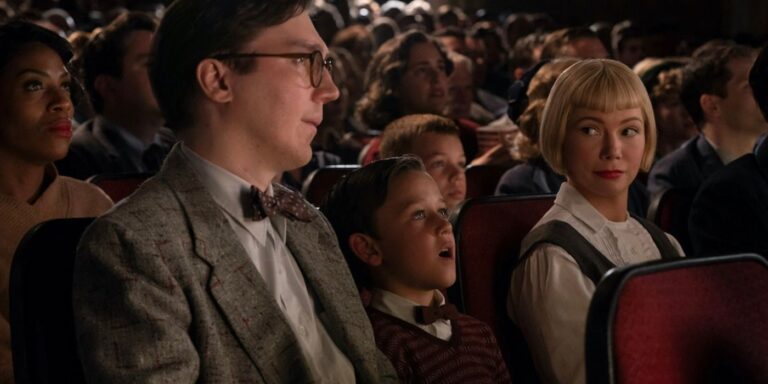
The Fabelmans
TÁR
Top Gun: Maverick
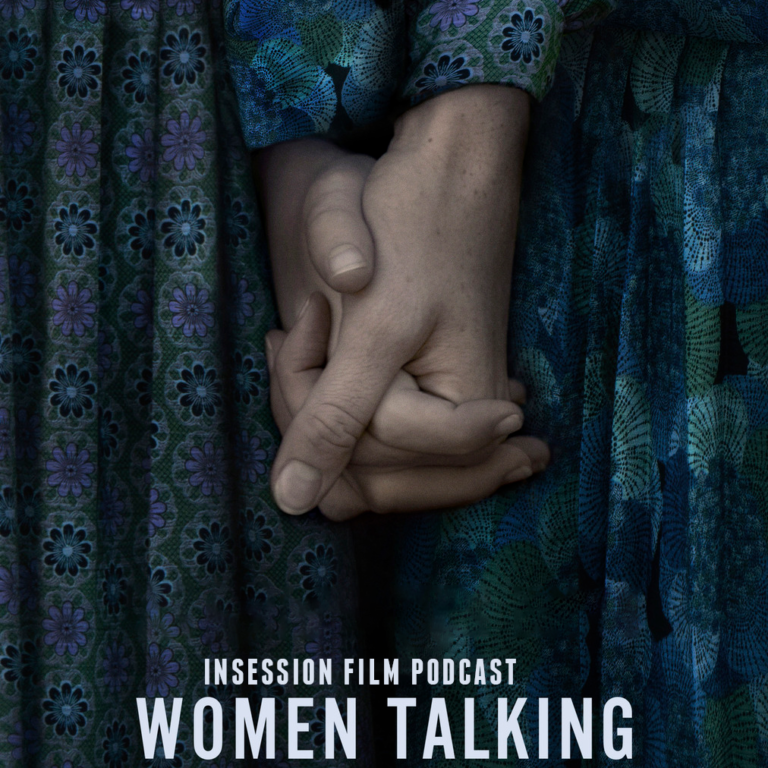
Women Talking
BEST MOTION PICTURE, DRAMA
Babylon
The Banshees of Inisherin
Everything Everywhere All At Once
Glass Onion: A Knives Out Mystery
The Menu
BEST DIRECTOR, MOTION PICTURE
The Daniels, Everything Everywhere All At Once
Baz Luhrmann, Elvis
Martin McDonagh, The Banshees on Inisherin
Sarah Polley, Women Talking
Steven Spielberg, The Fabelmans
BEST PERFORMANCE BY AN ACTRESS IN A MOTION PICTURE, DRAMA
Cate Blanchett, TÁR
Olivia Colman, Empire of Light
Viola Davis, The Woman King
Danielle Deadwyler, Till
Michelle Williams, The Fabelmans
BEST PERFORMANCE BY AN ACTRESS IN A MOTION PICTURE, MUSICAL OR COMEDY
Leslie Manville, Mrs. Harris Goes To Paris
Margot Robbie, Babylon
Anya Taylor-Joy, The Menu
Emma Thompson, Good Luck To You, Leo Grande
Michelle Yeoh, Everything Everywhere All At Once
BEST PERFORMANCE BY AN ACTRESS IN A SUPPORTING ROLE IN ANY MOTION PICTURE
Jessie Buckley, Women Talking
Kerry Condon, The Banshees of Inisherin
Jamie Lee Curtis, Everything Everywhere All At Once
Claire Foy, Women Talking
Janelle Monae, Glass Onion: A Knives Out Mystery
BEST PERFORMANCE BY AN ACTOR IN A MOTION PICTURE, DRAMA
Austin Butler, Elvis
Tom Cruise, Top Gun: Maverick
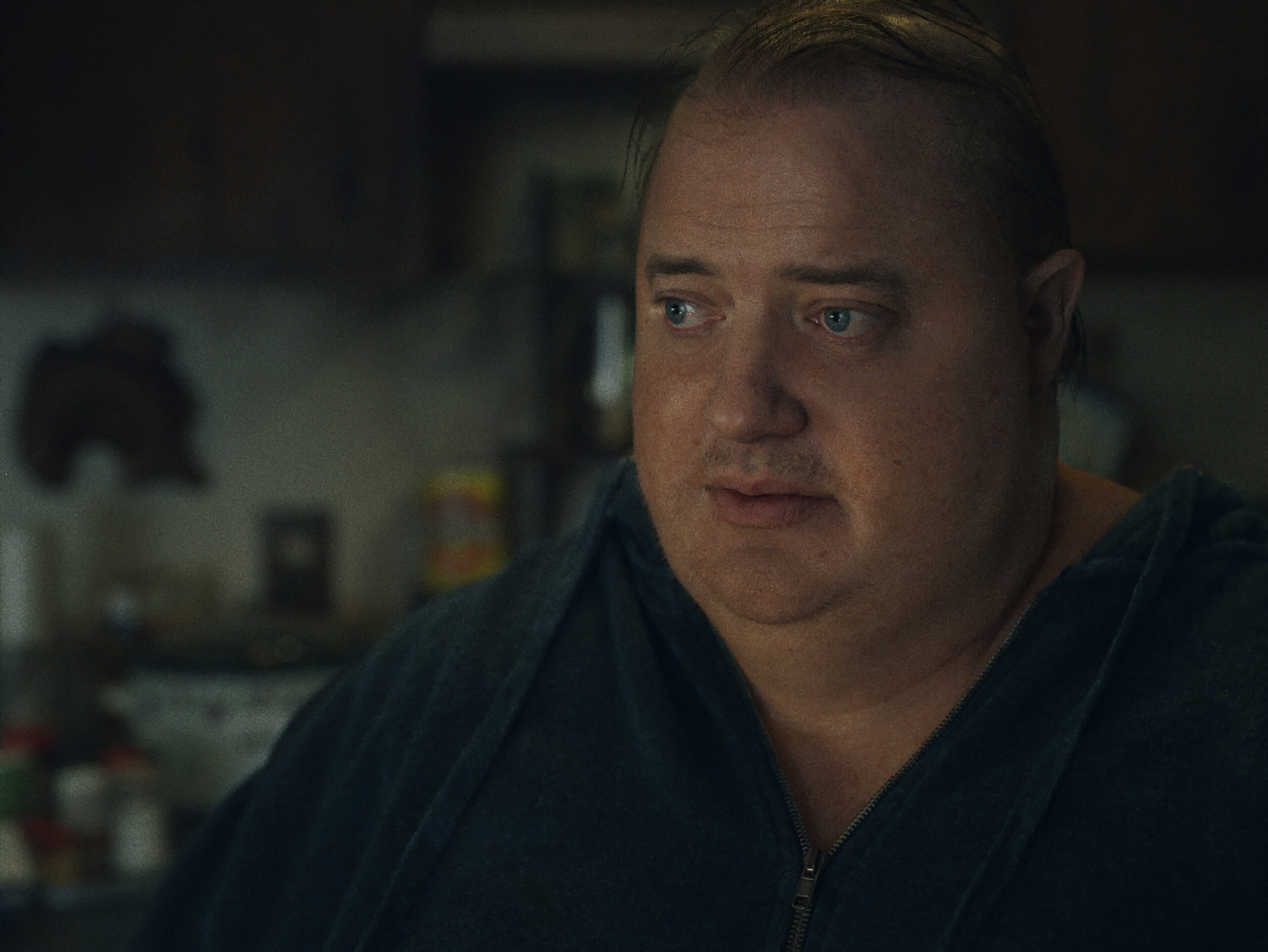
Brendan Fraser, The Whale
Paul Mescal, Aftersun
Bill Nighy, Living
BEST PERFORMANCE BY AN ACTOR IN A MOTION PICTURE, MUSICAL OR COMEDY
Diego Calva, Babylon
Daniel Craig, Glass Onion: A Knives Out Mystery
Billy Eichner, Bros
Colin Farrell, The Banshees of Inisherin
Adam Sandler, Hustle
BEST PERFORMANCE BY AN ACTOR IN A SUPPORTING ROLE IN ANY MOTION PICTURE
Paul Dano, The Fabelmans
Brendan Gleeson, The Banshees of Inisherin
Eddie Redmayne, The Good Nurse
Ke Huy Quan, Everything Everywhere All At Once
Ben Whishaw, Women Talking
BEST SCREENPLAY, MOTION PICTURE
The Banshees of Inisherin
Everything Everywhere All At Once
The Fabelmans
TÁR
Women Talking
BEST ORIGINAL SCORE, MOTION PICTURE
Avatar: The Way of Water
Babylon
The Fabelmans
Guillermo del Toro’s Pinocchio
Women Talking
BEST ORIGINAL SONG, MOTION PICTURE
“Carolina” – Where The Crawdads Sing
“Hold My Hand” – Top Gun: Maverick
“Lift Me Up” – Black Panther: Wakanda Forever
“Naatu Naatu” – RRR
“Nothing is Lost (You Give Me Strength)” – Avatar: The Way of Water
BEST MOTION PICTURE, ANIMATED
The Bad Guys
Guillermo del Toro’s Pinocchio
My Father’s Dragon
Puss in Boots: The Last Wish
Turning Red
BEST MOTION PICTURE, FOREIGN LANGUAGE
All Quiet on the Western Front
Bardo
Decision to Leave
Holy Spider
RRR
This week on Women InSession Podcast, we talk about some of our favorite holiday classics and why those movies resonate with us! We discuss everything from It’s A Wonderful to Home Alone to Elf and many more.
On that note, check out this week’s show and let us know what you think in the comment section. Thanks for listening and for supporting the InSession Film Podcast!
To hear this Extra Film episode and everything else we do, download our apps on the Amazon Market for Android and the Podcast Source app on IOS devices. The mobile app covers all of our main shows, bonus podcasts and everything else relating to the InSession Film Podcast. Thanks for your wonderful support and for listening to our show. It means the world to us.
Director: Jerzy Skolimowski Writer: Ewa Piaskowska, Jerzy Skolimowski Stars: Sandra Drzymalska, Lorenzo Zurzolo, Mateusz Kościukiewicz, Isabelle Huppert
Synopsis: Follows a donkey who encounters on his journeys good and bad people, experiences joy and pain, exploring a vision of modern Europe through his eyes.
Directors who choose to make films about Christlike donkeys who retain their dignity in the face of unimaginable human cruelty inevitably end up risking associations with Robert Bresson’s Au Hasard Balthazar (1966). That critically acclaimed masterwork has served as a touchstone for countless European auteurs but very few are brave enough to wear their influences as heavily as Jerzy Skolimowski does. It has to be said that there’s something undeniably admirable about his audacious approach to bringing this homage to the screen. This is not one of those adaptations that strikes the viewer as a pale imitation of a truly original piece of art. Skolimowski transforms Bresson’s simple premise into an artistic vision that is very much his own and embeds his own directorial signatures into many of the film’s quieter moments.
Bresson’s film centered around Balthazar, a gentle creature who watches on as the humans who surround him exhibit different facets of the human condition. He envisioned his saintly donkey as a victim of humanity’s inherently destructive spirit, whilst still taking the time to highlight moments of grace and levity. Skolimowski shifts his focus to EO, an inquisitive donkey who yearns for total freedom, even as he wistfully recalls being cared for by Kasandra (Sandra Drzymalska). He changes hands frequently and frequently finds himself in the employ of indifferent aristocrats who wrestle with familial conflict. He never succeeds in settling down in one place or establishing a close bond with any of his owners but manages to avoid succumbing to ennui and despair.
At its most thrilling and inventive, the film makes a case for itself as an example of pure cinema. Skolimowski appears to be having the time of his life experimenting with all of the tricks that he has up his sleeve. His sense of enthusiasm is infectious and you find yourself getting caught up in his occasionally chilly vision of the modern world. We are constantly thrown off balance by Michał Dymek’s insistence upon setting the events of the film in a slightly surreal version of Europe. Every now and then, he launches into a completely nutty digression that expands the sweep and scope of the narrative. These passages introduce a lovely playful quality into the proceedings that only makes the turducken-like nature of individual sequences even more ingratiating.
The promotional shots of a nervous EO standing in the middle of a paddock don’t prepare viewers for an utterly thrilling sequence in which we are invited to see the world through his eyes. Suddenly, the world opens up before our eyes and we are forced to reorient our perspective in a matter of seconds. It’s one of those set pieces that demands to be seen on the biggest screen possible. This is a spectacular, extravagant production, on the scale of its director’s most celebrated works and one worries that the film’s bombast will not fully register with the audience if viewers aren’t forced into a confrontational position. Amidst all of the deliberately jarring tonal shifts and wacky visual flourishes, it can be easy to lose a sense of the bigger picture. This is not a knock on the film itself but an acknowledgement that the theatrical experience gives audience members enough space to apply their critical thinking skills to the arthouse cinema that they consume.
However, it should be noted that one of the unexpected turns that the plot takes doesn’t pay dividends. When French superstar Isabelle Huppert pops up as the imperious chatelaine of an Italian estate that has fallen on hard times, she sets the film off course. She remains a charismatic screen presence but the strength and ferocity of her performance doesn’t mesh with Skolimowski’s overall vision for the project. Perhaps this disjunction was intentional and Huppert’s heavily stylized performance was supposed to introduce a layer of meta commentary into the plot. Other members of the cast achieve the desired result by tamping down their natural magnetism. It is difficult to create this effect without making the performances appear to be lifeless and inert. Somehow, the members of this cast get away with it for about 70 minutes and it’s still difficult to make any real complaints about a scene in which Huppert vamps around in an elegant frock for a couple of minutes.
For the most part, this is a stunning late career effort that suggests that loose remakes can and should play fast and loose with the rules and conventions that are typically attached to arthouse cinema. It’s not everyday that you encounter an 88-minute epic that could conceivably be a modest parable about man’s inhumanity to man or an allegorical representation of the ongoing climate crisis. You can get as pretentious as you want while generating theories about what it all means and nobody will judge you for it. That’s just one of many wonderful things that can be said about EO.
For this week’s Patreon Bonus Content, JD and Brendan get together to discuss some films they’ve caught up on over the last few weeks. JD finally gives us his thoughts on Tár after missing Episode 504. Both offer up their thoughts on All Quiet on the Western Front, Decision to Leave and Weird: The Al Yankovic Story! And to close, JD gives us his thoughts on RRR, She Said and Till!
To hear our bonus content episodes early, subscribe now on Patreon. In many cases, though, we offer our bonus content for free after a certain period of time and we do encourage (and very much appreciate) a small donation of $0.99 as a way to help support the show if signing up on Patreon isn’t for you. Click on the PayPal button below to donate and thanks so much for your support. You can also hear much of our Bonus Content via our mobile apps. See the information at the bottom of the post for more details.
[divider]
Mobile Apps!
Listen to all of our bonus content on our apps for just a one-time fee! Whether you have an iPhone, Android or Windows phone, our apps are available in many different ways that is convenient for you. With our mobile app, not only can you listen to all of our bonus content, but our main shows and our Extra Film podcasts as well. Click here for more info!
If you don’t want to purchase our bonus content, but still want to support us, there are other you can help us out. Click here for more info.
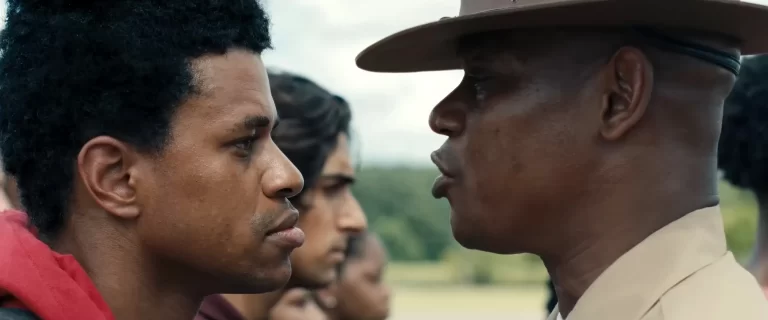
Director: Elegance Bratton Writer: Elegance Bratton Stars: Jeremy Pope, Raúl Castillo, Bokeem Woodbine, McCaul Lombardi, and Gabrielle Union
Synopsis: A young, gay Black man, rejected by his mother and with few options for his future, decides to join the Marines, doing whatever it takes to succeed in a system that would cast him aside.
Elegance Bratton’s feature directorial debut, The Inspection, is not easy to watch. Partly based on his real-life experiences as a Marine, the movie follows Ellis French (Jeremy Pope), who has recently enlisted in the Marines. His mother (Gabrielle Union) dismissed his son after he came out as gay, and he has little to no opportunities for his future. When French arrives at bootcamp, he is confronted by an aggressive drill sergeant (Bokeem Woodbine), who physically and mentally torments him for his sexual orientation.
French is also subject to homophobia from his recruits, notably Lawrence Harvey (McCaul Lombardi), who tampers with a cardboard target to make believe that French had not hit any target with his weapon. Meanwhile, French starts to have a bond with another sergeant, Rosales (Raúl Castillo) who teaches him how to toughen up as a marine without the physical and emotional abuse of sergeant Laws (Woodbine), which Rosales thinks he is going too far on French, and the recruits as a whole.
Seeing Woodbine’s Laws torment French like this is deeply gut-wrenching, simply because it was based off of director Elegance Bratton’s real life. We’ve seen many films where the drill sergeant abuses their recruits. It’s in every military movie, as a rite of passage if you will. But we’ve never seen it depicted in the way Bratton does in The Inspection, which feels painful to recreate and revisit for the filmmaker. It’s even more painful when the film ends with a dedication to hislate mother, with the audience never knowing if they reconciled before she passed away.
Pope is superb as French, giving one of the most emotionally impactful performances of the year. He has a hard time hiding his sexuality, developing an erection in the shower by fantasizing himself with Rosales, who may or may not be of the same sexual orientation as French. When the movie goes into French’s fantasies, it changes color, and brings a deeper emotional level to the film, and to the character. Cinematographer Lachlan Milne crafts shots with great depth and symmetry to the frame, representing the kind of stature any marine should have.
And yet, French does not, and will not fit in this oppressive system, as much as he tries to restrain himself from his sexual impulses. Castillo is a great supporting presence to Pope as Rosales, and shares two sequences with him that, in my opinion, are the heart and soul of the film. But the real show-stealer of the picture is Bokeem Woodbine, who continues to prove how big of a force he is in film and TV. Seriously, he has been doing this for more than thirty years, and continues to impress with every single role he takes, even if the film he stars in may be of lesser quality.
Thankfully, The Inspection is a well-written film, and he carries most of the emotional tension between French and Laws through his magnifying, and yet absolutely terrifying portrayal of the drill sergeant. Even when he is at his calmest, you know there’s something rummaging in his head that he hides to himself, and then inflicts upon the recruits. It’s one of the best performances I’ve seen in any movie this year, and one that cements Bokeem Woodbine as more than an “underrated” actor, and one of the greatest to have graced the silver screen.
Unfortunately, the movie does not develop Ellis’ relationship with his mother as much as it should. Gabrielle Union’s screen time is powerful, but limited, and that’s due to how much he spends time at bootcamp, away from his family. The film’s 95-minute runtime is short, and could’ve greatly benefited from an extra ten to twenty minutes to expand a bit more on how Ellis perceives his mother, and how his mother perceives her son, now that he has graduated from the Marines. The final scene between Union and Pope isn’t easy to watch, but there’s a bit of distance between the two characters that hinders its impact
Still, The Inspection remains a must-see. With career-defining performances from Pope, Castillo, and Woodbine, the film is one of the most important of the year, born out of someone’s personal trauma for the world to see. They’re not the easiest films to make, but the catharsis feels real. And you can’t help but laud Bratton for putting himself out there and exposing a part of his life on screen. It takes courage to do what he did, and to do it gracefully is even more impressive.
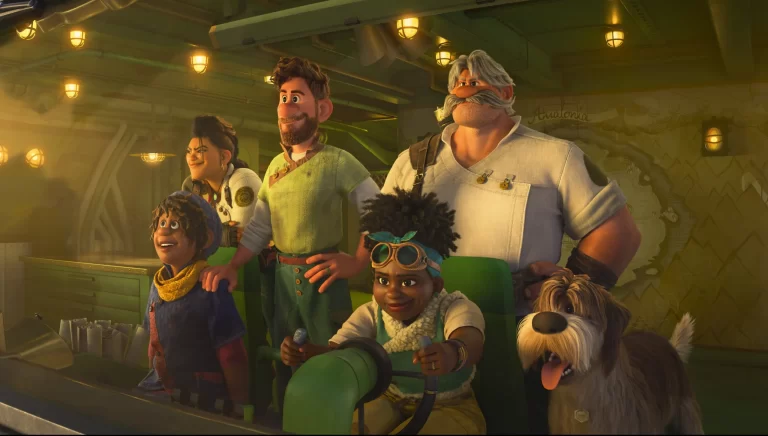
Director: Don Hall, Qui Nguyen Writers: Qui Nguyen Stars: Jake Gyllenhaal, Jaboukie Young-White, Gabrielle Union
Synopsis: The legendary Clades are a family of explorers whose differences threaten to topple their latest and most crucial mission.
For nearly 20 years now, Disney has nearly always released a new animated movie over the Thanksgiving season, giving audiences and families a reason to get out of the house and do something together. Some Disney classics released over the Thanksgiving season include Encanto, Moana, Frozen, and Tangled. This year, their entry is Strange World, a generational film about a family of explorers, and their adventures in the unique and, as the title suggests, strange world that surrounds them. While it’s stacked with a diverse cast, and what’s included in the film is amazing, unfortunately the film itself is just short of something special.
There have been countless movies that Disney has released in the past few years that have touted having “the first gay character”, only to dance around the topic, or not be forthright with it. Strange World pronounced the same accomplishment, and immediately, audiences were skeptical. Fortunately, one of the main characters in this film is very openly and outwardly gay, proclaiming to have a crush on another male classmate of his. It’s treated normally in the film, and the character never has a big coming out moment. It’s so beautiful and special seeing a teenage gay character in an animated kids movie – a Disney movie even – just treated so normally. It’s exactly what normalizes queer culture for kids to help teach them that there’s nothing wrong or bad about gay people, and it’s a normal part of growing up.
Additionally, it’s refreshing to see so many diverse characters in this film. For years, we’ve been conditioned to believe that Disney movies only focus on one type of character, usually white. While there are a few exceptions, and all more recently (The Princess and the Frog, Moana, and Encanto come to mind), it’s rare to see any characters of color that are fully fleshed out the way they are in this film. Strange World focuses on a blended interracial family, something that has been a staple for many families for generations. They also choose to center on a female president, who also happens to be an Asian woman, and she later leads the expedition that the film follows. It’s so much fun seeing all these characters finally have some time on the screen, and it builds a world that’s immersive, and feels very reflective of the one we currently live in.
While all those parts to the film are a breath of fresh air to watch, unfortunately, the film itself is much less exciting. Disney has featured what’s known as a “third act twist” for a while now, and it’s clearly working for their younger audiences because they choose to keep doing it. For an older audience however, it’s easier to spot from a distance. I’ll give them credit as this third act twist did take me a bit by surprise, but only because it feels like I’ve seen the rest of the movie before. I wasn’t engaged in the characters’ journeys or relationships to one another, and it all felt like a very shallow exploration of a family with different values. Parents expecting something different out of their children and creating tension out of that is so common in Disney films, this one didn’t feel special at all.
Strange World also tries to be unique by drawing inspiration from pulp magazines – cheaply produced adventure fiction that was widely consumed in the early 20th century. It’s definitely a unique style, but again, does not branch off anything new. I feel like I’ve seen something similar in other Disney adjacent movies – notably in Up – so this just feels bland in comparison. For older audiences, it’s also easy to see that this is nothing more than just a rip off of Journey to the Center of the Earth. While it’s a classic science fiction story, and there’s every right to create this, Strange World tries to present itself as something new and original, when in fact it feels like anything but.
I genuinely wish that I had liked this movie more, and I believe that if this movie doesn’t perform well, Disney will use the diversity of characters as an excuse not to make more films like this one, perhaps citing it as “too divisive”. In fact, Strange World is just not all that special or great. It’s easy enough to sit down and watch, and the kids will certainly love it due to the uniqueness of the world that they live in, but apart from that it barely reaches any depth, and just feels like a shallow attempt to push out another Disney property film over the Thanksgiving weekend to try to make some money.
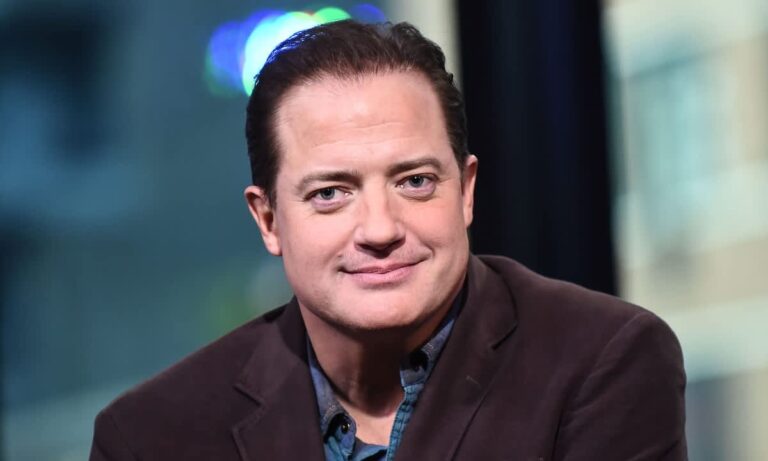
Everyone loves a great comeback story, especially when it pertains to someone as loveable as Brendan Fraser. Many of us grew up watching him in the nineties; his charm was infectious, from his goofy comedies to romantic action adventures. His optimism only made things worse when we learned the reasons for his sidelining, as it’s always hard to stomach sadness and pain from people who exude such positive energy. But seeing Fraser back the way he is now (garnering awards love too) serve as the origins of a true hero’s resurgence, and we couldn’t be happier for him.
Let’s celebrate his diverse and nostalgic filmography. What is your favorite film starring or co-starring Brendan Fraser?
Stars: Timothee Chalamet, Taylor Russell, Mark Rylance
Synopsis: Maren, a young woman, learns how to survive on the margins of society.
After a teenager gets her finger bitten off because of the cinnamon nail polish she has, a man takes her cannibal daughter to flee from the law. Welcome to this twisted entry in middle America as we follow Maren, played by Taylor Russell. an eighteen-year-old who suddenly finds herself struggling for her own survival. Maren is an outsider in Reagan’s America; she is a cannibal, naturally born as one who cannot resist human flesh when it attracts her. Now looking to find her mother in Wisconsin, Maren goes on a cross-country trek from Maryland westward, encountering a Southern loner, Sully (Mark Rylance), and a skinny young man in torn jeans, Lee (Timothee Chalamet), and both are cannibals as well. These are her first encounters with others like her on society’s fringes.
The cannibals can only survive amongst their instincts while keeping their unusual appetite a secret. As Sully tells Maren, they are called “Eaters,” for they can smell their own kind, just as how he is able to identify Maren as one. Maren finds in Lee someone who can help her move on with her quest and fall in love. It has an odd tone throughout because the story as not just one genre, but five: drama, romance, horror, suspense, and even a dark comedy. While the relationship between Lee and Maren is believable, how the drive plays out can leave a bitter taste in your mouth.
Camille DeAngelis’ young adult novel is entirely original and modernist in her approach to a coming-of-age story. How screenwriter David Kajganich adapted it for the screen, however, underlines the fault in the whole film. It plays on too many genres and too many emotions to really draw us in and keep us there. For director Luca Guadagnino, who reteams with Chalamet five years after Call Me By Your Name, it is a meandering attempt to mix millennials’ fascination with the gothic, the Americana feeling as seen in Paris, Texas, and the budding romance of two star-crossed lovers.
Other performances are fleeting, even if they are really good. Michael Sthulburg is a cannibal hick who drinks Budweiser and talking about eating an entire person (hence the title) is good, but it’s only that one scene. Jessica Harper as Maren’s adoptive grandmother Maren comes to get the answer she is seeking: she’s in and out. Going back to Sully for a moment, he’s in for just three scenes. This is not The Straight Story, but rather one that travels left and right like someone’s intestines. Speaking of which, yes, they are cannibals, but in a story with subtlety throughout, the amount of gore witnessed does turn off the mood.
The last scene of the film is what really does the story in with a sudden final act that totally embodies the confusing form Guadagnino is going for. It’s the only part where the score sounds like one from Trent Reznor & Atticus Ross when the mellow soundtrack doesn’t feel like one of theirs. There are more questions as to what should be a clear-cut ending and it leaves us unsettled and unrewarded. The answer to how you blend a story like this is that it does not taste well, cannibal or not.
This week on the InSession Film Podcast, we discuss Sarah Polley’s new film Women Talking and Ryan McQuade joins us to talk JD Dillard’s latest Devotion! Plus, a few thoughts on She Said and The Wonder.
We’ve been anticipating this episode for quite some time. We’ve championed Polley’s Stories We Tell as one of the best documentary’s of the last decade and have been eager to see what she does next. Well, Women Talking is here and it did not disappoint (on a side note, we did have a guest scheduled for this review as well, but unfortunately something came up at the last minute for her). As for Devotion, it may be the most underrated film of the year. It’s not what the marketing suggests and it’s surprisingly quite good (and a big thanks to Ryan for filling in for that review).
On that note, check out this week’s show and let us know what you think in the comment section. Thanks for listening and for supporting the InSession Film Podcast!
– Review: Women Talking (5:15) Director: Sarah Polley Writers: Sarah Polley Stars: Rooney Mara, Claire Foy, Jessie Buckley, Ben Whishaw
– Notes / Discussion (1:07:05)
This week for our break segment, we briefly discuss the journalism film She Said and Sebastian Lelio’s latest The Wonder. JD also gives us his thoughts on the charming documentary Good Night Oppy.
Review: The Whale
Top 3: N/A
Review: Empire of Light
[divider]
Help Support The InSession Film Podcast
If you want to help support us, there are several ways you can help us and we’d absolutely appreciate it. Every penny goes directly back into supporting the show and we are truly honored and grateful. Thanks for your support and for listening to the InSession Film Podcast!
Synopsis: A spy movie based in the 1980s National Security Planning.
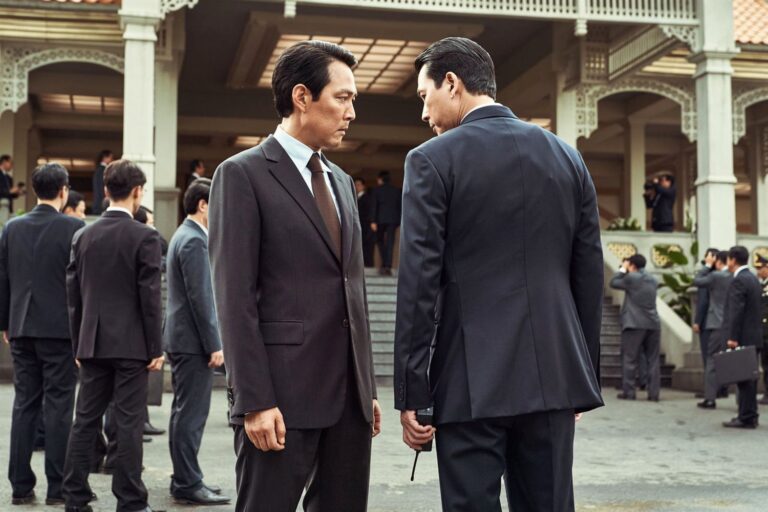
There are some sparks to Lee Jung-jae’s directorial talents, Hunt is bombastically muddled and doesn’t know if it wants the audience to take it seriously or indulge in its explosive subplot-covered demeanor.
Although he has been a South Korean star for almost more than a decade, people started to recognize Lee Jung-jae’s name via the mega-hit Netflix series Squid Game, which many binge-watched and held in high regard. He received critical acclaim for his performance in the series, which is receiving another season in due time, and a couple of awards, but Jung-jae is adding another achievement to his repertoire: a filmmaking debut, Hunt – serving as a triple threat in his debut as a writer, director, and lead actor (as well as producer). Doing all of those duties in your debut is quite hard to handle, but he tries his best to hold its espionage thriller genre trappings together with some action sequences and plot-dumping conversations. And in some parts, Hunt does find some footing and entertains slightly. However, the film is exceptionally disorganized and tries too hard to be a serious spy drama (extending its runtime by adding multiple subplots), causing the audience to lose interest quickly.
Hunt is set in 1983 in South Korea, where the 1979 assassination of the president by the KCIA (Korean Central Intelligence Agency, which was renamed the National Intelligence Service) left a weird haze in the atmosphere. There’s also a sense of distrust across the various government agencies. Amidst this turmoil, we meet two KCIA agents named Park Pyong-ho (Lee Jung-jae) and Kim Jung-do (Jung Woo-sung), who disagree with each other on multiple occasions due to some circumstances that happened between them. Their rivalry sometimes feels like a self-parody (think The Other Guys or Starsky & Hutch) due to the cliches and the nonsense of their history together. There are the classic stare-offs, quick brawls, and deception – the three basic narrative maneuvers that appear in spy thriller vendettas. Nonetheless, the two might have to work together, even though they want to tear each other apart, to find a mole within the agency and protect their country.
There are several conflicts, both from their pasts and the events transpiring, but the two need to find a way to settle their differences if they want to safeguard their place of birth. As they start doing some detective work and fighting their way through the various action-thriller sequences, Pyong-ho and Jung-do are going to confront a harsh truth that might ruin plenty of people’s lives. Will they ever find the mole within the departments? Probably, but it will be pretty difficult as everybody seems untrustworthy to somebody, causing them to question every decision they make. With lots of running and gunning, torture interrogation scenes, and endless bullet shootouts, Hunt changes its gears every couple of minutes, leaving the audience exhausted. It is too fictitious for its own good with an exaggerated sensation. There’s no sense of reality due to its expressions of violence, which tend to feel comical as the narrative, or the lack thereof, develops – including its multiple “plot twists” and backstabs.
There are times when Lee Jung-jae showcases some brilliance in Hunt via some action sequences properly choreographed by Heo Myeong-haeng, who’s known for his work in Train to Busan (2016). These sequences are drenched in pulsating exaggeration, but they are quite effective, even if they muddle the story more. One of the problems with Jung-jae’s directorial debut is that it wants to be two different things at the same time, and they have distinct tones: a serious mystery-filled espionage picture and an intense action-thriller. The balance between the two is met with only a handful of movies, which add more creaky and repetitive layers to the narrative; either it adds another action scene or goes into the rabbit hole and includes yet another plot twist. It begins to bother you as it continues because you see the quick sparks of potential in Jung-jae’s directorial effort. By the second plot twist and shootout, it lulls you into a trance of uninterest due to its convoluted narrative and repeat of what we saw before. While those are the most bothersome issues, there are also plenty of mistakes in its script.
The writers don’t take time developing the characters, leaving us with superficial details about their lives and past that, in the end, don’t make us care for the characters as a whole, especially since there’s a high body count. No coherence or substance is holding this picture together, so what is the audience supposed to grasp? It is hard to be engaged with a movie when all it wants to do (at least that’s what it seems like) is twist itself into oblivion just to appear intelligent and secretive. Hunt wants to be political and speak about it loudly via its explosive nature, and you can see it in the thin lines of the project’s malfunctioning spy-action division. However, since it is all at face value, there’s no significance to what it wants to say exactly. On paper, you can see the potential political forte, yet in execution, it blunders heavily. Even if most of Hunt doesn’t work entirely, Lee Jung-jae may have a promising career as a filmmaker because there are some interesting and creative decisions from time to time. Still, he needs to restrain himself in some manner and focus more on a singular story rather than plodding plenty of twists into a simple narrative.
This week on the Extra Film Podcast, Jay returns as they begin their Frank Capra Movie Series with It Happened One Night and they also review Luca Guadagnino’s latest Bones and All!
Frank Capra is a name that we’ve had on our list since the beginning. We’ve always been intrigued by his filmography and we felt now was a good time to dive into it a little bit. As for Guadagnino new film, we might of had a few bones to pick with it, but on the whole we enjoyed it.
On that note, check out this week’s show and let us know what you think in the comment section. Thanks for listening and for supporting the InSession Film Podcast!
– Movie Review: It Happened One Night (5:18) Director: Frank Capra Writers: Robert Riskin Stars: Clark Gable, Claudette Colbert
– Movie Review: Bones and All (43:21) Director: Luca Guadagnino Writers: David Kajganich Stars: Taylor Russell, Timothée Chalamet, André Holland
To hear this Extra Film episode and everything else we do, download our apps on the Amazon Market for Android and the Podcast Source app on IOS devices. The mobile app covers all of our main shows, bonus podcasts and everything else relating to the InSession Film Podcast. Thanks for your wonderful support and for listening to our show. It means the world to us.
It has been a decade since we last heard from wonderful storyteller Sarah Polley, that last film being the documentary Stories We Tell. Her new film is titled after yet another form of speech, Women Talking, whose title is not just prompting us to listen to the female perspective, but coincidentally the bountiful amount of female voices behind the camera in 2022. The year saw a lot of wonderful films directed by women (feature films and documentaries alike), so let’s lead by Sarah Polley’s example and celebrate what these directors had to say.
What is your favorite female-directed film of 2022?
Stars: Jonathan Majors, Glen Powell, Christina Jackson, Joe Jonas, and Thomas Sadoski.
Synopsis: A pair of U.S. Navy fighter pilots risk their lives during the Korean War and become some of the Navy’s most celebrated wingmen.
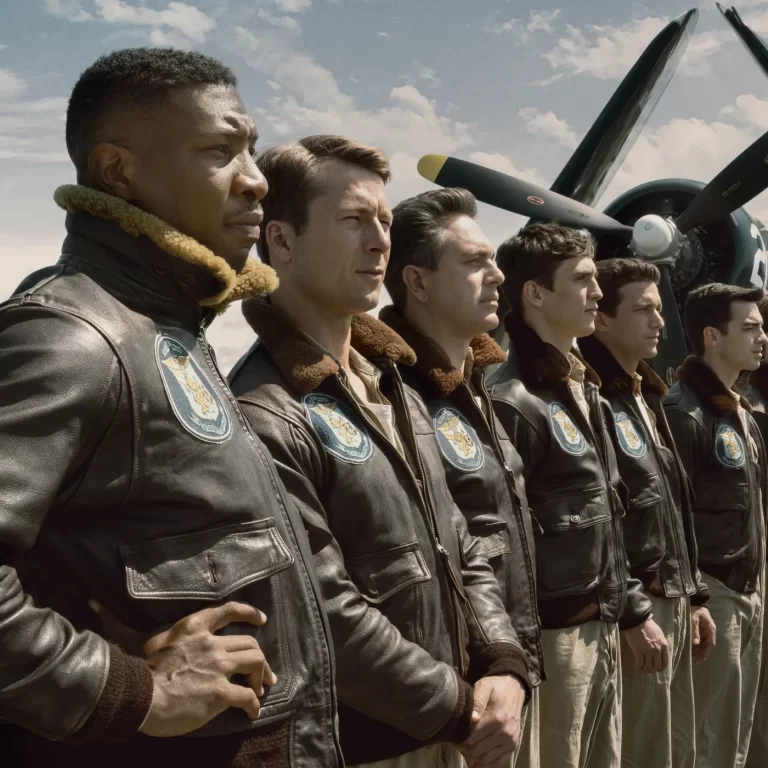
Let’s not beat around the bush: Jonathan Majors is a star. Don’t be surprised when he will predictably win an Oscar a few years from now. And he proves, once again, why that will be the case with his magnifying performance as Ensign Jessie Brown in Devotion. He carries every scene he’s in with massive emotional weight and makes the film a worthwhile watch.
The movie itself isn’t as interesting as director J.D. Dillard thinks it is, and it’s partly because it has no sense of pace. In Devotion, the movie chronicles how Brown befriended Lieutenant Tom Hudner (Glen Powell), one of the best examples of resilience during the Korean War. The first hour and a half is a huge exposition dump, chronicling the mission itself, how Brown befriends Hudner, training for the war, and a side plot in Cannes that slows the pace down to a halt.
There are a few memorable scenes inside that hour and a half, but most of it feels amazingly languishing, especially the stint in Cannes where Brown meets actress Elizabeth Taylor (Serinda Swan). That entire scene goes on for way too long and adds very little impact to neither the story at hand, nor the characters. We want to care about Brown and Hudner, but the film doesn’t give us many sequences where we can attach ourselves to their relationship, save for Hudner promising Brown’s wife (Christina Jackson) that he will always take care of him, no matter what everyone else thinks.
It would be crazy to compare Devotion with Top Gun: Maverick, another aerial film which came out earlier this year (and also starring Glen Powell), but there are many similarities with Joseph Kosinski’s sequel to J.D. Dillard’s biopic, especially with how it is structured. The first half is the training section, where we’re supposed to attach ourselves to the team, but the movie gives very little moments of “team bonding,” or tension between them. The supporting cast is mostly forgettable, especially Joe Jonas, who makes his big screen debut in a major motion picture, and yet, can’t be distinguished from everyone else. Every single side character is a chain-smoking, womanizing pilot. None of them have different traits, like in Top Gun: Maverick, where everyone has distinct personalities and abilities.
Since the movie focuses solely on Brown’s relationship with Hudner, there is no friendship, or character dynamic, being built around the team. And while Majors and Powell are the true driving forces of the movie, it isn’t necessarily the biggest flaw, but still remains a problem when you have to attach yourself to a team of pilots who can die at any second in the field of war. When a specific side character dies after his plane malfunctions, the scene doesn’t hit as much as when Goose dies in Top Gun, because we don’t know much about the characters who populate the film’s environment, save for Brown and Hudner.
And when the movie starts to kick into gear with high-stakes action, it feels too little, too late to save it. Even if composer Chanda Dancy adds lots of emotional weight to the action sequences, and cinematographer Erik Messerschmidt has a keen eye for visceral, albeit CGI-driven, visual flourishes, the character investment isn’t as strong as other aerial movies. As such, it’s hard to get invested into Devotion’s climactic setpieces, even as admirably shot and directed as they are.
Because of this, Devotion doesn’t have the impact it should have, even if Jonathan Majors and Glen Powell give powerhouse performances. They’re the true stars of the picture, especially Majors, whose next few roles in Ant-Man and the Wasp: Quantumania and Creed III will propel him to stardom even further than his tenure in Da 5 Bloods, Lovecraft Country, and The Harder They Fall. With Devotion, Jonathan Majors continues to prove that he is one to watch, and will win an Academy Award much sooner than everyone anticipated
Writers: Emma Donoghue, Sebastián Lelio, and Alice Birch
Stars: Florence Pugh, Tom Burke, Niamh Algar, Toby Jones, Ciarán Hinds, Kíla Lord Cassidy, and Elaine Cassidy.
Synopsis: A tale of two strangers who transform each other’s lives, a psychological thriller, and a story of love pitted against evil.
Sebastián Lelio’s The Wonder starts out incredibly promising, with the narrator (Niamh Algar) introducing us to the “film” that is The Wonder and showing the film set that its main characters will populate for the next 103 minutes. Ari Wegner’s impeccable cinematography and Kristina Hetherington’s sharp editing “transports” us to 1862 Ireland, as nurse Lib Wright (Florence Pugh) is tasked to observe a girl (Kíla Lord Cassidy) who has allegedly not eaten in four months.
Lib believes it’s impossible, but it’s up to her to determine what’s going on. A journalist (Tom Burke) also starts to investigate the phenomenon, and falls in love with Lib in the process, which complicates “the watch.” From there, The Wonder starts to veer off from a linear structure and becomes a fantastical drama, hindering any chance at character development, or legitimate investment.
Of course, the movie doesn’t want you to invest yourself in the realism of the story, but to be entranced by its metaphors and themes, which are interesting in isolation, but don’t amount to much as soon as the movie is over. I was much more taken aback by Florence Pugh’s incredible performance as Lib Wright, who truly holds the emotional core of the movie together from beginning to end. The scene in which she reveals how Anna (Cassidy) is “not eating” to a committee full of old, white men (featuring underused, but effective performances from Toby Jones and Ciarán Hinds) is the film’s highlight. Pugh continues to prove why she’s one of the greatest performers working today, and her emotional resonance she brings to the moment itself cannot be overstated.
She shares exciting chemistry between Kíla Lord Cassidy, whose Anna O’Donnell is painted as a “wonder,” because of how she was able to survive this long without food, but her “wonder” is more of a mystery. It’s intriguing to see how Lib tries to peel back that mystery and “wonder” (ha!) how she is able to naturally function for months without food.
Her real-life mother, Elaine Cassidy, plays Rosaleen O’Donnell, Anna’s mother, and she is just as terrific as Kíla. There’s a legitimate sense of tension going on between Rosaleen and Lib, to which Dr.McBrearty (Jones) tries to subside, but to no avail. Matthew Herbert’s frightening, string-heavy score, adds tons of riveting atmosphere to the material, including Ari Wegner’s amazing cinematography that paints the bleakest world possible. Those elements make the movie watchable, but the film’s numerous flaws prevent it from being a must-see.
None of the characters are that interesting, especially Tom Burke, a. Byrne’s relationship with Lib is barely developed, and doesn’t give us any time to attach ourselves to their characters, while Anna’s personality consistently shifts in so many different directions that it’s hard for us to start getting invested in the story, and understand what type of “wonder” she exudes. Anna says she gets her “food” from “manna from heaven,” but it may not be the case. This makes for an interesting premise, but Lelio prefers not to explore any of them within its second and third act, and instead craft an ambiguous story whose themes are enthralling enough, but never sticks the landing.
Because of this, The Wonder doesn’t instill “wonder,” nor enjoyment. It’s watchable enough, because of Pugh holding the emotional fort of the film down, Herbert’s score, and Wegner’s amazing shots, but it won’t linger in my memory more than that. Lelio’s previous films, A Fantastic Woman and Disobedience, are far stronger than The Wonder, though I appreciate him writing female leads that strong actresses can perform with such bravura. It’s a feat to applaud, even if the finished product isn’t perfect.
Directors: Steven Spielberg Writers: Steven Spielberg, Tony Kushner Stars: Michelle Williams, Paul Dano, Seth Rogen, Gabriel LaBelle, Judd Hirsch
Synopsis: Growing up in post-World War II era Arizona, young Sammy Fabelman aspires to become a filmmaker as he reaches adolescence, but soon discovers a shattering family secret and explores how the power of films can help him see the truth.
There have been a glut of semi-autobiographical films by prominent filmmakers over the last few years. Usually they are made by directors who have a style of course, but lack a certain coherence of vision throughout every project they dream up or undertake. You can see their bells and whistles, their favorite tricks, they work with a tight crew or a solid rotating behind the scenes cast, but none of them is Steven Spielberg. None of them have that presence on screen.
When you sit down to let the darkness of the theater take hold, to envelop you in the light of the screen, you know from the first frame, it’s a Spielberg picture. His standby techniques and his favorite compositions are familiar, but are no less astounding when they make their appearance. The Fabelmans has every Spielbergian trick to it, but it’s clear that, even with the trademarks, this is different territory for Spielberg as an artist.
It’s true that if one parses Spielberg’s films they find short bursts of autobiographical clues, feelings, nods, and whispers. He’s not an open book, but we know him like we know the rest of our idols. Often in a Spielberg film we’re given excellent moments of tension, beautiful beats of a moment landing, bombast, adventure, drama, tension, yes, but what The Fabelmans delivers is a moment of silence. There’s something to be said for a director to nod to us like he hears us. He nods to us like he heard our friend parrot an opinion about Spielberg not understanding real emotion. He nods to us like he heard the guy coming out of the theater claiming the film’s score is emotionally manipulative. He revels in showing us this silence, in not cutting from the discomfort and letting it drag out on screen. It’s not as clean or clear as his more populous films. The Fabelmans lives in a gray area, in the minutiae with no stoic heroes, no obvious villains. It has no strong score telling us who is who.
Most of the music in the film is diegetic. Mitzi Fabelman (Michelle Williams) is a skilled pianist and plays often throughout the film when there isn’t period appropriate pop music or those spare bits of John Williams’ brilliance. In one of the longest sequences, Mitzi plays late at night as Burt (Paul Dano) looks on and Sammy (Gabriel LaBelle) edits the footage of the family camping trip in his room. We see the reverence Burt and Sammy have for Mitzi, Sammy for her charms and lust for life and Burt for her intricate and precise skill. While Burt sinks deeper into his reverence, Sammy notices something in the background of his raw footage. He sees a secret he isn’t supposed to see. Spielberg lingers within this simultaneous moment. He bathes us in the full spectrum of the character’s emotional journey without a hint of dialogue or an easy answer, but what we see is Sammy’s heartbreak and we see the sheen of Burt’s awe slip as his mind wanders from Mitzi’s form to what Mitzi’s going through. The not incongruous music doesn’t push us to these emotional catharses, the actors, alongsideMichael Kahn and Sarah Broshar’s stellar editing shows us the depth of feeling.
There are several sequences like that where we’re shown how much Sammy is detached from everything else when he’s filming, where we’re shown how much he’s missing with a camera in front of his face. He detaches himself in the moment, but when he gets to his editing suite, he puts his emotional state into the visual metaphor of his work. It’s the shots of Sammy as he projects his finished product that are the best composed and the most imbued with the emotion he struggles to express. Cinematographer Janusz Kaminski builds these scenes of light and shadow across Sammy’s face with a delicate touch. Kaminski’s movement and Spielberg’s composition make these shots of Sammy and his audience the emotional core of the film. In spite of the failure Sammy has with communicating his emotions, his films speak volumes to the people he needs them to; whether they want to acknowledge it or not. It’s all done in the dark, but it’s so beautifully clear.
While the showier role is Mitzi, there’s something to marvel at Paul Dano’s Burt. It’s clear Spielberg wanted us not to blame Burt, not to force Burt into a corner either of pity or hatred. Burt is a man who says too much about the things he loves. He’s a passionate man who works, really tackles things. Never has Dano been better at his meek persona, his man bursting with ideas, who keeps it in reserve, who feels trod upon and forgotten. He doesn’t chew scenery, but seethes underneath it, lingers about it, and takes it all with a gentleness and benign nature that is utterly remarkable.
The Fablemans is a remarkable film overall, but it leaves a lot of loose threads. There seems to be a want to get all of it down, all of it in there at once. Focus is pulled, our eyeballs set on one thread, are bounced to the next. It’s possible that Spielberg told Tony Kushner when they sat down to write that he’s only going to do this once. So, then, they tried to get everything, while also having movies within movies and a coda that, while very fun, is a bit of hokum. In a movie this beautifully made, though, it’s easy to forget what you don’t like and marvel at the mastery of what you do like.
That’s Spielberg’s oeuvre in a nutshell. He’s made stinkers and masterpieces and some that are just a good time at the movies. He’s a director that appeals to the movie lover in all of us because in the midst of the bombast and action, he can find that heartstring to tug. He sees us in our seats and he wants us to feel something. With The Fabelmans he’s allowing us to feel all of him, warts and all. The warts are small and the feelings are magnificent. It may not be a masterpiece, but The Fabelmans is a beautiful work of art.
Synopsis: A father’s wish magically brings a wooden boy to life in Italy, giving him a chance to care for the child.
One of the greatest stories ever written, Carlo Collodi’s wooden puppet has seen countless adaptations. The beloved tale is one of the most essential stories ever told, in its deep commitment to teaching its audience about the difference between right and wrong. This story is ripe for further examination, as the world it exists in has only become more complex, so the prospect of a filmmaker like Guillermo del Toro tackling it rightfully garners excitement. After all, the maestro has shown cinephiles time and time again that even in the most dire and terrifying of situations, he can extract moments of beauty and turn them into some of the most dazzling films ever created. Guillermo del Toro’sPinocchio is no exception, as this stunning stop-motion animated film is full of darkness and despair, with an immense amount of beauty behind every miniature character and set piece.
Set during the rise of Italian fascism in between World War I and World War II, this adaptation reads far less like a fairytale than its predecessors. Of course, there are still an immense amount of fantastical elements that allow del Toro and his crew to express their wildest dreams, or nightmares, however they see fit. But, Monstro the whale and turning into a donkey are no longer the most terrifying elements of this children’s story. Instead, the characters within this film inhabit a very real and incredibly chilling period of human history. As banners of Mussolini can be seen all throughout the world of Guillermo del Toro’sPinocchio, there is a constant reminder of what Pinocchio (Gregory Mann), and subsequently all of his peers, neighbors, and even enemies, are up against. Even in the introductory moments of this film, del Toro highlights the wickedness and sheer cruelty of fascism. The reality of the film is set in stone with no sugar coating for its younger audiences, which is crucial, as Guillermo del Toro’sPinocchio thrives by treating audience members of any age with the utmost respect. In similar fashion to his 2006 film, Pan’s Labyrinth, being set just after the Spanish Civil War, del Toro depicts a world full of fantastical creatures at risk from a very real, deliberate evil. The stakes are painfully set in stone in both films, with no excuses being made to justify the cruelty that occurs in the face of fascism. To attempt to address the devastating effects of unchecked power and fascist beliefs in any way other than directly would be irresponsible.
As Pinocchio becomes discovered by the town, he is met with fear, disgust, and even outrage. That is not all, however, as the Podestà sees great potential in the wooden boy; he sees an unstoppable soldier, but more importantly, “an independent thinker” who could cause more harm than any true weapon ever could. In a statement regarding the film, del Toro said that he wanted to create “a story about a world, as Mussolini ascends to power in Italy, where everyone behaves like a puppet – except the puppet.” In the source material, as well as many subsequent adaptations, audiences have often seen or read how Pinocchio learns to become a real boy. Through the teachings of his father, Geppetto (David Bradley), and his conscience, Sebastian J. Cricket (Ewan McGregor), Pinocchio learns the difference between right and wrong, and in turn becomes a real boy. Guillermo del Toro’sPinocchio instead looks to circumvent these notions, and more often than not, we witness his Pinocchio teaching others in a variety of ways. With charming humor and exuberant style, the young protagonist doubles as a beacon of hope for those he encounters on his journey. And it is Mann’s wonderful debut voice performance that makes each encounter with the pure evil of fascism all the more upsetting. What makes Guillermo del Toro’sPinocchio so impactful is that whenever Pinocchio must face off against a villain, it feels like a battle for the very soul of innocence.
A film like Guillermo del Toro’sPinocchio should be treasured and protected. It’s a crucial reminder to appreciate what we have, and to recognize just how quickly it can be taken away. There will always be evil in the world that hopes to rise up and crush anything that may oppose it, but there will also be good. In this film, del Toro successfully navigates the space between the two, through the lens of a young puppet learning what it means to be alive.
This week on the InSession Film Podcast, the great Sophia Ciminello joins us to discuss Steven Spielberg’s latest The Fabelmans and we also review Guillermo del Toro’s new animated film Pinocchio!
A massive thanks to Sophia for joining us on the show this week. Her work on Extra Film over these last few months was astounding, and we’re grateful that she was able to hop on with us after they concluded our Martin Scorsese Movie Series with an almost 3-hour episode(!!). Her passion for The Fabelmans was more than welcomed and we had a great time talking about Spielberg through it all. We also had a lovely time reviewing Pinocchio, one of the best animated films from the last few years.
On that note, check out this week’s show and let us know what you think in the comment section. Thanks for listening and for supporting the InSession Film Podcast!
– Review: The Fabelmans (5:15) Director: Steven Spielberg Writers: Steven Spielberg, Tony Kushner Stars: Michelle Williams, Paul Dano, Seth Rogen
– Notes / Discussion (1:07:05)
This week for our break segment, JD gives us his brief thoughts on the horror film Barbarian and we talk about our next Patreon Bonus Content episode.
– Review: Pinocchio (1:28:56) Director: Guillermo del Toro, Mark Gustafson Writers: Guillermo del Toro, Patrick McHale Stars: Ewan McGregor, David Bradley, Gregory Mann
If you want to help support us, there are several ways you can help us and we’d absolutely appreciate it. Every penny goes directly back into supporting the show and we are truly honored and grateful. Thanks for your support and for listening to the InSession Film Podcast!
This week on the Extra Film Podcast, Ryan and Sophia conclude their Martin Scorsese Movie Series with a double bill of Silence and The Irishman! Thank you to Sophia for time with us over the last few months!
What an epic conclusion to one of the most enjoyable series we’ve ever done on the podcast. Martin Scorsese is simply the 🐐 and we had the best time breaking down all of his movies. Silence and The Irishman are especially fascinating because they’re manifestations of a filmmaker reflecting on what has defined him his entire career. So to end with those two was perfectly satisfying. Also, a huge thanks to Sophia for joining us once again. She was a great co-host and we’ve loved having her a part of the team over these last few months.
On that note, check out this week’s show and let us know what you think in the comment section. Thanks for listening and for supporting the InSession Film Podcast!
– Movie Review: Silence (4:31) Director: Martin Scorsese Writers: Jay Cocks, Martin Scorsese Stars: Andrew Garfield, Adam Driver, Tadanobu Asano
– Movie Review: The Irishman (1:19:57) Director: Martin Scorsese Writers: Steven Zaillian Stars: Robert De Niro, Al Pacino, Joe Pesci, Harvey Keitel
To hear this Extra Film episode and everything else we do, download our apps on the Amazon Market for Android and the Podcast Source app on IOS devices. The mobile app covers all of our main shows, bonus podcasts and everything else relating to the InSession Film Podcast. Thanks for your wonderful support and for listening to our show. It means the world to us.
Director: Noah Baumbach Writer: Noah Baumbach Stars: Adam Driver, Greta Gerwig, Don Cheadle
Synopsis: A contemporary American family attempts to deal with the mundane conflicts of everyday life while grappling with the universal mysteries of love, death, and the possibility of happiness in an uncertain world.
While there might be occasions where we see Noah Baumbach struggling a bit with the so-called “unfilmable” source material, White Noise ultimately thrives because of its self-aware, genuine heart and keen intellect on contemporary America. It’s a film fueled by our fear of death (the essence of nothingness and existential angst) and embalmed in brilliantly executed darkly comedic melancholy.
“All plots tend to move deathward. This is the nature of plots. Political plots, terrorist plots, lovers’ plots, narrative plots, and plots that are part of children’s games. We edge nearer death every time we plot. It is like a contract that all must sign, the plotters as well as those who are the targets of the plot.” These are some of my favorite lines in the world-renowned novel White Noise. Out of all the memorable and impactful texts written by the American novelist Don DeLillo, why was this the one that stood out to me? Well… because it is obviously true. Every narrative (no matter the genre), in some way, shape, or form, tends to move toward the eternal abyss of nothingness, whether it’s a story about two young lovers, a man chasing his dreams, or a person who has lost it all. Even if the central death (the end of the narrative’s leading character) isn’t showcased on-screen, you tend to think about its ending and what may occur in the future of the character(s).
This line brilliantly opens your eyes to the cinematic or artistic reality that every person with a vision and a knack for creativity often tends to deliver their stories with a sense of cessation in the air. And, somehow, that translates back into ‘White Noise’, whose main narrative gadget is an airborne toxic event – a black noxious cloud caused by a chemical spill from a rail car crash. That’s what’s occurring in the background; meanwhile, the characters are all experiencing a set of side effects that causes a deep sensation of desolation, melancholia, and depression. What’s brilliant about the book is that it fits this particular time we live in, specifically the last two years that have transpired. Because the pandemic had us all reflecting on our own mortality (our fear of death being more apparent than ever before), the safety of our loved ones, and how we would go back to normal after all of this time, people got inspired to write projects that didn’t mainly center around the virus but felt perfect for our times.
One of those projects was Charlie Kaufman’s I’m Thinking of Ending Things, which related to our constantly blurred state of mind and our contemplation of mortality as we stared into the ever-growing walls and ceilings of our rooms as the days passed each time, feeling as if it grew two sizes. It was morbid and truthfully melancholic, but Kaufman managed to capture what many of us felt during the time. Now, you can add another film to that small list of movies with yet another adaptation of what is considered an “unfilmable” novel: Noah Baumbach’s White Noise. This is not unlike any other project Baumbach has delivered in every single one of its aspects – visually, tonally, budget-wise (almost eighty million dollars), and its playfulness in genre trappings. It creates an absurd yet brilliantly effective Molotov cocktail that contains a deadly combination of dark comedy, horror, thriller, disaster movie, and drama tropes. That burning bottle is thrown to the audience and immerses us in the flames of chaotic despair enhanced by the film’s erratic behavior.
White Noise centers around a contemporary American family, the Gladneys, as they attempt to face the prosaic conflicts of everyday life while other problems arise – love, death, and uncertainty meet with one another in the form of a black cloud that blurs the sanities of this loving family and the people around them. It begins with a lecture by Murray J. Siskind (Don Cheadle), a professor at The College on the Hill in Ohio obsessed with American icons, most specifically Elvis Presley. However, the lesson isn’t about the rock n’ roll star but about the “American optimism” found in car crashes. He’s enthusiastic about it, often feeling as if he’s trying to convince the audience to agree with his sentiments. While he talks about the spectacle of the roaring flames caused by such accidents, the viewer notices that he’s emphasizing the aspect of death. That’s what draws the students’ attention. They seem to agree with what’s being told. Meanwhile, J.A.K. (pronounced as Jack) Gladney (Adam Driver), a professor in Hitler studies, is putting his attention on the station wagons – seeing the “fresh off the bus” people walking into campus.
After a hard day’s work, he goes home to his wife, Babette (Greta Gerwig), and his four kids (from four different marriages), Denise (Raffey Cassidy), Heinrich (Sam Nivola), Steffie (May Nivola), and Wilder. The first chapter of the film, titled “Waves and Radiation”, tells the story, in a satirical fashion, of how contemporary family functions and mocks the academic system in America. The capitalist consumerism and the allure that comes from supermarkets – shopping serves as a coping mechanism to figure out the strange world around them. Its beginning is all about displacement, mostly the disillusion and disconnection that characters have with one another, and the supermarket scenes help express that lack of association. Along with television, drugs, and news tabloids (icons of postmodern lifestyles), supermarkets serve as a way to help their inner worries – as an escapist gateway where everybody interacts without concern. It keeps them from losing their sense of control in a world constantly feeding fears and chaos into their minds.
Each time they visit a supermarket, they feel complete; the bigger the number of purchases, the more fulfilled they feel. The commodities drive their world, and avarice devours their mentalities surely, but slowly. When the second chapter arrives, “The Airborne Toxic Event”, that’s where we begin to see J.A.K. confronting his biggest fear: death. The chemical cloud flies through the skies, chasing the Gladney clan everywhere they go. And it haunts all of them, not only J.A.K.; they are pretty worried, even questioning how scared they should be regarding what’s happening. This is the key to the film; this is where everything starts to unravel – dread is added to the already darkly melancholic atmosphere. As The Gladneys experience different dilemmas to survive all this chaos, J.A.K. and Babette are struggling with getting a hold of themselves; because of this situation, death is swallowing their souls. A loss hasn’t happened, but just the fact that this toxic event might kill them, even if there is no proof, is causing them to panic severely.
The beauty of these hilarious yet saddening moments is presented not only because of the sharp script by Baumbach but the performances. Driver submerges himself into J.A.K.’s persona, delivering monologues about fame, death, and motherhood with ease. Meanwhile, Gerwig does what she does best, embrace the awkward to the point of brilliance. There might be a purposefully imbalance of tones in White Noise, but Gerwig and Driver manage to get a hold of everything DeLillo’s source material throws at them. Then there’s Don Cheadle, who does not have enough screen time and does a fantastic job giving Murray life on the big screen. His line delivery is acute and precise, matching the tone of the script perfectly. However, one of the essential factors in White Noise that some people might miss out on is the various sounds – the overlapping chatter and conversations, the background noises, static of the television, amongst others. Baumbach throws the idea that the racket and cacophony of the ongoing chaos in their daily situations distract them from embracing the harsh facts of reality.
They feel they can “cheat” death (and their fear of it) as long as there’s noise constantly buzzing in their ears. The white noise of its title refers to those same elements of distraction and disallowance to abide. There’s an ongoing intersection between death and sound (life), where they can even be confined in an eerie chime. And it is true; many of us use sound or even play something in the background to try and fall asleep. It’s brilliant that decades later, DeLillo’s work can still apply to today’s society, with little differences. The mechanisms of our existence have changed but in a more technological route. Yet, at its core, everything remains the same. While I don’t think it surpasses the emotional effectiveness of his previous feature, Marriage Story, Noah Baumbach’s White Noise truly serves its purpose, causing chills down your spine as you contemplate your own mortality and laugh at the pain of your insecurities and doubts toward the great beyond.
That’s why I genuinely love this movie; it moves the viewer because we all have had those days where, out of the blue, existential panic kicks in, and your mind blurs for a quick minute until you relax. And at the same time, one remains at ease because of its hilarious dialogue. This duality between hysterics and pang generates images in your mind that stay with you for an extended period of time. In the end, it is satirical and effervescently funny, poking fun at contemporary America for its banality, the resonance of capitalist consumerism, and the obsession (and the conduct that arrives) with impending doom. Nevertheless, there are moments of honesty where you feel that the cast and crew’s own fear of death power their respective work – Baumbach’s script, Adam Driver and Greta Gerwig’s performances, the score by Danny Elfman, etc. It’s an apocalyptic film that doesn’t revolve around the cataclysmic event that transpired but around how humanity copes (or at least tries to) with the fear of extinction, both as individuals and as a family.
White Noise is a weird experience that’s worth watching at the cinema to undergo its purposefully erratic and hilarious behavior, ending with an original dance sequence that involves LCD Soundsystem’s new track, “New Body Rhumba”, which serves as a “coming to terms with death” anthem (and it’s a smashing record to be completely honest). Although the dance-punk record might have a The B-52’s vibe and lively sensation, the song contemplates the film’s themes. Its first lyrics are “climbing the down escalator to the frigid bardo”, giving the listener (and viewer) their first hints that this is indeed an anthem about the liminal state between death and the great beyond. And the outro refers to the light at the end of the tunnel, where people tell the dying not to reach it because they don’t want them to go away. This reminds me of the bickering between Jack and Babette, where they talk about wanting to die before their partner because it would break their heart entirely – a conversation ending with “let’s just live forever”.
Through energetic guitars, clapping percussions, and funky synths all intertwined for seven minutes long, the track captures the slow road of embracing death while the cast of the film dance as if nobody was watching in the colorful supermarket aisles. This perfect conclusion complements what was presented beforehand and adds a level of cinematic magnetism. The more I have thought about and analyzed White Noise, the more I have found myself enjoying it. White Noise is one of those films where your conversations with other people about its dark topics can heighten your opinions towards it. I spent all night thinking about it and concluded that I loved it for all of these specified reasons; how it makes us contemplate life and laugh through the morbid makes up for a unique experience. This is by far Noah Baumbach’s most creative and distinctive, coincidentally being the one that has made me ponder the most. There might be occasions where you see Bambach struggling with the hefty source material, but, in conclusion, he delivers a worthy adaptation filled with empathy and dismay, both in captivating equal measures.
I’ve never believed in cancel culture because it doesn’t exist. You cannot erase a person’s work and you can admire someone’s art while acknowledging their troublesome past. Roman Polanski, Harvey Weinstein, Ezra Pound, Eric Clapton, and Michael Jackson; all are figures from different areas with some terrible reviews or actions they have done. Do you think even Kanye West’s Hitleresque remarks recently will make people delete his music? Nope. What about Bill Murray’s history of abuse towards others on sets? People will rewatch Ghostbusters and Groundhog Day,while I still love his performance in Rushmore and Lost In Translation. And then, there is the shocking fall of Claude Jutra.
Jutra is still one of Quebec’s greatest filmmakers. The French-Canadian got his start in movies at the age of 18 when he made two short films. After studying medicine in college, Jutra decided to pursue his interests in movies by joining the New World Theatre in Montreal. He would write plays for Radio Canada as well as act in them, then worked with the National Film Board as Jutra would direct several television programs. In 1957, Jutra and director Norman McLaren made A Chairy Tale, a short animation film that won the two an Honorary BAFTA and the Canadian Film Award for Best Experimental Film.
In the 1960s, Jutra started to branch out more independently and make full-length feature films. Inspired by the French New Wave and the start of the “quiet revolution,” a progressive shift in social and political norms in Quebec, Jutra made A Tout Prendre, a semi-biopic based on his own life in which he dated a Black woman while struggling to come to terms with his homosexuality. He and his ex-girlfriend, Johanne Harrelle, played a fictionalized version of themselves. Directors Jean Renoir and John Cassavettes would be among those to praise the film. A Tout Prendre would win Best Feature at the Canadian Film Awards in 1964.
Because of the controversy surrounding its content, Jutra, who produced the film himself at a very low budget, was forced to keep to documentaries for the rest of the decade. Then, in 1971, Jutra would make a film considered one of the greatest in Canadian cinema. It was Mon Oncle Antoine, a coming-of-age story about a teenage boy growing up in a mining town in old, clerical-run Quebec in the late 1940s. Keeping up with his style of modernist storytelling, Jutra put together a wonderful tale where the boy learns about love, sex, work, and death in a time when they were kept from advancing in society. Again, Jutra won Best Feature and was Canada’s entry for the Academy Awards, but did not get nominated.
Jutra would go on to work in Ontario on several films and TV productions before returning home to Montreal in the 1980s. He was diagnosed with early-onset Alzheimer’s Disease and Jutra committed suicide on November 5, 1986. Many tributes were given to him after his death, including the Jutra Awards, the ceremony honoring the best of Quebec cinema. It would be called such until 2016 when a massive expose rocked the whole province.
In a biography of Jutra, writer Yves Lever revealed that the legendary director was known in some circles to be a pederast, having groomed and had sexual relations with several underage boys. Although Lever hadn’t intended on writing about Jutra’s affairs at first, the revelations in just four pages caused a massive stir. An excerpt in Lever’s book stated: “At the time, it didn’t matter,” believed some, who did not imagine that Jutra had ever brutalized a young lover: he would have seduced with his kindness, his delicacy, his gifts. During the shooting of Mon Oncle Antoine, for example, rumors circulate in the region that some of the teenagers who participated in the film benefited from a very special relationship with the director. None of them talk to their parents, only to a few companions. A handsome teenager related to amateur actors who participate in the film becomes Jutra’s “official” lover and remains so for a few years.”
Not long after, victims of Jutra came forward to tell their stories to the public and their accusations were verified by others aware of the abuse. One was six years old when he and Jutra first met and was forced into performing sexual acts until he was a teenager. Another came forward and stated that Jutra molested him once when he was 12. Those close to Jutra admitted that he had affairs with teenage boys, but claimed they were no younger than 16. Regardless, it was substantial enough for the Prix Jutra to be renamed and for streets and parks named after Jutra to be changed immediately. Per The Globe And The Mail, “Few legendary figures have fallen so quickly and so completely. Merely 24 hours after the official publication of the first explosive allegation of child abuse against the Canadian cinematic pioneer, the film industry and governments started scrubbing the name Claude Jutra from every trophy, park, and street.”
Since this stunning posthumous downfall six years ago, Jutra is left as a great director in Quebecois cinema tainted by stories of his disgusting habits. There is enough testimony and support by those that acknowledge Jutra as a predator who liked underage men and boys. He is now with those associated with similar misconduct, which is devastating considering the value of his work in French-speaking Canada. Jutra’s work lives on but will forever have the shadow of his behavior hovering over him.