Home Blog Page 203

Movie Review: ‘The Midnight Sky’ is a Futuristic Drama Filled With Tropes


Director: George Clooney
Writer: Mark L. Smith
Stars: George Clooney, Felicity Jones, David Oyelowo, Caoilinn Springall

Synopsis: A scientist alone in the Arctic Circle must contact a crew of astronauts on their way home during a global catastrophe

[/info]

If there is a type of film that I always find intriguing at the very least, it’s the introspective space drama. In the last decade, we’ve been treated to spectacles such as Gravity, First Man, and Ad Astra that are not only visually striking, but dive into personal explorations of their characters. That’s why I was drawn to the new Netflix film The Midnight Sky, starring and directed by George Clooney. Unfortunately, rather than serving as another fascinating entry in the genre, the film spends its runtime sifting through recycled narrative clichés. 

Clooney’s character is Augustine Lofthouse, a scientist whose goal is to find habitable structures in Earth’s solar system. The film, taking place primarily in 2049, indicates that he was responsible for locating K-23, a moon of Jupiter that may be able to support human life. However, after a crew is sent to explore the moon, a radiation pandemic wipes out most of Earth’s population and leaves Augustine ill, with time running out. Rather than evacuate Earth, he decides to remain on his isolated base in the Arctic. He spends his time trying to reach out to active space missions, with the goal of informing them not to return to the ruined Earth. 

It is early in this period that a young girl (Caoilinn Springall) randomly arrives in Augustine’s research station. Assuming that she was accidentally left behind when others evacuated, Augustine unsuccessfully tries to communicate with the departees. Though she does not speak, Clooney learns through her drawings that her name is Iris, and the two have an almost immediate connection. Soon after, Augustine discovers that Æther, a space mission from K-23, is heading back to Earth. As a result, the primary conflict of the film is the journey of Augustine and Iris to find a strong enough signal to reach the spacecraft and warn the crew about the state of Earth. 

Essentially, this film features two stories: the one that takes place with Augustine on Earth and the one that takes place aboard Æther. The former begins in an intriguing way, depicting the new everyday livelihood of Augustine, including a daily routine of dialysis to survive as long as he can. However, this quickly descends into a wandering collection of expected common plot points and reveals. The second story feels almost meaningless, with characters that are thinly developed and just not given the time they require. 

Take, for example, a character (unnamed to avoid spoilers) who suffers a devastating injury while trying to repair a radar during an asteroid strike. The scene is played with heavy emotion, but it doesn’t work considering we barely knew the person before the incident. Even Sully (Felicity Jones), the character we are most meant to empathize with, comes off as forgettable leading up to a major reveal about her that feels completely unearned. 

But of course, the character we should be most concerned with is Augustine. Clooney plays the role quite well, considering what he had to work with. Thus, the issue isn’t the acting but the directing. In addition to a loaded, derivative narrative, the film’s pacing doesn’t allow for much excitement from the viewer. Though the relationship between Augustine and Iris should be the emotional draw of the film, it feels more random than anything else. In an effort to make the relationship worthwhile, the film resorts to an underexplored backstory and an eye-rolling twist in the end of the film. It’s clear that this aspect of the story was not fleshed out the way it needed to be, considering we spend so much time on Æther in the late scenes of the film. 

While the film struggles mightily by being built on tropes rather than an original, deeply personal narrative, there are some solid aspects here. The scenes in the Arctic and outside of the spacecraft are beautifully shot by cinematographer Martin Ruhe. And aside from a cartoonish use of green screen during a dream sequence on K-23, the visual effects are quite remarkable as well. Of course, Alexandre Desplat always delivers with the musical score, though at times it feels like more of a distraction than a cohesive part of the film. While the film isn’t a total loss based on these areas, the lack of a convincing narrative and a connection to the characters makes for a tough sit. 


Grade: D

Podcast: Indiana Jones and the Kingdom of the Crystal Skull / Bacurau – Extra Film

On this week’s Extra Film, Ryan and Jay conclude the Indiana Jones Movie Series with Indiana Jones and the Kingdom of the Crystal Skull, and they also review the Brazilian thriller Bacurau!

Known for being the most divisive film in the series, the Extra Film boys set out the review the last film in the Indiana Jones Series with Indiana Jones and the Kingdom of the Crystal Skull. Released around 20 years from the last installment, Ryan and Jay heavily debate whether all who are involved seemed to have the heart in this project. This makes for probably their best review of the series and leads to a lot of insightful, hilarious moments in this review.

In the back half of the episode, the boys take a look at Bacurau, a film from the beginning of the year they thought they need to review before the big end of the year show. Known for being one of the best films of 2020, Ryan and Jay discover a mind-bending exercise in genre and class that seems to meet all the praise it’s been receiving. Bacurau is one of the biggest surprises of the year and a movie everyone should see before you close out your best of the year lists.

Also, stay tuned for the end of the show to find out what the guys will be covering as their first director movie series of 2021!

Thanks for listening!

– Movie Review: Indiana Jones and the Kingdom of the Crystal Skull (3:50)
Director: Steven Spielberg
Screenplay: David Koepp
Stars: Harrison Ford, Cate Blanchett, Karen Allen, Ray Winstone, Shia LaBeouf

– Movie Review: Bacurau (56:47)
Directors: Kleber Mendonça Filho, Juliano Dornelles
Screenplay: Kleber Mendonça Filho, Juliano Dornelles
Stars: Sônia Braga, Udo Kier, Bárbara Colen, Thomas Aquino

– Music

Nevada, 1957 – John Williams
Bacurau – Mateus Alves
The Return of the Eagle – Atli Örvarsson

We try to make this the best movie podcast we possibly can and we hope you enjoy them. Subscribe today on iTunes, Spotify, or Stitcher, and please leave us a review on iTunes. You can also find us on Soundcloud, PlayerFM, and TuneIn Radio as well. We really appreciate all your support of the InSession Film Podcast.

Subscribe to our Podcasts RSS
Subscribe to our Podcasts on iTunes
Listen on Spotify
Listen on Stitcher
Indiana Jones and the Kingdom of the Crystal Skull / Bacurau – Extra Film

[divider]

To hear this Extra Film episode and everything else we do, download our apps on the Amazon Market for Android and the Podcast Source app on IOS devices. The mobile app covers all of our main shows, bonus podcasts and everything else relating to the InSession Film Podcast. Thanks for your wonderful support and for listening to our show. It means the world to us.

Op-Ed: 100 Years…100 Passions- ‘Vertigo’ (#18)

I will be watching and reviewing all of the films included on AFI’s 100 Years…100 Passions list. The list contains the 100 greatest love stories in American cinema and I plan to consider how our views on romance and social issues have changed over the years as well as judge whether the romances in these films actually made me swoon. As a fan of the romance genre, I expect to love each and every one of the nominees but I also don’t know if I would consider all of them romantic.


Does a film need to be flawless in order to be considered a masterpiece? I don’t think so but I don’t like it when people feel the need to argue that something is perfect simply because they love it. I would admit that most of my favorite films have one or two significant flaws but there is one overriding factor that causes me to overlook all of those negligible shortcomings. I think I understand why people are so obsessed with Vertigo as it puts them in a unique headspace. The protagonist exists in a world where nothing makes sense and he has to cling to his obsession as he makes sense of what is going on around him. This does not mean that the plot isn’t rather silly. Alfred Hitchcock brings in most of his usual preoccupations and crafts some of the most beautiful shots of his career as he puts the Golden Gate Bridge to use in an unforgettable manner and is able to put the audience in the position of a creepy voyeur whilst making the audience relate to said, creepy voyeur. I can’t help but feel like Vertigo is more of the same from Hitchcock as it explores all of the themes and motifs that were present in Hitchcock’s previous works but it brings everything together. If you want a Hitchcock extravaganza then this is the film for you but if you are slightly more resistant to his style, as I am, then you might end up feeling a bit unsatisfied.

The aforementioned silly plot involves Detective Scottie Ferguson, James Stewart, who has a fear of heights and develops vertigo after he almost dies while chasing down a suspect and has his partner fall off the rooftop he is holding onto. He hangs out regularly with ex-fiancée Midge Wood, Barbara Bel Geddes, but finds himself drawn to the enigmatic Madeleine Elster, Kim Novak when he is asked to tail her by her husband Gavin, Tom Elmore. Gavin believes that she has blackouts in which she becomes her ancestor Carlotta Valdes, who had a tragic life and commit suicide. Ferguson and Elster fall in love but she commits suicide and he is not blamed for her death. He looks for her in other women after her death and when he finds a woman who resembles her in Judy Barton, Kim Novak, he forces her to change her physical appearance to appeal to him. His controlling behavior ruins their relationship and when he forces her to pretend to be Elster again, she ends up plunging to her death from the top of a bell tower.

When I describe that plot it does sound overly convoluted and I think it is as Alec Coppel and Samuel Taylor could have dropped some of the melodramatic twists and turns and allowed Hitchcock to return to capturing the woozy dream state that he is looking for. For me, the story is what stops me from fully embracing this film as we get caught up in intricately plotted moments that stop Hitchcock from getting to the good stuff. It feels like he is obsessed with staying faithful to the scripts that other people have written for him but he doesn’t add any flourishes when it comes to the delivery of bland exposition that character actors need to choke out at several points. He was famously unwilling to do much work when it came to directing actors and viewed them as cattle but this means that he often got wooden, unnatural performances from actors when he needed vibrant, fully realized characterizations in order to fully bring his characters to life. When we find out about the big plot twist here we have to sit through a long sequence in which everything is explained to us. I’m usually not for ostentatious twists that aim to dazzle the audience and to me, the twist in Vertigo interrupted a story that was just becoming exciting.

I would also say that I just wasn’t involved in Vertigo during the first act. Yes, I could appreciate the cinematography and the framing and I could sense that this was all building up to something but in a truly great film I would have been fully engaged in the first thirty minutes. In one of Hitchcock’s more successful efforts, like Shadow of a Doubt (1943), you find yourself oddly compelled by the scenes that lead up to the scene of shocking violence or psychological torture. You get to hear Joseph Cotten delivering chilling monologues about his hatred of little old ladies who happen to be wealthy but frugal because he is oddly compelling even though he plays a psychopath. I did not feel that way with Vertigo because I was forcibly distanced from Ferguson and Barton by Hitchcock. These are most of my major complaints and this is what stops me from adoring Vertigo in the way that most critics do but from here on out, I will outline all of the things that I loved and admired.

Vertigo – review | cast and crew, movie star rating and where to watch film on TV and online

I have to talk about the visuals first as Hitchcock took the phrase “Every frame a painting” to heart. Nobody would deny that he was not a brilliant visual stylist and yet he outdoes himself with Vertigo as it is full of rich, striking colors and symbolism leaves any critic hurriedly writing notes as Hitchcock hits us with the third close up on the twist in Barton’s hair. I sound thick when I say that I was simply amazed by the use of color but I can’t deny the fact that I appreciated the prettiness of many shots, as glib and shallow as that statement sounds. At the same time, I was able to pick up on the fact that Hitchcock intended for the audience to be aware of the fact that they were watching a film that had been controlled by an auteur and he is as much of a character in this story as Barton and Ferguson. Yes, Ferguson is his self-insert character to some degree but Ferguson also becomes the subject of his voyeurism to some degree as he is allowed to be more vulnerable than some of Hitchcock’s male leads. He obsessed with a woman and ends up abusing her but Hitchcock is also looking upon Ferguson as one of the pieces of art that he has molded.

As Ferguson molds Barton into the woman he wants her to be, we can sense Hitchcock doing the same to everything else in the film. He can’t fully let go of her creations and this has the strange effect of making everything feel a little too controlled and sterile. It is incredible to see a piece of art that has been relentlessly shaped and prodded at by an individual and it ends up feeling like a cry for help from Hitchcock. We all know that the man was deeply flawed and I don’t think we should hold him up as some martyr who was deserving of all the sympathy in the world but he was a tortured human being and often his neuroses and insecurities bled over into the content of his art. He offers us a window into his soul and I did find myself trying to come to terms with this man and his confusion about the way that regular social functions. In some ways, the fake universe that he can construct in his films is a fantasy for him as he can have complete control over it and he can live through attractive male stars who get to romance beautiful women and confidently run away from threatening thugs. Some of these fantastical elements are present in Vertigo and you can feel Hitchcock salivating whenever we see a particularly well-composed shot but there is also a sadness to his direction. Perhaps the distance that I felt from the characters in the first half was intentional. Hitchcock has created a world that is perfect in his eyes but his own self-hatred prevents him from being a part of this world. If he were to insert an imperfect being like himself into this universe he would be ruining it, so he has to lurk in the shadows and pull the strings instead of getting to take center stage. His mad, frenzied anguish can be felt in the second act and his perspective overshadows anything else that is happening but the separation between Hitchcock and his art turns this into a real tragedy.

If we are going to argue that this is a love story then we might as well talk about the distinction between obsession and love. The central love story in the film is supposedly the one that exists between Barton and Ferguson but I don’t think they were necessarily in love. Ferguson is pleased by the idea of turning Barton into his ideal woman but he also turns her into somebody who is like himself. In pursuing her he is opening himself up and getting over the anxiety that has left him so debilitated after his accident but he is pushing all of his problems onto Barton. She is the human embodiment of all of the problems he faces as she becomes a nervous wreck who lives to please him and she loses her own identity as she gets closer and closer to being his ideal woman. We see them kissing and acting out the steps that people go through when they are courting but we always feel like Ferguson is driven by his desire to confer all of his issues onto her rather than his desire to kiss her or go out on a sweet date with her. This is why I don’t necessarily see it as a romance and I don’t think it should have qualified for this list. Like Sunrise: A Song of Two Humans (1927), this is a piece of art that is worthy of admiration and yet it has been grossly miscategorized. If any of you readers have treated your partners the way that Ferguson treats Barton then feel free to tell me that I’m wrong.

Madness and Despair: Hitchcock's "Vertigo" ~ The Imaginative Conservative

We have to get into Hitchcock’s relationship with women if we are going to talk about this film as his views on women do impact the depiction of the relationship between Ferguson and Barton. He liked his icy blondes and when Barton is playing Elster she fits into that category but she becomes an earthier brunette when she returns to being Barton. Ferguson then tries to turn her back into the icy blonde that he admired. This is very simple analysis but I suppose one could theorize that Hitchcock loved this type of woman because she was inaccessible and unattainable and that only made it easier for him to justify his voyeurism. These women wouldn’t submit themselves to his self-insert characters willingly so his male leads would often force themselves into the lives of these women and take control of them by manipulating them and picking up on all of their insecurities. His male leads seem to take pleasure in picking apart these women who act superior to them and in bringing these women down to their level they have achieved a victory of sorts. This behavior often ends up having a negative outcome for them as they become less interested in the women when they turn into the female equivalent of themselves. Their self-hatred consumes them and they reject the product of their efforts because they hate the fact that the women in their life was ‘weak’ enough to submit to them even though they actively sought to destroy this woman.

When these women are taken down from their pedestal they are often humiliated as they are revealed to not be the classy, refined ladies that they pretend to be. The men bring out the sadomasochistic urges in them or discover their affair with another man who inevitably comes to a bad end. All of this has caused Hitchcock to be charged with misogyny and his behavior towards women in real life, such as Tippi Hedren, certainly doesn’t bolster his reputation as a feminist ally but there is something more than blatant hatred of women going on here. Barton is seen through the eyes of a man and we are invited to see her as his creation but the film also suggests that Ferguson is hurting himself by taking control of these women and bending them to his will. I think that this is a charitable interpretation as Hitchcock is still resistant to adopt the viewpoint of female characters and Barton does come across as a pretty object at many points. You could say that this is beside the point as we are seeing this story from Ferguson’s point of view and he is so disturbed that he can’t fully understand women. I keep going back and forth when it comes to the points that Vertigo tries to make and I find it endlessly fascinating. You can have long conversations about singular scenes and you don’t get sick of coming up with different theories as there is so much material to work through.

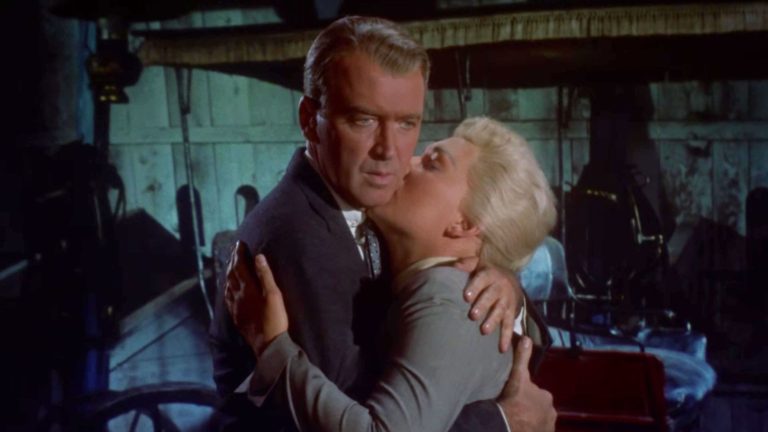
Another Hitchcockian trademark is the use of notable locations in big set pieces and because Vertigo is set in San Francisco it has to feature the Golden Gate Bridge. We have all seen the famous image of Stewart pulling a wet Novak out of the water and walking up the steps with her cradled in his arms while the bridge stands strong behind them. The shot is haunting as Novak’s body is limp in Stewart’s arms and there is something ‘romantic’ about the way she is positioned. When I say romantic I am talking about a romanticized vision as it was common for sickly, vulnerable women to be glamorized in this period. The idea of a saintly lady who endures a horrible illness, all the while becoming more gorgeous as she approaches death, has officially become a trope in the woman’s picture genre. This is a fairly troubling trope as it implies that weakness and suffering make women more attractive and it makes audience members believe that almost dying could be a positive thing. Hitchcock taps into the morbid fantasies that the women who loved Camille (1936) had but he puts his own spin on this trope. The nightmarish music tells us that this is not a heroic rescue that should be celebrated and the way that Stewart chucks Novak’s lifeless body into the back of a car just seconds later reminds us of the fact that he is using her. The visuals are lushly romantic as the green waters and Novak’s chic black coat fool you into thinking that this is a dream and not a nightmare but ultimately this scene makes us uncomfortable as we see two people acting out something that should be romantic and yet this is a story about obsession and abuse and it is saddening to see the two of them reaching for a love that is not there.

Review: Alfred Hitchcock's Vertigo - Slant Magazine

I know I promised that I wouldn’t include any more criticism but as a final note, I thought I would say that I wasn’t a big fan of Novak’s performance. I have already criticized a lot of the performances in Hitchcock’s films but I would like to note the fact that Henry Fonda is stupendous in The Wrong Man (1956) which proves that it was not impossible to give a full-bodied, layered performance in one of his films even when he wasn’t offering you much direction. Novak feels like she was left out to dry by Hitchcock as he spent far more time paying attention to the location of the brooch on her lapel than he spent instructing her on how to convey her character’s emotions. I suspect that these two never had a discussion in which they talked about Barton’s motivations and I doubt that Hitchcock politely offered her notes on her work after every take. I imagine that he would have been happy if she had mechanically delivered every line as long as everything around her was in the right position. My confidence in Novak as an actress is low as she has never impressed me in anything I have seen her in and I don’t even admire her as a great screen beauty. Even the dreaded Audrey Hepburn had an incredible face but Novak looks plain and doesn’t have any screen presence so it is difficult to forgive her for her uncompelling turn.


For a lot of people, it is nearly impossible to conjure up any film that is equal to Vertigo but I looked through the list and I think I came upon something that is in its league. Billy Wilder’s Double Indemnity (1944) is also a beloved classic that provides a lot of food for thought. Is Phyllis Dietrichson the greatest femme fatale of all time? Quite possibly. I can’t wait to ponder questions like this next week but I also get to enjoy the pleasure of seeing it again. I have not seen it in a few years and I have very fond memories of it so I hope I can keep those cherished memories intact. I do have a sneaking suspicion that Edward G. Robinson might steal the show because you never know what will happen when he is around.

Poll: What is your favorite “New Year’s Eve” movie?

We at InSession Film hope you all had a great Merry Christmas, as great as one could be during these times. And as we transition away from the Christmas spirit, we move on to celebrating what many of us are most looking forward to: the end of 2020. Admittedly, there aren’t many “New Year’s Eve” movies, but there are many great scenes celebrating the holiday, making the options for this poll both varied and vague in its depiction of a year’s closing. Some of these moments are celebratory, others not so much, and that juxtaposition felt appropriate given our own mixed emotions as we close out the year 2020.

With that said, what is your favorite “New Year’s Eve” movie? And before you scream, we deliberately left off The Godfather: Part II, because it’s a Godfather movie, and you know it would win.


Podcast: Wonder Woman 1984 / Soul – Episode 410

This week’s episode is brought to you by the Patreon and our awesome listener’s like you. Sign up now for early access to bonus content, t-shirts and more!

This week on the InSession Film Podcast, Ryan fills in for JD as we discuss Warner Bros. historic Blockbuster streamer in Wonder Woman 1984 and also Pixar’s latest in Soul! Plus, a few thoughts on the films we’ve been catching up on lately.

As you may have seen on social media, JD’s grandmother passed away so he stepped aside to be with his family, so a big thanks to Ryan for jumping in the co-host chair this week. We had a ton of fun talking about these two big studio films, something we haven’t really done since March. It’s also historic as Wonder Woman 1984 becomes the first major blockbuster to be released on streaming since the pandemic started. The film itself has also provoked some interesting discourse as well. So, a lot to talk about on this week’s episode.

On that note, check out this week’s show and let us know what you think in the comment section. Thanks for listening and for supporting the InSession Film Podcast!

– Movie Review: Wonder Woman 1984 (5:47)
Director: Patty Jenkins
Writer: Patty Jenkins, Geoff Johns, Dave Callaham
Stars: Gal Gadot, Chris Pine, Kristen Wiig

– Notes / Saint Frances / Miss Juneteenth / Zappa (48:36)
This week for our discussion segment, Ryan gave his thoughts on the Alex Thompson comedy Saint Frances and Channing Godfrey Peooples’ Miss Juneteenth, which we reviewed earlier this year on Episode 384. Brendan also gave his thoughts on the music documentary Zappa.

[divider]

RELATED: Listen to Episode 402 of the InSession Film Podcast where we discussed Wolfwalkers!

[divider]

– Movie Review: Soul (1:16:38)
Director: Pete Docter, Kemp Powers
Writer: Pete Docter, Mike Jones, Kemp Powers
Stars: Jamie Foxx, Tina Fey, Graham Norton

Show Sponsor: First Time Watchers Podcast

– Music

Themyscira – Hans Zimmer
Open Road – Hans Zimmer
The Great Beyond – Trent Reznor, Atticus Ross
The Return of the Eagle – Atli Örvarsson

Subscribe to our Podcasts RSS
Subscribe to our Podcasts on iTunes
Listen on Spotify
Listen on Stitcher
InSession Film Podcast – Episode 410

[divider]

Next week on the show:

Main Review: The Midnight Sky
Top 3: N/A

[divider]

Help Support The InSession Film Podcast

If you want to help support us, there are several ways you can help us and we’d absolutely appreciate it. Every penny goes directly back into supporting the show and we are truly honored and grateful. Thanks for your support and for listening to the InSession Film Podcast!

VISIT OUR DONATE PAGE HERE

Criterion Crunch Time: ‘Mother’

So, this month on Criterion Crunch Time, we have talked a lot about the trappings of genre and how great directors weave in and out of them. Well, we are not quite done yet. Instead of using one genre to play with expectations like Haneke’s Caché, this week we take a look at another director who combines genre in order to keep us all on our toes. In order to do that, we turn to cinephile’s latest favorite son, Bong Joon-Ho. And no, it is not Parasite, although that is a tremendous film that you can (and arguably should) own on The Criterion Collection. But two of his earlier films are, sadly, leaving the channel at the end of the month. This left us with the choice between Barking Dogs Never Bite and Mother. Being the more known of the two, and having a reputation for being a movie you have to see to believe, Mother is our movie of choice to end 2020.

Ok, so back to the genre. Is Mother a comedy? Is it a crime story? Is it the tale of a mother’s love? The answer, of course, is yes. To all of them. Yet, the way director Bong chooses to thread these stories and the order in which he does so is full of purposeful choices, each one more complex than the last. The film opens with Mother (Kim Hye-Ja) dancing serenely in a beautiful outdoor setting, managing to fool the viewer into a serene mood. It is also striking to see a film from a well-known director that focuses on an older woman, something sorely lacking in American filmmaking.

But quickly, Mother transfers to a more familiar scene set on a city street. In it, Mother’s son, Yoon Do-joon (Won Bin), in a delightfully dense performance, is almost hit by a speeding car. Despite the fact that the narrative begins to follow him, it is notable that this is funneled into how it impacts Mother. The perspective is hers as she injures her finger in her haste to check on him. Yoon Do-joon and his friend of debatable morality, Jin-Tae (Jin Goo) chase down the people in the car, eventually ending at a posh golf course. Although mildly violent, all of this chase and subsequent arrest is framed comedically. 

Despite that comedy, it ends with Mother arriving at the police station to save her son. Her son, who clearly has an intellectual disability and difficulties with memory, appears perfectly harmless. Because of this, he is taken advantage of by Jin-Tae repeatedly, even blaming him for damage to a vehicle after mocking him for not being able to manage it in the first place. Again, this is focused on the comedy, but is drastically important when the story darkens, to put it mildly. Despite the fact that we see him watching and following a girl, Moon Ah-Jung (Moon Hee-Ra), late at night, it is unlikely that we see him as a likely suspect when she is found brutally murdered the next morning. 

And this is when Mother switches into another gear. Very quickly, Yoon Do-joon stupidly signs a confession and the focus returns to Mother. Within the space of maybe 30 minutes, she goes on a journey which reveals both revelations about her past as a mother and the lengths that she will go to in order to protect her son, once again. But importantly, these steps do not require giant leaps of logic. In the hands of a less talented director and writer (Bong Joon-Ho co-wrote the screenplay with Park Eun-kyo), her actions would seem out of control and out of the realm of any sort of reality. But as we journey with her through her son’s night via her investigations and his limited memory, things definitely make sense, right up until the point when she goes past the edge.

Everything leading up to that moment feels honorable and good. Simply a mother fighting for both her beloved son and the truth. She knows he could not have done this terrible thing, so she must prove it, right? Well, what happens when the investigation proves his guilt? It is a masterfully created choice point for Mother built by Bong Joon-Ho. And neither choice is good. Mother must choose between defeat (and imprisonment of her son) and pure, unadulterated, vicious violence upon a man that does not deserve it. And even though this choice makes sense in the arc of both the script and character, it is shocking nonetheless. The camerawork (from cinematographer Hong Kyung-pyo) in that scene is memorable for the static choices. The camera zooms in on Mother’s face, not allowing us to look away from the end of this horrific journey.

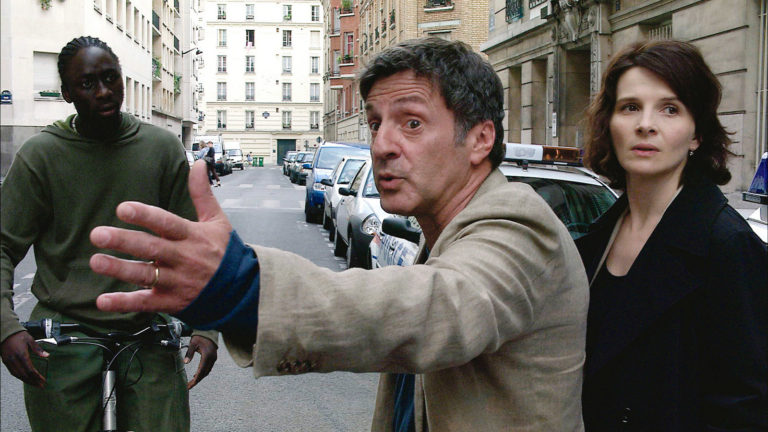
Mother is equal parts funny, engaging, and disgusting. Bong Joon-Ho’s mastery of disparate genres enables this balance and should have told us all a decade before Parasite just how talented he is in terms of direction, writing, and frankly, as a storyteller. It would be so easy to just make Mother one of these things. It is difficult to make a comedy, a mystery, a true-crime thriller. Director Bong manages all of this without the audience realizing the long game he is playing. After all, what mother would not protect her son, especially one as innocent as Yoon Do-joon?

Join us next month for four more movies leaving The Criterion Channel in January!

Criterion Releases: January 2021

New year, new collection. As we start the new year, the state of current cinema hangs in the balance of the post-COVID world, while historic cinema stays the same. Accessible and physically owned (yeah, you will never fully own downloads online), the next batch of works brings back the final trilogy of an iconoclast director, Scorsese’s latest rock n’ roll documentary, an amazing piece of Soviet war cinema, and a modern documentary that is more about manhood than it is about skateboarding.

Three Films By Luis Buñuel (1972-77)

Spanish-born Buñuel had shocked the world in 1929 with Un Chien Andalou, collaborating with painter Salvador Dali in splitting a woman’s eye open. He fled Spain due to his communist beliefs in contrast to Franco’s anti-liberal views and would make movies in Mexico, the United States, back to Spain, and finally in France. Known for his surrealist satire attacking the upper classes for their sexual morals, attraction to social status, and detachment from reality, the last three films Buñuel would make cemented his legacy as an iconoclast with his distinguishable taste in mocking the affluence for their ridiculous habits. The Discreet Charm of the Bourgeoisie (1972) won the Oscar for Best International Film, The Phantom of Liberty (1974), and That Obscure Object of Desire (1977), which garnered another Oscar nomination.  

The Ascent (1977)

During the Nazi invasion of the Soviet Union, two soldiers go out to hunt for supplies in the treacherous snows of Belarus. Caught by the Germans, both are faced with the ultimate dilemma: cooperate and live, or protect the comrades and die. The film is a religious allegory, and to get around the censorship, it was heavily promoted as a national story of hardship in the face of the enemy’s cruel occupation. Director Larisa Shepitko was among the very few international female directors around and made her masterpiece before her life was cut short in a car accident two years after this was released. But The Ascent, which won the Golden Bear at the Berlin Film Festival, etched her name in cinema glory for this achievement.

Minding The Gap (2018)

In his first documentary, Bing Liu captured growing up with two of his friends in Rockford, Illinois as they enter adulthood and must put away their love for skateboarding on the side. It’s a story of blue-collar lives who have to confront the new realities of subjects from fatherhood to racism to education. They open up about their dysfunctional lives up to this point and how skateboarding kept their mind away from the tougher side of life; as one of them says, “I could be having a kind of mental breakdown, but as long as I’m able to go skate it’s completely fine.” Netflix has already seen a few of their works released by Criterion and now it’s Hulu’s time to get the treatment.

Rolling Thunder Revue: A Bob Dylan Story by Martin Scorsese (2019)

This is the second film from Scorsese on the legendary musician (No Direction Home) but this focuses on the titled tour Dylan and a group of his musician friends – Joan Baez, Joni Mitchell, and Ramblin’ Jack Elliott among them – went on from October 1975 to May 1976. But this is not the same documentary as looking back on the origins of Woodstock or Live Aid. Instead, using archive footage and mixing it in with fictional figures and digital trickery, the line between truth and fiction merges. Viewers soon have to guess who was in it and who wasn’t, from a director named Stefan Van Dorp who documents behind-the-scenes evenings to Sharon Stone who was in her late teens and got hired to assist out with the costumes. It isn’t a Martin Scorsese picture, as viewers would see on the credits, but a story being told by Dylan himself in his confusional state – he jokes that it is so long ago that he wasn’t born when the tour happened – that meshes with the freewheeling form of the actual shows.

Follow Me: @brian_cine (Cine-A-Man)

Podcast: Indiana Jones and the Last Crusade / Mangrove – Extra Film

On this week’s Extra Film, Ryan and Jay continue the Indiana Jones Movie Series with Indiana Jones and the Last Crusade , and they also review director Steve McQueen’s Mangrove!

With Ryan returning this week, the Extra Film boys reunite to talk about one of the stronger films in the Indiana Jones series. After the darkness of the last film, Spielberg and Ford go back to basics and enlist the man, myth, and legend Sean Connery to join them on a quest to find the Holy Grail. With memorable pieces and great chemistry, Indiana Jones and the Last Crusade is a wonderful addition to the series that might actually be the most rewatchable of the films covered so far.

In the back half of the episode, the boys take a look at the first film in director Steve McQueen’s movie series, Mangrove. As part of his Small Axe collection, Steve McQueen returns with one of the most important films of the year, with a vivacious community of strong black people struggling to live in London because of the police. With comparisons to The Trial of the Chicago 7, McQueen is able to elevate his material past a courtroom drama and turn it into a study of an entire community and race of people. With this film and the rest of Small Axe, he continues to prove he is one of the best directors working today.

Also, stay tuned for the end of the show to find out what the guys will be covering for the last month of 2020!

Thanks for listening!

– Movie Review: Indiana Jones and the Last Crusade (5:36)
Director: Steven Spielberg
Screenplay: Jeffrey Boam
Stars: Harrison Ford, Denholm Elliott, Alison Doody, John Rhys-Davies, Sean Connery

– Movie Review: Mangrove (1:01:31)
Directors: Steve McQueen
Screenplay: Steve McQueen, Alastair Siddons
Stars: Letitia Wright, Shaun Parkes, Malachi Kirby, Alex Jennings, Jack Lowden

– Music
Indiana Jones Theme- John Williams
Mighty Sparrow – Jean & Dinah
The Return of the Eagle – Atli Örvarsson

We try to make this the best movie podcast we possibly can and we hope you enjoy them. Subscribe today on iTunes, Spotify, or Stitcher, and please leave us a review on iTunes. You can also find us on Soundcloud, PlayerFM, and TuneIn Radio as well. We really appreciate all your support of the InSession Film Podcast.

Subscribe to our Podcasts RSS
Subscribe to our Podcasts on iTunes
Listen on Spotify
Listen on Stitcher
Indiana Jones and the Last Crusade / Mangrove – Extra Film

[divider]

To hear this Extra Film episode and everything else we do, download our apps on the Amazon Market for Android and the Podcast Source app on IOS devices. The mobile app covers all of our main shows, bonus podcast’s and everything else relating to the InSession Film Podcast. Thanks for your wonderful support and for listening to our show. It means the world to us

Podcast: The Mandalorian – Patreon Bonus Content

Listen!

For our latest Patreon Bonus Content, Richard Newby of The Hollywood Reporter joins JD to discuss Season 2 of The Mandalorian and what we expect to see in Star Wars going forward!

If you’re already a Patreon supporter, you can listen to this episode NOW on Patreon by clicking here.

Sign up today to get early access and hear the entire episode!

[divider]

HELP SUPPORT THE SHOW

To hear our bonus content episodes early, subscribe now on Patreon. In many cases, though, we offer our bonus content for free after a certain period of time and we do encourage (and very much appreciate) a small donation of $0.99 as a way to help support the show if signing up on Patreon isn’t for you. Click on the PayPal button below to donate and thanks so much for your support. You can also hear much of our Bonus Content via our mobile apps. See the information at the bottom of the post for more details.


One-Time Donation


[divider]

Mobile Apps!

Listen to all of our bonus content on our apps for just a one-time fee! Whether you have an iPhone, Android or Windows phone, our apps are available in many different ways that is convenient for you. With our mobile app, not only can you listen to all of our bonus content, but our main shows and our Extra Film podcasts as well. Click here for more info!

If you don’t want to purchase our bonus content, but still want to support us, there are other you can help us out. Click here for more info.

Top 10: Non-Traditional Christmas Movies

Is [blank] a Christmas movie? It happens every year when a family member, or friend, utters the statement that Die Hard is their favorite Christmas movie. A hotly debated topic as to which movies are Christmas movies, and which are not. So with it being that time of year once again, here’s a look at some of the most debated non-traditional Christmas movies.

Watch 'Eyes Wide Shut': The Christmas Movie 2020 Deserves

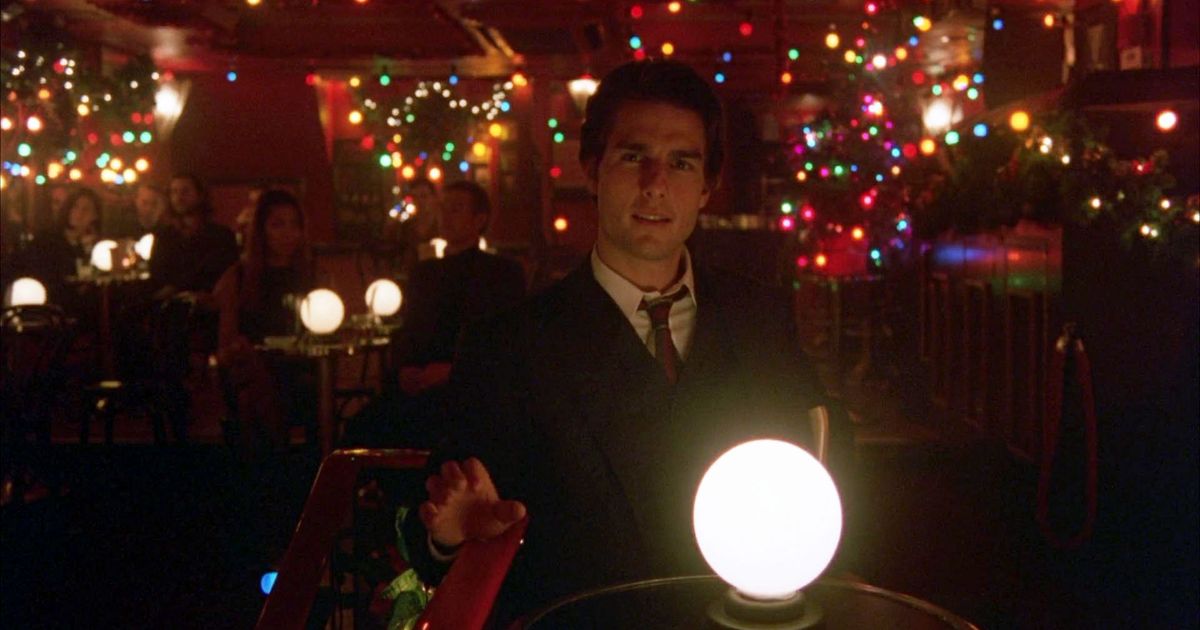
Eyes Wide Shut (1999)

Not all that glitters is gold, and Christmas lights can sure give off an ominous red color. With this collar-tug of a movie, one could shut down this conversation by not wanting to mix both the subject matter of holiday cheer with weird sex orgies.

This Stanley Kubrick classic is enveloped in the twinkles of Christmas as William (Tom Cruise), a respected doctor, is on an odyssey of sorts after finding out some unsavory “truths” from his wife, Alice (Nicole Kidman). Deeper and deeper goes Will down the rabbit hole, which leads him to an all-night orgy attended by powerful men.

Eyes Wide Shut has some of the most brilliant production design, including a magical Christmas party that I think many would love to attend. This film may not be your go-to Christmas movie, but who’s to say Christmas movies can’t be dark.

Is Gremlins a Christmas film? Five reasons why Steven Spielberg's classic is definitely a festive movie

Gremlins (1984)

For many years, the story of Krampus has interjected some creepy into the holiday season, so why not take it a step further with Gremlins. This 80s classic happens on the night before Christmas, but you won’t find visions of sugar plums dancing in their head — more like visions of strange creatures with tuffs of fur eating fried chicken and dancing in a smashed storefront window. Gremlins, in its chaos, has the characters fearing what lurks behind the corner. The film has some great odes to the holidays as the creatures are caught eating gingerbread cookies. Not to mention a tragic Christmas story that, even if you forget Gremlins in its entirety, somehow sticks with you.

What Your Favorite Christmas Movies Say About Social Justice - Yes! Magazine

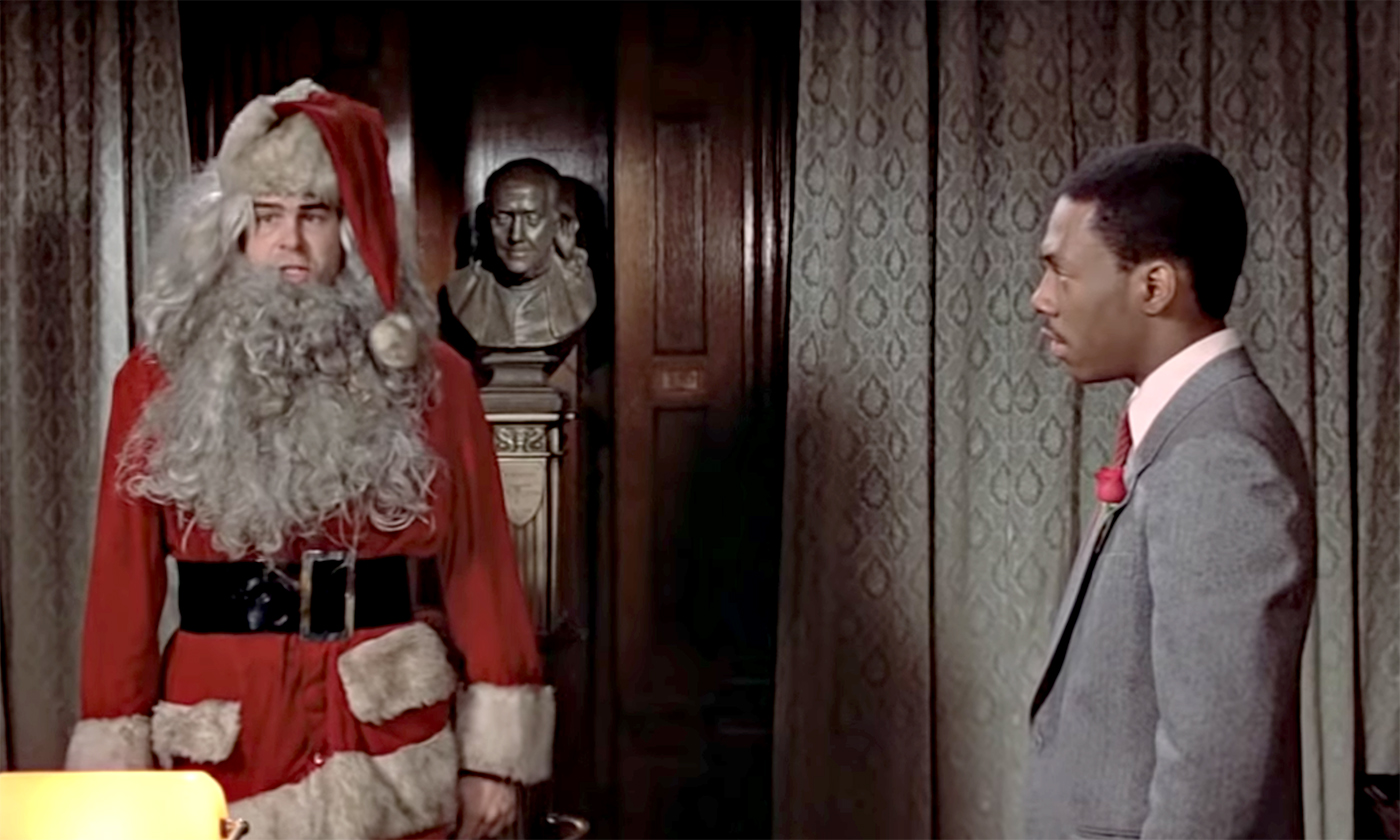
Trading Places (1983)

Yes, many elements of Trading Places haven’t aged well. And yet, the greedy and manipulative ways of Wall Street have aged very well, in my opinion. The social divide between the upper class and lower class, the lack of sympathy, is still pretty spot on. But the class divide aside, there are many references to the Christmas season throughout the snowy streets of New York City. Dan Ackroyd in a Santa outfit? Sign me up!

Why BATMAN RETURNS is a Magical Christmas Movie - Nerdist

Batman Returns (1992)

Batman Returns is set smack-dab in the middle of the holiday season with Christmas tree lightings, parties, and exploding gifts wrapped with candy cane wrapping paper. You could make the connection that Batman Returns is an ode to those who are alone during the holidays with the Batman (Michael Keaton), Penguin (Danny DeVito), and Catwoman (Michelle Pfeiffer) seemingly on the outs from the norm during the holidays. A dreary snowfall in Gotham city works to emphasize this bone-chilling background of the Christmas season. I mean, let’s be clear, any time is a great time to watch Pfeiffer as the best Catwoman.

The Nightmare Before Christmas' Movie Facts | Mental Floss

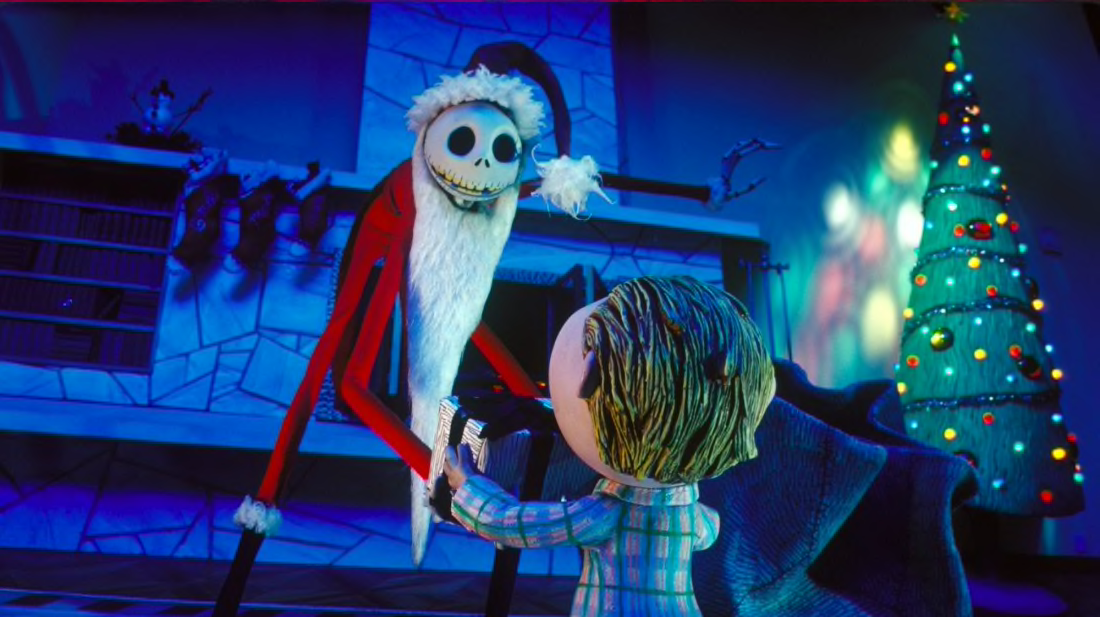
The Nightmare Before Christmas (1993)

Is it a Halloween movie or a Christmas movie? That is the question that divides most viewers of this animated classic. The Nightmare Before Christmas’ Jack Skellington is the king of Halloween Town and believes it would be great fun to play Santa after finding out about Christmas Town, a town next door. The story is all about bringing Christmas to Jack’s town, but it doesn’t go exactly as planned. With catchy tunes and a creative story, The Nightmare Before Christmas has deservingly earned a spot with the best Christmas movies.

Is "Catch Me if You Can" a Christmas Movie? | ResetEra

Catch Me If You Can (2002)

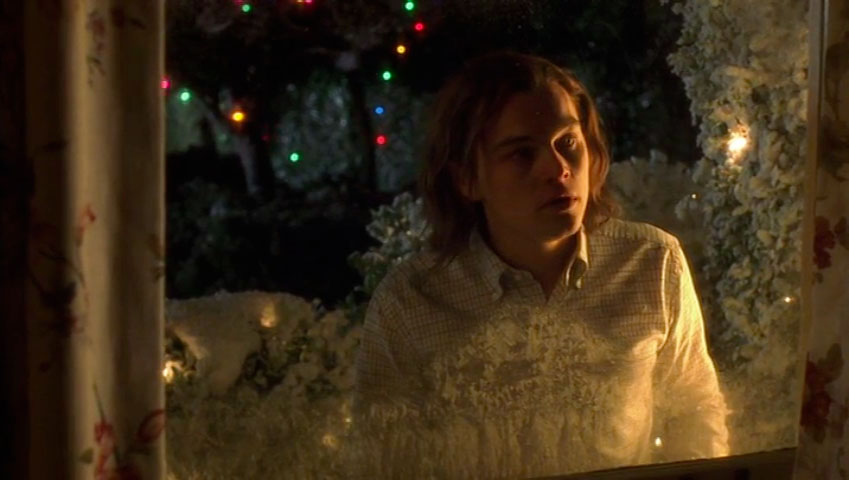
Catch Me If You Can spans several years as Frank Abagnale Jr. (Leonardo DiCaprio) cons his way from pilot, to doctor, to a lawyer. But why a Christmas movie? To avoid spoilers, in case you haven’t seen this movie that came out 18 years ago, important conversations between two characters constantly happen — like clockwork — during Christmas. Once again, another movie that envelopes itself with references to Christmas.

This is one of DiCaprio’s best. This is one of Tom Hanks’ best. This is one of Steven Spielberg’s best. Catch Me If You Can seems a fitting movie for the holidays, but you’ll be missing out if you don’t see this at basically any other time of the year.

Step Brothers (2008) - Photo Gallery - IMDb

Step-Brothers (2008)

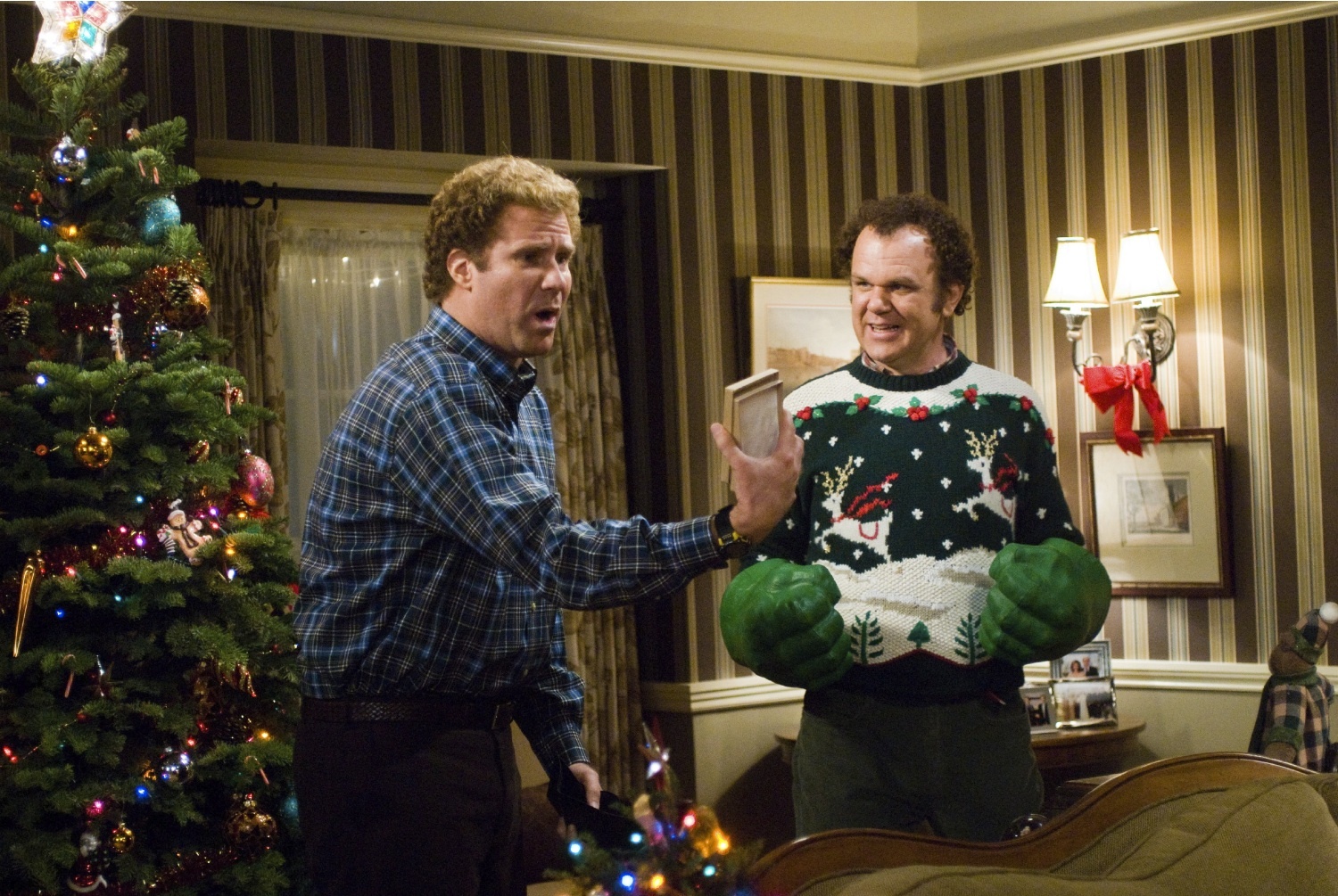
It’s a modern-day blending of families when two divorced, older people, with their adult sons living at home, decide to marry. This is no Brady Bunch. Well, maybe if Jan at one point crane-kicked Peter in the nuts. Step-Brothers is more 40-Year-Old Virgin meets Brady Bunch meets Christmas. One fan theory has gone as far as to classify Step-Brothers as a prequel to Elf. Now I wouldn’t go that far, but it sure counts as a Christmas movie — just maybe not for the whole family. Just like The Family Stone paints its dysfunctional family – eventually leaning on one another for comfort during the holidays – that same idea goes for Step-Brothers. And with that, this raunchy comedy is actually a sweet Christmas treat.

Christmas at TFE: "While You Were Sleeping" - Blog - The Film Experience

While You Were Sleeping (1995)

The Christmas trope in movies often accentuates the storyline of a romantic comedy. You can reference You’ve Got Mail, Sleepless in Seattle, and The Holiday to satisfy that need for a film with a Christmassy romance. While You Were Sleeping, however, is one of my favorites that often gets overlooked. Lucy (Sandra Bullock) is a young woman who falls in love with Peter (Peter Gallagher), a man whose subway token she takes every morning — barely uttering two words to him. During her Christmas shift, Lucy saves Peter from a subway accident, and when she visits him in the hospital, a nurse mistakenly assumes that Lucy is Peter’s fiancée.

Sure, Lucy’s actions may sound a bit stalkerish, but there’s a sweetness to her story. So I ask, what makes a movie a Christmas movie, anyway? Sometimes it’s the meaning behind the story that gives these movies a pass to the Christmas category. Christmas moments are fleeting within the film’s timeline, but shows the importance of family during the holiday season, and those who may not have someone to spend it with.

WHY I LOVE MOVIES.-Carol - 2015

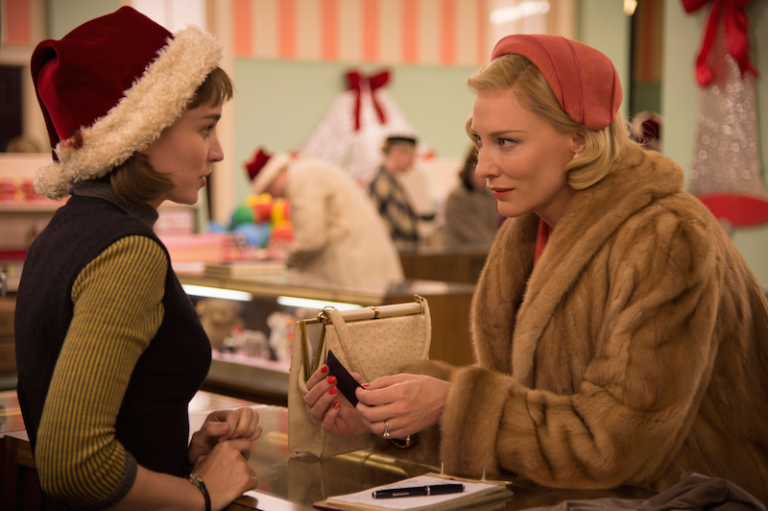
Carol (2015)

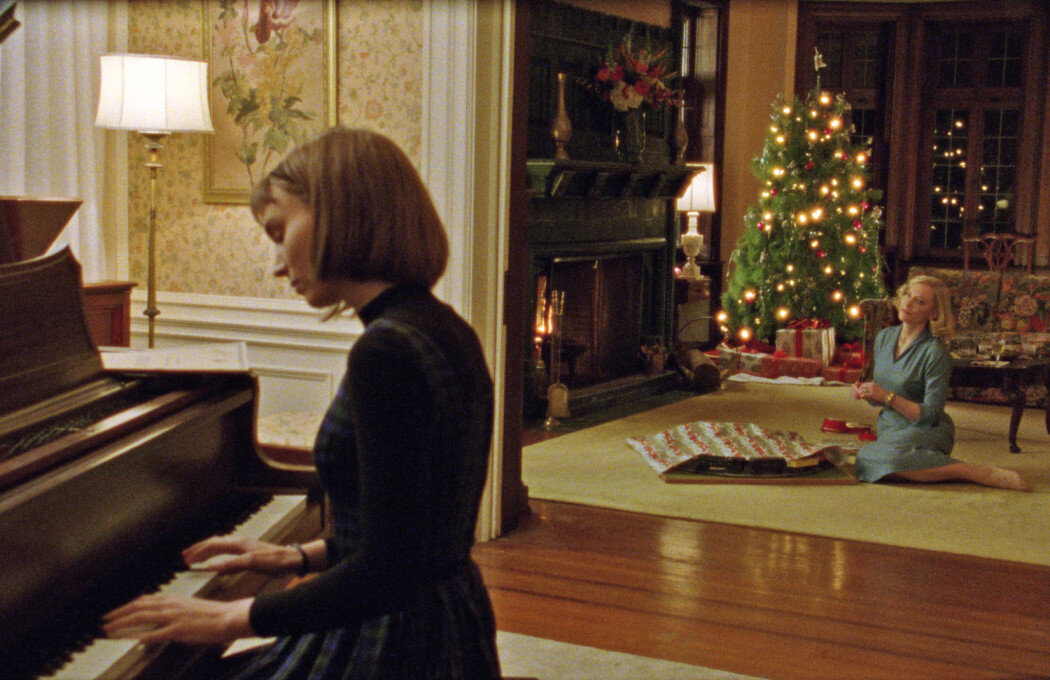
Set in the 1950s, Carol examines a lesbian affair between Carol Aird (Cate Blanchett) and Therese Belivet (Rooney Mara), set to the backdrop of, you guessed it, Christmas in New York City. Carol may find itself at the top of the “non-traditional” Christmas movies with a story, The Price of Salt, written by one of the greatest authors, Patricia Highsmith. Just like Eyes Wide Shut, Carol is a perfect dichotomy to the usual Happy Holidays or Seasons Greetings. We rarely see the inclusion of LGBTQ romances paired with the Christmas spirit. And with a forbidden love such as theirs, Carol makes for one of the saddest films on this list.

Die Hard Director John McTiernan Says Film Is a Christmas Movie | PEOPLE.com

Die Hard (1988)

Die Hard: the movie that sparked 1,000 Christmas movie debates. So I ask, how can it not be a Christmas movie? John McClane (Bruce Willis), an NYPD detective heads to his wife’s company holiday party on Christmas Eve, where he’s soon confronted by a German terrorist and his violent goons. You won’t find John roasting chestnuts on an open fire, but rather roasting enemies with a flood of bullets, climbing through air ducts, and escaping fiery explosions. This popular debate may not have a definitive answer anytime soon as director, John McTiernan, and screenwriter, Steven E. Souza, have stated that this is clearly a Christmas movie. However, Willis holds true to his beliefs that Die Hard is an action film and nothing more.

Interview With Director / Producer Will Thorne, Part Two: ‘Silent Night’.

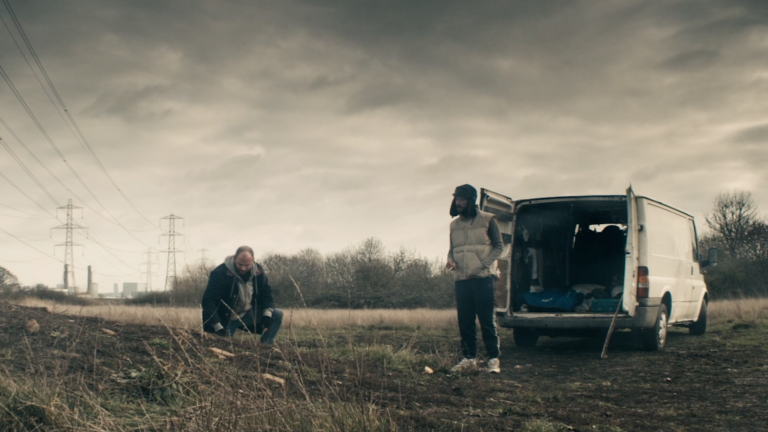
Will Thorne’s directorial debut Silent Night is that most unusual of genre mixes: a Christmas gangster thriller. It is a typically wry effort which takes some unexpected twists and turns and keeps the viewer on edge throughout. While most British gangster films will suffer the inevitable comparisons to Guy Ritchie, Thorne’s influences seem to come from elsewhere. Silent Night is a dark, absurdist, psychological spin on a genre which has plenty of champions in Britain.

Mark (played by Bradley Taylor) is an ex-con recently released from prison who’s trying to go straight. He’s determined to be there for his daughter Daisy. Unfortunately, Mark has no money and is living out of his van. To try to earn a crust, he takes a job cutting down trees for Christmas. It’s in this job that he runs into his old cellmate Alan (Cary Crankson) who offers him the opportunity for one last job and revenge against the crime syndicate which put him behind bars in the first place. Mark reluctantly takes on the job, but nothing goes according to plan…

InSession Film recently sat down with Will Thorne to discuss Silent Night. Throughout our discussion, we chat about many things from the state of the British film industry, the popularity of gangster movies, and the importance of cranberry in a Christmas meal.

Daryl MacDonald for InSession Film: So Silent Night was produced by your own company Break Em Films, right? Is this the first movie for them?

Will Thorne: Yes, exactly. I started the company in 2013 and made one or two shorts, then I got commissioned to do a bunch of music videos for Universal. I always had the intention to do features – that was always the goal – but I believed that I had to have a bit of a portfolio to show people I’m competent.

I just wanted to learn, you know. I wanted to complete some stuff on a smaller basis and then move up a little bit. Sometimes I do look back and think perhaps I should’ve just gone straight after the features!

You wrote the script for Silent Night. How long did it take you from writing the script to rolling the cameras?

Will Thorne: Well, at the end of 2013 we got a feature script in development with Nat (actor Nathaniel Martello-White, who plays Pete in Silent Night) and Joel (actor Joel Frye, who plays Seamus) and that went on for about 18 months and in the end went into turnaround. I really wanted to direct a script and when something like that happens, you’re left with nothing. So I thought “okay, if I write something, then it’s in my control. I can see it through”.

At the time we were working on another project that was high concept, a bit of a high budget, and that maybe wasn’t good for a first feature. So I put that on the shelf to go write something that was super low-to-no budget that I could go and make myself. Like, if I have to put the camera on my shoulder and go film this thing, I’m going to do it.

Like real guerilla filmmaking sort of thing?

Will Thorne: Yeah, that’s where a lot of the white van stuff comes from you know? It’s just two guys in a white van. We can buy a white van and drive it around (laughs). I didn’t think through the fact they would have to drive to other locations though! There’s a lot of locations in the film which is a bit of a logistical nightmare and can actually push the budget up!

Was that the whole point of Break Em Films? To give you control over your own projects so you can see them through to the end?

Will Thorne: Yeah, basically. I started working in film and TV back in 2004, so I’ve been working in and around the industry for a long time. But you’re always working for someone else, and someone else always has final edit. You can have a producer above you, or an executive producer, you can have a TV Commissioner above you, and that means you can work on something really hard for a long time and what you see at the end of it isn’t something you want to stand by, to be honest! (laughs).

So Break Em Films was all about control and taking the bull by the horns and trusting our own instincts. That was part of the point of trying to do shorts and make a portfolio. I knew I’d have to find money and investors and I wanted to show that we had a body of work and that we could step up and do a feature.

So you finally got a chance to direct a feature with Silent Night. How different was that to everything you’d done before?

Will Thorne: It was great! I had dreamt of making a feature film since I was about 14, so it was a dream come true. I loved every moment of it. In TV I had done a lot of producing or directing work where I’m the cameraman, I’m the sound man, I’m the first AD. I do everything, basically. So to walk onto a set and have a cinematographer come up to me and go “how do you want that to look?” to be honest with you was a lot easier! (laughs). I had a team, you know. You need a team to make something look good, which is what I’m really happy about with Silent Night; we had a good team.

So yeah, it was an absolute joy. I just loved it. I called in every favor and every person I knew to make it! One of the locations is in my mate’s mum’s house, another location was my mate’s house. We shot in my mum’s house, we shot in my dad’s house, we shot at the local golf course where we used to get drunk as teenagers (laughs). We shot in the old library. It was all shot in and around Sutton, which is where I grew up. So I knew the locations and I could just drive around and knock on doors and say “hey I’m from around the corner, can we use your house”. There was some really weird meta moments where we’d have a really long day shooting and everyone would leave and I’d still be there mopping my dad’s floor because I was worried he’d be annoyed! (laughs).

SILENT NIGHT (2020) British crime thriller set at Christmas - MOVIESandMANIA.com

Sounds like a really personal experience, having your family involved and the place you grew up. Did that have an influence on the movie, in the end?

Will Thorne: Yeah, I think so. The story isn’t necessarily personal, I don’t know that many hitmen (laughs), but how we actually made it was. I basically took 3 months off work and drove around finding locations. It was weird because I hadn’t lived in Sutton in a long time.

The end credits basically read like a who’s who of people I know and pulled a favour from! Brad’s older brother is my best mate, I’ve known him for a long time, and Brad went to the Brit School (a Performing Arts school in Croydon) when he was sixteen and met Cary (Crankson, who plays Alan) and Joel (Frye, who plays Seamus). And they’ve been mates ever since then. So I knew them by proxy. Angela (Terence, who plays Mark’s ex Julia) went to the Brit School as well, so they all knew her.

So it was like a real coming home experience.

Will Thorne: 100% yeah, and because I’d made a short film with Cary, and I’d made a short film with Bradley, and then again with Joel and Nat and they all knew each other from acting school, it felt a bit like the Avengers (laughs). We’re all in this one! I know for them it felt a bit of a trip to be on set working together on something.

Basically, if you’ve got no money and you’re just relying on a lot of goodwill and lot of favors, then the first place you go to is friends and family.

Originally in the script, Mark lived in somewhere like a garage, but I went past this location once and I could see rusted, burnt-out cars and pylons and I thought “wow, that looks epic”. So it took me a while to find out who owned it, and it turned out it was a landfill run by a garbage company. After a very long process I got through to the right guy on the phone and we agreed to meet and talk about it. So we meet him and do a site visit and I’m pitching the project to him and I tell him I lived in Sutton and he goes “yeah, me too. Where did you live?” I said, “I grew up in Belmont”. He goes “So did I! Whereabouts?”, I said “in the Crescent”, he goes “So did I!” (laughs). So he said I could have the location, didn’t have to pay for it, just to help me out. I think by doing local area stuff, things that came together and went in my favor.

Coming back to the cast, I was really impressed with who you got. Joel Fry, for instance, is up and coming now.

Will Thorne: Yeah, and Nat was in the Steve McQueen thing that was on the BBC recently.

Oh, yeah! Mangrove, right?

Will Thorne: I think so, yeah. I haven’t seen it but I was told there’s one he was a main character. And Joel, yeah, he’s doing great. Love Wedding Repeat was a big hit when we were all in lockdown and then he’s gonna be in Cruella, that big Disney prequel. When we were making Silent Night I lived about 50 yards from him so I’d sometimes drive him to set in the white van (laughs). He’s one of those people who’s just “got it”, you know? And I think his role in Silent Night was quite hard because he was doing comedy which he’s known for and good at but he also had to be a bit menacing. There had to be a kind of vibe to him, an undercurrent, which I think he pulled off.

Was it difficult to get him involved? I imagine he must have been really busy with all the stuff he was doing at the time.

Will Thorne: The thing was, we shot it in winter. Everyone’s basically out of work in December/January. A lot of shoots happen in the summer because of light, so because all the work dries up, everything shuts down and doesn’t really get going again until February.

The honest answer is we got lucky he wasn’t booked on other jobs. It wasn’t too bad. I think Joel and Nat probably only did about three days!
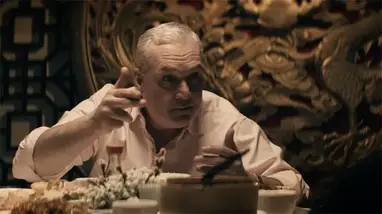
Silent Night (2020) – Film Review. Brit crime thriller with twists and humour.

You also got Frank Harper. That guy’s kind of like British gangster royalty in a way. He’s been in tons of movies. 

Will Thorne: Yeah! And actually, this was sort of his comeback movie. We were quite honored. I don’t know exactly how long he took a break for, but he hadn’t actually done anything in a good few years. I’d always had him in mind when I was writing the script, he was the reference point for Caddy, so I knew whenever we came to it we’d have to knock on his door.

I’d done a visual document where I referenced Shane Meadows, which Frank’s been in a few of his films. I think I even put a photo of him in a Shane Meadows film in the visual document (laughs), and we sent that off. When I met him for the first time I asked him what drew him to the project and he said the fact I mentioned Shane Meadows boded well!

So I take it you’re a big fan of Christmas movies? 

Will Thorne: Yeah, I am! I’ve always liked the vibe. It’s a good month where people let their hair down and you get to see old mates, and naturally, you just click on a bunch of films every year to get into that Christmas feeling, and if you can make a little cult Christmas film that people can get that vibe from, then you could make something that people revisit and watch. It adds a bit of extra value.

I can’t remember when or why I made Silent Night a Christmas movie. I think it was probably the sheer desperation of knowing that I’m definitely making this one, so why not chuck everything and the kitchen sink into it? (laughs). Let’s make it a Christmas hitman movie!

I’ve watched a million gangster movies and I can’t remember one being set at Christmas. Was that something you were conscious of?

Will Thorne: There must be! Someone must have done it! I wasn’t trying to trailblaze that, but I always knew that I wanted to make something that was a bit tongue-in-cheek. There’s a sort of underlying wink at the audience a little bit. You have a get-out clause there. You can just sit back and be entertained by this, you know, don’t take it too seriously. I want you to buy into it, but you can also just enjoy this thing.

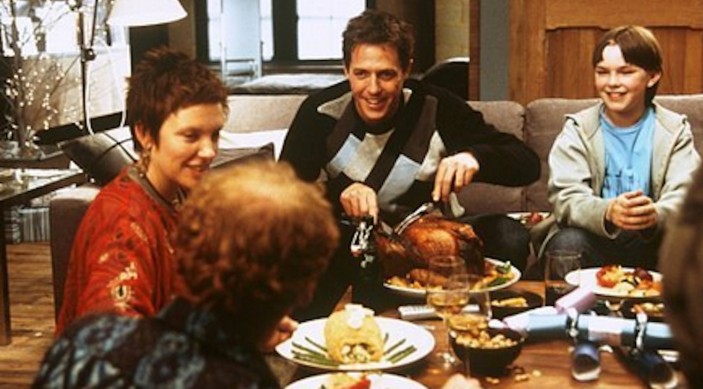
You know, when something dark’s happening in the film there’s a juxtaposition; you could be cutting someone’s hand off and then there’s a jolly Christmas situation happening. I think, tonally, for me, that seemed like it could be a good idea. Like the Christmas dinner scene, that was always supposed to be moody and dark, with shenanigans going on. And they’re sitting there and there’s a big turkey, you know? It’s ridiculous. Bradley used to call it absurd (laughs), and it is a bit absurd, which I think bleeds into finding interesting things to do with it.

You mentioned Shane Meadows earlier, who’s one of my favorite filmmakers. What kind of influences did you have when you were making Silent Night?

Will Thorne: Yeah, I’m actually really influenced by the Coen brothers. In their very first film Blood Simple there was a torture scene, and I just sort of nicked that (laughs). It was very inspired by that, although I don’t pull it off to the level that they did. It goes back to the absurd thing; I love it in Blood Simple where he’s got the gun and the broken finger, so he can’t shoot him. You take people really dark places and just went something’s about to happen there’s a little gag.

So yeah, I wanted to make something that was similar to them. There was stuff that didn’t make the cut because it was too long, which was more about social realism, but I did want it to be a bit more classical in the way we shot it. I wanted that gloss, I wanted it to really feel like a movie.

The thing about Shane Meadows is that I’d always recognize that UK look (in his films). It always looked a bit grim, a bit concrete, and even if it wasn’t where I was from, I’d recognize it. Sometimes when I watch other British films I don’t always recognize it. It seems too heightened. I wanted to make something that felt like, if you’re watching it in Sheffield you’re not just seeing people in old London or the East End, it could be anywhere. I wanted it to feel British in a way.

Yeah, I get what you mean. A lot of British movies I watch have elements that don’t exist in the world I live in. There aren’t many British movies that feel relatable on a working-class level, I think.

Will Thorne: Exactly. There’s almost a stigma against British gangster films. They’re sort of looked down upon by the establishment, and ironically they get some of the strongest audiences in the UK. I wanted to make sure I respected that and those audiences, and give them what they would want.

But I also wanted to make something that felt realistic and would be recognizable, even if we were shooting quite stylistically. I wanted it to feel like a real world. It was definitely a challenge getting the tone right, and deciding where we were pushing things too far or not enough, but for me the main thing was getting people that felt real, with dialogue that felt real. Where you could go “yeah, I know some guys like that”. They don’t have to be wearing suits, they could just be people that are on their arse who are maybe in the wrong situation.

It strikes me as a class thing. Those kind of crime movies have a lot of working-class actors, directors, producers, whereas on big-budget movies that’s not always the case. 

Will Thorne: Yeah, and I feel like it’s an authenticity thing, you know? You write what you know – and again, I’m not a criminal (laughs) – but I could make these guys talk, and could you believe it. I could put a few mates together and those relationships are still the same.

You go back to what’s the easiest thing to achieve authentically. I’d love to make a sci-fi thriller, but I’m gonna have to go off and learn a bunch of space shit (laughs). This felt like, I can go buy a white transit van and we can go off and shoot around the corner. And as long as I put care and effort into how that’s done, then it’ll work. So maybe people from different classes shy away from that stuff because they aren’t authentic or perhaps they just never get the call.

You mentioned that crime movies have some of the strongest audiences in the UK. Why do you think that is?

Will Thorne: It’s a really good question. I think it’s to do with underdogs. In a weird way. We love an underdog and most of the time that’s how these people are positioned; they’ve got a big job they need to pull off. There’s something about that. My dad was a copper, and he always had crime books and I think I was naturally drawn to crime films and thrillers. I knew there was a massive audience for British gangster films, so if I make one I’m going to give myself a better opportunity to get distributed. It was a very tactical choice to do that.

There’s also inherent drama in crime. The stakes are high. That’s quite an easy thing to tap into, like “oh a big bag of money’s gone missing! Oh, fuck!”

I heard someone from Signature, who distribute a lot of stuff like this, say that it’s escapism. And I think If you’ve had a tough life and you’re from a lower class, and you see people pulling themselves out – like a sort of Robin Hood thing – then there’s escapism from that situation.

It is interesting. I don’t know the psychology or why there’s a huge audience for it, but it is there!

I want to come back to that high concept project you mentioned earlier. Can you tell me more about that?

Will Thorne: Well that kind of went to the wayside, but there is another film I wanted to do before this. I hope Silent Nights shows that I can do it and perhaps I can jump up and get a better budget. It’s about a guy who returns to London because his brother killed himself and he wants to find out what’s going on. I’m still working on it now.

Reminds me of Dead Man’s Shoes.

Will Thorne: Dead Man’s Shoes is a great revenge film! This is a kind of a London underground thriller, you know, someone going around being a detective. Bradley’s working on a script that’s about a murderer as well. It’s all these films about crime and murder!

Like you said, there’s a lot of tension! Like in Silent Night where the police officer approaches them in the van.

Will Thorne: Well for Silent Night I originally wanted to do something where it’s just these guys driving around with bodies stacking up in the van! (laughs). But it was all a bit one-note and didn’t quite work. It could’ve gone down a whole torture thing in the back of the van. But always it was going to be that they’ve got to get a knock on the window by a policeman!

Back to Silent Night, there’s a lot of interesting twists and turns. Did you know what you wanted to do from the outset?

Will Thorne: Well, there was always two guys in the van sort of bouncing off each other. A lot of the film is about their relationship, and how a lot of Mark’s character development comes from Alan in a way. It was always those two guys together.

I’ve got one last question: how important is cranberry sauce to a Christmas meal?

Will Thorne: (laughs). It’s funny because when he first did it Nat was like “this succulent line is a bit funny” but we had to have it in there! The whole thing would’ve fallen apart otherwise!

He made it work though! 

Will Thorne: Yeah definitely, with Joel and Nat they had to play this kind of vibe where they’re mates but they could fuck you over. Perhaps you’ve come across this as well, but when you’re a teenager and you’re growing up you meet people who’re like mates, and then the next thing you know they switch, and you can’t quite trust them.

I know people like that, yeah. You’re not sure what they’ll do at any given moment.

Will Thorne: Exactly that. People who you think are your friends can also switch, and that’s really the vibe I wanted for the film.

Silent Night is out now on Digital and VOD.

Podcast: Critics Groups / Category Fraud – Chasing the Gold Ep. 28

On Episode 28 of Chasing the Gold, Ryan is joined by Clayton Davis of Variety to discuss the 2021 Critics Groups as well as a discussion of Oscar Category Fraud.

As the Oscar race is still heating up, regional critics groups are starting to announce their year-end awards, with plenty of out of the box picks and expect winners being announced. This also brings in a lot of questions about where certain performances should and shouldn’t land in the Oscar conversation for a nomination. With all of this, Ryan enlists his old friend Clayton Davis to give him his insight into these critics groups as well as the process behind category placement.

On that note, have fun with this week’s Chasing the Gold, and let us know what you think in the comment section below. Thanks for listening!

– Music
The Return of the Eagle – Atli Örvarsson

We try to make this the best movie podcast we possibly can and we hope you enjoy them. Subscribe today on iTunes, Spotify, or Stitcher, and please leave us a review on iTunes. You can also find us on Soundcloud, PlayerFM, and TuneIn Radio as well. We really appreciate all your support of the InSession Film Podcast.

Subscribe to our Podcasts RSS
Subscribe to our Podcasts on iTunes
Listen on Spotify
Listen on Stitcher
Critics Groups / Category Fraud – Chasing the Gold Ep. 28

[divider]

Mobile App

To hear this Extra Film episode and everything else we do, download our apps on the Amazon Market for Android and the Podcast Box app on IOS devices. The mobile app covers all of our main shows, bonus podcast’s and everything else relating to the InSession Film Podcast. Thanks for your wonderful support and listening to our show. It means the world to us!

[divider]

Help Support The InSession Film Podcast

If you want to help support us, we would greatly appreciate it! For more info, CLICK HERE.

Op-ed: 100 Years…100 Passions- ‘Woman of the Year’ (#74)

I will be watching and reviewing all of the films included on AFI’s 100 Years…100 Passions list. The list contains the 100 greatest love stories in American cinema and I plan to consider how our views on romance and social issues have changed over the years as well as judge whether the romances in these films actually made me swoon. As a fan of the romance genre, I expect to love each and every one of the nominees but I also don’t know if I would consider all of them romantic.


When we talk about Woman of the Year, we all end up thinking about the final scene. Instead of being the light, fluffy romantic comedy that it was intended to be when it was released in 1942 it has become a major talking point among feminist film critics. Part of the reason for this is that it could have been a feminist classic that presents an ideal world in which a flawed woman can balance her responsibilities and have a happy marriage and a thriving career. Katharine Hepburn was the ultimate strong, independent heroine in this era and played the sort of complicated, intelligent career gals that women liked to see on screen. Unfortunately, there was a dissonance between the energy that Hepburn brought to her films and the scripts that she worked with as they often felt the need to punish her for being strong and confident. Almost everything went wrong when it came to Woman of the Year and it ends up feeling like the sort of propaganda that is cooked up by conservative politicians to warn women against the dangers of taking on jobs.

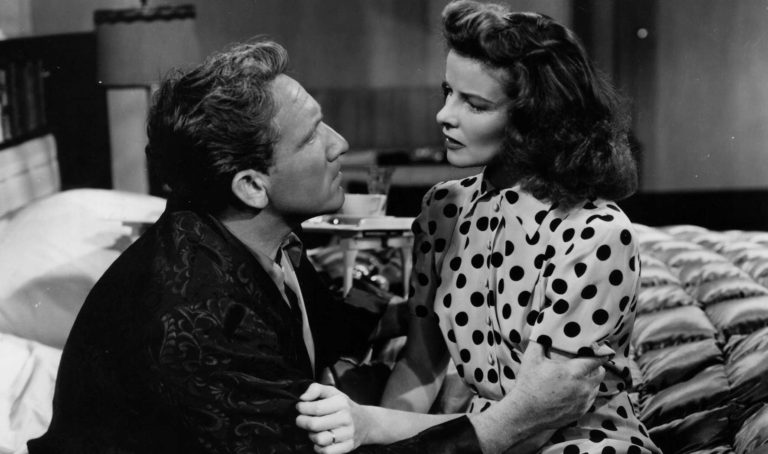
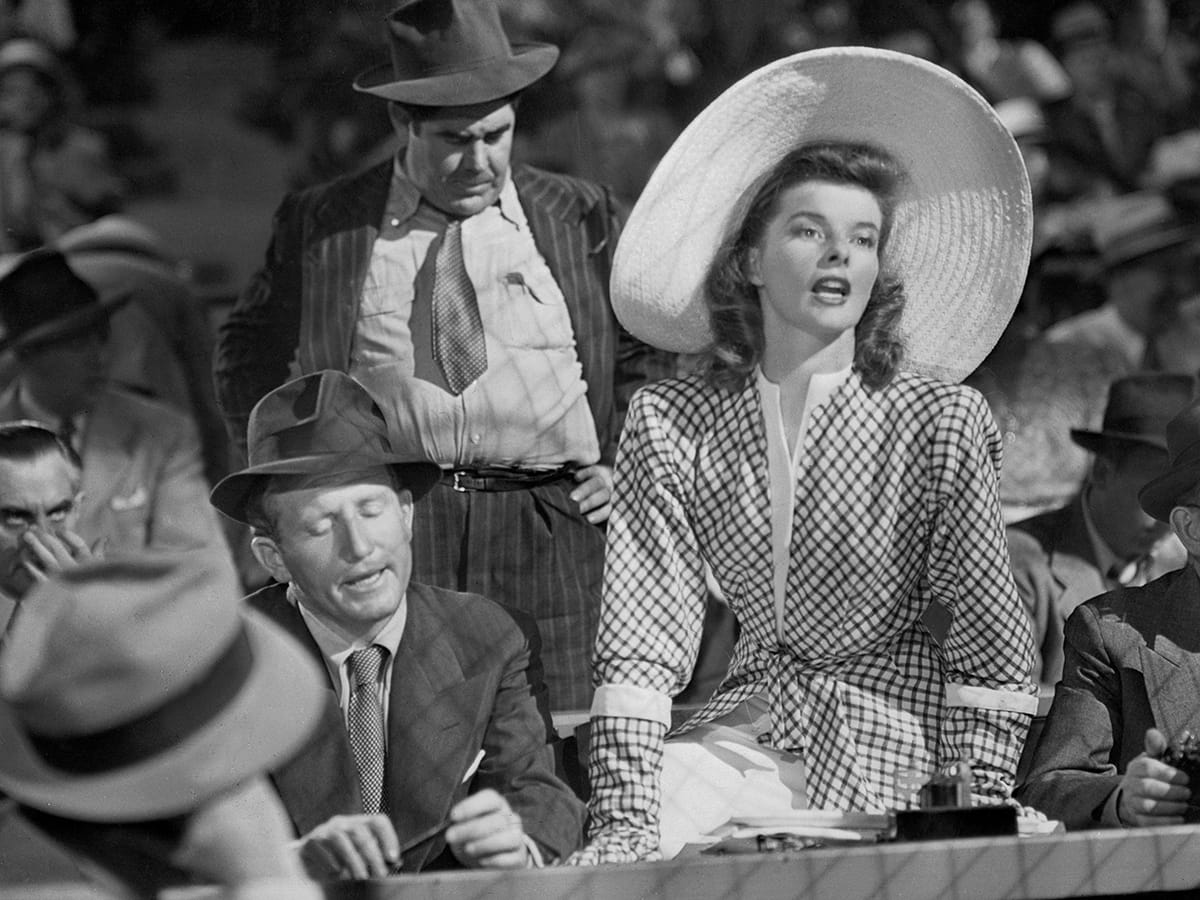
It is all about foreign affairs reporter Tess Harding, Katharine Hepburn, who is internationally respected and has political connections, but she comes into conflict with sportswriter Sam Craig, Spencer Tracy, when she suggests that baseball not be played during World War II. When the two meet, sparks fly and they are quickly married but married life with Harding is not what Craig expected and he discovers that she is inconsiderate and does not listen to him. He breaks up with her because he believes she will never change, and she is shocked by this development as she had thought that the two of them had the perfect marriage. She resolves to win him back by cooking breakfast for him but her attempt to make waffles is disastrous and she breaks down. She tells Craig she will quit her job to be with him and he agrees to take her back.

I don’t have any problems with the basic concept of this film as this is the rare romantic comedy that deals with marriage and not the early period of a relationship. It tries to be about the difficulties that married couples face when they rush into a marriage too quickly and discover that they aren’t ready to deal with the sacrifices that come with this decision. Harding is often cruel to her husband and the way that she forces him to take on so many responsibilities is unfair. I don’t support her poor treatment of her husband throughout most of the film and I thought this set up a fascinating situation. This could have been a story about a difficult woman learning that she has deep character flaws and we could have had several finely observed scenes in which she comes to grips with the fact that she must go through the onerous process of making significant changes to her lifestyle in order to accommodate for this relationship. This would have been a fine message to send to the audience as we can all relate to the feeling of trying to become a kinder, more patient person for the one we love. Instead of sending that message the film goes entirely too far and tells women that they have to give up everything just to be with their significant other. Their only responsibility in life should be taking care of their man and doing whatever he directs them to do. They will apparently experience bliss when they let go of silly interests like politics because women just aren’t smart enough to really be accepted in the political sphere.

The scene that establishes the fact that Harding should give up everything for Craig involves her cooking breakfast for him. As described in the plot description she fails as she has no background in simple domestic tasks because of her background as a wealthy reporter who has always relied on others to perform the tasks that housewives would typically take care of during this era. She does this in an effort to prove to Craig that she can be the caring, stay at home wife that he wants and he responds to her actions positively. When she says that she will give up her job he is enthusiastic about this decision and we are meant to believe that this is the fairy tale ending that every woman should want. There is a very careful use of language in the scene as Harding states “I’m going to give up my job, I’m going to be your wife” which implies that the two things are mutually exclusive and Harding must give up her job to be his wife. She affirms the fact that she will give up his job to her wife and then Craig expresses further displeasure at the idea of her work life bleeding into her personal life. Instead of accepting the fact that she has friends and colleagues who will naturally be a part of their life he decides to beat up her assistant when he arrives at their house. This represents him physically trying to remove every trace of her life as a career woman from their new life and it is very disturbing.

Woman of the Year (1942)

This is all very disappointing because the original ending of the film presented a more balanced view of the changes that would need to be made in this marriage. Craig would go missing and Harding would decide to try to win him back by going to a boxing gym to gain knowledge about sports so she could write an article for him. He would also try to become the man that he thought she wanted him to be by going to a school where he would be taught foreign languages that would allow him to move in her social circles. He reads the article she wrote for him and they reconcile at a boxing match where he assures her that she does not have to give up her career in order to be with him. The film was shown to audiences at test screenings, but audience members did not respond to this ending well. This may have been because the ending went against the typical Hepburn formula at this time. This formula involved her playing highfalutin, rather arrogant types who were humiliated and embarrassed before softening for love and adopting more traditionally feminine traits. She wouldn’t have been overtly humbled in Woman of the Year and men and women in the audience, who bought into the idea that conforming to traditional gender roles was positive, probably would have bristled at the idea of a woman who got away with doing things that were unthinkable. The ending was changed because of the influence of Louis B. Mayer, who likely knew that people liked seeing an ignominious Hepburn, and screenwriter Ring Lardner Jr. had to go along with these demands.

His description of the new ending was negative as he said, “She had to get her comeuppance for being too strong in a man’s world so they wrote a scene where she tries to fix breakfast…and gets everything wrong.” Hepburn allegedly called this new ending “The worst bunch of shit I’ve ever read.” Even though there was all of this pushback they had to go ahead with filming this new ending and the message of the story was fundamentally changed. Audiences ended up eating this film up and the strong box office returns encouraged studios to continue pairing Hepburn and Tracy together in similar romantic comedies. It is discomforting to realize that they loved it because it reinforced the retrograde views that they already held and that means that this does not hold up.

Beyond my issues with the messages about a woman’s role in society that this film tries to send, I don’t think that it is funny or romantic. The script is deficient as the bare bones of the story are appealing but Craig is written as a smug, sanctimonious chauvinist who also happens to be a salt of the earth fella that we are meant to fall in love with. I didn’t like him for a moment and because this story was largely told from his perspective it was important that I either rooted for him or had some interest in his actions or responses to the choices that his wife makes. It is hard to care about him but he is also infuriating in moments when he should be endearing. This is partly because of Tracy’s performance as he chooses to sport a self-satisfied grin during the infamous final scene and it only makes you hate him more when you understand why he is so elated. The screenplay is very into the idea that he is a man of integrity who sees through all of her fancy-schmancy crap and doesn’t respect her for knowing philosophers and receiving prestigious awards. This anti-intellectualism is a turn-off and I question whether the screenwriters would have used the same approach if Harding had been a man and his wife had been the righteous sports reporter.

SPENCER TRACY and KATHARINE HEPBURN in WOMAN OF THE YEAR -1942-. Photograph by Album

I believe that this is the first comedy that I have reviewed and I am stymied as I am almost always at a loss for words when it comes to explaining why I found something funny. I laugh and I often don’t know why. It is much easier to pick something apart when you don’t find it funny as you have time to dissect the scene in the moments when you would have otherwise been laughing. Most of the comedy in this film either revolves around Tracy’s confused reaction shots or slapstick scenes that involved food. The screenwriters seemingly thought that Tracy had a million different facial expressions in his arsenal so they wrote plenty of lines that would allow him to display his array of countenances. These lines are usually based around Hepburn doing something ridiculous or knowing something that Tracy has no frame of reference for. He also has to make these faces when Hepburn throws an orphan at him or tells him that she is going to be partying all night. The hilarity is meant to be derived from the fact that Tracy has such a rubbery, expressive face but he was not the Jim Carrey of his era and you can tell that he had to make these faces about five times before he could reach the right level of intensity. He looks rather haggard even when he is supposed to be bamboozled and energetic and it is hard to laugh at something when you can see that somebody has put so much work into making you laugh. The food slapstick just angered me as Hepburn messes up the most basic aspects of cooking and George Stevens asks us to titter while we witness waffle batter seeping out of a waffle maker. Where are the laughs meant to come in? Hepburn is stressed out and she has a lot of different responsibilities to balance but none of her reactions to her failures are all that funny.

As a romance, this should have delivered by presenting marriage as the romantic ideal even though it is something that people have to work very hard to maintain. We don’t typically think of marriage when we think of romance. Usually, the tension in these films is derived from whether two single people will end up getting married or whether two married people will step outside of their existing relationship and have an affair. Marriage is seen as the ultimate goal in the first case but married life is too dull to take up a whole film and we are asked to enjoy the fighting and flirty banter that can only exist before marriage in the eyes of certain filmmakers. In affair-based romances, we see marriage as something that is restrictive and suffocating and the spouses of the adulterers are either monsters who deserve to be cheated on or hopelessly unattractive but tragic figures. Woman of the Year aims to hit back against the traditional narrative by mostly focusing on the trials and tribulations that people face when they are married as well as capturing the subtle joys of day-to-day life in a committed relationship.

It is so emblematic of its era in the way that it deals with marriage. I have already touched on sexism and gender roles but I kept feeling like Woman of the Year was awkwardly sandwiched between two different eras and couldn’t figure out which template it wanted to follow. On one hand, you have the screwball comedies of the 1930s in which you could have perfect marriage. The Kerbys in Topper (1937) are inseparable and spend all of their time trading witty barbs, getting drunk, and singing show tunes at nightclubs. They both seem to find pleasure in the small benefits that they derive from being together and even find time to perform good deeds. They are the perfect couple but they are untouched by the problems that ordinary people face as they are extremely rich and neither of them have to work or worry about responsibilities outside of their marriage. Woman of the Year wants to have the witty barbs as it goes to great pains to illustrate the fact that Craig and Harding are opposites and therefore they have occasional fights in which they surreptitiously flirt with one another. It also wants to tell its audience that marriage can be a positive thing but, as stated before, it goes about making this point in the wrong way. It comes up short in wanting to be realistic as it tries to impart a serious message about marriage and has some interest in giving the audience insight into the lives of reporters. It can’t blend daffy comedy with heavy doses of realism and it ends up not delivering the yuks or the hard-hitting truths.

Woman of the Year (1942) | The Criterion Collection

On the other hand, it wants to be a glossy soap opera from the 1950s in which we get to indulge in seeing women behaving badly before being punished in the last thirty minutes. Soap operas from the 1950s could be seen as a forerunner to exploitation films from the 1970s as they are chock full of sadism and violence but feel the need to mask their dirtiness by moralizing to the audience about Christian values. Woman of the Year doesn’t involve sadism but it does want to turn two wild, reckless people into ordinary folk who act just like everybody else. The production values might have been at home in something like Peyton Place (1957) and the office space setting is fitting as it allows gossip to spread. It falls behind in featuring black and white cinematography as Cinemascope and glorious Technicolor would become prerequisites in this genre in the following decade. It also isn’t naughty enough to really get the audience going as the sins that Harding commits are not shocking enough to make anybody gasp and announce “Well, I never!”

The 1950s were also the decade in which the ideal marriage on screen was one that involved a non-speaking wife letting her husband go to work without asking any questions or it was a hell that men wanted to escape from at any cost. The Seven Year Itch (1955) deals with a mid-life crisis that a man experiences as he gets older and becomes dissatisfied with his henpecking wife. He desperately wants to get rid of her and run into the arms of the sexy Marilyn Monroe who stands around in skimpy outfits and doesn’t ask him to be held accountable for his actions as a wife would. Woman of the Year doesn’t fall prey to these clichés and Craig isn’t tempted to cheat by some good-looking floozy but it also doesn’t manage to make any progressive statements on marriage and it doesn’t recapture the magic of the 1930s comedies that seemingly inspired it.

If you couldn’t figure it out already then I am hear to tell you that I don’t think this is a successful romantic comedy. I am almost offended by the fact that it made this list and I have to assume that it happened because the partnership between Tracy and Hepburn is legendary and this is possibly their most famous collaboration. This is another case where I assume they selected this film based on reputation alone rather than putting themselves through it and realizing how shockingly unfunny it is.

As I look forward to next week I am rubbing my hands as I am going to discuss the film that is touted as the greatest movie of all time by Sight and Sound. Of course, I’m talking about Alfred Hitchcock’s Vertigo (1958) which has inspired an obsessive cult following that analyzes every little detail of every frame. I have discussed Hitchcock before and talked about my issues with his lack of interest in character development and performances but I remember feeling differently about Vertigo. I know that I will be lambasted if I identify any issues with something that is often spoken about as a masterpiece but I plan to dissect Vertigo as though it doesn’t have a fearsome reputation.

Poll: What is your favorite Christmas movie?

Happy Holidays from the entire InSession Film family! The holidays are typically time for joy, a time for love, a time for family, and a time for toys. This year however, much like Thanksgiving, has been different for us all, some more-so than others. The year 2020 will be concluding with mixed emotions, not too dissimilar from the many genres that can be found under the category of “Christmas movies”, but that does not mean we are incapable of finding joy this holiday season, and for many of us film lovers, that joy comes from watching one of the many films on this week’s holiday-themed poll.

With that said, what is your favorite Christmas movie?


Hollywood Deaths That Stunned The World

The recent passing of Chadwick Boseman to colon cancer aged 43 stunned many because his condition was never disclosed, as well as he was among the top actors in Hollywood at such a young age. His death is one of a long list of those that stopped the world for one moment and broke hearts because of the amount of talent left behind. Whether it is by natural causes, misadventure, or foul play, the loss is felt because of our sudden it is where there is no preparation of their passing and the reality that they are no longer with us take time to heal. These sudden tragedies including Jean Harlow, John Belushi, John Candy, Chris Farley, and Cory Monteith formed the fabric of the industry and their instant loss shook us, leaving an empty void seemingly impossible to fill in.

Rudolph Valentino Biography

Rudolph Valentino

The Great Lover of the 1920s came from Italy at just 18 years of age and went to Hollywood where he achieved sex symbol status for many women attracted to his performances in The Four Horsemen Of The Apocalypse, The Shiek, and The Son of Shiek. Valentino’s good looks made him deliciously hot and his slick masculinity made men jealous because he threatened the “All-American Man” they thought of looking towards the actor, Douglas Fairbanks. He was still at the top when Valentino was taken ill at the hospital and diagnosed with perforated ulcers. Complications from the surgery arose when he suddenly suffered from peritonitis to which he never recovered from and Rudolph Valentino died on August 23, 1926. aged 31. His death led to mass hysteria from thousands of fans who lined up to see his body, even having reports of suicide from adoring fans who wailed over his casket.

Why did Carole Lombard die?

Carole Lombard

A screen icon of the screwball comedy, Lombard was the highest-paid star in Hollywood and praised for charming personality and ability to fit perfectly with her characters in Twentieth Century, My Man Godfrey, and To Be Or Not To Be, which tragically was her final role. Lombard would also be recognized as Miss Clark Gable, having married “The King of Hollywood” in 1938. Upon America’s entry in the Second World War, Lombard quickly took up the role of leading the war bond drive and began crossing the country alongside her mother. On January 16, 1942, heading back home by airplane, Lombard was onboard TWA Flight 3 when the plane stopped in Las Vegas to refuel late at night; shortly after take-off, the plane crashed into the mountainside, killing all on board. A grieving Gable led the way to the crash site to retrieve the bodies and was later buried alongside her.

The short life of James Dean | All media content | DW | 30.09.2020

James Dean

As the icon of teenage disillusionment and angst against family norms, Dean had a good resume in TV and small, uncredited roles in movies when East of Eden and Rebel Without A Cause made him a star in 1955. Unfortunately, he would only live to see Eden be released. These two, plus his final film Giant, were made by three legendary directors: Elia Kazan, Nicholas Ray, and George Stevens, all who were impressed by Dean’s emotional depth and maturity to each of his characters. Dean, alongside Marlon Brando and Elvis Presley, served as figures in the social rebellion by the youth fo the 1950s, charismatic to all and feared by the parents. While Brando and Presley had a long career ahead of them, Dean’s life was cut short on September 30, 1955, when his racing sports car collided with another vehicle on a highway in California. He was 24 years old and would receive two separate posthumous Oscar nominations.

Marilyn Monroe - Turner Classic Movies

Marilyn Monroe

The blonde bombshell of the 1950s, Monroe was the biggest sex symbol of the decade thanks to her nude photography which was used in the first edition of Playboy. Movies like Monkey Business, Gentlemen Prefer Blondes, The Seven Year Itch, and Some Like It Hot made Monroe a major box-office draw with the persona (and stereotypes) of a woman who was attractive through their naïveté and openly sexual playfulness. It would affect her for the rest of her life as many believed that’s who she was, and Monroe’s personal life with failed marriages and depression would be tabloid blood spilled over, cultivating in her death by probable suicide on August 4, 1962. Despite condemnations against the press for the constant harassment Monroe endured, they still followed her through her funeral on to where conspiracy theories suggest she was murdered.

Top 5 Films: Top 5 Performances: John Cazale

John Cazale

Like Boseman, John Cazale died in his early 40s from cancer with a resume that only showed how immensely talented he was in different styles. He started out on the stage where he met future co-star Al Pacino and would win Obie Awards (Off-Broadway) together. Later, Cazale was called to an audition for his first film, The Godfather, and join a cast of then-unknowns alongside Marlon Brando, Cazale’s idol, in what would become among the greatest films in American cinema. This was followed by its sequel and The Conversation in 1974, Dog Day Afternoon in 1975, and his last film, The Deer Hunter in 1978 opposite Robert DeNiro and his girlfriend, Meryl Streep. Sadly, his lifelong smoking habit led to his diagnosis of terminal lung cancer and he died on March 13, 1978, not long after filming his scenes for The Deer Hunter. All of the movies he starred in were nominated for Best Picture, but he never received a nomination himself.

Biography - The Official Licensing Website of Rock Hudson

Rock Hudson

While Hudson was 59 years old at the time of his death in 1985, the announcement that Hudson was HIV-positive was a watershed moment in time. In the 50s, Hudson was an attractive figure for female moviegoers thanks to his performances in Magnificent Obsession, All That Heaven Allows, and romantic comedies alongside Doris Day, including Pillow Talk and Lover Come Back. He also received his only Oscar nomination for Best Actor (alongside co-star James Dean) for his performance in Giant. Despite roles as a leading man, Hudson was gay, a fact kept from the public but an open secret in Hollywood. After a public appearance that led to speculation about his health, Hudson’s diagnosis was announced, one of the first major celebrities to confirm being HIV-positive. This put to discussion public acceptance of homosexuality and brought awareness to the disease many were dying from with no help to save them.

River Phoenix died 25 years ago. He's still slipping away from us. -  Chicago Tribune

River Phoenix

The oldest of five siblings, all who would become actors (notably Joaquin), River started in TV in the early 80s before transitioning to film where he quickly rose towards massive critical success thanks to roles in Stand By Me, The Mosquito Coast, and Running On Empty, which he would receive a Best Supporting Actor Oscar nomination. But his most serious role was opposite Keanu Reeves in My Own Private Idaho, playing a gay hustler who travels with his best friend to search for his mother. Simultaneously, Pheonix began privately using heavy drugs, from marijuana to heroin, in contrast to the clean image of his veganism and environmental activism. On October 31, 1993, Pheonix was at a nightclub owned by good friend Johnny Depp, partying with his girlfriend, Joaquin, and members of the Red Hot Chili Peppers when he overdosed on cocaine and later died, aged just 23.

The murder-suicide that stopped Phil Hartman's heart – Film Daily

Phil Hartman

The death of the former SNL alum on May 28, 1998, is one of the very few important figures of stage and screen to be the victim of a homicide. Hartman was a Canuck import who joined the improvisational comedy group The Groundlings and then collaborated with Paul Reubens on the creation of Pee-Wee Herman. From 1986 to 1994, Hartman was on Saturday Night Live alongside Adam Sandler, Dana Carvey, Mike Meyers, and Dennis Miller; from 1995 to this death, Hartman starred on the sitcom NewsRadio. But his marriage was fraught with problems with his wife becoming addicted to alcohol and drugs, angry that she had zero success while Phil was a major star. Yet, Hartman, aged 49, fought to save the marriage, sealing his fate when she shot him dead as he slept before turning the gun on herself, orphaning their two children, and leaving many questions unanswered about those last hours.

Heath Ledger's friends and colleagues talk about his 'gentle way' - Los  Angeles Times

Heath Ledger

Before The Dark Knight, Ledger was already an A-lister thanks to roles in 10 Things I Hate About You, The Patriot, Monster’s Ball, and Casanova. Then, in 2005, he would turn in a generational performance of a lifetime in Brokeback Mountain opposite Jake Gyllenhaal and received his first Oscar nomination. (He lost to Phillip Seymour Hoffman for Capote; his death from a heroin overdose in 2014 also stunned Hollywood.) When the first trailer for The Dark Knight came out in December 2017, the film’s hype skyrocketed as the first scenes of Ledger as The Joker floored fans and critics, which would be confirmed upon the film’s release in the summer of 2008. Tragically, Ledger died before its release on January 22, 2008, aged 28, after an accidental overdose of prescribed medications. He would follow Peter Finch as the second posthumous Oscar acting winner ever.

Robin Williams Was King of the One-Off. Here Are 9 of His Best Short Roles.  - The New York Times

Robin Williams

Nothing in recent years has hurt so hard for so many when the news broke of Robin Williams’ suicide on August 11, 2014. Although he had been open with his past struggles using drugs and dealing with depression, nobody was prepared for the news as it seemed unfathomable that such a towering figure was in that much pain. Later, it was revealed that Williams had been recently diagnosed with Parkinson’s Disease and an autopsy found he had Lewy Body Dementia. While the cruelty of the illness was being known and we struggled to grasp Williams’ death, his legacy was cherished and celebrated by all because of the lasting impact going back to Mork and Mindy in the 70s, his brilliant standup work, and the string of movie hits from Good Morning Vietnam to his Oscar-winning turn in Good Will Hunting, Mrs. Doubtfire to Night At The Museum. His humor is so badly needed today and remains highly missed by all.

Follow me on Twitter: @brian_cine (Cine-A-Man)

Criterion Crunch Time: ‘Caché’

As per usual in this column, this week the Criterion Channel has afforded yet another opportunity to catch up with a director who is highly thought of but we may have missed out on. In this case, it is an Austrian filmmaker, Michael Haneke. Haneke is mainly known for difficult to watch films like the remake of Funny Games and The Piano Teacher. And frankly, this week’s film is not an exception to this rule. Caché, which will be leaving the service at the end of the month, is certainly difficult, but in different ways than other Haneke works.

If you simply read a synopsis of the inciting event of Caché, you might consider it a mystery. After all, in a slow, but stunning opening sequence, the camera allows us to see a home from the outside for a shocking amount of time. Just as we wonder if anything will ever happen, your screen twists oddly and the realization that you are watching a recording jolts you out of this almost painful process. Soon, we learn that married couple Georges (Daniel Auteuil) and Anne Laurent (Juliette Binoche) have been delivered a videotaped recording of the outside of their home with no other explanation. So, clearly, this is a mystery, right? It is not, and this is the brilliance of Caché in a nutshell. Haneke uses the trappings of that genre to build suspense while allowing the plot machinations to lead to shocking moments that you cannot possibly prepare for because of that focus.

Haneke seems disinterested in building the family life of the couple as anything more than a way to increase Georges’s stress and deteriorating state of mind. That is a shame because obviously, Binoche is a fantastic actress who could have handled so much more. This is not to say that the strained scenes between Georges and Anne don’t have an impact. They certainly do, but had we been privy to some happier times, the effect would have been all the more powerful. But despite casting Binoche, who is likely the most known commodity to American audiences, this is really about Georges, and especially his childhood.

Haneke, through this unsolved mystery, formulates a harrowing tale of how the events of our youth can follow us and even haunt us. The trappings of the mystery genre help create a palpable sense of dread, which focus the audience’s gaze in such a way that it is difficult to see anything else. Because of this, the flashes of Georges’ past seem to be just that, a flash that we should shake off so we can solve the mystery. But these disturbing flashes of a young boy, Majid (Malik Nait Djoudi), from Georges perspective unwittingly show us how our protagonist’s choices as a child are at the forefront of his mind. All it took to bring them to the surface is a reminder of Majid’s existence. 

Caché also teaches a beautiful lesson in perspective. As we are focused on the mystery of who could possibly be recording these creepy films, we are shown Majid (Maurice Bénichou) as an adult. His removed countenance leads us to think it is him. After all, we find out, through Georges memories and confession to Anne that he certainly treated him poorly. But, after the events of the film play out, we can see that Majid has never truly recovered from the events of his childhood, either. Georges choices nearly destroyed him and being faced with his own personal devil is a shock to his system, which can explain his odd behavior at this first meeting of the two as adults. 

Although Majid appears relatively late in the film, he is clearly the character upon whom the plot hinges. If through Georges recollections, you feel nothing for him, Caché, will be difficult, if not impossible to reach. Bénichou’s performance may be the best, and most subtle in the film, and, by its nature, is underplayed, until that moment. Majid is both the most devious and lonely character featured, and again, this is all dependent on your perspective. Majid is a completely different person as you’re watching the film play out, as opposed to as the credits roll. Caché offers a rarity. As a film, it purposefully fools you and offers you characters you believe that you cannot trust. And yet, after the film ends, makes you realize both that you were wrong and that you were focused on the wrong things. Caché does not demand a rewatch to understand these mistakes but will sit uncomfortably in your mind for hours after its ending.

Caché is not a movie you simply like or hate. It makes you question yourself, your own memories, and the purpose of genre as a whole. Can a mystery movie leave a mystery completely unsolved and yet be rewarding? Haneke toys with this perspective and feels almost as if he is mocking your futile attempts to figure out who sent the tape. Haneke is telling you that the tape is only the inciting incident and none of this matters in comparison to the trauma we can inflict on one another, especially early on in our impressionable youth. 

Next week we wrap up December and the year with Bong Joon-Ho’s Mother!

Top 10: Christmas Scenes in Non-Christmas Movies

0

The season of giving is upon us, and my gift to all of you is this top 10 list. We’ve argued too long about what qualifies as a Christmas movie, and what movies are just set at Christmas, not to mention the ones that somehow feel like Christmas – now it’s time to rank all the Christmas scenes in non-Christmas movies!

You know what it’s like. You’re watching a completely regular movie, then suddenly, out of nowhere, it’s Christmas all of a sudden! Usually, this will be a film that takes place over a considerable period of time, and these scenes do really well at revealing character. Do our characters feel out of place in the merriment, or show their inner child in the festive celebrations? But more importantly, they make us feel all cozy. Which one comes out on top? Which is the most Christmassy in a decidedly non-Christmas movie?

Bucketlist » Have a Christmas party like in "Perks of Being a Wallflower"  (Abigail Palmer)

  1. The Perks of Being a Wallflower

Stephen Chbosky adapted his own novel about a nostalgic wonderment for our teen years, the struggles to deal with trauma and how we see ourselves. Charlie (Logan Lerman) falls in the alternative crowd of Patrick (Ezra Miller) and Sam (Emma Watson), and things have been looking pretty good for our gang as they gather for a fun Secret Santa. The mystery and melodrama of who each character’s Secret Santa is dialed up to the extreme, and whether or not you’ll be moved by their giddy affection for each other really depends on how annoying you find these characters. I’m a sucker for people getting emotional when they’re given nice presents, so this Christmas scene managed to sneak on this list.

Yarn | Mistletoe alert. ~ American Psycho (2000) | Video clips by quotes,  clip | c5785219-63be-4606-b366-79602f0c0663 | 紗

  1. American Psycho

We’re taking a big leap in tone to number 9, to the seething, grisly cynicism of Mary Harron’s American Psycho. Murderer Patrick Bateman (Christian Bale) is thoroughly out of place at a Christmas party with his Wall Street colleagues, gazing with a disgusted scorn at the joviality around him, and delivering with such bitterness the line, “Hey Hamilton, have a holly, jolly Christmas.” The carol music is blasting uncomfortably loud, and everything the guests do or say sounds hollow and performative, revealing their superficiality even at the especially heartfelt season. It’s no wonder a serial killer like Bateman can hide amongst them.

Ho! Ho! Holiday Viewing! در توییتر "Finally got a chance to watch HUSTLERS  and, while it's definitely a stealth Christmas movie given the pivotal role  the holiday scenes play, I don't think

  1. Hustlers

Lorene Scafaria’s Hustlers is one of the most fun crime films in recent memory. Focusing on a band of strippers who start drugging and ripping off Wall Street brokers, the Christmas scene comes when ringleader Romona (Jennifer Lopez in the best performance of her career) hosts a decadent dinner in her penthouse for all their friends, family, and partners-in-crime, funded by their stolen cash. The energy is infectious, the charisma is overflowing, but it’s all tinged with this unspoken guilt that the amazing, thoughtful presents they’re giving to one another are all the ill-gotten gains of serious criminal activity. A highlight is when Destiny’s (Constance Wu) grandmother (Wai Ching Ho) reveals she once danced with Frankie Valli.

Little Women (2019) - Christmas / Beth's death scene - Movie clip - YouTube

  1. Little Women (2019)

Little Women is one of these films that feels like a Christmas movie even when it isn’t. It’s a heartfelt, family film that was released at Christmas, the first scene in the book is on Christmas day, and the narrative returns to the holiday numerous times to show how quickly the years pass by. The first Christmas scene showcases writer-director Greta Gerwig’s brilliant gift for dialogue, the bubbling sparring quality of the March sisters’ conversation is great at showing their energy and warmth, plus establishing different characteristics, as they learn the true rewards of charity. Meg (Emma Watson) getting hit in the face with a cushion is still one of the funniest gags I’ve seen in years.

Christmas Cracker Review – About A Boy – Hooked On Film

  1. About a Boy

Hugh Grant’s best role came in this late-era rom-com as Will, a man whose immaturity is challenged through his friendship with a child, Marcus (Nicholas Hoult). Grant’s bumbly-ness is dialed down to a more cynical, sarcastic note, and Hoult gives a wonderful performance as the odd, bright-eyed child whose sentimental way of looking at the world would soften any heart. All of this is shown brilliantly in the scene where Will spends Christmas at Marcus’ and is awed by his ability to receive bad presents with enthusiasm. It’s filled with excellent British awkwardness and a very confronting moment for Will’s character development.

Is "Catch Me if You Can" a Christmas Movie? | ResetEra

  1. Catch Me If You Can

Two Christmas scenes from Steven Spielberg’s crime caper are included here, both of them pivotal moments in the chase between forger Frank Abagnale (Leonardo DiCaprio) and FBI agent Carl Hanratty (Tom Hanks), but what’s more, both of them are crucial in revealing Frank’s insecurities. The first is a phone call on Christmas Eve where they toy with each other on a very lonely night, ending with Carl realizing that Frank has, “no-one else to call.” This is mirrored in the Christmas scene when Frank is finally caught, as he gazes through the window of his mother’s new family house, aching for the warmth and safety she now enjoys. They’re loaded with great melancholy, and great for showing how lonely the festive season can feel to those on the outside.

A Goodfellas Christmas: Henry's Red Velvet Jacket » BAMF Style

  1. Goodfellas

Goodfellas’ Christmas party has what every good Christmas party should have – Robert De Niro yelling at you at the door. After the Lufthansa heist, Jimmy Conway (Robert De Niro) has made it very clear that no-one is to buy anything too flashy or expensive, but what does everyone do? Exactly that. Like a lot of great Scorsese scenes, it starts out amiable, filled with warm atmosphere, The Ronettes are playing and the alcohol is flowing, then the tension is dialed up, arguments break out and it turns unpleasant. It’s great at showing the gangsters’ lack of restraint that will inevitably be their downfall.

Billy Elliot Christmas scene - YouTube

  1. Billy Elliot

Clocking in as the saddest entry on this list, Billy Elliot shows the hardship of the UK’s coal miner’s strike on a divided family, with young Billy (Jamie Bell) wanting to train as a ballet dancer. The short Christmas scene perfectly captures their impoverished Christmas, the enduring spirit that pushes the Elliot family ahead, and how their pride stops them from admitting weakness. Wrapped in blankets, gathered around the fire, they toast to Christmas in a muted chorus, before Billy’s dad (Gary Lewis) breaks down in tears at their situation. It’s a deeply moving reminder of hardship faced by struggling families at Christmas.

Broadway's Mean Girls Recreates Movie's Iconic 'Jingle Bell Rock' Scene at  Rockefeller Center in 2020 | Mean girls, Mean girls christmas, Mean girl  quotes

  1. Mean Girls

Tina Fey’s script for Mean Girls is just outstanding, and the ‘Jingle Bell Rock’ scene is a particular highlight. Cady (Lindsay Lohan) is climbing the ranks in the ‘Plastics’ clique at her new high school, which means performing an inappropriate dance accompanied by ‘Jingle Bell Rock’. Gretchen (Lacey Chabert) kicking the tape player into Jason’s face is hysterical, the whole number is a perfect mix of cringe and slapstick, coming together in a heartwarming rendition of the song by the whole auditorium. 

Harry Potter Movies Decor Ideas - Hogwarts At Christmas

  1. The Harry Potter Series

This is absolutely cheating to include multiple films in one spot, but Christmas is all about forgiveness, so please indulge me. Maybe it’s because Christmas appears in most of them, or that they’re always playing on television in December, but the Harry Potter films always feel like Christmas to me. Each film shows Christmas in a unique way to the director at the helm. The pure whimsical magic of the Chris Columbus entries, mixed with the Gothic leanings of Prisoner of Azkaban, not to mention the Yule Bale of Goblet of Fire – every variant of Christmas is included here. It’s always a nice respite from the dread of battling dark wizards, even if Harry feels increasingly guilty about celebrating Christmas when there are baddies to fight. He was always robbed of feeling welcome at Christmas, and his new wizarding family is happy to have him. Plus, Emma Watson has now featured three times in this list.

I hope all of you have a merry Christmas! Don’t let anyone tell you what is and isn’t a Christmas movie, watch whatever you want!

Podcast: Promising Young Woman / News of the World – Episode 409

This week’s episode is brought to you by the Breach. Follow us on social media for your chance to win a digital code!

This week on the InSession Film Podcast, our very own Alessandra Rangel joins us to discuss the highly buzzed Promising Young Woman and we also talk Paul Greengrass’ latest film News of the World! Plus, a few thoughts on The Mandalorian and The Prom.

Often times when we have two films to review, they vary in terms of style or genre, lending some nice diversity to the show. Sometimes they actually pair up aptly. However, on this week’s show, there is absolutely no common denominator between Promising Young Woman and News of the World. These two films could not be more different from one another. Not to mention that during the break, JD talks about a few others films (and a TV show) that only add to the hodgepodge that is this week’s episode. So, hopefully it makes for a fun listen!

On that note, check out this week’s show and let us know what you think in the comment section. Thanks for listening and for supporting the InSession Film Podcast!

– Movie Review: Promising Young Woman (4:16)
Director: Emerald Fennell
Writer: Emerald Fennell
Stars: Carey Mulligan, Bo Burnham, Alison Brie

– Notes / The Mandalorian / The Prom / Tesla / Blood Nose, Empty Pockets (1:02:48)
This week for our discussion segment, as noted above, JD gave his thoughts on Season 2 of The Mandalorian, which set the internet ablaze recently. He also talked about the musical The Prom, Ethan Hawke in Tesla, and the very compelling documentary Blood Nose, Empty Pockets.

[divider]

RELATED: Listen to Episode 402 of the InSession Film Podcast where we discussed Wolfwalkers!

[divider]

– Movie Review: News of the World (1:32:18)
Director: Paul Greengrass
Writer: Paul Greengrass, Luke Davies
Stars: Tom Hanks, Elizabeth Marvel, Helena Zengel

Show Sponsor: First Time Watchers Podcast

– Music

Uh-oh – Cyn
Love Thy Neighbor – Andrew Rannells / Cast of The Prom
Captain Jefferson – James Newton Howard
The Return of the Eagle – Atli Örvarsson

Subscribe to our Podcasts RSS
Subscribe to our Podcasts on iTunes
Listen on Spotify
Listen on Stitcher
InSession Film Podcast – Episode 409

[divider]

Next week on the show:

Main Review: Wonder Woman 1984 / Soul
Top 3: N/A

[divider]

Help Support The InSession Film Podcast

If you want to help support us, there are several ways you can help us and we’d absolutely appreciate it. Every penny goes directly back into supporting the show and we are truly honored and grateful. Thanks for your support and for listening to the InSession Film Podcast!

VISIT OUR DONATE PAGE HERE

Just When You Thought You Were Out, You Get Sucked Right Back In: ‘The Godfather CODA: The Death of Michael Corleone’

I’m a Sicilian-American and, like with many cultures, there are prized possessions. With Greeks it’s a bottle of Windex and mythology, with the Irish it’s Daniel Day-Lewis and Guinness, and with Italian Americans and Sicilian Americans it’s Sophia Petrillo and The Godfather Trilogy. It straight up comes with the territory, and it’s a rite of passage into maturity and adulthood. Now, when I say my family is of old school Italian descent, I mean my family is right off the boat in the 1920’s, the seven fishes at Christmas time, the big family gatherings where cigarette smoke filled the air and Galiano and wine flowed like water from the Trevi Fountain. We are loud, brash, and have actual mob-ties (allegedly). Italian families are where if you were hungry you ate, you were sad you ate, you got in trouble you ate, you were in love you ate, if you just ate you ate again, and as kids we were given wine in our sippy cups because ITALIAN! (You get the picture) 


Family was a big part of our culture that unfortunately is lost on us today. The older generations who kept us together have mostly died off, and it’s sad. One thing though that is not sad, is the pride we always carried with us with being Sicilian, which included where we came from and the celebration of the life of the homeland. So, when we were introduced to The Godfather Trilogy growing up, it was not only our rite of passage, but also led to an understanding of the generations before us. Francis Ford Coppola was family. He was a cousin, and even though none of us actually knew him, we were connected because of what he was able to bring to the camera. Coppola gave us the feeling and depth of the Sicilian-American family and the writing brilliance of Mario Puzo’s book. 


The first movie in the series, The Godfather, is a masterpiece and my personal favorite in the trilogy. The second film, The Godfather Part II, is way too long by a solid 30 minutes. While it’s good, you definitely feel the runtime and it seems to stall in its storytelling. The Godfather Part III was always the redheaded stepchild of the bunch, and I remember many family members telling me growing up, “Don’t worry about part 3, stop at 2”, while others proclaimed “You need to watch the full trilogy just don’t expect much from the 3rd”. So, I was always very curious as to why the final film had such a mixed reaction from people. But then I watched it and understood many of their criticisms.


For the record, I DO NOT HATE PART 3 (for the sake of this article I will refer to the theatrical cut as part 3 and the new cut as CODA) I never thought it was a bad movie. It’s a good movie that has faults, but I would neither call it a masterpiece on the level of the first movie nor fantastic like the second film. My biggest gripes with Part 3 were Andy Garcia, who I felt was completely miscast in this movie, the weird incest storyline, and calling it The Godfather Part 3. Yes, I’m dead serious when I say that Sofia Coppola isn’t an issue with me when it comes to this movie. She’s not an actress, never had the desire to be, and did her absolute best as an 11th hour favor to her father. Considering this, she’s really not that bad outside of her final line of “Dad!!??” I do have a hard time believing that that was the best take of her delivery. When it comes to my issues with the title, I truly believe that the odds were already stacked against Coppola when it came to Paramount wanting to do a third film. The main issue being the timing, as it had been 18 years since The Godfather premiered. There is an entire generation of folks who moved on with their lives and probably didn’t care about a third film. Additionally, the iconic status of the first two films made it difficult. It was going to be hard to be able to top those films with a storyline that would not only bring back the original fans but garner new ones, let alone give us a storyline that connected the first two into the third. It just didn’t work and it’s unfortunate but I was able to see years ago with my first viewing of Part 3 that Coppola was trying to continue not the story of The Godfather, but the story of the Corleone family. Please allow me to make that point more focused. Coppola has been very clear that he went forward with a third film to conclude the story of the Corleone family, and specifically Michael, as his intention was to title it The Death of Michael Corleone,  but it was at the persistence of the studio to rename it The Godfather Part 3. Therefore, with that title, it was automatically compared to the first two films. I truly feel that if Paramount would’ve allowed Coppla to keep the original title, the film would have stood on its own and viewed as its own entity in the way that “The Silence of the Lambs” was its own film, and not a sequel to “Manhunter”.


So, over the three decades since the release of Part 3, it hasn’t been given fair treatment. So, three weeks ago when I heard for the first time that CODA was being released for the 30th anniversary, along with a complete title change of The Godfather Coda: The Death of Michael Corleone, I was so curious to know how exactly it was different from Part 3. It has a shorter run time by just a few minutes but contains a new beginning, a new ending, changes in editing, and some footage sprinkled throughout that changes the storyline. So the Tuesday it was released, I woke up early to watch it during the morning hours. From the first few minutes, I could tell I was in for a whole different movie. From the get go, Coppola added the purpose of the story to the beginning to establish rhyme and reason throughout the events of the film that we already know. The editing changes made the film flow so much more smoothly that I had to check to see if Thelma Schoonmaker was on board for this (she is not). The movie glided so much easier throughout its runtime compared to the original cut, so it is a vast improvement. While Diane Keaton referenced in an interview that the audience would see Sofia Coppola in a new light, the most noticeable change to me has to do with Connie (Talia Shire) arriving at much more of a “boss bitch” status than it seemed in Part 3.


Now the ending is something spectacular because it changes by literal seconds but it’s definitely noticeable. In the new ending to Coppola’s vision, he gives us the events of the entire film a new meaning and it’s quite fascinating because, while this movie can now stand on its own, the ending to CODA connects the entire trilogy and makes you appreciate the message these movies were sending throughout the 18 years it took to tell these stories. 


I would say that CODA is a masterpiece in its own right and that it is its own story, while bringing back characters we’ve loved throughout all these years. I hope that the nay-sayers of Part 3 go into this film with an open mind about the power of editing because the changes that Coppola  made to his story really shine here and give us the opportunity to understand the Corleone family in their own right during the good, the bad, and the ugly. 


As a fan of the movies I would say I still rank them as such from favorite to least- Part 1, Part 2, Part 3. Including CODA I would rank them Part 1, CODA, Part 2. And that’s the story I’m sticking with.


Classic Film Review: ‘The Shop Around the Corner’ still charms after 80th anniversary

Just the other day, a friend and I had a discussion about what the last true classic Christmas film might be. While we get a number of films centered around the holiday every year (without even including the ridiculous number of Hallmark movies), it feels like a rare occurrence to get that holiday movie that becomes yearly viewing. That makes it even more astounding that such films used to not only be critically praised, but even nominated for Best Picture. Three such films received that honor just in 1946 and 1947 alone. And though it did not reach quite those heights, The Shop Around the Corner earns a place alongside those holiday classics such as It’s a Wonderful Life and Miracle on 34th Street. 

Though The Shop Around the Corner was released in January of 1940, it’s a film made to be seen in December, leading up to the Christmas holiday. It’s a romance taking place primarily in the titular setting, a leather goods shop in Budapest owned by Mr. Matuschek (Frank Morgan). Matuschek’s best employee is Alfred Kralik (James Stewart), who hopes to manage the shop someday. His free-flowing position as Matuschek’s top advisor is threatened by the arrival of Klara Novak (Margaret Sullavan), a new employee with experience who may be an even better salesperson than Kralik. Though the rivalry does not last long in that regard, the two are constantly at each other’s throats. With such a toxic partnership, the thought of the two ever falling in love seems impossible. 

However, what the two of them don’t realize is that they had a connection before Novak arrived in the shop. We learn that Kralik responded to an ad from a woman asking for a pen pal, in order to discuss topics of “culture.” He gets along with the anonymous individual splendidly through their letters, and the two hope to meet soon. The issue is that the pen pal is Novak, signalling that the two adversaries actually have much more in common than they think. When Kralik learns the truth about his pen pal, he faces a tough decision and a touching reexamination of his feelings for Novak. 

Part of the reason this film works so well is that it does not concern itself solely with one aspect of the plot and the setting. The film begins in the summer months with a brief introduction of all the shop workers. In this quick exchange between them all, we can already gain a sense of their unique qualities. For example, Ilona (Inez Courtney) is interested in gossip, but works hard at her job. Vadas (Joseph Schildkraut) is a sleazy troublemaker who likes to twist the words of others to mean something else entirely. This helps in establishing an environment that will serve as the locale for most of the film. Though we are primarily focused on two or three characters, we have a collection of folks that bring a family aspect to the shop. 

Of course, when you bring so many personalities and a compromising situation together, comedy is sure to ensue. The humor here works excellently, even after 80 years. Without the film trying too hard to create laughs, I found myself chuckling at a number of moments, such as when Felix Bressart’s anxious shop worker Pirovitch darts away as soon as his boss asks the group for their honest opinions on a product. The persistent humor also helps to maintain a light-hearted atmosphere for the film, even amongst the mystery between Novak and Kralik. 

But most of all, the film would not work without a strong connection between the two main characters, even while they constantly bicker with each other. Stewart and Sullavan were good friends and sometimes lovers, and that chemistry translates to the screen. No matter how you feel about them in the beginning, it’s challenging to not hope for them to learn about the predicament they are unknowingly caught in. This is especially true in a wonderful scene between the two in a diner, just after Kralik has learned the truth about their pen pal association. While he tries to gather whether she could actually be romantically interested in him, she rebukes his attempts in a manner that is both humorous and upsetting. This is Sullavan at her best in the film, delivering a spirited character who will not back down to the man she often spars with. 

Though this sequence is essential for the relationship between the two, the real standout scene of the film comes later on, after Kralik appears to decide that the relationship is worth pursuing. He visits a sick Novak in her room, where she is troubled by the fact that she has yet to meet her distant lover. During this scene, she reads a letter from said lover, which Kralik obviously wrote recently. As she reads the rich, intelligent prose of his letter, Kralik stares on with a hopeful but concerned look. It’s a brilliant bit of work for Stewart, and the silent moment is a uniquely special shift from some of the outbursts we’ve seen as the highlight of some of his other notable performances. In his face, we can see a look of a man who is both confused and afraid. He’s still not entirely sure if this relationship is worth pursuing, but most of all, he’s terrified that Novak will refuse to give it a try. Additionally, when the hell should he reveal what he has learned about them? 

Without spoiling how everything comes about, I will say that the relationship comes to a satisfying conclusion. It may be surprising that I’ve gotten this far without mentioning the role of the Christmas season in the film. But the truth is that this may be why it works so well. I’m a sucker for the holiday, but even I can tell when a film is doing too much to weave the Christmas themes into the plot. Here, Christmas is in the background, yet almost always present. Whether it’s the joyous chaos of holiday shopping in the store, or a fuss over the window display, the season certainly plays a role in upholding the joyful tone of the film. It’s also distinctly present through the changes we see in the character of Mr. Matuschek, played wonderfully by Frank Morgan, who takes on his own subplot involving his unfaithful wife. 

There’s quite a bit going on in this holiday feature, from workplace drama to nervous breakdowns. Not everything has aged well, particularly a few pieces of dialogue that come off as sexist today. Despite everything going on, the film holds together nicely because director Ernst Lubitsch displays an awareness of what serves as context to the central plotline. Though subplots have their time in the limelight, the relationship between Kralik and Novak is what we watch for. As a result, the film is a fascinating exploration of the complexity of people as unique individuals. Rarely has the “don’t judge a book by its cover” sentiment been so strong, along with the idea of how easily we can miss out on wonderful opportunities if we’re not paying attention. If you enjoy a nice holiday romance that is truly about something deeper (or if you enjoy the Tom Hanks and Meg Ryan remake, You’ve Got Mail), this is one to add to your Christmas watchlist. 

Grade: A