Home Blog Page 160

Movie Review: ‘The Desperate Hour’ Is Yet Another Senseless and Exploitative Film from Phillip Noyce


Director: Phillip Noyce

Writers: Chris Sparling

Stars: Naomi Watts, Colton Gobbo, Andrew Chown, Sierra Maltby

Synopsis: A mother desperately races against time to save her child as authorities place her small town on lockdown.


Director Phillip Noyce is now two for two in making horribly exploitative and misguided films. After the horrible Above Suspicion, he returns with The Desperate Hour (previously titled Lakewood when it premiered at TIFF), and the end result is even more senseless than his previous film. Even Naomi Watts can’t save the movie by running around desperately (heh) trying to reach her son. 

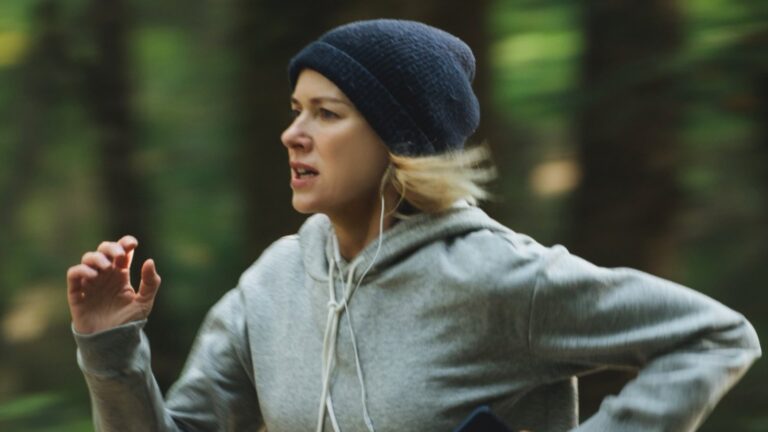
The movie follows a fairly linear plot. On the eve of the anniversary of her husband’s death, Amy Carr (Watts) decides to take a personal day. She goes for a morning run, in the hopes to clear her mind, while her son (Colton Gobbo) stays in bed. Suddenly, the police place all schools on total lockdown, as reports of a shooter infiltrating a school start to appear. In the middle of the woods, Amy must now run to the schools in the hopes of finding her son, who is trapped in a room with the shooter. 

Running at only 84 minutes, the movie takes no time in getting things going. The only good thing I can say about The Desperate Hour is how taut everything is; it gets straight to the action and wastes no time in going from point A to point B. Naomi Watts also anchors the movie with a somewhat decent performance. You can feel the tension when a cacophony of ringtones and phone calls multiplies, while she is trying to make it to her son’s school, far away from where she is. 

It’s unfortunate that screenwriter Chris Sparling and Noyce bog down Watts’ performance through repetitive situations in which she runs, stops to catch her breath, falls down, limps, runs again, falls down once more, limps, and runs again. And it follows the same structure without fail. When more calls reach her phone and she can’t discern what’s going on, she will fall down. And when things have calmed down, or a crucial bit of information is transmitted; she’s going to run, even if seriously injured. And it’ll never change that structure, to try and surprise moviegoers. Exactly like clockwork. 


Now to talk about the more exploitative aspects of the film requires spoiling some of its plot points, so if you want to go into The Desperate Hour without knowing much, you should stop reading now. 


But for those that do want to know why the film is so misguided, here it is. Noyce uses the school shooting aspect to draw a parallel on Amy’s bad parenting skills, and also manipulates the audience, for about twenty minutes, into thinking that Amy’s son is the shooter. Scratch that, the entire film is incredibly manipulative. For about forty minutes, the movie will make audiences believe that it’s due to Amy’s negligence as a parent that her son went to school in the first place. That can easily be forgiven if the rest of the film is gripping enough, but what comes after is even worse. 

A police detective contacts Amy and interrogates him on her son’s behavior, asking him directly if he had access to any guns, and if he takes specific medication. That’s right, the movie wants the audience to believe that Amy’s son is the shooter (even though he isn’t). And they will make the audience believe the same thing for over twenty minutes, as Amy scrambles further to try and get to her son. These moments are exploitative for two reasons. Firstly, and most obviously,her son isn’t the shooter. He never was, and the fact that the film goes to serious lengths in trying to make the audience believe that it’s him is truly repugnant. Secondly, it’s not Amy’s fault that her son went to school. She left for a run to clear her head, her son went to school thinking it would be a normal day. Simple as that. 

But the movie wants us to believe that it’s Amy’s fault so she can have a redemption arc during the film’s final act in which she directly confronts the shooter (Andrew Chown) on the phone and inadvertently saves her son. And it’s in that moment that I completely checked out of the movie, which exploits victims of gun violence as a backdrop for a “pulse-pounding thriller” and uses them as pawns for the “irresponsible mother” to become the hero of the story, especially after being manipulated by the police into believing that her son is the shooter. 

The Desperate Hour seems to have admirable intentions to talk about the effects of a school shooting on a parent, but its misguided script, the senseless exploitation of real school shooting victims to redeem Naomi Watts’ character automatically makes it one of the worst movies of the year and one to never watch, even if it’ll be on cable in a year or two. Phillip Noyce should stop finding manipulative films like these and go back to directing another Jack Ryan film. Now that would be incredible. 


Grade: D-


Movie Review: ‘Cyrano’ Cuts Off Its Nose to Show Us Its Big, Beautiful Heart


Director: Joe Wright

Writer: Erica Schmidt

Stars: Peter Dinklage, Haley Bennett, Kelvin Harrison, Jr., Ben Mendelsohn

Synopsis: Too self-conscious to woo Roxanne himself, wordsmith Cyrano de Bergerac helps young Christian nab her heart through love letters.


The original play Cyrano de Bergerac is so ingrained in the public mind that it’s likely lost a little potency because we’ve seen so many different interpretations of the work. Plus, in most direct parodies or adaptations, the main character wears a gigantic fake nose, which can remove the depth of the ache of Cyrano’s longings. With the film Cyrano, there is a rebirth of the material.

In adapting Cyrano de Bergerac first for the stage and then for the film, Erica Schmidt not only updated the language, but she added a lot more heft to the character of Roxanne. No longer is Roxanne (Haley Bennett) only an idol to be worshiped, a prize to be won, or a token to symbolize the ideal woman. Under Schmidt’s pen she becomes a woman who steers her own destiny, who may be a romantic, but is not a fool. She feels like she has much more depth and it helps that she’s not objectified by the gaze of the camera either.

This is where Joe Wright’s talents lie as a director. He is able to convey Roxanne’s transformation in agency by creating an appealing, but not objectifying visual language for us. Working with cinematographer Seamus McGarvey and editor Valerio Bonelli, Wright crafted a scene in which he showed us the arousal of Roxanne reading one of her letters. The scene has all of the key shots of what would be conveyed in a typical sex scene with Roxanne moving sensually on her bed, gripping the mattress, touching the letter to her coyly exposed flesh, and parting her lips with each deep breath. It’s astonishing how well it works and serves as the template for the montage of Christian and Roxanne reading each letter and the two bodies separated by space, brought together by their passionate imaginations.

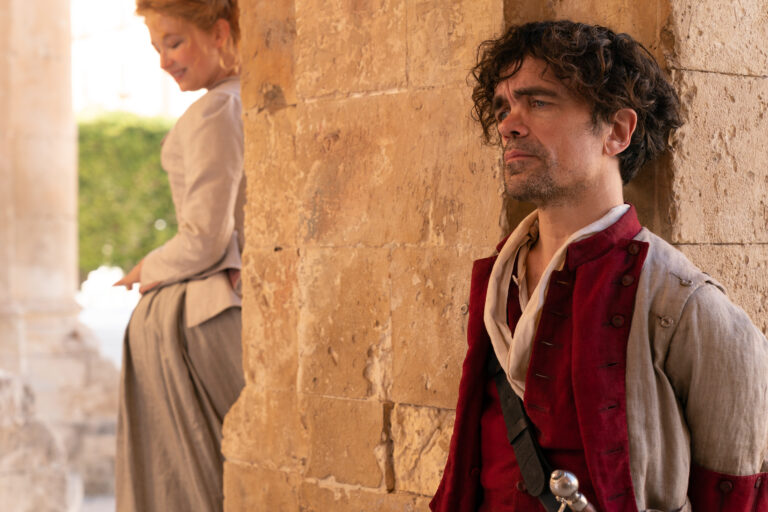
Though, of course, at the heart of the piece is Peter Dinklage who takes on the role of Cyrano with a tremendous amount of gusto. His performance transcends the material, not only because he’s utterly, magnificently, the dashing, debonair, soulful hero, but because without the fake nose to get in the way, his heartbreak is so very plain on his face. He’s able to bring out the agony of longing in a way that pales every other adaptation. His eyes, like bottomless pits of yearning, draw us to him and speak of all of our remembered, painful unrequited loves. Even his sonorous baritone seems to shake the tears from our eyes with its sorrowful rumble.

The music for Cyrano is written by Aaron and Bryce Dessner, members of the sad, dad rock band, The National and they deliver the aching lyrics the band is known for. It is easy to forget that Cyrano is a musical, as the songs come far apart and when someone starts to sing-talk it’s a nice little reminder that they exist. Not to say that the songs aren’t wonderful, which they are and beautifully sung, for the most part, but it is a little jarring at times. It’s like if you were seated across from your significant other as they break up with you and suddenly the waiter makes eye contact, the music swells, and the restaurant sings your feelings. So, kind of odd at first, but a little magical and emotionally fulfilling by the end.

Film is a collaborative art form that needs a sort of hive mind to function and there are some films where everything clicks very much into place. Cyrano is the type of film that can whisk you out of the seat, out of the theater, and into a world of beautiful romance. It’s true you may tumble back to Earth when snide Ben Mendolsohn is suddenly growling and strutting through his villainous song, but by the second verse, you’re pulled back in and see him as the worst of the worst and the grim reaper presiding over the lovers you’ve come to cherish. Cyrano is a heart-aching joy to watch.


Grade: A-


Op-ed: The Challenging Women of Pablo Larraín

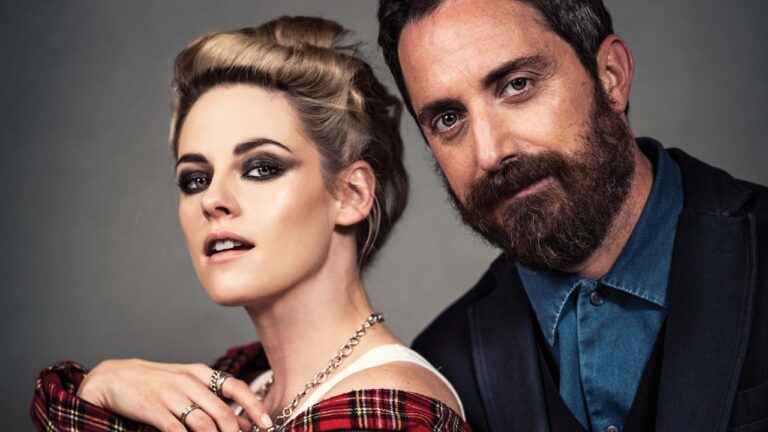
Pablo Larraín has made a career recently, especially in his last three feature films, delving deep into pain. Specifically, this pain focuses on his female protagonists. There is, of course, an easy comparison between two of these women, as they are based on ultra famous figures of political celebrity. But Larraín does not solely focus there, as we will discuss. In the films, Jackie, Ema, and most recently Spencer, Larraín leans in, sometimes uncomfortably for the audience, and forces our eyes to narrow in on trauma. In this piece, the hope is to engage with these struggles, regardless of the quality of the film or award recognition. That being said, Larraín certainly has an ability to coax or find great female performances that awards bodies gravitate toward. This year is no different, with Kristen Stewart managing an Academy Award nomination for Best Lead Actress despite missing out on many awards leading up to the granddaddy of them all.

You can’t really discuss these movies fully without bringing up the sense of class and wealth inhabited by them. In Spencer, the story centering on Princess Diana, Stewart is literal royalty, or at least in line to be so. Jackie, on the other hand, is an American version of this monarchy. If there ever was an American royal family, it was certainly the Kennedys. And Jackie (Natalie Portman), like Princess Di, has married into this family. There is an important distinction, however. Jackie never dreamed of fame or royalty. By her own admission, she remains distant from this and this is personified by her near unwillingness to engage with other people. Diana, on the other hand, according to the script of Spencer, penned by Steven Knight, lived just over the hill and seemingly dreamed of being a part of that world. Larraín does a wonderful job, along with cinematographer Claire Mathon, of absolutely destroying that dream with the crushing weight of both people and architecture. Ema is another story entirely. She is not royalty, American or otherwise. The film doesn’t necessarily show a monetary struggle, but she works a normal job and her surroundings are never elegant. This is both fitting to the character and necessary for her journey in the film. Indeed, it makes Ema more of a threat than either Jackie or Diana could ever dream of being. It almost seems to fly in the face of logic, but these rich, relatively powerful women are largely powerless, whereas Ema is absolutely the master of her own destiny. Not only that, but unlike her royal counterparts, Ema drags others into her orbit instead of keeping them at arm’s length.

Larraín also showcases the power of female anger through these three movies. In Spencer, there is almost a lack of this emotion. Stewart maintains her calm, because she feels that she must for the protection of her children who are perhaps her only solace. Jackie holds back her anger until the most impactful moment, when her ability to grieve the loss of her husband is nearly wrenched away under the guise of safety. Portman, perfect for the role for many reasons, embodies her anger well not least because of her diminutive stature. So, when that anger is unleashed, she is able to stand her ground against the largess of the room and everyone in it. Ema’s anger is cold, calculating, but burns just as hot. Her willingness to eviscerate her partner, Gastón (Gael García Bernal) throughout the film is dangerous from a filmmaking perspective. Larraín and his lead actress, Mariana Di Girólamo, risk making Ema too cold, and a woman we want no part of. Yet, her passion, desire, and love; all more evident on rewatch, carry us through to following her on this dangerous path.

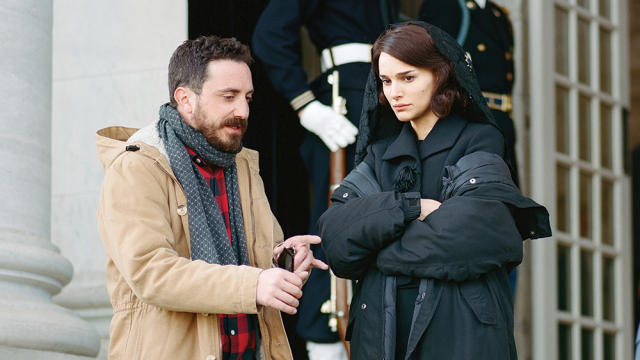
Jackie': Pablo Larrain Brings First Lady Story to Screen at Right Time

Another way that Larraín eschews normalcy in his female characters is the dividing line of gender. All three of these women have at least some attraction to men. In Jackie and Diana, we know this from actual history, or at least assumed history. Ema, has sexual relationships with both men and women. And yet, the men in these films are at best ineffectual, and at worst, obstacles. In Jackie, the most positive male character is known only as The Journalist and is literally a means to an end. Yes, in one of the more moving moments of the film, she opens up to him. But she immediately closes this down and tells him exactly what he is allowed to write and publish. The other men, most known by history, are consumed by grief or simply in Jackie’s way. The only other man who is attempting to provide solace is a priest (John Hurt) who also becomes ineffective in the face of her intense grief. Truly, the only person who is a help is Nancy Tuckerman (Greta Gerwig). Jackie leans on her, figuratively and literally, especially regarding her children. In Spencer, the men are more than ineffectual, they are attempting to ruin her at every turn. Although the film makes an effort to humanize her husband, Charles (Jack Farthing), he is still no help to her and will support the royal family regardless of the effect on her or the children. Darten (Sean Harris), the chef, attempts to guide Diana but given his station, he is powerless, as well. Larraín makes it clear that his concern is no replacement for power. Again, Diana leans on another woman, in the place of her dresser, Maggie (Sally Hawkins). It should be no surprise that the only moments of freedom are ones in which no adult men are present. Moments with her children, or alone with Maggie, are the simplest and kindest interactions we see in the film. The vision of Diana dancing and twirling on the sands with Maggie almost seems from a different life, a better life. As in all things, the relationships in Ema are vastly different from the buttoned up women in Jackie and Spencer. One could argue that Ema uses people of any gender to get exactly what she wants. But in her relationships with women, there is more of a softness and a guiding hand. As she engages with two other main characters Aníbal (Santiago Cabrera) and Raquel (Paola Giannini), the process is decidedly different. Anibal becomes a simple tool for her to get exactly what she needs. He is also simpler to seduce. Raquel and Ema’s relationship feels more genuine and focused. And when its untimely end appears, there seems to be a hint of regret and sorrow. Anibal, on the other hand, feels more like he is tossed aside without a second thought. It should also be noted that in most of the electric dance sequences, Ema is surrounded and supported by almost solely women.

Finally, all three of these movies are focused on power and performance. Ema is being dishonest with almost every other character. And yet, she feels more genuine than Larraín’s women of history. Ema is enacting something on the world. She has a specific goal and nothing will stop her. Not sexual partners, bureaucracy, lack of money, or even morality. In Jackie, we may have the purest example of the world happening to her. The film literally begins just after the death of her husband, an act no one could stop. Her world almost literally explodes before the film even begins. Given her status as “royalty,” she is really only able to impact the people that she views as lesser, from journalists to priests. She wields her power by offering them a view inside, only to rip it away when things get a little too real. Lady Diana of Spencer is closer to Jackie, as usual, but retains more humanity and empathy. Her greatest desire is to escape, to stop having the world crush her and her children. Given what we know of her history post credits, the two most impactful scenes are also tinged with tragedy. Diana playing a game with her children, in the dead of night and by candlelight, showcases not only Larraín’s gifts but Stewart’s as well. She engages fully and, for just a moment, all artifice of both the character and the actor are lifted. She is simply a woman, playing a game with her children, to take all of their minds off of the crushing weight of monarchy, celebrity, and expectation. Yet, we know how this ends. Those children grow up without a mother due to that exact combination of pressures. Similarly, the scene where they “escape” with the needle drop of “All I Need Is a Miracle” from Mike and the Mechanics blaring out of the car stereo: this moment cuts deep, as in the moment, it does feel like a miracle, a true escape for this small family unit we are all rooting for. But, as all moments in these Larraín films, there is darkness waiting. Diana does need a miracle to truly leave royalty, and even after physically leaving, the celebrity literally followed her, to her death and beyond. That freedom and happiness, tinged with tragedy, sticks with the viewer even as the credits fade. 

Whatever you think of Pablo Larraín’s films, they are engaging with these troubled women at a level that is sometimes missed even in “award caliber” films. These three women give wildly different, yet all incredible performances. Portman, in an affected vocal choice, is still able to access the trauma, pain, and the feeling of being trapped into this life of worldly gaze even years later. Di Girólamo is crackling at every turn, a challenge to accept, yet one cannot help but be lured in by her performance. The audience and every other character in Ema is drawn to her, even if it is hard to understand quite why. And in Spencer, the turn from Steward may finally rid her of the yolk of Twilight. Though many cinephiles know that she has been past this for some time, to the more casual viewer, this is an introduction to Stewart as a next level performer. She, like Portman, affects a particular voice for Lady Diana, but this is one that the working class people can reach. And this is why she is so wonderful as this character. If you lived through this time, you know that she was, in essence, the people’s princess. Her willingness to dig deep as an actor serves her, not only in garnering awards attention, but in finding Diana in the process. Larraín truly has found a gift in the last five years to zero in on difficult to access women and provide a structure to draw our focus. In these three films, he has proven that celebrity, class, and emotion are no barrier to seeing these women as complete humans, deserving of our attention and empathy.

Chasing the Gold: 2022 SAG Predictions

The SAG Awards are tonight and it may just be more important than ever to win this for the Oscar contenders. With the question of relevancy for the Golden Globes, the jury system of the BAFTAs and the pushed date for the Critics Choice, this will be the time that frontrunners are determined for the acting races. So, who am I predicting to win big tonight? Read below for my predictions and analysis on each of the six movie categories.

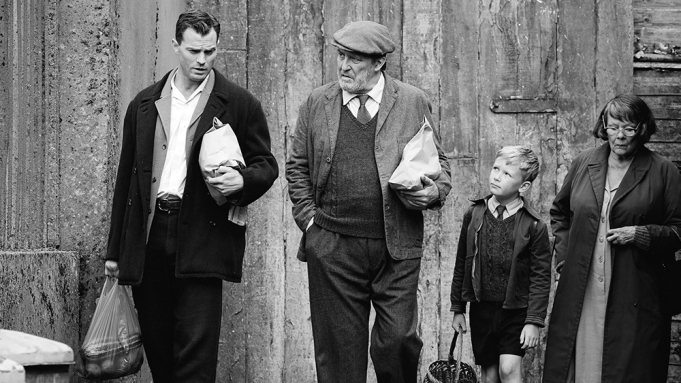
BEST CAST ENSEMBLE – BELFAST

With the omission of The Power of the Dog, the Best Cast Ensemble race is an interesting one that may help push some bubble contenders forward in the Best Picture race. Think back to the 2019/20 season in which Parasite won Cast Ensemble without an acting nomination, giving the film a major platform and push to eventually win the Best Picture race. 

This is a race that could be anybody’s to win. If the guild wants to do what they did last year for The Trial of the Chicago 7 and go for the film with the biggest cast, that could be a compelling argument for Don’t Look Up. Of course, that film failed to even bag a nomination for Leonardo DiCaprio, so a case can be made that the guild in general did not have much passion for the acting within that film. CODA and King Richard both scored one acting nomination outside of Cast Ensemble, but there is a strong chance that both of those performances will win in their respective categories. With that, there may not need to be a push to award the entire cast as they will already be represented within the show.

I actually think the competition is close between Belfast and House of Gucci. Gucci scored the most nominations on SAG morning, alongside The Power of the Dog, which is not even listed here. On top of that, with the poor performance at the Oscars and the growth of the SAG voting body including influencers, it may be enough to push a film with stars such as Lady Gaga and Jared Leto to victory. However, I am going to play it safe and predict the current Best Picture runner-up in Belfast. Sure, it only got one nomination for Caitriona Balfe in Supporting Actress, but both Hinds and Dornan would have been close in Supporting Actor and this would be a way to reward that film, making it potentially a closer race than we expect come Oscar night.

BEST MALE ACTOR IN A LEADING ROLE – WILL SMITH, KING RICHARD

Yes, there are people out there who are predicting either Andrew Garfield or Benedict Cumberbatch to pull a surprise and start their campaign off at SAG. Yes, I could see the argument for either of those cases to come to fruition tonight. However, I personally think it would be dumb to predict against Will Smith when King Richard is the only film in this category to also secure a Cast Ensemble nomination. Smith already has the Golden Globes, he managed to break into the Actor category at BAFTA over Andrew Garfield, and he is the favorite to win the Oscar. Winning the SAG would not only give him a chance to make a speech for the first time this season, but solidify his place as the frontrunner in this race as he has been since the film was announced.

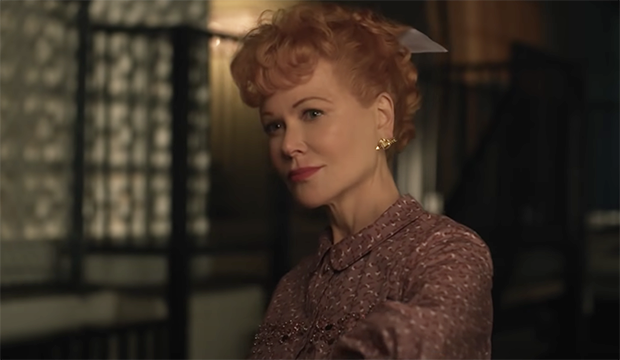
BEST FEMALE ACTOR IN A LEADING ROLE – NICOLE KIDMAN, BEING THE RICARDOS

The Lead Actress race, like last year, is going to have the chance to be interesting. With Kidman winning the Golden Globes, Stewart back in the running for Oscar without a SAG nomination and with Gaga scoring a SAG nomination but no Oscar nomination, this could either make the race incredibly boring or extremely close. This is the toughest race to call, and because of that I am simply playing it safe and sticking with the current frontrunner.

Jennifer Hudson has the hardest hill to climb, not getting recognition anywhere else and with little buzz for Respect. Chastain needs to get the SAG win for her campaign to kick off for The Eyes of Tammy Faye, and yet I also question whether her film has been seen widely enough to climb the rankings. Colman is someone that should never be ruled out, especially when her film overperformed at the Oscars, but I still wonder if she has the star power within SAG to top Gaga or Kidman. To me, Gaga and Kidman are the top two and while influencer and snub power could be enough to get Gaga the win here and cause chaos within the category, the best bet is to go with the actress that already has a major win and brought Javier Bardem tagging along into the Leading Actor category by predicting Kidman to win.

BEST MALE ACTOR IN A SUPPORTING ROLE – TROY KOTSUR, CODA

I know I have said to stay safe with the first three predictions, but the Male Actor in a Supporting Role category is where I am taking a swing. If you want to play it safe, predict Kodi Smit-McPhee to win for The Power of the Dog. It seems weird to predict that the Best Picture frontrunner would walk away empty handed and he has dominated the season with critic wins and the Golden Globe win, and that logic makes complete sense.

There is something about Smit-McPhee’s win that just does not feel right when looking at the Oscar’s past, and he would have to miss SAG or BAFTA for that pathway to start revealing itself. CODA has four nominations at the Oscars and the easiest chance it has to pick up a win would be for Troy Kotsur for Supporting Actor. He is campaigning like nobody else this year and Apple TV has the budget to focus specifically on his campaign, unlike with Netflix and Smit-McPhee. It would be an award for the history books and a way to reward CODA for the representation of the deaf community, and it just feels right. It isn’t the safe bet, but I am allowing myself one risk this year.

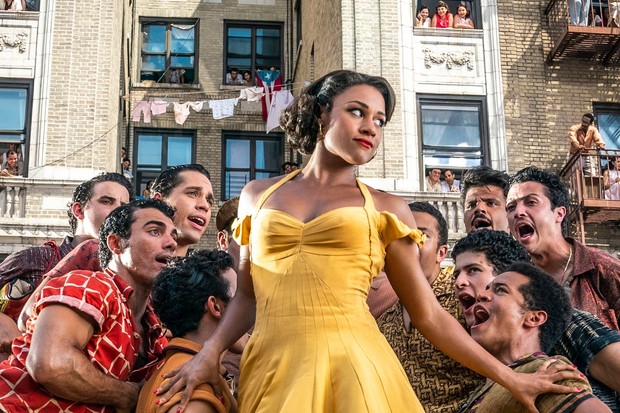
BEST FEMALE ACTOR IN A SUPPORTING ROLE – ARIANA DEBOSE, WEST SIDE STORY

If The Power of the Dog was to secure a win and it was not with Kodi Smit-McPhee, there is a world in which Kirsten Dunst is finally rewarded by her peers and wins here. She is a clear number two in this race with Aunjanue Ellis missing the nomination and there has been more publicity done for her individual campaign than with Smit-McPhee. However, this is a case like with Male Actor in a Leading Role where it would be dumb to predict anyone other than Ariana DeBose for West Side Story.

Yes, she is the only representative for that film and the film did miss out on the Cast Ensemble nomination. However, it was made clear that there were screener issues with West Side Story and she still managed to get in despite Ellis missing out. That should highlight the strength of both her performance and her place in the race, and I do not see anyone overtaking her this award season.

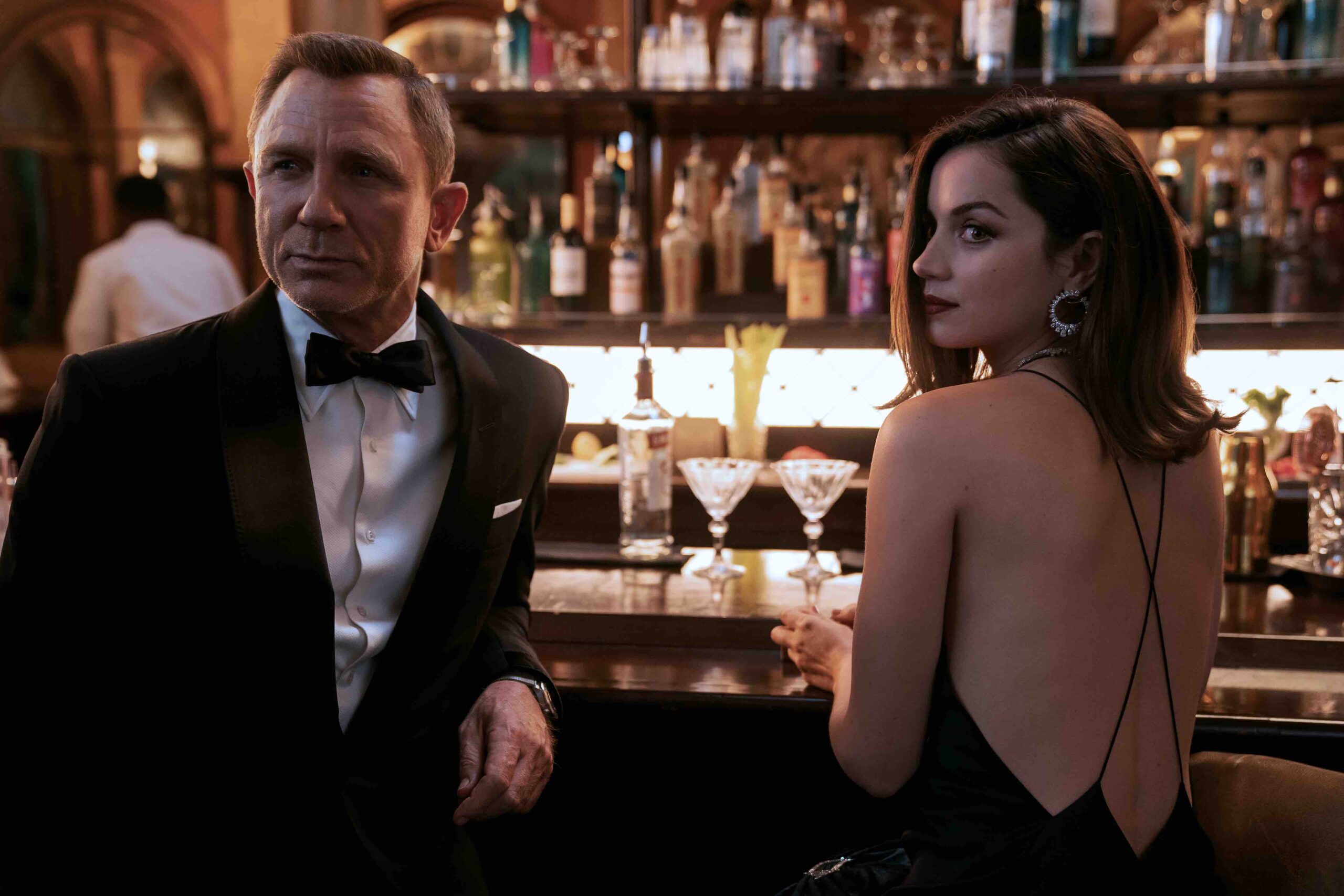
BEST STUNT ENSEMBLE – NO TIME TO DIE

Stunt Ensemble is seemingly a two-horse race this year between Best Picture contender Dune and the last Bond film of Daniel Craig’s era, No Time to Die. It may seem obvious to go with the Best Picture frontrunner and something that scored ten nominations total at the Oscars, and yet the betting odds have No Time to Die out at front and that is what I am going with here.

No Time to Die is still a blockbuster success at the worldwide box office and will most likely score at least one Oscar win for Billie Eilish’s “No Time to Die” in Original Song. It is also clear that the SAG branch likes the stunt work in the Bond films, awarding Skyfall the award in 2012. Sure, the stunt work in Dune is better than that in Best Picture contenders such as The Trial of the Chicago 7, Ford v Ferrari, or The Irishman, but I still think the final farewell to Craig’s Bond will be something that cannot be ignored when it comes to the stuntwork.

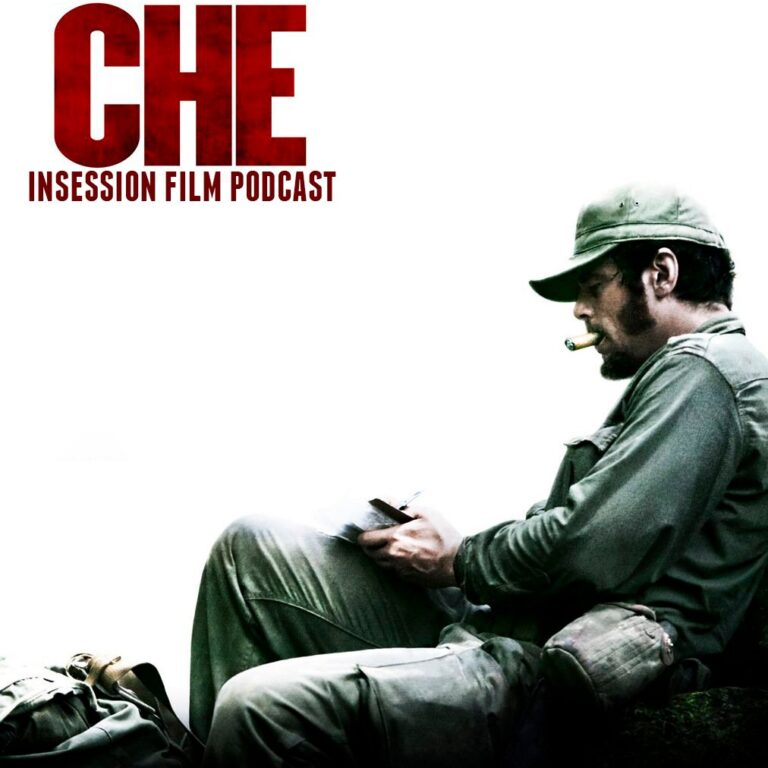
Podcast: Che / Sundown – Extra Film

This week on Extra Film, Ryan and Jay continue their Steven Soderbergh Movie Series with Che, and then they discuss the latest indie, Sundown!

After the success of Ocean’s Twelve, Soderbergh got himself caught in making a two-part epic that would see the end of his commercial run. Billed as a two-part historical biopic, he steps in at the last second for Terrence Malick to make a version of Che’s life that is complex and tragic. With a dynamite performance from Benicio del Toro, this is an interesting conversation between the two hosts.

In the back half of the episode, the boys dive deep into Sundown. Director Michel Franco has an ability with his work to be controversial yet riveting, and with his latest, he gives veteran actor Tim Roth a chance to shine in a dark leading role. Boys disagree a little on this one, but come to the conclusion that you should still check the movie out on VOD>

Thanks for listening!

– Movie Review: Che (5:35)
Director: Steven Soderbergh
Screenplay: Peter Buchman, Benjamin A. van der Veen, Terrence Malick
Stars: Benicio del Toro

– Movie Review: Sundown (53:16)
Director: Michel Franco
Screenplay: Michel Franco
Stars: Tim Roth, Charlotte Gainsbourg, Iazua Larios

– Music

Ten Years Earlier – Alberto Iglesias
How to Disappear Completely – Radiohead
The Return of the Eagle – Atli Örvarsson

We try to make this the best movie podcast we possibly can and we hope you enjoy them. Subscribe today on iTunes, Spotify, or Stitcher, and please leave us a review on iTunes. You can also find us on Soundcloud, PlayerFM, and TuneIn Radio as well. We really appreciate all your support of the InSession Film Podcast.

Subscribe to our Podcasts RSS
Subscribe to our Podcasts on iTunes
Listen on Spotify
Listen on Stitcher
Che / Sundown – Extra Film

[divider]

To hear this Extra Film episode and everything else we do, download our apps on the Amazon Market for Android and the Podcast Source app on IOS devices. The mobile app covers all of our main shows, bonus podcasts and everything else relating to the InSession Film Podcast. Thanks for your wonderful support and for listening to our show. It means the world to us.

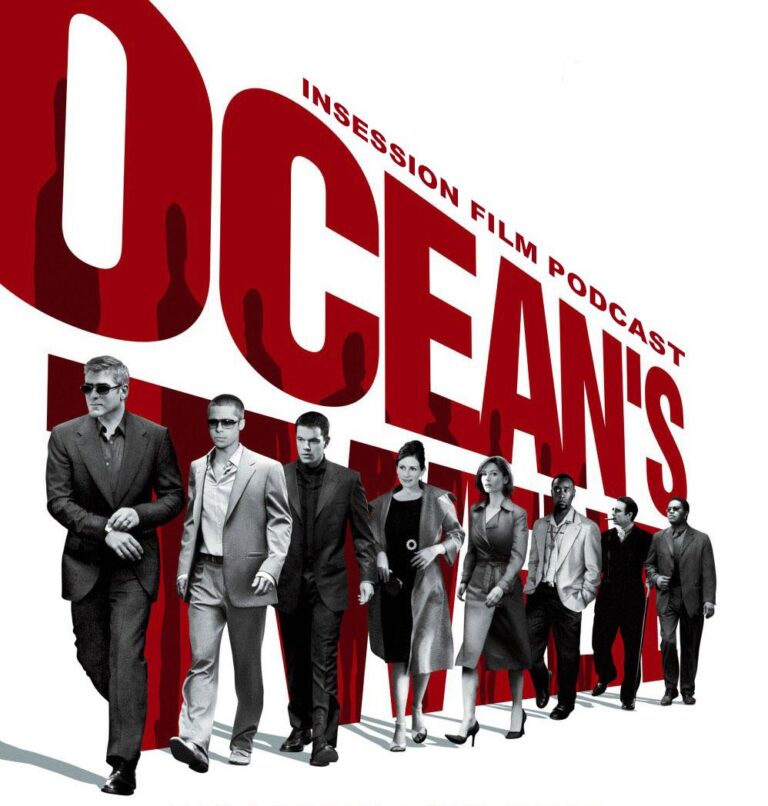
Podcast: Ocean’s Twelve / Kimi – Extra Film

This week on Extra Film, Ryan and Jay are joined by John Mark Junkins to continue their Steven Soderbergh Movie Series with Ocean’s Twelve, and then they discuss Soderbergh’s latest, Kimi!

After the failure to capture the box office audiences with Solaris, Soderbergh came back to the Ocean’s franchise with an unconventional sequel that was divisive at the time of release but is now considered a very good movie that rivals the original. Ryan, Jay, and John Marc had a lot of fun doing this show.

In the back half of the episode, the boys dive deep into Kimi. Coming back with another HBO Max film, Soderbergh makes a Covid based thriller about a tech working caught up in a conspiracy within her company. Led by a fantastic Zoë Kravitz, Soderbergh continues to show why he is still one of the best directors working today with one of the best films of the year so far.

Thanks for listening!

– Movie Review: Ocean’s Twelve (4:12)
Director: Steven Soderbergh
Screenplay: George Nolfi
Stars: George Clooney, Brad Pitt, Matt Damon, Catherine Zeta-Jones, Andy García Don Cheadle, Julia Roberts

– Movie Review: Kimi (1:29:04)
Director: Steven Soderbergh
Screenplay: David Koepp
Stars: Zoë Kravitz, Byron Bowers, Rita Wilson

– Music

The A La Menthe/La Caution – David Holmes
Kimi – Cliff Martinez
The Return of the Eagle – Atli Örvarsson

We try to make this the best movie podcast we possibly can and we hope you enjoy them. Subscribe today on iTunes, Spotify, or Stitcher, and please leave us a review on iTunes. You can also find us on Soundcloud, PlayerFM, and TuneIn Radio as well. We really appreciate all your support of the InSession Film Podcast.

Subscribe to our Podcasts RSS
Subscribe to our Podcasts on iTunes
Listen on Spotify
Listen on Stitcher
Ocean’s Twelve / Kimi – Extra Film

[divider]

To hear this Extra Film episode and everything else we do, download our apps on the Amazon Market for Android and the Podcast Source app on IOS devices. The mobile app covers all of our main shows, bonus podcasts and everything else relating to the InSession Film Podcast. Thanks for your wonderful support and for listening to our show. It means the world to us.

Criterion Crunch Time: ‘A Touch of Sin’

There is no more challenging genre of film for me as a viewer than the anthology film. As someone who is used to standard narratives (even if they are out of order or odd in their own ways), the anthology stands apart. There are, of course, wonderful films that are anthologies. For instance, Jim Jarmusch’s Cigarettes and Coffee is an all-time great. New York Stories, directed by Scorsese, Coppola, and Allen is basically untouchable and really tells, well, New York stories very well. Yet, there can be a disconnect. When you are used to following a centralized character (or two), it can be quite disconcerting when that story ends and we, as an audience, are jerked towards a completely new story. It takes a truly great director and script to accomplish this with little connective tissue (this is why I didn’t mention a film like Pulp Fiction). And leaving the Criterion Channel in just a few days, there is an anthology film in A Touch of Sin, from Jia Zhangke.

A Touch of Sin features four stories that are only connected in the loosest of possible ways. As I sat down to watch it, I did not realize this and that move from the first main story to another was certainly jarring. But with a master behind the camera, that fades pretty much immediately. In addition to being an anthology, A Touch of Sin is oddly almost a travelog film, as well. It takes place in chronological order, which gives it a real sense of movement and forward momentum, which is incredibly important with these jarring shifts. But another sense of movement is the fact that it takes place in different geographical locations across China. This may be more noticeable for Chinese viewers, but likely more important for those of us who are not. Another note that may escape viewers is that each vignette is based (somewhat loosely) on real events in China. A Touch of Sin shows us that our understanding of other countries is quite limited and we adjust our perspective ever so slightly.

It should be noted also that A Touch of Sin is perfectly titled. As with any anthology, there are rough points in the screenplay (also written by Jia Zhangke), but they are punctuated or pushed forward by literal small pieces of sin. The violence in the film is not constant, but it is ever present, lying in wait. When these moments finally happen, they are always shocking, but never seem excessive. There was some concern as the prologue opens with San’er (Wang Boaqiang) being attacked while on his motorcycle, to which he calmly responds by dispatching them with a firearm. Despite this character returning later as a vignette, the violence in the film is fleeting.

Although the possibility of violence constantly looms, A Touch of Sin really seems to be about individuals and our choices in the face of not only threat, but the weight of doom from forces larger than ourselves. 

The first story, focusing on Dahai (Jiang Wu), is a remark on on workers’ rights and the yolk that falls upon one man. Dahai is in the right, this is made impeccably clear. But the script also makes it clear that none of that actually matters in the end. Dahai speaks truth to power, and he is punished both physically and socially. After he recovers from his physical injuries, he is mocked by the very people he wanted to assist. 

San’er, from the prologue, returns and we are shown that he makes his living by killing people and taking their goods. In a moment that cuts the audience, he tells a loved one essentially that he is unable to live a good life as violence is all he can create. The helplessness and stoicism of that comment hangs in the air painfully. As we follow him further, we know he will incite violence, and there is nothing he or we can do to stop it. There is no catharsis in this act, he simply gives in to where his talent lies. 

When we meet Xiaoyu (Zhao Tao), she is doing the right thing in a difficult situation. She tells the man she loves (who happens to be married) to do the right thing and leave his wife, or she will leave him. She is not only punished for her actions, but also sees others arbitrarily punished. She is attacked, in a shocking scene, by this man’s wife and her friends. But after she flees, she witnesses governmental forces attack another worker. Much like her, he is victimized, due to choices not folly made by him. Watching Zhao Tao take all of this in, almost silently, is like watching a master at work. When she lashes out violently, we understand. But again, there is no solace here, as she immediately calls the police and informs on herself, knowing there is no real escape.

Finally, we follow Xiaohui (Luo Lanshan), a normal working man, who is also in love with a woman. This story, based on worker suicides in the early 2010s, is perhaps the most hopeless of all. He accidentally causes an injury to a co-worker and is made to pay for the lost time out of his own check. But this is only the introduction of unfair treatment. Through a tragic series of events, Xiaohui’s relationship falters and he leaves his job. The original man who he injured takes his revenge physically. Rather than deal with this humiliation, he leaps from a height and ends his life. All of this began with zero workers’ rights, just as with Dahai.

Jia Zhangke’s work on A Touch of Sin is an example of an anthology film truly working. Despite the lack of connection between stories, plotwise, the themes run clearly. This is hammered home in the epilogue, in which a performer turns the blame on the crowd. This is Jia Shangke looking directly at us, accusing us of not standing together. The film makes it clear that separately, none of us can stand against these forces, but together there is a slight change. As the opera performer intones, it becomes the lasting message. Do you understand your sin? Do you know what you have done, and how you can come together to atone, for all of us?

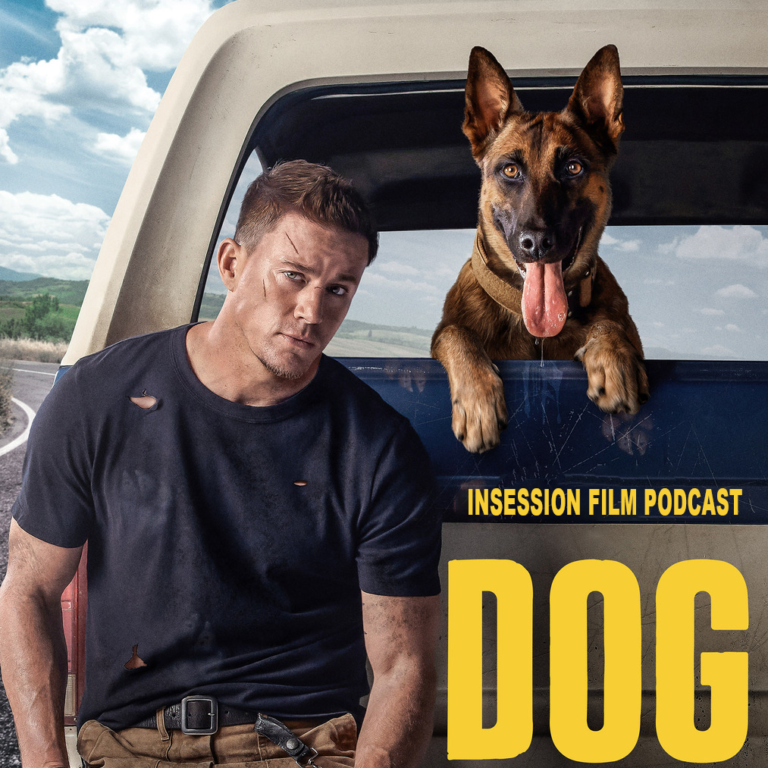
Movie Review: ‘Dog’ Solidifies Channing Tatum’s Stardom


Director: Channing Tatum and Reid Carolin

Writers: Reid Carolin and Brett Rodriguez

Stars: Channing Tatum, Ethan Suplee

Synopsis: Two former Army Rangers are paired against their will on the road trip of a lifetime. Briggs (Channing Tatum) and Lulu (a Belgian Malinois) race down the Pacific Coast to get to a fellow soldier’s funeral on time.


Throughout the 2010s, Channing Tatum had as big as any start in Hollywood. Whether it be his comedic roles in the Jump Street films, his sex appeal in the Magic Mike movies, or his various cameos (This is the End…still shocking), the dude was a Star. But then he disappeared after 2017. In recent months, we’ve learned that he had some family struggles, some passion projects of his fell through, and generally he felt he just needed a break. Additionally, in early 2018 he lost his dear friend, and real life dog, Lulu. It’s safe to say that Tatum was going through a lot and it makes sense that he would step away for some time (aside from doing a few vocal performances).

Given that context, it’s fascinating that his first movie after his hiatus, in which we see Tatum on-screen, is a movie called Dog. One based off his own where the main character is also called Lulu. Finding closure is one of the most potent human experiences and there’s no doubt that making Dog was a way to find catharsis and healing for him. Perhaps that’s why he decided to co-direct this movie as well, as he wanted to make sure it would be exactly what he needed it to be.

Dog is about two former Army Rangers, one of them being Tatum’s character of Jackson Briggs, who is struggling with PTSD and some sort of brain injury that keeps him from re-joining the Rangers. The other is the aforementioned Lulu, who is also suffering from PTSD and healing from gunshot wounds. Early on in the film we learn that Lulu’s handler, Riley, recently died in a car crash. This gives Briggs an opportunity to rejoin the army as he’s tasked with driving Lulu from Washington to Arizona for Riley’s funeral. If he’s successful, his captain will make the phone call necessary to get Briggs back in action.

However, as one can imagine, things do not go according to plan. In one scene early on as Briggs is trying to engage two women in a potential sexual encounter (a moment that is weird, but humorous), Lulu is barking her head off and it gets the attention of one passerby who tries to get her out. Lulu is a highly trained warrior, though, and maybe he shouldn’t have done that. Later, there is another scene in which Lulu escapes her leash and runs into the woods where he finds a marijuana farm. Things get a little strange from there. Not to mention the hotel scene, as prominently showcased in the trailer for Dog, where Briggs pretends to be blind so they can get a free hotel room. If you’ve seen that trailer, you’ll know it ends in awkward fashion.

What’s so compelling about the film and its levity, though, is that it’s somewhat of a ruse. Dog markets itself as a buddy-comedy, with some screwball elements to it, but in totality it isn’t that at all. At its core, it’s more of a poignant, psychological examination of two Army veterans who are broken and in need of healing. As mentioned, we learn that Briggs and Lulu have their psychological and physical wounds, but there’s also a familial component. Briggs has an estranged daughter. Lulu has lost her handler and friend. We also find out she has a brother who is also an Army vet. Tonally speaking, there is much gaiety throughout Dog, but mostly it becomes an emotional look at two Rangers who find purpose and healing in each other.

That idea sounds more schmaltzy than what it actually is in execution. Which is where Tatum and partner Reid Carolin thrive as directors here. There are scenes in Dog that could have been imbued with manipulative sentimentality, but they do a great job of avoiding convention. In the film’s most potent scenes, where Lulu is vulnerable, there’s no music to heighten emotion. There’s no elevated filmmaking to manufacture drama. Tatum and Carolin keep things simple and keep things organic. It’s a simple close up on Tatum where his facial mannerisms elicit a hefty response because we care about Briggs and Lulu. The film earns its conclusions.

It also works because of its sincerity. Dog is a movie that, shocking I know, loves dogs. Lulu isn’t just some animal that the military uses and then disregards. Not at the individual level, anyway. Riley maintained a book for Lulu that not only detailed her military experiences, but also featured poems he had written for her. There’s another scene with Noah (Ethan Suplee) midway through the film where we see he has adopted Lulu’s brother, another Ranger vet, and talks about his love for him. And of course, there’s Briggs and his journey with Lulu that eventually showcases how he finds purpose in his relationship with her. The overlords in Washington may see these dogs as expendable, but they mean something profound to the people who interact with them every day. There may be a small sliver of sentimentality with that idea, but it is mostly handled with diligence and affection.

We haven’t seen Tatum on screen for five years and Dog quintessentially proves why we love him. He gives another magnetic performance that’s funny at times, but his genuine turn in the back half is quite moving. He also shows great promise as a director. If he gets behind the camera again, consider me very excited. This is especially true if he finds material that he’s passionate about as we see with Dog. At times, the film is tonally jarring and the narrative meanders in ways that could be distracting, but those are small quibbles in the grand scheme of it all. Go see Dog, you won’t regret it.

Grade: B+

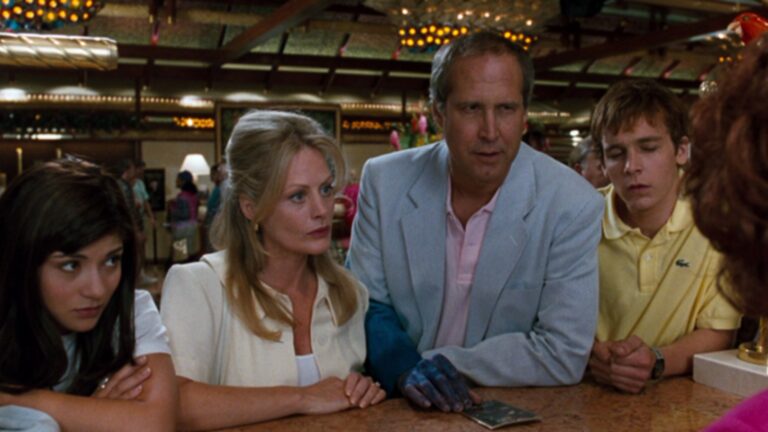
Film at 25: ‘Vegas Vacation’ a Tired Fourth Entry in the Comedy Franchise

0


Director: Stephen Kessler

Writer: Elisa Bell

Starring: Chevy Chase, Beverly D’Angelo, Randy Quaid

Synopsis: In the fourth outing for the vacation franchise, the Griswolds have to survive Vegas fever when they go to Las Vegas for a fun family vacation.


In the long history of movies nobody wanted or asked for, near the top of that list has to be Vegas Vacation, released twenty-five years ago in February 1997, a film with an existence so questionable even the National Lampoon in the title was dropped. If there was a trilogy that should’ve stayed a trilogy, it was the Vacation series, which has an excellent and highly quotable first entry (1983’s National Lampoon’s Vacation, directed by Harold Ramis), a lesser if  underrated second entry (1985’s National Lampoon’s European Vacation, directed by Amy Heckerling), and a hugely beloved third entry that plays on millions of home television screens every December (1989’s National Lampoon’s Christmas Vacation, almost directed by Chris Columbus).

 Something all three of these comedies have in common is John Hughes, who in the 1980s could pump out screenplays faster than most writers could pen a flash fiction short story—Ferris Bueller’s Day Off, for example, was reportedly written in its entirety in a single weekend. He didn’t direct any of the Vacation movies, but he put his stamp on those first three films in so many ways. His humor is almost always spot-on, and the escalating circumstances and wild problems Clark Griswold and his family continued to find themselves in is always worth multiple viewings.  

 The third entry looked to be a good place to stop, but lo and behold, eight years later the world got a fourth theatrical entry in the franchise with Vegas Vacation, a film that has its fans and isn’t by any means a complete waste of time, but unfortunately marks a giant drop in quality that hasn’t found favor with the passage of time. Some jokes still bring a smile to your face, like Christie Brinkley’s return as the woman in the Ferrari, and Clark being forced to climb up Hoover Dam. Beverly D’Angelo is a treasure like always, and Randy Quaid’s Cousin Eddie enlivens the proceedings, his presence sorely missed in the second installment.

 But little in Vegas Vacation makes you laugh out loud, the story not focused so much on the family this time as a unit but instead on Clark’s gambling problems, Ellen’s crush on Wayne Newton, and the kids getting into trouble both in and around the casinos. The first three films work as well as they do because the family typically stays together, but in Vegas Vacation they’re so often apart, the actors and characters are often not compelling enough to carry comedic subplots on their own.

 One of the biggest problems is the Chevy Chase performance, which doesn’t showcase the typical inspired insanity of his earlier comedies. Chase’s status in Hollywood was slowly dwindling throughout the 1990s, starting with flops like Nothing But Trouble and Memoirs of an Invisible Man, and continuing into his failed 1993 talk show and the lackluster Cops and Robbersons and Man of the House. By the time Vegas Vacation rolled around, his time as a leading man was all but over, and in some ways the film feels like a last-ditch effort at some relevancy for Chase, the comedy world having moved on by 1997 to Jim Carrey and others.

 The film could have been far worse, of course—reportedly Chase’s idea for a fourth film was A Swiss Family Griswold, which would have stranded the family on a deserted island. The filmmakers also could have tried to replicate the same plot of the original Vacation, putting the family on another cross-country trip. Las Vegas is a city filled with so much possibility for any movie, let alone a Vacation movie, but I didn’t think back when I was twelve years old that enough was done with this screenplay written by Elisa Bell, and my feelings today haven’t changed.

 Vegas Vacation always feels merely like a series of situations, never with a story we can care about, never with a narrative that has any forward momentum. Of course a lot of the problems with that middling narrative could be pushed to the wayside if the jokes were funny, but the soft PG rating hurts Vegas Vacation big time. There is nothing on display here like the raucous jokes of the R-rated first installment. Even National Lampoon’s Christmas Vacation, which so many families watch together during the holidays, has a ton of lewd sexual jokes and dark macabre humor that is almost never replicated in this fourth installment.

And the movie sadly gets worse as it goes along. The familiarity with the characters gives us enough to hold onto in that first so-so half-hour, but once the dubious plot sets into motion, there’s little to maintain our interest. The shrug-worthy finale is especially disappointing, the family having lost everything but managing to sit by the right person at the right time to see their problems evaporate in an improbable instant. 

 Now, to be fair, Vegas Vacation is better than some of the trash in this franchise that came after, like the direct-to-video Christmas Vacation 2: Cousin Eddie’s Island Adventure from 2003 and the criminally disappointing Vacation from 2015, which only had one funny scene involving Christina Applegate getting her drink on. Vegas Vacation is pleasant enough to play in the background of your living room while you’re busy doing other things, but this movie, a box office disappointment twenty-five years ago, is a mostly forgettable trifle that, at best, simply reminds you of all the better films worth watching in the franchise.    


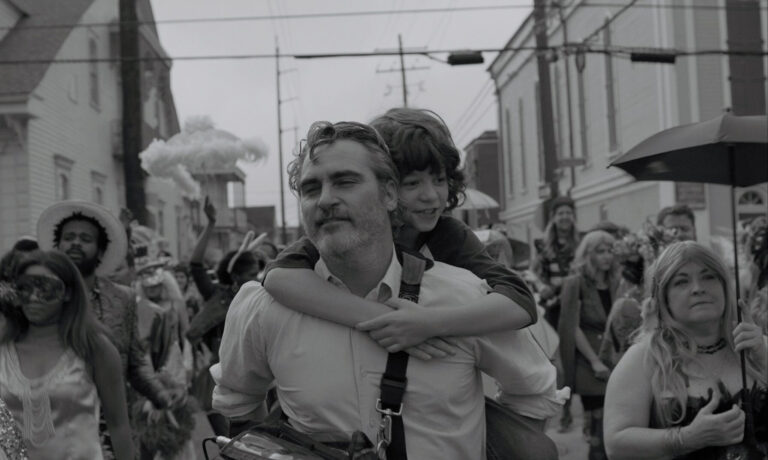
Movie Review: ‘C’mon C’mon’ Reflects on the Struggles of Parenthood in the Most Beautiful Way


Director: Mike Mills


Writer: Mike Mills


Stars: Joaquin Phoenix, Woody Norman, Gaby Hoffmann

Synopsis: Johnny (Phoenix) and his young nephew (Norman) forge a tenuous but transformational relationship when they are unexpectedly thrown together in this delicate and deeply moving story about the connections between adults and children, the past and the future.


Mike Mills is one of those screenwriters that I am fascinated by, due to his ability to capture human emotion. His previous film, 20th Century Women, was one that was easy to connect with because of how authentic those characters were. Here, Mills has managed to do the same as he spends a majority of the runtime delving into the main characters and focusing on the development of their relationship, something that many parents will be able to relate to. The situation may be a little more drastic than what most parents have to experience, but the connections and feelings are completely real as Uncle Johnny (Joaquin Phoenix) must warm up to looking after his nephew, Jesse (Woody Norman), for an unknown period of time.

What brings these emotions to the forefront of the film are the little moments that Mills includes in his screenplay. Mills highlights not only the best moments of parenthood, but also the stress and fear that comes from it. One scene in particular, which takes place in a supermarket, manages to build up fear and tension in a way that no parent ever wants to imagine. Mills is able to to show the story from both Johnny and Jesse’s perspectives and to create something that will always stick with any parent who watches this film.

It is no surprise that Phoenix gives a wonderful performance as Johnny, and yet it is the complete opposite to his previous role as the titular character in Joker. The versatility that he provides no matter what is on the page shows the passion he has for every role he takes on, and how he is more than what he may have been perceived as over the past few years. However, it is young Woody Norman who surprises and manages to go toe-to-toe with Phoenix and co-star Gaby Hoffmann. This 11-year-old boy is somehow able to pull off an American accent better than most other British actors can and still gives an incredibly strong performance. He is certainly one to look out for in the next few years. 

Alongside the main storyline of Johnny and Jesse’s relationship, the film follows a subplot in which Johnny is a radio journalist who is traveling around the country speaking to children about the issues they face in the world today. There seems to be no script for these sequences as the children that Johnny, or rather Joaquin, interviews are brutally honest in the best way possible. These children are talking about the future, their hopes and fears, and their current living situations. There is a mix of gender, religion, and race to give the wide scope of how the youth feel right now and it creates some powerful moments that help further explore the themes of parenthood. It creates a sense of urgency to have a connection and conversation with children to perhaps create a better world for them in the future.

If there is one stylistic choice that feels unnecessary, it may be the decision to make this film in black-and-white. While the cinematography is gorgeous, the film may have benefited from having some color within it. There is no real reason for this film to be in black-and-white and a stylistic choice which may have worked better would be to just have the radio journalism scenes in black-and-white, perhaps initially separating the two aspects of Johnny’s life to begin and then blending the radio scenes with Jesse’s storyline gradually throughout. With the backdrops that this film has and the story that it is telling, there is no reason to apply a color filter and separate the viewer from the characters in this way.

It has been over two months since I was first able to see C’mon C’mon and I am still thinking about it to this day. Mike Mills is able to focus on the everyday moments that may be hard to appreciate immediately, but are worthy of reflecting on and being shown from a different perspective. Experiencing stories like this on the big screen is a reminder of the power of storytelling and why these voices need to have a place in today’s cinematic space. In a year filled with epic sci-fi stories, major musical productions, large-budget superhero flicks and historical tales, this quiet yet beautiful film is one of the best of the year.

Grade: A-

Poll: What is the best narrative film featuring a real band as “themselves”?

Rock stars love being in the spotlight. That spotlight usually comes in the form of venues like Madison Square Garden, but in the case of rock n’ roll artists appearing in narrative films as themselves, the occurrence is surprisingly more common than you might think. Sometimes it’s just a brief cameo, other times you get the Foo Fighters starring in Studio 666. This serves as the inspiration for this week’s poll, looking at the films where rock stars also tried to be movie stars.

So, not including documentaries or concert films, what do you think is the best narrative film featuring a real band as themselves, or variation of themselves?


Podcast: Dog / Duel – Episode 470

This week’s episode is brought to you by Amazon Music Unlimited. Sign up and get it free for 90 days!

This week on the InSession Film Podcast, we discuss Channing Tatum’s new film Dog and we begin our Steven Spielberg Movie Series with his 1971 debut film Duel! Plus, a few brief thoughts on Death on the Nile and Kimi.

After a slight hiccup last week, it’s exciting to finally begin our Spielberg series with Duel. Given its budget and TV limitations, it’s remarkable how well that film still holds up. And as we’ve noted a couple of times, it’s also great to have the one and only Channing Tatum back on the big screen. We’ve missed him and Dog was a really fun conversation.

On that note, check out this week’s show and let us know what you think in the comment section. Thanks for listening and for supporting the InSession Film Podcast!

– Movie Review: Dog (4:48)
Director: Channing Tatum, Reid Carolin
Writers: Reid Carolin, Brett Rodriguez
Stars: Channing Tatum, Lana / Britta / Zuza

– Notes / Death on the Nile / Kimi (46:44)
This week for our break segment, after the Extra Film boys reviewed it on their latest episode, we spend a few minutes talking about Steven Soderbergh’s new film Kimi. There was some debate about the film’s writing, but on the whole, we both have good things to say about Soderbergh’s direction and filmmaking. JD also gives us his thoughts on Kenneth Branagh’s Death on the Nile.

[divider]

RELATED: Listen to Episode 456 of the InSession Film Podcast where we discussed Belfast!

[divider]

– Steven Spielberg Movie Series: Duel (1:19:56)
Director: Steven Spielberg
Writers: Richard Matheson
Stars: Dennis Weaver, Badass Truck

Show Sponsor: First Time Watchers Podcast

– Music

Turtles All The Way Down – Sturgill Simpson
Duel – François Sivignon
The Return of the Eagle – Atli Örvarsson

Subscribe to our Podcasts RSS
Subscribe to our Podcasts on iTunes
Listen on Spotify
Listen on Stitcher
InSession Film Podcast – Episode 470

[divider]

Next week on the show:

Review: The Cursed
Steven Spielberg Movie Series: The Sugarland Express

[divider]

Help Support The InSession Film Podcast

If you want to help support us, there are several ways you can help us and we’d absolutely appreciate it. Every penny goes directly back into supporting the show and we are truly honored and grateful. Thanks for your support and for listening to the InSession Film Podcast!

VISIT OUR DONATE PAGE HERE

Road to ‘The Batman’: In Defense of Schumacher

0

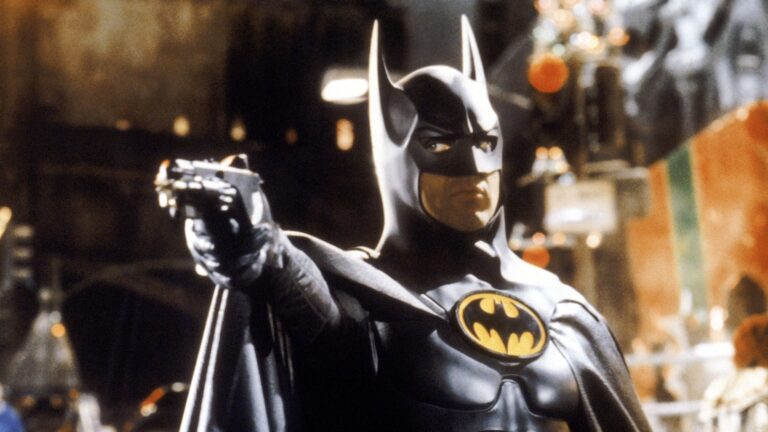
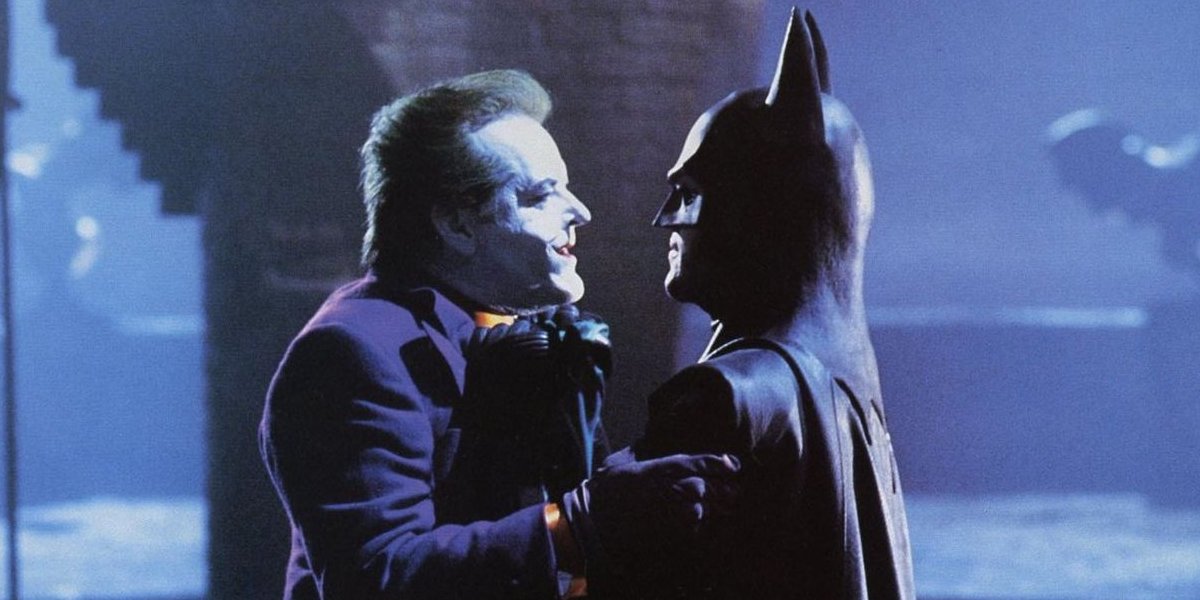
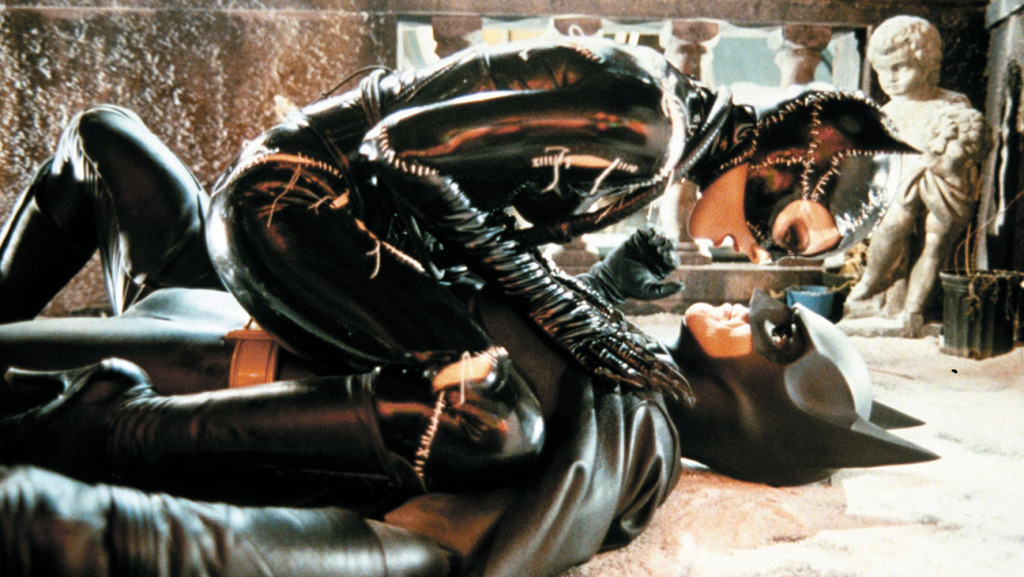
Last week, I discussed the impact and legacy of Tim Burton’s take on the caped crusader. Tim Burton’s eye for breathtaking visuals, gothic setting, and costume direction elevated the character for a late 80s audience. Where Adam West’s Batman was goofy and cheesy, throwing punches with “BAM” and “POW” effects, Burton’s Batman reveled in darkness. Despite Burton’s flawed first entry with the character, his directorial voice can be seen throughout the film. Batman may not be a complex character, but he is a serious one. The Joker isn’t just a maniac, but rather a power-hungry, prideful criminal of Gotham. The violence and 80s special effects were bordering on disturbing. All together, Burton’s Batman has an aesthetic that defined the character. 

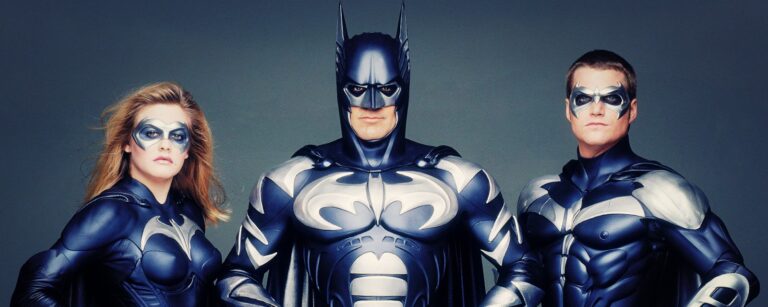
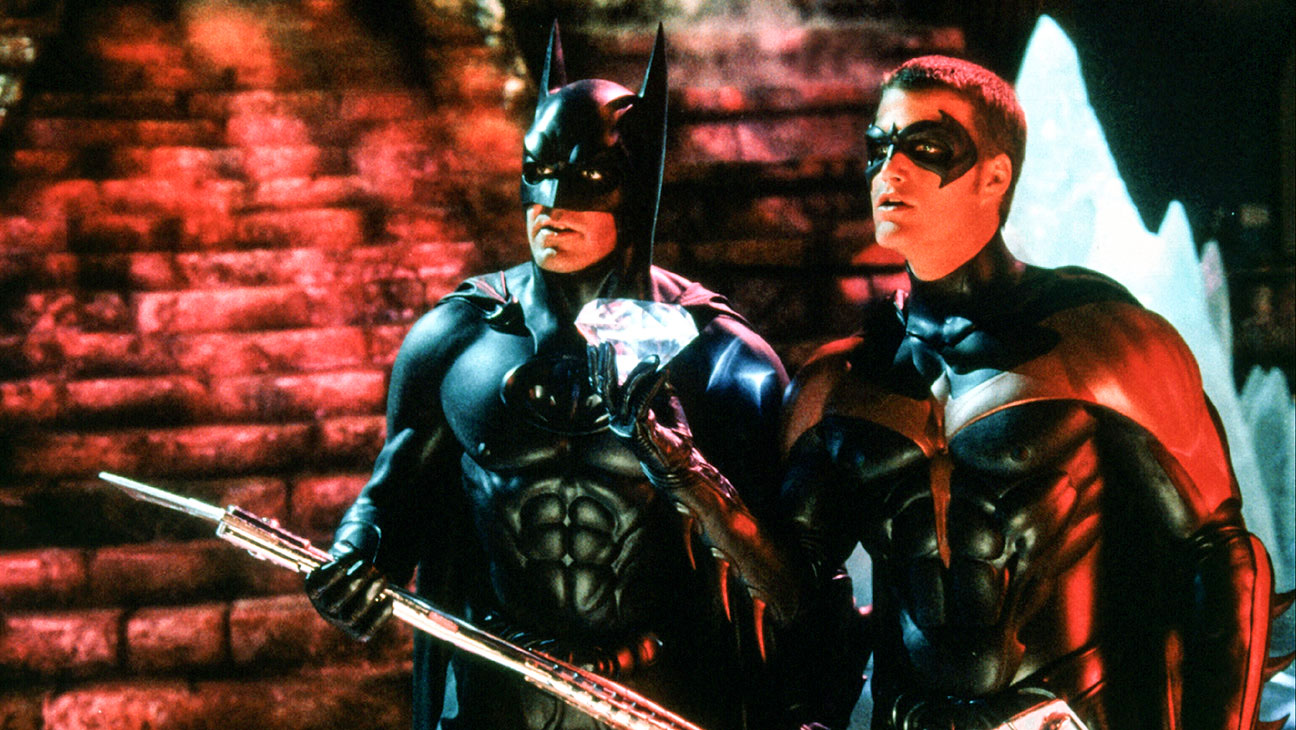
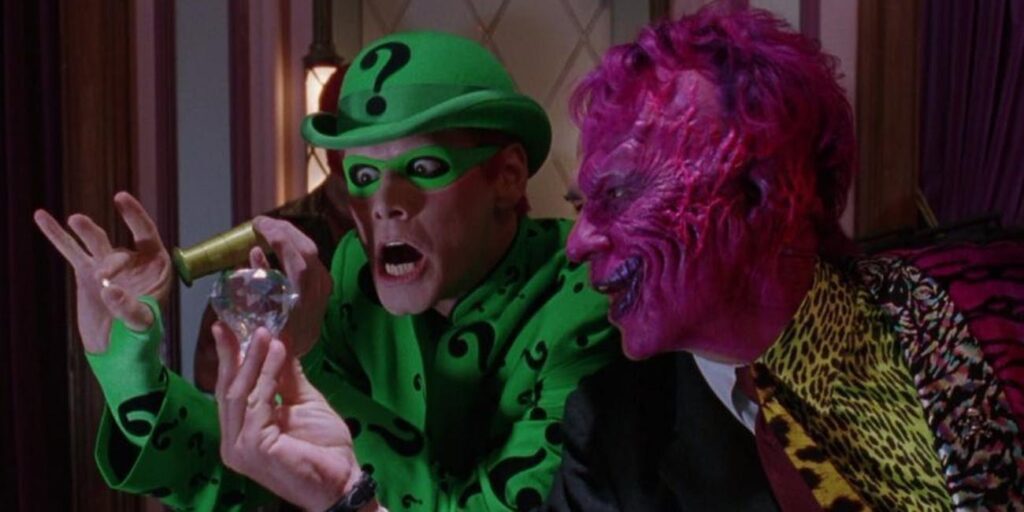
So in 1995, when Joel Schumacher’s Batman Forever was released, the tonal whiplash could not be more pronounced. It replaced Burton’s gothic Gotham with a megalopolis of God’s and legends. It replaced the darker tones with neon lights. It replaced Burton’s disgusting Penguin makeup with a comical Two-Face. It replaced Burton’s sharp costumes with rubbery spandex that reflected light, not darkness. And for 26 years, these films have been the punchline of every Batman joke. So when I sat down to watch Batman Forever, I expected to hate the cheesy jokes about the batmobile. I expected to hate the camp-infused design of the world. But instead, I came away from the film enthralled by Schumacher’s vision. So for the second installment of this retrospective, I want to defend these often overlooked design choices. Because the design, the heart at the center of these films is so much more than we give them credit for. 
Batman Forever (1995)

When I talked about Tim Burton’s first Batman film, Batman, I talked about the power of an opening scene. How Danny Elfman’s score, Roger Platt’s cinematography, and Anton Furst’s production design immediately created Burton’s Batman, and Burton’s Gotham city. And while Schumacher’s opening is nothing to scoff at, I think its finale speaks wonders about his Batman. Gotham City isn’t what matters in this story, rather, the reverence for Batman and Robin propels it forward. This is a story about what it means to be Batman, to be Gotham’s idol. It’s a story about the trauma that creates selfless people. And to that end, it succeeds with flying colors. 

Much of my criticisms levied towards Burton’s Batman came from it’s scriptwriting. It took Burton a whole film to find a Batman story worth telling. Batman as a story has little to stand on, because it’s a revenge plot that reveals that twist in the third act. Bruce Wayne is nothing more than window dressing in Batman. And while I applauded Burton’s second film with the Dark Knight for its much deeper tale of duality, it never really dove into who Batman was. It was more focused on the consequences of being Gotham’s knight. 

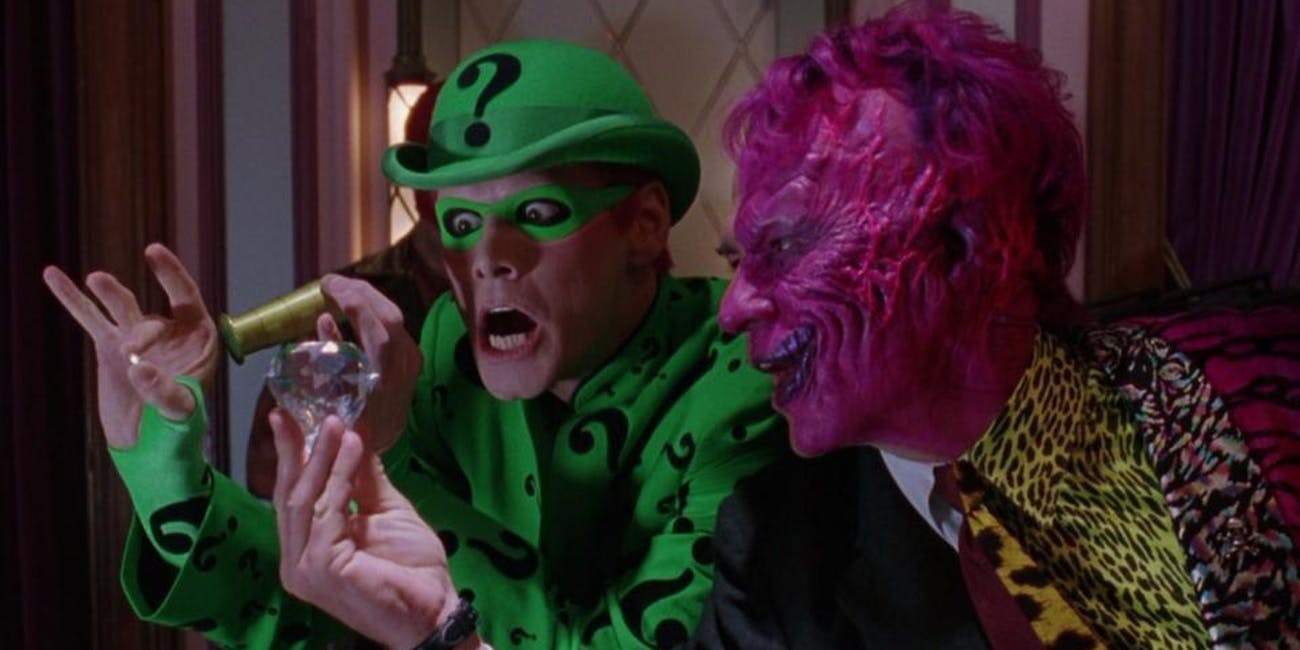
So when Schumacher’s first run with Bruce Wayne dares to dive into what makes Bruce choose to be Batman, I was amazed. It’s a story that dives into a lot of deep pools, and addresses some of the fragments of Burton’s Batman that some would consider antithetical to the character. The decision to give Robin the revenge plot is truly genius, allowing Bruce Wayne to pass along the wisdom he has learned. And the main plot is propelled forward by Bruce’s guilt, which is tied directly into Bruce’s love interest, Dr. Chase Meridian. And our two villains both have their own levels of thematic depth. Two-Face blames Batman for the acid that made him who he is, and The Riddler blames Bruce Wayne for being ignored at Wayne enterprises. These characters are driven by entitlement, and like the gods of ancient mythology, they take out their anger on the normal people of Gotham. 

These ideas are at the center of Schumacher’s world, and while some of the arcs feel a bit rushed, it’s still a major accomplishment that they all work. Robin may learn not to kill in one scene, but it still works. Bruce Wayne accepts his role in society as both Bruce and Batman, and it lands. Dr. Chase stands as one of the better Batman love interests on film, because of how involved she is with the plot. And the tantrums of both The Riddler and Two Face are quite amusing to witness. 

These are all thanks to both the narrative, and the stacked cast of Batman Forever. Val Kilmer, Nicole Kidman, Tommy Lee Jones, Jim Carrey, and even Drew Barrymore populate this world, and do so spectacularly. Kilmer’s Batman feels special, in part due to its scarcity, and due to his mature work as the character. Kilmer plays both Wayne and The Dark Knight perfectly, capturing the playful demeanor of Bruce Wayne that hides the trauma which propels him into the streets at night. Kidman plays Dr. Chase, and once again, elevates the script. It’s already an effective script, but the chemistry between Kidman and Kilmer is palpable throughout the film. Their relationship is akin to the screwball comedies of the 40s, being flirtatious and sensual, but not outright explicit. And Chris O’Donnell’s work as Robin is fantastic here. He anchors the revenge plot through his facial performance, and contains a youthful energy that is sorely missing from the rest of the cast. Contrasting our heroes, are the performances by Jones and Carrey, who both continue the on-screen tradition of having extremely campy villain performances. Tommy Lee Jones’ Two Face is still a marvel to behold, constantly keeping you on edge for when he might snap. And Jim Carrey’s Riddler works well alongside him, bringing out the more insane performance from Jones. 

With a story as layered and mature as this, it stuns me that Schumacher also decided to keep his world accessible for all ages. Art directors Christopher Burian-Mohr and Joseph P. Lucky infuse Schumacher’s Gotham with neon color at every level. Cinematographer Stephen Goldblatt often uses one or two point lighting to give a scene its darkness, and it inadvertently gives Batman and Robin much more power as characters. As with Burton before him, Schumacher understands the importance of iconography, and it is infused into each scene spectacularly. As noted earlier, the costumes present in Batman Forever can be considered very comic booky. Designers Ingrid Ferrin and Bob Ringwood continue to infuse color and style into these costumes.  It goes hand in hand with the makeup, designed by Rick Baker, which is clearly meant to take the comic book characters off of the page and onto the big screen. And while some may not like the “childish” nature of these designs, I think it’s fundamental to Schumacher’s story. This tale of the modern day gods needs to have the gods be distinct from humans. Batman and Robin both have tight fitting costumes that pronounce their fitness. They are depictions of the ultimate man, and without the costume, this wouldn’t work. 

And to further this narrative, Barbara Ling’s production design is built on creating a multi-level Gotham that worships these characters. Everyday people know the Batmobile, and hold a reverence for it. The world is populated by statues of Atlas, the son of a titan who carried the world from Greek Mythology. The parallels between the ancient gods and our modern day gods are front and center in the design of Schumacher’s world. 
Batman and Robin (1997)


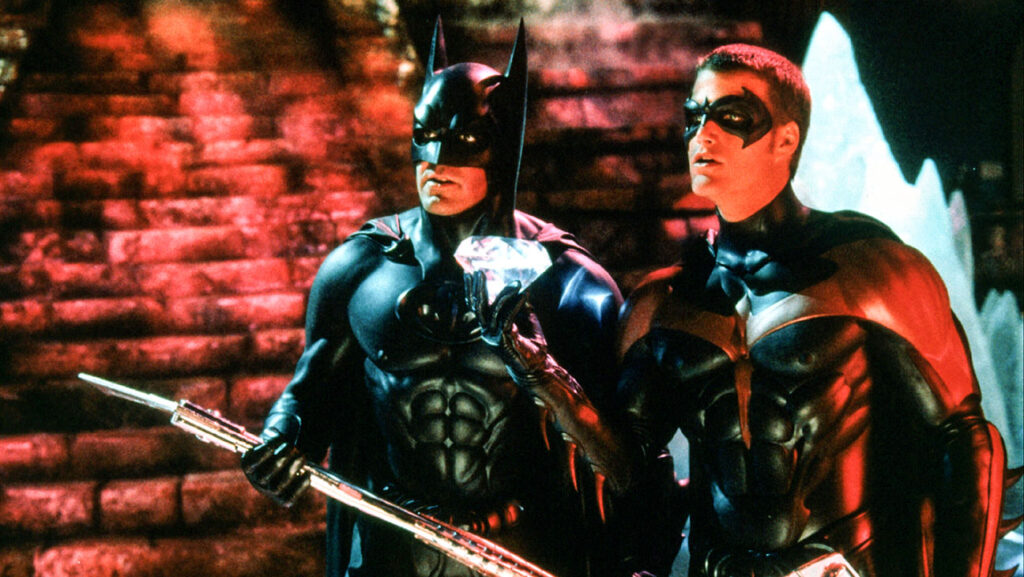
After Batman Forever, it was clear that audiences liked the direction of Schumacher’s Batman. It was child appropriate, genuinely funny, and good escapism at its finest. So it should come as no surprise that Warner Bros. doubled down on those elements, to make a Batman film that would be loved by all. The result of this push for a child friendly Batman movie was Batman and Robin, a film aggressively advertised to families, with television tie-in advertisements for McDonalds and Coca Cola. Much like Batman Returns, its aim was to give more of the stuff people liked about its predecessor. The neon lighting, colorful costumes, super-gadgets, and comedic script became the anchors of its story. The camp-infused performances of Gotham’s supervillains were brought back once again, but with even larger performances. The action set pieces were larger, with more chases, more unique environments, and crazier special effects. And these elements began to overshadow the story of family and jealousy at the root of Batman and Robin. 

See, those elements I listed are things most people despise about Batman and Robin. Arnold Schwarzenegger, Uma Thurman, and George Clooney are too campy for some people. The gadgets all feel too on the nose. “Like, how could anyone take a bat credit card seriously? The special effects are dated, with Mr. Freeze’s Blue teeth being a blue light that shined on his teeth. The costumes are too rubbery, and the suit up sequences emphasize butts and niples too much.” These aren’t just common critiques of the film; they are what most people associate with Batman and Robin. And yet, I don’t think they are half as egregious as some would lead you to believe, because at its core, these “problems” have been present since Burton’s first Batman film. As I said in my first piece, camp is a fundamental element of every performance in Burton’s films. Every villain over-emphasizes elements of who they are. Nicholson brings out the crazy of the Joker. Pfeiffer brings out the sexuality of Catwoman. De Vito brings out the anger and disgust at the core of The Penguin. Tommy Lee Jones brings out the twisted morality of Two Face. Carrey brings out the overlooked nature of The Riddler. It’s par for the course to have campy villains. So when Schwarzenegger has a bad ice related pun, it doesn’t seem antithetical to this generation of Batman. When Thurman plays up the sexuality of Poison Ivy, it works flawlessly. And while Bane is heavily under-utilized in the film, I don’t have a problem with it here. He doesn’t have a major role in this story, so his simplicity works. 

That’s the magic of Batman and Robin to me. It certainly has problems, but they weren’t what I had been led to believe them to be. I think Clooney’s Batman is a genuine gift, as he brings out the aged nature of the crusader better than anyone before him. And in a story about growing as a family, in taking others under your belt because you can’t do it alone, I think it works. It works so well that I daresay the casting was genius. There’s a world-weariness to the performance that no other actor to this point had been able to create. And I love that. Michael Gough is a true hero in this film, being the emotional anchor for the varying members of the Bat-family. He’s been there since the first Burton film, and it’s by no mistake. Chris O’Donnell and Alicia Silverstone are great as new-ish members of the Bat-family. And visually, Schumacher still keeps this Gotham rooted in modern gods. The statues of titans are more prevalent here than ever before, the quarrels between Freeze, Ivy, and Batman are portrayed as the Greek gods having a spat on mount olympus. It’s fitting for a story about family to be rooted in Greek mythology, where the conflict stemmed from being in a family. And I think that’s genius.

However, for all the praise I give this film, it comes with a dreadful caveat: the action isn’t good. It fails to have interesting and informative sound design. It fails to convey the geography of most scenes. It fails to have any momentum, and it fails to be rooted in the story. In spite of the larger thematic ideas that Freeze and Ivy represent, the action doesn’t tap into this. If Freeze is a good doctor hurt by circumstance, and Ivy is a eco-terrorist who is envious of all, the action doesn’t convey it. And the fact that these action set pieces are longer than before, full of cheesy one-liners, and given a poor sound design hurt the film. It doesn’t help that both Bane and Mr. Freeze have poor visual effects that often take you out of the story. It all coalesced into a grand story that I ultimately like. It’s definitely the weakest of all the Batman films, but not by much. 


Why Schumacher’s Batman Matters

So here we are, at 1997. Batman and Robin has been critically panned, with audiences generally disliking it, and making only $100 million more than its budget at the box office. In spite of it’s hopeful ending gearing up to tell the stories of Batman, Robin and Batwoman, Joel Schumacher’s Batman would never return. Instead, Batman would go on hiatus from live-action film for 8 years. 

So why does it matter? Well, frankly, these stories matter because Schumacher understood what made Batman stories accessible to all. The themes would always go a little deeper, but the films were made with a child audience in mind. And sadly, that has been lost in recent years. I may be extremely excited for Matt Reeves’ take on the character, but I can say with utmost confidence it won’t be for kids. And that kinda bums me out. Because Schumacher got that extremely well. He knows what these characters mean to so many people; they are the modern day gods of America. We tell their stories to be inspired to do better, and that is important for everyone. Schumacher knew how to infuse themes with these simple stories, and even if studio meddling would remove much of that depth, he knew how to keep it present enough to offer more for the keen viewer. And ultimately, Schumacher deserves our praise for making films that succeeded at being for everyone. 


Next week, join me as I delve into the Batman that came out of this 8 year hiatus: Christopher Nolan’s Dark Knight Trilogy. 

Movie Review: ‘Uncharted’ Never Lives Up To Its Videogame Counterpart


Director: Ruben Fleischer

Writers: Rafe Judkins, Art Marcum, and Matt Holloway

Stars: Tom Holland, Mark Wahlberg, and Antonio Banderas 

Synopsis: Street-smart Nathan Drake is recruited by seasoned treasure hunter, Victor “Sully” Sullivan, to recover a fortune amassed by Ferdinand Magellan, and lost 500 years ago by the House of Moncada.


The genre of video game movie adaptations has always carried a negative connotation. We have witnessed this trend growing within the past decade, and it feels like the number of films based on video games is increasing by the year (for better or for worse). As an avid gamer, I have seen multiple video game properties succeed in the hands of Hollywood such as Sonic The Hedgehog, Detective Pikachu, and Pokemon The First Movie. Unfortunately, there are around 40 video game properties that have recently failed in the eyes of video game fans. These would include Mortal Kombat (2021), Monster Hunter (2020), and Tomb Raider. However, the disappointment doesn’t stop there. I will be adding Uncharted (2022) to the pile of unsatisfying video game movie adaptations. 

For those who aren’t aware, the Uncharted video game franchise is a marvel in video game storytelling. Naughty Dog (the studio behind the Uncharted franchise) has carefully built this wondrous world to give its audience a sense of adventure, much like Lucas Film has succeeded with the Indiana Jones franchise. The Uncharted series is oozing with phenomenal character development, plots, historical figures, and exotic locations. But it pains me to say that its film counterpart is bland, flavorless, and doesn’t feel like an Uncharted adventure at all. In a way, it doesn’t feel like the movie that gamers and non-gamers alike deserve. As I mentioned before, Naughty Dog is considered to be one of the best single-player story-driven studios working today. And somehow, Sony Pictures found a way to make this film feel less cinematic in comparison to its video game counterpart.

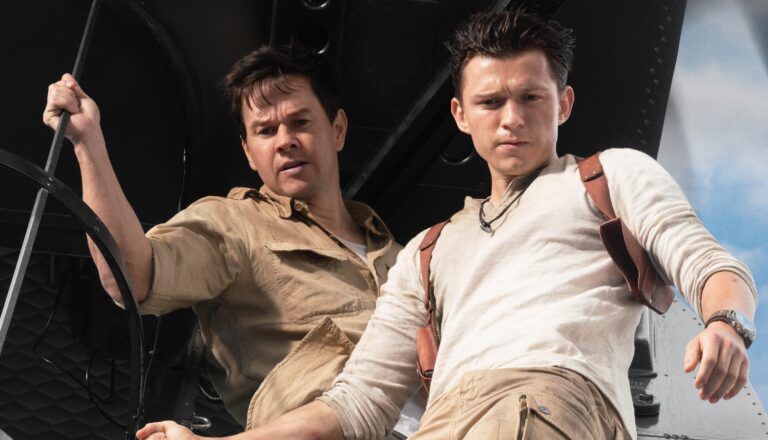
Let me start by saying that I think this is a perfect family movie that people will enjoy. You do get a sliver of history lessons throughout the journey and some of them are cool facts you can impress your friends with and you’ll leave the theater thinking you can be a bartender just like Tom Holland who plays the main character of Nathan Drake. The action in the film can be very entertaining at times. Much like the video games, you’ll see Nathan Drake (get into a few scuffs that he barely seems to make his way out of and is saved by a random stroke of luck. Nevertheless it felt like the stakes weren’t as urgent as they could have been. Every time Nathan Drake was in one of his traditional brawls it felt like the movie was borrowing quips and one liners from the Spider-Man movie franchise, especially with Tom Holland in a starring role.. It felt more like they wrote dialogue for the wrong franchise instead of researching Nathan Drake’s persona and mannerisms. 

Tom Holland was the star of the show putting his heart and soul into every role he plays, as usual. And I do think he was a great casting choice to start as a young Nathan Drake. We don’t get to see much of young Nathan in the games until the latter half and I think having a story dedicated to a young Nathan is a great idea. The film is not based on the video game franchise, but at times the story of this movie feels more like a collage of greatest action scenes torn from each game. This makes the pacing of the story extremely fast and it never gives the characters time to breathe or develop. Victor Sullivan (Mark Wahlberg) and Chloe Frazer (Sophia Ali)are extremely miscast. I felt as though there was no chemistry between them and the dialogue interactions were extremely basic. There are emotional beats in this story that could have been taken to new heights but they never reach the level of feeling empathy for the characters. Even though this is a younger version of Victor Sullivan aka Sully, I never once thought that he was the father figure that Nathan is supposed to turn to when things get sticky. Sullivan felt more like a long lost brother to Nathan than his brother Sam Drake did in the film due his mysterious disappearance. Chloe Frazer felt more like a stand in than a character. She’s supposed to be a clever Australian thief for hire but instead she feels more like a forced obstacle. Much like in the games, Chloe loves to play devil’s advocate and you’ll see that side of her in the movie even if it’s not properly executed. It would have been nice to see Elena Fisher instead, who is the main love interest of Nathan in the video game series. 

It doesn’t bring me joy to say this but Santiago Moncada (Antonio Banderas) was a horrible antagonist. I thought he did a great job with what he was given, but his persona of the villain felt short and his motives seemed somewhat justified due to the plot of the story. Unfortunately, he’s barely in the movie and doesn’t serve much purpose other than being the generic obstacle for the protagonist. For the majority of the film, I felt like Tati Gabrielle served as a better villain. She serves as Santiago Moncada’s right hand man in the film but isn’t given much character growth. I wish I could say more about her but her character is as generic as the rest of the Moncada’s crew. As with every villainous crew there’s always a hidden motive to take control of the operation and you’ll see that sequence play out in an abrupt course of action.

Uncharted is another unfortunate stereotype of a lackluster video game movie adaptation. I understand that it can be hard to adapt the pacing of a 9 hour game into a 2 hour movie,  but outside of Tom Holland, no amount of care was given to this film. This franchise would have done well as a series as opposed to a movie. I think the resources of the game were widely available for director Ruben Fleischer to use but it doesn’t seem like the final product mirrored what the video games have done so well. There is a clear cinematic disconnect that wasn’t met to show the audience what Uncharted is all about, a sense for adventure. If this movie has taught me anything it’s that video game movie adaptations will never be a sustainable avenue for Hollywood.


Grade: D+

Movie Review: ‘Texas Chainsaw Massacre’ Is a Gore-ingly Dull Legacy Sequel


Director: David Blue Garcia

Writers: Chris Thomas Devlin

Stars: Sarah Yarkin, Elsie Fisher, Moe Dunford, Nell Hudson, Jacob Latimore, Alice Krige, Olwen Fouéré, and Mark Burnham

Synopsis: After nearly 50 years of hiding, Leatherface returns to terrorize a group of idealistic young friends who accidentally disrupt his carefully shielded world in a remote Texas town.


After the success of 2018’s Halloween, it was inevitable that more horror “legacy” sequels would arrive, effectively retconning all subsequent installments past the first one. 2022’s Texas Chainsaw Massacre doesn’t even shy away from its inspiration from David Gordon Green’s Halloween reboot, with a trauma-fueled Sally Hardesty (Olwen Fouéré, replacing Marilyn Burns from the original, who died in 2014) preparing herself for the night in which she will have to confront Leatherface (Mark Burnham) once again. 

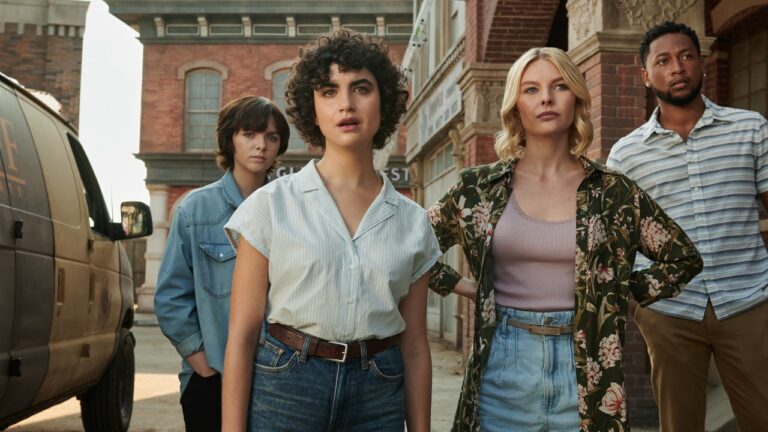
Hardesty waited 50 years to face him once again, and she won’t have to wait too long anymore as a group of entrepreneurs arrive in Harlow, a secluded Texas town in a bid to auction old houses to create a gentrified area. While Dante (Jacob Latimore) and Mel (Sarah Yarkin) examine an old orphanage, they meet Virginia McCumber (Alice Krige), who is still living in the house with her son, Leatherface. After the sheriff evicts her, and she dies of cardiac arrest in the car, Leatherface begins a killing spree once again and terrorizes the small town of Harlow, where Sally will be waiting for him. 

Texas Chainsaw Massacre doesn’t shy away from its extreme gore during its first killing sequence, in which Leatherface will break an arm and proceed to stab its victim with his broken bone. If you don’t like that, you certainly won’t like the almost ten-minute long sequence where Leatherface decimates potential investors partying inside a bus with a chainsaw one by one. This is, by far, the goriest Texas Chainsaw Massacre installment yet, surpassing even Tobe Hooper’s bloodfest, The Texas Chainsaw Massacre 2, by a mile. 

And while the film’s action sequences are admirably done, using lots of practical effects at its disposal to effectively produce a pool of blood and guts flying off the screen, it quickly becomes tedious, since none of the characters are engaging or compelling. Every time the movie introduces a concept, or in this case, a trait that will give the character more depth, it simply presents it and does absolutely nothing else with it. For example, Elsie Fisher portrays Mel’s sister, Lila, who is a victim of a school shooting. What does the school shooting have to do with anything? 

Aside from a brief scene in which she confronts gun-toting Richter (Moe Dunford), to which she explains what happened, director David Blue Garcia and writer Chris Thomas Devlin do nothing with this seemingly important piece of information (to which they keep cutting back to flashbacks of the shooting, as Lila is lying on the floor, with bullets in her body). It just comes across as a shameless way to exploit the horrors of a school shooting and parallel it with the horrors of a…chainsaw massacre? 

Even if the movie would’ve removed this horrible bout of “character development,” it still doesn’t save the fact that none of the actors give any good performances. Fisher, in particular, is wasted inside a role that does her absolutely no favors whatsoever, but Yarkin and Latimore are also wasted. After what happens with Virginia, Mel immediately wants to leave town, but Dante tells her everything’s fine…when Leatherface is coming for them. Every character makes the most inane decisions possible, even when it comes to their survival instincts. Instead of running away from the threat, they almost always run towards it, which constantly ensures that the audience stays in a perpetual state of eye rolls. 

Even the film’s ending will give you the biggest eye-roll of the year, or, worse, may bring you to yell out “Are you kidding me?” in front of your TV. In fact, the climax made me say that sentence twice, and then the ending came and screwed everything up. Without spoiling anything, there’s no justification for the movie to end the way it did, and even worse, to crap all over Tobe Hooper’s incredible 1974 original for pure shock value. But since there’s no emotional investment with any of the characters, including Sally Hardesty, there’s no reason for you to seek it out, unless you’re a franchise completionist. 

I don’t normally say that “X film” in a franchise completely ruins the original since I’m not the one making the movies, and coming up with the story. For example, when Prometheus came out, and some critics said that it ruined the original Alien, you have to remember that Ridley Scott created the franchise and can do whatever he wants with it, without your approval. But Texas Chainsaw Massacre only exists because it hopes to “fix” the mistakes of its “terrible” sequels, but ends up making even more mistakes than the sequels, while simultaneously doing nothing of interest with its original characters, aside from giving one hell of a middle finger to Tobe Hooper’s original film. It is why I’ll permit myself saying that Texas Chainsaw Massacre completely ruins the original, and any fan of that movie should steer far, far away from its latest installment and hope that the franchise will now stay dead and buried for good. 


Grade: D-

The Lost Movies of Stanley Kubrick

Upon his sudden death in 1999, Stanley Kubrick was finishing up his erotic mystery Eyes Wide Shut and had a few projects in line to do after. In between the large gaps in his projects, especially the twelve years in between Eyes Wide Shut and Full Metal Jacket, Kubrick had other large pictures he wanted to do. However, it seemed to be too large as budget problems and movies with similar subject matter were released earlier, forcing Kubrick to put his own work into turnaround or completely shelve them. One of those movies was A.I.: Artificial Intelligence, which his friend, director Steven Spielberg, personally made using Kubrick’s own notes and storyboards and was released in 2001. Yet, there were other major scripts Kubrick wanted to do and, sadly, never got to make.

Napoleon

Kubrick sought to make this movie after 2001: A Space Odyssey and was already immersed in many books to create every detail possible on the life of Napoleon Bonaparte, Emperor of France. He wrote a draft, scouted locations, and had in his mind Jack Nicholson in the titular role with Aubrey Hepburn as Napoleon’s wife. However, Russian director Sergei Bondarchuk released the massively successful Napoleon-era adaptation of War And Peace followed by Waterloo (which was not a success) and forced Kubrick to back off, although this allowed him to look at Barry Lyndon for his historical timepiece drama. Steven Spielberg has an interest in revitalizing the project; it was announced in 2016 that it would become a miniseries for HBO  which Cary Joji Fukunaga would direct, but there is no news of that project since.

Aryan Papers

In the 1970s, Kubrick, who was Jewish, had a desire to make a movie about the Holocaust. Initially, he tried to get renowned author Isaac Singer to write a script, but he turned Kubrick down and the project would not be returned until Kubrick finished with Full Metal Jacket. He would option the book “Wartime Lies” as the basis for his screenplay and, like Napoleon, Kubrick traveled East for possible locations to shoot the film. His desire ended when he saw Spielberg’s Schindler’s List and went back to A.I. and Eyes Wide Shut. But this isn’t the end of the project, as different directors have been attached to the project with Luca Guadagnino most recently considering the project if it ever gets off the ground.

Novels And Other Fanciful Ideas

Kubrick could have collaborated with Kirk Douglas again through an original script he wrote called I Stole 16 Million Dollars, about a pastor-turned-robber, but Douglas didn’t like the script. After collaborating with Terry Southern on Dr. Strangelove, an idea was pushed by Southern to do a high-budget porno that made it an art; this was the 1960s and the sexual revolution was on the way. Kubrick turned it down because he didn’t feel he could make such a film and Southern converted his idea into a novel, Blue Movie. Prior to Tom Twyker’s adaptation of Perfume: Story Of A Murderer, the novel was looked at by Kubrick first. And, long before Peter Jackson took hold of The Lord Of The Rings when the story was being considered as a Beatles vehicle, Kubrick was considered but he turned it down because Kubrick thought the project was unadaptable and J.R.R. Tolkien was opposed to having The Beatles involved in it anyway.

Besides Aryan Papers, there were several other World War IImovies Kubrick considered to make. Staying close to his family, he was interested in doing a film surrounding German director Veit Harlan, who made numerous Nazi-era films; Harlan was the uncle of Kubrick’s wife, Christine. Another story was set around the Battle of Monte Cassino, in which he asked his personal chauffeur, an Italian emigrant, to help with the research. Kubrick even was offered to adapt a memoir by Nazi figure Albert Speer but was turned away because Kubrick, who was Jewish, wanted Speer to recognize the extermination camps, but he always maintained that he never knew what was happening.

Stanley Kubrick had a mountain of various projects he could have done and what he would have done had he only had more time is only something we can only dream of. All of his movies remain a permanent fixture in our consciousness and we can only wonder what could have been if some of these projects went ahead.

Follow me on Twitter: @brian_cine (Cine-A-Man)


Op-Ed: AFI’s 100 Years…100 Passions – ‘Breakfast at Tiffany’s’ (#61)

I will be watching and reviewing all of the films included on AFI’s 100 Years…100 Passions list. The list contains the 100 greatest love stories in American cinema and I plan to consider how our views on romance and social issues have changed over the years as well as judge whether the romances in these films actually made me swoon. As a fan of the romance genre, I expect to love each and every one of the nominees but I also don’t know if I would consider all of them romantic.

Breakfast at Tiffany’s has a very complicated, almost paradoxical legacy. To most, it’s that fun romantic comedy in which Audrey Hepburn plays an adorable soignée fashion plate who lives it up as a café society girl during the early 1960s. They look towards Holly Golightly as an aspirational figure because she’s pretty, fashionable, quirky and able to wander around New York all day without having a ‘real’ job. I assume that a considerable portion of the young women who idealize Golightly are people who haven’t actually seen the film. They don’t care to consider the fact that Golightly is actually a prostitute who has to entertain wealthy older men in order to fund her lifestyle. They certainly don’t seem to pick up on the fact that Golightly is actually a woman who was forced to become a child bride at the age of fourteen. Viewers tend to brush aside most of the darker implications that are hinted at by the script and hold onto the idea that this is a feature length Givenchy commercial. 

I don’t think that it’s any coincidence that the film is looked back on as a light, fluffy romantic comedy. Like so many films made under the production code, it takes great pains to avoid bringing any controversial content to the fore and, at times, you are left wondering why they even felt the need to turn this into an adaptation of Truman Capote’s controversial novella. All of the things that helped the novella to capture the imagination of so many despairing, unhappy readers were removed from the story when it was brought to the screen. They keep the memorable character names, New York setting and the basic outlines of the plot but completely excise all of the material that made the novella interesting. 

George Axelrod’s screenplay always feels like it’s torn between being a generic studio comedy in the style of Come September (1961) and a cynical exploration of the soullessness and vacuity of the café society set. Axelrod leaves in a few stray references to Golightly needing to exchange sex for money but he also has to find a way to end the film with a scene in which Golightly and Paul Varjak enter into an ordinary heterosexual relationship. It often feels like a film that is at war with itself and you keep hoping that it will allow Varjak to be gay and end with Golightly running off to yet another foreign, exotic locale, without having resolved any of her problems. 

The film is particularly disappointing when it comes to its consideration of Golightly’s efforts to reinvent herself and escape from the life that was forced upon her at an incredibly young age. Golightly is most fascinating as a damaged drifter who can never quite achieve the freedom that she desires. She has to rely on the support of others to get by and will always be somebody who thinks that the grass is greener on the other side. Capote acknowledges the fact that Golightly is chasing after happiness and fulfillment in places where it does not exist, but he avoids turning her into an object of pity or disgust. Capote never implies that Golightly was wrong for trying to escape from rural Texas and even celebrates her somewhat successful reinvention. He crafts her into a proto-feminist heroine who tries and fails to build the life that she wants. 

There are times when the film does play around with the bitter, pinched emotions that the characters in the novella feel. When Golightly performs “Moon River”, a song about the pains of being a small town resident who wants to move to the big city and escape from the mundanity that surrounds them, it’s difficult not to be moved. It serves as such a perfect encapsulation of Golightly’s feelings of regret and sorrow, as she almost seems to be nostalgic for the period of her life in which she was just an impressionable young girl who thought that she could make it in New York City without having to make any major sacrifices. Even as an older, wiser woman she holds onto the version of New York City that she used to fantasize about. This is one of the few times when the film attempts to turn Golightly into more than an absurdly beautiful clotheshorse and it really does pay dividends. You feel like you have a strong understanding of what drives her to be so impulsive and irrational and wait for the rest of the film to follow through on the expectations that have been set by this scene. It’s a real shame that the film doesn’t continue to explore her character in any depth. 

It would be ridiculous to pretend that Hepburn doesn’t look utterly divine in that iconic little black dress, but the beauty of the costumes is overshadowed by the presence of Mr. Yunioshi, a horrifically racist caricature of Japanese people. It is fair to say that attitudes towards race and gender have significantly evolved over the past 60 years but, even by 1961 standards, this was considered to be racist. Critics at the time were critical of the casting of Mickey Rooney, a Caucasian actor, in the role and noted that the portrayal would be offensive to many. It’s one of those jokes that just doesn’t fly today and it’s easy to question whether it was ever really funny. Rooney’s performance is so broad that it’s difficult to believe that discerning audience members were chuckling at the bits of business that he incorporated into his performance. 

It is difficult to mount an argument in favor of this film when so many of its best elements could probably be better appreciated in a different context. If somebody wanted to see Audrey Hepburn’s beautiful gowns, they could check out the Givenchy exhibit at Morges Castle in Switzerland. They could get a firsthand look at her chic clothing without having to suffer through an entire feature film.


The Road to ‘The Batman’: Tim Burton’s Legacy

Part 1: The Legacy of Tim Burton

Batman’s first Comic book appearance was in Detective Comics #27, released May 30, 1939. Since then, Bruce Wayne has appeared in eleven live-action films, twenty-nine solo animated films, and three solo animated tv shows. And those numbers exclude the numerous references to the caped crusader in greater popular culture, as well as the various guest appearances and cameos of the hero. Next month, with the release of Matt Reeves’ The Batman, there will have been twelve live-action films for Batman. That’s a whole lot of Batman, considering the second film appearance was in 1989, 33 years ago. So how did we get from Tim Burton’s Batman to Matt Reeves’ Batman? That is the question I want to investigate, to identify what elements have passed between films and filmmakers, and what has been left behind.   


Batman (1989)


It’s impossible to understate the massive impact of Tim Burton’s Batman. Since the arrival of this film, there has been approximately one live-action Batman film made every three years. If we are to include every animated film and television appearance, then a Batman piece of film media has been released once every nine and a half months. And considering the largely disconnected nature of Batman media, this cultural dominance isn’t just impressive. It’s monolithic. And that all comes back to Tim Burton’s run with the character, which started here.    

From the opening moments of Tim Burton’s Batman, you already have a picture painted of the great defender of Gotham City. This film is an icon; for many, it defined the caped crusader alongside the animated series. And returning to this film after 30 years, it’s easy to see why. Production Designer Anton Furst created the definitive Gotham City: gothic towers dominate the landscape, crime runs rampant through the streets, and alleyways are full of low-level thugs. And into this world, comes Batman. His costume is pure darkness, but the whites of his eyes and yellow of the belt buckle show him to be so much more. Unlike the underworld of Gotham, Batman is a guardian in those dark alleyways. And that is what Tim Burton captures so beautifully with cinematographer Roger Pratt. 

Every element of the production design makes Gotham what it is. From the sleek design of the Batmobile and Bat-plane to the make-up of the Joker; Burton, Pratt, Lynda Armstrong and Furst complement each other perfectly. Burton uses shots of Batman posing to suggest the power of the dark knight. When Bruce Wayne is in front of the Bat-Computer, the harsh lighting gives weight to Keaton’s performance. Every special effect has the right amount of camp for this comic book adaptation, and it complements the eccentric performance of Jack Nicholson as The Joker. This film never strives for hard realism, instead of allowing its setting, lighting and visuals to create engagement from the audience. Those visual choices are so inspired, especially looking back from the 2010s era of realistic superhero movies.

 But for as spectacular as Tim Burton’s visuals are, the story being told in this film is incredibly shallow. The characters populating Gotham have little resemblance to their comic book counterparts, and the plot itself is plodding and seemingly an afterthought. While Alan Moore would interrogate what it means to be Batman through his various comic book runs, Burton seems to not have an interest in Bruce Wayne’s psychology. Luckily, Micheal Keaton’s performance as an orphaned outcast billionaire injects the character with much-needed humanity to enable us to root for him throughout the film. And Batman isn’t the only character to truly feel like a shell in this movie. Batman is full to the brim of one-dimensional characters, from the beautiful and smart reporter, Vicky Vale (Kim Basinger), to the megalomaniacal and egotistical Joker/Jack Napier (Nicholson). The relationship between Vale and Wayne is built solely on natural chemistry between Keaton and Kim Basinger, thanks to their surface-level interactions in the script. And despite the plethora of screen time given to Basinger, it never truly enables Vale to appear as little more than a romantic partner and damsel in distress for Batman to save. Even Jack Nicholson’s truly unhinged take on the crown-prince of Gotham feels like an afterthought for the screenplay. And all of that is saddening because these performances are the bread and butter that give Batman its breath. Kim Basinger almost becomes the protagonist, uncovering who Batman is, and her performance makes me long for a Batman story centeredaround a reporter discovering Batman’s identity. Nicholson’s screen presence is impossible to deny, as he finds new ways to terrify the people of Gotham. 

Batman is the strangest Batman movie, because the beauty of the film is found in the craftsman behind the camera. The story becomes secondary to the work of those who created this world. Tim Burton’s eye for iconography eclipses the story being told. And that design paid off huge, paving the way for the dominance that Batman has had within popular culture.


Batman Returns (1992) 


Three years later, the first Batman sequel was released. Batman Returns was Burton’s second, and final, Batman film. It takes everything that worked in Batman and cranks those elements to eleven. The costumes and special effects got more disturbing, the performances embraced more camp, and the visual storytelling got even better. But what makes Batman Returns so good is its writing. 

Batman Returns is a film about being alone. The Penguin (Danny DeVito) is alone, Bruce Wayne is alone, and Selina Kyle (Michelle Pfeiffer) is alone. And like the best ShaneBlack films, it places this story of loneliness at Christmastime. When families come together for the holidays, our central story focuses on those who have no family. And through that framing, we see how they cope with being outcasts. For the Penguin, it’s through manipulation and corruption. For Selina Kyle, it’s through acts of violence and flirtation. And for Bruce Wayne, it’s through fighting crime to protect the city. In spite of the darker, more violent nature of Batman Returns, this story fits in with the greater Batman canon. It dives into what makes these characters tick. And that is a massive step up from the previous outing. 

As for the craftsmanship of this film, they really did crank the dials to eleven. The first major change that was made for this film was to have it set at Christmas, and the production design reflects this perfectly. Not only does this serve the story exceptionally well, but it makes for a Gotham city that feels a little bit brighter than before. In having Christmas lights and bright snow, the lighting of Gotham is able to reflect the effect Batman has had on the populace. It’s no longer the darkest city, but rather one of hope. It’s a city that embraces the weird people that populate it, instead of immediately shunning them. Production designer Bo Welch, a frequent collaborator with Burton, builds on Furst’s Gotham by adding details to the monolithic buildings. Shopping centers, walkways, greenhouses, and individual decor are added to enhance every detail of the story. Selina Kyle’s room is brought to life with neon lights, pink wallpaper, and a pullout bed. Max Shreck’s (Christopher Walken) business building is left massive yet hollow, much like the businessman himself. And The Penguin’s sewers are kept wet and grime-covered, painted with green lights. It’s effective because it keeps the characters front and center.   

And those characters define this film. Costume Designers Bob Ringwood and Mary E. Vogt know how important iconography is to Burton’s world, so the costumes reflect these characters wondrously. Selina Kyle may be alone and often disregarded, but, as Catwoman, she demands what she wants. The skin-tight leather suit and Catwoman’s whip solidify her role as a femme fatale and perfectly exemplify what Selina wants to be. The Penguin’s costume is gross, excessively fat, with flippers for hands, and a massive pointed nose. And it’s perfect for describing who The Penguin is. And while Batman’s costume didn’t change for this film, it isn’t as bulletproof this time around. Bruce is forced to take off the mask in the third act, framing the themes of the film around Bruce Wayne, and not simply Batman. 

The acting here is just as good, if not better than that of Batman. Keaton continues to deliver in spades, being immediately likable as both the shy Bruce Wayne and as the imposing Batman. He is given a lot more to do as Bruce Wayne, and once again elevates the screenplay. Alongside Keaton is Michelle Pfeiffer, who plays the famous anti-heroine Catwoman. Her performance is infused with both sincerity and camp, purr-fectly capturing the Catwoman of Burton’s Gotham. Add in the eccentric performance of Danny DeVito as The Penguin, and this film exceeds its predecessor. 

Batman Returns is all about the weird outcasts coming to terms with who they are. It’s a very Tim Burton story, and yet it feels fresh because of the world it’s placed in. It’s a great Batman story about the cost of double identities in ways most other Batman stories aren’t. It’s a fantastical interpretation of Gotham city that reflects the caped crusader’s effect on the world. All in all, it’s a fantastic, albeit dark, Batman film.  


It’s fascinating that audiences drew the line at Batman Returns with regards to its darker, violent story. The backlash to the film led to Tim Burton leaving the Batman franchise. The reactive nature of the studio led to Joel Schumacher’s lighter films aimed at younger audiences. But most importantly, it led to the creation of the Batman animated series. Batman: The Animated Series was a massive hit because it understood what Burton’s Batman did so well. And that was the importance of establishing a setting. Gotham’s gothic architecture, with flat rooftops, is a staple of the character. Without Gotham, there is no Batman. And Batman needs to be a larger-than-life figure, both within the screenplay and the visuals. And ultimately, it’s something that the trailers for Matt Reeves The Batman seem to highlight as well. The importance of visual storytelling hasn’t gone away, and hopefully, it will once again become a pillar of the superhero genre.   


Join me next week as I review Schumacher’s Batman films, and discuss their impact on the Batman franchise. 


Poll: What is your favorite film starring or co-starring Channing Tatum?

Why is Channing Tatum the most adorable and likeable man ever? While he has done some recent voice work, it has been nearly five years since we last saw Tatum in a starring or co-starring role, with Logan Lucky in 2017. Fatherhood will do that to you, and if you pay attention to his social media, he is now the most adorable father ever. Not only does this weekend see the return of Tatum to the big screen, but he’s also directing, alongside his Magic Mike partner Reid Carolin. This alone makes Dog worth checking out, let alone the fact that it’s Channing Tatum and a Belgian Shepard in a movie together.

So let’s celebrate his return. What is your favorite film starring or costarring Channing Tatum?


Podcast: The Sky is Everywhere / 2022 Oscars – Episode 469

This week’s episode is brought to you by Patreon and our awesome listener’s like you. Sign up now and get awesome rewards!

This week on the InSession Film Podcast, Ryan fills in for Brendan as we discuss Josephine Decker’s new film The Sky is Everywhere and the 2022 Oscars! Plus, we offer up a few thoughts on the wild new trailer for Doctor Strange in the Multiverse of Madness.

This week’s show ended up being a little different than originally planned (thanks Ryan to joining us last minute!), but we had a great time talking em>The Sky is Everywhere and how it’s quite a turn for Decker. And it’s always interesting whenever Ryan and JD get together to talk film awards. Things were no different this time around, but we hope you enjoy the conversation and what we expect to see at this year’s Oscars.

On that note, check out this week’s show and let us know what you think in the comment section. Thanks for listening and for supporting the InSession Film Podcast!

– Movie Review: The Sky is Everywhere (6:30)
Director: Josephine Decker
Writers: Jandy Nelson (screenplay, based on the novel by)
Stars: Grace Kaufman, Jacques Colimon, Cherry Jones, Jason Segel

– Notes / Doctor Strange in the Multiverse of Madness Trailer (52:02)
This week for our break segment, we spend a few minutes dissecting that Super Bowl trailer for Marvel’s Doctor Strange in the Multiverse of Madness and the insane reveals it gave us. We’ve been anticipating the X-Men’s entrance into the MCU for awhile, but for the trailer to just straight up show Patrick Stewart’s Charles Xavier was quite the surprise. We can’t imagine what else that film has in store, and we had a great time talking about how excited we are for it.

[divider]

RELATED: Listen to Episode 456 of the InSession Film Podcast where we discussed Belfast!

[divider]

– 2022 Oscars (1:28:08)

We had originally planned to begin our Steven Spielberg Movie Series this week, however with Brendan gone, we decided instead to have a discussion about the Oscars and this year’s crop of nominees. We also talk about the culture that surrounds the Oscars and why it’s often toxic, and of course we had to get into the announcement that we have names for this year’s hosts.

Show Sponsor: First Time Watchers Podcast

– Music

Till Forever Falls Apart – Ashe
The Power of the Dog – Jonny Greenwood
The Return of the Eagle – Atli Örvarsson

Subscribe to our Podcasts RSS
Subscribe to our Podcasts on iTunes
Listen on Spotify
Listen on Stitcher
InSession Film Podcast – Episode 469

[divider]

Next week on the show:

Review: Dog
Steven Spielberg Movie Series: Duel

[divider]

Help Support The InSession Film Podcast

If you want to help support us, there are several ways you can help us and we’d absolutely appreciate it. Every penny goes directly back into supporting the show and we are truly honored and grateful. Thanks for your support and for listening to the InSession Film Podcast!

VISIT OUR DONATE PAGE HERE