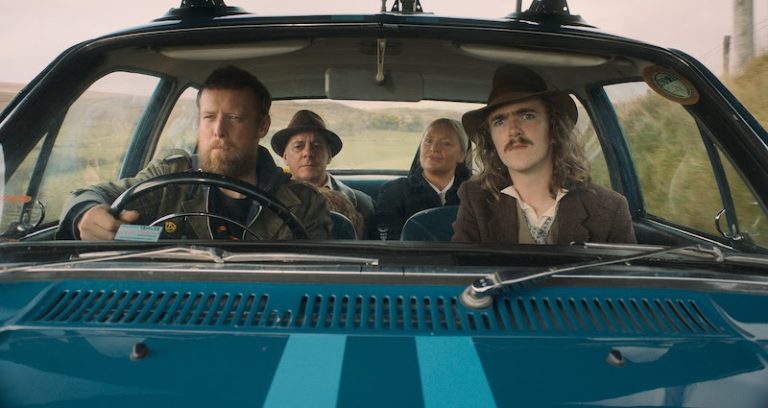
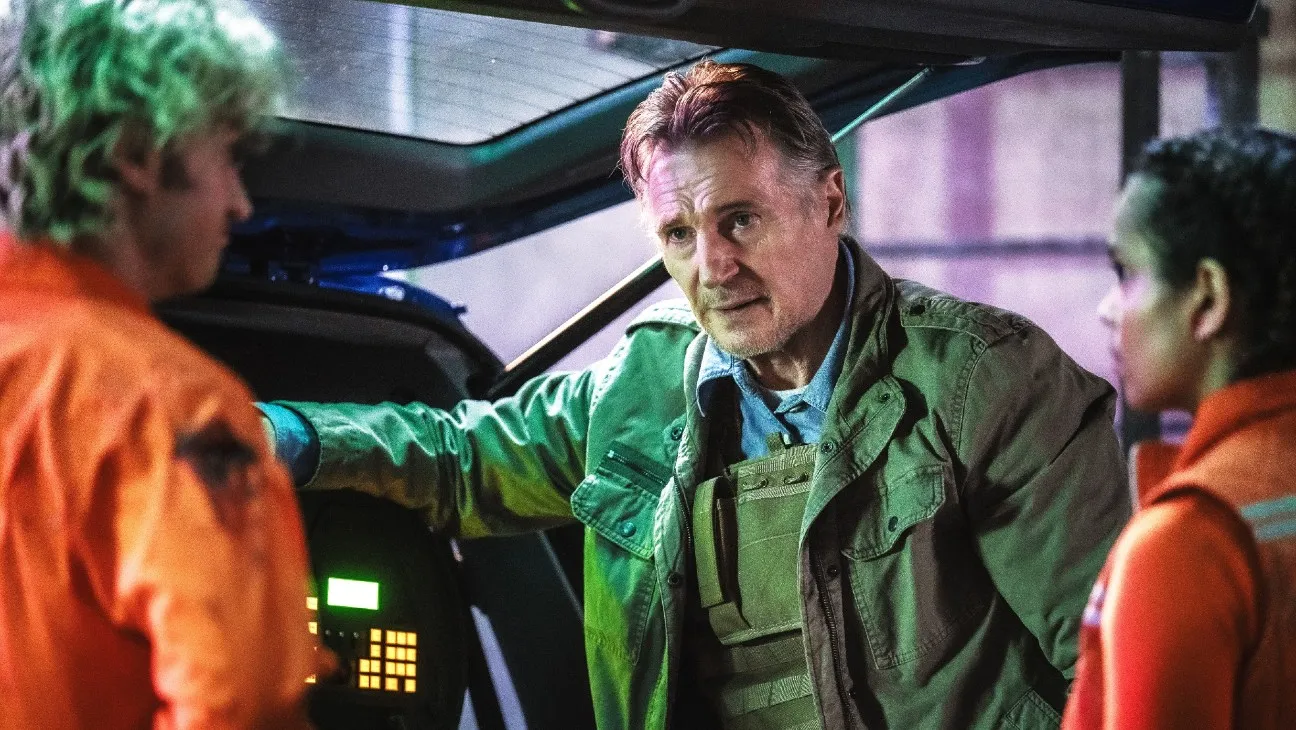
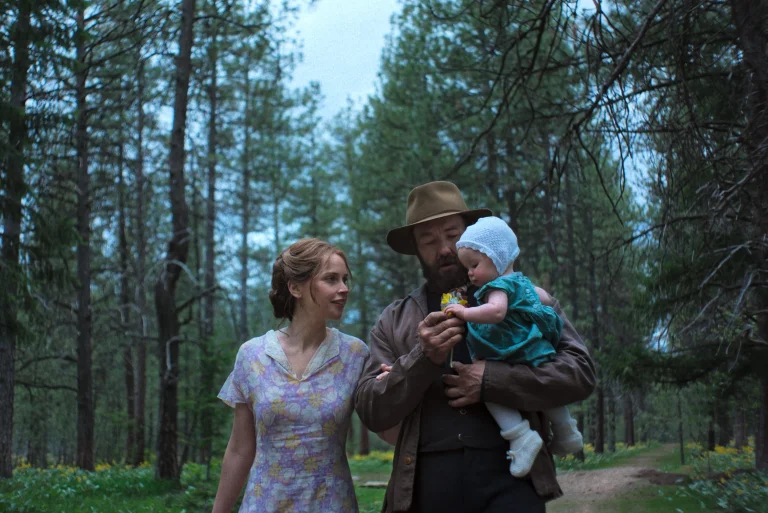
Director:Michael Head Writers: Colin Broderick, Mark McCausland Stars: Tara Lynne O’Neill, Brenock O’Connor, Owen Colgan
Synopsis: Two music-loving but unlikely friends have two days to travel the length of Ireland to save their record store from closure. For one of them, not having a car is just one of the problems.
There’s a particular kind of film that doesn’t so much demand your attention as invite you to hop in the passenger seat. The Spin, directed by Michael Head, is exactly that sort of ride; a scruffy, warm-hearted Irish road trip comedy that knows the journey matters far more than the destination. Screening as part of Tull Stories’ Joy of Cinema strand and landing in UK and Irish cinemas from 27th February, it’s a modest film with modest ambitions, and, refreshingly, no shame about either.
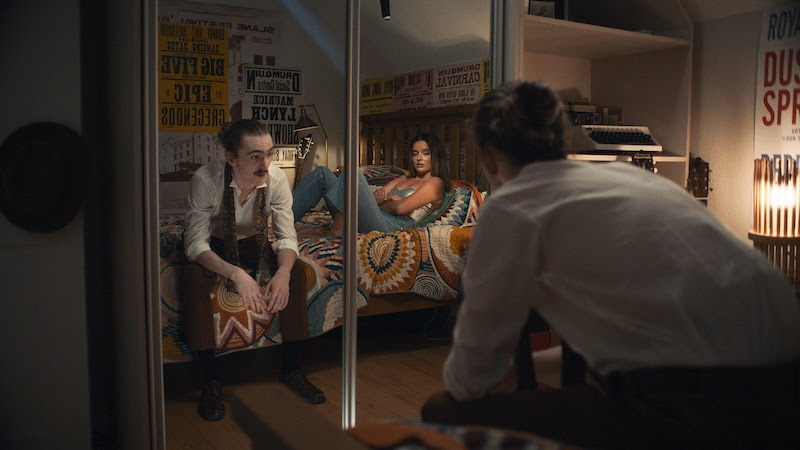
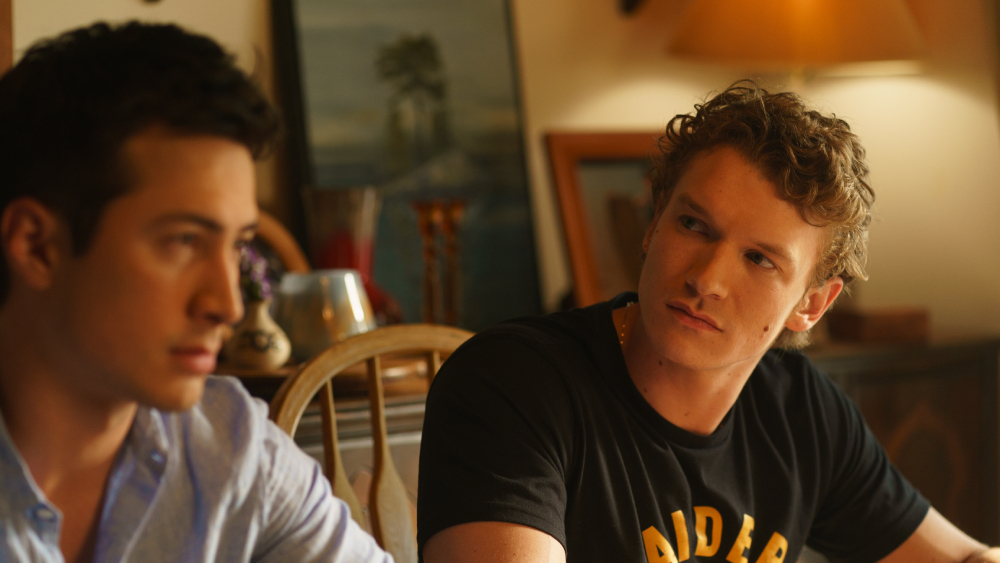
Set in Omagh, Northern Ireland, the story follows Dermot (Brenock O’Connor) and Elvis (Owen Colgan), two devoted music obsessives clinging to their struggling record shop like it’s the last vinyl pressing in existence. The shop is behind on rent, their landlord, Sadie (Tara Lynne O’Neill), is circling with sharp impatience, and the future looks as bleak as the moors. Then comes the miracle: a tip-off about rare Robert Johnson records for sale in Cork at a suspiciously low price. Salvation, it seems, lies at the other end of Ireland. They’ve just got to get there in time.
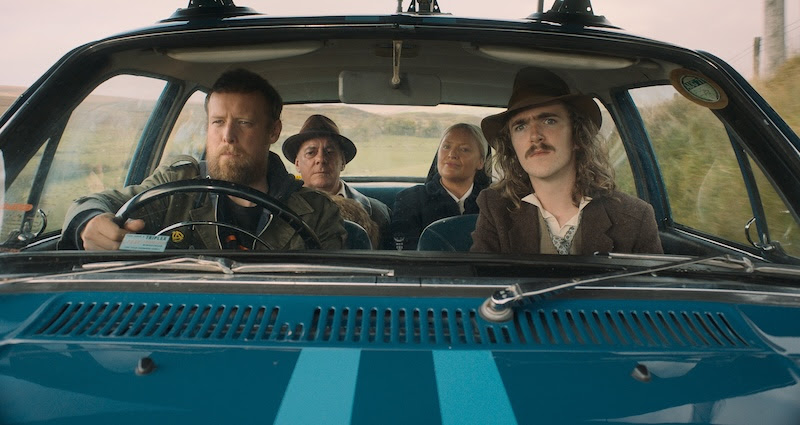
The set-up is classic buddy-movie territory. Two underdogs, a ticking clock, and a rusty blue car that’s seen better decades. But what gives The Spin its personality is its distinctly Irish rhythm. The humor is conversational, observational, and often delightfully daft.
Brenock O’Connor and Owen Colgan’s chemistry is undeniable. Like two old friends who’ve known each other for years, their performances are some of the more genuine I’ve seen in years. Tara Lynne O’Neill’s Sadie is a particular highlight: less pantomime villain than pragmatic operator, she injects just enough bite to keep the stakes from dissolving entirely into whimsy. The script is filled with ridiculous conversations, such as how much a horse costs, and with the Irish accents, the jokes roll off the tongue effortlessly.
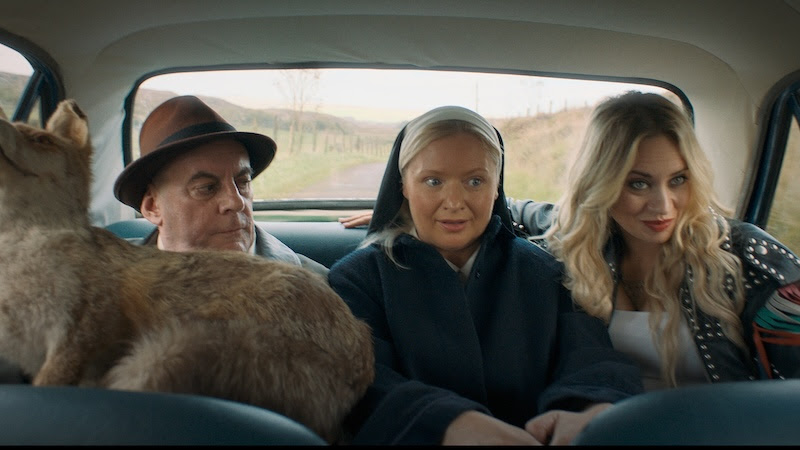
On their journey, the film opts for the scenic route. There’s a handy little map that helps time and distance pass for audiences who might not know how far they’re having to travel. There are plenty of shots of the beautiful, and damp looking, Irish countryside. Along the way, the duo encounter a smattering of locals and cameos, including Kimberley Wyatt and Maura Higgins in her feature debut, as well as blink-and-you’ll-miss-them appearances from Irish music stalwarts Barry Devlin and Steve Wickham. These moments add texture, but feel more like affectionate nods than fully integrated plot beats. But we do have to give a shoutout to some of the secondary characters who add so much fun and flare, especially the gentleman with the fox called Peter. His accent is very strong so subtitles might be needed.
The film’s strongest asset is its soundtrack. Based on a semi-autobiographical short story by Mark McCausland, who also provides the folk-inflected score, the music gives The Spin a soulful undercurrent.
Still, The Spin isn’t without its rough edges. The pacing can drift, particularly in the middle act. The stakes, while clear on paper, rarely feel truly perilous. Viewers expecting high-concept twists or sharp narrative turns may find the film’s gentleness bordering on inertia.
Yet there’s a quiet confidence in that restraint. Director Michael Head has described the film as a “feel-good buddy movie that doesn’t take itself too seriously,” and that self-awareness proves its saving grace. The Spin isn’t trying to reinvent the road movie or dissect economic precarity with forensic depth. It simply wants to offer audiences a warm, communal laugh and perhaps a renewed appreciation for the simple pleasures in life.There’s something disarmingly charming about a film content to be small, funny, and heartfelt. The Spin may not change cinema, but it understands the simple magic of sitting in a darkened room with strangers, sharing a story that hums along like a favourite track on an old record player. This is the type of cinema audiences are screaming for – a complete breath of fresh air. With a heartfelt ending, this lovely little film makes for fun, easy viewing.
Director: John Patton Ford Writers: John Patton Ford Stars: Glen Powell, Margaret Qualley, Jessica Henwick
Synopsis: Disowned at birth by his obscenely wealthy family, blue-collar Becket Redfellow will stop at nothing to reclaim his inheritance, no matter how many relatives stand in his way.
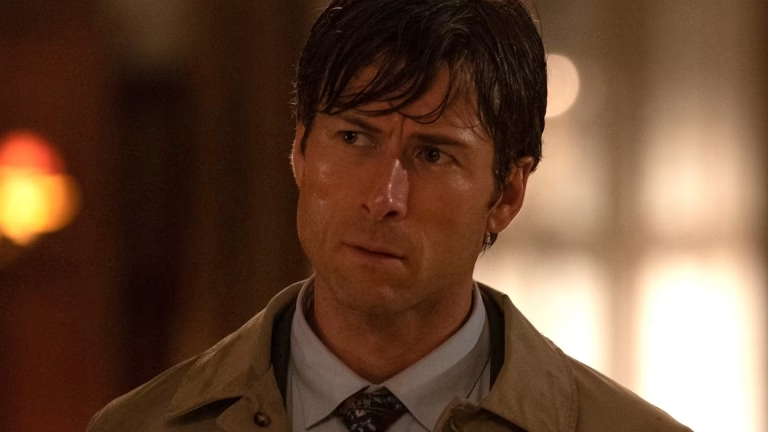
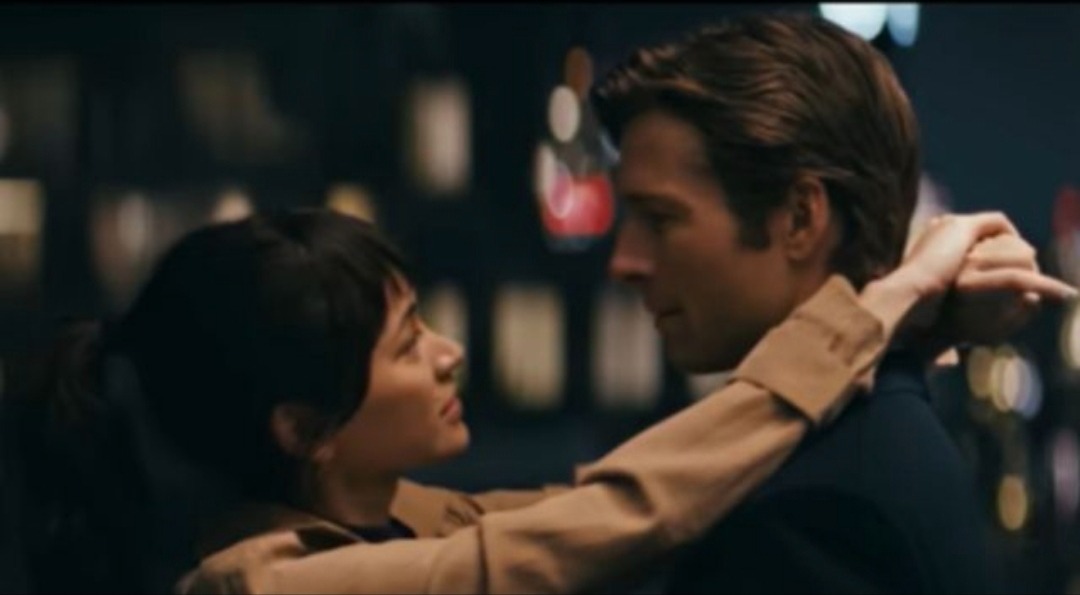
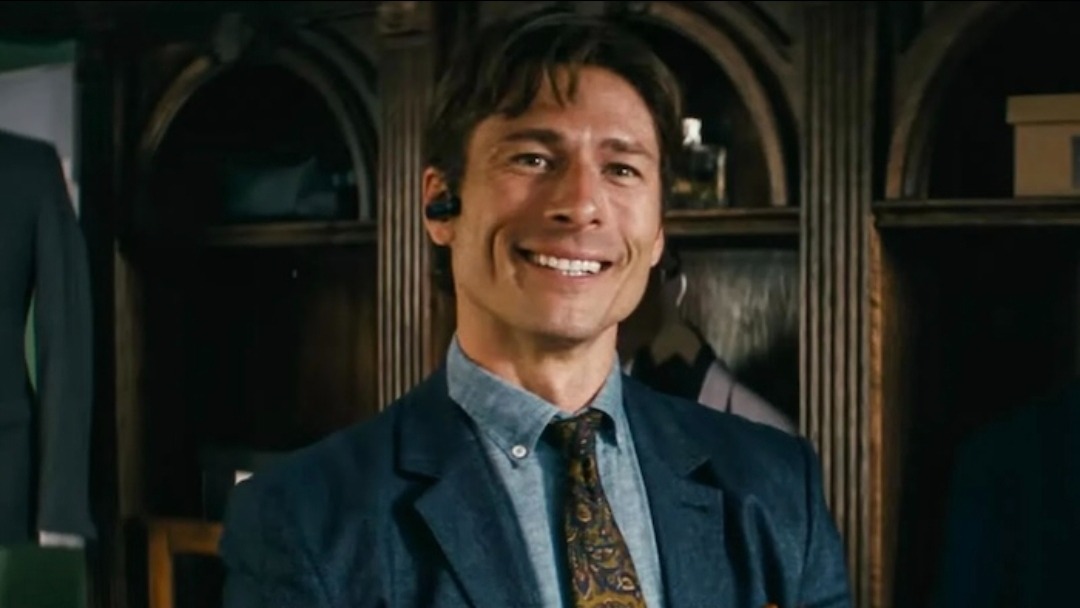
It’s hard to pinpoint just what is wrong with the new A24 film How to Make a Killing. The movie boasts an A-list cast, led by what was once supposed to be a megastar in waiting, but who has now delivered two box-office clunkers in a row, a potential star falling back to earth. Frankly, any time I see Glen Powell on screen now, I feel like I have to make a wish. However, at least Powell takes chances in a film that doesn’t know what to do with its wickedly delicious premise.
How to Make a Killing has its moments, but by the time the third act arrives, the execution fumbles and rushes, and the culmination comes across as a film without guts, especially for one with a money-first worldview. The ending never crescendos; instead, it offers a broad overview that panders to audience expectations. That is a strange choice for a studio that cut its teeth on bold, unconventional storytelling.
The Glen Powell vehicle builds toward total chaos and moral decay, only to refuse to enforce consequences and take the easy way out.
The story of How to Make a Killing is as old as time when it comes to Hollywood clichés. The film follows Becket Redfellow (The Running Man’s Glen Powell), a young man who was disowned by his family after his young mother, Mary (Blinded by the Light’s Nell Williams), chose not to have an abortion when her lover ostracized her in an attempt to get rid of the unwanted family scion.
However, not a day goes by that his mom doesn’t tell him stories of his blue-blood lineage to her blue-collar son. Mary made Becket promise to strive for the life he deserves. Unfortunately, Redfellow, shallow pockets and all, takes that too literally, wanting to make sure the heirs of today are gone tomorrow. Becket decides to kill the remaining seven heirs to the $28 billion fortune.
Things begin to get complicated, Byzantine indeed, especially when Ruth (The Royal Hotel’s Jessica Henwick), the girlfriend of one of Becket’s estranged, now-dead cousins, enters the picture. Also throwing her hat into the ring is Redfellow-lite’s best friend, Julia Steinway (Blue Moon’s Margaret Qualley), who wants to be an ivory opportunist and key conspirator in Becket’s plans.
Loosely based on Kind Hearts and Coronets, How to Make a Killing is from John Patton Ford, a critical darling after his feature film debut with Emily the Criminal. His sophomore slump lacks conviction, treating greed as a moral test rather than a behavior that cannot change. This is the moral of the story, something that cannot be turned on and off with ease. Instead, we have a script that rips off several movies as if this were a clean-out-the-fridge meal.
Powell’s Becket is essentially Patrick Bateman, in a film without the sharp American satire the first act promises. Qualley’s character is a cliché we have seen thousands of times before: a childhood friend returning for that long-awaited, delayed reckoning. Where is the capitalistic pig, cutthroat cannibalism we have come to know and love in films like Swimming with the Sharks, Glengarry Glen Ross, or even the recent Triangle of Sadness?
You know what I mean, where even a small taste of greed can send the most ethical person into a Wall Street tailspin? I can almost picture Alec Baldwin storming into John Patton Ford’s office, barking about closing, demanding a brass set from a Newton’s cradle as proof of consequence. To make matters worse, the actual murders are uninspired and lack cleverness, failing to push the envelope and matching the bland themes and subtext of Ford’s script.
If, for the love of money, is the root of all evil, especially in the times we live in, the pandering ending to How to Make a Killing is the coward’s way out.
You can watch How to Make a Killing in theaters starting February 20th!
Director:Gavin Polone Writer:Andrew Kevin Walker Stars: Georgina Campbell, James Preston Rogers, Malcolm McDowell
Synopsis: A police officer tracks a killer after her husband, a highway patrolman, becomes one of his victims.
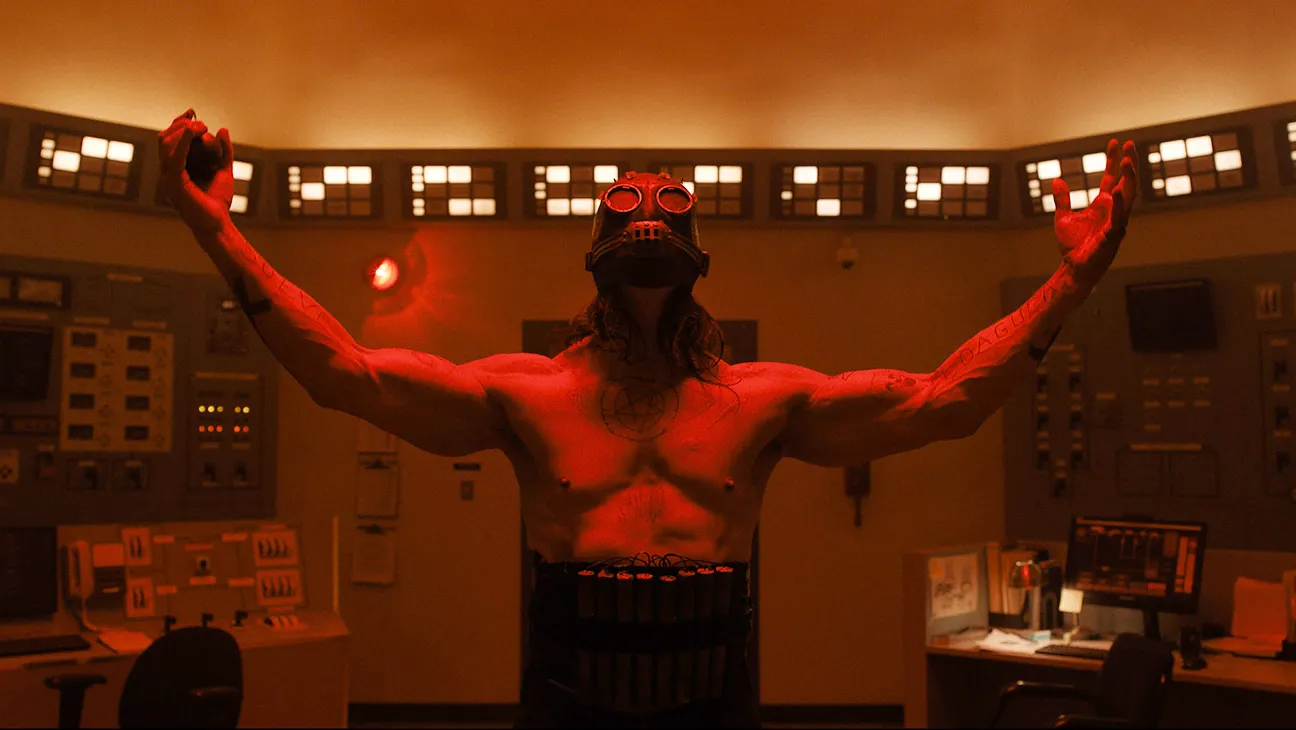
Andrew Kevin Walker is a screenwriter well known among cinephiles. His writing perfectly complemented David Fincher’s ambition for Se7en. His new screenplay, Psycho Killer, attempts to recapture the eerie serial killer magic of Walker’s golden years. The ingredients are certainly present. The film has a killer who keeps his face in the shadows. Visually, everything feels BDSM-inspired because Satanists are required to love leather for some reason. And of course, the soundtrack has an industrial kick, with opening credits featuring scribble fonts and grainy textures. The nostalgia should work, but it instead feels like an unintentional parody of a mid-’90s horror/thriller.
Directed by Gavin Polone from a screenplay by Walker, the film centers on a highway patrol officer named Jane Archer (Georgina Campbell). In our first introduction to Jane, we see her husband murdered by a mysterious, long-haired gentleman in a black car. The setup is shot beautifully, with the camera remaining fixed on the reflection of the psycho’s sunglasses. Then the first red flag reveals itself. The mysterious gentleman speaks, and the voice has been ADR-ed to make the character sound cartoonishly menacing. It’s like someone in the production watched Nathan Explosion from Metalocalypse and thought, “This is the way.”
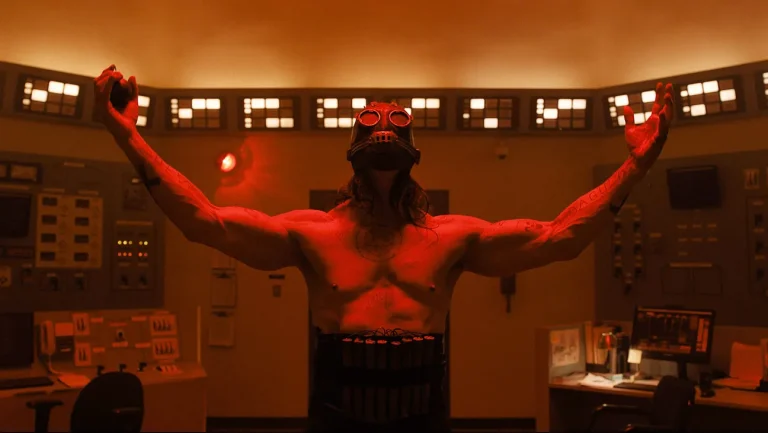
Following her husband’s death, Jane learns that the man responsible is a serial killer called the Satanic Slasher (James Preston Rogers)—a vicious serial killer who has been leaving a trail of carved-up corpses across multiple states. Unlike Se7en, the latest film from Walker does not shy away from having extensive sequences with the Psycho Killer himself. We spend long moments with the long-haired maniac as he brutalizes victims, scopes the classifieds for other satanists, and sleeps in hotel closets. His ability to hibernate in hotel closets is another head-scratcher, given Rogers’s towering stature at six feet five inches. It shows him curling up in a closet with a gun, which seems impossible since most motel/hotel closets are limited in space.
The design of the Satan Slasher is incredibly on the nose and lacks nuance. He embodies Maynard James Keenan of Tool, but lacks the rockstar charisma. The overall execution reads like a collection of checkboxes for a mass murderer, such as they must wear black, have hair like Rob Zombie or Alice Cooper, and everything must feel “Metal.” For instance, one sequence sees the Satanic Slasher enter a Catholic Church to give confession, only for the conversation to end with him stabbing the priest in the neck with a giant metal straw and drinking the blood of the priest. The execution should be tense in moments like this, but instead, it accidentally feels like a movie making fun of the genre.
Se7en worked because the screenplay understood the simplicity of John Doe. He was a psychopath who could easily blend into the background because nothing about his presence screams dangerous. The 1995 film brilliantly commented on the expectations of evil as Morgan Freeman’s character, Detective Somerset, explains, regardless of the extremity of his crimes, “He is still just a man.” With Psycho Killer, the movie feels like Walker never escaped the 1994 timeline. One can almost picture Psycho Killer as the screenplay he wrote before Se7en, while sitting in his office listening to “The Downward Spiral” by Nine Inch Nails on repeat. The film desperately wants to relive the industrial rock era of cinema, when bad guys wore leather and rocked out to Stabbing Westward. Movies like Spawn, for example, borrowed heavily from this example. Admittedly, there is something terrifyingly pleasurable about the industrial rock aesthetic of ’90s thrillers. But the visual nature of movies like Se7en was never the draw; it was the exceptional character work and story. And for the most part, the film is completely absent from character development.
Psycho Killer is not a complete disaster. For about ten minutes, the film loosens up and embraces its own absurdity. The Satanic Slasher tracks down a wealthy Satanist through the classifieds. It’s here that we meet Mr. Pendleton, played by the incredible presence of Malcolm McDowell. The sequence has elements of world-building akin to John Wick, hinting at an underworld of ritualistic devil worshippers. The humor is played up because the Satanic Slasher is too weird for even them. However, the sequence is short-lived and follows a massacre, bathed in a distracting amount of CGI blood.
By the time the film concludes, it reveals a major plot twist that raises more questions than it answers. We are given the reasons the Satan Slasher has been on a bloodbath, and the reveal is devoid of emotion. We should feel a sense of emotional dread for Jane and those who may be affected by his master plan, yet we do not. And once the whole climax unfolds, we are offered a tease for a sequel that no one will rightfully beg for. At the end of the day, the film’s quality shouldn’t be surprising. Psycho Killer has been in development hell for years, and at one point, Fred Durst of Limp Bizkit was attached to direct. Even so, the idea that Andrew Kevin Walker wrote this screenplay is baffling.
Synopsis:Follows a mysterious herd of ghost elephants in the jungles of Angola.
Werner Herzog is a filmmaker whose voice recalibrates how we look at the natural world. With Ghost Elephants, a lyrical and searching documentary presented by National Geographic Documentary Films, Herzog returns to familiar thematic terrain: obsession, endurance, and humanity’s uneasy relationship with nature. Yet here, in the mist-heavy forests of Angola, his gaze feels unusually tender, attuned not just to the grandeur of the quest but to the fragility of what may already be slipping away.
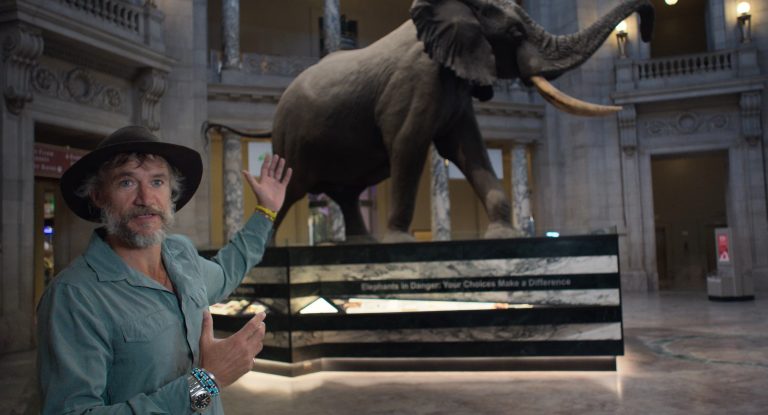
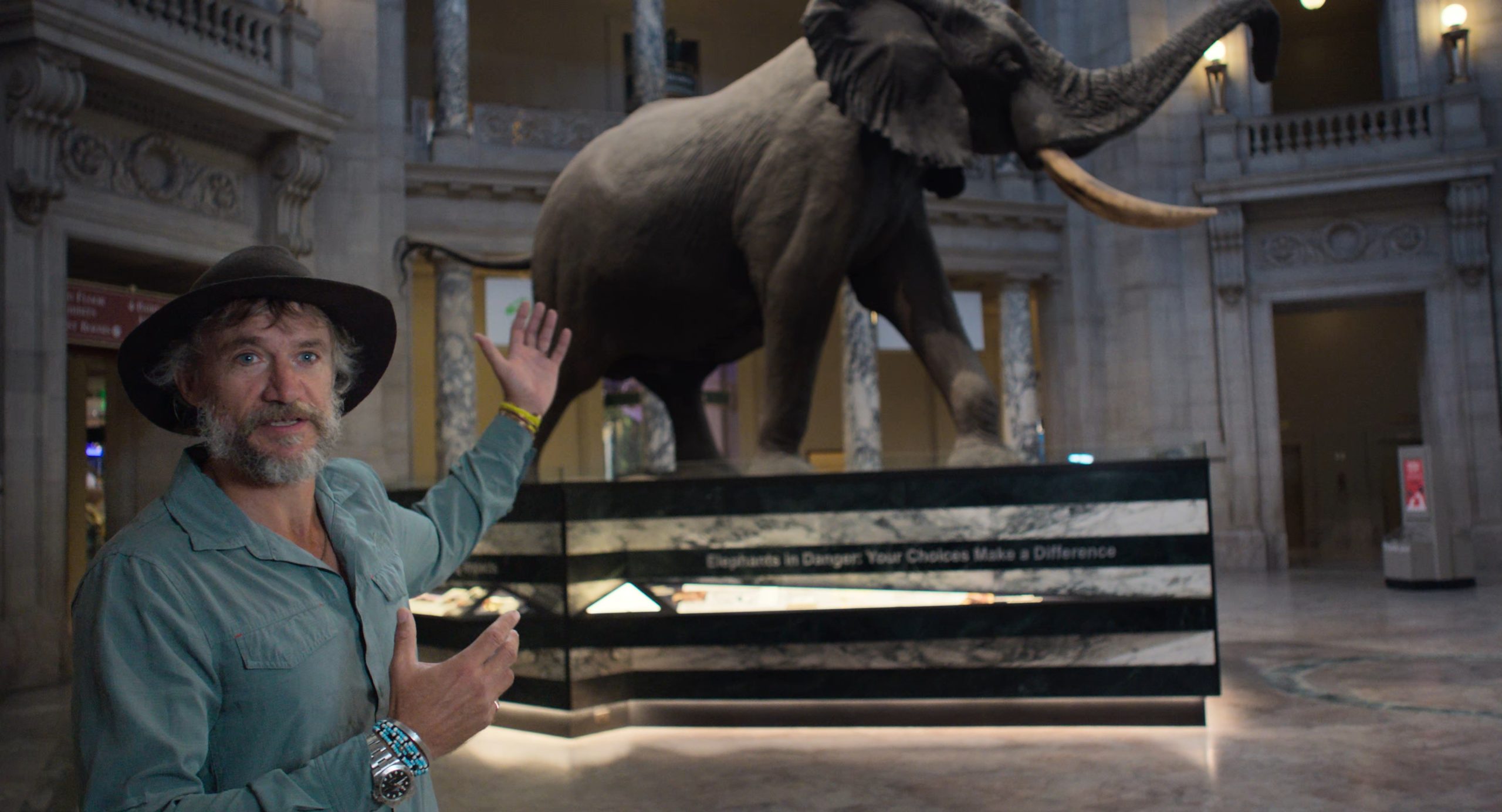
Dr. Steve Boyes stands in the rotunda of the Smithsonian Museum. He describes his emotions seeing Henry the elephant. (Credit: Skellig Rock, Inc)
The film follows conservation biologist and National Geographic Explorer Steve Boyes as he attempts to prove the existence of the so-called “ghost elephants of Lisima”. Rumored survivors, possibly descendants of the largest land mammals ever recorded, are believed to exist only in legend. It’s a premise that fits neatly into Herzog’s long-standing fascination with myths that refuse to die and with humans being compelled to chase them, regardless of the cost. Ghost Elephants teaches its audience how to listen, how to move slowly, and how to trust knowledge systems long dismissed by Western science.
In the one hour and thirty-eight minute runtime, Boyes is joined by fellow National Geographic Explorer Kerllen Costa, and quickly learns that satellites, drones, and data sets are no match for the lived expertise of the KhoiSan master trackers, Xui, Xui Dawid, and Kobus. Their ancestral knowledge forms the film’s quiet backbone. And their tracking skills are incredibly fascinating and inspiring to watch.
The first photo of a ghost elephant captured by a motion controlled camera. The eyes glow in this night shot. (Credit: Courtesy of The Wilderness Project Archive)
Herzog’s narration reflects on survival, extinction, and the human impulse. His voice is like that of an old university lecturer; someone with so much wisdom you trust and so you hang on every word. He guides audiences through this documentary almost as if he’s holding your hand.
Visually, Ghost Elephants is striking without being showy. There are some beautiful underwater shots of elephants swimming against orchestral music. The Angolan highlands are captured in muted greens and silvers, their beauty inseparable from their opacity. The bushmen in the desert allow intimate close-ups of their rituals and dancing by the fire under the moon; it’s magical and mesmerizing. Long stretches of landscape unfold, reinforcing the idea that absence, too, is a form of evidence. When traces of the elephants do appear, they are fleeting and ambiguous, resisting the definitive proof that conventional documentaries often demand. There’s supporting evidence in the form of videos, old newspaper articles, and drawings, when discussing the media and how elephants have been treated throughout history, especially hunted for sport.
There’s an incredibly sad section discussing poaching, game hunting, and even filming, and you’ll want more hope for the future of all animals being destroyed by humans. You’ll want more justice and change. But don’t worry, there’s not a lot of distressing footage used, and it’s not long, so don’t let this put you off watching.
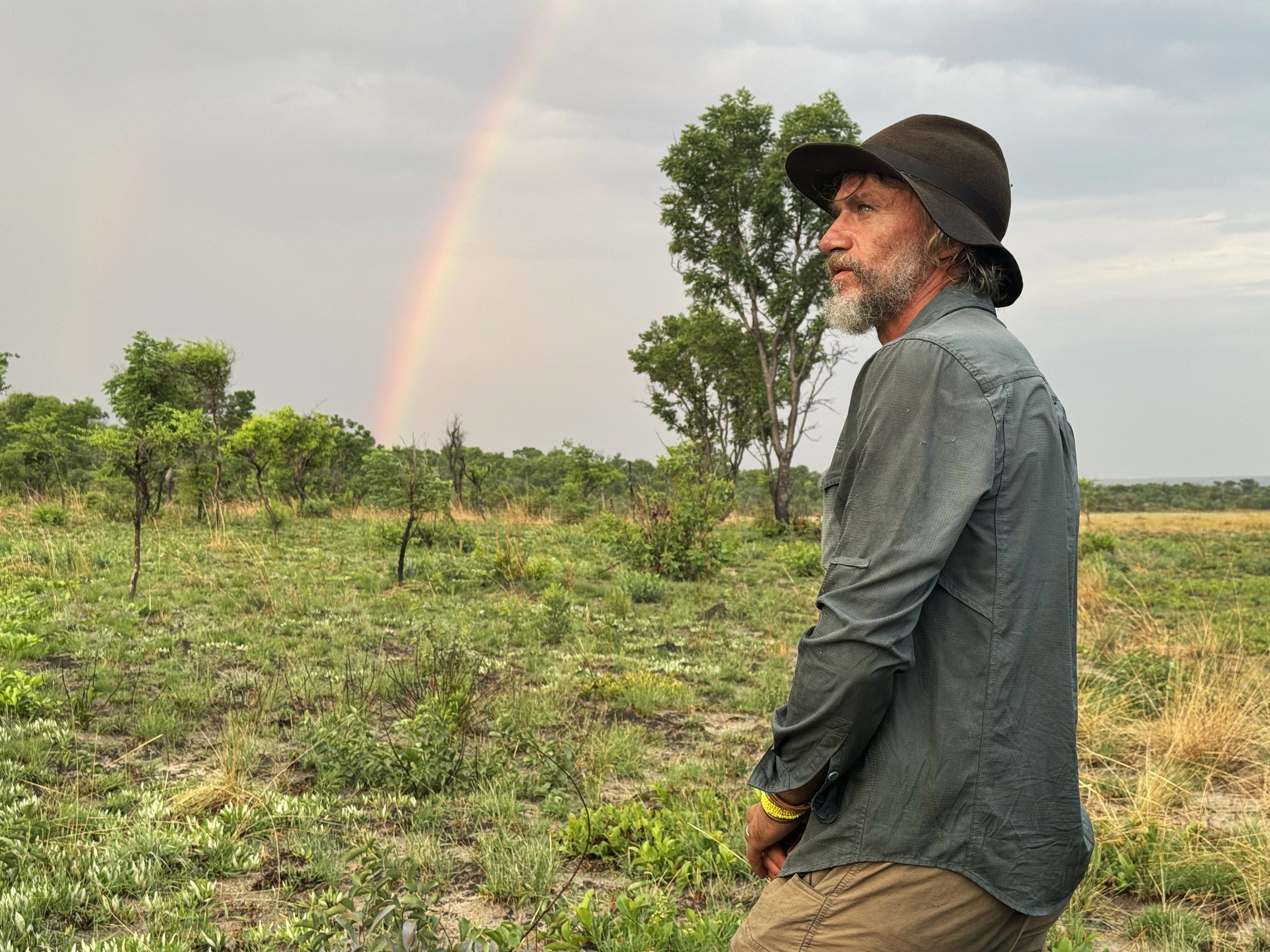
Dr. Steve Boyes, with a rainbow in the background, experiences the first signs of the rainy season. (Credit: Ariel Leon Isacovitch)
The documentary is very informative with easy-to-understand language and supporting images. The Smithsonian allowed the film to see elephant tusks up close and personal. Getting a look into these archives feels very special – being privy to something you shouldn’t. Toward the end, we get a glimpse into DNA and how data is used/going to be used in the future. They compare the Ghost elephant’s DNA with that of other species of elephants.
If the film has a limitation, it’s its smoothing over the harsher political realities of conservation in post-colonial landscapes. The presence of Indigenous knowledge is celebrated, but its ongoing marginalization is only lightly interrogated. Viewers expecting a dramatic reveal might feel frustrated. Audiences will have to be willing to dwell in the unresolved, to accept that some truths exist beyond the reach of cameras and confirmation.
Ultimately, Ghost Elephants is less a documentary about finding animals than about recovering ways of seeing. It asks whether reconnection with land, with history, with each other, is still possible in a world that prefers a fast pace and instant gratification to patience. Like the elephants it seeks, the film moves quietly, giving you time to absorb the information and learn something. The love and respect for nature, especially elephants, is heartwarming and inspiring. This is a gentle documentary, one for those interested in animals, nature, and adventure.
See the full list of 2026 BAFTA award winners below.
Best Film
Hamnet Marty Supreme WINNER: One Battle After Another Sentimental Value Sinners
Best Director
Yorgos Lanthimos, Bugonia Chloé Zhao, Hamnet Josh Safdie, Marty Supreme WINNER: Paul Thomas Anderson, One Battle After Another Joachim Trier, Sentimental Value Ryan Coogler, Sinners
Best Actor
WINNER: Robert Aramayo, I Swear Timothée Chalamet, Marty Supreme Leonardo DiCaprio, One Battle After Another Ethan Hawke, Blue Moon Michael B. Jordan, Sinners Jesse Plemons, Bugonia
Best Actress
WINNER: Jessie Buckley, Hamnet Rose Byrne, If I Had Legs I’d Kick You Kate Hudson, Song Sung Blue Chase Infiniti, One Battle After Another Renate Reinsve, Sentimental Value Emma Stone, Bugonia
Best Supporting Actor
Paul Mescal, Hamnet Peter Mullan, I Swear WINNER: Sean Penn, One Battle After Another Stellan Skarsgård, Sentimental Value Benicio Del Toro, One Battle After Another Jacob Elordi, Frankenstein
Best Supporting Actress
Odessa A’zion, Marty Supreme Inga Ibsdotter Lilleaas, Sentimental Value WINNER: Wunmi Mosaku, Sinners Carey Mulligan, The Ballad of Wallis Island Teyana Taylor, One Battle After Another Emily Watson, Hamnet
Best Adapted Screenplay
The Ballad of Wallis Island Bugonia Hamnet WINNER: One Battle After Another Pillion
Best Original Screenplay
I Swear Marty Supreme The Secret Agent Sentimental Value WINNER: Sinners
Outstanding British Film
28 Years Later The Ballad of Wallis Island Bridget Jones: Mad About the Boy Die My Love H is for Hawk WINNER: Hamnet I Swear Mr. Burton Pillion Steve
Best Animated Film
Elio Little Amélie WINNER: Zootopia 2
Best Film Not in the English Language
It Was Just an Accident The Secret Agent WINNER: Sentimental Value Sirāt The Voice of Hind Rajab
Best Documentary Film
2,000 Meters to Andriivka Apocalypse in the Tropics Cover-Up WINNER: Mr. Nobody Against Putin The Perfect Neighbor
Best Children’s & Family Film
Arco WINNER: Boong Lilo & Stitch Zootopia 2
Best Editing
A House of Dynamite F1 Marty Supreme WINNER: One Battle After Another Sinners
Best Casting
WINNER: I Swear Marty Supreme One Battle After Another Sentimental Value Sinners
Best Cinematography
Frankenstein Marty Supreme WINNER: One Battle After Another Sinners Train Dreams
Best Production Design
WINNER: Frankenstein Hamnet Marty Supreme One Battle After Another Sinners
Best Sound
WINNER: F1 Frankenstein One Battle After Another Sinners Warfare
Best Special Visual Effects
WINNER: Avatar: Fire and Ash F1 Frankenstein How to Train Your Dragon The Lost Bus
Best Costume Design
WINNER: Frankenstein Hamnet Mary Supreme Sinners Wicked: For Good
Best Makeup and Hair
WINNER: Frankenstein Hamnet Marty Supreme Sinners Wicked: For Good
Best Original Score
Hamnet One Battle After Another WINNER: Sinners Bugonia Frankenstein
Outstanding British Contribution to Cinema
Clare Binns
Outstanding Debut by a British Writer, Director, or Producer
Pillion The Ceremony Wasteman A Want In Her WINNER: My Father’s Shadow
Best British Short Animation
Cardboard Solstice WINNER: Two Black Boys in Paradise
Best British Short Film
Welcome Home Freckles Magid / Zafar Nostalgie Terence WINNER: This Is Endometriosis
EE Rising Star Award
WINNER: Robert Aramayo Miles Caton Chase Infiniti Archie Madekwe Posy Sterling
One Battle After Another leads the 2026 crop of BAFTA nominees with 14 mentions, Ryan Coogler’s Sinners follows close behind with 13. But, I predict February 22nd will be a particularly good night for Hamnet. Why? BAFTA tends to “spread the wealth,” more so than the Oscars, and tends to favor films with a home court advantage. The Brittish Academy went big for Conclave last year; they could course correct and rubber-stamp One Battle’s frontrunner status. Or deliver some surprises and give Chloé Zhao’s drama a much-needed boost.
For U.S. viewers, BAFTA will air with a delay on E!. Although a VPN will allow you to watch live as the event takes place on Sunday, February 22. Emmy-winning Traitors host Alan Cumming will serve as MC. And Paddington Bear is among the presenters, reason alone to tune in.
On this episode of Chasing the Gold, Shadan is joined by Doug Jamieson to discuss their final predictions to the 2026 BAFTA’s! Are all the major categories locked up? Could Hamnet surprise with these awards being on their home turf? We talk about all this and more with our winner predictions.
Check out this week’s show and let us know what you think in the comment section. Thanks for listening and for supporting the InSession Film Podcast!
On this episode, JD and Brendan discuss Gore Verbinski’s new film Good Luck, Have Fun, Don’t Die! Starring a really fun Sam Rockwell and always underrated Haley Lu Richardson, the film is brazen with its satire and darkly very humorous. But its messaging on AI is striking and quite clever.
Review:Good Luck, Have Fun, Don’t Die
Director: Gore Verbinski Writers: Matthew Robinson Stars: Sam Rockwell, Haley Lu Richardson, Michael Peña, Zazie Beetz
ComMANNdment #3: Thy Movie Shall Have a Lone, Complicated, & Imperfect Male Lead
If nothing else is known about Mann as a screenwriter and storyteller, it should be known and etched in stone that he gravitates towards the lone, complicated, and imperfect males in his films. While there will be an entire ComMANNdment dedicated to women later, it is the psyche of these often-damaged males that propels Mann (and us as the audience) through the tale being told.
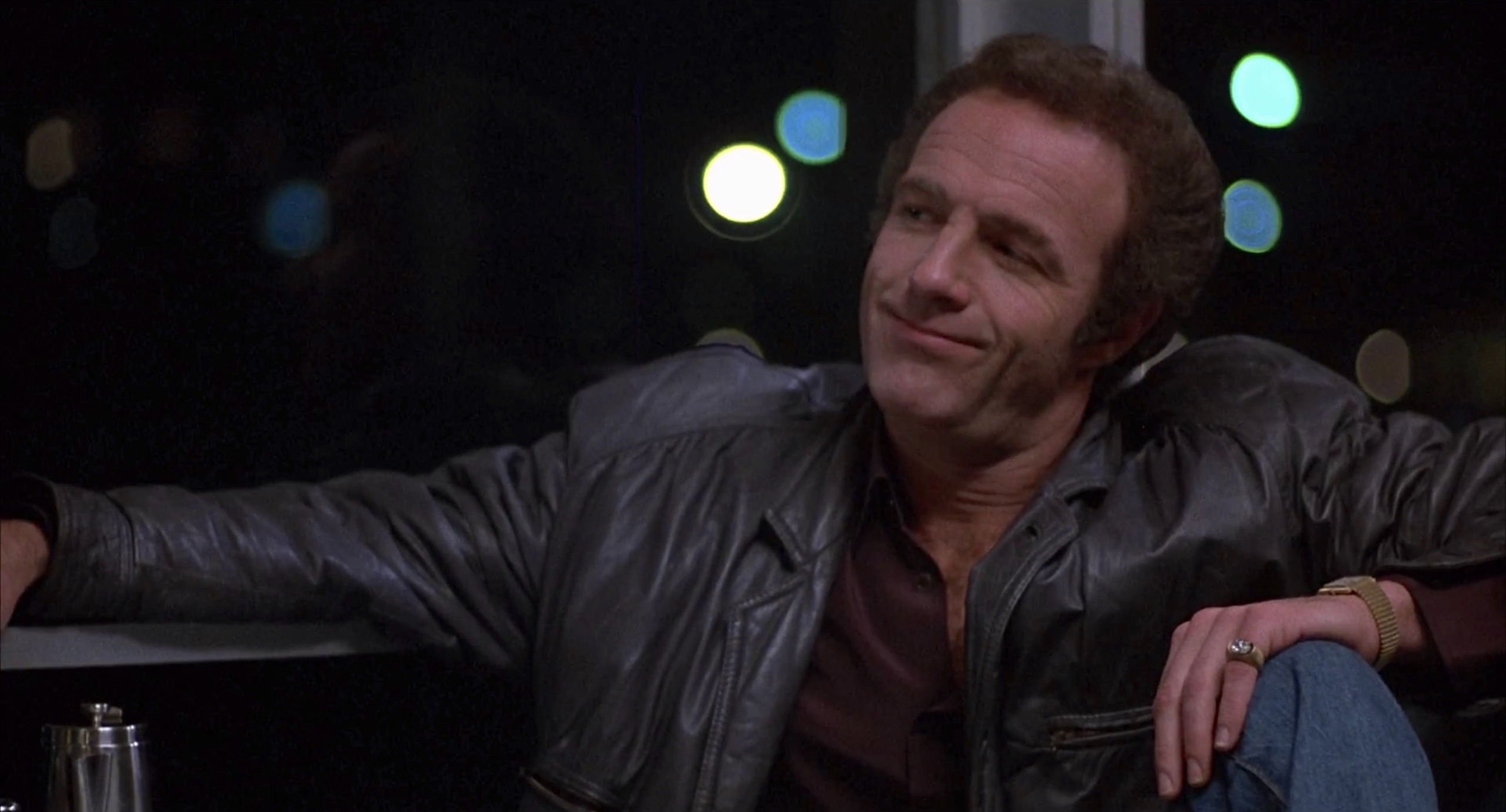
Frank in Thief is Mann’s first foray into this type of character. In his coffee shop confessional to Jessie, we learn of his time being incarcerated and the violence both inflicted upon him and that he inflicted upon others. And while we may think that these actions are excusable or justifiable, it does not negate the moment prior to this scene where Frank forcefully pushes Jessie through the bar, onto the street, and into his car. Among other things, we also learn in the failed adoption scene that Frank was state-raised and has strong feelings about children going through the system. Watching this moment of desperation may get you to empathize with Frank, but remember in this scene he uses racist stereotypes to describe the kind of child he would take.
For The Keep, I don’t think Glaeken should serve as our imperfect, lone, complicated male lead because I’m not sure he is entirely human. And Dr. Cuza ends up under the control of Molasar for a chunk of the film. However, Jürgen Prochnow’s portrayal of Woermann does fit well under this ComMANNdment. He is sent to these alps and is clearly on the wrong side of history: he is alone, separate from his men, and is bearing some huge, internal guilt. Through the revelation of character, we discover that his family has been killed and that he would have been fighting on the same side as Dr. Cuza’s son. In fact, Woermann is so conflicted that he eventually stands up to Kaempffer because he knows that what the Nazis are doing is wrong. This rebuff to his Nazi supervisor ultimately leads to his death – with no resolution or chance to right any previous wrongs.
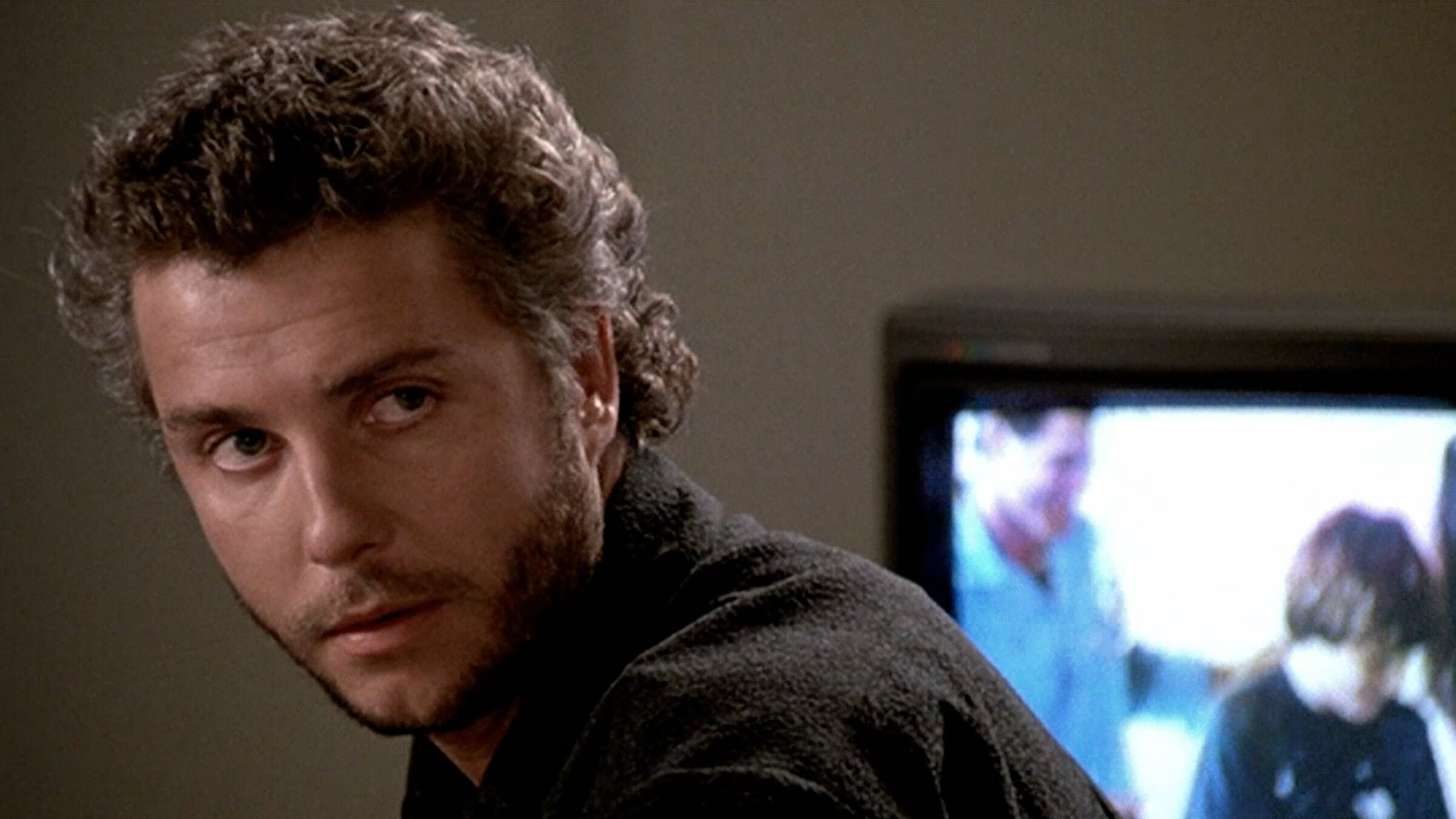
You could go so far as to say that Manhunter has three complicated, lone male figures: Lecktor, Dolarhyde, and Graham. For the purposes of this conversation, I’ll leave out Hannibal as that character is featured more prominently in the Anthony Hopkins trilogy. The characters of Will Graham and Francis Dolarhyde are different variations on a loner theme. Will has a family and has extricated himself from his prior life after a run-in with Dr. Lecktor leaves him close to death and in a terrible mental state. Francis’s past is mostly unknown to us (source material set aside), and we have to make assumptions as to why he destroys these families. What links these two characters is the fact that they are both quite alone even though they allow themselves to be around people. For Will, he has a wife and son to protect and future families to save from the mayhem of the “Tooth Fairy.” Will has a moral obligation to use his skill of seeing through the killer’s eyes to stop further crimes from happening. Francis, on the other hand, wants attention AND isolation – these conflicting states causes his emotional unrest towards the end of the film. Isolation is needed to plan and enact these heinous murders that he has perpetrated on the Leeds’ and Jacobi’s families, but attention is ultimately what he is seeking from his victims (mirrors in their eyes who ultimately see his transformation). What Francis does not expect is for REAL attention to come his way in the form of Reba, who instantly clings to him in a way that makes him question his transformation. While this ComMANNdment has been discussed already in Thief, Manhunter becomes the first example of multiple male figures who tend to work better alone with complicated thoughts towards the world.
Complicated male characters make up what feels like the entirety of The Last of the Mohicans. As to our lead, played impeccably by Daniel Day-Lewis, his past is extremely complicated that is summed up to Cora rather succinctly: his family was killed when he was very young, Chingachgook took him in and raised him as his own, and he and his new brother Uncas learned English at a religious school. While all of that can be true, it also puts a white man into the world of the Mohican people – he is an outsider that has been accepted. Magua’s storyline is a bit inverted: he grew up with his Huron people, but his family was killed by soldiers led by the “gray hair” (Alice and Cora’s father, Munro). This has led Magua down the path of pure revenge – so much so that he veers away from the nature of his Huron people. And just to throw in one more complicated figure, let’s bring in Duncan. Duncan is after the heart of Cora, but she outright refuses him multiple times. After having his manhood tested and bested in front of Cora by Nathaniel, Duncan lies about what he heard regarding the villagers and their families and actively pushes for Nathaniel’s death once he helps the villagers escape. And yet after all this animosity towards Nathaniel, Duncan sacrifices himself so that Nathaniel and Cora may escape from the Huron camp. The French-Indian war was a complicated time, so it is not out of the realm of plausibility that many of our male lead figures would have complicated pasts and storylines.
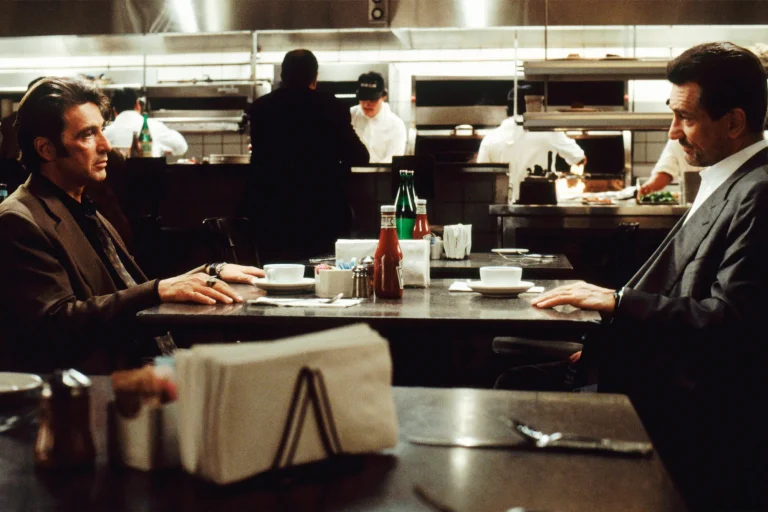
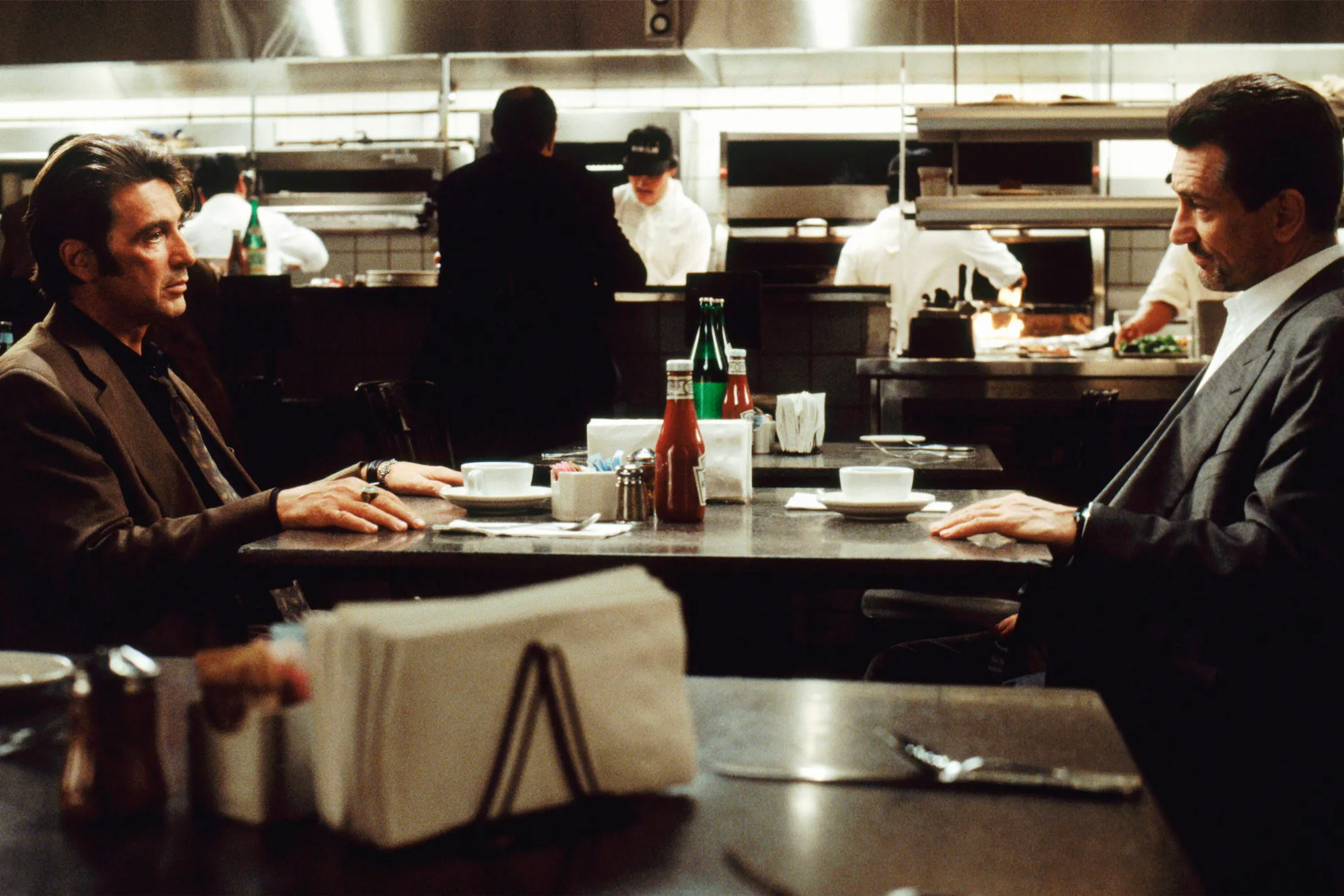
Upon having their only conversation in Heat, Neil McCauley says to Vincent Hanna “There’s a flipside to that coin.” And there you have it: Vincent and Neil are the two sides to the lone, complicated male lead coin. Vincent’s code – to catch the bad guys, even if his methods are extreme. Vincent is not a good husband and has no aspirations of being a family man. The indication that he has only focused on what he is chasing at that moment proves that Vincent would rather be on the street or tracking down a lead then having an emotional, in-depth conversation with Justine. And however complicated Vincent may be, he is a man of his word: “I do what I say, and I say what I mean.” Neil is a bit more complicated. We hear personal accounts of his family and upbringing and they do not paint a pretty picture. We know Neil has done time in prison and that he will not be going back. We also know his code: “Don’t let yourself get attached to anything you are not willing to walk out on in 30 seconds flat if you feel the heat around the corner.” What I find amazing about this code is that it is very clear and we see Neil stick to this when he hears a sound (from a SWAT member across the street) during the platinum heist. Of course, we know the heartbreaking decision that is made when Neil sees Eady but knows that Vincent is hot on his tail so he decides to leave her in the dust (Or is it heartbreaking? We’ll discuss this more later.) All this is to say that Mann sets up a really great collision of character: two men with strong work ethics who just so happen to be on either side of the law.
When you have a strong moral compass and are forced to review the recent events of your life to determine if that compass has been pointing true north it makes for compelling character arcs. With The Insider, we are treated to two different compasses that need to be examined and due to the structure of the storytelling we really get to see each one examined separately. Jeffrey Wigand’s code is very diligent: he knows the rules and follows them. In his scene with Sanderford after being called back to Brown & Williamson, he very directly tells him he had no intention of breaking his confidentiality agreement. Wigand, as a man of science, knows how to make calculated decisions UNTIL he is pushed too far. The true north for Wigand diverts as he is followed at driving ranges, finds a bullet in his mailbox, and receives death threats in his email. Once he decides to do the interview and give his deposition, Wigand struggles to find his bearings and it takes a lot of will power and another man with a code to help. Lowell Bergman is a newsman with journalistic integrity: he never burns a source. You could say Bergman’s eye for spotting people with information important for the world to hear is his due north. Unlike Wigand’s challenges that rack him with emotional and financial strain, Bergman faces an ethical dilemma within CBS and how the corporate division decides not to air the interview. Bergman starts to wonder if he means anything at all (“I’m Lowell Bergman. I’m from “60 Minutes”. You know, you take the “60 Minutes” out of that sentence, nobody returns your phone call.”) His path back to true north means getting back to his roots and doing some investigative work on the smear campaign being leveled against Wigand; it even means Bergman selling out what happened behind closed doors to the New York Times. These two men, their codes and imperfect natures, and the methods in which they try to find their moral center is what makes for incredible arcs and gets us to empathize with them so deeply.
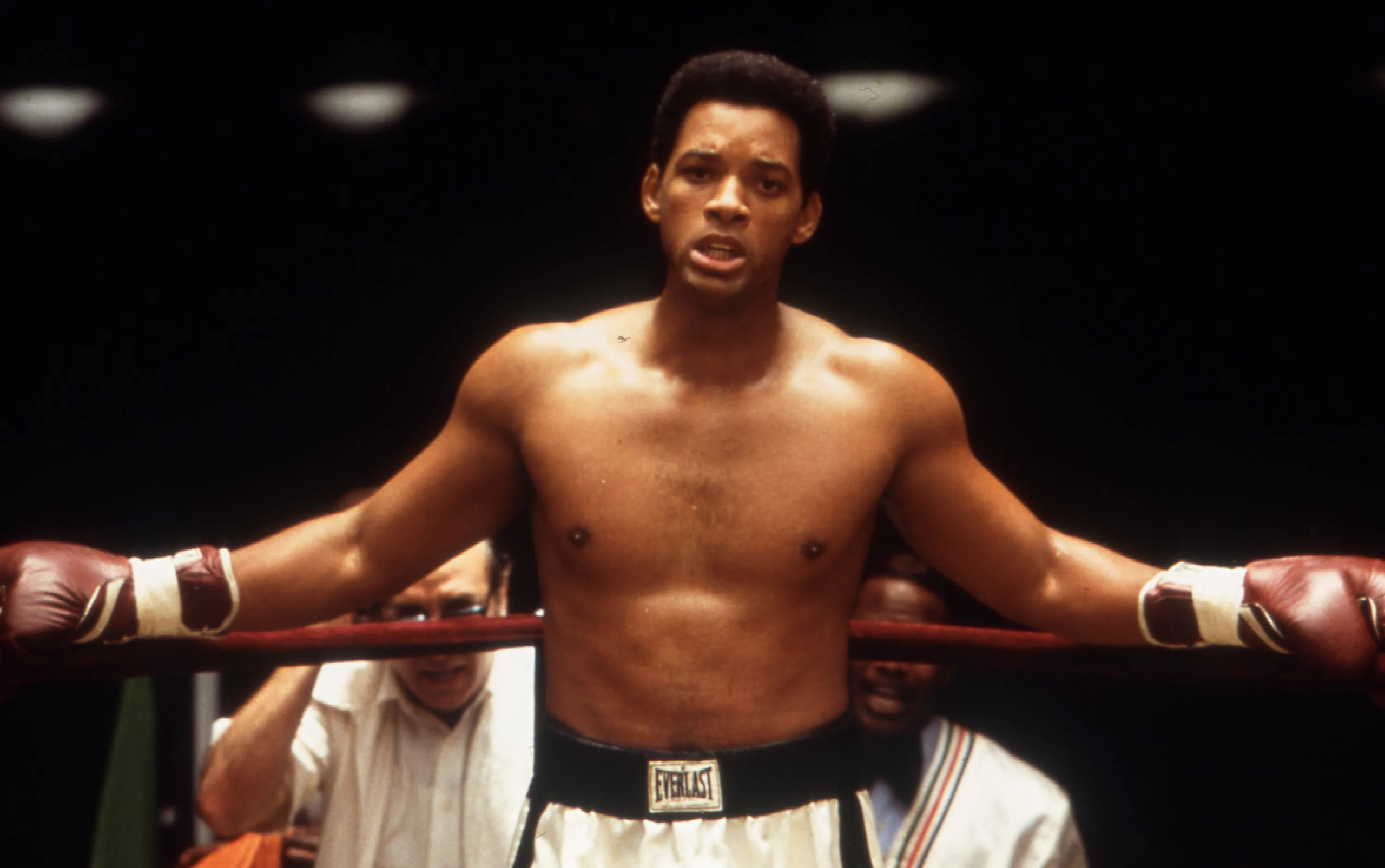
They say it’s lonely at the top – and being at the top of your field can complicate how your choices are interpreted by family, friends, and mainstream media. While I have some issues with the overall scope of the film Ali, one thing that is clear is that we see our pugilist hero transform multiple times over the course of the film. In name, we go from Cassius Clay to Cassius X and ultimately end on the now cemented Muhammad Ali. Nowadays, we see Ali as a man who conquered the sporting world and stood up for his personal and religious beliefs – but the film also shows a personal side that tells us just how complicated his life was. To start, we see how the name change affects Ali’s relationship with his father. We also see that as Ali’s fame and power rises and his involvement within the Islamic community grows, he starts to become more of a philanderer. And complications mount we he refuses to be inducted during the Vietnam War and later on live television we hear him admit that he is broke. All this leads Ali and his family down a treacherous path with an uncertain outcome. It will not be until Ferrari that Mann focuses on an individual with so much personal power and influence in the sporting world, but the story of Ali does reinforce how lonely being a champion boxer can be.
Hot take: Vincent in Collateral follows the “30 second flat” rule better than Neil in Heat. Vincent was hired for a very particular job and he aims to complete it: come to Los Angeles and kill 5 people in one night. No matter what happens along the way, whether it be meeting random mothers or stopping in the listen to jazz or losing all of the information needed to find these people, Vincent will not be stopped. Vincent excels past Neil in another facet in that he (seemingly) has not chosen to become intertwined in a relationship. Vincent is methodical and relentless – he is almost a horror villain in the way he is always moving in on his prey. And what may make Vincent even more scary is the fact that part of his code and personality is knowing that life is fleeting. All you need to do is review his diatribe to Max to understand this: “Now we gotta make the best of it. Improvise. Adapt to the environment. Darwin, shit happens, I Ching, whatever man. We gotta roll with it.” This ability to just keep moving forward regardless of what has just happened make this lone, complicated, and VERY imperfect male lead so devastating: nothing will stop him from the task at hand.
What is Sonny’s code in Miami Vice? Theoretically, Sonny is here to avenge the death of a CI and help the FBI take down an international drug dealer capable of mass amounts of death and destruction. As part of his act, Sonny is very aggressive and behaves more like a deviant than he normally would. Upon his arrival into this new mission and after meeting Jose Yero, he starts to infiltrate his way into the world of Isabella (whom we later find out is a confidant of Montoya – the man running this entire operation). They dance, drink mojitos, have sex, and…fall in love? Really? As far as Rico is concerned, his code seems clear: he doesn’t like seeing the woman in the green dress getting manhandled in the club during the opening scene, he is very protective of Trudy, and when he learns that she is in danger he will stop at nothing to help rescue her (this will come up again during ComMANNdment #7, but I’ll let it be for now). Rico has his head on straight EVEN when personal matters arise. Sonny, on the other hand, seems to only be thinking with his…you know…All of this leads to a conclusion that is baffling: Isabella being taken away in a boat and sharing a somber moment of connection with Sonny – but why? Both had codes and morals they chose to live by, but in the course of their business (crime and punishment) are we meant to believe they fell in love? Call me cynical if you must, but Rico was the lead with a code – Sonny not so much.
Two male leads both on either side of the law and both with moral and ethical codes that guide their decisions. Christian Bale has the more “thankless role” of Melvin Purvis, but still we see a man who wants to rid the United States of criminals and do everything within his power to take down public enemy #1. We see Purvis as a driven man, but also a man with faults: pride being the one that gets in Purvis’s way the most. When he lets Babyface Nelson escape and misses out on another Dillinger robbery, he owns up and takes full responsibility with J. Edgar Hoover. Purvis has one mission: capture Dillinger. And while other FBI agents seem to be out for vigilante justice and use torturous tactics on Billie, Purvis is there to stop it. Dillinger also has a code, but the thing about being a criminal is that you can expel that code when it doesn’t suit you anymore (you can refer to Heat for how this works). Dillinger is loyal to those who are loyal to him, but if you cross him, it’ll be the last thing you do. After agreeing to a bank robbery job that includes Babyface Nelson, Dillinger’s trusted accomplice Red reminds him of a code: “Don’t work with people you don’t know and don’t work when you’re desperate.” Had Dillinger stayed true to this code, he never would have gone on the job with Babyface and the Little Bohemia shootout would not have happened, resulting in the death of Red. Despite all these events and ideals, Dillinger is also a man of his word – he tells Billie that he will always lookout for her. It is this promise that leads to her being caught, detained, and ultimately to them never seeing each other again.
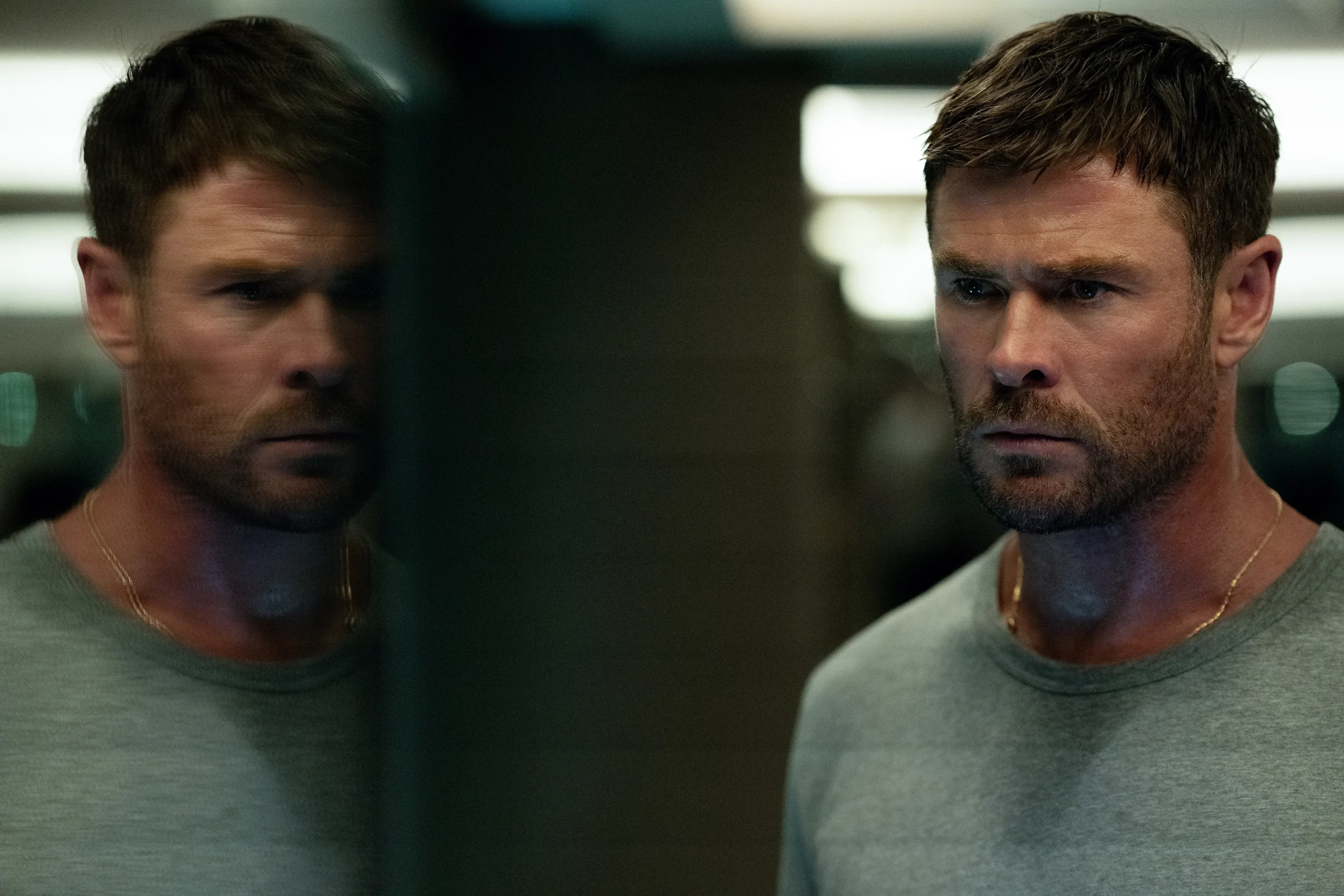
Nick Hathaway (Chris Hemsworth) is a digital age version of John Dillinger: “I only steal from corporations. I don’t burn people.” We will get more into Hathaway’s backstory in the 9th ComMANNdment, but he is a complicated individual in relation to why he does what he does. Among the many choices made by this character, the most compelling (at least from a storytelling perspective) is that he chooses to hack the Black Widow software. In committing this act, he is essentially breaking the conditions of his future release and leads to the dismantling of the well-oiled team (coming up in our 4th ComMANNdment). Is this a selfish act of Hathway? Is he trying to be the hero? What are his motivations? Despite the repercussions, Hathaway is trying his best to think of the others – sending Dawai, Jessup, and Carol out of the room so that they could at least say they didn’t see it take place. A rather complicated character, we are not done exploring Hathway yet. By this point in my life, I should just assume that any powerful man who seemingly finds himself at the top of his field must have some skeletons in his closest and trauma he hasn’t worked through yet. Ferrari presents us with a man coming to a fork in the road that leads in two directions: Laura or Lina. Enzo has fathered an “illegitimate” child, Piero, with Lina while continuing to grieve for the loss of his son with Laura. The decision as to whether Piero will be baptized as “Lardi” or “Ferrari” is looming. Meanwhile, the Ferrari business is not doing well financially and Enzo either needs to take on a partner or win the Mille Miglia (or both). And while both things are going on, Enzo is also seemingly dealing with the death of his brother and the resentment of his mother (“The wrong son died.” she so eloquently states in the film). What does this all mean? It means we’re watching a Michael Mann film – Enzo at no point shows regret in his decisions and holds onto that trauma because to reveal it would be unmanly and against his code. The level of machismo is through the roof in this film, but so much oozes from Ferrari himself that to say he is imperfect is an understatement.
“How can you forgive this guy for standing you up and not forgive me for this tiny little thing of putting you out of business?”
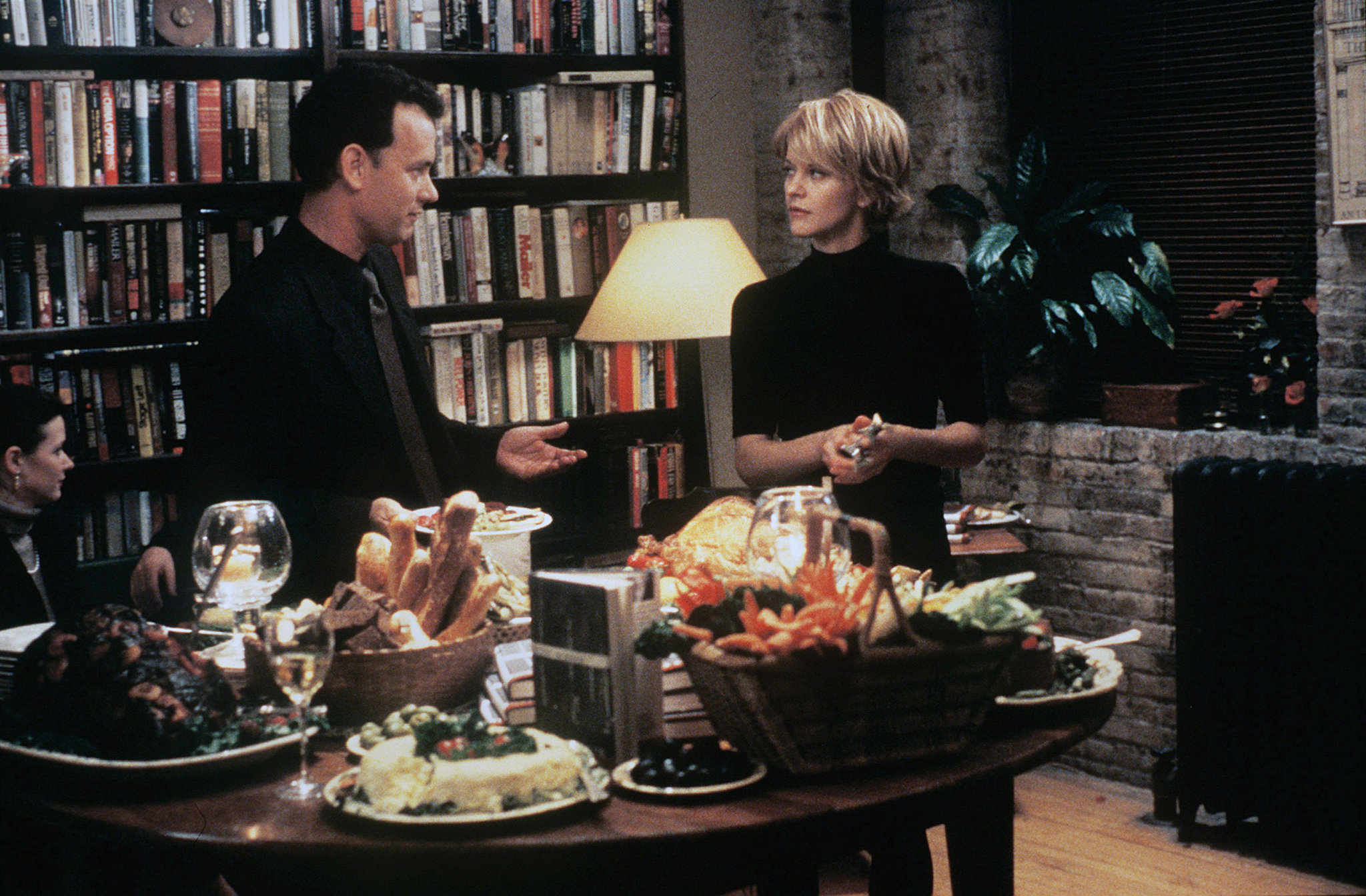
That’s my favorite line from one of my favorite romantic-comedies, Nora Ephron’s You’ve Got Mail. The 1998 movie, starring Meg Ryan and Tom Hanks, is a divisive movie. Its happy ending comes with a cost, its characters are thorny and contradictory, and its worldview acknowledges that life can put you through the wringer and that’s actually preferable. Or at least okay.
You’ve Got Mail has a happy ending–our two leads Kathleen and Joe end up together–but how it gets there involves some challenging beats. Ephron herself made a career out of nominally crowdpleasing mainstream movies that are quite daring and unconventional when one actually pays attention. She foresaw parasocial relationships and the contentification of culture in Julie & Julia. And she parodied the corporatized nostalgia and the hollowness of IP mining in Bewitched well before that became our real life. With You’ve Got Mail she depicted the transition from analogue to digital, and a New York losing itself to chain stores. I wonder how Ephron, who died in 2012, would feel about how nostalgic we are for Barnes & Noble in the Amazon age.
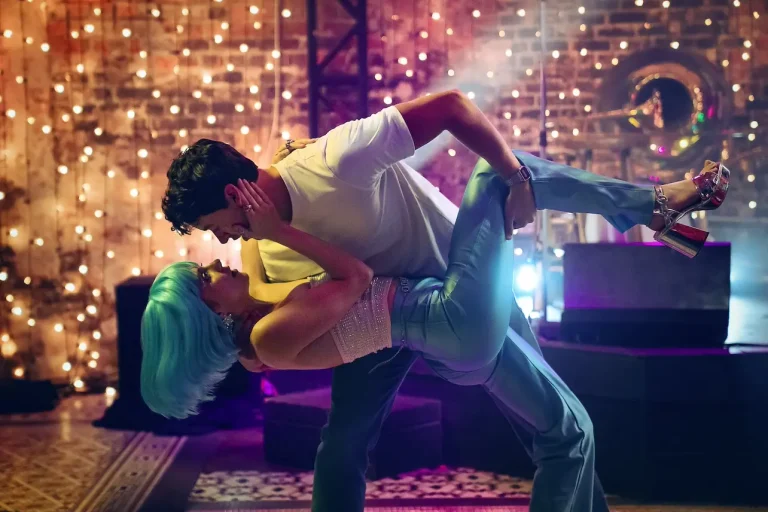
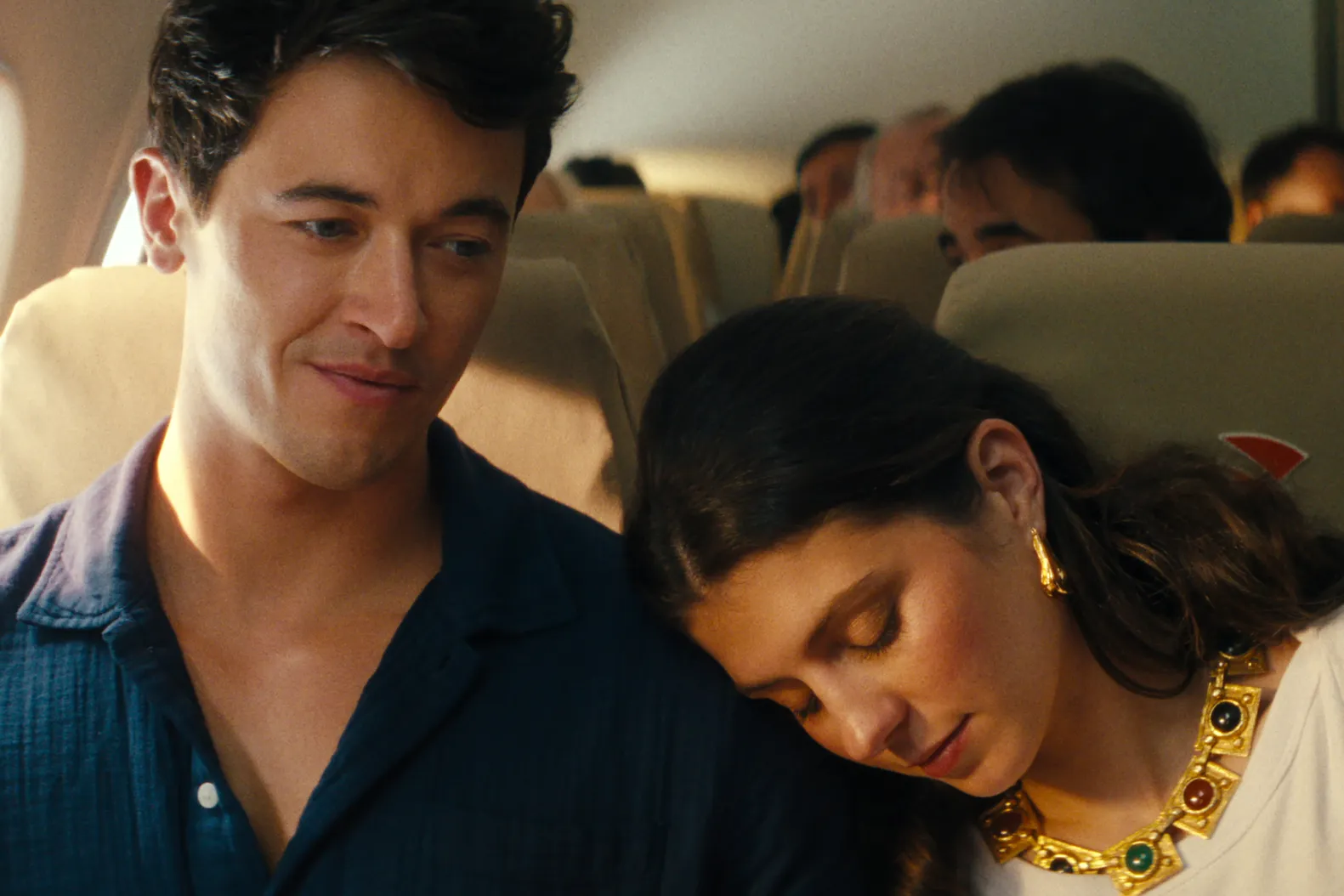
I thought a lot about Nora Ephron while watching the Netflix romcom, People We Meet on Vacation. The Brett Haley film is a riff on When Harry Met Sally, basically taking its opening stretch straight from the Rob Reiner directed/Ephron written 1989 classic. It’s your standard friends to lovers story about Poppy (Emily Bader) and Alex (Tom Blyth) going on vacation once a year and discovering that they were meant to be together all along. There’s nothing offensive about Vacation. The leads are pretty, and the movie is watchable. I myself saw it during the January 2026 blizzard and it was a nice way to spend an afternoon.
But the movie, along with many other modern romcoms, is so gosh darn protective of its characters. Poppy and Alex can afford to go on vacation because Poppy is a travel writer with a seemingly endless budget for bland Airbnbs across the globe. And at the end, she decides she’s done traveling and quits her job. This is all without fear of what lies ahead or even acknowledgment that her chosen field is shrinking. Alex is in some on-again off-again relationship that mainly stays offscreen and underdeveloped, and then resolves quite laughably. It makes me even more sad about Ephron’s death to consider what she could have done with Poppy and Alex’s love story. Poppy’s career and Alex’s relationship would feel lived-in and idiosyncratic. Instead they’re just window dressing for bland fanservice.
Like most gay men, I watched all of Heated Rivalry, and found myself similarly frustrated. As Shane (Connor Hudson) and Ilya (Connor Storrie) begin their illicit situationship, the series gives no room for them to wrestle with their queerness or even actively refuse to wrestle with it. The first few episodes fly through incoherent time jumps. While the sex is steamy, there is little context for who the characters are in between sex scenes. Shane in particular feels like he has no curiosity about 2010s gay cultural touchstones. Was he ever curious about Craigslist/Grindr? What porn does he watch, if any? Was he ever tempted to visit a gay bar? Or is he so isolated from queerness that he has no awareness of those things? That’s interesting to me, but the show seems to only be interested in “yearning” and creating a straight-friendly monogamous gay romance.
My frustration is that I think there’s a fear of upsetting a chronically online and moralistic audience who do not like to be challenged. Or there’s such a hyperawareness of tropes that audiences expect things to go from A to B to C in a specific manner. Or maybe everything these days is made to be watched on our phones. But there’s something blocking modern romcoms from being as prickly as they once were.
A generation that grew up half-watching romcoms on TBS may not realize how movies like Moonstruck, Broadcast News, Pretty Woman or even 2000s/2010s era hits like How to Lose a Guy in 10 Days, Crazy Rich Asians, Crazy Stupid Love or He’s Just Not That Into You featured uncomfortable ideas and biting sensibilities. So they’re somewhat horrified to discover that they are not just disposable escapist larks but real movies that portray human beings as messy, inconsistent, and at times selfish. Movies like Anora, Poor Things, and Materialists are a step in the right direction, even if they’re not all perfect movies individually. But those movies face a superficial and righteous discourse that doesn’t quite engage with what’s actually on screen. It’s entirely possible that I’m out of step with most people. I like when movies go to dark places, even seemingly pleasant ones like You’ve Got Mail. I’m the one who thinks that losing her store is the best thing that could have ever happened to Kathleen. It gave her the push to find her own identity and truly grieve her mother’s death. A modern version of the movie, especially a Netflix one, would let Kathy keep her store and even have Joe invest in it. That’s probably a movie that most audiences would enjoy and approve of. But would it have the shelf life of You’ve Got Mail? Would People We Meet on Vacation? I don’t know the answer to that. But I do know a certain era is decidedly over and that’s something I have to make my peace with.
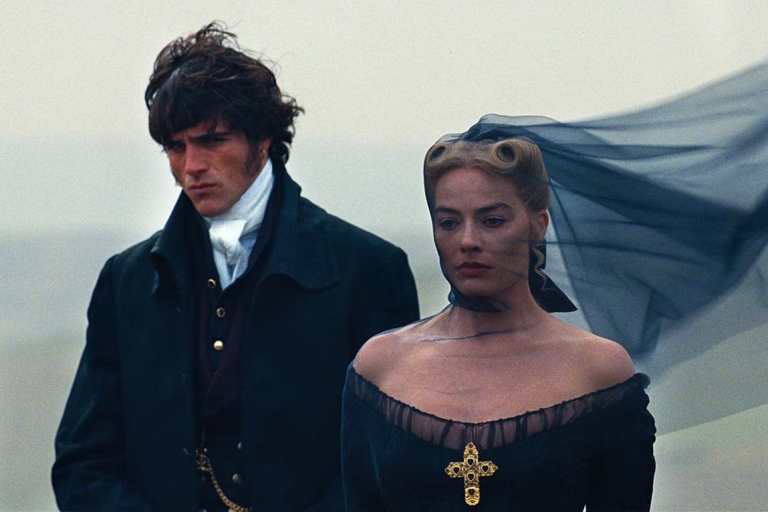
On this episode, JD and Brendan discuss Emerald Fennell’s latest film Wuthering Heights! As it has been with Fennell, this film has been quite polarizing and given her approach to the material, it’s quite understanding why fans of the book would find it off-putting. But she does have cinematic flair that’s undeniable.
Review:Wuthering Heights
Director: Emerald Fennell Writers: Emerald Fennell Stars: Margot Robbie, Jacob Elordi, Hong Chau, Shazad Latif
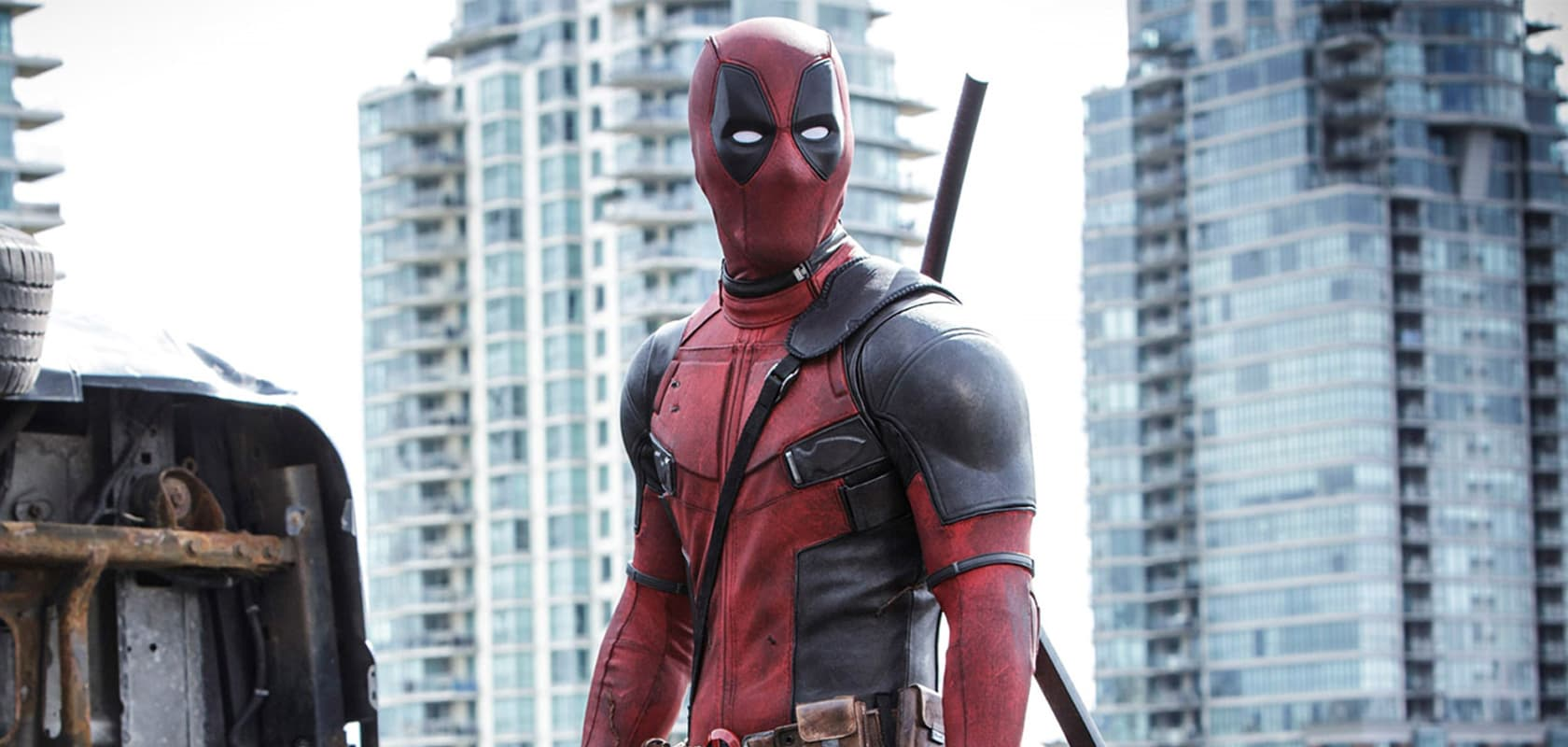
Director:Tim Miller Writers: Rhett Reese, Paul Wernick Stars: Ryan Reynolds, Morena Baccarin, T.J. Miller
Synopsis: A wisecracking mercenary gets experimented on and becomes immortal yet hideously scarred, and sets out to track down the man who ruined his looks.
No one thought Deadpool would happen.
Okay fine, maybe Ryan Reynolds did, but to the rest of the world, it felt like an unrealized pipe dream that only existed as a reality in the imaginations of fans and comic readers. Not for lack of trying, as in 2009, an attempt was indeed made to bring the “Merc with a Mouth” to the big screen in X-Men Origins: Wolverine, a movie whose sole legacy is now to be remarked upon as one of the biggest miscalculations in comic book movie history, particularly when it came to Deadpool, as a silent, mouth-sewn assassin with an amalgamation of mutant powers and none of the defining traits of the character. Reynolds, as well as every single fan of the character, was incredibly unhappy with the movie and the representation of Deadpool, and proceeded to completely disown Origins as a whole.
On paper, Deadpool is a risk and then some. The character is far from family-friendly, and has an array of expletives, twisted humor, pop culture references and visceral violence up his sleeve at every given moment. There is no way to effectively pull off the character on screen without an R rating, a major concern for any studio looking to make profits. And yet, one viral leak of a spectacular test sequence later with Reynolds as Deadpool mercilessly and hilariously laying waste to a bunch of gangsters in a car on a crowded freeway–which may or may not have been released to the world through the man himself, we will never know–that pipe dream became a potential reality, and after some time of lobbying and demand, 20th Century Fox (for only another three years, guys, sorry) finally flipped a coin and greenlit Deadpool, and in 2016, that movie graced theaters on the eve of Valentine’s Day weekend.
Defying all odds, Deadpool immediately became a success with both critics and audiences, even becoming the biggest R-rated movie at the time with $782M in grosses, and for good reason. Reynolds, along with director Tim Miller and writers Rhett Reese and Paul Wernick, realized the dream, bringing the absolute best version of Wade Wilson and his tight-red spandex alter ego to the big screen, unfiltered and untethered, breaking the fourth wall in more ways than one, from its now infamous opening credits that pokes fun at everyone from its stars to the studio executives themselves, Deadpool sometimes breaking the fourth wall within another fourth wall break–“that’s like 16 walls”, as Wade remarks–and putting bullets in the heads of bad guys and skewering them with his katanas as violently and brutally as possible, with a heavy dose of style and charisma. The cherry on top: getting the character to do something that didn’t happen the first time in X-Men Origins: Wolverine…talk! Every crass remark, abusive word, pop culture reference you can expect to hear from him makes its appearance here, expertly so, realizing the character even more effectively and flawlessly. If ever a course correction and love letter was needed for Deadpool, this was the best version of one.
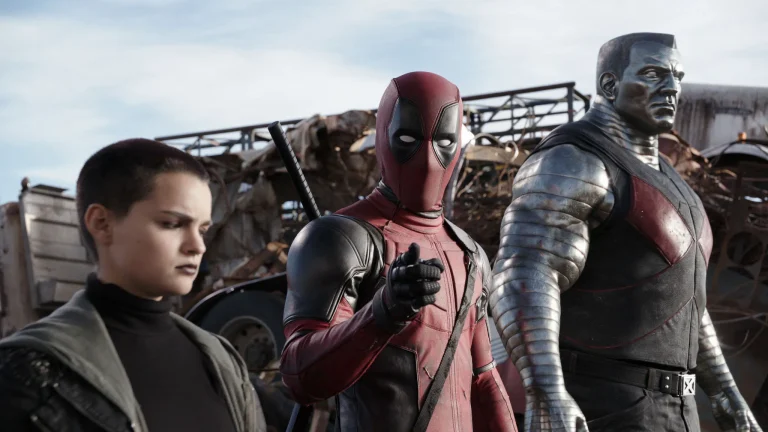
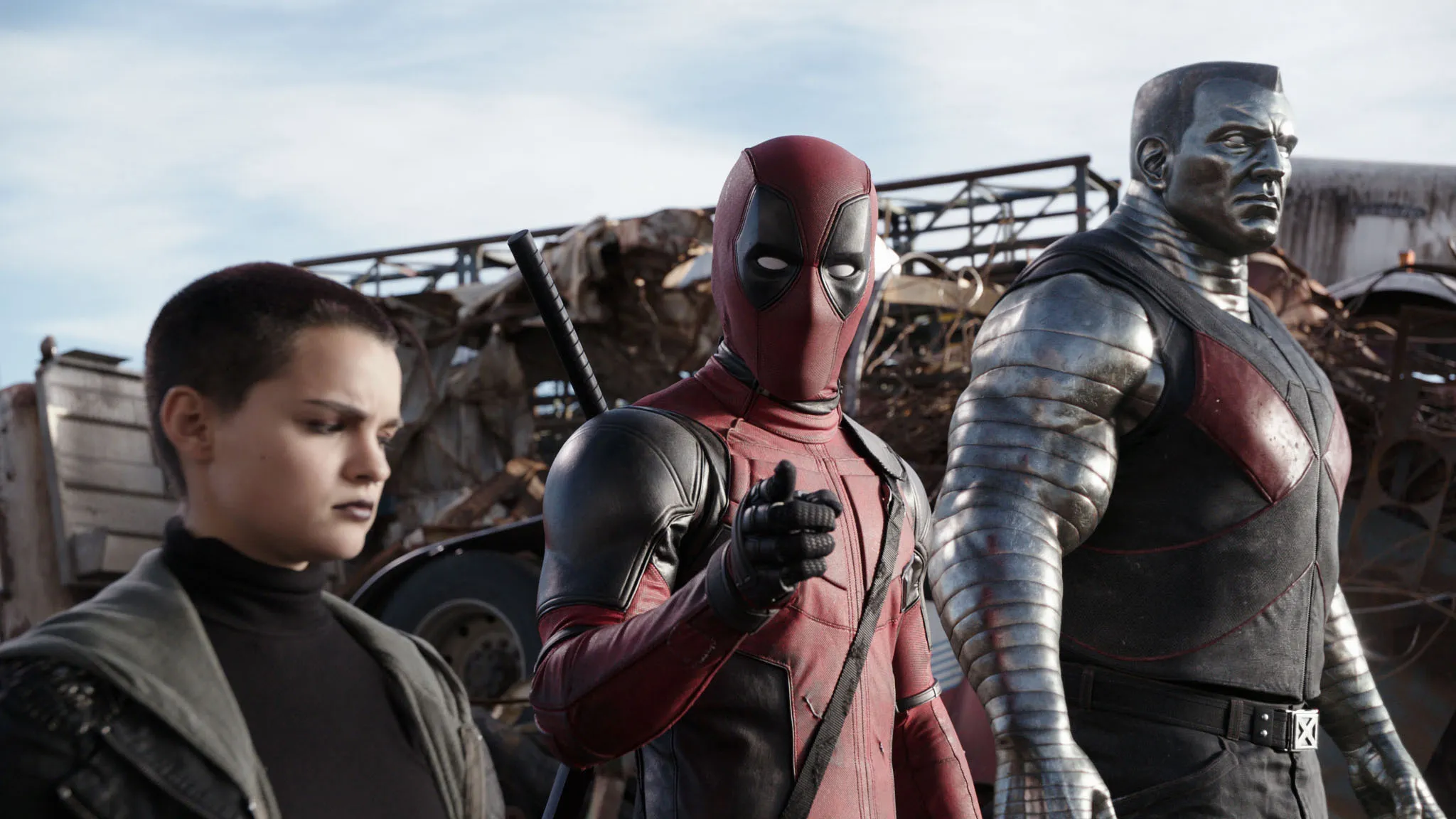
What also makes Deadpool work, however, was its balance of the morally grey line Wade walked. A mercenary-for-hire who never thinks of himself as a hero, seeing his romance eventually with Vanessa (Morena Baccarin) and the genuine love between them grow–thanks in part to an outrageously funny and appropriately raunchy sex montage set to Neil Sedaka’s “Calendar Girl”–and the tragedy that comes from his cancer diagnosis and wanting to find a cure, leading to a mysterious program run by a sadistic and petty doctor named Ajax/Francis (Ed Skrein). Then, a procedure that turns him into a deformed but invincible mutant, all the way to eventually taking on everyone who wronged him while making his way to Ajax, leaving a trail of bodies in his wake and acting against every heroic principle, Reynolds portrays Deadpool perfectly, channeling the character exactly like the comic counterpart before him. He proves one of the best casting choices for a comic book character, as even his next two entries, Deadpool 2 and Deadpool & Wolverine, have showcased. Toss in a few more memorable characters like Negasonic Teenage Warhead (a wonderful Brianna Hildebrand), Colossus (Stefan Kapičić) and the hilarious Blind Al (Leslie Uggams)
10 years on, it’s easy to look back on Deadpool and take for granted what a watershed moment it was for comic book movies. At a time when studios were afraid to take a more mature route and risk an R-rating, the Merc with a Mouth accomplished the impossible, leading to more efforts like Logan the year after. On paper, the narrative of Deadpool is simple: a revenge story and wanting to gain the love of your life back, but the movie’s strength is in pulling that off in the best way that it needs to. Miller’s movie doesn’t need to be a bonafide masterpiece to be a perfect movie in its own regard, and Deadpool certainly is that. Maximum effort!
Director: Yuen Woo-ping Writers: Tai-Lee Chan, Chao-bin Su, Larry Yang Stars: Jing Wu, Nicholas Tse, Jet Li
Synopsis: Dao Ma, the “second most wanted fugitive,” who is entrusted by his benefactor, the chief of Mo family clan, to take on a mysterious escort mission-escorting the “most wanted fugitive,” to Chang’an.
Yuen Woo-ping’s Blades of the Guardians might have set a record for the times I said, “Hell yeah!” during the course of a film. While that accomplishment is certainly not the lone merit the film enjoys, it stands as an excellent entry in the wuxia subgenre of martial arts films.
Despite being 80 years old, director Yuen proves he still has what it takes to deliver action spectacle, even under today’s action-movie standards. Blessed with his years of personal experience, a more than capable cast of actors, and the affording of a big-budget, Yuen delivers an action film to rival his multitude of classics in the genre.
Even with all that action adventure, there needs to be a semblance of plot, which Blades of the Guardians has in spades. Bounty hunter Dao Ma (Wu Jing) spends his days bringing in wanted bandits alongside his young nephew, Xiao Qi (Charles Ju). Dao Ma’s benefactor, Lao Mo (Tony Leung Ka-fai), asks him to escort the most wanted fugitive, Zhi Shilang (Sun Yizhou), to safety across the desert.
Joining Dao Ma is Lao Mo’s daughter, Ayuya (Chen Lijun), who has recently broken off her engagement to a powerful family leader, Xeyi Xuan (CiSha). As they flee, the group runs into the mysterious swordsman Shu (Yosh Yu), who is bringing in the sultry Yan Zuniang (Li Yunxiao). As political lines shift, one of Dao Ma’s former compatriots, Di Ting (Nicholas Tse), throws his hat in the ring in order to get their hands on Zhi Shilang.
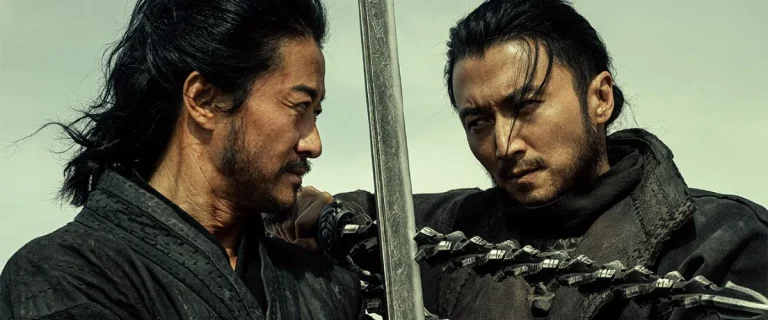
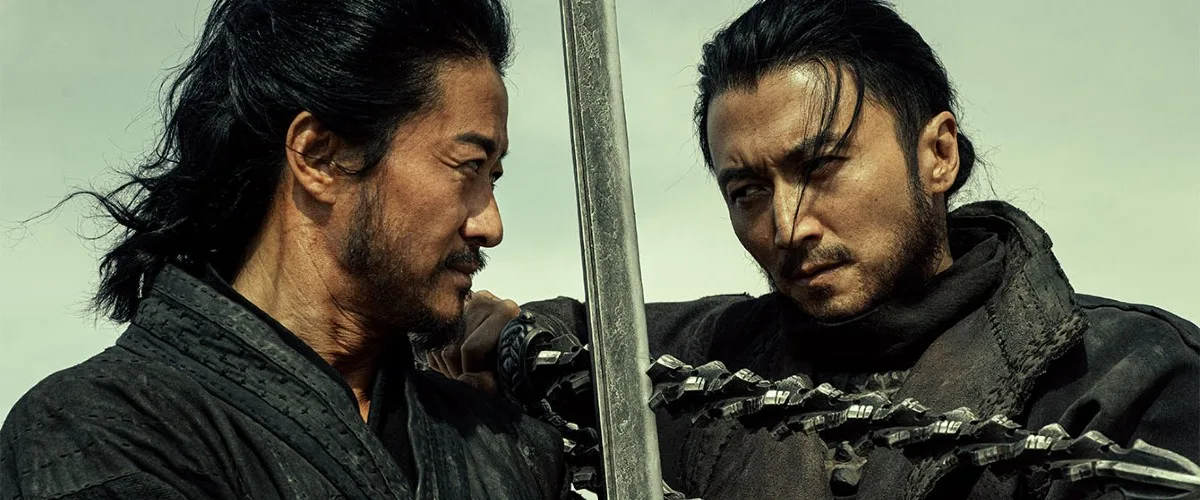
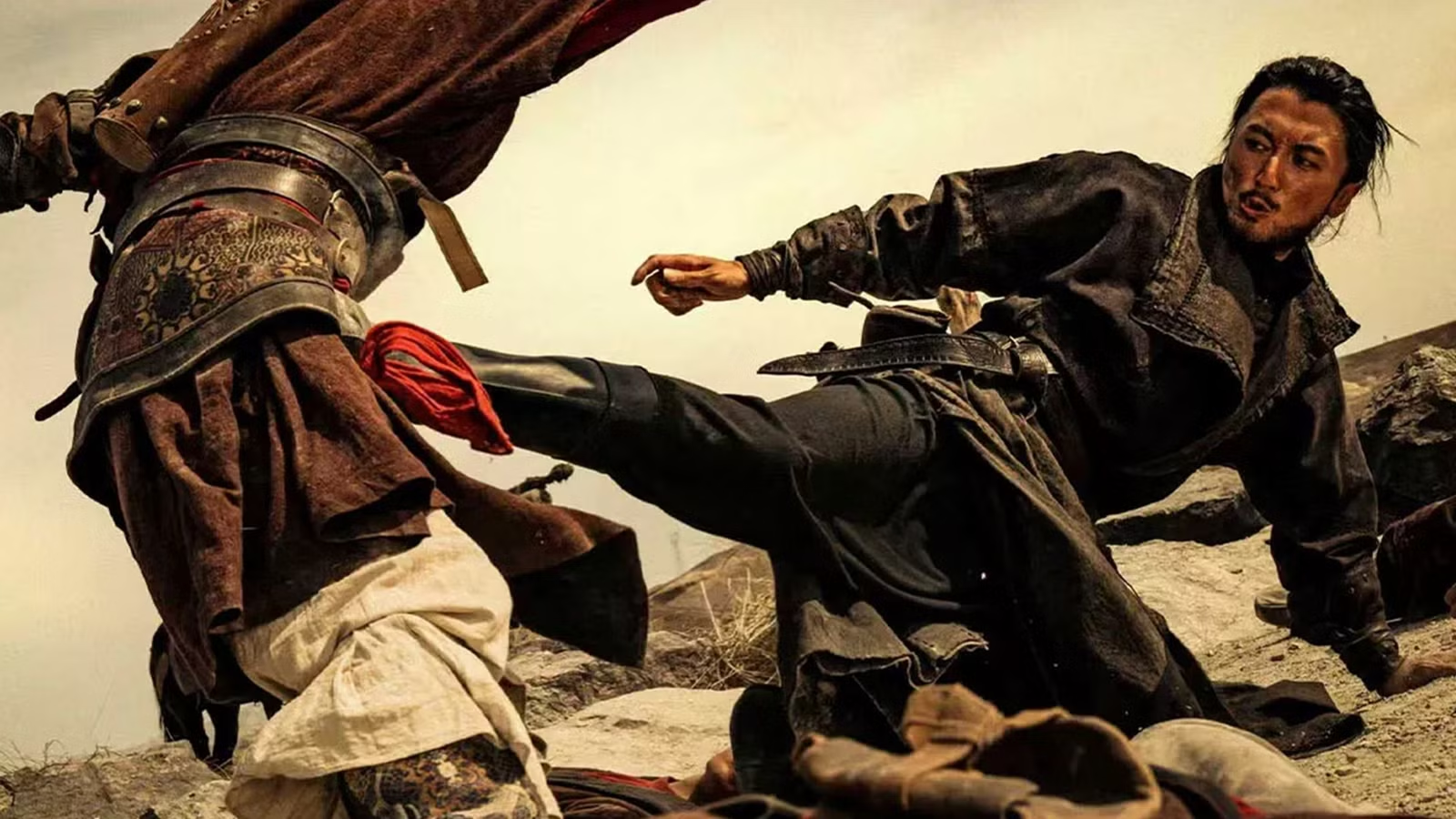
All of that doesn’t really matter. It’s just a means to an end in order to get everyone fighting. And boy, do they ever fight. Gone are the shaky cam fights of the early 2000s. Instead of the gravity-defying acrobats of Crouching Tiger, Hidden Dragon (also choreographed by Yuen), we are treated to down and dirty martial arts with little suspension of disbelief. On the whole, these fights seem feasible in reality. At one point, Jet Li shows up as an evil regional governor just to have an excellent fight scene, and then goes away. And that’s in the first 20 minutes! If you can dispense with Jet Li after 20 minutes and still have another 100 minutes to go, you know you have something special on your hands.
Yuen utilizes the underseen parts of the Chinese landscape to give his film (and fight scenes) texture and substance. In a scene seemingly inspired by Mad Max: Fury Road, the group attempts to escape into a sandstorm to evade a caravan of pursuers. Dao Ma and Di Ting have an epic sword and martial arts fight as the sand whips around them and dust devils take the characters off their feet. It’s a perfectly crafted scene of imagination and innovation. Obviously filled with a mix of practical and visual effects, each progressive scene looks incredible and feels that much more impressive.
There is too much plot, and the various factions and former battalions blend together, but that doesn’t matter when you have the world’s coolest decapitation scene. It doesn’t matter if the audience is confused on the character allegiances…did you see the sword fight with oil and fire? Yuen has made a career of filling the frame with well-versed and easy-to-follow action sequences. Why did he decide to bog down the film with excess plot? Who cares? Look at that lady shoot arrows on horseback!
That action wouldn’t work if there weren’t charismatic actors doing the work. Wu, in particular, maintains a stoic heroism essential to the film’s success. Yu shows up as what seems to be a secondary character, to eventually emerge as the co-lead. Lijun might do the most impressive work as a righteously avenging angel of beauty and capability, while Li and Leung get the most weighty of scenes. All actors are very impressive physically and non-physically.Blades of the Guardians is just too freaking cool. Don’t get too worried about the plot mechanisms, you’ll catch up eventually. Just sit back and take in the first-class martial arts action adventure.
Director: Matt Johnson Writers: Matt Johnson, Jay McCarrol, Jared Raab Stars: Matt Johnson, Jay McCarrol, Ben Petrie
Synopsis: When their plan to book a show at the Rivoli goes horribly wrong, Matt and Jay accidentally travel back to the year 2008.
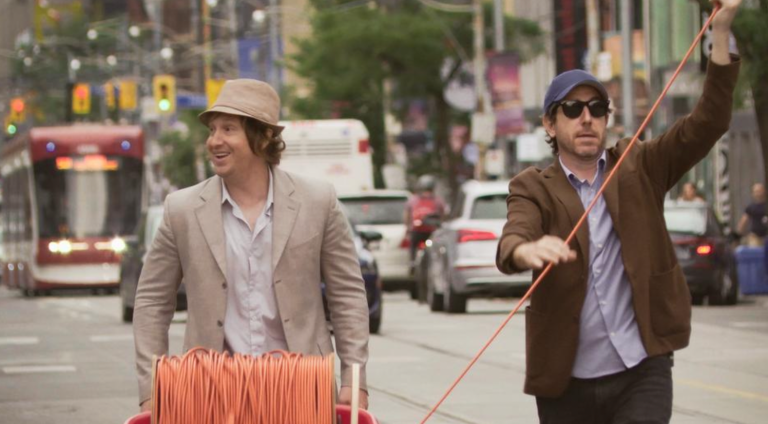
17 years ago, two friends Matt Johnson and Jay McCarrol had a singular dream: to start a band and play the Rivoli, a prominent bar and restaurant space in Toronto that would catapult them to the top. “Nirvanna the Band” would constantly try to make this dream come true, with all manner of absurd schemes and ideas put into play, though all of them were to no avail. Despite their trials and tribulations however, Matt and Jay stayed the best of friends, and kept things afloat no matter what. “Nirvanna the Band the Show” is a treasured cult show for many in Canada, being a love letter to the country and Toronto itself, as well as a fun and bizarre collection of adventures that never seemed to work out entirely for Matt and Jay.
Years after the series, the two friends make one more play to feature at the Rivoli with Nirvanna the Band the Show the Movie. The plot is simple: now in 2025, Matt is still certain that he and Jay can potentially pull off this feat, and while Jay is still tagging along for the ride, he wonders if all this is worth it, or if they should just move on with their lives. In an attempt to get it right once and for all, Matt comes up with one final plan: to convert their RV into a time machine and going back to 2008, the year they first decided to play at the Rivoli, and change things so that life works out in their favor and they get the musical careers they had always wished for. However, as time travel usually works, once they make it back to Toronto 2008, things begin to go horribly wrong and change the future for the worse.
Much of Nirvanna the Band the Show the Movie is a sequence of events that will make you wonder “how did they do that?” every 5-10 minutes of its 1 hour, 40 minute runtime, as the shenanigans and stunts become increasingly more bizarre and unbelievable. Johnson and McCarrol waste no time getting to it, opening the movie with a plan to skydive from the CN Tower into Rogers Stadium to announce they will be playing at the Rivoli. Much to the shock of the viewer, they do in fact go the extra mile and then some to make that plan come to life, and it is an astonishing feat of physical comedy and stuntwork, and that stunt is just a taste of what is to come. It had to be a logistical and legal nightmare for them to pull some of this stuff off, especially when the movie directly begins homaging Back to the Future and brings in very direct references and even Alan Silvestri’s musical cues to bring the journey to life. It is a testament to the duo, then, that Nirvanna is as real and tangible as it is. The result is one of the funniest movies of the year, and one of the wildest.
Johnson’s attention to detail and slick direction is on full display here, even when portraying 2008 in the most accurate way imaginable, with ads for The Dark Knight and Grand Theft Auto IV looming over them, loud screenings of The Hangover, using camcorders from the time to reflect the show’s original visual style, switching aspect ratios from 1.85:1 to 1.43:1, connecting moments from the original web series into the newly filmed footage seamlessly. Where this attention to detail is most effective, however, is in showcasing Toronto and its various landmarks. Nirvanna is unapologetically Canadian in every facet, being a love letter to Canada and its culture, with tons of in-jokes and references to nostalgic advertisements, celebrity situations, real events that made the news, food items and drinks–a lot hinging on an Orbitz bottle in this story–making the movie a whole lot more special.
Johnson and McCarrol are fantastic here, realizing the dynamic between their two fictional counterparts wonderfully, as Matt tries to remain more fun and youthful, coming up with plan after plan to finally become a success, as Jay is getting increasingly frustrated and thinking about going on his own path. And yet, the movie excels in showcasing their friendship and how despite everything that comes their way, they still look out for one another, especially when they get to revisit and remark upon moments of their lives while Nirvanna the Band was coming to fruition and are reminded of why they have endured all these years. It’s a surprisingly effective, heartfelt and hilarious ode to the people in your lives who will be there for you through thick and thin, even if it involves entertaining plans surrounding jumping off the CN Tower or going back in time using an RV.
The less said in detail about Nirvanna the Band the Show the Movie, the better. It is a movie best experienced by just going to the theater yourself. Once they get back to 2008 and the timeline begins to get ruptured, the sequence of events that follow are outrageously funny, shocking, and even unbelievable to witness, and the result is a memorable continuation of the cult show Johnson and McCarrol started all those years ago. Do some jokes land a little less effectively? Sure. Are some plot beats predictable as it is a direct riff on Back to the Future? Also yes. Despite those minor gripes, one couldn’t ask for a more satisfying comedy venture from this team, and if Nirvanna the Band the Show the Movie is any indication, it seems like they are just getting started as far as their vision goes, and the world is all the better for it.
This week on the InSession Film Podcast, Megan Kearns fills in for JD as we discuss our Top 5 epic romance movies! With Valentine’s Day over the weekend, we wanted to linger in the spirit of love by talking about the cinematic romances that have resonated the most with us.
– Robert Duvall / James Van Der Beek (2:34) After some opening banter, we start the show by discussing the unfortunate passing of the legendary Robert Duvall. He was an incredibly talented actor whose career spanned seven decades and included some all-time movies. Not to mention his Oscar-winning performance in Tender Mercies and another seven nominations over the years. We also talk about the wonderful James Van Der Beek and his heartbreaking death last week.
– Top 5 Epic Romance Movies (10:53) With Valentine’s Day taking place over the weekend, we thought it would be fun to dive into our favorite epic romance movies. How you define “epic” in this context may differ, but no matter how you look at it, there’s been some incredible romance movies over the decades. There’s nothing like a grand spectacle that’s able to make you swoon and feel a deep sense of love and admiration. That said, what did you think of our top 5 epic romance movies?
If you want to help support us, there are several ways you can help us and we’d absolutely appreciate it. Every penny goes directly back into supporting the show and we are truly honored and grateful. Thanks for your support and for listening to the InSession Film Podcast!
Director: Mark Fischbach Writers: Mark Fischbach, David Szymanski Stars: Mark Fischbach, Caroline Kaplan, Troy Baker
Synopsis: In a post-apocalyptic future after “The Quiet Rapture” event, a convict explores a blood ocean on a desolate moon using a submarine called the “Iron Lung” to search for missing stars/planets.
Iron Lung has been hard to get a full gauge on since it was announced. The film is directed and co-written by Mark Fischbach – more commonly known as ‘Markiplier’ for his immense YouTube fame – in what is his directorial debut on the big screen. Thus, given his multi-million follower popularity, Fischbach’s name has clouded this film with a sheen of support from his varied cast of diehard fans.
This isn’t necessarily a bad thing, but Iron Lung is more about Mark the filmmaker, rather than Mark the YouTuber. Even so, his transition from the latter to the former went smoother than most, it seems. Iron Lung is a visceral, well-acted, sharp thriller. It’ll do anything but blow you away, but for his first swing at a feature film on a reported budget of less than $3 million dollars, this is a win for Fischbach’s young future in the field.
Following Simon (also performed by Fischbach), the film is set in an apocalyptic future in which stars and planets have disappeared. Our main character is then forced to explore a desolate moon’s ocean of blood in a submarine; for the film’s circumstance, this is a groundbreaking discovery.
How exactly you could define this one, whether sci-fi, thriller, horror or otherwise, Iron Lung carves a unique identity regardless. It’s one of those that may combine a number of genres to tell a story that, despite being a bit thin, weaves through each of them with precision.
While it may overstay its welcome with a runtime just over two hours, Iron Lung manages to find success through sharp colors and claustrophobic sets, in addition to Fischbach’s strong performance as basically the movie’s only constant character. He’s emotional to an extreme at times, but the thing is shot more than competently in a way that structures his outbreaks in audience understanding. Angles are tight, and the walls of his literal iron lung, in the form of the aforementioned submarine, are grimy and pressing.
Fischbach is sweating and shouting in equal parts; if you’ve played the video game the film is based on, it replicates that intended feeling quite well. The concept’s nihilistic attitude, as tiring as it may be, is also retained. It’s a gritty watch that certainly won’t be for everyone. Then again, on a landscape of big, blockbuster movies without any stakes – not that this film is necessarily a blockbuster, although it shares a space with them – Iron Lung’s tangible stakes are a breath of fresh air.
And the film’s ending, too? It almost feels like a direct response to those sorts of movies; the sort that don’t challenge or ask anything of the audience. Iron Lung can be messy, unfocused and, at times, terribly slow, but it’s also a movie committed to this story to a fault. Fischbach clearly believed in the tale, and the film doing well at the box office in spite of its low budget and plain issues is a testament to general moviegoer’s desire for that.
After all, there’s enough in Iron Lung – whether or not you have a YouTube background with the director – to get just about anyone through on the early-year cinematic landscape. Especially considering the harsh reality that stuff like this, with a shoestring budget and sole vision, is extremely rare and becoming rarer with time, this is one to be celebrated.
Come for the noise about a content creator turned moviemaker, stay for properly eerie visuals and a solid lead performance, both of which drive this low-budget thriller up the wall and over the edge. Iron Lung is worth a look at least once for that reason alone. It helps that the movie looks good, plays things (mostly) straight and is clearly a passion project. Take the proper excuse to go to the cinema and be glad things like this can still exist in the medium today.
Synopsis: When a highly dangerous fungus escapes from a secret laboratory, a former bioterrorism agent is called back into action. Alongside two young employees, he must confront an invisible and out-of-control threat.
Public storage facilities have become ubiquitous in our human landscape. There seems to be one off every interstate exit and one every ten city blocks. It’s a wonder these monuments of human hoarding haven’t made for fun fictional fodder before. There could be any number of horrifying, terrible things hidden in these units. So it stands to reason that a public storage facility built into the remains of a secret army base would have the most horrible things of all.
The plot of Cold Storage, while requiring a suspension of disbelief, is rather ingenious. A-list screenwriter David Koepp adapted his own novel for the film. It’s intricate, if farfetched, and each piece of the plot fits snugly together. Even the idea that it is farfetched is etched into the script and all possible plot holes you could try and poke at have an explanation, if a silly one. There are strange and funny characters, as well as circumstances that are shockingly ridiculous.
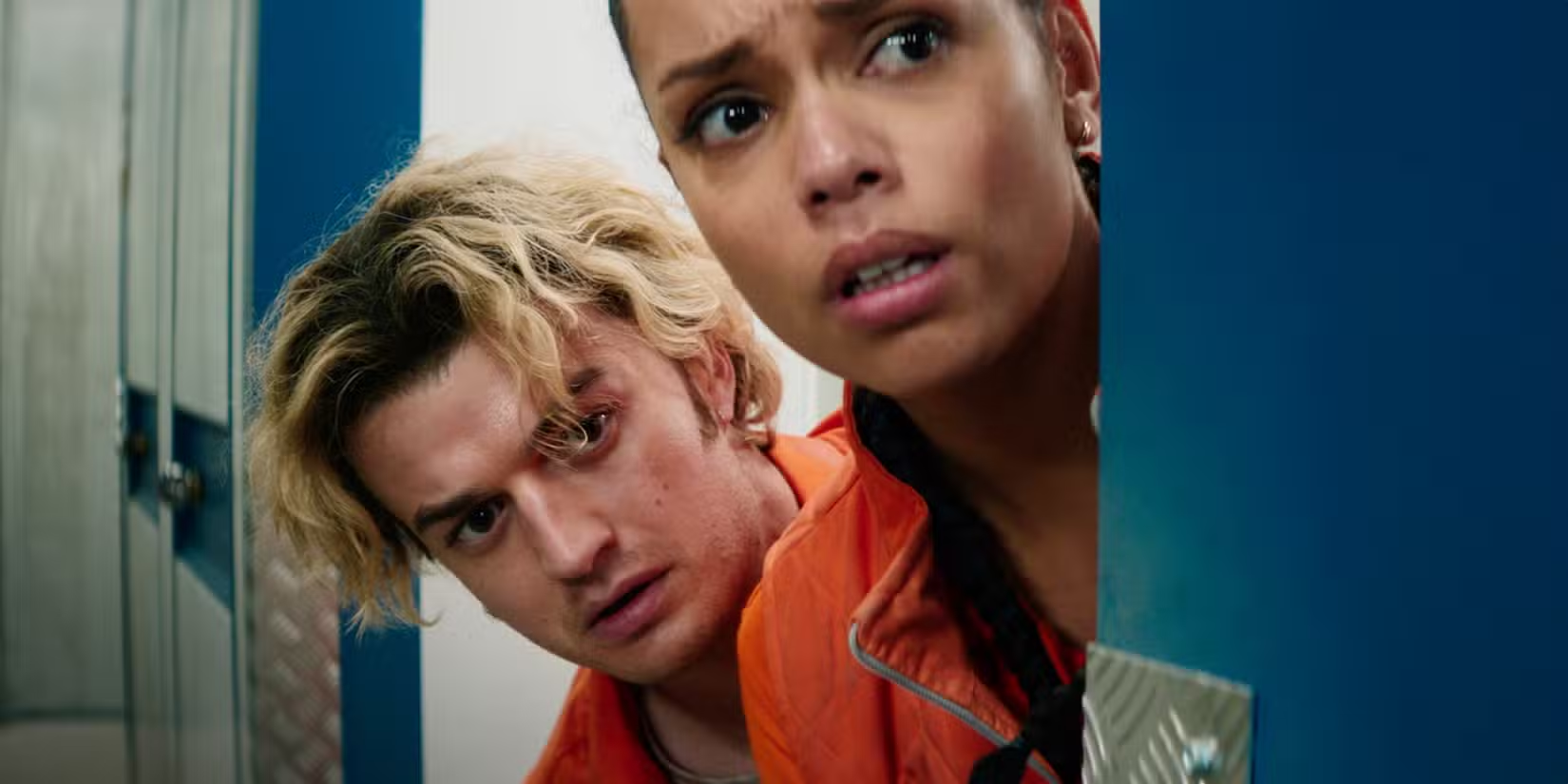
Without a solid cast, though, this script and plot wouldn’t work. The two leads, played by Joe Keery and Georgina Campbell, are charming and funny, but it’s the odd couple of Liam Neeson and Lesley Manville that steal the show. Neeson and Manville play old colleagues who had a hand in originally locking the deadly fungus away. The character’s comfort and knowledge of each other makes for an exciting chemistry. Neeson’s gruff believability mixed with his excellent comedic timing in tandem with Manville’s wild card bravado is a match made in heaven.
Even with this good script and excellent characters, the film relies far too heavily on deus ex machina for moving the plot along. There’s the old woman, Mrs. Rooney (Vanessa Redgrave), whose enigmatic reasons for being in the facility lead to her purpose and then quietly shuffling away from the horror. There’s Mike (Aaron Heffernan), Naomi’s (Campbell) exe, whose reason for being at the facility is even more bizarre. It’s not lazy writing, but it is a shortcut that feels like it moves the story along faster than it should. It could also be that the fungus itself is too powerful and this was the only way to show that. Even if it looks good on screen, this fungus is near unstoppable, which makes for a whopper of an ending.
The visual effects that bring the fungus and several of its hosts to life aren’t flashy, but they really convey how much of a destructive force it can be. The fungus is a lush green and it pulsates when it’s trying to find new hosts or just spreading across a surface. It feels like the filmmakers used CGI to enhance some delightfully gross special effects. The makeup team created some gnarly stages of infection. As fast as the infection and the plot moves, it’s exciting to see that level of detail for something so brief in many instances. Everything is so slimy and crawling, it’s wonderfully icky to watch this goo take hold.
A film like Cold Storage is a pure entertainment vehicle and it really delivers on that. In spite of what the logic center of your brain will say about some of the story elements, the portion of your brain that just wants something funny, gross, and entertaining will get an absolute kick out of this film. It’s worth taking in for the side bits of story alone, like Romano’s (Manville) little back-and-forth with her son as she and Quinn (Neeson) tote something that likely never should have left a military base from the son’s basement. Let the mayhem overtake you and you won’t be disappointed.
Director: Maryam Touzani Writers: Nabil Ayouch, Maryam Touzani Stars: Carmen Maura, Marta Etura, Ahmed Boulane
Synopsis: An aging Spanish woman in Tangier resists her daughter’s decision to sell her home. Determined to stay, she does everything she can to keep her home and reclaim the belongings of a lifetime. Along the way, she rediscovers love and desire.
When I went into Calle Málaga, I wasn’t entirely sure what to expect. I went in completely blind, and if you (like me) enjoy being put under a film’s spell, you will certainly be entranced here. Calle Málaga is a filling, heartbreaking, and rich film about one’s home and the forces that want to take that away from us. But I had no idea just how invested I would be by the city of Tangier, Morocco and the world set up by Calle Málaga. Simply put, Calle Málaga is as excellent as it is crushing.
Calle Málaga is about an elderly woman in Tangier named Maria Angeles (Carmen Maura) who is unceremoniously evicted from her home of over forty years and her fight to get it back. The kicker is that the person evicting her is Maria’s own daughter, Clara (Marta Etura), who legally owns the flat and is selling it to cover expenditures relating to Clara’s messy divorce in Madrid. The eviction, while tragic in its own right, has also given her a new lease on life. The set up and delivery is incredibly simple but its unremarkable quality is a major feature for this film. In going this direction, the film’s focus is incredibly controlled and you can then spend more time to see how the seeds planted through each scene blossoms until the very end.
Maria is a stubborn yet densely layered woman. Her resilience is admirable and left me immensely charmed during the duration of the film. This woman has a routine of seeing a childhood friend who is now a nun, vowed to silence, and Maria tells of her daily drama, going to her local street market asking the men who run the various shops to do favors for her, and visiting the graveyard where her husband and various deceased friends now reside. In another film, this routine could become incredibly stale and quite quickly, but Maura’s presence and charisma keeps the film moving. Hell, I can’t relate to an elderly Moroccan woman who is on the verge of losing everything but Maura can really sell it.
With that said, Calle Málaga’s greatest feature is its texture. Tangier, as much as Maria, is a character in its own right. The film’s director, Maryam Touzani, is a native of Tangier and her experiences and lifestyle feel rich and, although I’ve never been to Tangier myself, I feel as if I understand it better having seen this film. Tangier has been Maria’s home for all of her life, and the prospect of leaving it feels devastating. To an extent, Calle Málaga feels like a break-up film, given the untimely removal from her home. While obviously displacement places a greater toll on someone than a romantic break-up, the feeling of devastation is easily translated to someone who has never felt geographically displaced.
Calle Málaga pulls a veil over your eyes during the duration of the runtime. You are lulled into this false sense of safety, as if everything will be alright. Maria is at the hands of her daughter who has clearly made up her mind about what she’ll do with the flat without consulting her. But Maria is spunky, she fights hard to keep her home and rebuild it after parts of it go away. The heartbreak you feel at the beginning of the movie drops like a hammer at the end when you see how much community she has built for herself. Few films can pull off the “fool me once, shame on you; fool me twice, shame on me,” but at the end you feel betrayed, in the most morbidly delicious ways possible. I walked out of my screening heartbroken but proud to have been put under this film’s spell – to feed from the director’s hand then to take it away from you (thank you Maryam Touzani).
If you want to spend a good two-ish hours in the theater you will not be disappointed with Calle Málaga. I was the youngest person in my screening of the film, but that shouldn’t stop you from seeing it. If you want a good cry, whether happy or sad, you will have no shortage of reasons to pull from. A film that lifts you up then pushes you down should not feel this good (but it certainly does). Calle Málaga is a charming film and Carmen Maura completely captures your heart with her no nonsense drive as Maria.
The 2026 Independent Spirit Awards were held on February 15, streaming live on YouTube. See the full list of film winners below.
Best Feature
Peter Hujar’s Day The Plague Sorry, Baby WINNER: Train Dreams Twinless
Best Director
WINNER: Clint Bentley, Train Dreams Mary Bronstein, If I Had Legs I’d Kick You Lloyd Lee Choi, Lucky Lu Ira Sachs, Peter Hujar’s Day Eva Victor, Sorry, Baby
Best First Feature
Blue Sun Palace Dust Bunny East of Wall WINNER: Lurker One of Them Days
Best Lead Performance
Everett Blunck, The Plague WINNER: Rose Byrne, If I Had Legs I’d Kick You Kathleen Chalfant, Familiar Touch Chang Chen, Lucky Lu Joel Edgerton, Train Dreams Dylan O’Brien, Twinless Keke Palmer, One of Them Days Théodore Pellerin, Lurker Tessa Thompson, Hedda Ben Whishaw, Peter Hujar’s Day
Best Supporting Performance
WINNER: Naomi Ackie, Sorry, Baby Zoey Deutch, Nouvelle Vague Kirsten Dunst, Roofman Rebecca Hall, Peter Hujar’s Day Nina Hoss, Hedda Jane Levy, A Little Prayer Archie Madekwe, Lurker Kali Reis, Rebuilding Jacob Tremblay, Sovereign Haipeng Xu, Blue Sun Palace
Best Breakthrough Performance
Liz Larsen, The Baltimorons WINNER: Kayo Martin, The Plague Misha Osherovich, She’s the He SZA, One of Them Days Tabatha Zimiga, East of Wall
Best Screenplay
A Little Prayer WINNER: Sorry, Baby Sovereign Splitsville Twinless
Best First Screenplay
Blue Sun Palace Friendship WINNER: Lurker One of Them Days Outerlands
Best Cinematography
Blue Sun Palace Dust Bunny Peter Hujar’s Day WINNER: Train Dreams Warfare
Best Editing
Eephus Good Boy Splitsville WINNER: The Testament of Ann Lee Warfare
Best Documentary
Come See Me in the Good Light Endless Cookie My Undesirable Friends: Part 1 — Last Air in Moscow WINNER: The Perfect Neighbor The Tale of Silyan
Best International Film
All That’s Left of You On Becoming a Guinea Fowl A Poet WINNER: The Secret Agent Sirāt
Robert Altman Award
WINNER: The cast, casting director, and director of The Long Walk
Someone to Watch Award
WINNER: Tatti Ribeiro Neo Sora Annapurna Sriram
Truer Than Fiction Award
Tony Benna WINNER: Rajee Samarasinghe Brittany Shyne
John Cassavetes Award
The Baltimorons Boys Go to Jupiter Eephus WINNER: Esta Isla Familiar Touch
This week on Women InSession, we discuss our favorite movies and performances from the great Dutch actress Carice van Houten! She’s had a fascinating career and some extremely notable roles in Game of Thrones, Black Book and Black Butterflies especially. We dig into those and much more in this conversation.
Panel: Kristin Battestella, Jaylan Salah
On that note, check out this week’s show and let us know what you think in the comment section. Thanks for listening and for supporting the InSession Film Podcast!