



Director: Edgar Wright
Writers: Stephen King, Michael Bacall, Edgar Wright
Stars: Glen Powell, Emilia Jones, Josh Brolin
Synopsis: A man joins a game show in which contestants, allowed to go anywhere in the world, are pursued by “hunters” hired to kill them.
Watching the remake of Edgar Wright’s freakishly exciting and relentlessly propulsive The Running Man, if you didn’t know it before, you’ll know it now: Glen Powell is the next great movie star. You’ve known since the man burst onto the scene with Everybody Wants Some!! that he was destined for cinematic greatness. When he was passed over for the role of Goose’s son in Top Gun: Maverick, he licked his wounds and turned “Hangman” into a magnetic creation all his own. He even survived the media-engineered off-screen romance rumors with Sydney Sweeney, but before you knew it, reviving the rom-com at the box office with Anyone But You.
Now, with the resurrection of the character of Ben Richards, a role originated by Arnold Schwarzenegger, he cuts through the chauvinistic bullsh*t for a performance that straight rips and slaps and f*cks, or whatever the kids are saying nowadays. Powell is angry, wanting to grab the audience by their vengeful throats—a turn for one who knows how it feels to be impoverished, starving, and downtrodden. In almost every scene, this can be felt viscerally.
The remake of The Running Man is an action thriller packed with glorious carnage, humor, and a message about socioeconomic status that captures the reason Stephen King created the source material in the first place: don’t mind the fact that corporate media is entertaining you, but consider what it is preparing us for.
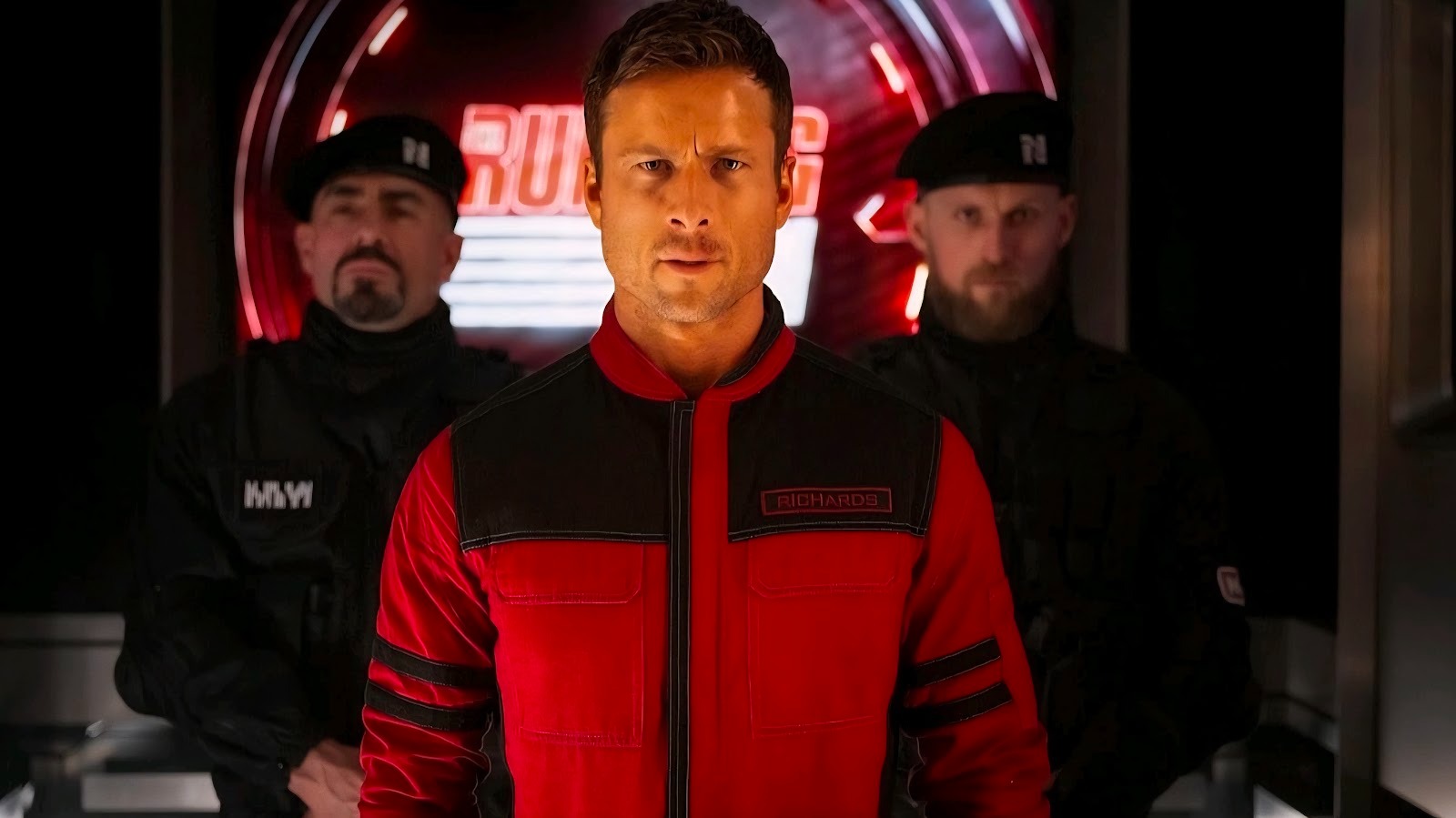
If you’ve seen the 1987 original, you’re familiar with the story. Powell stars as Ben Richards, a laborer who makes being fired for insubordination a national pastime. When we meet Ben, he’s holding his sick child, who is dying of the flu, and pleading with his boss for his job back. Richards is denied, bringing his baby girl only to stop himself from burying the arrogant supervisor’s face in his metal desk and leaving an indentation like Han Solo’s face in carbonite.
Ben has one big, furious chip on his shoulder. He is out of money, which he needs for his daughter’s medication. He is enraged that his wife, Sheila (Sinners’ Jayme Lawson), has to work for tips at a sleazy club to help make ends meet. His ego is bruised. His manhood is shaken. And the man is so prideful that it shields him from showing any humility. So, what does he do? Ben decides to try out for a series of game shows that will test his mental toughness and physical capacity to earn the cash his family needs.
However, in today’s dystopian society, nearly all of them injure, cripple, and maim their contestants. There is just one game show he will never try: the worldwide sensation The Running Man. What is it? Well, it is a killer network reality game show that promises to give a worthy player one billion dollars if they survive 30 days without being killed by five of the world’s finest hunters. Of course, the show’s producer, Dan Killian (Josh Brolin at his seedy best), sees Ben as an instant star. Not to mention a man who may change the game forever.

Edgar Wright helms the remake of The Running Man, deconstructing the genre by treating the audience to an enthralling thriller that highlights the absurdity of corporate media while also conveying an emotional core that keeps viewers engaged. Wright also brings the same qualities he’s known for in his previous works, like Baby Driver, Scott Pilgrim vs. the World, and Hot Fuzz: he infuses a kinetic energy that is unmatched. His lens has rhythmic transitions that convey musicality and rhythm.
Wright’s beats are unmistakable, along with comic precision brought out by a few notable supporting turns. There is Michael Cera, an underground dissident from Maine who wants to help Powell’s character bring down the Network with pamphlets, squirt guns, and, I don’t know, gumption. Then there is the great Colman Domingo, whose loquacious, morally corrupt ringmaster hosts the series that has taken the world by storm. The Academy Award-nominated actor brings a commanding, morally complex presence that perfectly embodies the themes.
Is the movie perfect? No. For instance, the ending is too abrupt, fixated on an influencer gimmick that can detract from the immersive experience. There is a sleight of hand that is a bit too convenient and neat, where it feels like a compromise between studio demands and an artist’s self-indulgence. Some may quibble that Powell’s turn becomes a little unhinged when speaking directly into the camera, which may be perceived as a tad pandering.

Yet, at the same time, the cherry-on-top-of-sorts ending does encapsulate the revolt against authoritarianism that the movie holds up with a giant middle finger to the establishment. The script, written by Wright and Michael Bacall, also smartly utilizes modern technology to keep the viewer guessing where the story is headed. This is where Brolin’s villain is so compelling, always one step ahead of our hero, but as the ending reveals, never able to predict a cultural shift in society.
The Running Man is worth watching for its well-earned self-awareness. Yes, this is an adrenaline-fueled, action-packed, and amped-up satire. Yet, it feels apt considering we are living in a time when politicians are controlling the media and holding up food subsidies for needy families. At the same time, the oligarchy, fat cats, and corporate overlords are throwing costume balls as people experiencing poverty suffer.
Wright has crafted a big studio remake that keeps a pulse on what is happening today, on our digital screens, and right before our eyes.
You can watch The Running Man only in theaters starting November 14th!