“How can you forgive this guy for standing you up and not forgive me for this tiny little thing of putting you out of business?”
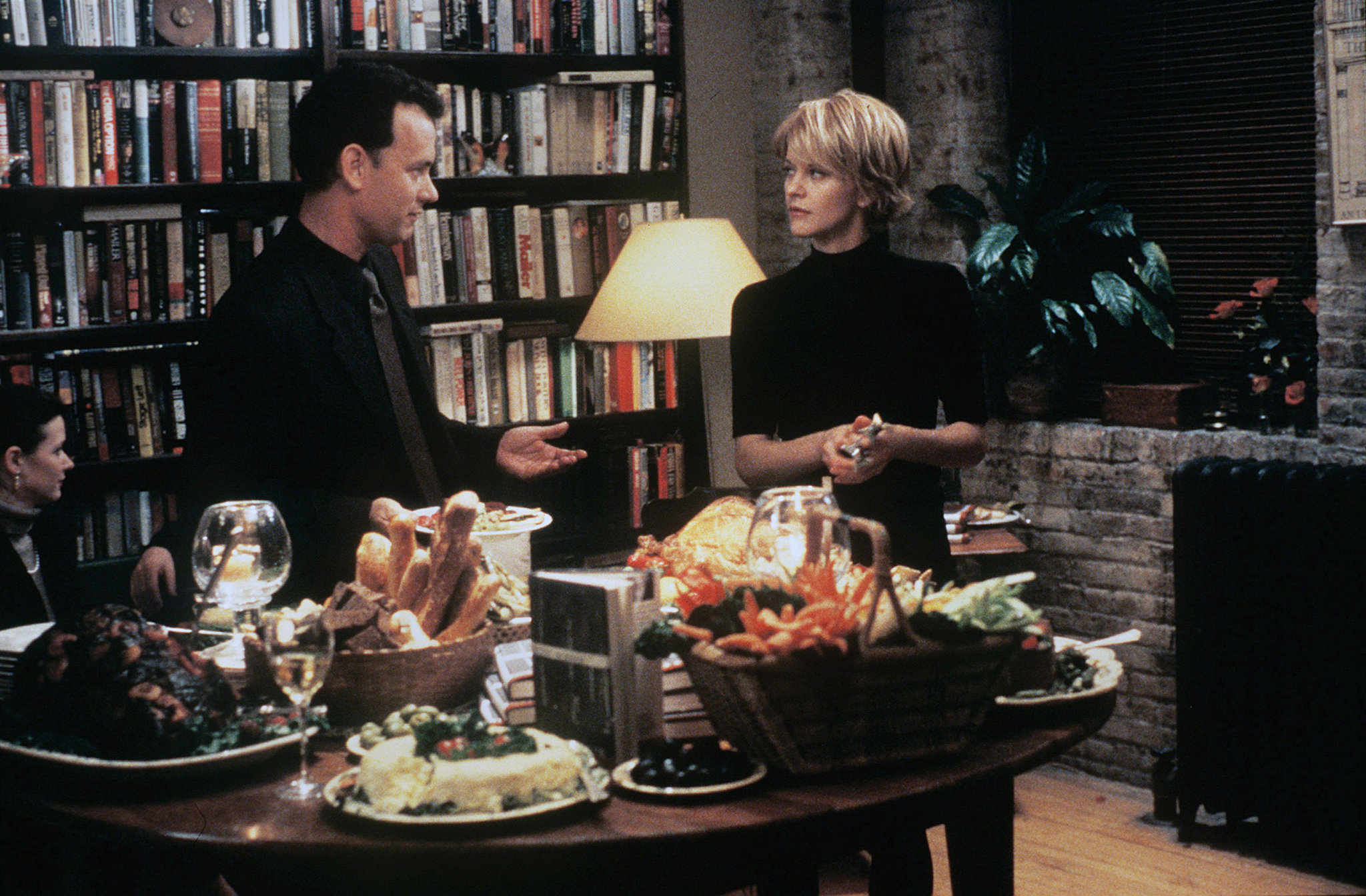
That’s my favorite line from one of my favorite romantic-comedies, Nora Ephron’s You’ve Got Mail. The 1998 movie, starring Meg Ryan and Tom Hanks, is a divisive movie. Its happy ending comes with a cost, its characters are thorny and contradictory, and its worldview acknowledges that life can put you through the wringer and that’s actually preferable. Or at least okay.
You’ve Got Mail has a happy ending–our two leads Kathleen and Joe end up together–but how it gets there involves some challenging beats. Ephron herself made a career out of nominally crowdpleasing mainstream movies that are quite daring and unconventional when one actually pays attention. She foresaw parasocial relationships and the contentification of culture in Julie & Julia. And she parodied the corporatized nostalgia and the hollowness of IP mining in Bewitched well before that became our real life. With You’ve Got Mail she depicted the transition from analogue to digital, and a New York losing itself to chain stores. I wonder how Ephron, who died in 2012, would feel about how nostalgic we are for Barnes & Noble in the Amazon age.

I thought a lot about Nora Ephron while watching the Netflix romcom, People We Meet on Vacation. The Brett Haley film is a riff on When Harry Met Sally, basically taking its opening stretch straight from the Rob Reiner directed/Ephron written 1989 classic. It’s your standard friends to lovers story about Poppy (Emily Bader) and Alex (Tom Blyth) going on vacation once a year and discovering that they were meant to be together all along. There’s nothing offensive about Vacation. The leads are pretty, and the movie is watchable. I myself saw it during the January 2026 blizzard and it was a nice way to spend an afternoon.
But the movie, along with many other modern romcoms, is so gosh darn protective of its characters. Poppy and Alex can afford to go on vacation because Poppy is a travel writer with a seemingly endless budget for bland Airbnbs across the globe. And at the end, she decides she’s done traveling and quits her job. This is all without fear of what lies ahead or even acknowledgment that her chosen field is shrinking. Alex is in some on-again off-again relationship that mainly stays offscreen and underdeveloped, and then resolves quite laughably. It makes me even more sad about Ephron’s death to consider what she could have done with Poppy and Alex’s love story. Poppy’s career and Alex’s relationship would feel lived-in and idiosyncratic. Instead they’re just window dressing for bland fanservice.

Like most gay men, I watched all of Heated Rivalry, and found myself similarly frustrated. As Shane (Connor Hudson) and Ilya (Connor Storrie) begin their illicit situationship, the series gives no room for them to wrestle with their queerness or even actively refuse to wrestle with it. The first few episodes fly through incoherent time jumps. While the sex is steamy, there is little context for who the characters are in between sex scenes. Shane in particular feels like he has no curiosity about 2010s gay cultural touchstones. Was he ever curious about Craigslist/Grindr? What porn does he watch, if any? Was he ever tempted to visit a gay bar? Or is he so isolated from queerness that he has no awareness of those things? That’s interesting to me, but the show seems to only be interested in “yearning” and creating a straight-friendly monogamous gay romance.
My frustration is that I think there’s a fear of upsetting a chronically online and moralistic audience who do not like to be challenged. Or there’s such a hyperawareness of tropes that audiences expect things to go from A to B to C in a specific manner. Or maybe everything these days is made to be watched on our phones. But there’s something blocking modern romcoms from being as prickly as they once were.

A generation that grew up half-watching romcoms on TBS may not realize how movies like Moonstruck, Broadcast News, Pretty Woman or even 2000s/2010s era hits like How to Lose a Guy in 10 Days, Crazy Rich Asians, Crazy Stupid Love or He’s Just Not That Into You featured uncomfortable ideas and biting sensibilities. So they’re somewhat horrified to discover that they are not just disposable escapist larks but real movies that portray human beings as messy, inconsistent, and at times selfish. Movies like Anora, Poor Things, and Materialists are a step in the right direction, even if they’re not all perfect movies individually. But those movies face a superficial and righteous discourse that doesn’t quite engage with what’s actually on screen.
It’s entirely possible that I’m out of step with most people. I like when movies go to dark places, even seemingly pleasant ones like You’ve Got Mail. I’m the one who thinks that losing her store is the best thing that could have ever happened to Kathleen. It gave her the push to find her own identity and truly grieve her mother’s death. A modern version of the movie, especially a Netflix one, would let Kathy keep her store and even have Joe invest in it. That’s probably a movie that most audiences would enjoy and approve of. But would it have the shelf life of You’ve Got Mail? Would People We Meet on Vacation? I don’t know the answer to that. But I do know a certain era is decidedly over and that’s something I have to make my peace with.