


Director: Richard Linklater
Writer: Robert Kaplow
Stars: Ethan Hawke, Margaret Qualley, Bobby Cannavale
Synopsis: Tells the story of Lorenz Hart’s struggles with alcoholism and mental health as he tries to save face during the opening of “Oklahoma!”.
How lucky are we as audiences that we get two Richard Linklater films releasing in 2025? This output is quite fitting considering the first of the two films, Blue Moon, is all about duality and the multitudes contained within us as people. It’s evident in the freewheeling nature of Nouvelle Vague versus the chamber-piece format of Blue Moon. And the thematic ideas about duality are made quite clear via the pair of opposing quotes used to open Blue Moon, celebrating its New York premiere at the 63rd New York Film Festival. Of Lorenz Hart (a transcendent Ethan Hawke), Oscar Hammerstein II (Simon Delaney) described the songwriter as “alert and dynamic and fun to be around.” On the other side, Mabel Mercer considered him “the saddest person to be around.” It’s a stark duality to create the entire baseline of the film around. This conflict is felt even more by the fact that Linklater opens his film with abject tragedy: that of the legendary Hart’s lonely death, shot in a cold, dark alleyway full of trash. With its depiction comes a sad irony to wash over everything that follows. It creates tragic undertones which permeate through a film occurring entirely during a celebratory event. For Blue Moon then jumps back seven months in time, to March 31, 1943: the opening night of “Oklahoma!” on Broadway.
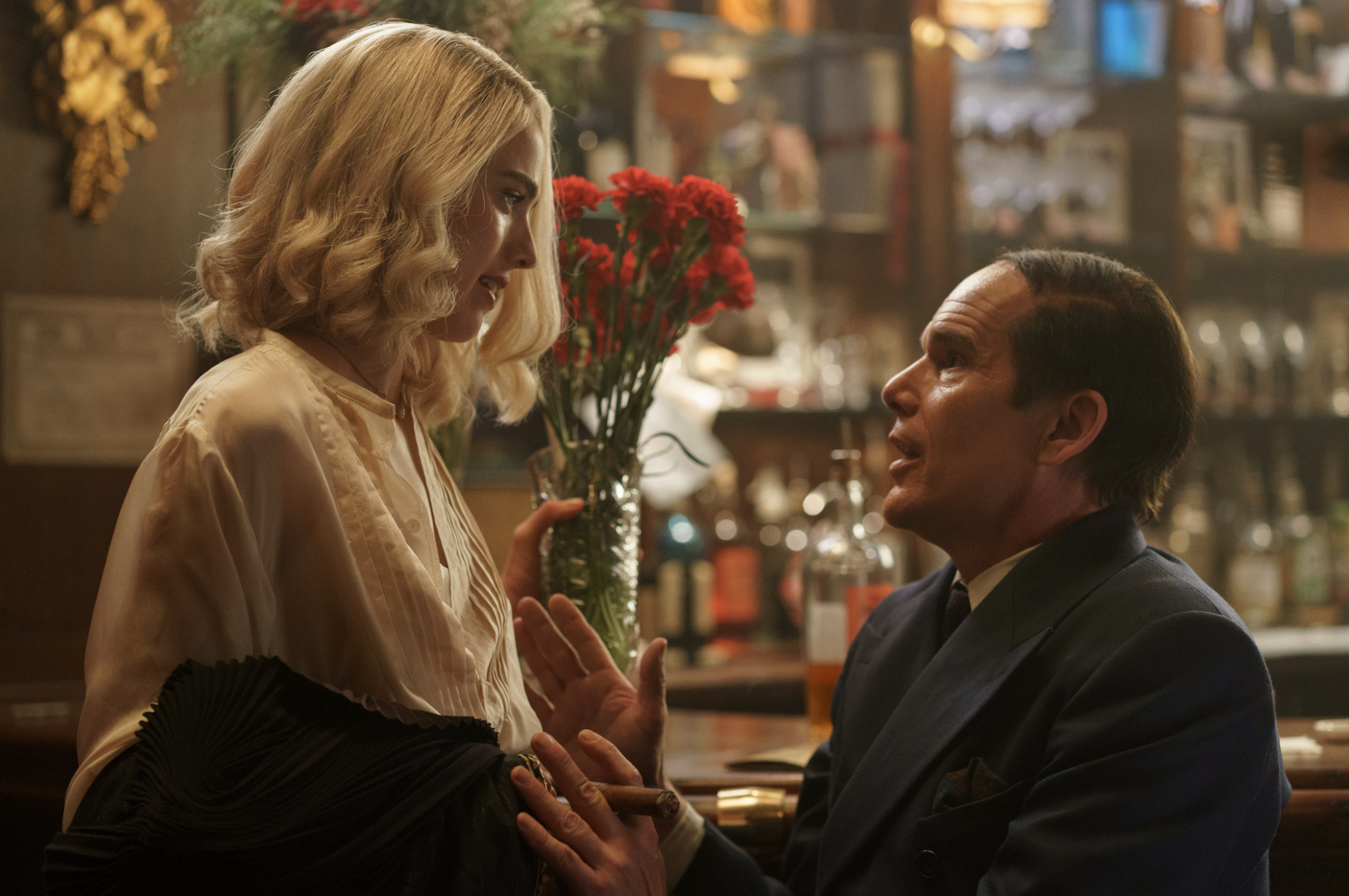
The arrival of this landmark musical signifies a joyous time for countless individuals involved with the show. It’s also a moment in history of which the reverberations from its impact are still being felt. But for Hart, the night couldn’t be going any worse, and the musical certainly isn’t helping his spirits. So off he goes before curtain call to the bar where the afterparty is being held. It’s in this setting that the chamber-piece film truly begins. In many ways, it’s a perfect fit within Linklater’s classic hangout film tempo. After all, Blue Moon primarily sees Hart fraternizing amongst the familiar faces of the bar he very clearly frequents. Yet the warm embrace of living in a specific moment commonly found in Linklater’s hangouts like Dazed and Confused or Everybody Wants Some!! isn’t as present as it typically is. Mind you, the warmth stemming from an attention to period details are both visible on the screen and baked into Robert Kaplow’s script. But this is a hangout film spurned on by a tragic driving force: Hart is simply seeking solace from the emotions which currently haunt him. There’s a veil of pain thrown over this extended “hangout.”
Lucky for audiences, Hawke is delivering a fully committed performance which allows him a ton of space to play within. Yes, Hart is a tragic figure in Blue Moon. But he’s also a bit of an entertaining scoundrel. 90% of the film’s runtime must be devoted to Hart’s blathering about his thoughts on theater, the state of the music business, sexual conquests, random anecdotes, and more. One might think a character like him haunting the local bartender would become frustratingly overbearing at a point. And while he may be a bit much, that’s deliberate. The charm within his behavior is part of what unlocks this character. There’s a poetic elegance to Hawke’s character that, even when he’s fully deriding something, you can’t help but be equally shocked and impressed at the way he goes about conveying his opinions. The script, delivered by Hawke, becomes something that’s both beautiful and crass. Before Richard Rodgers (Andrew Scott) ever even arrives at his own party, the clashing dualities of Hart and Blue Moon feel like such fun magic on the big screen. It’s only upon Scott and Hawke finally coming face-to-face that Linklater’s film takes on an entirely new emotional weight.
Rodgers enters the bar to thunderous acclaim and celebratory remarks. Everybody wants to get a word in, and for a moment, Hart remains alarmingly silent for the first time thus far; make no mistake, it’s merely a brief pause for what’s to come. After all his remarks bashing “Oklahoma!,” Hart steps in with such lovely praise for both Rodgers and Hammerstein. The bitterness read across his face stings. Despite his intentions of hiding it, Hart isn’t as great an actor as Hawke is. It makes for many comedic interactions, of which this film has several, despite the deeply sad context the jokes are stemming from. We never find ourselves laughing at Hart, but the more time spent with him, the more our laughs become somewhat pitiful. The central conflict of Blue Moon is one never directly stated between the two opposing forces. But that doesn’t mean it isn’t painfully obvious, causing an intentional rift in what should be a hangout among old friends. For Hart, he never reveals his true feelings to Rodgers. But the man has no issue tossing veiled insults in the direction of his now more successful (and younger) creative partner. In Rodgers, his frustrations with Hart come from a place of worry and care. Scott’s performance is so touching in this regard. As he captures the excitement of a man about to be on top of the world, there’s a sad desperation in his eye as he is looking back and offering a hand desperately needed to lift up a friend and a mentor.
Nearly everybody in Blue Moon sees the spiral Hart is experiencing. Most, like Eddie the bartender (Bobby Cannavale) or E.B. White (Patrick Kennedy), merely lend an ear or company alongside the chance for a free drink. Rodgers is the only one who, initially through nudges and later through shoves, makes any verbal attempt to get through to Hart. He takes action where all else believe they don’t have a place in this story. It’s what makes Scott’s place in this film all the more heartwarming amongst all its tragedy. Rodgers holds back his true feelings, and these attempts can be seen plain as day, as he understands that Hart needs somebody to catch him rather than explain all the reasons why he’s flailing towards rock bottom. Despite the fracture between the two artists, the friendship depicted is one of simple beauty. “Art waits for you,” says a character at one point in the film; unfortunately, life doesn’t. It flies beyond our control with no care for our pain and sorrow. But it does provide us with people to share those experiences alongside in order to ease that pain. Hart is a deeply frustrating individual, but Rodgers’ pleading to provide help and displays of generous encouragement to a friend in need is as touching and beautiful a depiction of friendship as anything is. In the end, Blue Moon depicts both a heartwarming friendship and a tragic breakup. It’s a hangout that seems doomed from the very start. Hart is a man torturing himself with everything he doesn’t, or simply can never, have. Hawke holds so much pain in his face, yet he’s such an endearing and charming performer that you’re left smiling throughout. Blue Moon is both celebratory and funereal, and how Linklater balances the two clashing tones so effortlessly reaffirms why he’s one of the all-time great filmmakers.
Blue Moon celebrated its New York premiere at the 63rd New York Film Festival as part of the Spotlight section.