Director:Alex Garland, Ray Mendoza Writer:Ray Mendoza, Alex Garland Stars: D’Pharaoh Woon-A-Tai, Will Poulter, Cosmo Jarvis
Synopsis: A platoon of Navy SEALs embark on a dangerous mission in Ramadi, Iraq, with the chaos and brotherhood of war retold through their memories of the event.
Ray Mendoza spent significant time with Alex Garland, his co-director on Warfare, when he was acting as a military consultant on Garland’s Civil War. While Civil War imagined a divided America through the eyes of photojournalists, Warfare is not imagined, it is remembered. An immersive cinéma-vérité recounting a mission Ray Mendoza (D’Pharaoh Woon-A-Tai) was a part of serving as a JTAC in 2006 in Iraq. Mendoza is committed to replicating the experiences of a group of Navy SEALs who were tasked with identifying al-Qaeda insurgents in Ramadi.
Unlike many a war movie, even those that recreate real events based on a living person’s experiences, Warfare isn’t interested in giving background or backstories to the soldiers involved. Mendoza and Garland show a pre-mission gathering around a video of Erik Pryde’s Ministry of Sound club hit “Call on Me.” What the audience sees is that the soldiers are young, pent up, and ready to go. Camaraderie is established and that’s all. Rank, specialty, and relationships unfold within the operation and the miasma of an unexpected IUD attack.
The lack of “characterization” is deliberate. Mendoza and Garland reiterate that the events happened as they are filmed and unless something was said by the soldiers during that time it wasn’t included. The audience has to sink or swim with the people they see on screen; there’s little time to judge any of the ethical issues, of which there are inherently many, nor is there space to bond with the soldiers. It’s war and you’re inside it.
Not knowing much about the men means they become a kind of “everyman” inside the pressure cooker. Will Poulter’s Officer in Charge, Erik seems collected and battle ready, but like the rest of his squad he’s barely able to keep it together once the chaos begins. The two armed translators who are tasked with keeping the Iraqi families whose house the squadron have decided to use as a vantage point for the operation are almost pushed as fodder into the fray. Tommy, a younger recruit played by Kit Connor, stands shocked, unable to work out what is going on. Cosmo Jarvis’ sniper Elliott makes jokes with his fellow sniper Frank (Taylor John Smith) to try to relieve the tension of looking down the scope at men gathering across the street. It is up to them to report if someone is “peeking or probing” suggesting they’re insurgents, or if they’re simply innocent residents going about their day. Joseph Quinn’s Leading Petty Officer, Sam, waits in another room. The wearing pressure of “hurry up and wait” during the surveillance is its own pressure cooker.
Warfare is replete with talented young actors. Charles Melton, Noah Centineo, Evan Holtzman, Henrique Zaga, Finn Bennett and actual Iraq veteran Alex Brockdorff are amongst the mix of SEALs, FSOs, ANGLICOs (Marines) in the cinematic real time operation. They’re each solid in the ensemble which favors the point of view of Ray who switches between communicator, stand-in field medic (along with Michael Gandolfini’s Lt. Macdonald), and interim 2IC.
The sound design, editing, and cinematography are top notch and there’s no doubting Warfare is a visceral experience as it moves through the chaos of a dangerous and desperate military situation. However, the authentic reproduction of the operation is both a boon and an impediment to the film. Mendoza and Garland so want the audience to experience events that they actively discourage consideration of them. It is all too easy to get caught up in the whirlwind of pain, fear, bravery, and “brotherhood” in propulsive war stories, that the focus excludes contextualizing whether that war was something soldiers should have been deployed in. The Second Gulf War, or the Iraq War, remains controversial as it was considered illegal by the United Nations and the cumulative cost in terms of civilian lives and the lives of the United States Military and its allies, plus the post invasion disorganization and monetary investment were widely condemned.
Warfare is a technical achievement par excellence; both raw and urgent. But once the adrenaline wears off and the movie reaches its coda, the questions begin to gather – the main being, “Why were they there in the first place?”
On this episode, JD and Brendan discuss Daffy Duck and Porky Pig in the wonderfully loony animated film The Day the Earth Blew Up: A Looney Tunes Movie! It’s an incredible irony that we almost didn’t get this movie because it’s one of the very best surprises of the year so far. It’s perfectly loony, extremely funny and quietly nuanced for a fun animated movie like this.
Review: The Day the Earth Blew Up: A Looney Tunes Movie (4:00) Director: Pete Browngardt Writer: Darrick Bachman, Pete Browngardt, Kevin Costello, Andrew Dickman, David Gemmill, Alex Kirwan, Ryan Kramer, Jason Reicher, Michael Ruocco, Johnny Ryan, Eddie Trigueros Stars: Eric Bauza, Candi Milo, Peter MacNicol
Tracie Laymon’s feature film Bob Trevino Likes It is all about found family and remaining kind through life’s biggest obstacles.
Since its premiere at SXSW in 2024, winning the Grand Jury Audience Award, its positive reception has spread, garnering even more festival wins. Laymon is a triple threat, directing, writing, and producing the film, which stars Barbie Ferreira and John Leguizamo in a heartfelt story that reflects all walks of life.
Based on events in her own life, Laymon explores how films like Little Miss Sunshine inspired her to make films with meaning. Bob Trevino Likes It, which hits theaters nationwide on March 28th, marks a debut from Laymon that shows our stories can be dark, but our futures are bright.
Megan Loucks: Thank you so much for sitting down to talk to me about your newest film, Bob Trevino Likes It, which you directed, wrote, and produced. What was it like wearing that many hats on your feature film debut?
Tracie Laymon: Oh my gosh. Well, it was tough, and I have some gray hair under my bleach now—my Bob Trevino hair. But I had a wonderful, wonderful team. I had great producing partners, Sean Mullin and Edgar Rosa. The whole team was wonderful: Felipe Dieppe and Carl Effenson. It takes a village. It really, really, really takes a village. And to be that vulnerable on set and look out and know that people had my back, the cast and crew had my back. I had their back, and they had my back. That helped a lot. I know that I could not have gotten through this without them.
Megan Loucks: This film is a roller coaster of emotions I wasn’t expecting. It’s a very moving story. How does it feel to see people resonate with your film, especially given that it’s based on your life?
Tracie Laymon: It’s so cathartic because, you know, part of my narrative when I was younger was that I was alone. And as I share this story that I was really just saying because I had to say it, I’m finding that there are a lot of people like me out there who have been through similar things, and they tell me their stories, and then neither one of us is alone. You know, the power of storytelling to bring us together and make us know that we’re all, though we’re all unique, we’re not alone, and our shared experiences are not so dissimilar.
Megan Loucks: I got that straight away from the opening scene with Lily as she’s opening her phone, and you get the sense that she’s a very kind person, a very people pleaser kind of person, and I resonated with that a lot. What made you decide to showcase her personality in that kind of way?
Tracie Laymon: I think it was just me being very honest about things I’d been through. You know, Thad is an amalgamation of that guy in the text; he’s an amalgamation of many people in my life and my past life. But, you know, Barbie is just incredible, and she has such vulnerability. And that was actually supposed to be the third scene, but we made it the first scene because she just knocked it out of the park. And I was like, what sets up the character better than this? It shows that she’s extremely kind, that she’s being overlooked, that she’s afraid to get angry, and that she needs to get angry. She doesn’t really have anybody in her life, and she needs people who see her and get her like we all do. So it was just kind of easy to show it. Barbie brings such magic to everything she does.
Megan Loucks: I’ve been following the film’s behind-the-scenes press tour, and you guys are also very close outside of the filming. What was it like working specifically with Barbie, John, and Lauren Spencer in their roles in the film?
Tracie Laymon: I do a lot of work before making an offer. I’ve been told it might be annoying to some people because they’re like, ‘Make an offer!’ I’m looking at their work. I’m looking at things they did 20 years ago. I’m looking because you cast the cast, and you also cast the crew. I do the same thing with the crew. I interviewed many people, but you’re creating people who will become a little family on set, like your team, and in some ways, you’re a little family, a chosen family. And it’s so important to me to cast the right people and every single person in our cast and our crew had a good heart. I looked really hard. I feel like we all did. We brought our whole hearts to this film. And so I think that’s what people are responding to as well. Everybody was grateful and happy to be there, and we had each other’s backs. I think it did help that it was inspired by a true story because I was already being vulnerable by sharing this.
Mike Nichols, one of my favorite directors, said, ‘If you want an actor to go somewhere, be willing to go there first.’ And I’m very much willing to go there. I’m not gonna leave someone hanging out there alone, you know, in front of a camera and a crew. I’m with you. I’ve got skin in the game, and I’ll meet you wherever you’re at, and we’re gonna figure it out together. So, lucky for me, this incredible cast just went there with me.
Megan Loucks: I think one of the most relatable aspects of the film is how you explored Lily’s (Ferreira)personality through social media and also Bob’s (Leguizamo) personality through his wife’s scrapbooking. I feel like you blended two different generations together so well. So what was it like exploring those avenues of showing the audience without telling them?
Tracie Laymon: It is generational, right? That social media for Lily and Bob being kind of clunky on the computer. He doesn’t really know how to do it. He gets a notification. He’s like, ‘What is that?’ Like it’s the craziest thing ever. I think that social media is a way to bring us into the real world, and that’s why I love that scrapbooking was kind of like a tool. Social media is a tool to bring us into the real world, to connect and have tangible things, and share moments in real life, which they very much do in the film. I appreciate both, and I feel like both have a purpose. And I also feel like the younger generation is learning something from the older generation, and the older generation is learning something from the younger generation. So, neither one is judged as bad. In fact, they’re both good.
Megan Loucks: The entire time I was watching this movie, just, you know, ugly crying. I wasn’t expecting it to be honest. What was your first reaction upon seeing the finalized version of the movie?
Tracie Laymon: We did a lot of test screenings. Sean Mullin, one of my producing partners, had done a test screening before. And so thank God it was in a safe environment because I’m very hard on myself. But it was probably like the seventh test screening before I thought, ‘Okay, it’s going to be okay because I’m so meticulous and I’m so hard on myself.’ We moved some things around and some scenes, and things got tighter. And I was like, ‘It’s gonna work.’ And that’s when people started really crying and really feeling themselves in the film. We did a lot of work after that, but that was the moment that I was like, ‘It’s gonna be okay. I don’t know what okay is, but I know it’s gonna be okay.’
Megan Loucks: There’s not a lot of information about you online. This is your first feature debut, making our conversation even more exciting. Who are some directors that you watch their movies and you’re like, ‘Oh yeah, this is what I want to do. These are the kind of stories that I want to tell.’
Tracie Laymon: Well, I was first influenced by Todd Solondz and Todd Haynes, actually, killer films in general. They were kind of showing a darkness that I felt existed in the world that I wasn’t really seeing in my other teenage movies that were like rom-coms and things. And so I just really liked that. But then I realized I’m not that dark, to be honest. I’ve been through the darkness, but the darkness is not me. I want to be a light in the darkness, and I want to show people that you can go through hard things, prevail, and choose to see the light. You can find family, even if you don’t have it necessarily. And so, a lot of my work tends to do with a sense of belonging and challenging perceptions. But Little Miss Sunshine was the film that showed me that you can do that. You can show real things, and you can do it with heart, and the characters can be flawed, and they’re still lovable. And that just, the film changed my life. So I think it’s a perfect film.
Megan Loucks: That Little Miss Sunshine scene where she’s talking to her grandpa gets me every single time. I just rewatched it the other day, too.
Tracie Laymon: She doesn’t want to be a loser. She’s so not. She’s so completely perfect and precious. It’s so touching.
Megan Loucks: Is there anything that you want to say to the audience before heading to see your film coming out soon?
Tracie Laymon: Yeah, I think if you can just please get to the theater because, you know, we’re in a time where people are telling us that we’re all different and we’re all divided and that that in ways it’s making us feel like we’re powerless and our kindness doesn’t matter. But this film, really, I really think it will remind you that it does matter and that we’re not all so different and to be in the room laughing and crying with strangers, I hope that it restores a little bit of your faith in humanity because we need each other and we can do this.
Bob Trevino Likes It releases in New York & Los Angeles on March 21st, expanding nationwide on March 28th.
On this episode, JD and Brendan review Disney’s latest live-action remake in Snow White, starring Rachel Zegler and Gal Godot! These remakes have progressively become more banal and visually bland over the years, and unfortunately this one is no different. Its fundamental approach is exactly what the doc ordered, but its execution is certainly questionable.
Review: Snow White (4:00) Director: Marc Webb Writer: Erin Cressida Wilson Stars: Rachel Zegler, Andrew Burnap, Gal Gadot
Director:Noah Pritzker Writer:Noah Pritzker Stars: Griffin Dunne, James Norton, Miles Heizer, Rosanna Arquette
Synopsis:Manhattan dentist Peter Pearce is facing a midlife crisis after his wife of 35 years leaves him. On the spur of the moment, he books a trip to Tulum, Mexico, only to crash his son’s bachelor party.
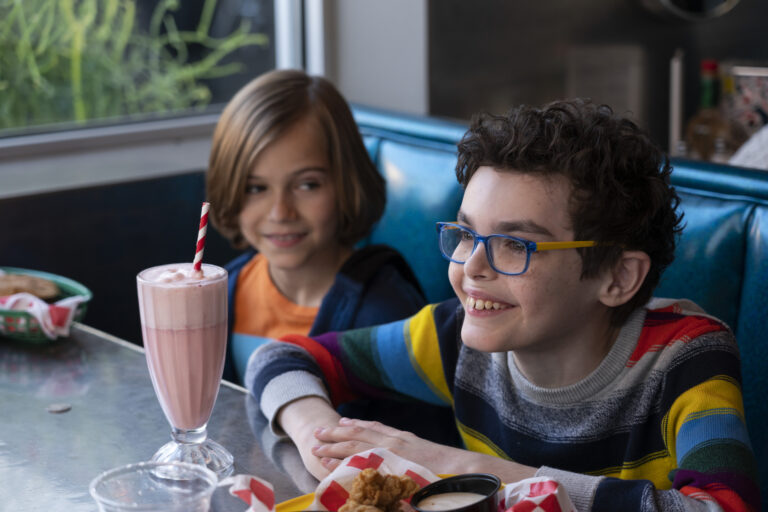
It sounds like a half-baked Hangover retread, or perhaps a version of American Wedding where Eugene Levy’s Mr. Levenstein is the one to threaten his son’s nuptials rather than the almighty Stifler. But Noah Pritzker’s wry and honest dramedy Ex-Husbands – which sees a father inadvertently crash his eldest’s bachelor trip while on a personal journey of his own design – is careful to be light on tigers and face tattoos in favor of heavy emotional breakthroughs, ones so purposefully crafted that they hit home, even if our homes have never dealt with the same unease in an explicit fashion. Pritzker’s emphasis on making growth and reflection the pillars of his sophomore feature doesn’t abuse the viewer with psychotherapy-friendly personal revelations as much as it introduces them as unique individual scenarios for its characters to work through in real time. What could have been a lazy, bro-happy raunch fest about what happens to our testicles when we age instead becomes a male-heavy dramedy focused on the lessons we learn both for and about ourselves as we get older, wiser, and occasionally, lonelier.
Originally written as a salve in the aftermath of his own parents’ decision to separate after 35 years of marriage, Ex-Husbands shares some thematic and spiritual tissue with Pritzker’s 2015 directorial debut, Quitters, which followed a young man’s search for found family after his mother checks into rehab and his relationship with his father crumbles in kind. The former, however, is a more confident (and interesting) step into the independent filmmaking landscape for Pritzker, whose assured direction and few-frills script is the indication of someone more seasoned than his young career might otherwise indicate. Better still, it’s a tale of masculinity that isn’t too eager to prove itself as a modern rejection of deservedly oft-ired tropes; it would rather eschew that toxicity in a manner as natural Griffin Dunne once felt in a zany thriller directed by a young Martin Scorsese.
Not that Dunne couldn’t feasibly slot back into the singular vision of After Hours’ Manhattan underworld today, but the now-grizzled veteran of more understated dramatic work feels right at home in Pritzker’s rendering of New York. Plus, Rosanna Arquette isn’t the onset of a terrifying evening in the city that never sleeps in this setting; she’s merely filing for divorce. The unexpected news sends Dunne’s Peter Pearce into something of a personal rut, not least because Arquette’s Maria seems to have been inspired to pull the ripcord by Peter’s own father (Richard Benjamin), who abruptly shares that he is leaving Peter’s mother after 50 some-odd years of marriage for a slew of half-baked reasons that amount to a state of late-in-life boredom. As the opening credits roll prior to the film they’re seeing that afternoon at Lincoln Center’s Walter Reade Theater (much of Ex-Husbands’ Manhattan-set sequences maintain an authenticity that New Yorkers should recognize, cinephiles or not), so, too, do Pritzker’s titles. By this point, the film’s whip-smart, mature tone has already been set in motion with more sincerity than most seasoned directors feel the need to employ.
What follows keeps apace, with more marital/familial snags resulting in unearthed tensions coupled with newfound common ground, two narrative aspects that only work as well as they do because we believe that the Pearces – a nuclear family in every sense of the word – have plenty of shared issues, too. When we first meet Nick (an understated, soulful James Norton) and his eventual fiancé, Thea (Rachel Zeiger-Haag), they’re the embodiment of the picture that sits next to the phrase “meet cute” in a dictionary; it’s a slight, delicately-crafted prologue filled with shared smiles that indicate the potential for a more meaningful future together. Six years later, a few months before their wedding, we come to realize how difficult things have gotten at home thanks to Nick’s lack of writerly ambition and Thea’s urge for a stable future. Nick doesn’t share the nature of his inner turmoil with his brother, Mickey (Miles Heizer), who planned an epic weekend in Tulum, Mexico for the former’s bachelor party. Naturally, the somber Peter has unknowingly booked a trip to the same resort on the same weekend for some much-needed bumming in the sun. Once word of this mishap reaches the groom, Peter ensures his boy that he won’t even know he’s there.
Of course, that wouldn’t make for much of a movie, so Nick, Mickey, and the groom’s dopey gaggle of bros include Peter in their getaway’s proceedings, making their elder feel seen, accepted, and loved, all of which had been lacking from his life prior to his vacation. Yet despite Pritzker’s insistence on keeping his characters connected in a shared space, a distance between them remains, one that necessitates a number of exposition-heavy dialogues that afford the Pearce men opportunities to explain how and why they’ve landed in their respective set of circumstances. Peter is getting divorced; Nick’s relationship is on the ropes; Mickey hasn’t been able to meaningfully connect with a romantic partner since coming out, and soon finds himself entangled in a complicated affair with a married friend of his older brother’s; they all frequently wax poetically about why these situations are difficult to be in, and how easy solutions have been difficult to come by. Thankfully, there’s never an absence of thoughtfulness in Pritzker’s writing, thus keeping Ex-Husbands optimistic in the midst of its slew of seemingly dour situations. In other words, there’s a future for each of these men, even if it isn’t quite the one they imagined they would be embarking on when their stories began.
That core notion is aided most by the main trio’s performances as the male members of a family in need of a compass to point each of them toward their individual north stars, though it’s undoubtedly Dunne whose work most stands apart from that of the film’s ensemble. His turn here is quietly reminiscent of his time on NBC’s family drama This Is Us, though there was an anger to his character on that show that Peter eschews in favor of existing as a kettle eager to boil over. Once he does, the inevitable screech is one that we accept given how much life we’ve witnessed over the previous 90 minutes, in all its pain and glory. That’s also precisely why it doesn’t matter that Ex-Husbands doesn’t break the mold. It’s focus on proving that we’re never stuck inside the molds our lives present us with is what really counts.
Ex-Husbands will be available to rent on PVOD on March 24.
Director:Jessica Palud Writer:Jessica Palud, Laurette Polmanss Stars: Anamaria Vartolomei, Matt Dillon, Giuseppe Maggio
Synopsis:Maria Schneider, a young, struggling actress, lands her dream role in a film by an emerging Italian director, starring alongside an American superstar. What begins as her big breakthrough quickly turns into a living hell.
“Let the scene lead you,” Bernardo Bertolucci (Giuseppe Maggio) tells Maria Schneider (Anamaria Vartolomei), the ingénue starring alongside the larger-than-life force that is Marlon Brando (Matt Dillon) in the Italian director’s new film, Last Tango in Paris. He doesn’t want to rehearse the scene in question – one in which Brando’s character rapes Schneider’s – not in spite of its intensity, but because of it. Bertolucci wants raw intimacy; “On my films, there are no actors,” he later tells Schneider, noting that he “didn’t want [her] to act,” only to exhibit her true feelings as the scene unfolded. In the decades since production concluded, the film’s leads, the filmmaker himself, and others on the outskirts of the production have had differing accounts as to whether or not the rape was actually in the script. In 2007, Schneider told the Daily Mail that the scene was abruptly added after Brando came up with the idea, while at a 2013 Cinémathèque Française retrospective, Bertolucci claimed that it was performed as it was written. One thing is for sure: the use of butter as a sexual lubricant was nowhere to be found in the script. In addition, though the rape itself was simulated, Brando’s application of the butter and his forcible actions during the take felt authentic to the unsuspecting Schneider, which left her feeling “a little raped, both by Marlon and by Bertolucci.”
There’s more to Jessica Palud’s Being Maria – which premiered at the 2024 Cannes Film Festival and screened at Film at Lincoln Center’s 2025 edition of Rendez-Vous with French Cinema – but Maria Schneider’s days on the Tango set play a more pivotal role in the film than any other, much like its consideration in Schneider’s life and career. The French star, who was 19 when she filmed Tango and 58 when she died of cancer in 2011, suffered abuse and used drugs in response to the instant fame she obtained following her breakout, and Being Maria goes to reasonable lengths in its efforts to paint the full picture of a life in the limelight. But it’s admittedly difficult to latch onto everything else Palud’s biopic attempts to mine from the aftermath of the aforementioned trauma, not least because of how vivid and harrowing the director’s depiction of that on-set assault is. Both what precedes and follows one extended moment in this movie is an uninvolved glance at the booklet of biopic tropes, disappointingly so. Much like what Brando tells Schneider right before action is called on the now-infamous incident, “It’s only a film.”
The one person who understands that sentiment to greater heights than anyone else in Being Maria is Vartolomei, whose own burgeoning star and seemingly endless range are put to great use in the titular role. The French actor, who recently stole a few scenes in Bong Joon-ho’s Mickey 17 but should be better remembered for turning in one of 2021’s best performances in Audrey Diwan’s Happening, likely called upon that breakout to inform this part given its psychologically unrelenting similarities, though it feels as though she’s evolving in real time here. Expressive and entrancing, Vartolomei is never once overshadowed by Dillon’s Brando, perhaps because the actor’s hair and smirk are about as close as he gets to the complex, venerated legend of stage and screen, but in actuality, it’s because she’s a presence unto herself. You can feel Vartolomei actively embodying Schneider’s conflicted gamut of emotions while filming Tango, the nature of acting while feeling truly broken as she inhabits a “part.” That she and Dillon have a real chemistry is indicative of how Schneider said she felt in his orbit prior to the scene that altered their professional relationship: “There was no attraction between us. For me, he was more like a father figure and I a daughter.”
Aside from what occurred on Bertolucci’s film, the relationship between Schneider and her family is much of what Palud and co-writer Laurette Polmanss lend their focus to. Working from Vanessa Schneider’s 2018 memoir, “My Cousin Maria Schneider” – great SEO, to be fair – Being Maria attempts to create dramatic tension from estrangement, though those links aren’t nearly as fleshed out as what the film is clearly most interested in. It doesn’t help that the first time we see Maria, she’s watching her father, the French actor and director Daniel Gélin (Yvan Attal), as he directs a film of his own; this seems to be the beginning and end of their bond, one that is more professional than it is personal. Of course, that was partially due to the fact that Maria was the result of an affair and thus could not be recognized as his daughter, and partially because Maria’s mother (Marie Gillain) wanted Maria to have no contact with him. But it’s one thing to interrogate the turmoil that such discord could cause and another thing entirely to accept it on its terms, finding alternate ways to examine why this ultra-green actress just might have some daddy issues. Brando and Bertolucci, as much blame as they deserve for the torment Schneider endured for the remainder of her life given their actions towards her, are positioned as fuel to Maria’s fatherless fire. It’s no wonder that Gélin appears in so few scenes yet is mentioned in so many, as a tale of a young woman’s tribulation can never be about her suffering alone, but about who caused it and why.
There’s some merit to that: Men should be held accountable for the pain they inflict on women, no matter the circumstances nor their claims that calls for accountability should fall anywhere but on their shoulders. And Palud understands that, but only to a point. Being Maria spends a lot of time portraying Schneider in pain and enduring ridicule and criticism from the press, audiences, and friends alike, yet in doing so, it remains intent on repeating one refrain: “You wanted this.” It’s a common idea to include in a film about young artists who struggle, either at the onset of their careers or in the heart of their fame, but it’s a frustrating one to cling to as a narrative buoy. Not coincidentally, the only time Maria seems to be far from drowning is when she’s in the company of her eventual partner, Noor (Céleste Brunnquell), though that is a part that is as thankless as Maria’s joy is treated. Another film could have lent just a touch more focus to the fleeting instances of euphoria shared between lovers, a sometimes necessary reprieve from perpetual agony. Then again, if my grandmother had wheels, she would be a bike.
Being Maria was released in theaters by Kino Lorber on March 21.
Director:Tracie Laymon Writer:Tracie Laymon Stars: Barbie Ferreira, John Leguizamo, French Stewart
Synopsis:When lonely 20-something Lily Trevino accidentally befriends a stranger online who shares the same name as her own self-centered father, encouragement and support from this new Bob Trevino could change her life.
The simple kindness of another human being is something we could all use. An acknowledgement of our existence or a bit of encouragement is fulfilling. It can be hard to be lonely and to not know how to tone down the excitement you, as a lonely person, feel because of a simple interaction. It can be hard when you’re desperate for that modicum of human kindness because the people who are supposed to do it unconditionally and don’t are the cruelest of all.
Bob Trevino Likes It isn’t reinventing the idea of found family, but reinforcing why it is the most important thing we can do for one another. To choose to love someone is to show them that they are known. While most of us haven’t experienced the utterly reprehensible self-centeredness of Lily’s (Barbie Ferreira) father Bob Trevino (French Stewart), we still feel that a biological link isn’t the strongest link there is even with the worst of our biological family shouting at us how important that link is.
Writer and director Tracie Laymon has brought a story to life that will open up a lot of wounds, but only to allow the idea that they can heal properly. The story is based on Laymon’s own experiences and she brings a depth to it that really opens Bob Trevino Likes It to a wholly new take on a strained parent/child relationship. She writes each character with such a loving eye. All of them are broken, but with each other can be rebuilt.
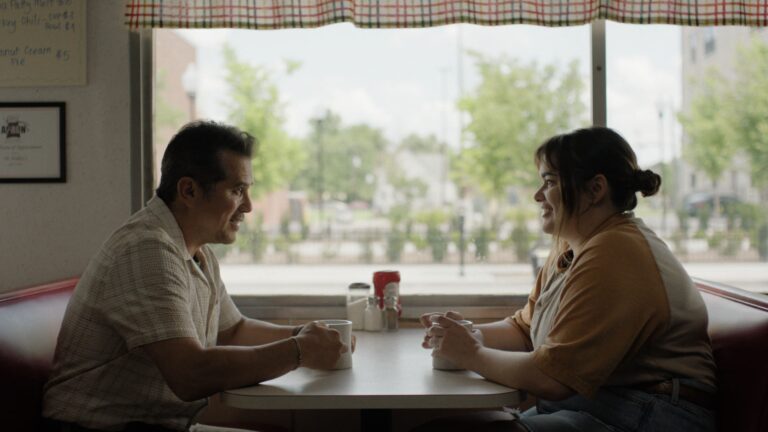
There aren’t any easy answers, either. There are difficult conversations, things left unsaid, and misinterpretations of actions. There’s a scene with Lily and her new friend Bob Trevino (John Leguizamo) that really emphasizes this shift in perception. The two of them are having a nice, if a little stiff, conversation when Lily takes a call from the woman she works for, Daphne (Lauren “Lolo” Spencer), who accidentally mentions Lily’s lie that this Bob is her father. Bob is notably upset and, as a defense mechanism, Lily tries to do everything she did to appease her father when he got upset, but none of it works. She then tries to walk away. Bob stops her and says that they need to talk about it. He’s telling her in a way he wants to try and work out why Lily lied and get past it.
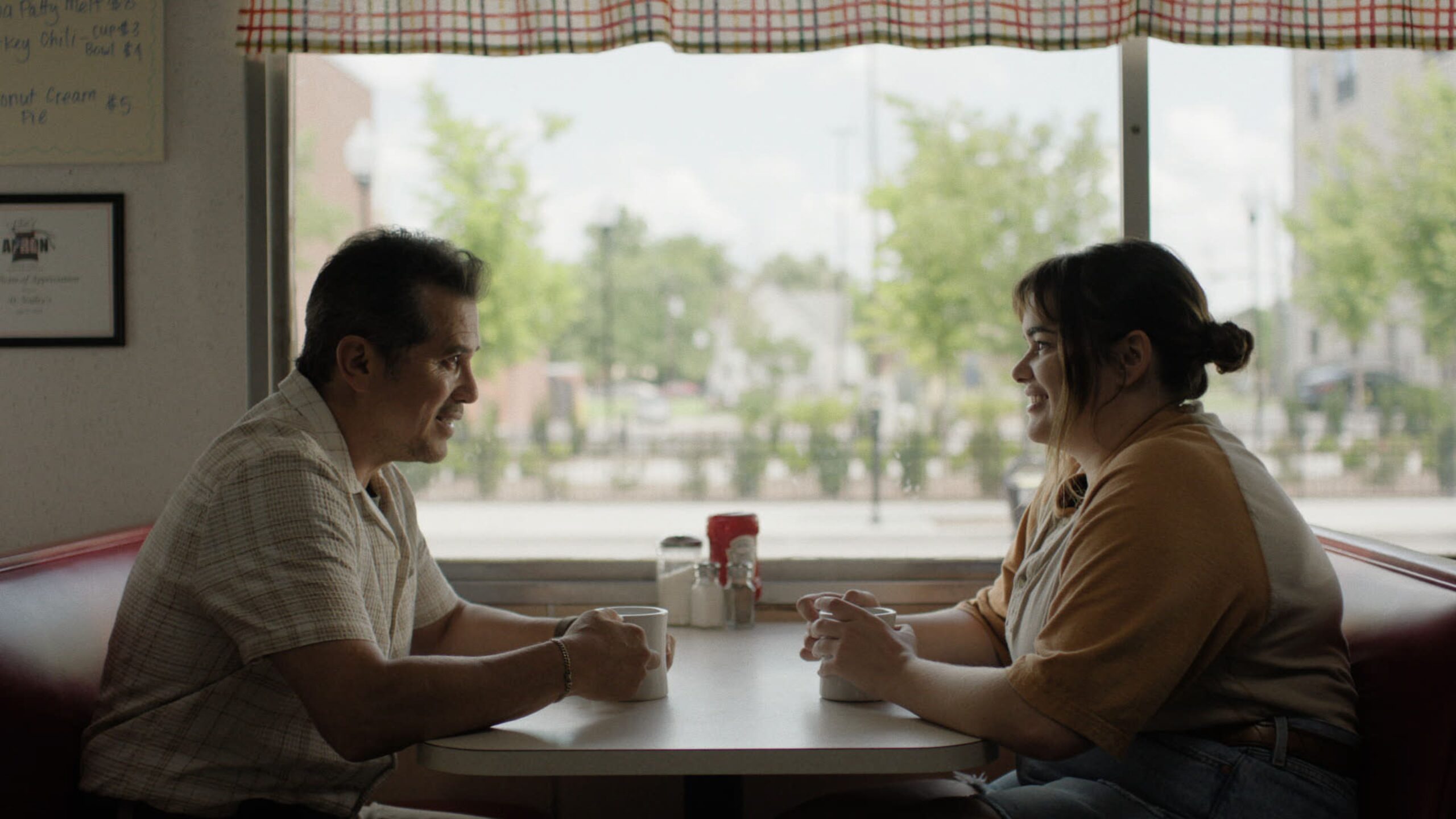
This is where Laymon’s great work as a director matches her phenomenal script. Instead of shooting Bob as he calms Lily down, Laymon and cinematographer John Rosario focus on Lily’s face. We watch as Lily realizes Bob is making an effort. Her face gets softer and her mouth opens a little. It’s a perfect turning point in this character’s life. It’s like a light bulb has been illuminated. Laymon and Rosario then continue this movement as we watch from outside as Lily and Bob talk, really talk. The shot of the two of them through the diner window, the silence of the dialogue, and the musical cue is just beautifully composed.
Bob Trevino Likes It is not only blessed with behind-the-scenes talent, but the actors are superb as well. While French Stewart gives a villainous performance for the ages, the two leads are utterly magnetic together. Barbie Ferreira is an actress who is incredibly adept at character work. Her physicality and presence make her a chameleon. As Lily, she breaks your heart and then mends it so that you laugh through your copious tears. John Leguizamo proves once again he’s an incredibly talented actor, if given the right material. He plays mundane in a way that’s incredibly compelling to watch. The two of them together are the perfect combination. Their chemistry is dynamite even as they have those awkward first steps that all new friendships go through.
Bob Trevino Likes It is a film that reminds us of the capabilities we all have to be better humans to each other. You don’t have to go as far as Bob, but meeting someone where they’re at is a good first step. A hello, a small conversation, or an acknowledgement of their being is sometimes enough. It’s enough to give that person the strength and knowledge that they are seen. That’s a beautiful thing and Bob Trevino Likes It is an absolutely beautiful film.
This week on the InSession Film Podcast, inspired by Disney’s live-action Snow White, we come up with our top 5 animated movies to pitch to Hollywood for the next live-action adaptations! Plus, we continue our Best Picture Movie Series with the 1964 winner My Fair Lady.
– JD on The Electric State / Black Bag (5:51) After missing the review episodes last week, JD opens the show by giving his thoughts on the Russo’s latest with Netflix in The Electric State and Soderbergh’s second film of the year Black Bag. Simply, one of these films is arguably the worst of the year and the other is undoubtedly the best film of 2024 so far.
– Live-Action Adaptation Pitches (24:45) We live in a world where remakes and IP rule the day, so instead of fighting it, we thought we would have our say at where this saga should go next. In this exercise, we bring up a lot of animated films that we think would transition well to live-action (in theory, because, you know, execution matters) and in the end come up with a top 5 that we are going to pitch to Hollywood. What do you think of our list?
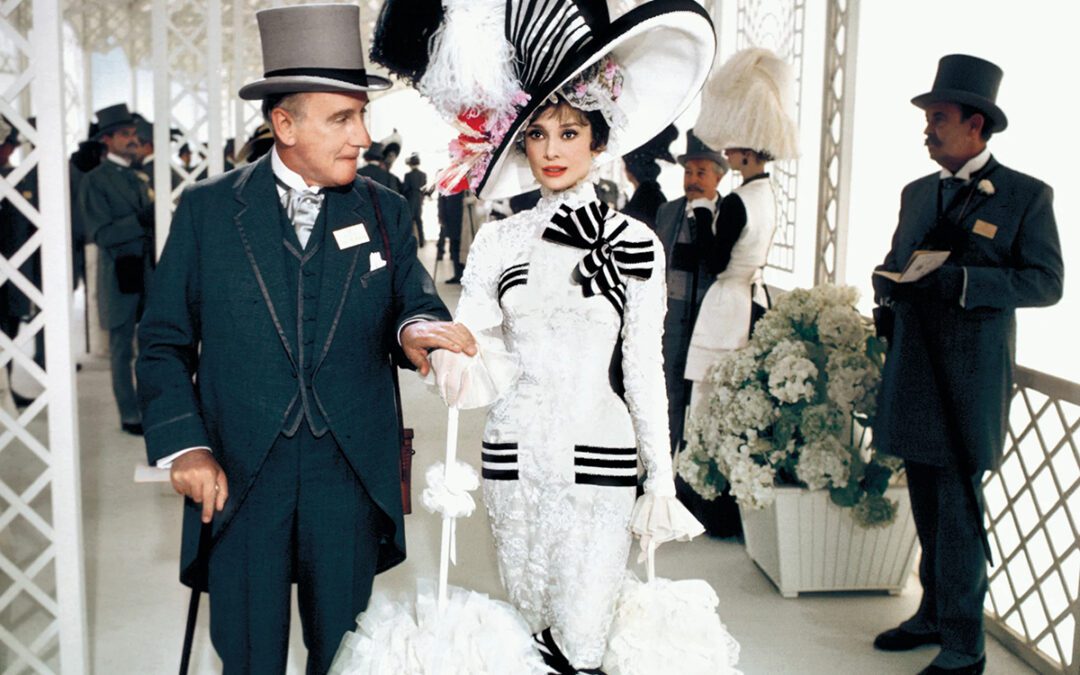
– Best Picture Movie Series: My Fair Lady (1:22:24) We continue this series with a Best Picture winner that did not age gracefully at all. My Fair Lady is one of the ugliest films to win the big Oscar over the years, and while that could have been fascinating if handled well, the film fails to stick the landing. Leaving audiences in a muck that just doesn’t sit well when the credits roll. Perhaps miscast, but Audrey Hepburn is innocent.
Best Picture Movie Series – 1960s: The Sound of Music
Help Support The InSession Film Podcast
If you want to help support us, there are several ways you can help us and we’d absolutely appreciate it. Every penny goes directly back into supporting the show and we are truly honored and grateful. Thanks for your support and for listening to the InSession Film Podcast!
Director:Anthony Russo, Joe Russo Writer: Christopher Markus, Stephen McFeely, Simon Stålenhag Stars: Chris Pratt, Millie Bobby Brown, Woody Harrelson
Synopsis: An orphaned teen hits the road with a mysterious robot to find her long-lost brother, teaming up with a smuggler and his wisecracking sidekick.
I used to think the gold standard of product placement in films was any Michael Bay Transformers movie or that moment when Brad Pitt took a satisfying swig from a can of Pepsi in World War Z, proving he was smarter than a world full of zombies who ran past him (and somehow not into him). But no—the Russo brothers told the entire world to hold their beers.
Not only do they discuss Panda Express at exceedingly ridiculous lengths (yes, I agree, everything they make is delicious—please send all Panda Express inquiries to the InSession Film email), but the Russos also create an entire character out of a mascot for a fine American company, Planters. Again, I love the Dry-Roasted variety—send all proposed business collaborations below.
Speaking of product placement, I am writing this review on a brand-new HP Envy laptop. With premium features, top-tier performance, and a high-resolution display, it’s one of the most versatile laptops on the market.
Now, do you see how distracting product placement can be—especially when it’s thrown right into the middle of this review? Yes, Anthony and Joe, we can agree that popular movies can (and should) be held in higher esteem. Here’s looking at you,Top Gun: Maverick, but not at the expense of ruining the story.
Based on the popular graphic novel of the same name by Simon Stålenhag, the story follows a teenager, Michelle (Stranger Things star Millie Bobby Brown), who lives with her abusive father, Ted (Jason Alexander). Michelle resides in a world under authoritarian rule after a war broke out between humans and robots in the early ’90s.
Fortunately for the human race, Sentre CEO Ethan Skate (Stanley Tucci) developed Neurocaster technology, allowing humans to upload their brains to drone robots, ultimately winning the war. As a result, all robots were banished to the “exclusion zone.” However, as a metaphor for the overuse and dependence on modern technology, humans escape their mundane lives through an established virtual reality, remaining in near-comatose states while robots handle all the work.
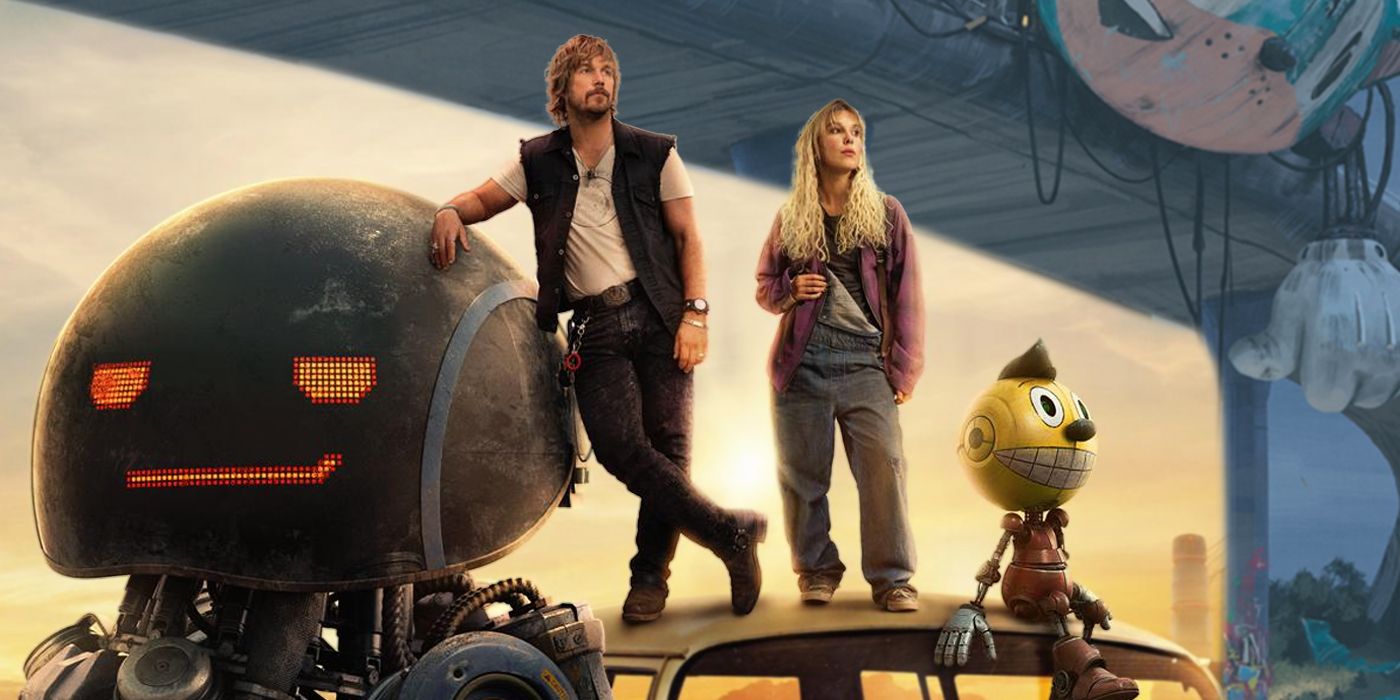
That is until an adorable robot named Cosmo—who communicates in a way reminiscent of Wall-E—runs into Michelle. She takes them in and soon realizes that this bot contains the uploaded mind of her deceased younger brother, Christopher. After a violent encounter with her abusive father, Ted, Michelle and Cosmo escape. As they venture into the dystopian landscape, they cross paths with Keats (Chris Pratt), a smuggler, and his towering robot companion, Herman (Martin Klebba). Together, they set out for the exclusion zone, hoping to prove that Christopher may still be alive.
The Russo Brothers didn’t just create the year’s biggest dumpster fire; they made a large metal trash receptacle on wheels filled with boxes of fireworks going off. It looks flashy, colorful, and expensive, as the filmmakers hope to use a barrage of bad CGI to cover up a story with little depth, unfunny humor, and—most importantly—such a lack of emotional connection that the big moment the film builds toward feels practically sterile.
This marks yet another Netflix film where Millie Bobby Brown encounters characters with little nuance as the studio attempts to cash in on expensive streaming entertainment that hardly works. I’m worried she will be typecast in these roles when she should focus on mainstream scripts like Enola Holmes, highlighting her strengths, like verbal and physical comic timing. Meanwhile, Chris Pratt does his usual routine. He looks like a disheveled, unkempt surfer living out of his van, going off on tangents that combine comedic relief with product placement word vomit that never seems to end.
To summarize, The Electric State’s story and performances are paper-thin. The movie is a recycled effort, which is also an issue that should be pointed out with the source material. The approach is heavy-handed when the film tries to focus on its core themes. Essentially, this is an expensive story about collective synergy and the idea that “family is what you make it.” Yet, it lacks cohesion and, even worse, fun—pure cotton candy cinema at its worst.
You can now stream The Electric State only on Netflix!
Synopsis:1969. Dr. Audrey Evans joins world-renowned children’s hospital and battles sexism, medical conventions, and the subterfuge of her peers to develop revolutionary treatments and purchase the first Ronald McDonald House, impacting millions.
There is perhaps no other genre quite as maligned as the ever-present biopic. I have been one of its many detractors as every year we are inundated with “important stories” or tales of untold greatness; from Leeto A Complete Unknown. It is no longer enough to tell these stories in a straightforward way. Because we are all aware of the tropes and signals of biopics, only the greats, like Oppenheimer or The Social Network, will stand the test of time. The rest, well meaning as they may be, are likely to be watched and forgotten. One of the reasons that the above examples are lasting is due to their decisions to focus on specific sections of their subject’s life. But the exact section matters.
Audrey’s Children is the latest on the biopic train, focusing on Dr. Audrey Evans. Evans pioneered treatment for Neuroblastoma, an incredibly deadly form of cancer which, before her advancements, killed 90% of patients, many of which were young children. She was also the Chief of Pediatric Oncology at the Children’s Hospital of Philadelphia. Further, she was one of the founders of the Ronald McDonald House, helping to provide housing for millions worldwide. And herein lies the problem. Choices must be made in what to cover, and for how long in a standard two-hour film. Entire movies could be made about the founding of the house, about her struggles bucking up against a misogynist system, or about her new treatment strategies.
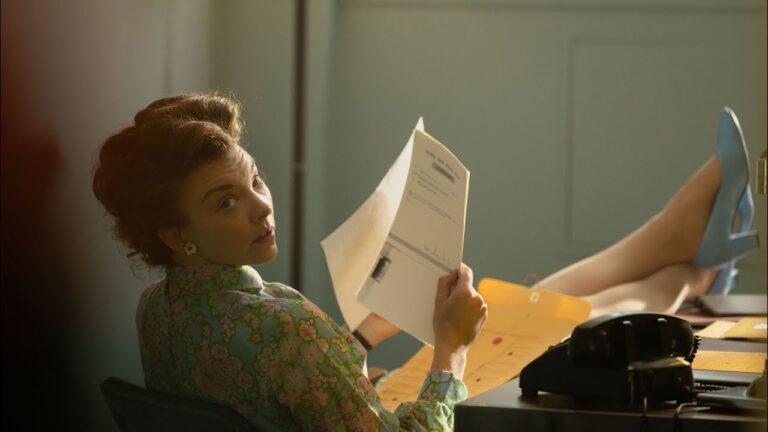
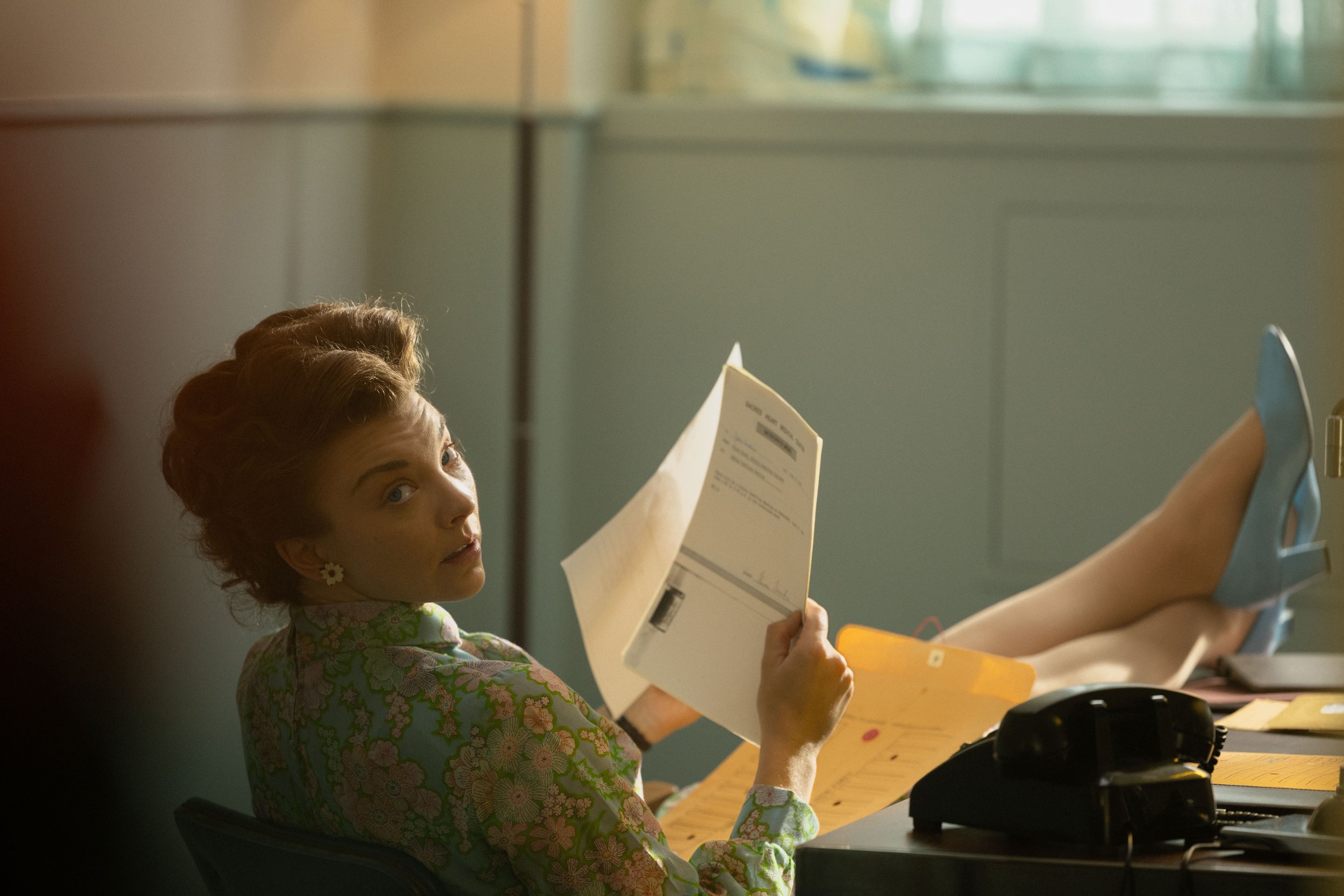
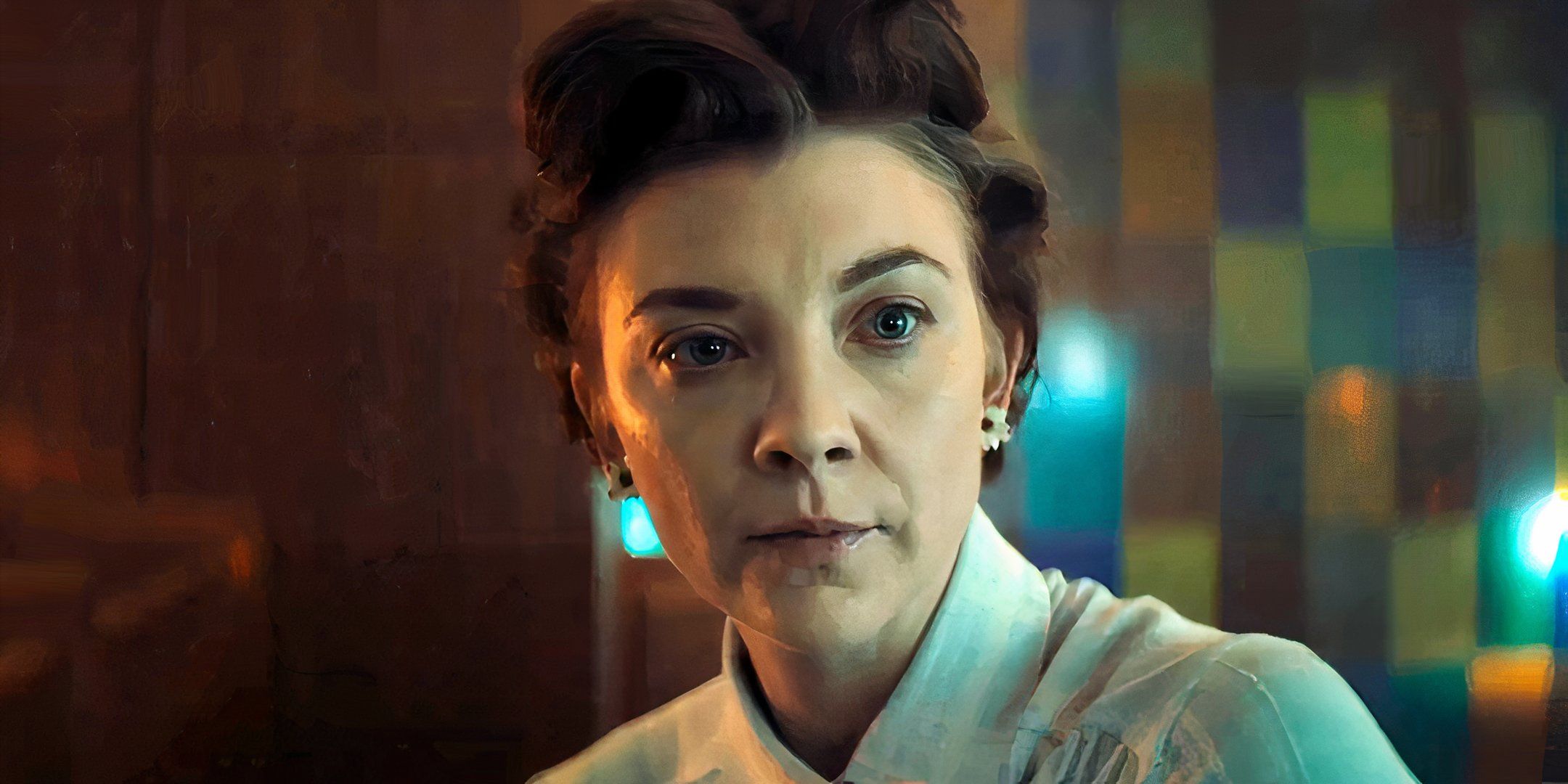
The film, instead, covers all of these areas. Director Ami Canaan Mann does an admirable job of balancing all of these ideas, from a script penned by Julia Fisher Farbman. The film begins with Audrey (Natalie Dormer) immediately making waves on the staff in Philadelphia, including Dr. C. Everett Coop (Clancy Brown) and Dr. Dan D’Angio (Jimmi Simpson). Dormer expertly performs the role with equal parts good humor, hardened focus, and kindness. This is a difficult performance that feels effortless, as all of these many plots hinge on Dr. Evans being both aspirational and charismatic.
The movie mostly gives lip service to the assumed sexism she must have faced before reaching the heights of her profession. This is understandable given the incredible life and accomplishment of Dr. Evans. Audrey’s Children has to make room for her research, her connection with her patients (the titular children), her incredible passion and intelligence, battles with hospital administrators, and even a burgeoning romance with Dan. None of these plotlines are problematic, in and of themselves, but the story seems a bit out of balance.
All of that being said, it is nearly impossible to not be moved by this incredible story. After all, the focus is children literally dying from cancer. Really, the moments where the film loses its motivation is when it is forced to set the time and place. One can almost feel the effort being made, despite little payoff. Although the production design (Amber Unkle) and costume design (Sarah Maiorino) do an admirable job, the film ends up looking just slightly muted. Audrey’s Children is at its best when focusing on the intensity of Dr. Evans and her relationships. Her back-and-forth conversations with Coop ring true, if a bit too focused on capturing the look of future Surgeon General. On the other hand, Simpson and Dormer together, though chaste, have an immediate spark and connection that is impossible to ignore. Despite the romance being a B plot, every time they are together, we simply want more. His gentleness, paired with her passionate desire for both life and the children afflicted by Neuroblastoma, makes for a relationship that pulls the movie forward despite its crowded screenplay.
As the film moves through her many accomplishments in the second half, it moves with a speed that is staggering in comparison to the rest of the plot. It plays as a bit of a greatest hits montage, and there is where the frustration can creep in again. The sheer amount of good that Dr. Evans has done, in many different arenas, ends up being what holds Audrey’s Children back from greatness.
This is a good, honorable story to tell. Despite many wonderful performances, a story worth telling, and emotional connection, Audrey’s Children will not be seen as one of the greats of this particularly difficult genre. However, it nowhere near the bad side of the biopic. Dormer, Simpson, and Brown all make this a worthy, if eventually forgettable watch.
Director:Marc Webb Writer:Erin Cressida Wilson Stars: Rachel Zegler, Gal Gadot, Andrew Burnap
Synopsis:A princess joins forces with seven dwarfs to liberate her kingdom from her cruel stepmother the Evil Queen.
As easy as it is to attack the Disney live-action remake machine, there is certainly a variety when it comes to quality. Cinderella (2015) is the gold standard, taking advantage of visual flourishes and an astounding villain performance. On the other side of the spectrum lies The Jungle Book (2016), a film so tedious that one struggles to remember anything about it besides Bill Murray half-heartedly voicing Baloo the Bear. As adults, it is important for us to remember two things. First, these movies are not primarily for us as an audience. They exist to pass the torch from father and mother to son and daughter. These stories, for better or worse, are the closest that we have to an oral tradition. Secondly, despite the perceived lack of originality, these movies can be done well.
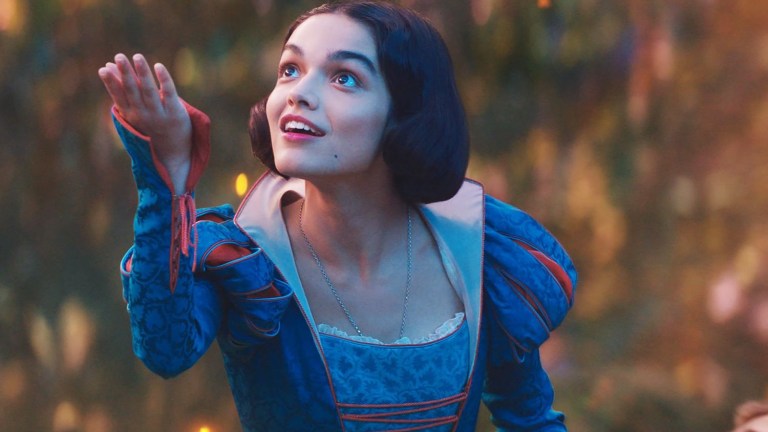
Snow White does not manage this in nearly any way. This is the story you know, mostly only in name, and that is not inherently a problem. This version of Snow White (Rachel Zegler) is much more active, as opposed to her namesake who essentially had a snack and a nap. This Snow was raised by a King and Queen and taught that the right way to live was through sharing resources among all of the subjects. Of course, very quickly, Snow White’s mother takes ill and dies. After, the woman who would become The Evil Queen (Gal Gadot) enters, marries Snow White’s father, and eventually sends him off to war, never to be seen again. Snow White essentially becomes a servant to the Queen and is struggling to find a way to help her people. After helping a dashing thief, Jonathan (Andrew Burnap), escape she eventually meets the dwarves and a group of bandits pushing Snow along her journey. The film, oddly, is a bit of a greatest hits of Disney, featuring introductory art that looks like Sleeping Beauty, a servant subplot that feels like Cinderella, and the costume of the original Snow White.
Rachel Zegler is the only person who manages to come out of this troubled film unscathed (the internet’s monsters, notwithstanding). That poor woman’s arms must be exhausted from carrying this movie toward being almost watchable. It is no secret that she is a talented singer (watch West Side Story (2021) for proof). Here, she manages to make the uninspired new songs from Pasek and Paul worth listening to for her tremendous performance, and is able to breathe new life into the classic songs from the original Disney version. She even managed to uplift most of her scene partners, both human and hideous CGI creations. Most, but not all.
Much has been said about Gal Gadot’s poor performance as the Queen and, somehow, the negativity goes nowhere to describing the pain she puts the audience through. Her line readings are terrible, as expected, but sadly, it does not stop there. Director Marc Webb, along with screenwriter Erin Cressida Wilson, decide to give her a musical number explaining that she is essentially a mean girl and there are almost no words to describe the experience. This extremely extended sequence, choreographed by Mandy Moore (La La Land), is full of exaggerated hand motions, missed notes, and leaves you begging for the end. It seems almost like a Mel Brooks musical moment, but played painfully straight. We talk (too much) about nepotism and its effect on the film industry, but here we have pretty privilege running amok. There is no possible way that she was the best person they could find for this role and every time she is on screen, fashion moments aside, Snow White comes to a screeching halt. Her acting makes us pine for the days of Angelina Jolie as Maleficent, an actual performer who owned the screen instead of making us turn away from it. When she becomes a hag, the continued poor effects work matches her acting prowess.
One of the biggest problems that this film has is the lack of true laughs or enjoyment. Is this because the dwarves all look horrifying? Only partially. The “jokes” aren’t funny, unless you consider the fact that a possible regent is supporting a share and share alike political system. Of course, with a large corporate identity like Disney, one cannot expect anything truly radical. This is the best we can hope for and a good message for children. It is just a shame that the movie surrounding it, both visually and narratively, is so excessively sloppy.
As much as we hope for a remake that takes chances and shows us something we could not see in our old clamshell VHS days, it still has to be done well! Once your eyes adjust to the uncanny valley of dwarves that are supposed to be both comic relief and have character journeys, it becomes ultimately clear that Snow White had nothing but a few good ideas, along with a perfect lead. Sadly, this, and all movies have so many moving parts, so many variables that can affect the end output. This simply has too much working against it. Middling direction, poor writing, horrifying animated characters, and the blackest hole one can imagine in its antagonist. Snow White might keep children mildly entertained for its runtime, but it will not be destined for repeat watches, even in the most pro-Disney home.
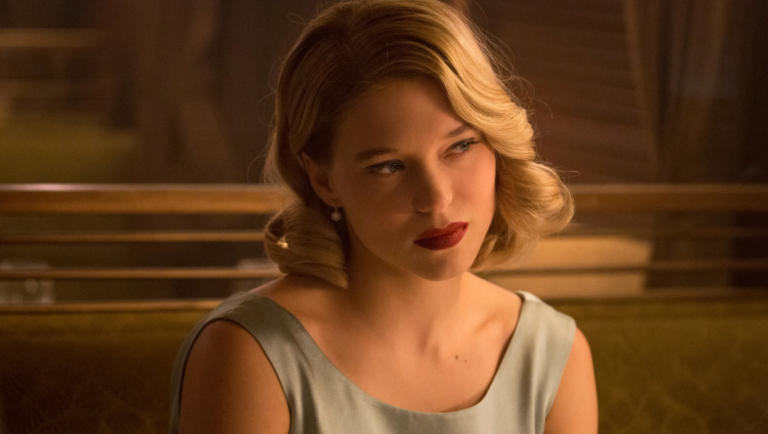
This week on Women InSession, we talk about the portrayal of Bond women over the years and the misogynistic elements that have defined their depiction. Some of those characters are still quite memorable despite the tropes that lift them up. Either way, there was plenty to discuss with the Bond girl. We also have a little conversation about Amazon’s take over of the franchise and the concerns we have.
Panel: Kristin Battestella, Zita Short
On that note, check out this week’s show and let us know what you think in the comment section. Thanks for listening and for supporting the InSession Film Podcast!
On this episode, Brendan is joined by Shaurya Chawla to discuss the Russo’s latest Netflix blunder in The Electric State! Spending $320 million on this project for the results we get here is nothing short of incredible. There is much to parse about the film regarding the Russo’s storytelling, where that money went and how lazy it is.
Review: The Electric State (4:00) Director: Anthony Russo, Joe Russo Writer: Christopher Markus, Stephen McFeely Stars: Millie Bobby Brown, Chris Pratt, Stanley Tucci
Director: David Yarovesky Writer: Mariano Cohn, Gastón Duprat, Michael Arlen Ross Stars: Bill Skarsgård, Anthony Hopkins, Ashley Cartwright
Synopsis: A thief breaking into a luxury SUV realizes that he has slipped into a sophisticated game of psychological horror.
This summer will likely be the summer of the gritty thriller genre. Novocaine has been out already exceeding box office expectations. Black Bag brings a twist on the spy thriller genre game with two hot leads and a hotter director. Now, David Yarovesky’s Locked releases in cinemas with much anticipation, and for good reason. It is one “Highway to Hell,” a rollercoaster ride of a movie that delivers everything it sets out to achieve.
Last year, I watched Bill Skarsgård in Boy Kills World and I wasn’t impressed. I felt that he needed a better film to place him as one of the upcoming movie stars of a turbulent, unpredictable period in the film industry, where nothing makes sense anymore, and the ebb and tide can crush a promising young actor in a minute. Then they released Nosferatu, but it was more of a Lily-Rose Depp star vehicle than Skarsgård’s, and even as he received praise, he still needed something worthy of putting his face on the screen.
This is where Locked comes into play. Some of the most enjoyable 95 minutes of my life, a film purely made for the big screen and one, that if someone is a thrill seeker or a midnight moviegoer like me, then this is the film to buy a ticket for. The claustrophobic survival thriller is an ongoing horror ride, one where the moment our protagonist enters the demon car -yes, that’s what I call it- nothing slows down. The action-packed flick goes on from there to draw in lovers of Skarsgård but also those on the hunt for the action movie that would keep them pressed to their seats, unaware of the passing time.
Formalities first: Eddie is a down-on-his-luck petty thief, a former delinquent with a baby face and family baggage. To pay a debt, Eddie breaks into a luxury SUV, thinking it’s his lucky day, but his labyrinth of pain starts when he hears the car owner’s chilling voice enthusiastically explaining Eddie’s dire situation as a hostage of the Death Proof-like automobile. The fun begins, and it feels like a sophisticated Jigsaw trap between Eddie and William (Anthony Hopkins), and with Skarsgård’s star power and Hopkins’s chilling performance, it can’t get any better. It’s “Eat the Poor” as if the rich are given the chance to strike back after a series of now predictable films about the working class rising to flip down the social order and consume the rich. Now the rich get their payback time and it’s so fun to watch.
Events unfold quickly without losing Eddie’s sense of humanity, whom audiences slowly warm up to as the harsh cases of his imprisonment become more and more emblematic of the sinister nature of William’s faux moral system. William exacts his punishments like a scary Biblical figure, his utter dismissal of Eddie’s vulnerability seems baffling, but as the film progresses it becomes clearer where his disturbing moral code stems from, and it’s a fun cat-and-mouse game between two wonderful actors.
Locked would have never worked out without the stellar performance from both leads, Skarsgård and the veteran Hopkins who mostly appears as a cold, detached, psychopathic voice. But the credit goes more to Skarsgård, who is at his best here, flipping from anxiety, bitterness, and rage, all the way to despair. Playing a character out of his comfort zone -which is primarily nonexistent at that point- he bares his beautiful face, but uses the physicality of a down-on-his-luck man, creating an illusion of fractured beauty, a man beaten down by life and its cruelty left its marks on him. He basically acts with himself, a one-man show for the masses, and Bill’s girlies are in for a treat because even with blood pouring down his face and some mild gore (and gross out) moments, he looks hotter than ever.
Locked doesn’t weigh itself down by asking questions or giving answers. It doesn’t set a firm line between victim and perpetrator and in that lies its magic. The magic of that obscure action thriller that one discovers randomly on a trip to the movie theater, oblivious to the buzz of film tweeters and movie recommendation channels. Go watch it on a big screen where it belongs.
Synopsis:When Scott and Teresa LeRette learn that their son Austin is both autistic and has brittle bone disease, they initially worry for their son’s future. But with Scott’s growing faith and Austin’s incredible spirit, they become ‘unbreakable’, finding joy, gratitude, and courage even in the most trying times.
As distressing as it is that quote-unquote inspirational, faith-based dramas continue to get made on a churn-happy assembly line that is somehow only slightly less bankrupt than the films it produces, it’s relatively easy to understand why once you’ve suffered through one. So long as an audience member is unwilling to ask any questions of the substance being violently jammed down their esophageal tubes over two hours and change, these movies have the Power™ to make people feel better about themselves. Most of the time, those behind the one-way mirror supplying this force believe that they are doing so in a manner that their God would approve of, hence the “no questions asked” policy that many viewers believe should be the de facto rule when it comes to their adulation for such works. You might have noticed that most Sound of Freedom truthers were happy to take umbrage with any minor theatrical inconvenience that disrupted their screening of 2023’s most problematic (and, domestically, 10th-highest grossing) feature presentation, but questions about whether or not the film stokes the QAnon movement’s favorite conspiracy theories should not be levied so long as they reside in one of the 50 glorious United States of America. (Or are we at 51… have we commandeered Greenland yet?)
Gavin Warren as Logan and Jacob Laval as Austin in The Unbreakable Boy. Photo Credit: Alan Markfield
For these reasons – among other, similarly pitiful ones – the folks at Angel Studios and their brethren alike continue to creep in their petty, cinematic pace from day to day, with Kingdom Story Company being but one of the growing many. The Lionsgate offshoot behind Ordinary Angels (shockingly solid), the KJ Apa vehicle I Still Believe (uhhhhhh…), and Jesus Revolution (UHHHHHH…) were built on the ideology (and reliable profits) of films by the Erwin Brothers and, since 2019, have had their clasped hands in nine different projects, all of which manage to sound and look like the same sunny glint from the heavens that repeatedly takes on the most basic, rudimentary approach to personal growth. If ChatGPT has yet to develop a Biblical arm, it’s probably being programmed by someone in their ranks. Thoughts and prayers, as they say.
Case in point: Jon Gunn’s The Unbreakable Boy, though with this film, the top believers somehow stumbled even further into the depths of Hell by doubling down on their Zachary Levi stock. Just four short years after RFK Jr.’s could’ve-been running mate starred as Kurt Warner in Kingdom’s production of American Underdog, the odyssey of a grocery store shelf stocker who became a Hall of Fame quarterback, all thanks to the man above, Levi returns here as Scott, the man in need of a spiritual awakening. Will it come in the form of a relationship with Teresa (Meghann Fahy; innocent, methinks) that is rushed along by a surprise pregnancy after date number three? As a cause of that eventual birth, one that brings Austin – their autistic son who also has the same Osteogenesis imperfecta (“brittle bone” disease) as his mom, though hers is a mild case – into the world? The revelation that his heavy, midday-to-midnight drinking might represent a real problem?
It should come as no surprise that the answer to all of the above is “yes,” both because The Unbreakable Boy is based on the true story of the LeRette family, one to which it is ostensibly faithful, and because there’s no other direction for the film to go. Once Austin (Jacob Laval) is introduced, the film’s title is given a physical and supposedly emotional representation, but even his most compelling moments in this anecdote-based sketch of a character’s life feel like offramps deliberately implemented to provide Scott with a way through what the film believes to be an infinitely more complicated journey. To make matters worse, Gunn’s most concerted efforts to make what could have been the heartwarming tale of a theoretically-different kid’s discovery that it was never his job to fit in, but for others to accept him for who he is, seem designed to bolster audience satisfaction scores. Remember, as long as we end a movie feeling validated re: how we’re all good people, it doesn’t matter what the movie actually has to say, how it says it, or if it bothers going beyond the surface at all.
Every introduction of a new character aims to serve this same goal. Scott’s parents (Patricia Heaton and Todd Terry) only pop up to give Austin a less enthusiastic hug than they gave their other grandchild, Logan (Gavin Warren), or to reassure their son that his bad choices don’t define him. Teresa’s sister (Amy Acker) essentially does the same, reminding the former that Scott is nothing like their Dad; his drinking went on for years, she says, while Scott’s has only been a real problem for… well, about a decade, but still! The two men Scott can regularly confide in come in the forms of his lifelong imaginary friend-slash-conscience, Joe (Drew Powell) and their local church’s preacher (Peter Facinelli), whose bond with Scott grows as they discover they have much more in common than just the Higher Power they theoretically share.
Above all of its many detracting elements, The Unbreakable Boy can’t even be bothered to mine the right lessons from its painfully obvious set pieces. That is, if there are “right” takeaways to be had, given how thinly they’re all drawn. Attending, let alone speaking at an Alcoholics Anonymous meeting should be categorized as a step in the right direction for any human being who struggles with such a cunning, baffling, and powerful disease, but Gunn’s film treats each of Scott’s revelations in those settings like the aforementioned Warner probably felt each time he won his way to a Super Bowl. When Scott and Teresa fight for their son’s right to stay at the school that opted to direct the family to a care center more capable of aiding Austin’s special needs, it’s the teachers and students who are afforded an assembly to celebrate their hand in bringing him back, not his family nor the unbreakable boy himself. Even as the narrative crawls its way toward its inevitable, cloying conclusion that Austin was always going to be the one to fix his dad, not the other way around, it’s hard to buy any of it given the common knowledge that its star supports an administration that believes vaccines cause neurodivergence. One can only hope that Levi’s insistence on how it was less important to save his career than to vote the way he did actually has some real ramifications.
That prayer might make its way from moviegoer’s mouths to God’s ears, but if Kingdom-esque companies have anything to say about – and they are literally the ones who have something to say about it – it will only be a matter of time before his beliefs and those of others like him (looking at you, Caviezel) will be plastered across yet another poster and/or trailer urging us to open our hearts to love and acceptance. (At the moment, Kingdom Story has four films in various stages of production.) What’s ironic is that the studio has yet to open their own hearts to anything that isn’t already festering within the dingy cavern pumping blood, oxygen, and blindness to the brain. The Unbreakable Boy is no different, a shortsighted, ill-conceived document that proclaims to have seen the light while it only actually cares about banging the drum its makers have been recycling since they opened their doors. The shell is hollow; if only the noise it unfortunately continues to create wasn’t so loud.
The Unbreakable Boy will be available to rent on PVOD on April 4.
Synopsis: In the capital of Transylvania, Cluj, Orsolya serves as a bailiff. She has to evict a homeless guy from a cellar one day, which has disastrous results and sets off a moral problem that Orsolya must try to resolve.
When I finished watching Do Not Expect Too Much from the End of the World at the 2023 New York Film Festival, I immediately thought that Radu Jude was becoming a protegee of Jean-Luc Godard in his own right and manner. Jude, like Godard, is not shy about speaking his mind about whatever people ask him about or asking himself questions about modern society and its inhabitants. The frustrations of the pandemic era, labeling, and privacy in Bad Luck Banging, or Looney Porn. The intellectuality of Europeans, influencer culture, and Romania’s government and its unwillingness to change in the aforementioned picture. The historical amnesia that societies have regarding the racial and ethnic exterminations of minorities in I Do Not Care if We Go Down in History as Barbarians.
All of his features have that bravery and boldness that Godard contained; one might even say that Jude, in terms of politics and thematic exploration, is far more ballsy than the French cinema legend. But after watching his latest work, Kontinental ‘25 (screening in competition at the 2025 Berlin International Film Festival), he is becoming one of those essential filmmakers of our time–one above all, with his ability to portray the world around us in all of its coldness, ugliness, and ignorance. Many contemporary directors hold a mirror to society and make us think about how we can be better humans. However, none have Jude’s creativity, work ethic, and panache. In his latest experiment, the Romanian filmmaker tackles, as usual, an array of topics that are currently plaguing the world–generational racism, the housing crisis, the Russia-Ukraine war, and our post-pandemic melancholy–through intricate observations.
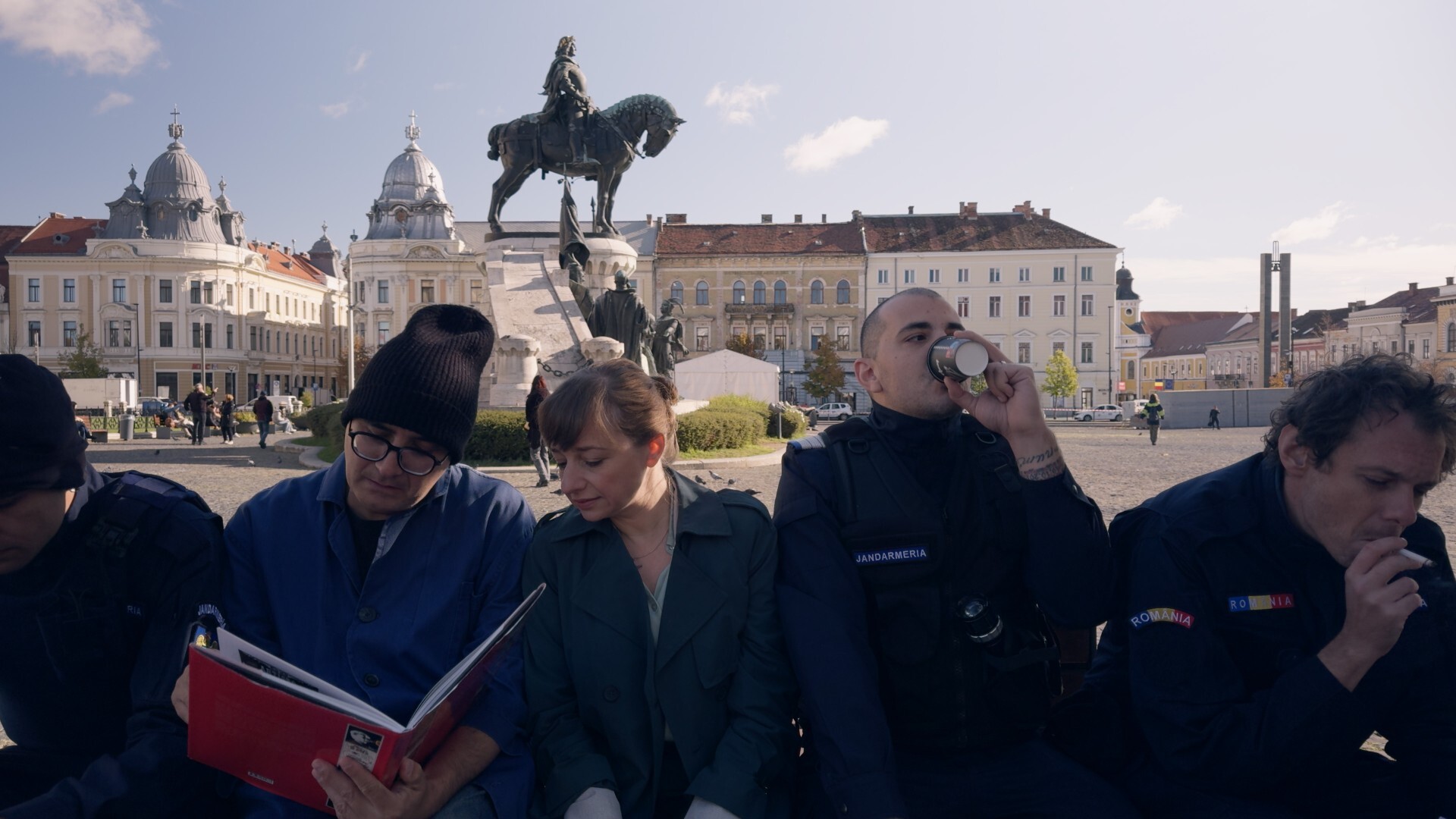
Kontinental ‘25 begins with the drowning guilt and existential crisis of Orsolya (Eszter Tompa), a woman living her daily life as a bailiff in Cluj, a city in northeastern Romania. She is overseeing the eviction of a homeless man named Ion (Gabriel Spahiu), who has been staying in the basement of an abandoned building for a long while. He squats on the bottom floor with nowhere to go, as there haven’t been any repercussions. Until now, the building has been sold to some real estate developers. So, Ian is forced to leave the premises. But the man does not want to comply with Orsolya’s orders. Hence, he decides to kill himself in the basement he has been lodging in. This leaves the bailiff completely traumatized and riddled with guilt. Why? Because she was the one who ordered the eviction.
As cinephiles might have noticed with the film’s title and cold opening, Radu Jude references Roberto Rossellini’s 1951 Europa ‘51. In the film, Ingrid Bergman’s character, Irene Girard, starts to devote herself to ending the suffering of the poor after her young son commits suicide. The film follows Irene as she leans towards humanitarianism to help those around her, especially ones in need. Rosselinni explores how we can make the world a better place if we stick together and assist the people who are rejected by society. Meanwhile, Jude sees how everything has changed and that our decisions have less humanitarian sensibility. One person can try to help, but those around them do not bother to do so. This is Orsolya’s predicament in Kontinental ‘25.
Her morals fracture entirely, leaving behind a body slowly losing its vivacity amidst the trauma caused by such an incident. Even though she tried to help Ion by extending the eviction a couple of times, Orsolya still mourns and feels culpable about his death. The story then takes a loose approach by focusing on conversations and dialogue rather than actual events transpiring. Jude utilizes this cold open to pave the way for what he wants to explore, which is a picture of our constant questioning and fluctuating ethics, both from religious backgrounds and past experiences. From this point on, in whichOrsolya finds herself responsible for Ion’s suicide and has some kind of existentialist crisis, Kontinental ‘25 shows us the daily lives of these characters, where the incident (or their opinions about it) shift their actions, responses, and expressions.
Jude’s characters are often complex and vulnerable in one way or another; they continually grow or plummet into their doubts, self-questioning, and life struggles. Most importantly, they are vessels for the philosophical and ethical notions that Jude wants the viewer to ponder. Some gags, quips, and juxtapositions heighten the film’s sense of reality to some degree, although without the potency and cinematic piquancy that Do Not Expect Too Much from the End of the World contained in spades. One of the faults Kontinental ‘25 has is that it feels like Jude’s work is restrained in experimentation and political ruminations. However, his commitment and leniency towards demonstrating essential topics and subjects currently plaguing Romania without sugar coating or cushioning them adds to the film’s effectiveness and staying power.
No subtext or metaphors exist, only cold-face truths through evocative, daring screenwriting. It gives Kontinental ‘25 a sense of urgency and importance, never leaving these societal critiques to lose meaning amidst the story’s many narrative beats. Another filmmaker would have had a different approach to the film; they would have depended on allegories to have some effectiveness. And while Jude has done much in the past–and to his benefit–the departure to do that in his latest makes the film more contemplative. It is challenging for some viewers to engage with for the entire runtime. Each scene contains a specific theme and commentary–almost like a vignette, although the scenes connect entirely–which is tricky to grapple with initially since all of them are crucial. However, it rewards those who are patient with a film that is tightly woven and substantial.
Synopsis:A pastor and a detective, driven by their beliefs, pursue a missing person case, with the pastor seeking retribution after a divine revelation identifies the culprit who abducted his son.
Two years after the disappointing JUNG_E, South Korean director Yeon Sang-ho is back with yet another Netflix original title, Revelations, which tackles the subject of religion or, more aptly, divine interventions. Sang-ho became a household name in modern South Korean cinema when his 2016 Zombie flick, Train to Busan, was a massive crossover success, so much so that Hollywood was almost instantly bullish on greenlighting an English-language remake, with Timo Tjahjanto in the director’s chair.
Whether or not it will see the light of day remains to be seen, as we haven’t heard many updates on the status of that remake. However, the best thing to have come out of this international acclaim was for audiences to continue following Sang-ho’s work beyond his Zombie franchise. From the hyper-stimulating Psychokinesis to his terrific television series Hellbound and Parasyte: The Grey, his voice is one of the most exciting in South Korea and in genre cinema as a whole. While his last movie failed to instill the same form of excitement as many had watching Train to Busan, Revelations may well be his best ever.
It could seem like hyperbole for someone to say this, but this critic has been more let down by Sang-ho’s work than enthralled, especially his recent feature film output (Peninsula? Good lord). In Revelations, he takes a relatively simple premise, the disappearance of a young churchgoer, and turns it into a riveting police procedural with some of the most dynamic and spiritually-charged camerawork I’ve seen since John Woo’s 2024 reinterpretation of The Killer.
Of course, Sang-ho isn’t painting a positive portrait of the South Korean Megachurch empire, nor does he want us to sympathize with both protagonists who we’re going to spend 122 minutes with, pastor Sung Min-chan (played by Alienoid’s Ryu Jun-yeol) and detective Lee Yeon-hui (Shin Hyun-been). Both of them have inner demons they wrestle with for the bulk of the runtime, with one of the characters eventually letting them take hold of himself as the story takes multiple dark avenues.
Still, it’s interesting to see that the filmmaker has much more to say about how religion, or more aptly, devotion to a messianic figure, corrupts the human soul than the entirety of Edward Berger’s Conclave, which was lauded for examining the roots of corruption within the Catholic Church. That Oscar-winning film did shed light on its dubious practices with a relatively incurious lens and only used the backdrop of the Vatican as a prop for its “papal gossip” drama. It never bothered to engage with any of its religious imagery: what the mantle of the Cardinal means in the eyes of the Church, how many people do not see the Pope as a figure of responsibility and hope, but power, and how several members of the Church will use their “connection” with God for their own gains.
In the first thirty minutes of Revelations, Sang-ho immediately tells us that its main protagonist has a twisted view of what religion should strive to achieve and fills each ounce of his frames with as many strong images as possible, such as a thunderstorm reflecting on a rock that – strangely – looks exactly like the face of Jesus. That’s enough to make anyone who thinks they have a close connection with the Lord believe that He is speaking directly to them. It may be as unsubtle as a Zack Snyder religious subtext, but when it reflects upon the pastor’s eyes (through a staggering close-up), one has the idea that this movie will not take a happy turn and consistently pull its audience further and further inside Sung’s descent into sin.
Revealing anything about the plot would rob you, dear reader, of the multiple surprises Sang-ho has in store for you as the movie progresses. That is why this review has only mentioned the bare bones of the story to keep everything under wraps. Its opening scene may seem unimportant in how Sang-ho introduces each moving piece and has the characters intersect in the same mile radius when none of them know each other, but it quickly becomes the most important section of the movie when the filmmaker reveals more information on the plot. It’s so intelligently constructed, and meticulously cut together, that we become immediately attracted by its hypnotizing, evocative imagery and how each close-up of a character discovering something crucial to the case communicates with each other.
Sang-ho is in complete control of his visual storytelling, knowing precisely what to show (and what to keep under wraps) to keep the audience guessing at all times and ultimately deceive them. These deceptions – or, more aptly, revelations (see what I did there?) – end up being the film’s funniest sequences, with a sick sense of perverse humor that few filmmakers would even dare attempt to do and execute so well. One scene, in particular, the apotheosis of a confrontation between two opposing characters, ends with a twist that is so darkly funny that one may think Revelations is the year’s most hilarious film. The cathartic release of morbid laughter we get out of watching these sequences play out is exactly where the director wants us to be. As much as we want to be two steps ahead of the script (at some point, we know more than most characters do), we fall right into Sang-ho’s trap and are instantly blown away when we realize they’ve been tricked all along.
Such impeccable precision in its structure wouldn’t have been possible if the acting wasn’t on point, and, luckily, Sang-ho has two impeccable turns from two highly talented figures of South Korean genre cinema leading the fray. Jun-yeol retains a form of catholic innocence that compels us to his character until he becomes sinful and has no desire to repent. This shift continuously makes him riveting, even if it ultimately becomes complicated for the audience to latch onto him when he descends further into impiety. On the flip side, Hyun-been’s turn as the detective is a bit more dramatically layered than the pastor due to a past trauma continuously haunting her, giving some dramatic heft to the proceedings and tangible stakes when the film’s denouement becomes a race against time.
It’s at that point where Revelations becomes a run-of-the-mill, conventional thriller, even if its final shot is an early contender for the most potent symbolism of the year. While I was a bit disappointed in how the movie wrapped up, what comes before is nothing short of exceptional. It’s unfortunate that all of us are forced to experience such an incredible motion picture at home. Sang-ho’s visual precision is worthy of the big screen treatment, and his sense of visual poetry remains unmatched. Here’s hoping his next directorial effort doesn’t get dumped on Netflix and gets the IMAX treatment it so deserves.
On this episode, Brendan is joined by Maxance Vincent to discuss the new Steven Soderbergh film Black Bag! It’s been one hell of a year for Soderbergh so far. Not only is Black Bag his *second* film of the year (and it’s only March!), it’s arguably the best film of the year so far. We had a great time talking about this film and why Soderbergh is on an absolute tear at the moment.
Review: Black Bag (4:00) Director: Steven Soderbergh Writer: David Koepp Stars: Cate Blanchett, Michael Fassbender, Marisa Abela, Pierce Brosnan
Synopsis:Three middle-aged couples come to grips with universal questions about marriage and fidelity, professional success and failure, and the challenge of finding a second act.
While it’s certainly not impossible for movie studios to make and/or release proper dramas for adults these days, it seems far more difficult for them to ensure that their hired guns are able to execute the mission at hand. If Millers in Marriage is the litmus test, the latter doesn’t merely “seem” to be the case: It’s a fact. The latest effort from multihyphenate Edward Burns – who has written, directed, produced, and acted in all 14 of his features – only works if you’re willing to accept the signature wine-soaked mélange of sex, affluence, and well-furnished homes with open concept floor plans that Burns has made the principal pillar of his artistic career at face value. Dig any deeper and you’ll start to twitch, one soap opera-worthy line of dialogue at a time.
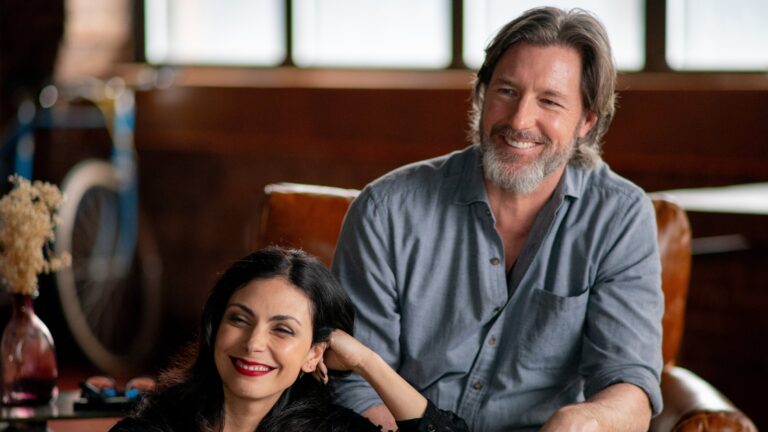
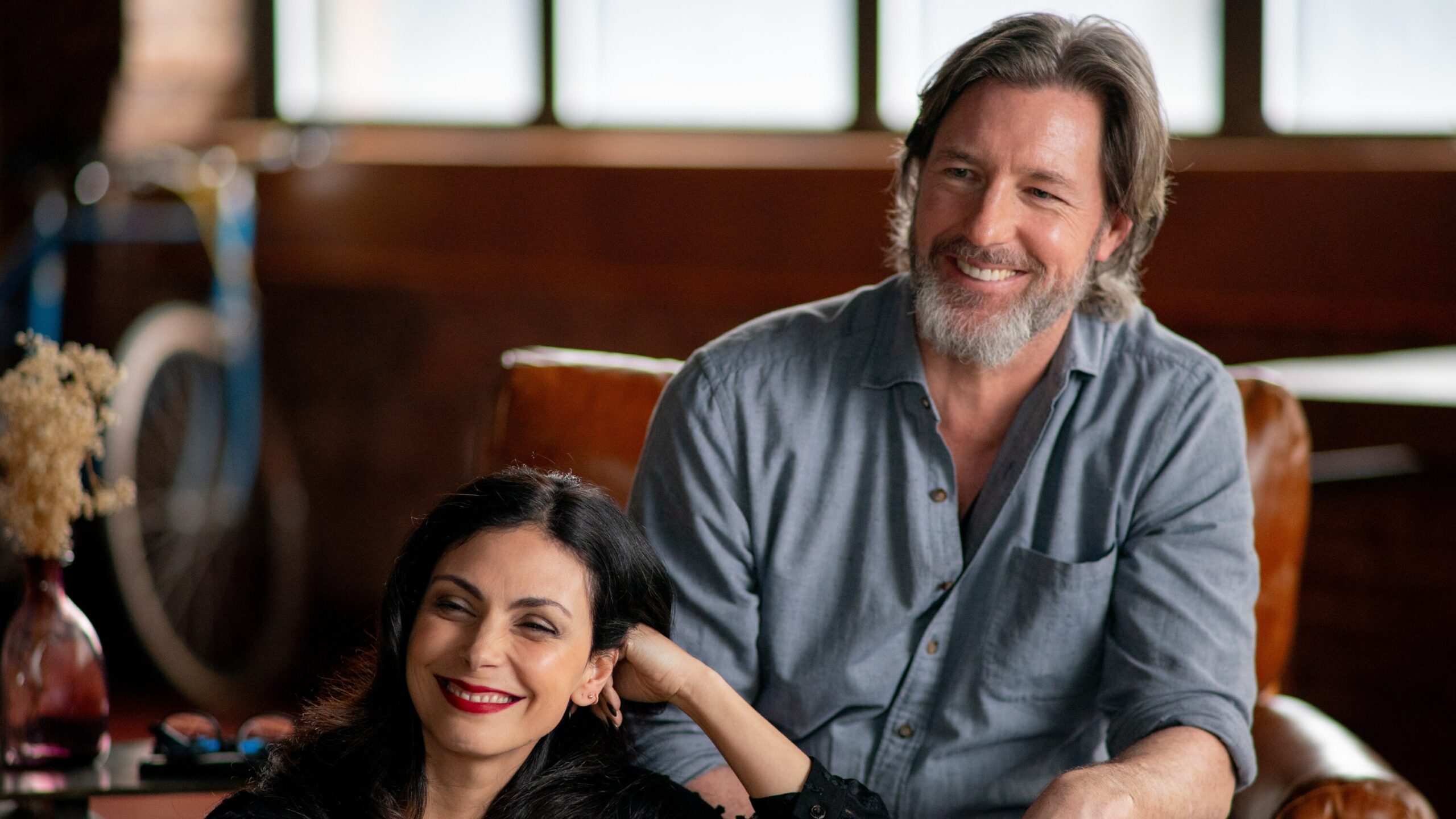
Perhaps there’s a sliver of charm to one man’s insistence on writing entire scripts that sound like matured variations of the classic “You’re giving up on your dream, son!” refrain, but there would certainly be more to appreciate if this slice of life story wasn’t so lifeless. Millers in Marriage, like most of Burns’ features, is a drama focused on relationships, with those at this tale’s center being that between three siblings (the Millers) and their individual partners. All involved are artists of some sort, which naturally make them the foremost authorities on love and the very concept of intellectualism, though… gee, how do I put this… none of them should ever be allowed to talk about either topic, nor many others. Burns plays Andy, a painter who recently separated from his wife, Tina (Morena Baccarin), and entered a relationship with the same ex’s former colleague, Renee (Minnie Driver, the best part of the film). The trouble, wouldn’t you know it, is that Tina still captures part of Andy’s attention, causing a deceit-laden rift in his burgeoning romance with the new woman in his life, the one who knows what she wants.
Elsewhere, the second Miller, Maggie (Julianna Margulies), is enjoying the life of a successful novelist, one who has just finished her latest manuscript, and it’s all but guaranteed to be next summer’s hottest beach read. Her husband, a fellow writer named Nick (Campbell Scott), can’t get out of his own head, thus spinning his wheels in a writer’s block rut that proves difficult to escape. “Nick not writing is like Nick’s heart not beating,” Maggie notes – with a straight face, mind you – early on in the film, but she also doesn’t seem to mind being the more prolific half of their relationship. She doesn’t mind the praise that comes her way, specifically from Dennis (Brian d’Arcy James), a friend with whom she once slept once, especially when things with Nick are on shaky ground. The latter’s snarky attitude towards Maggie’s writing never goes unnoticed; Nick’s work “takes precision and focus,” he says, while Maggie can just spin mindless tales about horny Manhattan moms with “trainers they wanna fuck.” In other words, they’re the poster children for supportive partnerships.
Finally, we have Eve, passionately portrayed by Gretchen Mol in the heftiest role of the three Millers. Once a promising singer-songwriter, Eve left the indie musician life behind when she got pregnant and married Scott (Patrick Stewart), her then-manager and now-tumor of a hubby whose rampant alcoholism is used more as a deliberate way to push the two apart than a potential reason for them to come together. That would never work, though, as there’s zero doubt that he is a more effective bully than he ever was a husband or manager. The counter offensive to Scott’s poisonous presence is Johnny (a charming Benjamin Bratt), a music journalist who takes every opportunity to remind Eve that he had a crush on her back in the day, yet given that not-so-subtle approach to igniting a flame, it doesn’t appear that this infatuation ever dissipated, at least not fully.
Occasionally, these folks all come together for a dinner, but it’s more likely that they’ll be seen in twos, either sharing a bottle of vino or enduring over-the-phone chit chats that extend well into the night. All of their relationships, like clockwork, tend to be on the verge of changing, being threatened, or being questioned, sometimes all at once. Yet while decisions are certainly made by the Millers and their significant others through this interwoven triptych, the film itself exists in a stagnant, “on the verge” state. The characters in Millers in Marriage don’t develop so much as they exist on paper, and just the first page, the one in which they are cleanly described and, if we’re lucky, given a hair color so we can conjure up some image in our mind. The single blessing that viewers are afforded in this case is that they are viewers, not readers. Otherwise, they’d be up a creek without a paddle, if they even elected to get in the boat in the first place.
To be fair, things do happen over the course of Millers in Marriage’s two-hour runtime, but things of consequence? Let’s not kid ourselves. This is a film by the talented, pleased-to-be-aimless Edward Burns, a meandering stroll on Central Park West where we aren’t even afforded the excitement of getting mugged. In his Irish Catholic cinematic worlds, responsibilities are optional, dreams are a must (as long as they aren’t too detailed), and romantic crises are mandatory. But the thing Burns fails to understand about including said plights in his films is that in order to be interesting, it’s imperative to be invasive. One would assume that he can’t continue to probe without ever going so far as to puncture, yet Millers in Marriage exists. (“He can’t keep getting away with this!” etc.) As far as this particular viewer goes, the umpteenth crack at this Wile E. Coyote-esque viewing journey simply has to be the last, for sanity’s sake. Hey, at least it’s not my dream I’m giving up on.
This week on the InSession Film Podcast, inspired by Steven Soderbergh already having two films out this year, we thought it would be fun to go through all the year’s where directors had multiple films out in a given year! But we don’t just stop there, we rank our Top 10 pairings and determine which director had the best double feature. Finally, we continue our Best Picture Movie Series with the 1963 film Tom Jones!
– Director Double Feature (14:04) It’s always interesting when director’s have two films come out in the same year, and it’s even more surreal when you realize that some of the best films ever made are featured in this context. To name a few, Steven Spielberg (who has done it twice), Alfred Hitchcock, Ingmar Bergman, Francis Ford Coppola, Martin Scorsese and Akira Kurosawa have all had multiple films in a given year. So, to make it even more fun, we decided to rank the top 10 combos of films that these directors have released in a single year. It wasn’t easy to narrow down, but this was a really fun discussion.
– Best Picture Movie Series: Tom Jones (1:10:52) We continue this series with one of the more overlooked Best Picture winners in Tom Jones. It doesn’t have nearly the reputation as many of its contemporaries, and after seeing the film, it’s easy to see why that is the case. Tom Jones is quite the departure from others who have won the big Oscar. Its comedic flavors do give it an interesting legacy, but we argue that it has its limitations as the film is uneven in execution, despite its genuinely compelling subversions.
If you want to help support us, there are several ways you can help us and we’d absolutely appreciate it. Every penny goes directly back into supporting the show and we are truly honored and grateful. Thanks for your support and for listening to the InSession Film Podcast!