



Director: Aaron Sorkin
Writer: Aaron Sorkin
Stars: Mikey Madison, Betty Gilpin, Jeremy Allen White
Synopsis: Follows Frances Haugen, a young Facebook engineer, who enlisted the help of Jeff Horwitz, a Wall Street Journal reporter, to blow the whistle on the social network’s most guarded secrets.
While talking with fellow critics and scrolling through social media after the screening of Aaron Sorkin’s highly anticipated The Social Reckoning, I couldn’t help but take in colleagues’ observations about the follow-up to The Social Network. And not just the anticipated debate about how David Fichtner’s sleek, propulsive, cerebral, and quietly menacing vision of Facebook’s inception contrasts with Sorkin’s theatrical, earnest, even adversarial, and very Capra-esque lens of the platform’s descent into depravity.
It was the realization that a universal opinion is that The Social Reckoning tells us the state of the world we already know (and hopefully despise). That statement made me think not of how far we have come, but how far we have fallen. While I assume many will respect, one that I cannot help but admire, Mr. Sorkin’s straightforward approach, perhaps we are missing the point. The fact that we can watch a scene filled with so much hate desensitizes us as a culture to racial prejudices that continue boiling over and cannot possibly be contained.
The Social Reckoning signifies the era of moral collapse. It looks at a technological achievement meant to bring people together, not tear them apart. The kind of norm-shifting that began to target loneliness and the need for connection brought people together through fear, prejudice, and anger, finding a highly profitable and toxic combination of morbid curiosity and a little thing called attention economics. Yet Mr. Sorkin avoids falling face-first into exposition overload and makes a film that’s so entertaining, so accessible, and somehow incredibly hopeful.

The Social Reckoning proves that reflection is never a weakness, and Mr. Sorkin’s poetry helps prove that point.
The opening scene is startling: two police officers of color stop to help a young white blonde woman (Portia Doubleday of Mr. Robot fame) stranded on the side of the road. She is combative, rude, ornery, and overtly racist. So much so that she is arrested for making deadly threats while recording the entire sequence on her cell phone. Later, a data engineer in Facebook’s compliance department, Frances Haugen (Anora’s Mikey Madison), recognizes her as an old friend who used to volunteer with her on Democratic campaigns.
Frances, socially awkward but strong-willed, begins to wonder how the woman she once knew became radicalized so completely. When she starts to investigate, her colleague (Heart of the Beast’s Anna Lambe) tells her to drop it because she has college loans. Then, when Teddy (A Big Bold Beautiful Journey’s Billy Magnussen), the public relations face of the tech company, fails to give her the time of day to report her findings, Frances receives an email from the man Teddy has been telling everyone to avoid and report if he comes into contact.
That would be Jeff Horwitz (The Bear’s Jeremy Allen White), a Wall Street Journal investigative reporter out of the San Francisco bureau. Jeff sent everyone in her department a personalized email seeking information on Facebook’s professional facade versus the internal willful blindness to what their data represents. With help from his editors (GLOW’s Betty Gilpin and The Wire’s Gbenga Akinnagbe), Jeff and Frances work to expose a tech company hiding its moral decay behind addictive likes, shares, and so-called friendships.
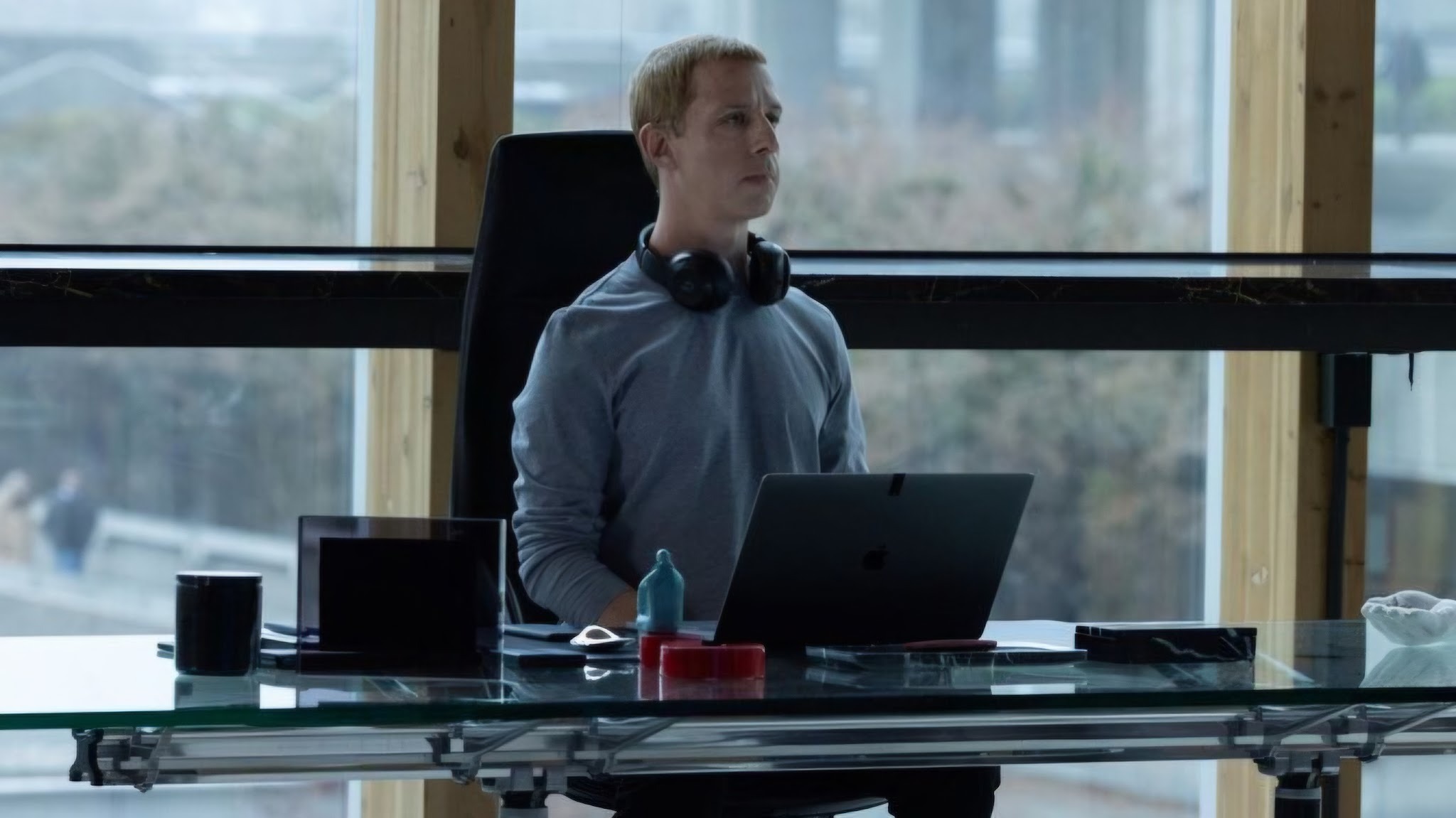
Mr. Sorkin’s script also brings back Mark Zuckerberg (a terrific Jeremy Strong), who prepares for testimony in the U.S. Senate on the same day as the 2021 Washington insurrection. Told across two timelines, before and after the beginning of the pandemic, the movie does a wonderful job of educating the viewer on various important facts. First, it shows how Facebook used technology in perverse methods to boost its bottom line, and second, how techniques and ethical standards in journalism are set and upheld, something that social media, like cancer, is killing.
Of course, it is the journey Mr. Sorkin takes the audience on: a scintillating, provocative ride of moral ambiguity. You may argue that the famed Academy Award-winning writer’s characters all sound the same. However, his dialogue has that snap, that crackle, and that Sorkin pop that is funny, heartfelt, and incredibly addictive. However, Madison plays the socially inert character with such conviction; the contrast between her and White’s Josh works because of that friction that has a refreshingly golden-age Hollywood style.
While Madison and White carry the film, there is a deep bench of actors here that is an embarrassment of riches. Sinners’ Wunmi Mosaku is electric as a member of Zuckerberg’s legal counsel, and we must point out Bill Burr, who ends up stealing every scene he’s in, as the blunt and abrasive angel on his former friend’s shoulder. Of course, Strong, a chameleon, brings that internal intensity, dash of pathetic social awkwardness, and overwhelming arrogance, like an intellectual train wreck you simply cannot turn away from.
Yes, Sorkin-heads like me will disregard his recycling of set-ups (a main character oblivious to technology), as well as some of the same jokes (a male character’s head is harshly slapped at least once in almost any movie or show or play the man has written), and tolerate men being calm and stoic, while the women act stereotypically emotional from time to time. However, his invigorating poetry of his words he uses elevates the debate by raising the bar, and not for a second lowering it.
Sorkin may be telling a story we already know, but the real sobering power of The Social Reckoning is that it forces us to look in the mirror that confronts what Nietzsche said about what goes beyond good and evil. We can then come to realize such behavior has been so normalized and tolerated that it has been given a platform and become commonplace on a scale beyond our wildest nightmares.

You can watch The Social Reckoning only in theaters on October 9th!