



Director: Andrey Zvyagintsev
Writer: Andrey Zvyagintsev, Simon Liashenko
Stars: Dmitriy Mazurov, Iris Lebedeva
Synopsis: When Gleb, a successful company director, finds himself under siege from mounting corporate pressures, an increasingly unstable world, and the discovery of his wife’s affair, the collapse of his carefully ordered life accelerates toward violence.
In a movie year where the most culturally-dominant adaptation of a Greek legend has been the most famous story ever told, consider the myth of the minotaur for a moment. Born to Queen Pasiphae after she succumbed to her lustful draw to the Cretan Bull, Asterion (translation: “the starry one”) entered the world half-man and half-bull, a plague that would cause his existence to devolve into savagery as he aged, leading to his ultimate exile. The creature was imprisoned in a labyrinth constructed by Daedalus, the same craftsman whose work had allowed his queen to be impregnated by the bull, which was a gift to King Minos from Poseidon and caused the transference of his love for the beast to his wife. The son may have been born from a distinct kind of generosity, but his life would result in reliance on sacrifices. Each year – though some say it was once a decade – 14 souls would be thrust into the maze, their death warrants signed in blood as they were devoured by the throne’s heir, now known as the Minotaur. What else is he to do, after all? Sit and wait for freedom? Or fight for every scrap, never knowing when the last taste may come?
Leave it to one of our great auteurs, the Russian filmmaker Andrey Zvyagintsev, to wear this tale like a loose garment draped over a snugger piece of attire, Claude Chabrol’s 1949 film The Unfaithful Wife, and to turn the two stories into Minotaur. Staggering and masterful in its maze-like construction, Zvyagintsev’s domestic drama (screening at the 64th New York Film Festival) takes the essence of Chabrol’s erotic thriller and transposes it onto modern-ish Russia, where its character’s psyches are not only threatened by one another, but by the onset of the Russo-Ukrainian war. Combine such a thorny political football with the tension burbling beneath the foundation of of a near-loveless marriage, and you have not only one of the preeminent films of our time, but about our time, a work of genius that could feasibly have come to screens at any point yet feels particularly resonant in the here and now.
It comes as no surprise given Zvyagintsev’s track record, as his films – from 2003’s The Return to 2014’s Leviathan – have always seen contemporary anxieties reverberating through landscapes both familial and local. Perhaps the real shock is that Minotaur was made at all. Zvyagintsev had not delivered something new since 2017’s Loveless, though it was illness and not a lack of inspiration that caused the delay. More specifically, he was hospitalized in 2022 due to a severe reaction to the COVID-19 virus, eventually placed in an artificial coma due to further complications, and was only discharged from care after 11 months of lengthy hospital stays. The filmmaker was left with paralysis in his legs, an inability to speak or sit up on his own accord, and significant damage to his lungs. According to The Guardian, he has since re-learned to walk and even hold a spoon, all while living in exile due to his stance against Russia’s war with Ukraine. It was in France that Zvyagintsev made Minotaur, which later premiered at Cannes, won him the festival’s Grand Prix prize, and landed him on his home nation’s radar of foreign agents.
None of these burdens have caused him to forget how to make a film, however, as nearly 10 years have passed since his last and Zvyagintsev hasn’t skipped a beat. Minotaur centers on Gleb (an icy Dmitriy Mazurov), the CEO of a shipping company who finds himself under the pressure of both the nation – to deliver a list of 14 employees that should be drafted into the military, normal stuff – and his household, where his wife Galina is beyond fed up with the circumstances of their union. Played by Iris Lebedeva with both the fire and fatigue of a woman whose husband seems to be more turned on by low-cost box trucks than her presence in post-dinner lingerie, Galina has been reduced to the role of wife, mother, and lady of the house. Her only outlet of freedom, one that Zvyagintsev and co-writer Simon Liashenko spend little time concealing, is an affair with a younger photographer (Yuriy Zavalnyouk) who makes her feel desired and cherished, something worth savoring rather than a fixed entity as permanent as the glass fortress in which Galina lives with Gleb and their son Seryozha (Boris Kudrin). Her daily rendezvous seem secure until Gleb begins to notice inconsistencies within his wife’s daily routine and behavior; once he learns of Galina’s infidelity, he takes matters into his own hands, which always goes well.
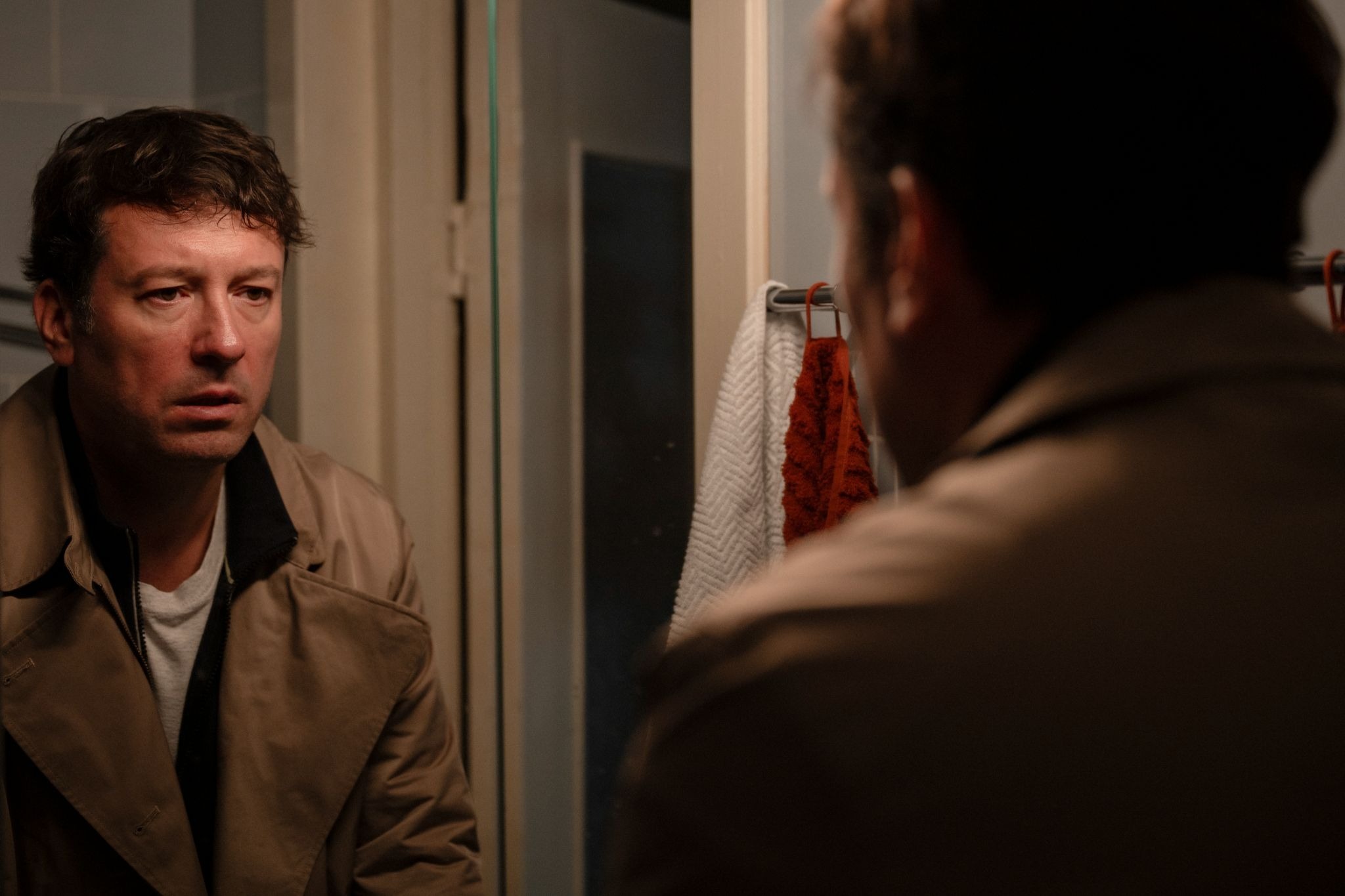
This is as close to The Unfaithful Wife as Zvyagintsev allows his film to get, taking its familiar setup and reframing it in a modern light with an emphasis on international strife and marital dissonance in equal measure rather than forcing either element to play second fiddle. While Minotaur moves to the beat of its central relationship’s drum, institutional pressures remain abound, particularly those brought on by Gleb’s relationship with the town mayor (Vladimir Friedman). It affords Gleb lenience in one sense and ramps up his overall unease in another. Being a CEO is taxing enough. Who wouldn’t expect a tightly-wound man to snap after learning of his wife’s extracurriculars while also facing pressure from the Russian military?
“Snap” is one word for it; “devolve” is another, and Zvyagintsev takes great pleasure in playing in that sandbox, crafting a film that is both dark and darkly funny in moments when you least expect it. (It helps that laughter is hardly heard in Minotaur, so the brief moments of reprieve land solely for the audience and not the players.) Much of Gleb and Galina’s downward spiral towards psychological ruin comes within a literal sandbox, their modernist fortress clad with floor-to-ceiling windows and empty spaces galore, offering no place to hide. It’s a feat of production design (a dual effort by Andrey Ponkratov and Mariya Slavina) that the director’s go-to cinematographer Mikhail Krichman emphasizes with such clarity that the juxtaposition between what we’re witnessing and what Gleb and Galina are living is so stark, so vast that the proverbial exit signs are hidden in plain sight and thus even harder to find. This home is a cold one; you can practically see the sheets of ice beginning to crawl along each countertop and upholstery, but the outside is no warmer. Where is one to run in the first place?
The most glorious thing about Minotaur is in just how agonizing it can be to sit in, not a quality that detracts from that of the film, but one that underlines just how gifted Zvyagintsev is in crafting narratives – original and inspired by others – that feel conversant with those that we often go to great pains to avoid. (That the Film at Lincoln Center team programmed a day of press screenings that played Fjord, Naza, and Minotaur in back-to-back-to-back succession is nothing short of a test of wits and tear ducts, no?) The adultery-focused plot and its central downtrodden spouses may hint at treading waters we’ve waded in before, but like he’s done with housing crises and familial conflict before, Zvyagintsev persists in his efforts to destabilize expectations with real-world ideas baked into his projects and realizing their presences with actual importance.
Is Minotaur a marriage story? Is it a crime thriller? Is it a war drama? The answer to all three questions is the same: Yes, but it’s especially interesting because it is all three and more. Perhaps it is also the film that sends Zvyagintsev’s name into conversation with not just fellow international auteurs of preeminent standing (Cristian Mungiu, Ryusuke Hamaguchi, Lee Chang-Dong, and others come to mind) but those who stand atop the list of our best filmmakers, period. Something tells me he doesn’t care much about such accolades. It’s that the film got made – and that he was alive to make it – that matters most.
Minotaur had its New York premiere at the 64th New York Film Festival. Mubi will release the film in U.S. theaters on November 20.