


Director: Tom McCarthy
Writer: Thomas Bidegain, Noé Debré, Tom McCarthy
Stars: Evan Peters, Paul Rudd, Tatiana Maslany
Synopsis: In October 1980, twenty environmental experts convene at a Florida hotel to draft a congressional statement on carbon dioxide emissions, but struggle to agree on the wording.
Tom McCarthy’s A Statement begins with a genuine shock for the uninitiated. It reveals that, as far back as 1896, Swedish scientist Svante Arrhenius formed the hypothesis around which the foundational argument and issue of climate change effects would make itself apparent. Imagine the frustration to read such a discovery; one that explicitly reveals how ineffectually we have handled the climate crisis. This is something that has been known for over a century now, and even still, it would appear as if nothing meaningful has been achieved with any sense of urgency. It’s immensely frustrating, borderline disheartening, and impossible to spin as anything other than a complete and tragic failure. Right here is the hurdle that A Statement needs to overcome within its runtime. How does one make a film about a group of people outright destined to fail? It’s the obstacle these conference panelists also need to break through in order to achieve their goal: they are tasked with crafting the first statement for Congress towards meaningful action in the battle against climate change. Now this may seem like a dour affair simply because of the majorly worsening dilemma we find ourselves in. But surprisingly, A Statement finds an almost effortless ability to remain a humor-filled affair amidst the impossibly aggravating scenario presented to the audience. It’s perhaps the film’s biggest strength in imbuing life until this whole affair, although it can still occasionally teeter on the edges of feeling a bit dull.
It feels obvious to note this is a film primarily drenched in tragic irony. Despite that tone, McCarthy and his screenwriting partners never approach this subject with anything other than sincerity or reverence. The key element driving all of A Statement is understanding exactly what the central goal of this film is. We know the goal of the committee brought together in a Florida hotel conference room in 1980. The 20-person ensemble cast, made up of government officials, scientists, activists, and more, must craft a statement for Congress on how they should best handle the rising levels of carbon dioxide plaguing the planet. Of course, anybody watching this film in 2026 could tell you such actions would likely be a folly. Some of the people in the room seem to have believed that as well. But that’s not to say A Statement is a waste of time because audiences know the overall inefficient outcome of global policy with regards to climate change. It’s instead an exercise in crafting a complete story with various arcs surrounding the notion of collective failure. It can be immensely difficult to pull off. Although McCarthy’s film strives for the challenge with admirable effort, it can occasionally remain stagnant because of that weighted baggage. Still, there’s a compelling quality to A Statement in its unflashy portrayal of flawed people striving for success, all with their own desires, frustrations, and goals.
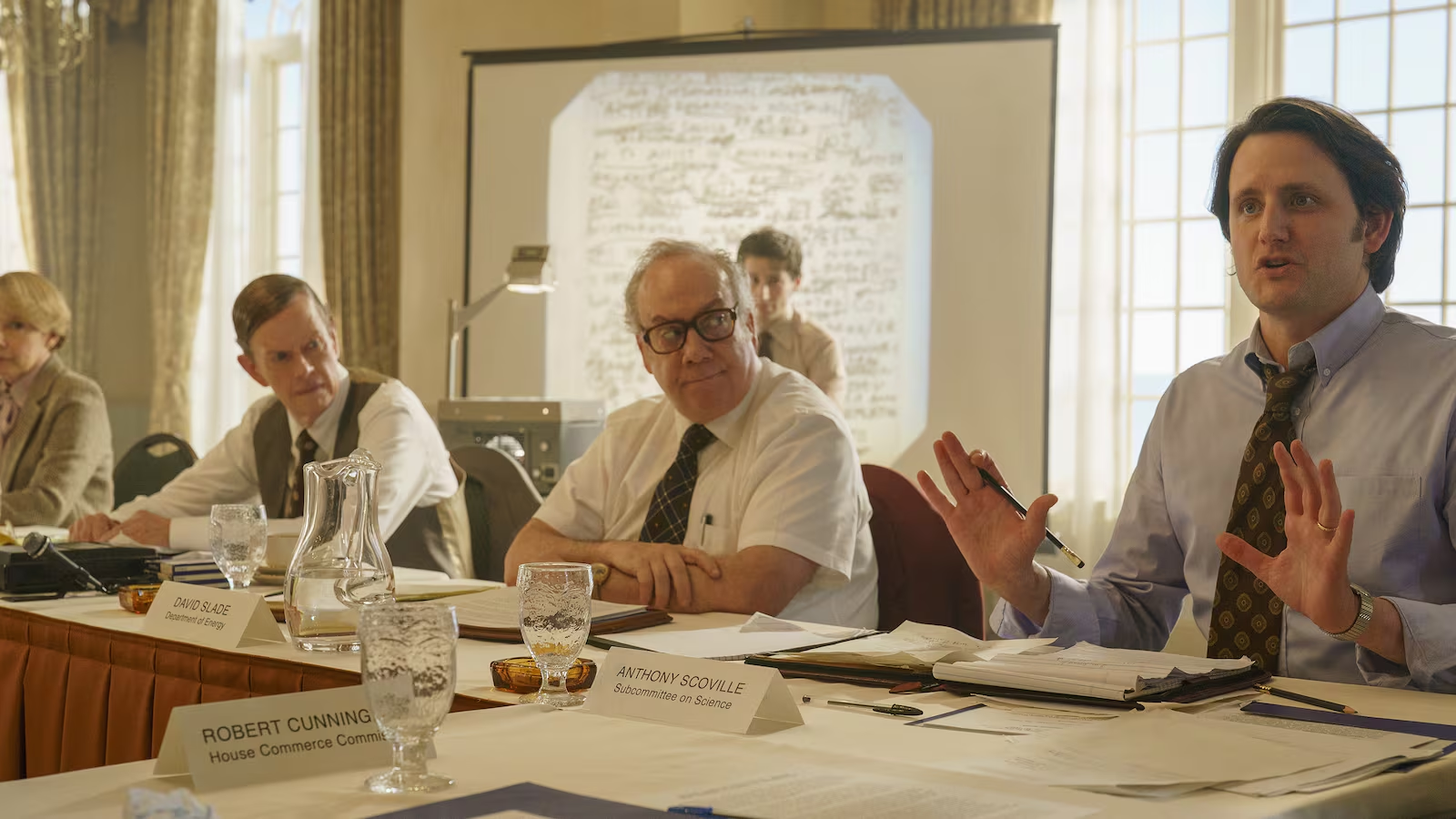
A Statement is a film acutely designed around its ensemble. There’s no single protagonist, instead offering every character actor in the primary setting their own potential at leading a film of their own. There’s something almost refreshing about McCarthy’s approach to this story. It’s meat-and-potatoes filmmaking, striking away everything non-essential to merely get to the fundamentals of the story. For example, how does one go about introducing all 20 people in a stuffy conference room in an efficient manner? The answer lies in the very history from which this film pulls much of its script: the actual transcript from the conference. So once the room is full, McCarthy quite literally slides the camera across each side of the table, one-by-one having each individual introduce themselves and the organization they represent in the exact fashion it was done in 1980. It’s as blunt as can be, yet it’s undeniably effective. And such a direct approach towards the directing of this film does allow the fundamentally real drama of the conference participants to unfold as the primary star of the film. It’s a creative decision which majorly pays off, if only to emphasize the potential of a story within any moment across history.
With every piece of dialogue during the conference-set scenes being pulled verbatim from historical transcript, the film becomes imbued with a genuine authenticity. McCarthy even goes so far as to initially include the words themselves on screen, akin to subtitling. It immediately reminds the viewer that these are all real people, each bringing their own biases, thoughts, and emotions into the room with them. It quickly makes some of the more foolish and baffling sentiments held all the more enraging. It makes the cowardice of neutering genuine arguments based in facts for the sake of not ruffling any feathers in the room immensely frustrating. There’s so much emotion baked into the very essence of this film. The zealous edge of A Statement, even if it may not be sensationalized in any sort of meaningful way, is still felt through some of the performances. It’s difficult to not adore the caddiness of John Turturro’s performance as a nuclear scientist, the comically frustrated yet passionate Evan Peters as an environmental activist, or the completely fed-up, overworked, and underpaid Paul Giamatti character, as the director of the Department of Energy. A Statement even has Jason Clarke doing what he does best: torturing the people around him with a baffling series of inquiries or statements while sitting in a non-descript room at a makeshift table. Somebody notes that all of this deliberation is just “letting the democratic process play out.” But what happens when that process becomes largely ineffectual in dealing with such a massive issue?
What then plays out over the remainder of the conference is quite akin to Sidney Lumet’s 1957 masterpiece, 12 Angry Men. While this is a much more muted film in many regards, it too captures the fundamental idea of being trapped. There’s the obvious confinement of being locked away in a specific room. But the characters in both films carry the weight of a massive burden being placed on their shoulders. In A Statement, while most of the participants can largely agree on the general sentiment that rising levels of carbon dioxide will become increasingly problematic for humanity, they’re not even getting caught up in the details of what should be done about the matter. Infuriatingly, they instead verbally grapple over what should merely be said about the issue in the first place. There’s so much argument surrounding the minutiae of the issue that the issue itself becomes a backdrop for their own frustrations and biases to bubble up. A Statement takes advantage of such a wide-ranging, open-ended discussion and uses it to form a deeper examination at the fundamental flaws present within America.
A Statement largely reveals a country whose ideals have bred ineffectual action and outright foolish decision-making. We favor short-term gain and give little forethought as to what may come next for the world around us. It’s what makes the moments which occur outside of the conference room equally compelling, and arguably twice as tragic. Any time McCarthy includes a character that isn’t part of the conference, they simply couldn’t care less when the subject of the climate is broached. And there’s no judgement directed at these characters; although perhaps there’s a fair bit of mockery at play. But this tragic lack of knowledge ultimately feels like a deserving indictment of this country’s long-storied inability to bring forth meaningful change regarding an issue that has already had permanent effects on our lives and will continue to escalate until something is done. Amy Ryan portrays a representative from the public health sector, and in a conversation on the phone during a recess, she states, “I feel human… and useless.” It would appear that the systems within government meant to make everything more fair and balanced can often force many to feel their abilities and knowledge have been completely reduced. We simply must cut to the very root of the matter and state issues such as these as plainly as possible. There can be no worry of discomfort or shock when such a vital dilemma is at hand. As A Statement comes to a close, McCarthy does indeed deliver a film that feels as timely as ever, yet it can’t seem to ever shake the bits of stagnancy that hold it back from truly being great. Still, its ability to remain entertaining as a whole and the opportunity it offers for a deeply-stacked ensemble to just show off their talent for two hours makes it a fairly solid watch.
A Statement celebrated its World Premiere in the Spotlight section at the 64th New York Film Festival.