Home Blog Page 102

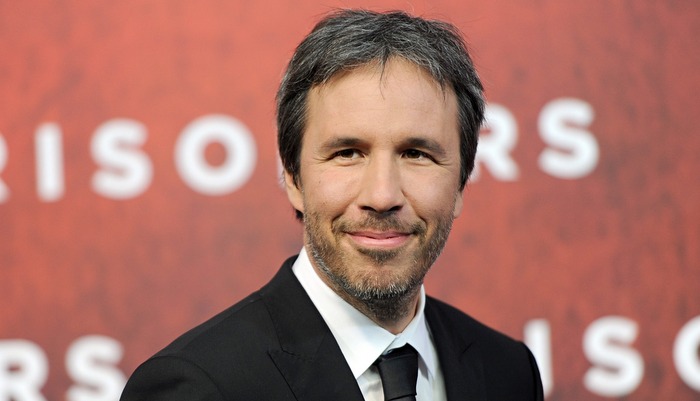
Podcast VIP: Ranking Denis Villeneuve (Updated)

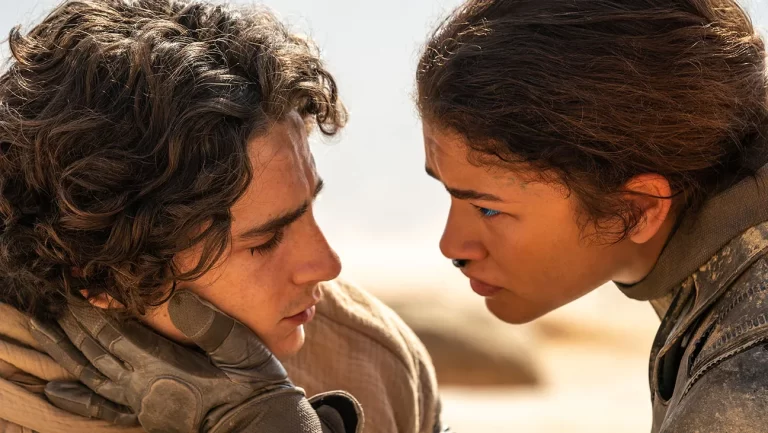
On this episode, JD goes solo as he gives his updated rankings of Denis Villeneuve after the release of his latest film Dune: Part Two! We gave some previous rankings on Episode 574, but now that we’ve seen Dune: Part Two, it’s time to update them.

Listen on Patreon
Listen with Apple Podcast Subscription
Watch with YouTube Membership

Movie Review: ‘Arthur the King’ Crowns Sentiment Over Danger


Director: Simon Cellan Jones
Writer: Michael Brandt
Stars: Mark Wahlberg, Simu Liu, Nathalie Emmanuel

Synopsis: An adventure racer adopts a stray dog named Arthur to join him and his team in an epic endurance race.


Unfolding like a thematic cross between Nyad and one of the many recent find-and-replace titles like A Dogโ€™s Way Home, or Journey, or Purpose, or Dream, or Will, or Tale, or โ€” you get it, yes? โ€” there isnโ€™t anything particularly special about Arthur the King. Itโ€™s an adventure film, one so easy to pin down youโ€™ll feel as though youโ€™ve seen it before. One you know the beats of before it begins, one youโ€™d be hard-pressed not to predict, a movie with a one-track mind that is more interested in tugging at your heartstrings than telling an original story. Maybe thatโ€™s because itโ€™s based on a true story, which is to say that a single cursory Google search will tell you whether or not the titular dog dies at the end. I wonโ€™t spoil that here, but I also wonder if doing so would really tilt the scales of your interest in seeing this movie in the first place.

Thatโ€™s also not to say, despite its telegraphed narrative and cloying efforts to get you to shed a tear, that thereโ€™s anything particularly wrong with Arthur the King, either (Apart from, you know, its racist starโ€™s penchant for hate crimes, sexism, et. al. But he found God!). Director Simon Cellan Jonesโ€™ follow-up to 2023โ€™s The Family Plan, which seemingly got him hooked on Mark Wahlberg, or vice versa, is as by the numbers as it gets, an underdog tale about a group of adventure racers discovering the value of manโ€™s-best-friend-ship, all while overcoming adversity in the form of rough terrains, battered egos, and the โ€œinsurmountableโ€ odds stacked against them. Whether or not the central team wins their race isnโ€™t the point; this film is hell-bent on making you feel something, one way or another.

Perhaps that feeling is anger, for having spent two hours of your life subconsciously rooting for Wahlberg (who plays Michael Light, an Americanized iteration of the real-life Swedish adventure racer Mikael Lindnord, on whom the film is based). Or perhaps you’ll find genuine inspiration watching the periodic triumphs of Lightโ€™s team, a murdererโ€™s row of seasoned adventure movie tropes โ€” we have the climber (Nathalie Emmanuel), the navigator (Ali Suliman), and the Instagram-famous comedic foil (Simu Liu). Michael is widely considered to be one of the best to never win his sportโ€™s top competition, and heโ€™s all-but aged out of prime contention for the Adventure Racing World Series. 

Yet he canโ€™t escape the itch, an inkling that if he had just one more shot at the title, along with the right team by his side, heโ€™d be able to come out on top. So, Michael convinces his wife Helen (Juliet Rylance) that this will be his last ride, and he finds enough sponsors to fund his training for one last brush with his perilous passion. The crew packs their bags with enough water and frozen meatballs for a journey through the Dominican jungle; along the way, they encounter a stray dog, whom they call Arthur. He loves their meatballs, while the ever-softening Michael loves his company. Itโ€™s a match made in heaven from the jump. 

Many will find it difficult not to roll their eyes at the filmโ€™s hokey framework, and yet I canโ€™t deny instinctually pumping my fist whenever this underestimated crew made some sort of strive toward potential victory. I also canโ€™t deny the existence of the titular canine, reason enough to latch onto Arthurโ€™s otherwise-predetermined structure. And although these sorts of stories tend to be my kryptonite โ€” Iโ€™m happy anytime a dog appears on screen; sue me โ€” there is more to Arthur than a recognizable narrative, cast, and the existence of its central mutt.

Arthur The King is far from perfect, but at least it effectively harnesses the power these movies rarely neglect yet never master: Being infused with hope, no matter the adversity the characters face. When it comes to garden variety sports movies, straying from the stock formula is more likely to drive typical audiences away as opposed to steering viewers in a given filmโ€™s direction. What separates the sports movies that are โ€œfineโ€ and those that are โ€œstraight-up badโ€ โ€” great sports films are few and far between these days โ€” often boils down to talent in front of the camera and/or a steady hand behind it. Thematically, you can find quite a few similarities between Remember the Titans and Next Goal Wins, but only the former starred Denzel Washington. The latter was mailed in by Taika Waititi and not even Michael Fassbender could keep Next Goal Wins above water.


Stylistically, I can imagine Baltasar Kormรกkurโ€™s version of this film, a slightly darker rendition of the same story that leans more into the danger these adventurers face on a daily basis while treating their fifth teammate as a furry sidekick deployed only when necessary, and then placed front and center during the final act when Michael has to choose between glory and loyalty. But the choices Cellan Jones makes in Arthur the King arguably better serve a film of its ilk due to their emphasis on sentiment. Sure, Arthur lays its heart on a little heavy at times, but youโ€™d rather that than be stuck with a film that is okay leaving every ounce of warmth on the cutting room floor in favor of needless stunts and weightless action.

Grade: C+

Movie Review: ‘Asleep in My Palm’ Gives Grace to Difference


Director: Henry Nelson
Writer: Henry Nelson
Stars: Tim Blake Nelson, Chloรซ Kerwin, Grant Harvey

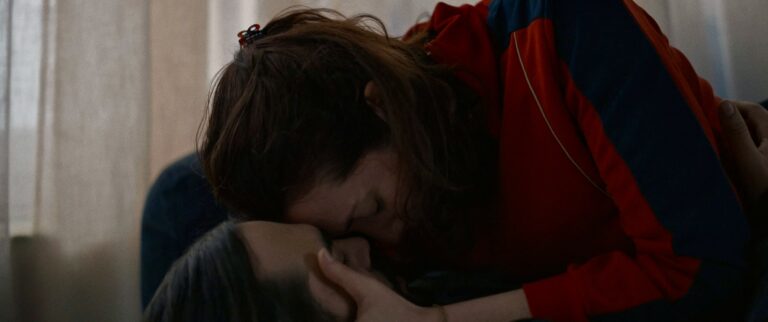
Synopsis: Asleep in My Palm explores the nature of parenthood and class as a father and daughter live off the grid in rural Ohio where they must confront the challenges of her sexual awakening as he escapes a violent and conflicted past.


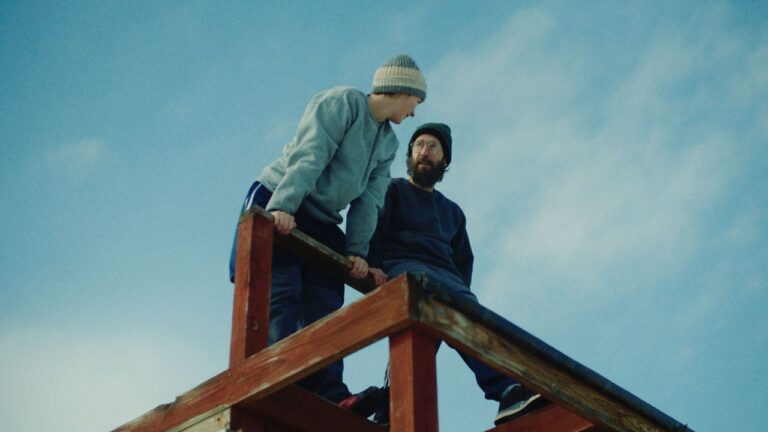
Henry Nelsonโ€™s Asleep in My Palm is almost as heartbreaking as Debra Granikโ€™s Leave No Trace. The comparison is naturally going to be made between the two films as both feature a father and daughter duo living off grid because of the fatherโ€™s intense military service-related PTSD. Granikโ€™s film is a masterpiece and Nelsonโ€™s work will exist in its long shadow. However, Asleep in My Palm distinguishes itself by shifting the focus to the self-imposed predicament created by Tom (Tim Blake Nelson) as one based in uncontained rage at the world. His only balm is Beth Ann (Chloรซ Kerwin), now sixteen years old and beginning to find herself curious about the world beyond the one created by him.

The film begins with Tom giving Beth Ann his interpretation of Disneyโ€™s Chicken Little. Not the original short made for American wartime propaganda, but the panned 2005 movie. His version is a tale heโ€™s telling about himself. A โ€œbespectacled homunculusโ€ chicken who no one believes or likes, who maybe lives in Paterson, New Jersey. One who is bullied and ostracized by the community and later forms a gang to take them down. He doesnโ€™t have to because everything does go to shit. This Chicken Little โ€œLooks up and heโ€™s happy because heโ€™s been dead for years, and the last thing heโ€™s going to see is those fuckers eating shit.โ€ Maybe he saw the crack and what others canโ€™t see.

Beth Ann questions his story with a sleepy kindness and tells him to be safe as he leaves their tiny storage unit which doubles as their home. Despite the sodden and slushy Ohio snow, the storage unit is still a โ€œhome.โ€ Whatever Tom is doing, and most of it is criminal, his focus is keeping Beth Ann wrapped warm and tight.

But how tight can someone like Tom really hold on to a young woman who is beginning to wonder about the world beyond the two of them? Tom has given her a better education than most college kids would get. They are living near the famous Oberlin College; a place where a monthโ€™s tuition would keep Tom and Beth Ann alive for years. Yet, Beth Ann has never been to a party. Sheโ€™s committed crimes โ€“ she can break and enter like a professional, but sheโ€™s almost a total innocent.

Tom is used to the exhausting hustle. Along with Jose (a strange incel type played by Jared Abrahamson) he steals whatever he can from the college dorms. Jose believes that women liking Radioheadโ€™s โ€˜Creepโ€™ is an act of cultural appropriation. Heโ€™s an idiot Tom tolerates but seemingly doesnโ€™t care about. His manic energy and ridiculous statements weary an already weary man. 

Tom is cynical and jaded about the modern world and has kept Beth Ann from it. No phones, no television, no computers. An itinerant life where they can just move on once a place no longer serves its purpose or gets โ€œtoo hotโ€ โ€” if he was in a Michael Mann film heโ€™d almost be considered urbane. But Asleep in My Palm is not Heat.

Tom is an enigma, perhaps even to himself. The audience knows he was in Desert Storm, but who was he before that? Who did he become afterwards? How is a man living hand to mouth able to debate metaphysics or give a quick lesson on the Stoics? When he meets a bunch of bored college kid โ€œSatanistsโ€ heโ€™s able to break down the philosophy of โ€œDo what thou wilt shall be the whole of the Law,โ€ as espoused by the Thelemites and Aleister Crowley.

Crafting an imaginative world filled with joy and small wonders for Beth Ann has filled his aching loneliness. Beth Annโ€™s mother is simply, โ€œgone.โ€ But Beth Ann canโ€™t stay forever the urchin and waif โ€” the Paper Moon lifestyle of modern-day panhandling and swindling has an end point. That end point is sexual maturity and adult curiosity.

Chloรซ Kerwin plays Beth Ann with vulnerability and curiosity. She adores Tom, she wants to protect him as much as he wants to protect her, but she meets people who show her that there is a world sheโ€™s been forbidden to explore. One that can be as ugly as Tom warned her, but one which also contains beautiful and enchanting women such as Gus Birneyโ€™s rich girl Millah, who likes the idea of slumming it with Grant Harveyโ€™s โ€˜Dark Mortius.โ€™ A single kiss from Millah and some time spent being seen by someone else and Beth Ann is smitten. 

Just as Tom (Thomasin McKenzie) says to Will (Ben Foster) in Leave No Trace, โ€œThe same thing that’s wrong with you isn’t wrong with meโ€ Beth Ann has to tell her father โ€œNo oneโ€™s going to remember me. Just you. There are no pictures of me.โ€ Itโ€™s not enough for her any longer to be invisible from the institutional monsters. She has the one thing Tom wishes she would never have, desire. Not a desire for the material, but for some form of autonomy โ€” which ironically is what Tom was striving towards himself but canโ€™t manage.

Henry Nelson captures life on the outskirts with humanity and sometimes almost absurd humor. He doesnโ€™t pretend that it is a life anyone would truly desire unless they were broken by uncaring systems. When Millah tells Beth Ann that she is more adult at the age of sixteen than she will ever be, she means it. They have a shared envy of each otherโ€™s lives. But Millah eventually will just fall into a safety net of privilege. She will live a small life but a safe one. College is the time she gets before she ends up married and doing charity events.

Asleep in My Palm is a film which documents the small American tragedies. The world of poverty is still around the rust belt next to generational wealth. Asleep in My Palm is a lyrical film with extraordinary performances by Nelson and Kerwin. It is patiently and expertly shot which makes the interspersed violence all the more impactful. The only real criticism that can be leveled is an extraneous mystery and solution at the end of the film which brings up a question no one was asking. 

Asleep in My Palm is an outstanding debut by Henry Nelson, and he has the great fortune to be directing his father, who is one of Americaโ€™s finest character actors. Love is complex and families even more so. Asleep in My Palm gives grace to two people just trying to find a place in the world โ€” one who will never truly belong because he has never healed his trauma, and one who has a chance to fly higher and see if the sky really is falling in.

Grade: B+

Women InSession: International Film Oscar Nominations

This week on Women InSession, in the spirit of the Oscars, we take a look at the International Film Oscar and talk about the process in how they’re selected, and the quality of nominations in recent years! There’s been some phenmonal international films over the years. Some of them make the cut. Others somehow miss. So we dive into how that makes it one of the more compelling categories at the Oscars.

Panel: Kristin Battestella, Shadan Larki

On that note, check out this week’s show and let us know what you think in the comment section. Thanks for listening and for supporting the InSession Film Podcast!

Subscribe to our Podcasts RSS
Subscribe to our Podcasts on iTunes
Listen on Spotify
Listen on Stitcher
Women InSession – Episode 76

To hear this Extra Film episode and everything else we do, download our apps on the Amazon Market for Android and the Podcast Source app on IOS devices. The mobile app covers all of our main shows, bonus podcasts and everything else relating to the InSession Film Podcast. Thanks for your wonderful support and for listening to our show. It means the world to us.

Movie Review: ‘DogMan’ is Besson Off His Leash


Director: Luc Besson
Writer: Luc Besson
Stars: Caleb Landry Jones, Jojo T. Gibbs, Christopher Denham

Synopsis: A boy, bruised by life, finds his salvation through the love of his dogs.


Roger Ebert said of Nicolas Roegโ€™s Track 29, โ€œSomebody asked me if I liked this movie, and I had to answer that I did not, but then I realized once again what an inadequate word “like” is. The reason I didn’t like it is that the film is unlikable – perhaps deliberately so. But that doesn’t make it a bad film, and it probably makes it a more interesting oneโ€ฆ it is bad-tempered. But not every film is required to massage us with pleasure. Some are allowed to be abrasive and frustrating, to make us think.โ€ Ebertโ€™s quote would be germane to Luc Bessonโ€™s DogMan if the film was setting out to make the audience think. However, Besson decides on unlikeable, frustrating, and doing all the โ€œthinkingโ€ for the audience. DogMan is blunt-force abrasive, but it is possible at least to find sections interesting.

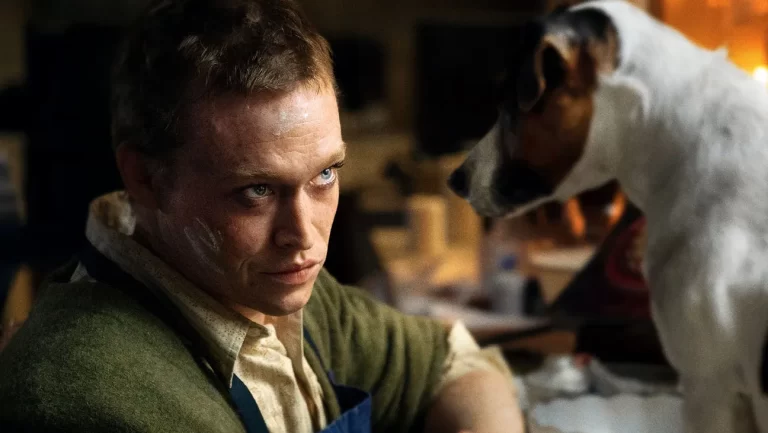
Douglas (Caleb Landry Jones) is a man whose tortured existence means the only pack he can trust are his preternaturally clever โ€œchildrenโ€ โ€” a motley crew of smooth criminal canines. Brought up in a strangely timeless Newark by a violently dysfunctional family, Doug has more โ€˜anti-heroโ€™ origin stories than a continually re-written comic book character. Was it the moment he was caught feeding scraps to the dogs his father bred for fighting? Was it when his slack-jawed ultra-religious brother had him locked in the cage with the dogs for most of his childhood? Was it when his beloved mother finally left the cradle of filth that was his home neglecting to let him out of the cage as she departed? Or was it when his father decided to shoot the puppies Doug was protecting but instead shot off one of Dougโ€™s fingers and left a bullet lodged in his spine which will one day kill him?

Doug is arrested in full Marilyn Monroe drag trying to flee the scene of a gang war massacre with his beloved babies, and it is up to Doctor Evelyn Decker (Jojo T. Gibbs) to work out the enigma of the fluid and adapting Dog Man through his baroque narration of his life.

Doug is polite, educated, and so well versed in the Bard his history is Shakespearean. Is he Viola, Richard II, Falstaff, or Iago? Is he Hamlet or Juliet? Avenging angel or demon from the bowels of hell? Perhaps he is all three of Macbethโ€™s witches? The only thing that is certain is that he is weaving constant illusions to avoid being uncovered. That, and he regards humanity as a blight because they believe they have transcended their animal instincts. โ€œThe weak are killed in nature. But they survive in humanity. For a while. God always finds his own.โ€

A bizarre Bildungsroman, DogMan chronicles Dougโ€™s life as an institutionalized child who falls in love with his guidance counselor and drama teacher Salma Bailey (Grace Palma) who takes the broken boy through the whirlwind of make believe which he first experienced reading his motherโ€™s hidden โ€˜Womenโ€™s Magazines.โ€™ Through Salma, he becomes a wheelchair using Richard Burbage, Will Kemp, and Margaret Hughes. Makeup and make-believe transport him from his isolation. He is seen and admired by his previously bullying peers, but not for being himself โ€” for being someone else. Eventually, Salma heads to Broadway leaving a heartbroken boy who will eventually find his way back to the ones he cannot abandon, and will not abandon him, his dogs.

Dougโ€™s journey through the callousness of reality is echoed by the strays he cares for. He has no home โ€” they have no home. He doesnโ€™t train his children to do tricks, they simply understand what he wants. Instead, he trains himself to perform. Unable to find a job despite having a degree, Doug holes himself up in an abandoned high school with his ever-expanding fur family and by chance becomes a drag artiste doing swirling renditions of ร‰dith Piaf (an extraordinary scene) and Marlene Dietrich in “Lili Marlene” mode. Community supported by Annie Lennoxes, Madonnas and Chers, Douglas finds liberation behind illusion. He also has a successful side hustle in high end jewelry theft carried out by his crew. None of it is about the money โ€“ he just needs enough to keep his family fed.

Insurance investigators and Latino gang-bangers all try to take Doug down and meet a grisly end. It is Willard without the horror, or Doctor Dolittle as Duela Dent. Grisly, gritty, and stylishly captured, the essence of Bessonโ€™s cinema du look heightens the choreographed violence. Fetishistic in extremis, but also peculiarly sexless.

There is Godโ€™s law and dogโ€™s law; Douglas is an adherent to both. God sent him dogs as a panacea to soothe his suffering. โ€œDogs only have one flaw, they love humans.โ€ One suspects Besson decided to make the whole film in English and film it in โ€œAmericaโ€ because chien spelled backwards means nothing.

Dougโ€™s confession to Evelyn serves a purpose to prove his existence before it is erased and to alleviate her pain. An exhausted single mother with a violent father and similarly violent ex-husband, she canโ€™t keep from her young child; Evelyn is also in need of protection. Hence the man behind a thousand curtains comes into the light to send her an angel before he meets his fate. 

DogMan should be, in some manner, entertaining. It is darkly funny, but Besson enjoys torturing the audience through Dougโ€™s misfortunes too much. The philosophical and ethical discussions between Doug and Evelyn are exhaustingly exposition heavy. Besson shows and over tells, never getting the balance right. For example, we see Christopher Denhamโ€™s venal and sweaty insurance adjuster stalking Doug thinking heโ€™s captured the femme fatale; but Doug has already told Evelyn (and shown in flashbacks) his knack for manipulation and dog-eat-man war. We know exactly what is coming.

If not for Caleb Landry Jonesโ€™ wounded but bravura performance, DogMan would be near insufferable. Jones is a compelling and beguiling presence. Itโ€™s not surprising he has been previously scooped up as a villain in Jordan Peeleโ€™s Get Out. Heโ€™s also a fragile romantic interest in Neil Jordanโ€™s Byzantium. His best roles are the ones where he is an oddball outsider such as Brandon Cronenbergโ€™s Antiviral. His best role to date has been the titular character in Justin Kurzelโ€™s Nitram. Thereโ€™s something indefinable about his screen charisma. Heโ€™s a less beautiful Cillian Murphy or Christopher Abbott but whatever those two have, he also has.

Besson has never opted for subtle nor is he beyond self-plagiarism. Heโ€™s made La Femme Nikita essentially three times (the original which spawned a two remakes and two television series), as evidenced by Lucy and Anna. His best loved science-fiction film The Fifth Element he cannibalized for Valerian and the City of a Thousand Planets. As for subtlety, although gorgeous, Les Aventures extraordinaires d’Adรจle Blanc-Sec required two cuts. One to appeal to the younger aged adventure and Gaslamp enthusiasts, and one which had our fearless heroine very often unclothed just because sheโ€™s beautiful. An entire paragraph can be written just about the Taxi and Transporter franchises. Lรฉon: The Professional is again a topic too large to be here within encompassed.

DogMan could be construed as mash-up of Le Dernier Combat and Subway. DogMan is low budget Besson off his leash after the massively expensive flop that was Valerian and the City of a Thousand Planets. It has style to burn but substance is either blatantly telegraphed or scant.

If you crave Luc Bessonโ€™s mysteriously religious, ultra-camp, and ferocious style with Caleb Landry Jones (and the junior version of Doug) being caked in mud, blood, or pancake makeup while devising schemes like an obsessive scrapbooker and master chef: then by all means DogMan is there for the taking. Also, there are the wonderful dogs working like a finely tuned orchestra. However, be warned, the antihero revenge wish fulfilment fantasy is often sickly and sloppy. It is more a tatty wig and obvious scars than genre hybrid genius. 

Grade: C

List: The Best Onscreen Smokers

Note: This is in no way an endorsement of smoking or tobacco use. This is for entertainment purposes only

Full disclosure: I used to smoke. Itโ€™s not something Iโ€™m particularly proud of, but itโ€™s also something I miss every day. This constant longing for nicotine has endeared me to the actors and actresses in films who take to smoking like an artform. Ask any former smoker, and they can tell you who actually smokes or who has never had a cigarette in their lives before lighting up on screen. The 2023 Oscar season featured a number of accomplished smoking performances, including Helen Mirren in Golda, Bradley Cooper in Maestro, and Daโ€™Vine Joy Randolph in The Holdovers. This year is off to a solid start with Kristen Stewart’s on-again-off-again smoker in Love Lies Bleeding. Inspired by Stewartโ€™s tour-de-force smoking ability, I now present to you, the top ten film smokers.

10. Denzel Washington โ€“ Best Smoking As A Prop

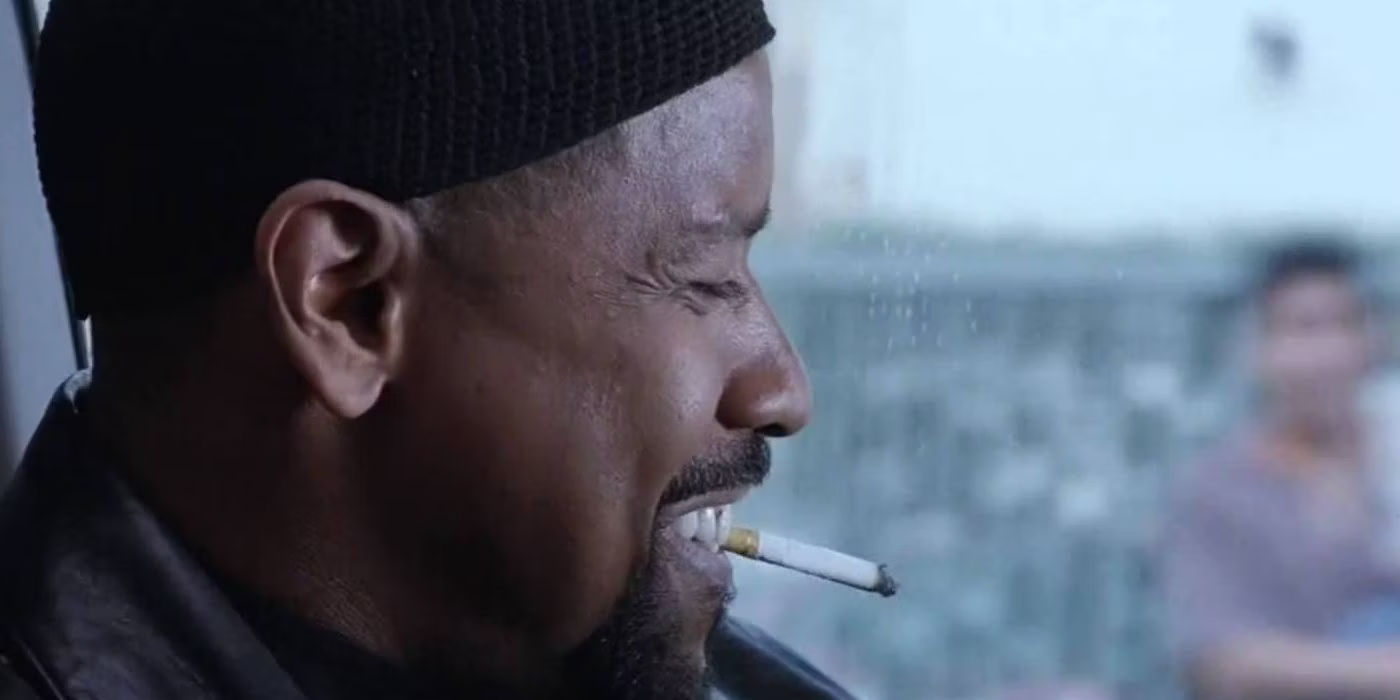
You could make a strong case as Denzel being the best living actor. One of his greatest achievements is his ability to shift his on-screen persona. But more than anything, Washington uses each piece of his environment to create a character, and that includes cigarettes. Whether itโ€™s the loosey he applies during the early scenes of Malcolm X, the coolly accessorized cigs from Devil in a Blue Dress, or even the climactic poison smoke in Fallen, the smoking serves a purpose. And there is none more purposeful than in his Oscar-winning turn in Training Day. Denzelโ€™s corrupt cop smokes throughout the film, whether in a car, on a rooftop, or in his bedroom counting his money. No one knows how to add to a character with a cigarette quite like Denzel. And donโ€™t you dare wince when he blows smoke in your face.

9. Robert Mitchum โ€“ Best Noir Smoker

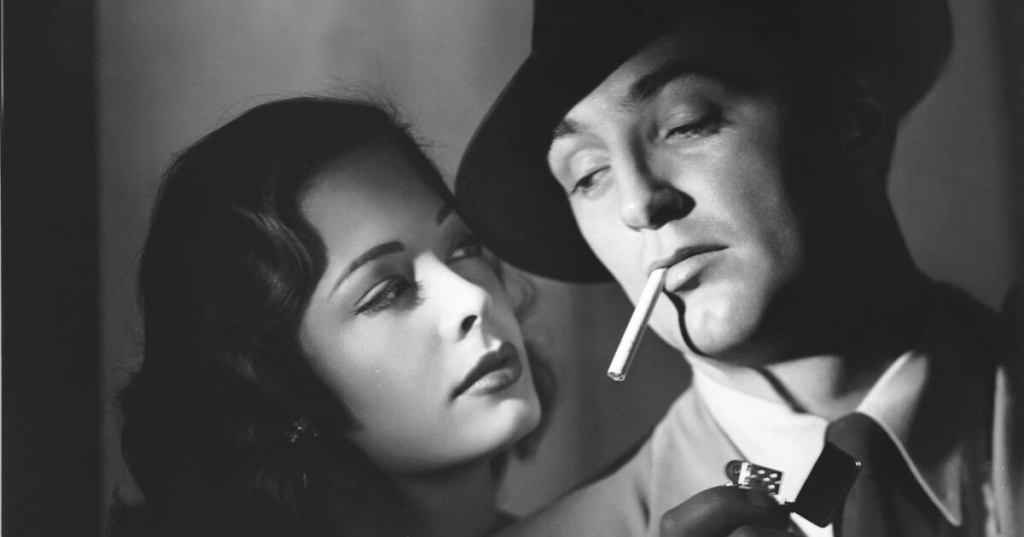
Mitchum was never seen as the most accomplished of actors, but the guy knew what he did well: film noir. The actor famously went into scenes in Out of the Past unprepared to make the film more spontaneous and tense. Smoking is such a part of Mitchumโ€™s noir pastiche, itโ€™s on the freaking poster! Cigarettes are a touchtone of film noir atmosphere, and no one made it fit better than Mitchum.

8. Marlene Dietrich โ€“ Prettiest Smoker

Few people have a face like Marlene Dietrich. Black-and-white photography and proper lighting just makes the womanโ€™s face glow in a way others just donโ€™t. While the act of smoking is much associated with illness and repugnance, Dietrich makes it look like the most natural thing in the world. Even one of her most iconic images features a cigarette, which just looks right. In one of her most famous roles, 1931โ€™s Shanghai Express, she drags and just lets the smoke lazily waft up past her lips, nose, eyes, and hair. Itโ€™s like the cigarette is screaming at the audience to note how mind-numbingly gorgeous this woman is. I canโ€™t blame the cigarette for trying to get us to notice.

7. Humphrey Bogart โ€“ Smoking as a Companion

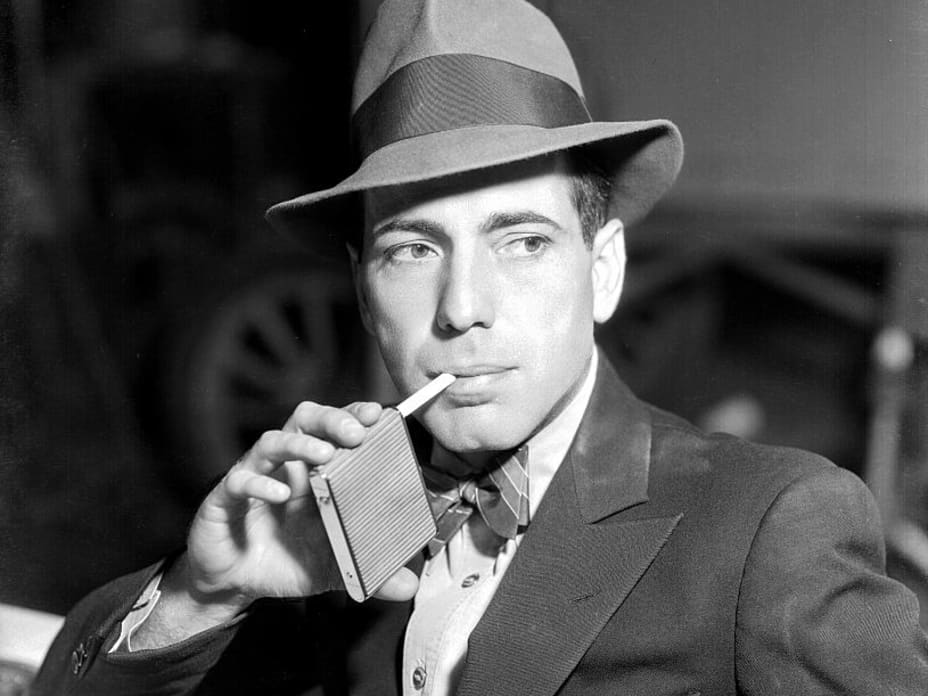
Has anyone looked more natural with a cigarette than he? Never did a film go by where Bogie wasnโ€™t supported by his favorite tobacco co-star. That being said, he never made it a part of his performance, but rather a piece of art imitating life. The man lived to smoke and that obviously would translate to his on-screen adventures. His entire film persona wasnโ€™t one of action and adventure, but one of passive complacency. You donโ€™t see much of Bogart mixing it up. You see more of him sitting behind a desk with a whisky and a Lucky Strike. Itโ€™s as much a part of him as his iconic voice. Itโ€™s not even the first few things you think about his persona. Itโ€™s just a part of the package. You want Bogart, you get smoking.

6. Samuel L. Jackson โ€“ Cigarettes as the Coolest Accessory

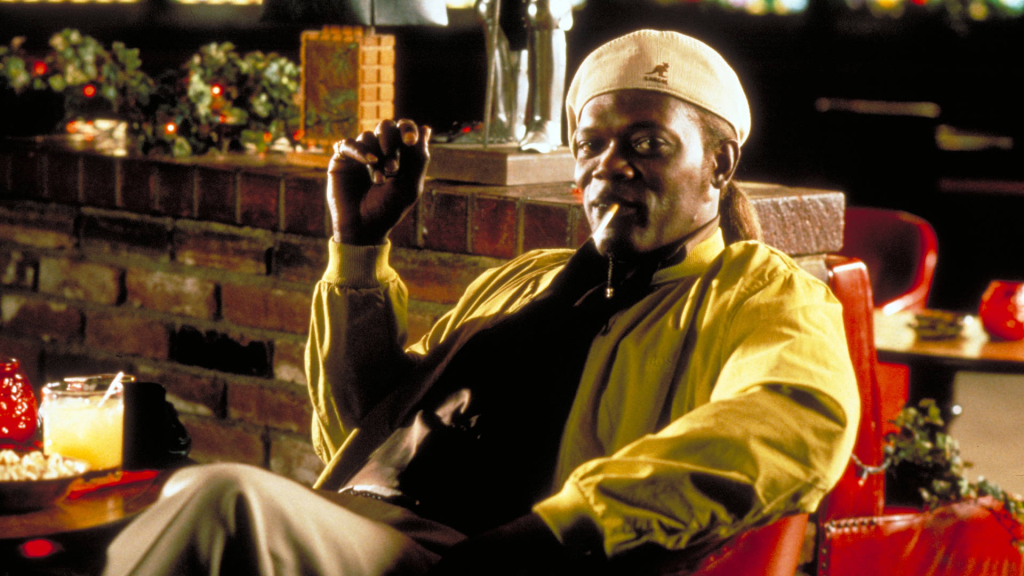
Samuel L. Jackson is one of the most consistently cool-as-hell actors of our time. When he smokes in film, it just makes him seem that much cooler. Whether itโ€™s the down-on-his-luck Mitch Hennessey in The Long Kiss Goodnight, the chain-smoking Mr. Arnold in Jurassic Park, the โ€œwhere can I put my ashโ€ of Ordell in Jackie Brown, or the smoking-while-playing-guitar melancholy of Lazarus in Black Snake Moan, Jackson makes it look that much cooler. This piece is not supposed to be an endorsement of smoking, but Jacksonโ€™s on-screen-smoking charisma makes it tough.

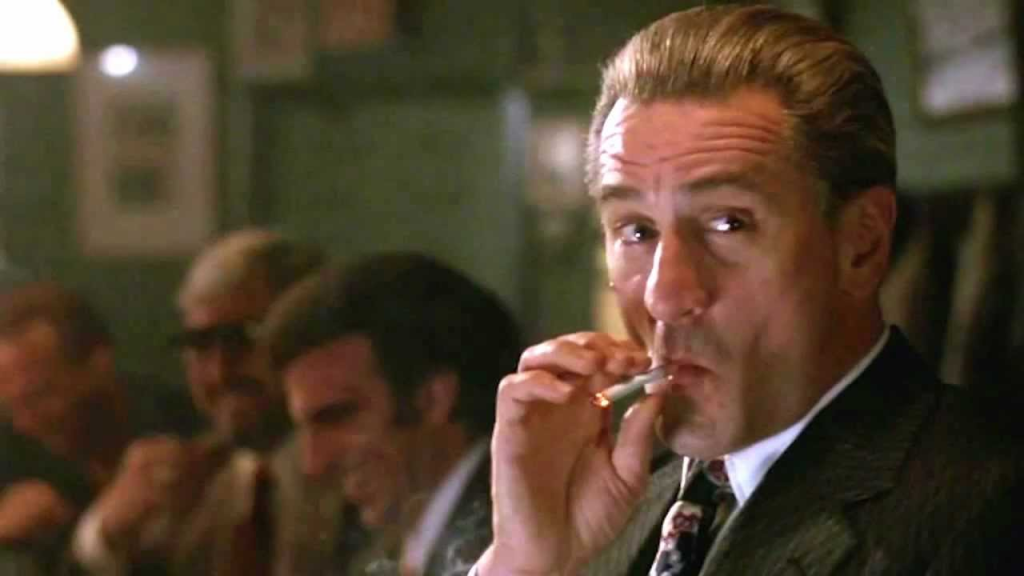
5. Robert De Niro โ€“ Smoking as Method

Robert De Niro is famously method. The guys lives his roles. When that character is a smoker, De Niro lives smoking. Whether itโ€™s the 9,000 cigarettes he goes through in Casino, or his cigarettes turning into an actual plot point for Midnight Run, De Niro places his smoking into his roles seamlessly. Youโ€™ve seen that โ€œhear an imageโ€ meme going around, and nothing is better encapsulated that than De Niro in the above image from Goodfellas. Just look at that guy. He is not faking it. His cheeks are pulled in the whole way. That heater never stood a chance against De Niroโ€™s commitment to the role.

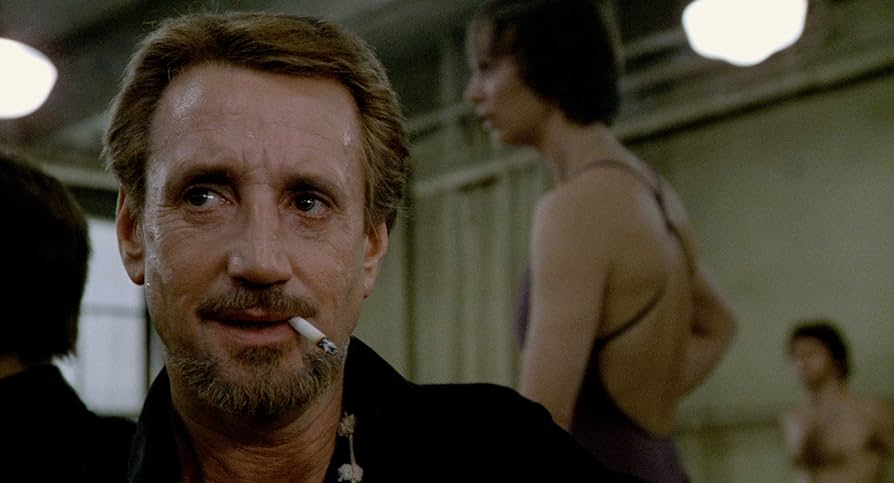
4. Roy Scheider โ€“ Best Hands-Free Usage

You know those Oscar categories like Production Design or Makeup/Hairstyling where the best usually means the most? When it comes to the โ€œmostโ€ smoking, Scheider comes out victorious just because of his performance in All That Jazz. Not only is it a constant, never-ending stream of cigarettes entering, lighting, ashing, discarding and entering again, no one hangs on to a cigarette while talking like Scheider. His hands are too busy as the thinly-veiled version of Bob Fosse. That performance could have gotten on this list alone, but Scheider also has iconic talk-smoking in Jaws. Not only is he smoking without using his hands, he delivers one of the most iconic lines in cinema with a cigarette hanging out of the corner of his mouth. Thatโ€™s smoking talent.

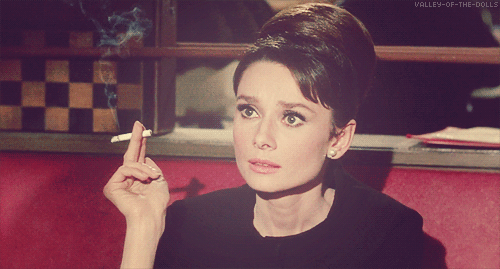
3. Audrey Hepburn โ€“ Most Regal Smoker

Audrey Hepburn is the peak of regal, classic beauty. You donโ€™t automatically think of her as a smoker, which only enhances her power. But her proclivity for on-screen smoking speaks for itself. Who else has a nearly-18-minute montage of smoking? Even one of her most iconic roles in Breakfast at Tiffany’s features her cigarette hanging out of a long black filter. Smoking has been long-associated with early aging and diminished beauty. But not for Hepburn. One of cinemaโ€™s most enduring beauties didnโ€™t let a little thing like constant smoking stop her from aging gracefully.

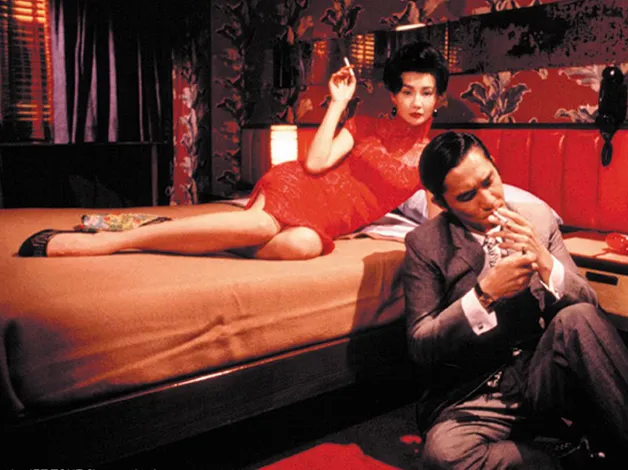
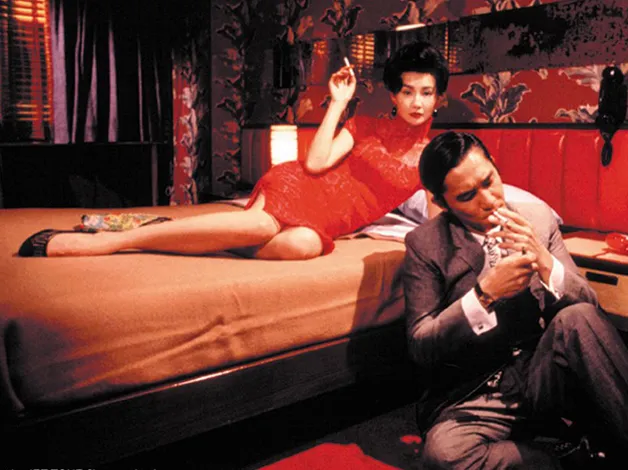
2. Tony Leung/Maggie Cheung โ€“ Sexiest Smoking Couple

This is almost cheating, because this list is meant to encapsulate a career of smoking. That being said, how do you negate the pair of sexiest smokers in the history of film? Leung and Cheungโ€™s searing chemistry is already there, but the lingering smoke seeping in the air in front of Wong Kar-Waiโ€™s camera adds as much to the story as the silence does. I could have just included Leung, as his partnership with Kar-Wai has a long history of smoking, but it felt wrong not pairing Leung and Cheung. They are intrinsically linked through their shared nicotine intake.

1. Brad Pitt โ€“ The Smoking GOAT

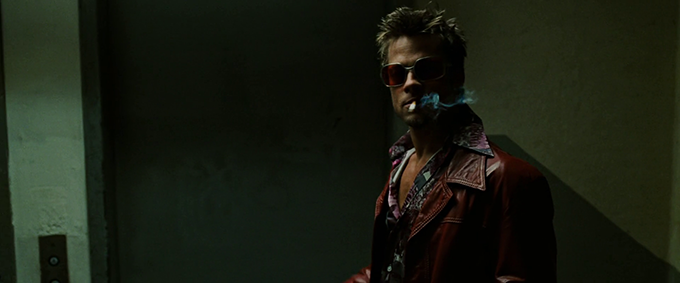
The greatest on-screen smoker. It probably helps that Pitt has reportedly smoked off-screen for years, but no one makes it look more natural. Thelma & Louise, Sleepers, Kalifornia, Snatch, Killing Them Softly, Fury, Once Upon A Time in Hollywood, and Babylon all feature a cigarette-laden Pitt puffing away. But it was his tour-de-force smoking performance in Fight Club which sets the Oscar-winner apart from the crowd. Itโ€™s not just about his memorable chiseled physique and gonzo energy; itโ€™s constantly paired with a smoke. Itโ€™s not an accessory, itโ€™s an extension of his body. Thereโ€™s nowhere and no situation where Pitt doesnโ€™t light up. In a bar, pre-fight, post-fight, while intimidating a city official, even in the freaking bathtub. No one smokes like Brad Pitt and no one ever will.

The Films Of Monsieur Max

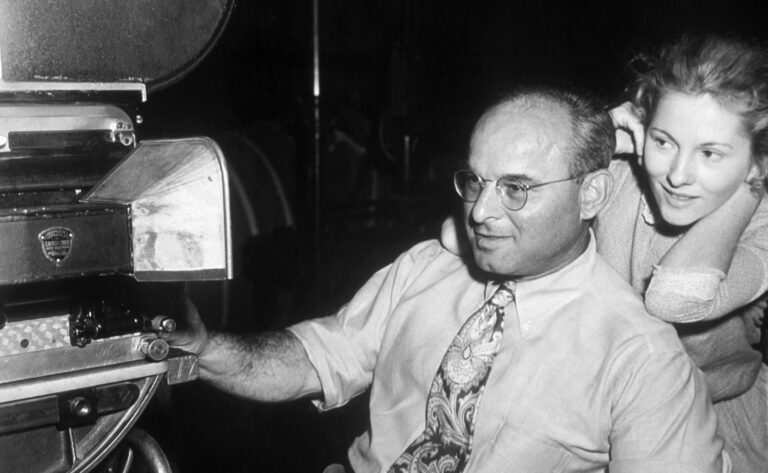
In the opening scene to 1950โ€™s La Ronde, the master of ceremonies (Anton Walbrook) walks across the stage and the camera follows him. It goes from one side to the other as he walks off the stage and goes behind the floodlights and camera on set while explaining the story is a series of episodes about love. He will pop in and out of the episodes, sometimes interfering with visual gags (the actual cutting of film), leading viewers to complete the titular circle of love. This was the first film I saw directed by Max Ophuls, who clearly had a unique eye to change how a camera moved and not simply horizontal or vertical on a track. Instead, he drew circles around his cast like a professional ballroom dancer to a Viennese waltz.   

Life Of A Ringmaster

Max Ophuls was born in Saarbrรผcken, Germany, in 1902. His family, successful in textile manufacturing, disapproved of Maxโ€™s interest in the theatre, so he changed his last name. His surname was not Ophuls, but Oppenheimer (no relation to the atomic bombโ€™s maker), and as a Jewish man, he was aware of the obvious anti-Semitism in his country after World War I. Ophuls first sought to be an actor and was for a short period until he was given the opportunity to direct a play. In 1923, Ophuls began directing a string of plays in Dortmund and in Vienna, Austria at the Burgtheater. There, he would meet an actress, Hilde Wall, who he would later marry and have a son with, Marcel, who directed The Sorrow And The Pity about the French resistance. The city would be central to his filmmaking career.

In 1930, Ophuls would get his start in directing movies when he was hired by UFA in Berlin, joining other major directors including Fritz Lang, Josef von Sternberg, and Ernst Lubitsch; all before they moved to Hollywood. His first film was a forty-minute comedy called Iโ€™d Rather Have Cod-Liver Oil. But after Adolf Hitler became Chancellor in 1933, Ophuls and his family fled to France and later became citizens. When World War II began in 1939, Ophuls was hired to write and perform on radio a series of anti-Nazi broadcasts, but as France was on the verge of falling, Ophuls and his family again fled, first to Portugal, and then reaching the United states in 1941.ย 

However, he would not get work immediately until writer/director Preston Sturges, a fan of Ophulsโ€™s film Leibelei back in 1933, persuaded studios to hire Ophuls as they had done with emerging European directors including Alfred Hitchcock, Jean Renoir, and Billy Wilder. His first film, the Howard Hughes-produced Vendetta, was a fiasco as he and Sturges were both fired due their slow pace of work. Four films were completed in Hollywood, most notably The Exile (1947) starring Douglas Fairbanks Jr., and Letter From An Unknown Woman (1948) starring Joan Fontaine and Louis Jourdan. After this frustrating period, Ophuls decided to return to France.

The last four films he would make โ€” La Ronde (1950), Le Plaisir (1952), The Earrings of Madame de . . . (1953), and Lola Montรจs (1955)โ€” are considered his masterpieces. La Ronde would actually win the BAFTA for Best Film, as well as garner an Oscar nomination for its screenplay. After the difficulty of finishing Lola Montes, he would go on to start making Montparnasse 19. Sadly, he would not get to finish it. While in production, Ophuls died from heart disease on March 26, 1957, aged 54. His close friend, director Jacques Becker, would complete the picture and release it the following year. 

The Man With A Dancing Camera

The camera exists to create a new art and to show above all what cannot be seen elsewhere: neither in theater nor in life; otherwise, Iโ€™d have no need of it; doing photography doesnโ€™t interest me. That I leave to the photographer. – Max Ophuls

Ophuls was widely known for his unique camera movements and long takes, never keeping anyone static, but always making a meaning for his camera. They are smooth, with dollies, and the use of crane shots. He uses countless tracking shots and long takes, minimizing the editing, and is open to having his camera moving up and down and gliding in different angles. โ€œLife is movement,โ€ Ophuls once said. James Mason, who worked on two films directed by Ophuls, wrote a poem in tribute to him mentioning his directing style. โ€œA shot that does not call for tracks is agony for poor old Max,โ€ he wrote. โ€œWho, separated from his dolly, is wrapped in deepest melancholy. Once, when they took away his crane, I thought he’d never smile again.โ€ 

Ophuls focused on themes of adultery, love, honor, idolatry, and the hypocrisy of the elite for their superficialness. The Earrings of Madame deโ€ฆ is such an example in which the opening sequence involves the leading character with her lavish lifestyle forced her to sell a pair because of debts. He is interested in the private lives of these people because the public has a fascination with them, especially the scandalous parts. The atmosphere is circus-like, as seen in Lola Montes, and there is always a Baroque element in his sets and costumes, which he leaves to the designers to take care of. Vienna is a usual setting because of time there and how much it influenced him in his career. The score is more waltzy than traditional in which the actors also dance with it. 

Actors loved working with him, even when he could turn tyrannical at times, but he was so widely admired that actors returned to work with Ophuls for other films. It was rare to have a closeup of them, insisting that their body language be the main expression. Besides James Mason, other notable names who worked with Ophuls include Anton Walbrook, Simone Signoret, Peter Ustinov, Simone Simon, Charles Boyer, and Martine Carol. Most of his films are female-centered, although not always sympathetic to its characters, and there are virtually no happy endings. Famously, for Lola Montes, Martine Carol was not his preference for the titular role but was forced upon him, as was the use of color, and that it had to be shot in English, French, and German. 

No Cushions For Hypocrites

Max Ophuls loved to poke at these historical figures who do not uphold such high esteemed values, making his latter films strong social satire. His interest in the perverse was buttered up with an air of cruelty that sometimes denied a happy ending, yet did not have it end on a strong down note. For someone who didnโ€™t have a really scandalous private life, Ophuls was someone who loved to find novels and plays that dug up dirt on these people and spun it to humiliate them with glee in a comical manner. His spinning top was the camera moving at a pace to make the characters, not us, dizzy in their pursuit of pleasure. The ending of The Earrings of Madame de . . ., while ambiguous, is a lose-lose result for the main character. The last words of Lola Montes is a resigned, โ€œLife goes on.โ€ 

Ophulsโ€™ work is playful and sensual without overdoing it, choosing subtlety over overtness. It is the total opposite to Yorgos Lanthimosโ€™ hypersexualized surrealism in the era of Queen Anne and the Victorian period. There is an emotional pull that connects every scene and every episode within his work. Dying young robbed us of more films from Ophuls that entertained the moments of love that lead to probable heartbreak, that the desire for gratification is a very fragile and fickle thing. Then again, life is shortโ€ฆand life goes on.
Movie Review: ‘Ricky Stanicky’ Cannot Be Helped, Even By Efron and Cena


Director: Peter Farrelly
Writers: Jeffrey Bushell, Brian Jarvis, James Lee Freeman, Peter Farrelly, Pete Jones, Mike Cerrone
Stars: Zac Efron, John Cena, Jermaine Fowler, Andrew Santino

Synopsis: When three childhood best friends pull a prank that goes wrong, they invent the imaginary Ricky Stanicky to get them out of trouble. Twenty years later, they still use the nonexistent Ricky as a handy alibi for their immature behavior.


One of my bigger gripes with streamers unceremoniously dumping genre fare on their platforms with all the fanfare of a traffic jam is how well many of those films would play in a theater. Of course, many recent titles landed on streaming services partially due to the impact the COVID-19 pandemic had on the moviegoing experience (oh, how I wish I could have seen Palm Springs in a packed picturehouse). But even in the years since cinemas reopened en masse, movies of ostensible theatrical quality have fallen by the wayside in regards to the attention they should receive due a streaming release. 

Think about a film like 2022โ€™s Prey, a fresh offering under the Predator umbrella; it was a sneaky hit on Hulu, yet I canโ€™t help but think about the way it wouldโ€™ve looked on the big screen. Bradley Cooperโ€™s Maestro, a Netflix original, is a curious case study. It received plenty of acclaim, not to mention seven Academy Award nominations, but as someone who saw the film both in a theater and at home, I can confidently assert that it plays significantly better when projected rather than displayed on a television or laptop. I have serious fears for Richard Linklaterโ€™s Hit Man, a sexy, uproarious rom-com that premiered to much acclaim at festivals last fall, yet will land on Netflix on June 7 with no accompanying theatrical release, per usual. That film is simply so alive; it begs to be seen with a crowd.

Ricky Stanicky does not.

Thereโ€™s a bit more to it than that. But perhaps the best way to summarize its potential for such status is by noting that a lot of what Ricky Stanicky feigns to be โ€” not just be about, but be in substance โ€” it screams โ€œtheatrical comedyโ€, provided that weโ€™ve traveled back in time to 2007. I can envision a cast featuring Paul Rudd, Jason Segel, and Danny McBride, or actors of that ilk, playing a trio of successful jamokes who, in their youth, invented an imaginary scapegoat and have let him live on into the present. They have jobs, wives/partners, and adult responsibilities, all of which they are willing to abandon on the condition that they wonโ€™t be faulted for said abandonment. Of course, thatโ€™s because the blame always falls on Ricky Stanicky. I can see Judd Apatow or Adam McKay mining humor out of this premise, the aforementioned actors making lemonade out of the outwardly-lemonish dick jokes theyโ€™ve been served on a platter, and audiences eating it all up. 

Maybe these visions of mine carry more weight because that was the intention for the project back when it landed on the 2010 Black List, thus deeming it one of that yearโ€™s best unproduced screenplays. Since then, Jim Carrey, James Franco, and Joaquin Phoenix (?!) were all in line to play Ricky, a dubious honor that ultimately went to John Cena. And itโ€™s even more evident that the script has gone through an incessant slew of revisions over time, to the point where it now has six credited writers, as well as two separate โ€œstory byโ€ credits for David Occhino and Jason Decker. Itโ€™s a patchwork piece at best, which is too bad, considering how much fun Cena is clearly having (and willing to have), and the fact that, in better hands and at a different time, I can genuinely imagine it making just north of a nine-figure box office return. 

Instead, itโ€™s 2024, so Ricky Stanicky is littered with stand-up comedians who donโ€™t act so much as they play renamed versions of themselves, directed by Peter Farrelly, and plopped on Amazon Prime, right around the corner from the discount toilet plungers. (I can only assume that a poop joke was left out of Ricky Stanickyโ€™s final cut, though a pee joke made it through the edit alive.) Its footprint, solely digital; its jokes a return to form for Farrelly, who made Green Book and The Greatest Beer Run Ever; and clearly felt heโ€™d done his duty for sincere-ish storytelling and wished to retreat to his dick joke haven. 

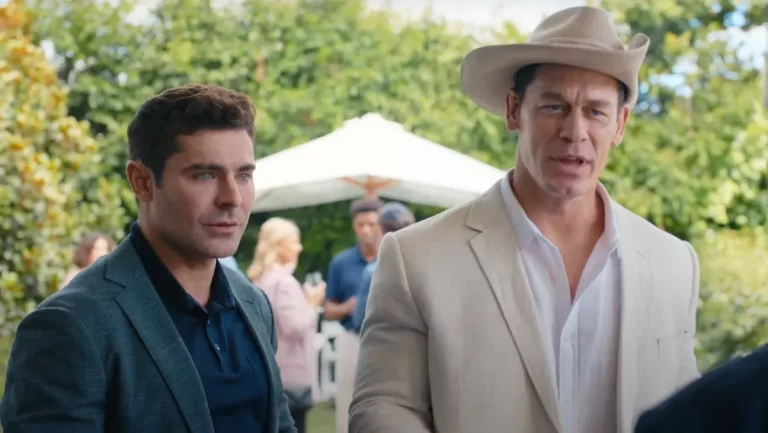
Zac Efron (Dean) stars as a nothingburger of a hedge fund bro who, along with Andrew Santino (JT) and Jermaine Fowler (Wes), have a get-out-of-jail-free-card for just about anything in the form of the titular character. One of the first examples we see is Dean and JT itching to ditch  JTโ€™s baby shower in favor of a Marc Rebillet concert in Atlantic City. How do  they get out of the shower? Rickyโ€™s cancer is back; the boys have to head to Albany to be present when he gets out of surgery.

When the dudes are forced to leave their weekend getaway early when JTโ€™s wife goes into labor โ€” darn! โ€” they return to an entourage of dubious family members, who called every hospital in Albany trying to get a hold of one of the guys (they turned their phones off so they couldnโ€™t be tracked), and there was no record of any Ricky or Stanicky anywhere. So, in an effort to keep up appearances with their loved ones, Dean comes up with a bright idea: Why donโ€™t they hire the alcoholic actor they met while at a bar in A.C.? His name is โ€œRock-Hardโ€ Rod, and while he might not be the best bet at convincing their families of Rickyโ€™s legitimacy, our main men arenโ€™t exactly swimming in options.

Enter Rod, who is just as committed to the bit of being Ricky as Cena is to playing him, but the whole sham these morons cooked up is a disaster waiting to happen. Especially because Rod enjoys being Ricky so much that he wonโ€™t take the money and run. Once the gig is up, Rodโ€™s method acting persists; he even gets hired by Dean and JTโ€™s boss, and swiftly receives a title with higher status and pay than the aforementioned duo. Nevermind that Rodโ€™s only true skills are finding ways to sexualize the lyrics to popular rock songs for his one man show โ€” it didnโ€™t make me laugh, but Iโ€™d kill to see Peter Framptonโ€™s reaction to Rod singing, โ€œOoh baby, I masturbate, everyday yeah, yeahโ€, โ€” because โ€œRickyโ€ is a jack of all trades. The more Rod hams it up, the further into chaos Dean, JT, and Wesโ€™ lives are thrown.

If only this chaos was handled with any sort of regard for real humor rather than a rapidly-unspooling thread of stale quips and gags. This is the sort of film that is more concerned with how a line reads than how it lands or even relates to the plot; I recall Wes mentioning, โ€œSometimes I feel like Iโ€™m in a gay Handmaidโ€™s Taleโ€, but what that referenced is of less import to the script than the fact that Wes mentioned a recognizable streaming property. The point โ€” both of this line and the movie as a whole โ€” isnโ€™t to reinvent the wheel, but youโ€™d think it might at least try to split the difference between Thereโ€™s Something About Mary and Hall Pass
All this is made infinitely worse by it being the Efron performance immediately following his outstanding turn in last yearโ€™s The Iron Claw, a prestige project that saw the otherwise-solid actor reach unforeseen dramatic heights. Not even he can support the movie-stealing work of Cena, an up-for-anything performer who grows as an actor every time he appears on screen. Yet despite his best efforts, the Academy Awards will go down as the funniest thing Cena appears in this month. Somehow, more work went into crafting a gag to accompany the presentation for achievement in Costume Design than into a new feature film from an Oscar winner. If only that was as much of a sham as this.

Grade: D

Scarlett Johansson: The Bombshell of Body Dysmorphia

Scarlett Johansson has always been an unreliable narrator of sexuality and femininity in its primitive form. The blonde bombshell of the ’50s and ’60s reincarnated, her breasts and her voluptuous figure, her features that combine sultry coyness and childlike girth have made her a dream girl of the late โ€˜90s and early โ€˜00s. The actress has admitted lately that this wasnโ€™t the image she wanted to be seen through as an actress, that she wasย groomedย into the blonde bombshell/pretty baby archetype in her earlier acting years. Scarlett defied that, however, through her later career choices, where she became more comfortable in her skin to the extent of shedding it all off.

How Johansson Inverted Heteronormative Sexuality

There are two films in which Scarlett plays on the โ€œScarlettโ€ persona with a mischievous in-your-face rebellion twist: Under the Skin and Ghost in the Shell. Although the latter might have brought criticism for casting choices due to whitewashing, it was -on her part- a brave choice and a bold move to deconstruct her celebrity image.

When Scarlett first appears on screen in Ghost of the Shell she is stripping. Everybody anticipates. Itโ€™s Scarlett Johansson on the big screen getting naked with flawless skin and lips that have always been marketed as the ultimate cis hetero manโ€™s (and lesbianโ€™s) dream. Scarlett never fails to drag on hungry onlookers, perverse spectators from behind their laptop screens.

But something else is revealed. Scarlettโ€™s female body is sexless without all the definite features that cause a female to be -arguably- female: no nipples, clitoris, or vulva. Itโ€™s a sewn female body without all the openings, but itโ€™s still there to ponder with all its sexual/sexless energy. Itโ€™s a female mannequin like the ones found in horror movies such as Maniac and Lights Out, a sea of genitalia-less female figures displayed and not exposed. This defines Scarlettโ€™s rendition of Motoko or Major Mira Killian, the first full-body cyborg. A human whose brain has been implanted in another body, her sense of abduction is a constant reminder that her presence is in a body where she doesnโ€™t belong. A reminiscence on body dysphoria or a hijacking of sorts translates much that many people might not be able to express in words.

In multiple scenes of the movie, Scarlett is seen naked, but itโ€™s a form of cocooned nudity, a bare body imprisoned in the confines of gender aesthetics. She is still Scarlett, still described in one of the video titles on YouTube โ€œBeing Thirsted Over by Menโ€. But she redefines what it means to be a woman, and a past sex symbol for all that matters, having all the metrics of the penultimate sexy Hollywood blonde. Scarlett doesnโ€™t dispose of her attractive features for the sake of a role. Sheโ€™s not Charlize Theron shaving her brows or Nicole Kidman donning a prosthetic nose, but sheโ€™s retaining her cool features, cat-like eyes, and infamous pout, without a body underneath to complete the wet dream.

In Ghost in the Shell, Scarlett plays a character with a gender identity crisis, coming to terms with her body and existence. She questions the link between biological sex and actual gender with her subtle treading on gender lines, being a fully-developed female and refusing to succumb to the gender plethora of femininity. Major Mira Killian is not just a cybernetically modified human but a lost soul, a creature that hovers on the borders of feminine and female, not fully conforming to either.

The idea of owning a body, gendered but non-gendered, becoming but also unbecoming, working the way through gender discovery and dysphoria, is the core of the original Ghost in the Shell animated movie. Aside from the A.I. anxieties and the futuristic doom, we are attached to Motokoโ€™s journey across humanity and bodies, identifying with her quest to discover her true self and those around her, in the process she touches on different themes and pathways that make her distinct, that is her corporal journey as she comes to terms with her bodily restrictions and capabilities.

Body Discomfort, Dysmorphia, and Gender Identity Crisis

In Under the Skin, Scarlett is a female. She just exists with a skin that she puts on to become more familiar with the planet she plans to invade. Sheโ€™s not a woman but a female entity that doesnโ€™t conform to presumed ideals of sexualizing that gendered being. The alien is incapable of having sex and is almost punished for that by being forced into it. The alien becomes an embodiment of an agender dream. It is a female on the border of gendered expression, without femininity, but also defined as such.

Itโ€™s easy to dismiss someoneโ€™s identification or lack of their body. Itโ€™s a question that has plagued my mind for years. What is a body? What is a male or female body? My body scared and intrigued me in how it differed from other members of the same gender that I was supposed to belong to. When I noticed the quirks and mismatching details, I realized that body dysphoria is not that foreign.

The idea of an imperfect female body begins at a very young age for some girls, and itโ€™s also something that some women struggle with as they grow up. However, the idea of a โ€œweirdโ€ female body is something else. Thereโ€™s always something wrong with this woman: too much hair, dark armpits on fair skin, a mustache that needs constant waxing or painful laser sessions to remove, a weird-looking boob, a vagina buried underneath bushes of coarse hair, a strange-looking face; blemishes, scars, pigmentation, freckles, too many freckles, etc. As someone who has always felt like an alien in their own body, suffering the scrutiny of female peers who might or might not have criticized or pointed out an eccentricity, it was refreshing to watch Scarlett Johansson reject that embodiment of feminine perfection.

What is Under Scarlettโ€™s Skin?

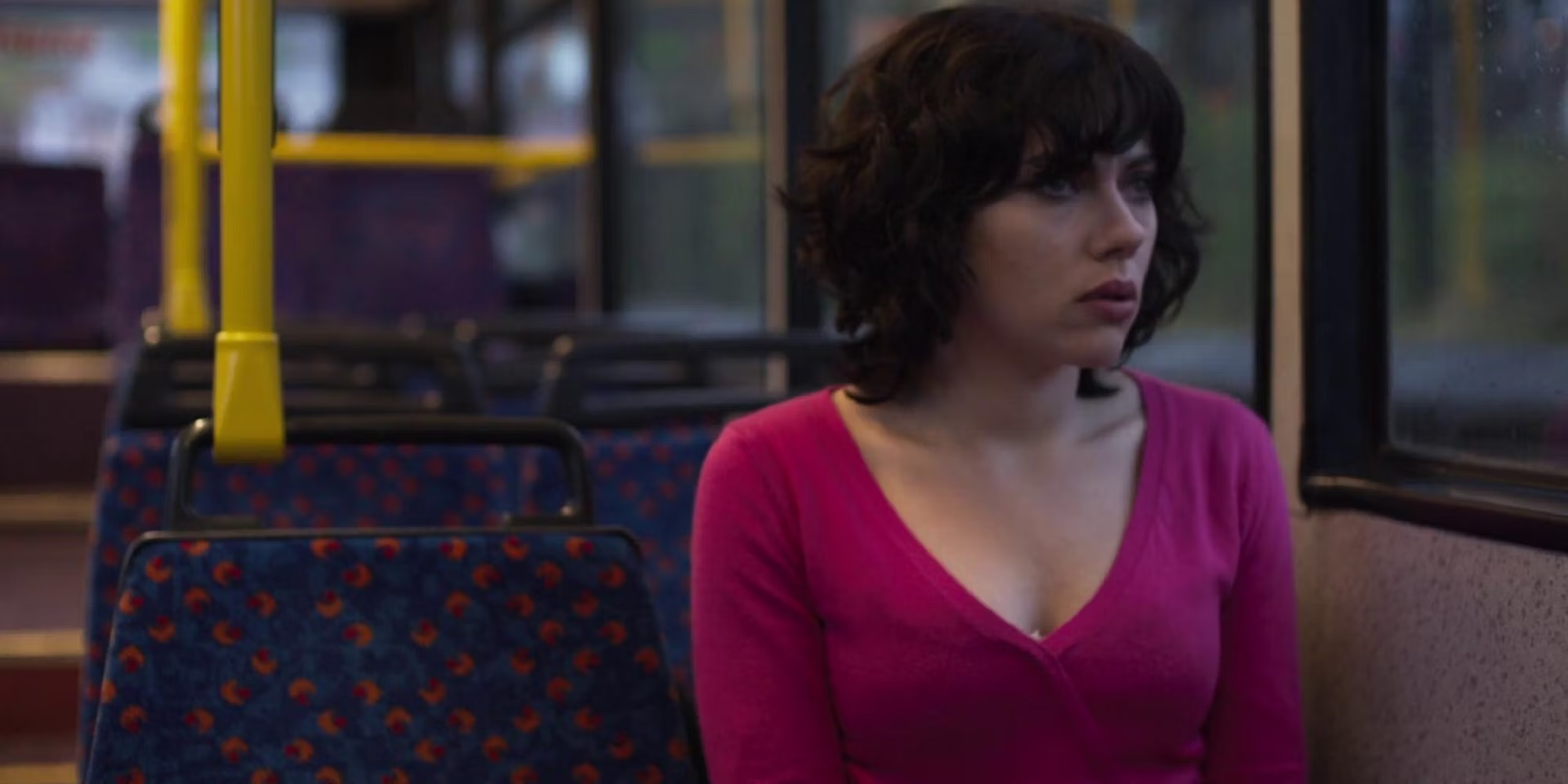
In Under the Skin, Scarlett sheds the skin of a sexy female luring people. She harbors on the fringes of the world, wearing a fur coat that creates an allegory to prominent male figures in other cinematic masterpieces -The Driver in Nicholas Winding Refnโ€™s Drive– but doesnโ€™t provide proof of consent to being male or female. Scarlett plays an alien, preying on unsuspecting men and feeding them to the void, where matter dissolves and shrinks. People are merely energy sources for a more considerable creation. Scarlettโ€™s creature is female underneath, but the escalation to the revelation of the true self also brings up how gender is a barrier in peopleโ€™s perceptions of them and how universal expectations of them hinder their emotional, physical, and actual growth in an accepting world. Scarlett again plays on the fetishized version of her. She is nude without a sexual undertone. She sheds the skin that has usurped her all of her life, to reveal the truth, a female but in a version that heteronormativity would never understand.

What does it take to be a woman? And how does one accomplish so? The freak reaction of the sexual predator throws shade at the culture of objectifying women, like Scarlett, or setting definitions for femininity and gendered existence where a woman would not feel safe to become who she chooses to become. And in the scary scene at the end, Scarlettโ€™s reality is burned. The creature is burned alive and itโ€™s as if people are burning the mere thought of her existence. But in reality, Scarlett is burning that skin, her sexualized younger self is given the final treatment, buried deep underneath the new woman who exists as beautiful, sexy, or even quirky and funny as she chooses to be, but further from the old self than one could expect. To depict gender dysphoria using her old, very archaic, and normative self as a backdrop to a shifting world in terms of gender and sexuality is not only an act of liberation but a rebellion against the ideal femininity trope which could be a deicide in progress.

Movie Review: ‘Kung Fu Panda 4’ is Pure Retread


Directors: Mike Mitchell, Stephanie Stine
Writer: Jonathan Aibel, Glenn Berge, Darren Lemke
Stars: Jack Black, Awkwafina, Viola Davis

Synopsis: After Po is tapped to become the Spiritual Leader of the Valley of Peace, he needs to find and train a new Dragon Warrior, while a wicked sorceress plans to re-summon all the master villains whom Po has vanquished to the spirit realm.


After watching Kung Fu Panda 4, I have come to one inevitable conclusionโ€”it’s time to put this panda to sleep. The original Kung Fu Panda was fun, but overrated. Iโ€™ll admit, the delightful sight of a chubby panda becoming a ninja warrior gave everyone that warm and fuzzy feeling of doing endless panda rolls down a hill full of delightful glee. This phenomenon then spawned three needless sequels like DreamWorks’ goofy cousin, whom you see once every couple of years during the holidays.

The fourth installment goes through the motions, repackaging ideas, themes, and jokes. Besides a few examples of genuine, delightful panda-paw banter between star Jack Black and Hollywood icon Dustin Hoffman, Kung Fu Panda 4 is a pale comparison, even for this franchise’s standards. To make matters worse, the series is still looking for that emotional connection between the filmmakers and the audience to reward fans for their investment.

The story starts when Po (Jack Black), a lovable big-boned panda, is told he must select a trainee for a new โ€œDragon Warriorโ€ by Master Shifu (Dustin Hoffman), a wise red panda who gives you those Yoda vibes. In some of the movie’s best scenes, Po continues to choose himself to continue to be the legendary protector of Shifuโ€™s amusing frustration. Black and Hoffman have some delightful chemistry with that panda-paw-banter we mentioned above.

Po then arrests a โ€œquillariousโ€ Corsac Fox, Zhen (Awkwafina), who is in their kingdomโ€™s jail for mischievously trying to steal the Valleyโ€™s ancient weaponry. While talking to Zhen, he discovers that Tai Lung (Viola Davis) has returned as a Chameleon who is shape-shifting into an animal of her choosing. In order to put off the major change in Poโ€™s life, he tells Shifu he is going to take Zhen on a mission to stop the impending ominous force that threatens everyoneโ€™s way of life. 

Kung Fu Panda 4 has Mike Mitchell at the helm for the latest installment. If that name sounds familiar, you are one of the few proud fans of Rob Schneider comedies. Mitchellโ€™s first film was the infamous 1999 comedy Deuce Bigalow: Male Gigolo. He has remade himself in animation, directing Shrek Forever After, Trolls, and The Lego Movie 2: The Second Part, all of which have been well-received.

The issue is that, while the film is marginally better than the first two sequels, the script has too many hands-on retooling the script. Five writers have been credited with the final product, with Jonathan Aibel and Glenn Berger returning to write the latest entry with the help of Darren Lemke. While the script does pay homage to the original, the effort to have a stand-alone story ultimately falls flat because itโ€™s recycled material from the former villain and adds nothing new to popular films. That includes Poโ€™s worried fathers, disappointing physical humor, and visual gags.

Since this is a visual medium, animation can be beautiful and, in certain moments, breathtaking. The movie’s beginning has a wondrous color palette with stunning texture, especially in scenes involving Blackโ€™s Po and Hoffmanโ€™s Shifu walking through The Valley of Peace. Yet, these visual pleasures become inconsistent when the script moves the characters to Juniper City, and the cinematography choices become humdrum.

And thatโ€™s a shame because the Kung Fu Panda franchise has become the Pixar version of Cars. This low-quality animated family film experience serves only as a cash cow for the studio. At the very least, the original deserves a better effort to right the ship of this ever-sinking series before they develop too much ill will with their fanbase. Of course, with streaming potential, itโ€™s no longer about quality but keeping up with new content. 

Kung Fu Panda 4 is not worth watching because it borrows too many elements from previous films (and others in the DreamWorks filmography) that stunt any potential creativity to be a proper standalone entry in the franchise. 

Grade: C-

Episode 576: Recapping the 96th Academy Awards

This weekโ€™s episode is brought to you by Koffee Kult. Get 15% OFF with the code: ISF

This week on the InSession Film Podcast, Brian Rowe joins JD to recap this year’s Oscars and the great winners of the 96th Academy Awards! It was a show with everything. John Cena was naked. John Mulaney broke down Field of Dreams. Al Pacino lost his mind. Ryan Gosling brought the house down. The winners were great. Lots to talk about with the Oscars this year!

Check out this weekโ€™s show and let us know what you think in the comment section. Thanks for listening and for supporting the InSession Film Podcast!

– Oscars Reactions Part 1 (5:45)
To begin, we talk about the ceremony and why the flow was quite good for a broadcast that lasted over three hours. We, of course, break down Best Actress and talk about the wild discourse that followed. Christopher Nolan finally gets his first Oscar and Oppenheimer will go down as an all-time great Best Picture winner.


RELATED: Listen to Episode 516 of the InSession Film Podcast where we discussed our Top 10 Movies of 2023!


– Oscars Reactions Part 2 (44:25)
In the back half of the show, we continue talking about the Oscars with The Zone of Interest winning Best Sound – one of the most inspired wins in The Academy’s history. We talk about the greatness of The Boy and the Heron winning Animated. We also talk about Poor Things sweeping Costumes, Production Design and Make-Up, and so much more. What was your favorite win at the Oscars this year?

– Music
Can You Hear The Music – Ludwig Gรถransson
What Was I Made For? – Billie Eilish

Subscribe to our Podcasts RSS
Subscribe to our Podcasts on iTunes
Listen on Spotify
Listen on Stitcher
InSession Film Podcast – Episode 576

Next week on the show:

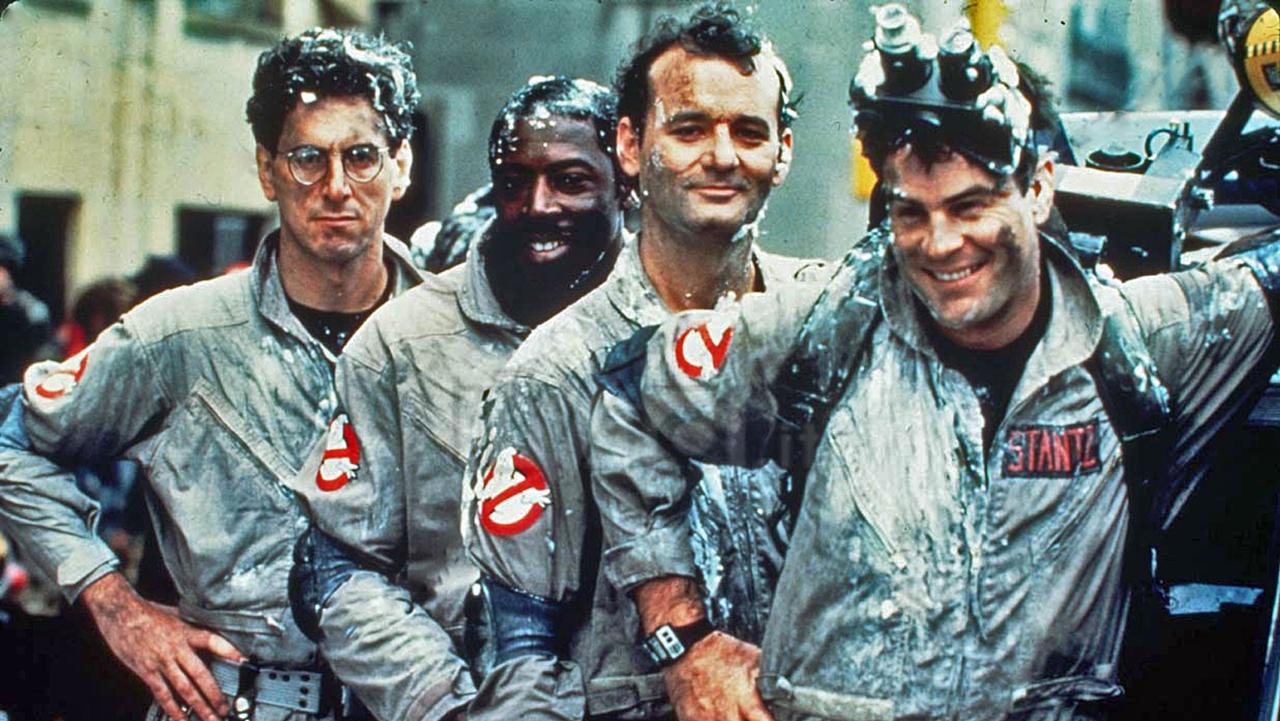
Ghostbusters Retrospective

Help Support The InSession Film Podcast

If you want to help support us, there are several ways you can help us and we’d absolutely appreciate it. Every penny goes directly back into supporting the show and we are truly honored and grateful. Thanks for your support and for listening to the InSession Film Podcast!

VISIT OUR DONATE PAGE HERE

Movie Review: ‘Through the Night’ is a Poignant Exploration of Trauma


Director: Delphine Girard
Writer: Delphine Girard
Stars: Selma Alaoui, Veerle Baetens, Anne Dorval

Synopsis: One night, a woman in danger calls the police. Anna takes the call. A man is arrested. Weeks pass, justice is looking for evidence, and Aly, Anna and Dary face the echoes of that night that they can’t manage to leave behind.


Delphine Girardโ€™s short film, A Sister, vehemently shook me to my core the first time I saw it in my screenwriting class, with the filmmaker in attendance, a year before the film ultimately got nominated for an Oscar. The script was airtight and masterfully built its tension through Alyโ€™s (Selma Alaoui) exchanges with a police dispatcher (Veerle Baetens), pretending to talk with her sister over the phone, as her abuser, Dary (Guillaume Duhesme), holds her hostage in his car and drives to an undisclosed location.  

The context behind their relationship is missing, but everyone understands her pain as she is in desperate need of help before something far worse happens. When Dary is ultimately arrested, the film ends. This abrupt closure leaves the impression to the audience that justice has been served and that everything will go in Alyโ€™s favor once Dary is put behind bars. Of course, the current justice system makes it very difficult for victims of sexual assault to see justice. If it does happen, it usually takes years, and it isnโ€™t as clear-cut as other legal cases. 

In her feature-length expansion of A Sister in Through the Night (Quitter la nuit), Girard explores what happens after the events of the short film (after recreating it for the opening scene), as Aly files a complaint for rape and false imprisonment in the wake of Daryโ€™s arrest. At first, sheโ€™s interrogated by the police, who believe her recollection of events as true, while Dary vehemently denies any wrongdoing. As legal procedures begin, he moves back with his mother (Anne Dorval), who Dary convinces there is nothing to worry about, as the exchange between him and Aly was consensual. 

Meanwhile, Aly has difficulty grappling with her assault, crying alone in her apartment as her daughter helplessly watches, and the police investigation takes (a lot of) time. The dispatcher, Anna, is also having difficulty moving on from the call, as Alyโ€™s situation wasnโ€™t a simple life-or-death phone call. She had to use codified language to get help, not to raise suspicions from Dary. It takes great skill to catch what Aly was saying to โ€œher sisterโ€ on the phone, as most dispatchers would have likely hung up the phone, which is part of why Anna canโ€™t bring herself to continue her work as normal. 

These moments of intense contemplation are the bulk of Through the Nightโ€™s suffocating first half as you watch these three individuals attempt to pretend their lives are normal after an event slowly consumes them. One of them wonโ€™t admit guilt, but his mind keeps replaying the night through fragments as if it doesnโ€™t want to believe that he did commit rape, while Aly tries to recover from Daryโ€™s psychological and physical abuse. 

Because of its release, the film will likely be compared to Molly Manning Walkerโ€™s How to Have Sex, which also dealt with a protagonist who grappled with her assault. While both movies focus on  similar themes, and Walkerโ€™s film is vastly superior from a visual perspective, Girardโ€™s Through the Night is equally as effective, if not more, through careful screenwriting and editorial choices that elevate the character drama beyond surface-level observations on the characters picking up the pieces. 

Scenes where characters recollect events to the police are long but necessary in our understanding of the two protagonists. Alaoui gives a magisterial turn as Aly, whose petrified eyes will stick with me for a long time. Itโ€™s not so much emptiness as it is torment, attempting to recover from a harrowing, traumatizing event as life goes on with her child and family. The scene that perfectly represents her anguish happens a bit later in the film, in which she attempts to tell her ex-husband, Pierre (Gringe), what happened but canโ€™t bring herself to do so. The longing in her facial expressions are clear, and the silences in between Pierreโ€™s questions speak so much louder than her own words. 

When the movie eventually cuts to two years later, when the trial will take place, many may also compare it with Justine Trietโ€™s Anatomy of a Fall, where the prosecution team attempts to twist the phone recording between Aly and Dary during the trial. However, thereโ€™s no ambiguity here: the rape happened, and Dary physically assaulted Aly during the phone call when he suspected something. One film leaves the door open for multiple points of interpretation, while the other directly shows how the justice system never favors its victims, even when the crime itself is clear and the police believe them.ย 

When Girard ultimately shows the rape and directly cuts to Dary sitting in his car as his mind fully recollects what happened two years ago while his mother stares at her son point blank, the emotional impact is immensely upsetting. Dary lied not only to the police and judge to save face but also to his own mother  โ€“ it gets even worse when he tells her he did it without hesitation. It takes an expert like Dorval to react the way she did and make us feel for a loving, caring mother who took her sonโ€™s side, thinking he was innocent, only to realize that he is just as cruel, if not worse than Daryโ€™s father (whose innate penchant for violence likely comes from him, though Girard doesnโ€™t directly state to it). With it, she gives her greatest-ever dramatic performance, a layered and emotionally charged turn where her quiet composure is more effective at conveying raw feelings than the relationship she holds with her son. 

However, the next scene, in which Anna reveals herself to Aly, is when the emotional buildup of the film fully takes form. With one line, she describes the injustice she will likely face as Dary will live with the guilt he will literally and figuratively carry for the rest of his life. The emotional resonance is devastating and far more poignant than How to Have Sexโ€™s ending, which teased a hopeful future incompletely. After Aly eventually confronts Dary, her life slowly begins to rebuild itself in a more hopeful direction. Itโ€™ll take time, but it will happen as the rest of the story belongs to her. 

Grade: A

Movie Review: ‘Damsel’ is in Deep Distress


Director: Juan Carlos Fresnadillo
Writer: Dan Mazeau
Stars: Millie Bobby Brown, Ray Winstone, Angela Bassett

Synopsis: A dutiful damsel agrees to marry a handsome prince, only to find the royal family has recruited her as a sacrifice to repay an ancient debt.


Netflix’s Damsel is an example of a rite of passage for rising talent. It used to be that a young female star would take the reins of a romantic comedy to cement their status as a Hollywood starlet. Soon, when the rom-rom left the public eye like the radio star, the young-adult romantic drama became the next big thing. While the YA film may never go away, youthful actors have yet to set their sights on a new kind of launching platform.

That would be the costume dark fantasy action film, proving that girls can be just as kick-ass as the rest. The Kissing Boothโ€™s Joey King did one for Hulu in the summer of 2022 called The Princess, a fairly entertaining film that proved King could hold her own. Now, Stranger Things megastar Millie Bobby Brown has her John McClane moment as a young woman who finds herself as the damsel in distress who only needs to rely on herself. The result is that Brown holds her own in some gnarly action sequences, but the rest of the film fails to live up to its potential as a fun action diversion.

Brown stars as Eloise, the daughter of a king (Ray Winstone) who oversees a dying kingdom in the farthest point north. His people are poor, without adequate shelter and food. Eloise’s mother died many years ago, and her father married Lady Bayford (Angela Bassett), whose bloodline is anything but royal, being the daughter of a rope maker. The noblewoman has a younger sister, Floria (The Peripheral’s Brooke Carter), whom Eloise schools on leadership qualities.

Soon, the King is approached by a wealthy royal family with more gold than Eloise has ever seen. They are looking for a young lady to marry Prince Henry (Nick Robinson), the son of Queen Isabelle (Robin Wright). From the trailer, you know what happens next. They marry and soon whisk Eloise away to an ancient ceremony on the cliffs of the highest point of the kingdom. There, the Queen takes a dagger and draws blood from both happy couples’ hands so his royal blood can mix with hers. 

Oh, and then Henry tosses Eloise over a bridge as a ritual sacrifice.

Yeah, that took a turn. Damsel was directed by Juan Carlos Fresnadillo (28 Weeks Later) and written by Dan Mazeau (Fast X), who falls into the trap of what I call making a video game script. As soon as Brown’s Eloise is tossed off that bridge, her mission is to escape the caves where she was sacrificed to be killed by a fire-breathing dragon. The scenes are written and filmed in a way remarkably similar to narrative-driven gameplay on your Playstation or Xbox. 

For instance, each time the titular character escapes, she finds writing on the wall that provides her with clues, warnings, and directions on how to escape. As soon as you get the feel of it, this takes away much of the suspense because you know what will happen as quickly as they start. You even have Eloise running into a few potential saviors who give her just enough information on the “mystery” of why she was betrayed, which was evident, and more escape instructions.

These special effects drenched pictures are reasonably good for a UHD television, producing a certain amount of addictive energy. However, almost all the characters are underwritten, from the villains to the main character. Again, all the departments of a video game are involved. Wright fares reasonably well, even though she is rather a one-note villain. Winstone hams it up as much as he can with nothing to do. Bassett’s only job is to act concerned, and she is over-the-top helpless, which is strange to watch from an actress known for portraying such strong female characters. Then you have Nick Robinson, who is so good in Love, Simon has nothing to do but argue with his mother, without any backbone to make the audience care.

Damsel is built for Millie Bobby Brown, who showcases her ability to helm a special effects-laden film, yet the production forgets to build around the star. Even the dragon (voiced by Shohreh Aghdashloo) has no emotion and feels like you are listening to AI-generated dialogue and responses that do not resonate with the viewer. Neither does the subtext of feminist empowerment themes, which never go beyond the shallow narrative, which plays more like a marketing ploy to mirror todayโ€™s socially conscious times than have anything significant to say about the matter.

While Damsel will undoubtedly entertain fans of Brown and those who like their films consumed on autopilot, Damsel fails to generate enough interest to justify your most valuable assetโ€”your time.

Grade: D+

Oscars 2024: A Reaction

Another Oscars has come and gone. Many laughs and many tears as well as a beautiful moment of an entire room of professionals collectively deciding Jimmy Kimmel has overstayed his welcome. He won us over with a setup and lost us with a disappointing punchline. It was a bit of whiplash as Kimmel received boos at his shot at SAG president Fran Drescher, while then getting cheers for talking about solidarity between the unions. Maybe the Academy should give no host a shot again or find writers who have better knowledge of movies rather than just knowledge of mistakes celebrities have made in the past. It was utterly painful to watch as Kimmel couldnโ€™t land his joke and kept needling Robert Downey Jr. about his past behavior.

In spite of Kimmelโ€™s bland attempts and uncomfortable sexual harassment of Ryan Gosling, the show was pretty enjoyable. Many presenter jokes didnโ€™t land, but were still charming, like Octavia Spencer and Melissa McCarthyโ€™s double act. There was also the Arnold Schwarzenegger and Danny Devito bit. It was GREAT, especially as they brought in Michael Keaton, who deliciously mugged at the two actors who have played Batman villains. Though when the two men got to the actual presentation, they lost some steam and had a hard time getting it back. 

The best of the best were those fully committed to their bit and transitioned seamlessly to the presentation. John Cena walked out naked to present the award for Best Costumes. Kate McKinnon and America Ferreraโ€™s presentation for the Documentary categories included a terrific bit about Jurassic Park that included a very game Steven Speilberg. John Mulaney pontificated on the strange rules of ghost baseball before he presented Best Sound. Ryan Gosling and Emily Blunt squashed the Barbenheimer beef while stealthily promoting their upcoming movie The Fall Guy, about a stuntman in the wrong place at the wrong time, with a clip package of excellent stunt work from the year.

This year also brought back a sweet presentation of five past winners presenting each of the acting awards. Some of the pairs of presenter and nominee were incredibly poignant, others made the best of their very wordy material that some of them had a hard time getting through. A terrific highlight was Sam Rockwell presenting to Robert Downey, Jr. with Downeyโ€™s famous line from Tropic Thunder, his last nomination, about not dropping character until the DVD commentary. Nicolas Cage was an odd choice for Paul Giamatti, but like all the others he was given a perfect connection to his gonzo method with Giamattiโ€™s willingness to wear a contact that would mimic a lazy eye.

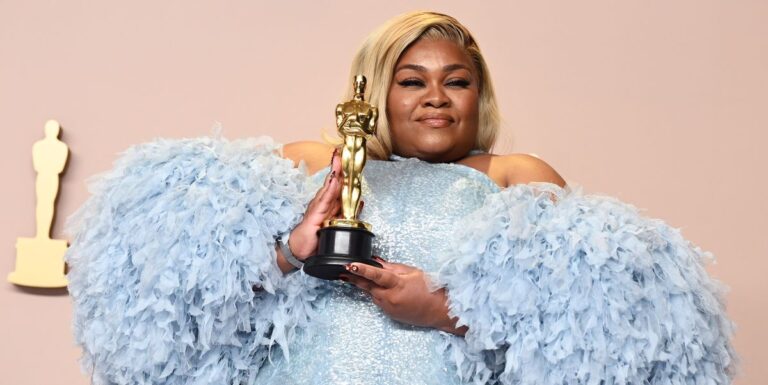
Itโ€™s hard to pick a winnerโ€™s speech to highlight as most of them were funny, humane, and absolutely tear jerking. Daโ€™Vine Joy Randolph brought tears to us all and a camera even caught a solitary tear coming down Paul Giamattiโ€™s cheek. Randolph also started the running joke of the night of thanking a publicist. Cord Jefferson gave the rallying cry to studios that one $200 million dollar movie is the same risk as 20 $10 million movies, encouraging them to take more chances. Documentary feature winner Mstyslav Chernov impactfully reminded us that he wishes his feature didnโ€™t exist as it chronicles the ongoing suffering of the people of Ukraine in their struggle against Russian aggression. Johnathan Glazer in his acceptance of the award for International Feature Film gave a stirring address about the parallels of complacency with atrocity in his film, The Zone of Interest, and what is occurring in Gaza as the Israeli military attempts retribution for the terrorist action perpetuated by the Hamas group on October 7th.

The speech that surprised and delighted us all, even herself, was from Emma Stone. After she won her second career Oscar in the highly competitive Best Actress race, she began with a little self-deprecation about her broken zipper and a quick zinger that it obviously happened during โ€œIโ€™m Just Ken.โ€ She then gave us the incredible awww of describing how much she loves her daughter. Itโ€™s this kind of spontaneous, genuine moment that makes the Oscars worth watching.

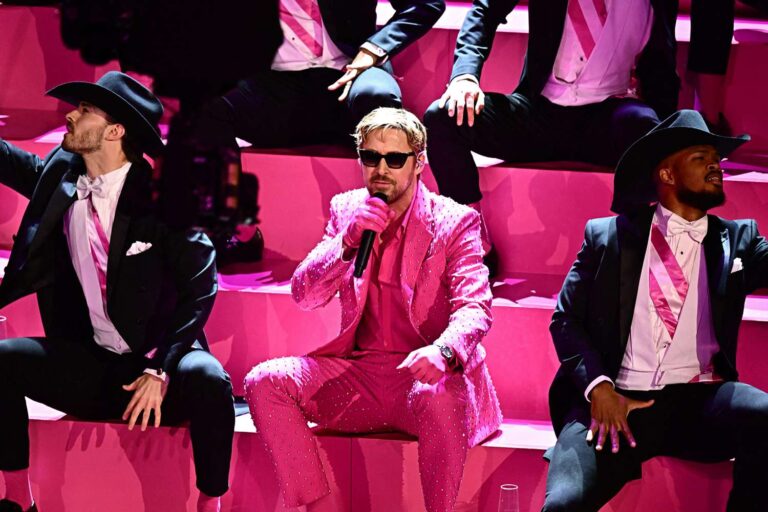
That and they can still pull off a truly spectacular scripted moment. Love Barbie, hate Barbie, indifferent toward Barbie, it canโ€™t be denied that the performance of โ€œIโ€™m Just Kenโ€ was all killer and no filler. It brought the house down if not only for an A-list, nominated actor putting his whole self into his performance, but also bringing in surprise after surprise. Kens from the film! Mark Ronson rocking a pink shirt and guitar! Audience participation! SLASH SHREDDING HIS AX!! The nominated songs this year were an eclectic bunch, the performances were well done by all and this was just the amazing capper to those achievements.

After last yearโ€™s love fest for Everything Everywhere All at Once and this yearโ€™s avalanche for Oppenheimer, it seems as though we are trending away from the idea that in the expanded Best Picture era, every nominee in the category should go home with something. Past Lives, Maestro, and Killers of the Flower Moon all went home empty handed. Tragically, this isn’t the first time a Martin Scorsese film has blanked on Oscar night after early laurels in fall, remember The Irishman? It’s a trend that has been seen to varying degrees in the past and in a year as lauded as 2023 has been, it is a bit surprising to see two films dominate as much as Oppenheimer and Poor Things did. It certainly harkens back to twenty years prior when presenters had to make it through saying, The Lord of the Rings: The Return of the King 11 times in one night.

All in all, a great spectacle as the Oscars should be and with the new early start, long, but not overwhelming. Seriously, though, Academy, ditch Jimmy Kimmel. He’s had his chance. Get someone new, someone old, or no one at all. 

Chasing the Gold: 2024 Oscars Reactions

This week on Chasing the Gold, Shadan Larki and Erica Richards give their thoughts on the 96th Academy Awards! It was an eventful evening with some incredible winners and musical performances. There’s so much to talk about and we get into everything that made this year’s Oscars a memorable one.

On that note, check out this week’s show and let us know what you think in the comment section. Thanks for listening and for supporting the InSession Film Podcast!

Subscribe to our Podcasts RSS
Subscribe to our Podcasts on iTunes
Listen on Spotify
Listen on Stitcher
Chasing the Gold – 2024 Oscars Reactions

Mobile App

To hear this Extra Film episode and everything else we do, download our apps on the Amazon Market for Android and the Podcast Box app on IOS devices. The mobile app covers all of our main shows, bonus podcast’s and everything else relating to the InSession Film Podcast. Thanks for your wonderful support and listening to our show. It means the world to us!

Help Support The InSession Film Podcast

If you want to help support us, we would greatly appreciate it! For more info, CLICK HERE.

Movie Review: ‘The Book of Solutions’ is Unfiltered Gondry


Director: Michel Gondry
Writer: Michel Gondry
Stars: Pierre Niney, Blanche Gardin, Franรงoise Lebrun

Synopsis: Follows a man, a director who tries to vanquish his demons, which are oppressing his creativity.


Ever wanted to spend 102 minutes living inside Michel Gondryโ€™s unfiltered mind? No? Then immediately avoid The Book of Solutions. If your answer is even a tentative yes, going through a fictionalized version of the directorโ€™s post Mood Indigo breakdown is still a lot to take in. If you are on the (fantastically inspired inventor) Gondry train already, The Book of Solutions is high-wire absurdity, and youโ€™ll enjoy the constantly derailing ride.

Marc Becker (Pierre Niney) is a director presenting his unfinished film to his financiers. His working partner is doing what he can to run interference between Marcโ€™s increasingly nebulous film (which will come together in the yet to be filmed fifth act) and the financiers who just want to take what there is and cut it into โ€œsomething.โ€ Marc refuses to relinquish his film and enacts an immediate heist along with his editor, Charlotte (Blanche Gardin) and producer Sylvia (Frankie Wallach) with some quick moves by the intern Gabrielle (Camilla Rutherford) to take all the hard drives to his Auntโ€™s house where they will finish the film in secret.

Marc is clearly having an extended nervous breakdown. His loving Aunt Denise (Franรงoise Lebrun and partially based on Gondryโ€™s own aunt Suzette) takes in Marc and his team and patiently deals with his personality peccadilloes which have been exacerbated by his decision to suddenly cease taking his psychiatric medication. Marc is off the charts; his internal narration is almost consistently at odds with that is happening on screen. Heโ€™s selfish, temperamental, paranoid, anxious, and an egomaniac. Heโ€™s also avoiding actually finishing or even looking at the film.ย 

For all the farcicality, and there is more than most films could deal with even Gondryโ€™s own, there is the recognition that any artist who wants control of whatever they are making has to fight not only the material roadblocks of the process, but also the creative roadblocks. What if the film just isnโ€™t any good? What if the film is genius but can only be so if there is proper collaboration? What if there are too many ideas or worse, too few? You canโ€™t just make something and assume people will show up โ€” a metaphor Gondry uses with Marcโ€™s animated film about a fox attempting to open a hair salon.

Every possible genre gets squeezed in somewhere. Imagined gangster film, a smidgen of science fiction, obviously some slapstick humor, a will they/wonโ€™t they romance, paranoid imaginings, some odd psychosexual stuff, angry office equipment, and whatever is happening in Marcโ€™s seemingly never to be completed magnum opus, โ€˜Anyone, Everyone.โ€™ Marc also somehow ends up as a real estate owner, the interim mayor of the town in the Cรฉvennes where he grew up with his much beloved aunt. And a hairdresser for a day. Because of course he does.

There is method in Gondryโ€™s madness. Through Nineyโ€™s hyper-energetic performance we see an astounding set piece in which he conducts an orchestra with no score โ€” they have to play based solely on his body movements. His โ€œBook of Solutionsโ€ a book of rules he keeps making and breaking to facilitate the perfect piece of art does contain some wisdom โ€” although Marc can barely tie his own shoelaces. He spends two days observing a bug. Days making an editing suite for Charlotte which is devised from an old truck. He has Denise star in her own comedy cooking show. Eventually he even gets Sting to play on the soundtrack to the film (Marc tells Sting how to play and gets away with it). He observes the โ€˜second gearโ€™ rule while driving just to annoy people. He constantly wakes Sylvia up with new and urgent requests. He takes a dislike to one of the crew, Carlos (Mourad Boudaoud) for coughing too often. He makes pinhole cameras out of leaves, cuts down tree branches which he happens to be sitting onโ€ฆ he is unbearable but endlessly charming too.

Once Marc moves back to Paris after the film is somewhat abandoned (but rescued by Charlotte and Sylvia) he becomes even worse than he was in the Cรฉvennes. The depression which follows the creative mania sets in and he quietly rejects everyone who reaches out to him, including Denise. Yet he finds a kindred spirit in his dream girl Gabrielle (with whom he had a fantastical relationship with earlier in the film). Can two oddballs who recognize each other be the solution? Is his no longer completely autonomous โ€˜Anyone, Everyoneโ€™ a film he will finally watch?

Explaining the plot of The Book of Solutions is akin to using skywriting in a foreign language on a cloudy day. You might see part of it, but just as you think youโ€™ve got a handle on it, it vanishes. The themes are key. Marcโ€™s love for Denise (a stand in for Gondryโ€™s own aunt, Suzette) without whom he would not have his most important audience. Overcompensation because artistic vision has been โ€œvandalizedโ€ before. The terror of facing the work which has been done. And recognition that one can be a โ€œgeniusโ€ and a โ€œarsehole directorโ€ simultaneously and you can only get away with it for as long as you are giving something to the world. Marcโ€™s real gift has nothing to do with the movie. One of the gifts he contemplates proffering is, shall we say, not something anyone wants.

Michel Gondry made in conjunction with Charlie Kaufman a film so beloved that it propelled him to a kind of fame he could never again live up to. Despite being involved with dozens of smaller projects, music videos, animations, television series โ€” Gondry is always The Eternal Sunshine of the Spotless Mind guy. The Book of Solutions finds Gondry reflecting on his own career โ€” parts are so self-referential and metatextual they require a non-fictional Gondry Bible.

Michel Gondry has thrown everything at the wall and seemingly randomly lets the audience decide what sticks โ€” which is the most apt way of describing a career which includes the Seth Rogen starring The Green Hornet next to The Science of Sleep. Or The We and the I next to Human Nature. Gondry after all these years is still figuring out his formula, and The Book of Solutions might just be the most fun you will have trying to unlock his puzzle box mind.

Grade: B-

Interview: Director of ‘Silver Haze’ Sacha Polak

Nadine Whitney: Silver Haze is your second collaboration with Vicky Knight after Dirty God your English language debut. It was something you were working on for a long time before you met Vicky. For her it was an essential part of healing from trauma and being perceived as monstrous. The film also helped to usher in significant change in the British Film Industry and created a long overdue discussion of how people with scars, disabilities, and noticeable facial differences are used in media. Silver Haze again stars Vicky. In this film you are partially drawing on her own life experience with the fire which caused her burns as a child. You also reference her work in healthcare and acknowledge her queerness. The film is filled with damaged and damaging people. Yet it also has a core sensibility of forgiveness and moving on from the thing you believe defined you. Can you tell me a little about the process of working with Vicky and how you collaborated with her to speak a kind of truth about her life?

Sacha Polak: This film was written for her and loosely based on her own life stories. After Dirty God, Vicky and I traveled all over the world to promote the film. I was so touched in the way Vicky spoke to people telling them her life story and comforting them. We had a lot of tears in the audience and Vicky was so powerful. This was one of the reasons why I wanted to make another film with her. 

After I wrote the script we improvised around the scenes. For me it was important that we have lots of time to find honest performances but also playfulness and humor. 

In the there is also a lot of anger and people hurt each other, itโ€™s a harsh world. I hope the characters have both sides though. Frankyโ€™s mother Jenn is traumatized and there is choice there between moving on or being stuck in the past. Franky in the end chooses to move on. 
NW: Through Florence, Franky manages to escape not only the heteronormativity and violence of her East End community but meets Alice and Jack in Southend which seems like a magical place for her. For a while Franky is bewitched by Florence and the kindness Alice shows her. For the first time in years someone is taking care of her instead of her carrying the weight of others. How did you fashion the golden moments with Florence, Alice, and Jack?

SP: Franky falls in love with Florence. Although it is her first romance it is overshadowed by her breaking up with her family. She comes to Southend, a place full of kindness. Something she is not used to at all. With Angela I spoke a lot about making Alice human, not an angel. But somebody who does take care of Franky who was taking care of everyone in her work, her family and Florence. I spoke a lot about how it feels like to fall in love for the first time with both Esmรฉ and Vicky. 

NW: Without spoiling too much of the film, Florence is more than mercurial. Sheโ€™s mentally ill. She thinks herself an evil person. Yet Florence can no more control her actions than Jack can control his neurodivergence. Nor Alice stop the cancer which is killing her. You give Florence a space of grace despite her behaviour and eventual turn on Franky. How important was it to you to show that Florence despite her cruelty, is also living with internal scars which she canโ€™t keep hidden?
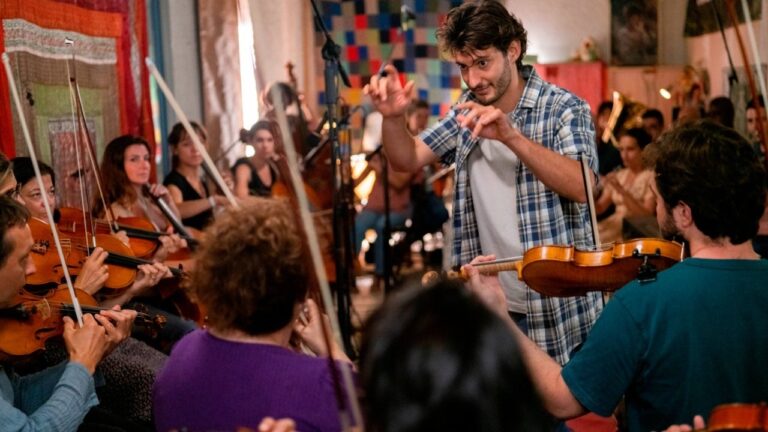
SP: Silver Haze is a love story, and it deals with trauma. In the beginning of the film Florence doesnโ€™t want to live anymore. She has already given up. Franky is a fighter; she solves everything with fighting. This is why their relationship can’t work. Florence does love Franky but doesnโ€™t love herself. 

NW: Silver Haze is about the importance of letting go of rage. Frankyโ€™s mother, Jenn canโ€™t let go of the fire because it wasnโ€™t even so much the moment when she almost lost a child, it was the moment she felt betrayed by her husband and best friend. Leah feels a quiet guilt because she was supposed to be in the pub that night. Franky needs to know how it happened because she was a small child at the time and no oneโ€™s stories align.

In letting go of her rage, especially against the people she was told consistently were responsible, she has a chance to heal. She also has the opportunity to extend her kindness to people who deserve it. Her found family, and Leah who has somehow found herself in an unusual manner. Can you tell me a little about building the process of self liberation for Franky and Leah?
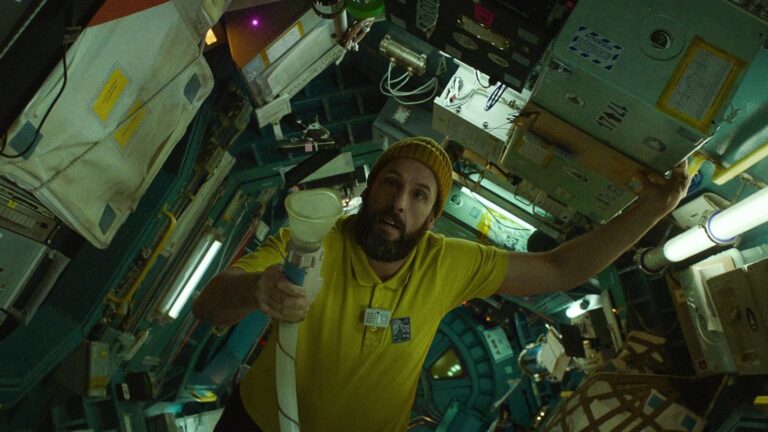
SP: Franky and Leah have been taught to constantly fight. I believe that rage is not a way to overcome trauma. Franky has a chance to heal and finds love and warmth in Alice and Jack even though she loses Florence in the process. Finding a family even though itโ€™s not blood resonates with me since both my parents have passed away. 

NW: Your work has been compared to Ken Loach and early Andrea Arnold. It is social realism, yet it is never exploiting the people it is depicting. How do you create the balance between realism, authenticity, and avoiding poverty cliches?

SP: It was very important that this film would never be โ€œpoverty pornโ€ as they call it. That it would be a film full of light and love and humor. Because this is how I see Vicky and her family. 

NW: Your cast is excellent. Vicky was not a professional actor before she met you. Leah, played by Charlotte Knight is Vickyโ€™s real-life sister. Archie Brigden as Jack was not a professional actor. The most experienced cast members you have on the film are Angela Bruce and Esmรฉ Creed-Miles who grew up around the film industry. How do you collaborate with emerging talents. How much of the script do you give to them to improvise?

Thank you. It was helpful that I knew Vicky and Charlotte before from working with Vicky on Dirty God. So, Charlotte had seen the process with her elder sister. We spoke about what this film would be about. Which scenes were important to me to keep as written and what would be the scenes to play around with. We shot a lot in Dagenham where they both lived. Esme I also knew from the tv show Hanna I directed. Vicky and Esme immediately hit it off. For me it is important that the actors feel safe, and they trust me and each other. That there is space to try things. Working with Archie was especially tricky for me because he is autistic, and I found out that I need to be very precise in how I direct him. It was confronting for me to find out how sloppy I am with words. Also, he found it important that the character of Jack would not be a victim and would be portrayed in a way that would be respectful to people with autism.

Podcast Review: Spaceman

On this episode, JD is joined by guest Jacob Throneberry to discuss the Johan Renck film Spaceman, starring Adam Sandler and Carey Mulligan! As we talk about in the discussion, it might not all work, but it’s the kind of sci-fi we tend to like and who doesn’t love dramatic Adam Sandler?

Review: Spaceman (4:00)
Director: Johan Renck
Writers: Colby Day
Stars: Adam Sandler, Carey Mulligan, Paul Dano

Subscribe to our Podcasts RSS
Subscribe to our Podcasts on iTunes
Listen on Spotify
Listen on Stitcher
InSession Film Podcast – Spaceman

Podcast Review: Dune: Part Two

On this episode, JD and Brendan discuss Denis Villeneuve’s latest epic in Dune: Part Two, starring Timothรฉe Chalamet and Zendaya! We are big fans of the first Dune, and have been anticipating this film for quite some time. There’s much to discuss here and we had a great time delving into everything that makes Dune: Part Two as massive as it is.

Review: Dune: Part Two (4:00)
Director: Denis Villeneuve
Writers: Denis Villeneuve, Jon Spaihts
Stars: Timothรฉe Chalamet, Zendaya, Rebecca Ferguson, Josh Brolin, Austin Butler

Subscribe to our Podcasts RSS
Subscribe to our Podcasts on iTunes
Listen on Spotify
Listen on Stitcher
InSession Film Podcast – Dune: Part Two

Movie Review: ‘Lovely, Dark, and Deep’ is a Horrifying Forest of Terrors


Director: Teresa Sutherland
Writer: Teresa Sutherland
Stars: Georgina Campbell, Nick Blood, Wai Ching Ho

Synopsis: Lennon, a new back-country ranger, travels alone through the dangerous wilderness, hoping to uncover the origins of a tragedy that has haunted her since she was a child.


The first mistake Robert Frost made when he approached the infamous โ€œtwo roads diverged in a yellow woodโ€ was entering the woods in the first place. Nothing good happens in the woods. Those who disagree are either not of this world or superior beings to us normies. John Muir is one of those people; the naturalist author, who created the National Parks System, wrote a great deal about the beauty of nature and its mysteries. He once wrote, โ€œAnd into the forest I go, to lose my mind and find my soul.โ€

That passage, which appears at the beginning of Teresa Sutherlandโ€™s directorial debut, Lovely, Dark, and Deep, is a common misquote โ€” he actually wrote, โ€œAnd into the forest I go, to lose myself and find my soul.โ€ But the version Sutherland cites feels more fitting for a horror film these days, particularly one where the main character experiences most of their terror not just in the forest, but because of the forest. It might as well read, โ€œAnd into the forest I go, to eventually die.โ€

Which isnโ€™t quite how things unfold for Lennon (Barbarianโ€™s Georgina Campbell), but just as well! We first meet our heroine, a newly-minted park ranger with a haunted past (Indie Horror Mad Libs, anyone?), as she drives to work in the dark, listening to a radio broadcast about missing persons, specifically those who have gone missing in the woods. Along the way, Lennon comes to a stop at the sight of a black deer in the middle of the road. It stares into her soul; she stares back. But her attentive gaze is interrupted by a screeching sound on the A.M. dial. She switches it off, exhales, and when she looks up, the deer is gone.

Itโ€™s a familiar opening sequence โ€” a character, alone in a dark setting, is harshly disturbed by a frightening creature/object that doubles as a foreboding omen. Yet just because something is familiar doesnโ€™t make it cheap. What follows may feel repetitive and safe at times, but this set piece lays the groundwork for a competent film about how we respond when old wounds reopen. 

Lovely, Dark, and Deep delivers beats youโ€™ve seen before, but in distinctive ways. Deer, for instance, pop up in horror films all the time โ€” they represent innocence and protection, often presenting themselves to others if youโ€™ve been hurt and your heart needs tending, which makes the dead deer we see at the start of Jordan Peeleโ€™s Get Out all the more heartbreaking. But have you ever seen a deer with smoky, blackened fur? Youโ€™ve seen a deer in headlights before, but have you ever seen a character be more fearful of the deer than vice versa? 

In short, what follows is The Cabin in the Woods if the cabin was the woods, an imbalanced yet absorbing descent into madness and terror through the eyes of a tortured vessel. As has become a staple in the genre, the seeds of this terror were planted long ago: When Lennon was a child, her sister went missing in the woods, a loss she feels responsible for. Naturally, itโ€™s what led her to becoming a park ranger: she who was once responsible for one person in the wilderness must now be responsible for all of its visitors. 

This sort of narrative decision does feel rather on the nose โ€” no longer is it oneโ€™s fear that is the mind-killer in horror films, but oneโ€™s trauma โ€” yet it doesnโ€™t matter nearly as much as it otherwise might thanks to Campbellโ€™s layered performance. The ascendant Scream Queen draws more out of her character than one imagines Lennon could have been in lesser hands. While Barbarian required Campbell to access terror on full-tilt, Lovely, Dark, and Deep sees her mining authentic hope out of a hopeless scenario. To instill even the slightest shred of optimism in an audience well aware that the backdrop to her terror is a vast, dangerous national park essentially defies the impossible.ย 

Not as impossible, yet still an impressive feat, is the ability to render real scares in broad daylight. And though Sutherlandโ€™s film does so with sharp orchestral strums and screams from those suffering, both common cues in the genre, itโ€™s commendable that it even tries. Midsommar this is not, particularly because Lovely, Dark, and Deep does still spend a great deal of its time in the dark. Ari Asterโ€™s second film did what no film had done before, drawing discomfort and dread out of increasingly bright landscapes littered with inviting bursts of color that made up its central Swedish cultโ€™s design palette. 

But Lovely, Dark, and Deep still manages to create something fresh, tactfully keeping its reliance on recognizable, cult-adjacent themes that give a heftier weight to its chills to a reasonable minimum. What matters more to Sutherland is what we struggle to live with whether the lights are bright or have gone out completely, and how it impacts our mindset, for better or worse. In a horror film forest full of trauma-laden trees toppling silently, this is the rare sort that makes a sound.

Grade: B