


Directors: Maiken Baird
Synopsis: Celebrated as a prophet and vilified as a terrorist, Palestinian-American scholar Edward Said was America’s most outspoken critic of the West and Palestine’s fiercest advocate. Twenty years after his death, Said guides viewers through the untold history of Palestine through a kinetic assemblage of footage, recordings, and newly digitized archives.
One of the first things we hear Edward Said say in Maiken Baird’s illuminating new documentary, Edward Said: Between Worlds is perhaps the best way to encapsulate just what made him so important: “I was born in a country that doesn’t exist anymore. It’s called Palestine.” He then details his experience applying for a passport, where he wrote “Jerusalem, Palestine” as his birthplace, only for his official passport to arrive reading “Jerusalem, Israel.” His argument, though one he shouldn’t have had to make, was that he wasn’t born in Israel. When he visited the passport office to rectify the error, noting that Israel didn’t exist when he was born, he was given a “fixed” document, one that simply read “Place of birth: Jerusalem.” There was no nation listed; just a city. The passport, shown in the film, notes that it was issued in 1982. Today, if you Google Said’s name, the abridged summary that populates on the right side of your screen reads “Born November 1, 1935.” Where the city and country should be is a single word: “Jerusalem.”
Though it was far from the first moment Said ever had of being labeled a man without a country, it serves as a cornerstone in a life that was dedicated to advocating for Palestine’s recognition, a fight that remains ongoing more than 20 years after his death. The origins and evolution of Said’s chosen purpose – as well as his never-ending pursuits of knowledge and culture, and the harsh consequences he faced due to his wholly justifiable words and actions – are Baird’s focus with Between Worlds. How the film stands apart from the majority of modern documentary portraits is the kicker: Rather than pushing its subject into the background as interviewees proffer their own opinions on their legacy, practically the only voice present here is Said’s. “Between Worlds” consists almost entirely of footage from Said’s speeches, appearances on news broadcasts, narration of his own writings, and other videos from the family’s archives. The library’s worth of excerpts and clips are woven together by co-editors Jay Arthur Sterrenberg, Plummy Tucker, and R.A. Fedde to chart the expansive history of a great thinker’s many thoughts. It’s a daunting effort, and its seamless execution is a filmmaking triumph.
Is Between Worlds a film crafted in memoriam? In hopes that audiences new and old can discover and/or reengage with Said’s work, from the most revered (his 1978 book “Orientialism”) to those lesser known (his 1968 essay “The Arab Portrayed”)? Is it coming now, in 2026, due to the fact that the word “Palestine” is one that seems to be on everyone’s lips in contexts both humane and vile? According to Baird, all three could be considered the project’s jumping off point. “I thought his voice was so lacking in our current world, and his humanity, and his understanding, his own personal experience of Palestine, and his ability to speak about it,” she told IndieWire ahead of the film’s premiere at the Toronto International Film Festival. “It was a no-brainer. After October 7th, I thought, ‘let’s bring it back.’”
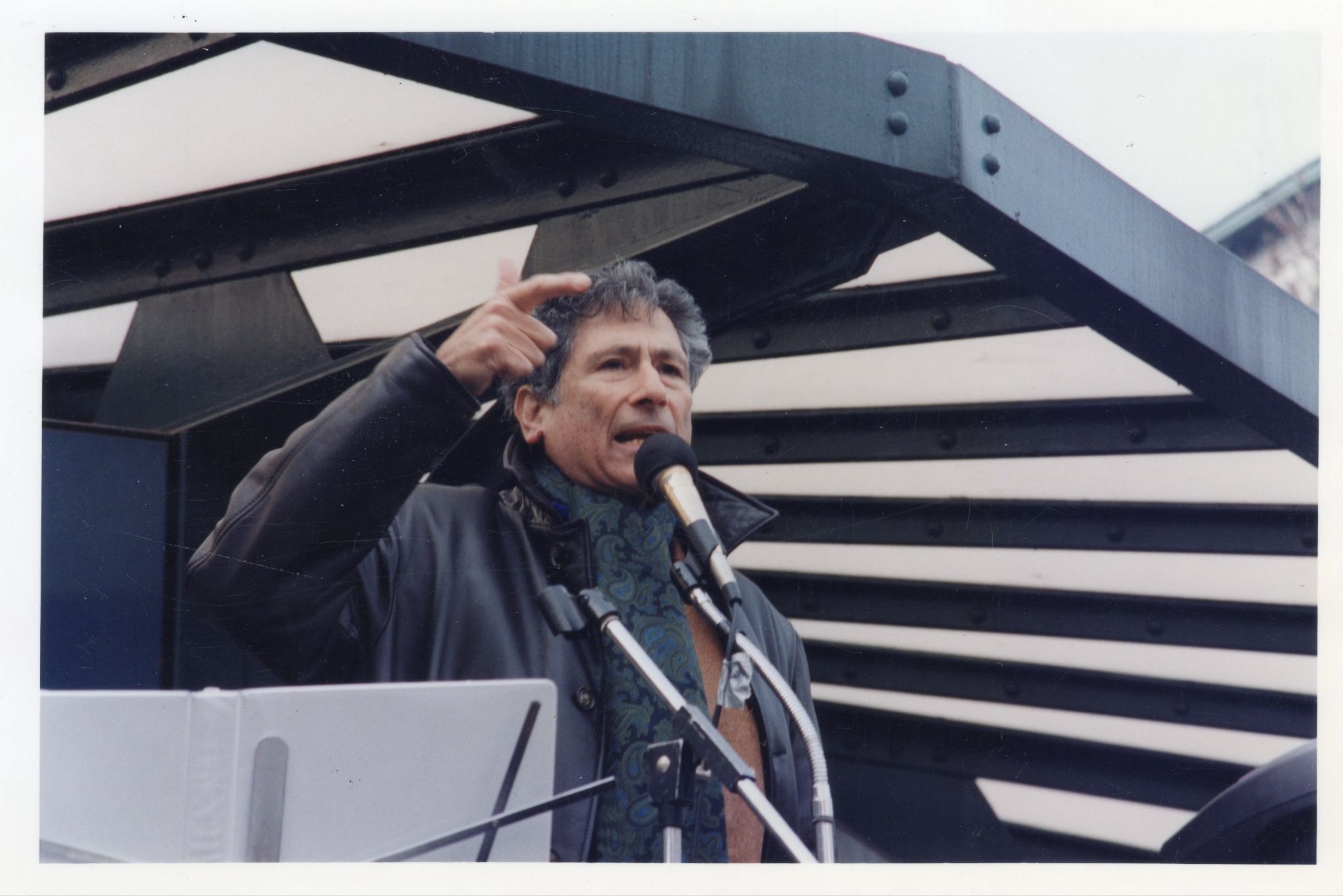
In bringing it back, Baird and her collaborators have done their part in showing the world just who Edward Said is, and “Between Worlds” should land with audiences for which he is a household name and for those who only know the man exists because his eponymous documentary was programmed at their favorite film festival. (It is currently making the rounds in search of U.S. distribution, and most recently screened in the 64th New York Film Festival’s Spotlight section.) Indeed, it arrives amidst Israel’s genocide in the Gaza Strip, as the nation attempts to rid the world of every trace of Palestine’s existence. And like its fellow NYFF selection, Naza, Between Worlds raises Israel prime minister Benjamin Netanyahu’s longstanding vitriol for Palestine and its people, specifically in how Netanyahu refused to speak with Said because, in the former’s words, “he wants to kill me.” Where Between Worlds especially excels – not more than Yuval Abraham and Rachel Szor’s documentary, but in an entirely different way – is in showing Said on the defensive, even growing increasingly frustrated when berated with nonsense from those who deny his home’s validity.
“You get angry because it’s obviously meant to be intimidating and to threaten you,” Said said. “The overall feeling that I have is one of astonishment that the depth of hatred towards me by American Zionists is so great.” To be both clear and fair, Said’s “defense” takes a composed, informed shape, not one of fury or denial. It’s precisely in moments like these, however brief, where Between Worlds diverges from your typical silver-screen biography, often cradle-to-grave narratives that hit the facts and nothing else. And though Baird and co. certainly maintain a simple approach – one that intermittently causes these proceedings to feel formulaic by nature – what matters is not the framework in which Said’s testimonies are further immortalized. At a time when there are masses only just learning that his homeland technically no longer exists, what better way to sustain his legacy than to let him tell us why it was significant in the first place?
Edward Said: Between Worlds screened at the 64th New York Film Festival. It is currently seeking U.S. distribution.