



Director: Paolo Strippoli
Writers: Jacopo Del Giudice, Paolo Strippoli, Milo Tissone
Stars: Michele Riondino, Romana Maggiora Vergano, Roberto Citran
Synopsis: In Italy’s happiest village, a haunted teacher discovers dark secret behind weekly gatherings where locals seek healing from a teenage boy’s embrace. His quest to save the youth reveals the sinister nature of a community hiding behind joy.
Paolo Strippoli has had a heck of a couple of years as a filmmaker. He’s had two films make the fall festival circuit: The Holy Boy and The Spiral, both premiering at Venice in 2025 and 2026, respectively; the latter of which received a lot of buzz as New Line Cinema received U.S. distribution rights after being nominated for the Golden Lion in Venice and coming in second place in Toronto’s Midnight Madness People’s Choice Award. U.S. audiences can dip their toes into Strippoli’s filmmaking with Shudder’s release of The Holy Boy, a folk horror film set in the happiest countryside town in the Alps, Remis. It follows a depressed, angry physical education teacher, Sergio (Michele Riondino), who moves to the small town to get away from a past that haunts him. As he begins his new life, he discovers the source of this town’s happiness and wrestles with the implications of the arrangement they’ve made.
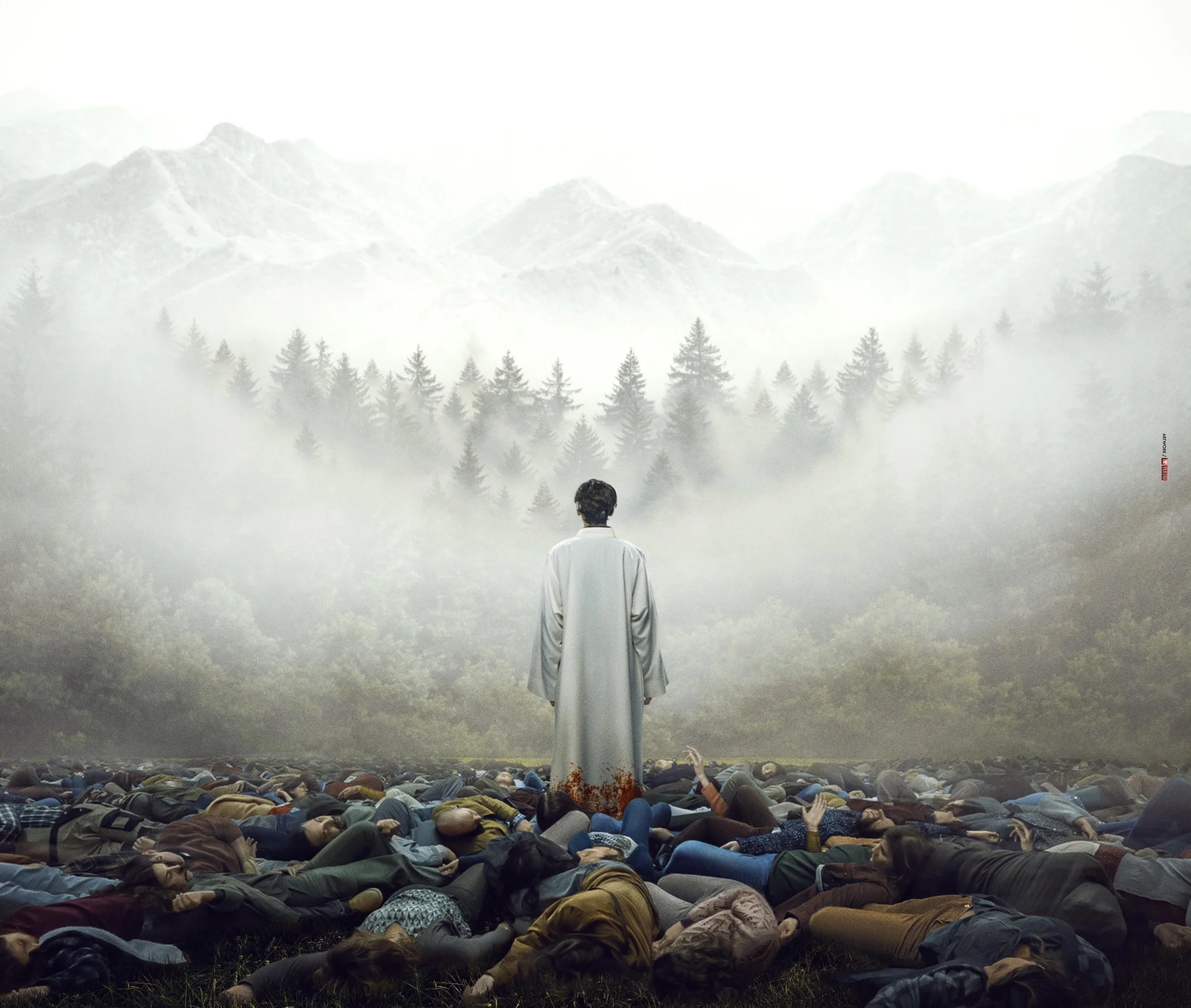
If you’re anything like me, being around happy, energetic people when you’re in a bad mood only makes things worse and can trigger the worst parts of yourself to come out. Sergio’s experiencing this to the max, with no one around him seeming to be able to relate to his downtroddenness and anger at the world. He even lashes out at the bartender of the local watering hole, Michela (Romana Maggiora Vergano), as she tries to get to know him through friendly small talk. Nothing anyone says or does can help him through this loss. That is, until he’s introduced to Matteo (Giulio Feltri), a student of his who is revealed to be the source of the town’s happiness.
Matteo’s embrace, just a simple hug, is the only thing needed for someone’s pain and sorrow to disappear. They get instant relief from all past traumas, entering a feeling of bliss and peace that’s nearly impossible to achieve on their own. “I still have the memories, but no feelings about them,” someone describes. Eliminating all negative emotions from traumatic experiences, Matteo is keeping this isolated town running. People line up at the church doors, where the local priest and his father trade his power for donations to the parish.
After this initial encounter, Sergio strikes up a friendship with Matteo and quickly learns how the community has been treating him. He’s kept from interacting with others much outside of his “duties,” and can essentially go nowhere unsupervised for fear of something happening to him. He has no friendships, no shared joy in being around such happy people. He is just a commodity to them, used over and over again for their benefit.
From this point on, the film is an excellent exploration both of the ethics of using someone for their gift like this and of the impact of completely removing any negative emotion or pain from our lives without processing them. What right do we have to hold someone like Matteo in functional captivity so that we can gain from his existence while diminishing his chance of having a normal life? What level of responsibility does he have to give his gift to those around him, knowing it makes their lives so much easier? He’s too young to really understand their exploitation and is just getting rebellious enough to be an issue. He has no guidance from those who are meant to be leading him, chiefly his father and priest.
Sergio also seems to be the only one who sees the downside of stripping ourselves of sadness and pain. Of course, it’s great to have days without being affected by those emotions, but it’s impossible to ignore that tough experiences make us who we are. We don’t have to be defined by them, but they allow us to grow out of them. It’s a realization that happens even in The Sheep Detectives, where the titular sheep have the ability to simply forget bad things that happen to them so they can go on without ever thinking about them again. This ultimately leaves one stagnant. What good is a feeling of great joy if you can’t remember or stir up the hardships you went through to get to that moment? The whole town is living a half-life, a false existence that’s rejecting the full human experience.
These themes are handled thoughtfully and elevate the film above a one-note horror movie, and are paired with a visually striking third act that delivers on the town’s dependency and Matteo’s growing frustrations with his life. Feltri is phenomenal as Matteo, portraying anguish and desire effortlessly with a glance. His eyes communicate so much until the last frame.
The Holy Boy is a stellar dive into dealing with grief and balancing how we are used for our talents in our communities. Strippoli is certainly a rising talent in the horror space, ripe for a launch into the mainstream with this film and the upcoming release of The Spiral.