Director: Kent Jones
Writer: Samy Burch
Stars: Willem Dafoe, Greta Lee, Edmund Donovan
Synopsis: A long time ago, Ed Saxberger wrote a book of poetry that no one ever cared about. When a group of young artists rediscover his work, he must reassess his genius. The wild card in the group is Gloria, a talented and mercurial theatre actress who toys with affections and who is all set to be admired by Saxberger.
Filmmakers like Hong Sang-soo and Jean-luc Godard have enjoyed a long-running embarrassment of riches at the hands of the New York Film Festival selection committee, to the point where it could feasibly be called those international filmmakers’ home away from home. Kent Jones, on the other hand, is experiencing a singular triumph, that of premiering (in North America, at least) a film at the festival he once ran. From 2013 to 2019, the former critic/Martin Scorsese video archivist/actively-working documentarian had a hand in selecting its prestigious titles; his second narrative feature, Late Fame, is now among the selected.
It could feasibly be considered a wild conflict of interest if Jones’ film wasn’t such a scintillating commentary on the haughtiest side of New York City’s art scene, a portion of which tends to wander about the Lincoln Center-adjacent area on the Upper West Side with paperbacks tucked in their back pockets and Mubi and/or New Yorker tote bags thrown over their shoulders. They don’t have jobs as much as they have interests that they’d sooner dub “callings” than “hobbies;” they say they read and write all day, eager to create something profound, but you never see them doing anything aside from talking amongst themselves and consuming copious amounts of green tea. (If the day is really dragging, they might opt for an espresso, or a martini, but never the trendy combination of the two.) They obsess about 45-year old writings because the new stuff doesn’t speak to them the same way the words of people who “really lived” do. They posture; rarely do they publish.
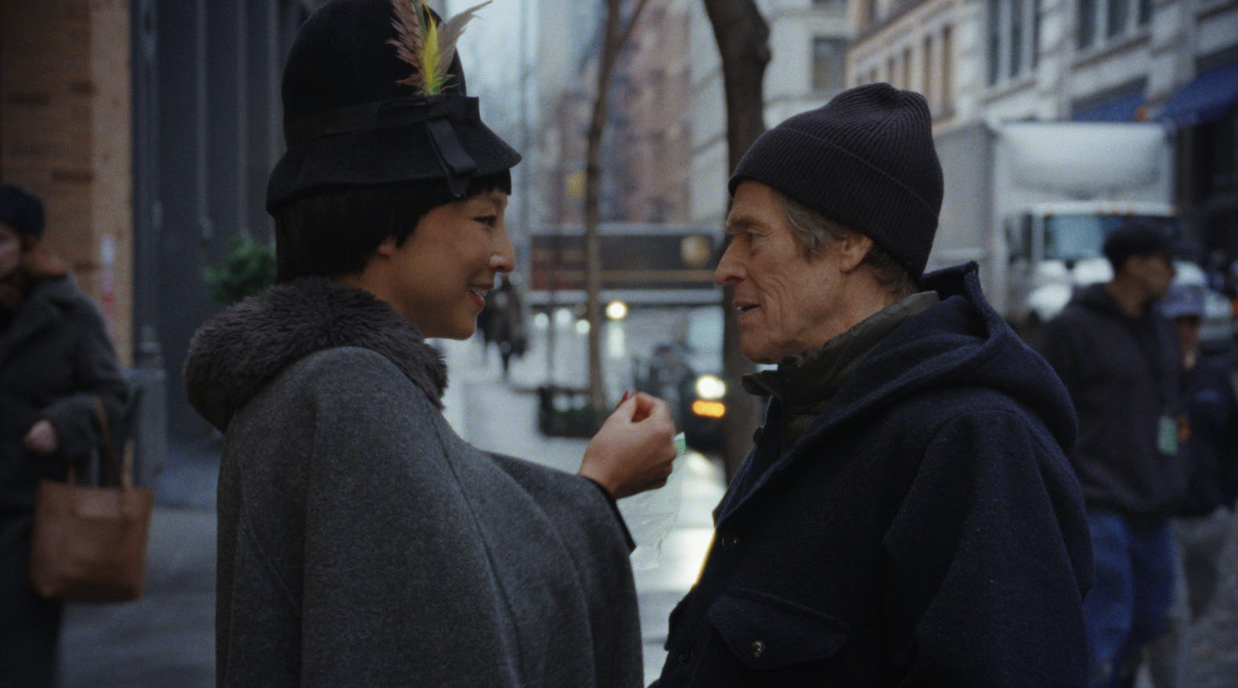
This sketch was admittedly painted with a broad brush, but in Jones and May December screenwriter Samy Burch’s view, this is the exact sort of group that is worth exploring. In Late Fame, they’re known as the “Enthusiasm Society,” and when we say “known,” we mean “they call themselves that.” Their self-appointed leader, Meyers (Edmund Donovan), wears turtlenecks as though another kind of shirt has yet to be invented. The rest of the group ranges in mood, from plucky and eager to learn (Luca Padovan’s Winn) to knowing everything there has ever been to know (Clay Singer’s Brussard). Gloria (a hammy, delightful Greta Lee, stealing the show from the entire ensemble) is an actress and the crew’s lone female companion, though it’s safe to assume that this is because her own circle grew tired of her theatrics before they even started rehearsals.
The odd man out is Eduard Saxberger (Willem Dafoe), because of course it is, and of course it’s spelled with a “u,” not a “w.” Now a postal worker, he was a poet who once published a book called “Way Past Go,” but it was quickly forgotten, and so, too, was his faith in the craft. In many ways, he represents the ideal discovery for Meyers and company, a man who keeps old copies of The Village Voice in a cardboard box like childhood sports trophies, a collection that any other mortal would have tucked away in a storage unit decades ago, but he pulls it out every now and again to reminisce. He’s so much the ideal that, in an instant that disrupts Ed’s menial existence – one involving frequent visits to a dive bar that has his order ready at the same time every day and houses patrons who know him by name – they rope him into their circle with the promise of belated regard, adoration, and a dash of hope for the reignition of his more creative past life. Call it engagement, call it love, or call it late fame. Just don’t call it a sure thing.
Jones’ film tends to be exactly that, though, principally due to the world Burch builds for the filmmaker to bring about on-screen. Late Fame’s Manhattan is familiar enough while also maintaining a specificity that will attract the attention of those who possess a cursory familiarity with its makeup, and perhaps especially to those who are quick to roll their eyes at it. It’s populated by people who are more likely to celebrate those who dropped out of college to pursue the life of a struggling artist more than they merely acknowledge those who procured a Master’s degree and went on to major success. The former is the more romantic route, after all, and the tribulations that clutter its path are ones who make the man a more established champion, the lack of an expansive body of work be damned.
Said appreciation for mystique – a desire for questions more than answers – does inhibit the “Enthusiastics” from ever really evolving beyond caricaturistic vessels carrying a stereotypical view of literature and the craft of creation through what is otherwise a clever, thoughtful dramedy. But the groundedness with which Dafoe portrays Saxberger more than makes up for it. Like his character, this is an actor that simultaneously belongs in everything yet sticks out like a sore thumb whenever he appears. And this is precisely what makes him so brilliant.
That’s a far-too-simplistic way to describe one of film’s most prominent, beloved, and uber-gifted performers, one who has been pumping out his signature chameleonic mastery for so long that he’s been able to play both Jesus Christ and Vincent van Gogh, and make them feel like inventions pulled directly from his diaries. To say that Dafoe is “great” in a film, Late Fame included, is to say that he appears in it, and one almost wishes he was starring in one that wasn’t so eager to make his journey back into a world that idolizes him so obvious, its beats appearing in high definition from a mile away. His character is as “real,” simply put, as Mary Kay Place’s titular character from Jones’ 2019 narrative debut, Diane, a gutting indie about family in which a woman’s life becomes unrecognizable as she attempts to piece together wreckage her addicted son has left for her to piece together.
Ed Saxberger might be more comfortable operating as a secondary character in that film, one where he can be the version of himself he’s dedicated the back half of his years to playing. But what works most in Late Fame’s favor is its commitment to that discomfort, and the fact that, when read at face value, it’s a film about what we come to realize about ourselves when we’re asked to peer into a past that’s less safe than the present. It could be read as a film about the cost of our dreams, the roads less traveled, or even the act of making films after once critiquing them and selecting them for participation in a major fall festival. Or, maybe, it’s just about art: What it gives us when we’re making it, takes away when we stop, and continues to provide as we consume it from afar, no matter how ardently we subconsciously long to return to the beautiful chaos that it produced.
Late Fame screened in the Main Slate at the 63rd New York Film Festival. It is currently seeking U.S. distribution.