Director: Luca Guadagnino
Writer: Nora Garrett
Stars: Julia Roberts, Ayo Edibiri, Andrew Garfield, Michael Stuhlbarg, Chloë Sevigny
Synopsis: A college professor finds herself at a personal and professional crossroad when a star student levels an accusation against one of her colleagues, threatening to expose a dark secret from her own past.
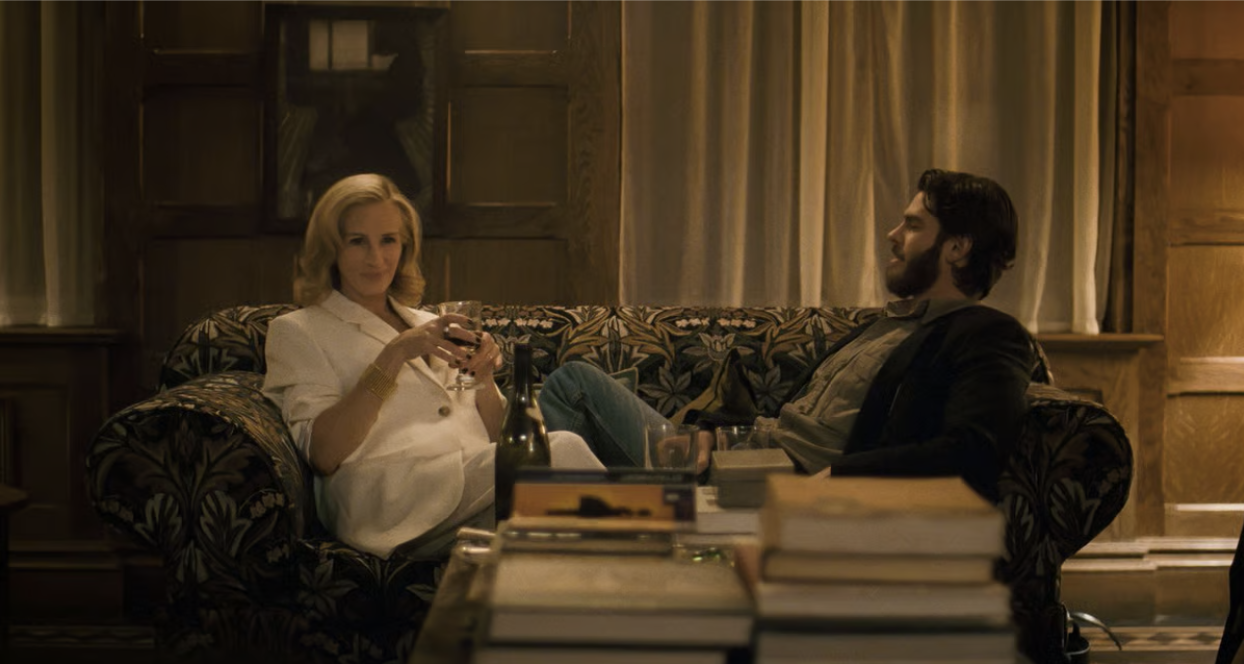
Post-screening press conferences tend to be a mixed bag – a mishigas, if you will, to steal a term that Andrew Garfield used to describe the many conversational aspects about the films of Luca Guadagnino, particularly the one he co-stars in and is speaking about on this particular afternoon on Manhattan’s Upper West Side. Gathered in Film at Lincoln Center’s Walter Reade Theater, the home for Friday’s press and industry screening of the 63rd New York Film Festival’s Opening Night selection, After the Hunt, are Guadagnino, his screenwriter, Nora Garrett, and the principal players in his new film’s cast. Garfield is just one of the few; to Guadagnino’s left is Julia Roberts, and to Garfield’s sits Ayo Edibiri, and to hers, Michael Stuhlbarg. Somehow or some way, this press conference keeps coming back to the idea of provocation. Theoretically, it’s a fitting topic when it comes to After the Hunt, a glossy drama that centers on the fallout over a campus scandal involving a high-profile PhD candidate (Edibiri’s Maggie Resnick) and one of the philosophy department’s most beloved professors, Garfield’s Hank Gibson. “it happened at Yale,” lowercase “it” and all, reads the film’s opening text, though the “happened” isn’t solely referring to the sexual assault that Maggie has accused Hank of committing. As the audience came to learn as the film unfolded, what “happened” also points at the effects these allegations have had on Maggie’s relationship with her mentor, Alma Imhoff (Roberts), a revered member of the philosophy faculty who is up for tenure; the impact the incident has had on Alma’s marriage to Frederik (Stuhlbarg) and her friendship with Dr. Kim Sayers (Chloë Sevigny), the university’s psychiatrist; and Alma’s status at the school overall.
Everything here, it stands to reason, is cause for provocation, and the cast and crew are willing to talk. “He’s a provocateur in a lot of ways, and I think he’s very conscious of what he’s doing a lot of the time, and deeply unconscious of what he’s doing a lot of the time as well,” Garfield shared. “[Guadagnino] wants all of your nuance, all of your humanity, no matter how dignified or undignified it is.” A bit later in the discussion, after this idea has been raised again, the filmmaker felt the need, albeit jokingly, to defend himself: “I think I’m a kind guy,” he mumbled, receiving a healthy supply of laughs that only a beloved filmmaker could receive, and are a part of the typical standard operating procedure at festival Q&As. “I don’t like to scandalize for the sake of it,” he noted. “I think that’s a little bit childish and I hope I’m not… Before I’m anything else, I am a spectator. Film, for me, is obviously an experience that transformed me, that changed me. That made me want to become something else, that maybe changed my mind on things that could have also provoked me in a way that made me uncomfortable, and then I’d ask myself, ‘Why was I uncomfortable?’”
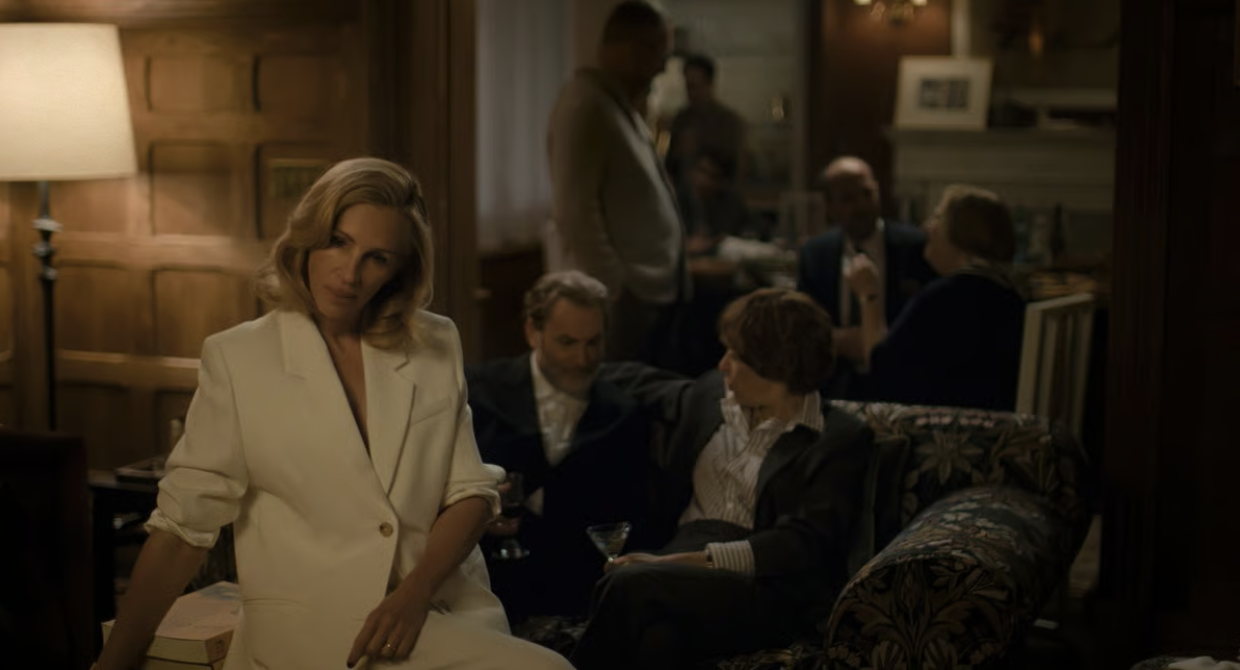
After the Hunt’s inherent discomfort isn’t much of a “needle in a haystack” situation; this heap is all needles, and there’s no way to avoid being pricked, no matter how careful you are as you reach for the quill of your choosing. It’s a film about sexual assault that is wearing #MeToo-colored glasses, those with a prescription to fit viewers of all qualities of vision – no matter how hard the picture’s preeminent voices try to tell us it’s not. (It would be cheap to shove the film under a “Cancel Culture Cinema” umbrella, but to insist that that isn’t one of its few hats would be a wardrobe violation.) It’s a film about campus politics, the sociopolitical gamut of race and gender and sexuality and privilege, the kind of movie in which the starring faculty hold lavish parties at their ridiculous and garish private residence, a movie in which “TART!” is yelled at to the entire soiree in an attempt to distract from the debate at hand, as if the presence of a strudel the size of a Scrabble board is a regularity at these post-work convocations. Maggie is a queer Black girl who comes from money; her partner (Lío Mehiel) is a nonbinary transgender person studying to become a lawyer, and offers “professional” counsel whenever possible. Hank is a celebrated educator who came from nothing; Alma and Frederik are intellectuals who have everything. This isn’t a melting pot as much as it is a meticulous and obvious gumbo of personified tropes who have been created explicitly with the aim of making a point.

But is the point in the room with us now? And, better yet, is it worth searching for a point when the characters lobbing it back and forth like a hot potato are, for the most part, unlikable ingredients in a modern serving of duck soup? The answer to the latter question is simple: Yes, and when Stuhlbarg was asked about these rather detestable additives, he put it plainly: “They are all so focused, and so busy, so preoccupied, and so brilliant individually that I don’t think they have time for likability and, frankly, I don’t think they think about it either,” he said. “And I think how they’re judged says as much about the people judging as it does about the individuals being judged.” The crux here, though, is a thinner, mishandled, uninvasive probe that postures as though it is provoking but barely manages to poke. If the needle does, in fact, make contact with the skin, it sure as hell doesn’t produce any blood.
Perhaps that’s the cause of a script that is attractive on its surface but not promotable, and though the two tend to be mutually exclusive, Guadagnino seems intensely interested in doing both at once. The director brings his singular panache here, much of which is a credit to his trust in his collaborators, specifically those below the line, including He Got Game cinematographer Malik Hassan Sayeed and his now-regular composers, Trent Reznor and Atticus Ross. Sayeed’s photography, when paired with a fine-toothed edit from Marco Costa, who has now cut five Guadagnino projects, including Challengers, Queer, and Bones and All), doesn’t so much resemble Sayombhu Mukdeeprom’s work on Challengers and Queer in 2024 – what could? – as it finds the director adhering to an individual visual sensibility, one that has been remarkably refined from 2017’s Call Me By Your Name on. Thus it seems to be the pages he’s been handed by first-time screenwriter Nora Garrett that lack in real verve, instead opting to revel in the idea of mimicking it. This material is punching the air, believing it’s knocked out a heavyweight, and strutting about the ring in triumph, knowing not that its opponent has yet to exit the tunnel.
Everything about After the Hunt feels like cosplay, to the point where it’s even difficult to believe that Roberts, Edibiri, and co. would ever dress the way they do throughout the proceedings. One recurring nugget that works is Maggie’s evident reverence for Alma, to the point where she dons similar blazers, pants, and even lengthy necklaces with a single ornament on the end to those her object of professional (?) adoration sports like a second layer of skin. The rest of the theatrics feel as dull as the lamp-lit yet still greyed-out surroundings of the film’s Ivy League setting, a location that feels utilized for the sake of emphasizing its populace’s privilege, or at least the sense of the quality that they posit like a badge of honor. In reality, it’s barely armor. Roberts (predictably terrific) and her castmates have been saddled with nothing but a baseline prompt that watching them squirm to create something real and radical is akin to watching a baby deer take its first steps. Only this calf has no footing to find. It’s been doled out under the assumption that it should be easy to locate and master, but the necessary guidance is nowhere to be found.
Is that Garrett’s doing? A blasé direction of performances by Guadagnino, who routinely pulls revelatory turns out of his stars, no matter their preexisting reputations? Perhaps it’s both, as aside from Roberts, only Stuhlbarg and Sevigny have anything particularly captivating to conjure, and they’re sixth men here. Stuhlbarg’s clever schtick as an unofficially-cuckolded husband (thanks to Roberts and Garfield’s chemistry, and the unsubtle hinting at an unspoken amorous connection between their characters) between persists throughout the film and provides a necessary humor that is otherwise dry – not in style, but to the touch and taste – but this critic’s opinion will not be a universal one. His spell, like that of the film’s dramatics, cannot possibly have the same impact on every single audience member. In fact, there’s bound to be an interpretation of his performance as an obvious curveball in a movie that aspires to a fastball-like fervor, but carries the ferocity of a meatball. Just watch Hank deny the claims levied against him only to swiftly rip off his knit sweater (you’ll never guess what color… it’s grey) in agitation and attempt to wrangle with another viewer over its subtext. You’ll end up muddy, exhausted, and wondering why you ever bothered.
Therein lies the true tragedy of After the Hunt, such a rare misfire from the otherwise-steady Guadagnino that its lone cause for optimism is, in fact, its failure: That it warrants little to no discussion regarding its substance, its goals, even its slightly recommendable qualities, of which there are precious few. “Every time I’ve left the cinema [after one of Guadagnino’s films], I need somebody to talk to,” Edibiri told a packed theater on Friday, likely full of patrons aplenty whose opinions coincide with hers. “I can’t see one of your movies alone. If I do, I feel crazy. I need somebody to talk to about this thing that I’ve seen, or this image that I’ve somehow never seen but feels so familiar. Or if I am upset or frustrated, I need somebody to talk to about it.” After the Hunt inspires no such feelings, to the point where it’s not two-plus hours wasted, but time spent thinking about what went wrong. For all of its on-paper promise and its talk of a pursuit, there’s a giant, red X marking not just one spot, but hundreds of them, each hiding not red herrings, but no buried treasure either. It makes you wonder what the hunt was ever for. To a blunter point: Is the “hunt” in the room with us now?
After the Hunt opened the 63rd edition of the New York Film Festival. Amazon MGM Studios will release it in theaters on October 10.