



Director: Adrian Chiarella
Writer: Adrian Chiarella
Stars: Joe Bird, Stacy Clausen, Mia Wasikowska
Synopsis: Two teenage boys must escape a violent entity that takes the form of the person they desire most — each other.
If The Holy Bible was a legislative doctrine – and, with apologies to our American cohabitants from a grave collection of jurisdictions, it is decidedly not – we’d already be residing in Hell. Maybe we already are. But in either case, the truth remains: The Bible is a document that classifies the people it preaches to in ways that are not only outdated (supposing that they were ever all that “dated”) but restrictive. Classification is inherently restrictive, which explains why a skim of the foremost religious text will note that slavery, genocide, and the forced marriage of survivors to their rapists are all kosher practices.
Also permitted is homophobia – worse yet, the damnation and death of those who love a member of the same sex. Leviticus 20:13 reads, “If a man also lie with mankind, as he lieth with a woman, both of them have committed an abomination: they shall surely be put to death; their blood shall be upon them.” This Old Testament verse is an apt reference point, then, for Australian writer/director Adrian Chiarella’s feature debut; even more aptly, Leviticus takes its title from the book in which it sits, growing more and more antiquated with time. Yet despite that world’s ever-churning evolution continues to creep in this petty pace from day to day, hatred toward members of the LGBTQ+ community creeps as well, and Chiarella was sure to make note of that ugliness back in April when he introduced his film’s Opening Night screening at the New Directors/New Films Festival, telling audience members that they would “see scenes of homophobia and anti-queer violence in [his] film… and those scenes [would] be depicted through the lens of the horror genre.” Chiarella went on to encourage viewers to recall the legacies of artists like F.W. Murnau, Mary Shelley, James Whale, and Clive Barker, all “queer storytellers who truly shaped horror into the powerful genre it is today.”
Instead of taking inspiration from these artists in the forms of Murnau’s Count Orlok or Clive Barker’s Pinhead, Chiarella digs beneath the surfaces of those terrifying presences and taps into something altogether more frightful: The sensation of intense desire, the kind that paralyzes and hypnotizes, that renders everything else in one’s life moot, at least until it is satisfied. It’s not long before we see Naim (Joe Bird) operating in this exact state as he grows closer to Ryan (Stacy Clausen), a classmate who lives across the street from the house Naim and his mother (Mia Wasikowska) now call home in a small Australian town. As it is only wont for two teenaged not-quite-men to do, their afternoon activities at a local abandoned mill begin with the duo seeing who can throw the heaviest object across the building and evolve into an impromptu wrestling match. Yet their delicious, sexually charged flight-or-flight rendezvous ends with a passionate kiss, one that hints at something the audience has already picked up on: Not only that Naim and Ryan are queer, but that a place like this – barren, filthy, isolated – is where they are the safest to be themselves, and with one another.
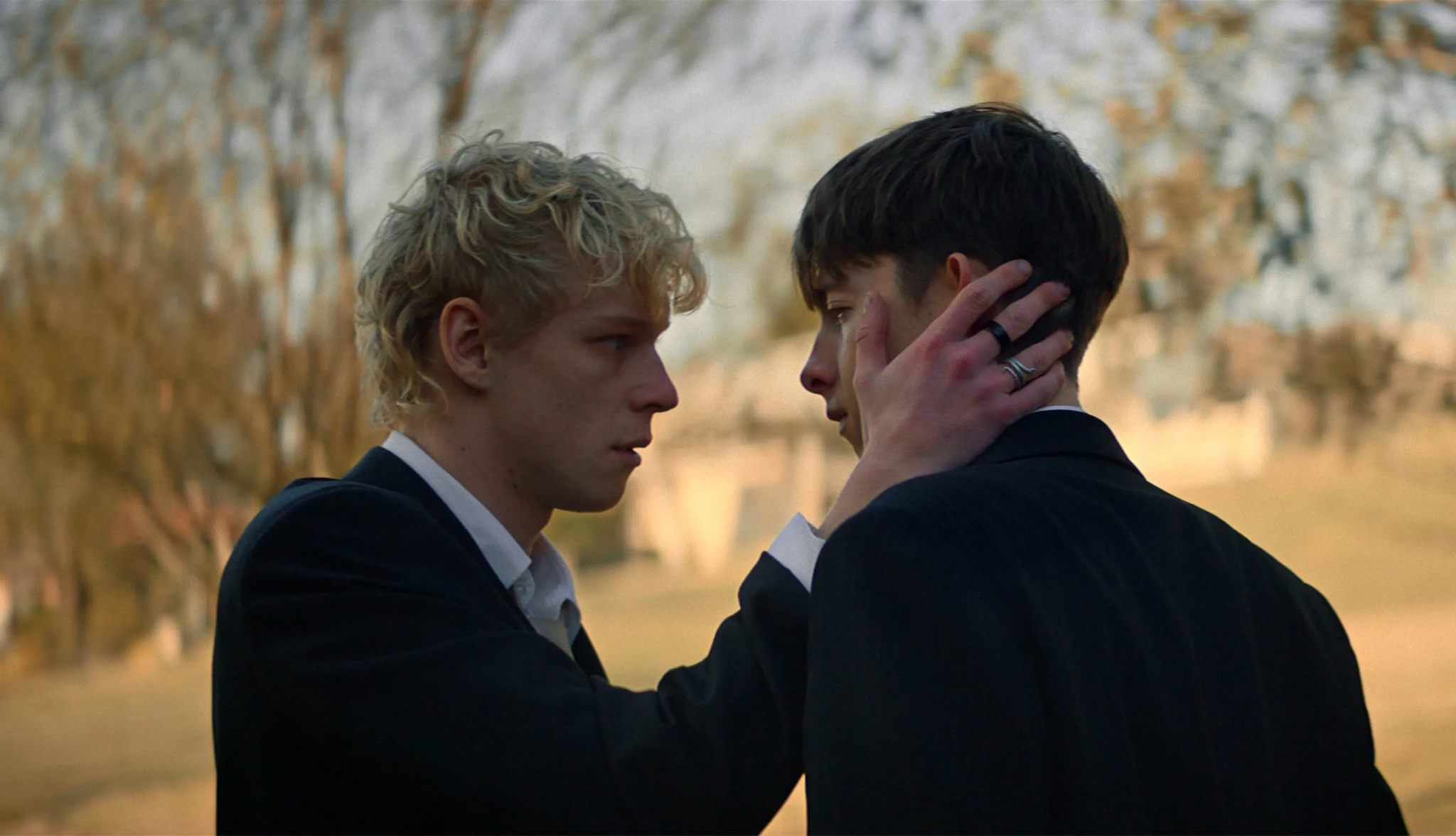
Just as it didn’t take long for the connection between our main protagonists to be established in an introductory stage, Chiarella swiftly presents the challenges they’ll face should they proceed in engaging in a romantic relationship. For starters, their town is all but defined by the Christian parish that attracted Naim’s mom to the area in the first place; everyone in the town is a member, and no one is exempt. (Certainly not the young men in its “congregation,” those of which it seems to target with its proclamations and most devilish practices.) Its emotional pastor (Ewen Leslie) is like plenty we’ve seen before in cinema, and certainly within the confines of the horror genre: Charming and powerful with a cunning, cutting edge to his sermons that targets those who don’t blindly follow his creed. Not helping matters is the introduction of a Deliverance Healer (Nicholas Hope), who it appears is no stranger to this town nor the queer youth that reside there. His job, as both he and the community see it, is to cast out the sinful desires that fester within their souls. When Ryan’s sexuality becomes public knowledge, the sequence that follows is a gruesome act of torture, but not one that merely leads the teen to fear his own identity, but something he can only see due to the Healer’s spell: The person he wants most, only an invisible, menacing variant that uses love as a weapon designed to deliver maximum pain.
Not only are Bird and Clausen’s performances particularly strong – their distinct interpretation of young love leans closer to longing than it does to the typically giddy butterfly-laden crushes we see in many lesser teen-led romantic narratives – but it’s striking how seamlessly they pivot from one mode of emotional ferocity (amorous passion) to the other (still a passion, but a vicious one). That could be due to horror’s bylaws; it’s often that a romantic couple takes center stage in a fright fest, but rarely is it done well. In 2026 alone, we’ve seen Obsession succeed but Passenger, Corporate Retreat, and, er, The Bride! falter. Leviticus is something entirely different, a work of true terror and of sincerity. It is because of that that it eschews direct comparisons to “similar” works, using horror as its draw but not its only discovery upon viewing.
Also evident is how assured Chiarella is in understanding his influences more than he borrows from them. It’s a feat that shouldn’t go unnoticed, especially considering how fond we tend to be of adorning fresh filmmaking faces as genre kings and queens before they’ve even ascended to prince/esshood just because one shot in their picture recalls The Shining. He may revere the likes of Murnau, Shelley, Whale, and Barker, but he’s not telling their stories, nor is he trying to. That’s what makes it especially disheartening to read and hear accounts of the film that liken it to David Robert Mitchell’s It Follows, a film that similarly deals with how your past liaisons come back to haunt you, but charts an entirely different path in doing so.
Worse yet, the streaming television hit Heated Rivalry has been mentioned in what I can only assume is a few desperate attempts at SEO-mining, but what Chiarella is doing is far too sophisticated and amorous to be reduced to a formulaic tale of two young, gay men attempting to find themselves individually and sexually only for a litany of challenges to appear along the way. It honors that trope, and can occasionally be just as expositional as those projects in its plot explanations, but does plenty more to create something profound that surges past the latest YA adaptation of note. Limiting its reach by making broad associations misses the point. If we’re to take anything from Leviticus, it shouldn’t be that these stories share commonalities, but that they each carry their own value and exercise such in ways that touch audiences new and seasoned to the form. It just so happens that Leviticus does so in a way that looks beyond the works that came before it, brilliantly and brutally so.