



Director: André Øvredal
Writers: Zachary Donohue, T.W. Burgess
Stars: Lou Llobell, Jacob Scipio, Melissa Leo
Synopsis: After a young couple witnesses a gruesome highway accident, they soon realize they did not leave the crash scene alone, as a demonic presence called the Passenger that won’t stop until it claims them both turns their van life adventure into a nightmare.
Many audience members equate “horror movies” with “jumpscares,” but there’s nothing more boring in this economy of listless cinema than a technique that transforms an experience of pure agony and terror into a theme park ride. Jumpscares don’t make a movie scary – the atmosphere and sense of tension do. Look at Ian Tuason’s undertone as a note-perfect example of how to employ a jumpscare through its aural designs, and compare it to André Øvredal’s latest misfire, Passenger. In this film, jumpscares are overused to distract the audience from its nonsensical plot, to the point where it becomes a festival of “BAAAAAAAAAAAAAAAAAAH!” moments that permanently blast your eardrums forever.
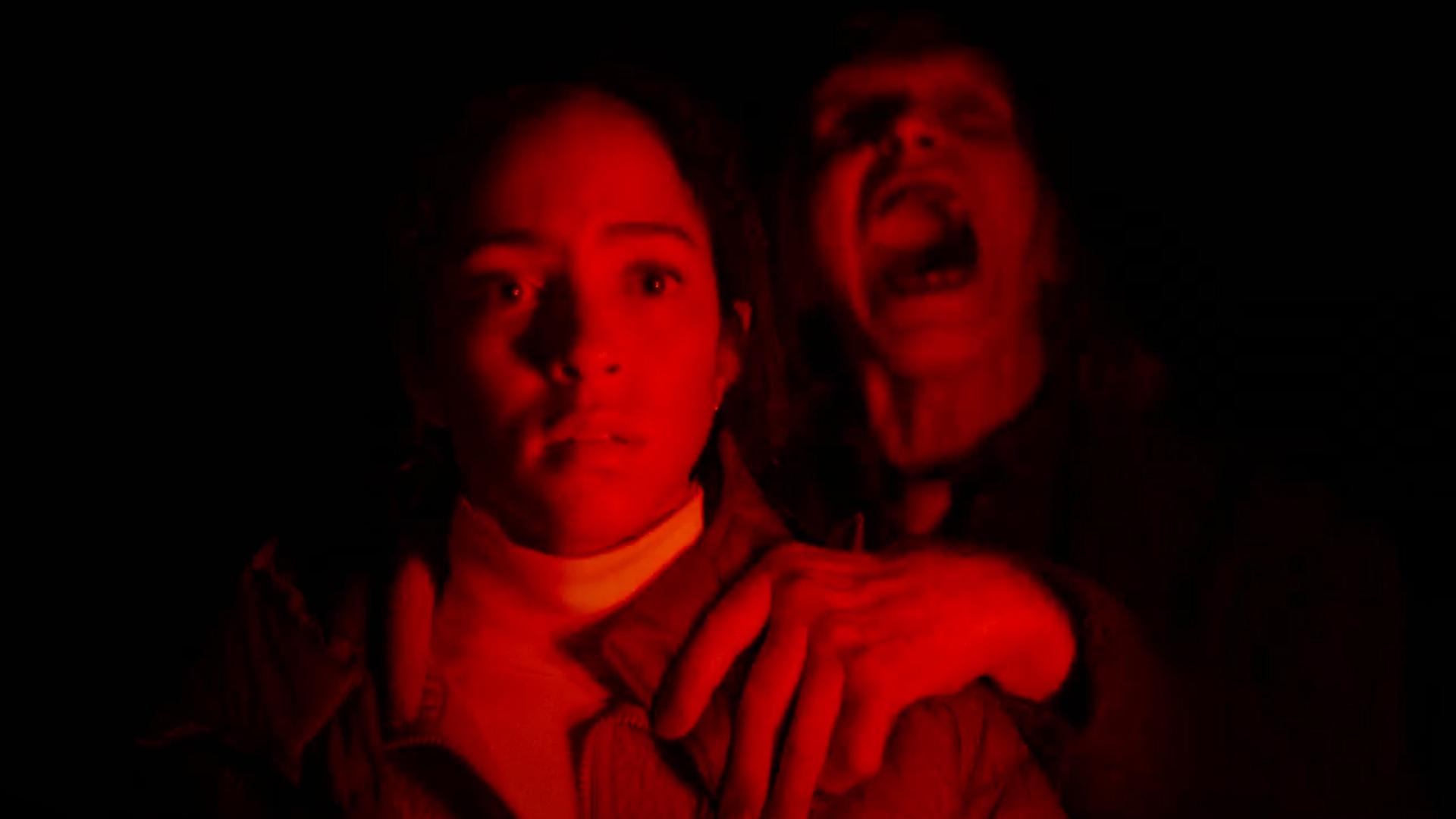
It’s a real shame, because there are two excellent sequences in this movie that show how capable a filmmaker Øvredal is at establishing tension through the visual medium of cinema. One sees protagonist Maddie (Lou Llobel) walk into a vast parking lot to her camper van. Ever since she was the witness of a horrible accident with her fiancé, Tyler (Jacob Scipio), Maddie has been seeing visions of a demonic entity dubbed “The Passenger” (Joseph Lopez), who has been tormenting them by continually distorting space and time until they no longer recognize what is real.
With the aid of cinematographer Federico Verardi, Øvredal circles his camera around Maddie as she walks around this expansive parking lot to reach her van, but she’s hearing ominous footsteps of an unseen creature. Every time she tilts her head back, the van gets further away from her. It’s an incredible sequence that perfectly establishes the creature’s mechanics and the aesthetic impulses of the picture, without relying on cheap jump scares to scare people…until Maddie reaches her van, turns on the vehicle’s touchscreen and, well, I don’t need to tell you what happens next, right?
The same thing happens later in the movie, when Maddie and Tyler watch William Wyler’s Roman Holiday, and the Passenger appears on their screen, looking to rip it wide open. Instead of using their flashlights to investigate the demonic being’s whereabouts, they instead look at the dark woods through the projector, which hasn’t stopped playing the film. The faces of Audrey Hepburn and Gregory Peck eventually bleed out on the trees and coalesce on the Passenger, creating the most evocative (and jaw-dropping) visual juxtaposition of Øvredal’s entire career. And yet, the sequence still ends on a dumb jumpscare, almost as if the Norwegian filmmaker can’t help himself and doesn’t feel confident that he can sell this sequence of pure atmospheric terror on its own.
Why the insistence on such a tired trope to fill your entire runtime with? This is also what sank (pun intended) Øvredal’s last movie, The Last Voyage of the Demeter. Instead of building atmosphere and leading to rewarding – and scary – sequences, Øvredal uses jump scares to distract audiences from a lack of a compelling hook and a story that makes narrative sense. Of course, in horror movies, you have to suspend your disbelief. Demonic occurrences do not happen in real life (until proof of the contrary), so it becomes necessary to throw some logic out of the window.
However, as Øvredal and screenwriters Zachary Donoghue and T.W. Burgess begin to expand on the lore of the passenger and link it to the Catholic figure of Saint Christopher, the Patron Saint. The use of Biblical imagery is always welcomed in horror films, until we realize that Øvredal is doing nothing (and I mean nothing) with the parallel he presents, other than haphazardly linking the Passenger to scripture and wasting the talents of Melissa Leo as an exposition-delivery machine who will tell the protagonists that the creature can be weakened if it’s brought to a specific Church no one can find. Of course, that character disappears from the picture as soon as important pieces of exposition have been fully delivered, but none of what she says has any significance.
It’s hard to go into deeper detail on the religious parallels of the film without spoiling anything, but let’s just say it retroactively makes The Passenger less scary, because Øvredal contradicts many of the entity’s parameters that were introduced in the thrilling parking lot and projector sequences. The film’s climax is an explosive confrontation that wants to add a demonic dimension to Steven Spielberg’s Duel, but let’s just say it falls much flatter than Demeter, even if it’s at least more aesthetically polished than Øvredal’s previous entry in the world of transportation horror (his next movie is going to be set on a plane, right?).
At least Llobel and Scipio give impassioned performances and keep the movie relatively engaging until its final moments, which removes all the romantic tension the two actors thoughtfully built. Passenger is more engaging than The Last Voyage of the Demeter because it sees Øvredal evolve his techniques away from trying to become the next Guillermo del Toro. However, he needs to do away with jumpscares for good, or at least know when to use them. All of them are predictable. All of them are boring. And none of them actively enhance the story; they only highlight the movie’s cracks even more. If you’re going to do Catholic horror, please engage with the images you’re crafting. Otherwise, what’s the point?