


Director: Antonin Baudry
Writers: Antonin Baudry, Bérénice Vila
Stars: Simon Abkarian, Simon Russell Beale, Benoît Magimel
Synopsis: June, 1940. France collapses and signs the armistice. In the midst of the chaos, one man refuses to give up. Alone against the odds, this unknown general flees to London to save what remains of freedom.
Antonin Baudry’s De Gaulle: Résistance, the first in a two-part epic based on Julian Jackson’s “De Gaulle: Une certaine idée de la France,” Marvelizes a figure whose role in history remains the subject of controversy. Some laud the general-turned-President as a hero; others vilify his policies and style of governance. The film, of course, refuses to interrogate any of it. Some audience members will likely dismiss it as nothing more than “propaganda,” and they would be correct to think so. After all, glorifying such a figure without ever attempting to examine the thought behind his decisions seems strange, but at least most of its star-studded cast will repeat “LA FRANCE!” a thousand times to reinforce the sentiment of patriotism seeping across the country, right? Right?!??
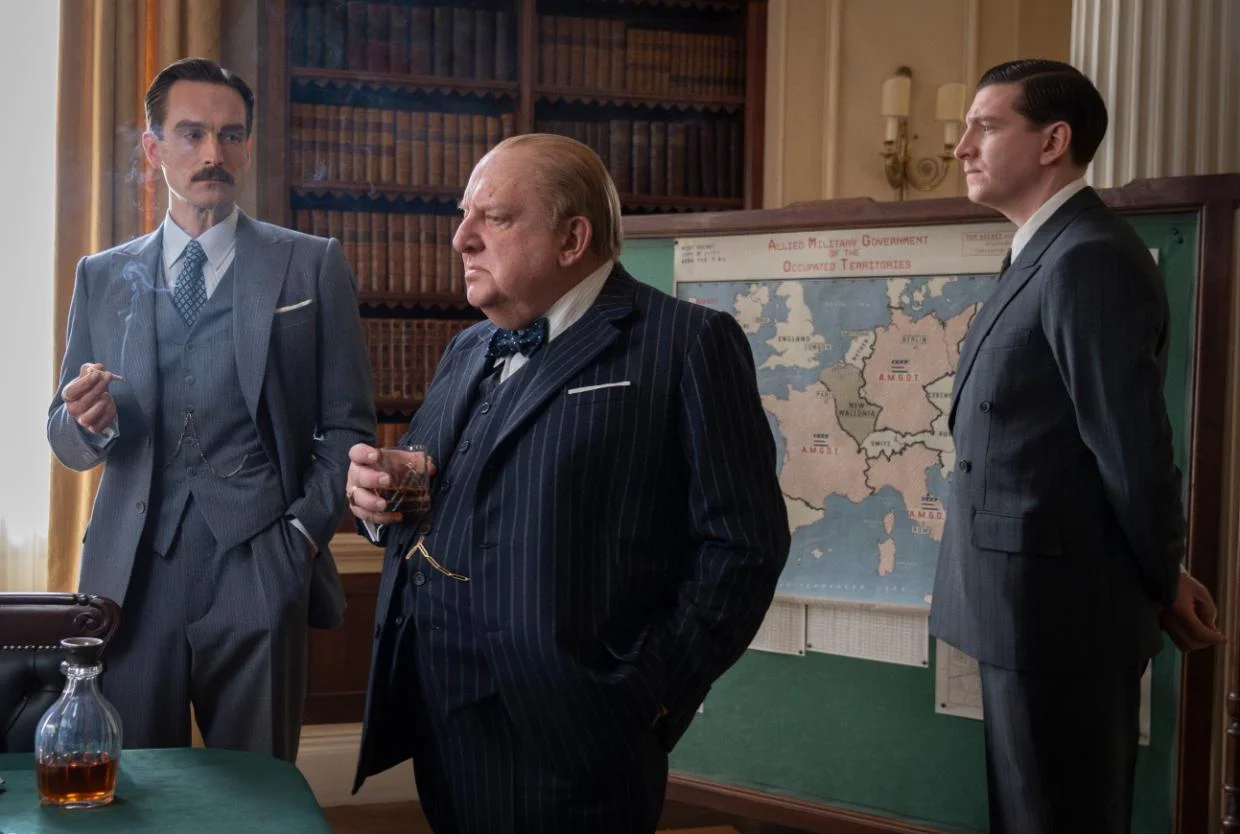
The Marvel comparisons are exacerbated when, later in the movie, as French resistance protestors Fernand Bonnier de La Chapelle (Florian Lesieur) and Olivia (Anamaria Vartolomei) must flee Paris after the Nazis overtake a protest on November 11, Jean Moulin (Félix Kysyl) is introduced as if he’s Nick Fury. I was almost waiting for the “Jean Moulin will return in Moulin” tagline after the film’s post-credits scene (yes, there’s a post-credits scene, I’m not joking) to link this interpretation of the resistance hero to Gilles Lellouche’s portrayal in László Nemes’ upcoming film, but that didn’t happen.
Of course, the bulk of a “Part One” will mean lots of table-setting and exposition before the (likely) action-heavy second part, and that is what Résistance (mostly) delivers. A good chunk of the film examines the power relations between a once-unknown Charles de Gaulle (Simon Abkarian) and Winston Churchill (Simon Russell Beale), who doesn’t know whether he should unquestioningly trust the general’s instincts in the wake of France’s capitulation. Its Head of State, Philippe Pétain (Alain Libolt), and his second-in-command, François Darlan (Mathieu Kassovitz), have succumbed to Nazism and are now working hand-in-hand with Hitler to integrate the party’s core ideologies within France.
Churchill is, of course, strongly opposed to Hitler’s totalitarian reign and the Nazi ideology as a whole. He is looking for allies across all countries. However, the United States President, Franklin D. Roosevelt (Campbell Scott), wants no part in the war, and most governments believed the Germans would win World War II and capitulated. De Gaulle is the Prime Minister’s last hope, but his methods in toppling the Vichy government to liberate France are complex and unorthodox.
We thus get a fairly sanitized examination of De Gaulle’s methods, alongside frictions between the United Kingdom and France, as the general’s actions may very well put the future of the war in jeopardy. Simultaneously, we examine the story of Fernand, an anti-Vichy protester and member of the French resistance whose disdain for the country’s current authoritarian government will ultimately lead him to assassinate Darlan, resulting in his execution. This event removed a massive hurdle for the Allies and ultimately led to De Gaulle becoming the leader of Free France, though this part is reserved for the second installment.
Most of the first part occurs through tense, closed-door conversations between Churchill and De Gaulle, as the general’s actions don’t seem any closer to ending the war. These conversations are of varying quality, but the one undeniable thing is how great its massive ensemble is. Abkarian impresses as De Gaulle, perfectly embodying his stern mentality even during times of great uncertainty. There’s a certain stoicism to his performance that feels as if De Gaulle was brought back to life; the intonations of his words always feel urgent and necessary, as composer Volker Bertelmann reheats his All Quiet on the Western Front and Conclave nachos (yet again) to draw pressure-cooker compositions even when there’s no “action” on screen.
Even with the same string-heavy patterns as his most recent scores (hopefully, Clayface will be different), Bertelmann’s music still punctuates the film’s images well, which are of sweeping grandeur and scale. In an era where American blockbusters look smaller in scale and have the ugliest possible aesthetics, Antonin Baudry reminds us all what a massive motion picture should not only look, but feel like. The film’s final battle in Bir Hakeim is what the French call “un grand morceau de bravoure,” because the sense of scope and immediacy that such a scene evokes is genuinely awe-inspiring. Baudry also doesn’t shy away from showing the brutal, inhumane, cost of war, even if he’ll occasionally veer into jingoism, especially when “LA FRANCE!” is screamed and repeated ad nauseam.
The climax sets the table for what’s to come, which, from the looks of its post-credits trailer, will be much grander (and more patriotic) than this drawn-out, but admittedly entertaining first part. One can complain that the movie does feel very much in the line of modern-day propaganda pieces such as Tsui Hark, Chen Kaige and Dante Lam’s The Battle at Lake Changjin diptych, but the thing is: there’s enough here that feels more like a real movie than something so blatantly nationalistic. There’s texture in the character work. The performances are genuinely impassioned. The action scenes have genuine scale and clarity. The tension is simmering, and the exchanges between diplomatic figures cut deep. It sometimes veers into dull nationalism, but never to the detriment of the film’s emotional experience.
When the credits ultimately rolled, the question that was at the back of my mind was simple: will I return to the cinema next month for Part II: Liberté? No hesitation that I will be there, and I assume the Québec audience will also fly out in droves, considering how packed my 2 pm public showing of the film was on a bright, sunny Friday afternoon…