


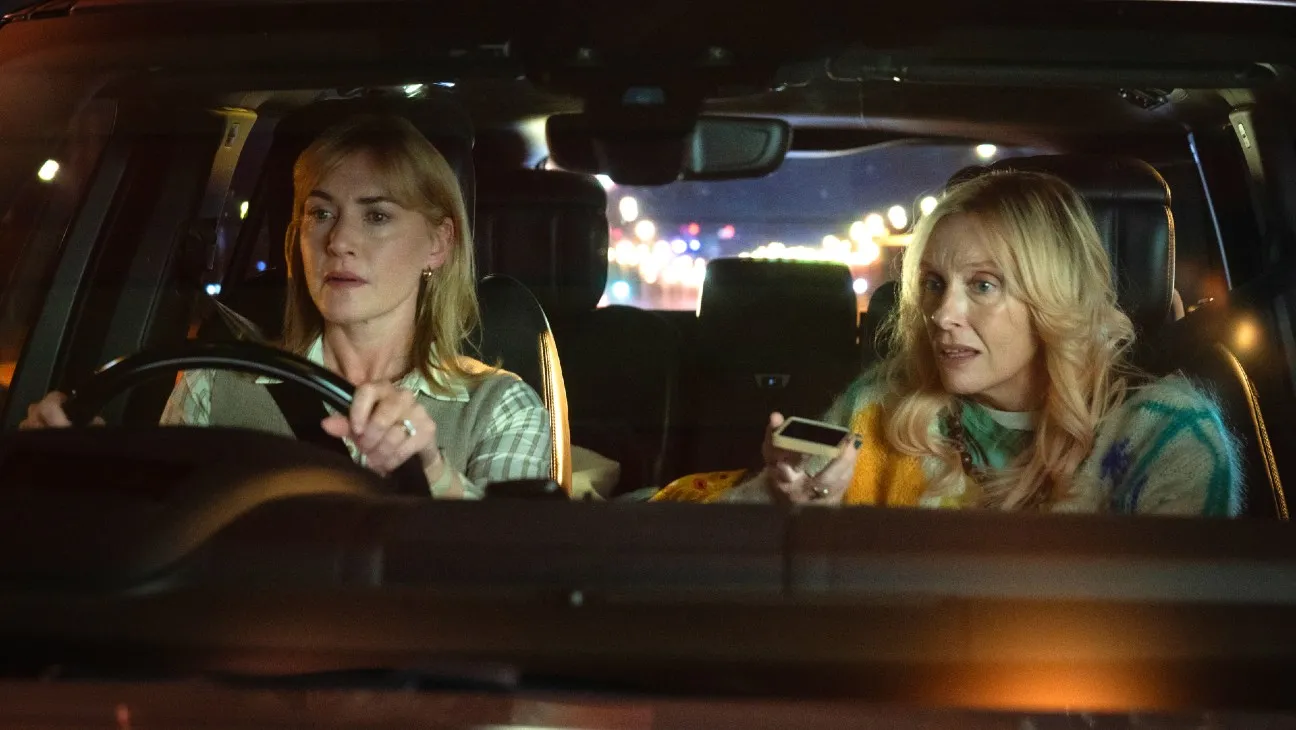
Kate Winslet’s debut directorial film Goodbye June, written by her son Joe Anders, tells the story of an indomitable matriarch played by Helen Mirren whose cancer has progressed to the point of palliative care. June’s husband, Bernie (Timothy Spall), seems completely at a loss to express himself. June’s chaotic family is made up of three sisters, played by Toni Colette, Kate Winslet, and Andrea Riseborough, and a son played by Johnny Flynn. With grandchildren, in-laws, and unexpected surprises, June’s large and often argumentative brood gather around her in December to come to terms with what not having June in their lives will mean.
Nadine Whitney had the opportunity to speak with Kate about why she felt ready to direct and how she created a supportive environment for her ensemble cast.
Nadine Whitney: Kate, I’ve kind of grown up with you. I remember seeing Heavenly Creatures in the cinema and I have been following your career. I always thought you were such a brave and but also precise actor that I imagine she’d make a great director. I felt too with Lee that that you know your role extended beyond producer and actor. I felt that that there must have been moments when you were directing that film as well because it was so close to you. Now you are a director. How does it feel to have finally done it with the title attached.
Kate Winslet: Thank you for saying all those very, very generous things. I have to say I’m just not the kind of person who does anything by half. I don’t do anything unless I know how to do it. Because the risk of failure is so huge and also I don’t want to panic, I didn’t want to feel that technically I didn’t know what I was talking about and I have learned so much over the years, and increasingly, certainly in the last decade.
I realize I’ve become quite a technical actress. My own understanding of what the director is doing to craft a scene narratively based on where they put cameras and so on. I have now an innate understanding and appreciation of what that is and why that is and how those choices can really dictate the flow of a story and can generally make or break a narrative. Because you can’t just film a bunch of stuff and then go into the edit and figure it out. First of all, you have to listen to the actors, because great actors will always show you. The most comfortable experiences I’ve ever had as an actress is when a director says to me, “What do you think? Show me. Let’s try, let’s see.”
Making an environment open and supportive enough that the actors feel that they are the most important thing on that set and in that moment. It’s only when the actors reveal the real emotion of a scene for you, it doesn’t matter how you imagine it might be, but is only when they reveal that that you can truly understand exactly how to cover it.
I did actually have to do quite a lot of holding my nerve in the way I wanted to tell this story in the first part of our film. So, this is a family of disparate siblings. It’s messy, it’s chaotic, it’s tense. There are two sisters who haven’t spoken in years there who are physically keeping a distance from each other. In order to experience that feeling of distance you really have to actually see it. You have to see the spaces between them.
I sometimes really had to say to myself, “Come on Kate, be unafraid to just stand back and let them create it.” I had to be firm with myself about that. Our cinematographer, Alwin H. Küchler, we have a fantastic relationship. I’m really lucky to have worked with him three times as an actress before then doing Goodbye June with him as the director and actress. We had really mapped out that that visual journey of the film and the actors would never have been aware of it, but it was so important never to really go in close into the eyeballs until that moment when Connor (Johnny Flynn) is reading June a poem. It’s the first time then that you truly see what June is feeling and knows what she is also leaving behind. We see her own sadness at that despite her strength, despite the fact that she has total agency over what’s happening. June doesn’t let on until much later in the story. It was so important to see her love for her son, and through that we then go into her and then we’re allowed to see the backs of hands and those transparent elements of her face that are utterly heartbreaking.
I’ve just really always loved film, I love being on film sets, I love the process of being with everybody the cast and crew together. I wanted to create an environment on this film that perhaps felt a little bit different for our actors, because often sets are really chaotic—there’s a lot going on you have to sometimes tune out the noise in order to be able to concentrate. I was able to keep that noise as limited as possible it would only ever mean that the actors felt they could really breathe and be very free in the space. Our crew, lots of whom I have known for decades, were really understanding and supportive of that. During our seven-week pre-production preparation, myself with the key camera team, we really established with the actors how they felt each scene might unfold so that they could be ready with whatever equipment they needed.
I also wanted to give the actors the opportunity to sometimes be in front of the camera but with no one else in the room. I actually never had it as an actress, locking off with cameras rolling and everyone just quietly walking away truly walking away from behind the camera and just leaving the actors in a room with a closed door and cameras rolling on them and letting them just play the scene. It really did have an impact actually on how they felt in terms of how real they could be and the smallness of things and how intimate they could be. They were given permission to be, because they were in charge of the space. I loved being able to offer them that and it really it really made a difference to how they felt. I was so pleased for them that they were able to really feel that.
Nadine Whitney: You’ve also known the screenwriter Joe Anders for quite a long time (since birth). The film is based partially on your own mother’s passing and my mother passed in a very similar manner. How difficult was it to block off the memories of the feelings that would have come with making the film?
Kate Winslet: You know, it was impossible Nadine. But I do have to say it really isn’t our true story, it isn’t, it is a completely fictional story with a with a fictional family, and a fictional version of events. Joe, when he got a place in screen writing school, he was encouraged by this fantastic female tutor to the write from the heart, just write what you know. In his young life and at the time actually he was only 19 when he started writing it, he’d gone through COVID, which was as dramatic for him as any other teenager around the world; but the biggest thing that happened was the loss of his grandmother when he was a teenager and how we all came together and really gave her this great and very beautiful passing.
He was so struck at the time by how we’re all there because we came from this one woman. He took that as his emotional backdrop and created his fictional story from there. But it was impossible for me to tune out my own experiences not least because while my character Julia was very different to me. I myself, I never witnessed any of the private conversations between my parents, they were private. I don’t know what my siblings were saying to one another or to my mother, or how they were dealing with things because those were their experiences of loss. So, actually there were moments when I really did feel as though a part of my own life was playing out before my very eyes but the bits that I’d never gotten to see. Especially in the scenes with Helen Mirren and Timothy Spall with June and Bernie. It was so, so, hard directing those scenes and I would just find myself trying to retreat into the quietest possible corner that I could, almost behind our focus puller Max who I’m very close with anyway. Max and I would just sit there together and quietly cry through it and then have to step out and tenderly help the actors whenever they needed it. Keeping it together myself, yes there were moments that were very challenging, but they were challenging for all of us for a variety of our own different personal reasons.
Nadine Whitney: Kate, thank you for your honesty, your bravery, the dignity you gave June. It means a lot to me.
Kate Winslet: My God, you’re right the dignity, I wanted to make sure she had her dignity. That mattered enormously to me.