


Director: James L. Brooks
Writer: James L. Brooks
Stars: Emma Mackey, Jamie Lee Curtis, Jack Lowden
Synopsis: An idealistic young woman juggles her family and work life in a comedy about the people you love and how to survive them.
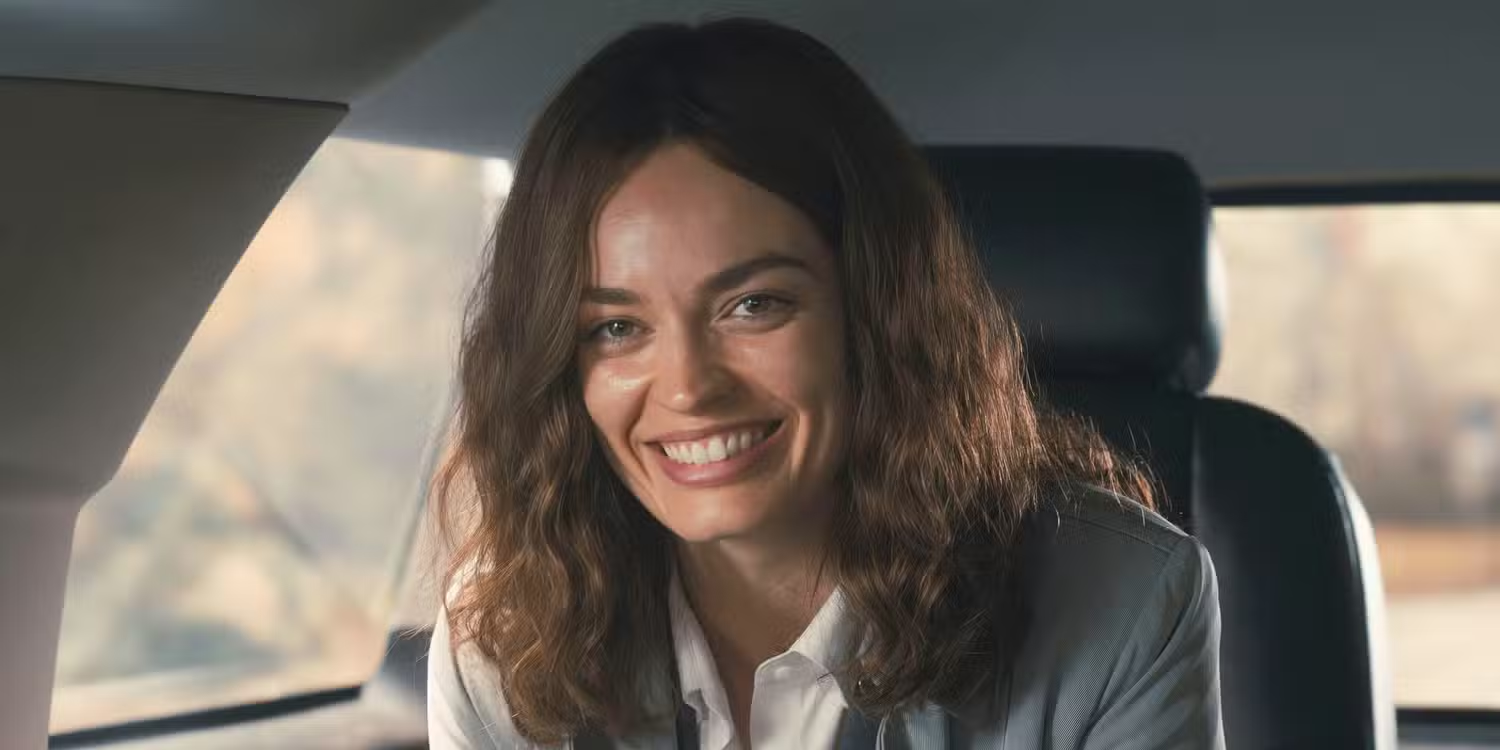
The most fascinating aspect of James L. Brooks’ Ella McCay is how its style, from cinematographer Robert Elswit, plunges us into an era of comedies we no longer see, both on the big and small screen. Through a soft, but effective score by Hans Zimmer giving light notes to a movie that, on paper, doesn’t want to take itself seriously too much, Elswit’s photography reminds us of a time where all movies looked like…movies, and not the digitized grey sludge we’re all too used to seeing on any screen nowadays. There’s actual depth of field, the colors are warm and inviting, and every actor in this star-studded ensemble looks like they are capital S movie stars.
It’s a type of filmmaking that has sadly been glossed over for reasons I don’t understand, and there was hope that Brooks’ return to moviemaking, after 2010’s How Yo Dou Know, would make audiences yearn for more smaller-scale comedies that look and feel like something you can’t miss on the big screen. Sadly, Zimmer’s score and Elswit’s images are the only elements of note in what is otherwise one of the most disastrously conceived studio films I’ve seen to come out in my lifetime, one that gives ammunition to the “comedy on the big screen is dead” crowd more than any other film released in the 2020s. Many will probably tell you that Brooks’ writing is dated. Yet, even in the period Ella McCay is depicting (the Great Recession, specifically 2008), the movie somehow feels like it’s been released 30 or so years too late and would’ve done gangbusters at the box office in 1987.
With such an amazingly-mounted cast and an effervescent Emma Mackey in complete control of the camera as the film’s titular character, you would think that the movie would somehow be palpable enough to be at least watchable. Yet, Brooks genuinely has no idea what he wants to talk about, through alien dialogue exchanges that feel so caricatured that no actor, as talented as they may be, can perform with the texture and humanity of his previous directorial efforts. There’s a moment or two where some characters will perform light gestures and movements that recall Brooks in his heyday, which are charming in their own right. Still, they’re sandwiched between overlong and drawn-out nonsense that one wonders if the guy who brought us Terms of Endearment, Broadcast News, and As Good As It Gets is truly behind the camera.
And thank God he has Elswit cooking with gas, because his directing (alongside Tracey Wardmore-Smith’s nonsensical cutting) is on autopilot. Brooks’ writing is no longer sharp and incisive; it’s cartoonishly dated and inert. The jokes never land, and always feel like they overstay their welcome when they weren’t even funny the first time a character uttered them. It’s the cinematic equivalent of punching at dead air for two uninterrupted hours. In fact, one could rename this film Dead Air: The Movie because Brooks never devotes his focus to Ella’s journey of self-actualization. The premise of the movie sees the titular character become the Governor of an unnamed state and has to juggle the responsibilities of being married to a devoted husband (Jack Lowden), repairing the fractured relationship she has with her father (Woody Harrelson) ever since the death of her mother (Rebecca Hall, completely wasted), while also dealing with the pressures of becoming a female Governor who must get to work and actively enact laws that will benefit her state.
All of that is great, but the movie spends far too much time not making it the sole aspect of the picture and devoting its time to interminable sequences where characters throw punchlines at one another, without ever meaningfully developing who any of these people are. One such sequence sees Ella’s brother, Casey (Spike Fearn), ask his ex-girlfriend, Susan (Ayo Edebiri), for another shot, and it seemingly goes on much longer than you think. Brooks no longer possesses any sense of timing (which was his bread and butter, back in the day), nor does he know when the film’s lightly funny sections stop being so, because sections where the audience chuckles are immediately hampered by the same joke that gets repeatedly beaten to the point where we feel bad for having laughed the first time we heard it. Worse yet, none of the multiple storylines, which take up the bulk of the runtime, actively pay off or mean anything in the grander scheme of the film, nor do we learn anything about its protagonist. She’s a governor who has to deal with a lot. By the end of the film, she screams with her Aunt Helen (Jamie Lee Curtis), but still has to deal with the same problems. There’s no evolution. No cogent message. Just tedium.
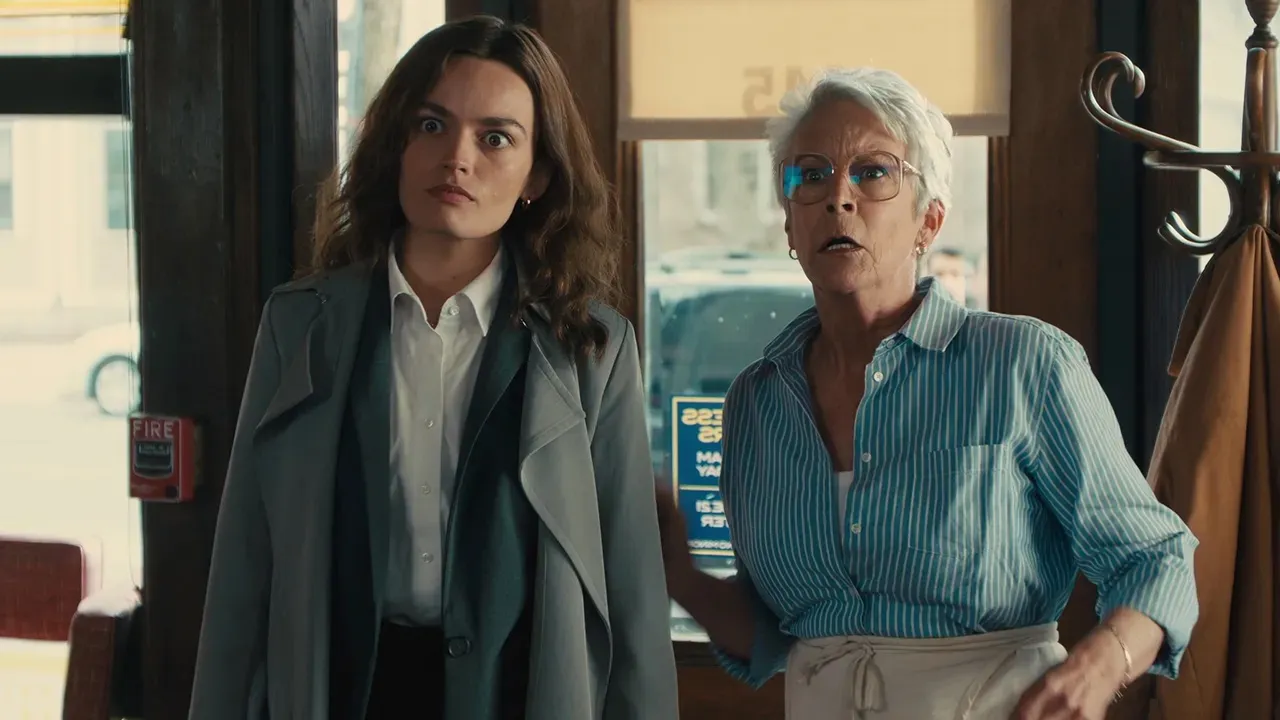
The problems Brooks creates are trivial and uninteresting, and they bloat the story to the point where we have no idea why we should care about anyone on screen, even Aunt Helen, who is a constant source of affection and support for Ella after her mother passed away. There are sequences in which one thinks Brooks will do something to flesh out these familial relationships, but he always settles for comedic platitudes rather than making comedy an integral part of Ella’s development as a fully-fledged, three-dimensional human being. Each scene reads as silly; there’s no tangible examination of who these characters are beyond the jokes they tell each other, and it all gets increasingly tiresome as we begin to realize this movie is going literally nowhere.
Thankfully, Emma Mackey seems incredibly committed to the role and clearly enjoys being in a James L. Brooks film, but the rest of the cast doesn’t fare as well. When Ella McCay’s structure makes itself apparent, one yearns for the movie to end as soon as possible instead of meandering inside a cyclical screenplay that will never amount to anything by the time it reaches a footnote of a final scene with nothing, and I mean nothing, to hold onto. If this disastrously unfunny comedy is touted as the “grand return” of a moviegoing era we’ve sorely missed in cinemas, then I’m afraid it’s better for all of us that this era stays dead and buried forever.