


Amy Thomasson had the opportunity to sit down with Louise Bagnall, Director of Julián
Amy Thomasson: This is Amy Thomasson with InSession Film. I have the honor of interviewing film director Louise Bagnall for her new movie, Julián. It’s an honor to have you here today. What drew you to this story?
Louise Bagnall: The film really was born when I saw this beautiful picture book, “Julián Is a Mermaid,” for the first time. It’s full of these gorgeous illustrations, but at the heart of it is this really tender, beautiful relationship between Julián and his abuela. And Julián is going on this journey of self-expression, and there’s this tension that comes as a result where the reader is left to think about whether, ‘is Julián going to get in trouble for pulling the curtains down, or if Abuela is going to understand what he’s really doing?’
So this kind of tension doesn’t dictate to the reader this sort of understanding of how we can all bring our own understanding to that moment, which was something that I just found really powerful when I read the book. And of course, it has this joyful tone as well. So those kinds of things were the things that, like, when I read the book, I understood that there was a deeper resonance there, and that there was a bigger story that could be told with those characters and with the kind of moment at the heart of the book, and also one that could be incredibly fun and joyful and full of celebration.
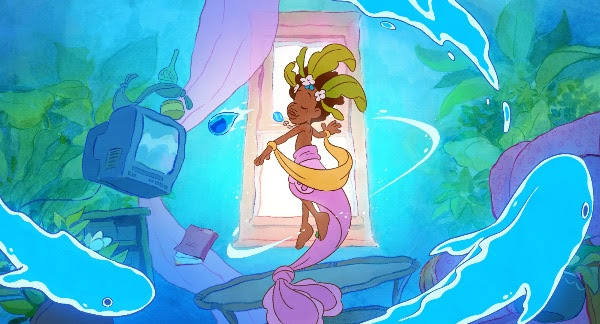
Amy Thomasson: I definitely picked up on that. I thought the colors that were used were gorgeous, and I wanted to know this little boy. I wanted to go to the mermaid parade with him, and I think it’s going to hit people who have been told their entire lives, “You’re a little bit too much. You’re a little bit too much. Tone it down.” And that hit me on a personal level because I’ve been told that myself.
What was the biggest challenge in expanding a relatively short picture book into a full-length movie?
Louise Bagnall: I think, when we were doing that, we expanded on the focus of the world. We were able to look at Brooklyn, which is a fantastic place to set a film, and we were also able to deepen our understanding of these characters that we meet in the book and introduce the characters who would be around them, so their community.
So that was a really great way to take that step into expanding it. But what we had to be very careful of was not introducing any artificial conflict or not introducing something that didn’t align with the tone and the intention of the book, because that would’ve been really doing a disservice to that initial creation.
But also, it would’ve been doing a disservice to why I originally wanted to make the film. So we had to find a way to tell this story that was maybe a little bit more complex in terms of the storytelling in that it’s a little bit… I think It’s quite emotionally truthful for our characters, and that’s something that takes a bit of work and care to make sure that it comes out in the right way. That was beautiful.
Amy Thomasson: Have you spent time in Brooklyn? I grew up right outside of New York City, so that really resonated with me.
Louise Bagnall: I haven’t spent a lot of time in Brooklyn. We got to visit one time in 2019, after I’d originally read the book, and we got to visit the Mermaid Parade, which was amazing. But I never got to go back because then COVID came, so that was it. But what we did have was an incredible writer, Juliány Taveras, who was able to really speak and bring in that specificity and the authenticity, even on the script, with their own experiences growing up there. We also had different cultural consultants who could help us paint that picture in a really authentic way.
And then of course researching ourselves and things like that. But we did, we wanted everything to, in Brooklyn, to feel, to be like, we wanted it to be seen from Julián’s eyes. We want it to be beautiful and colorful and exciting and full of possibility, but we also don’t; we didn’t want it to be too polished, too pristine, because it just wouldn’t feel right.
Amy Thomasson: It wouldn’t be Brooklyn.
Louise Bagnall: Exactly. We still have the cracks in the pavement, and we still have a little bit of paint chipping off on the walls, but that’s also a wonderful place where he can discover community, yeah, so it was trying to bring that to life on screen and certainly taking inspiration from and having conversations with our writer, Juliány and others that would really help to inform and enrich that kind of understanding of Brooklyn on screen.
Amy Thomasson: I think one of the things that was so effective was the amount of world-building that you were able to do in a movie that’s not even quite 90 minutes long.
Louise Bagnall: Yeah.
Amy Thomasson: I loved that. I think really captured it, and I think a lot of people are going to be able to resonate with the abuela’s friends. Obviously, Julián is such a rich character. Abuela, his papa, they were so rich, but the friends, I thought “Yeah … I’ve seen those ladies at the pool before.”
Louise Bagnall: Exactly. I think there’s definitely something familiar about them. And I think that goes across a lot of different cultural places, the ladies who are getting together to have a little bit of a chat and hang out a little bit and talk about what’s going on around and what’s happening in the community and everything like that. It was really fun. I really loved being able to bring more of a spotlight onto the community characters. The three women, ‘Las Viejitas’ we call them, and then also the three girls on the block, we call them the ‘City Block Girls, CBG.’ We thought of them almost like two Greek choruses for our two main characters.
Amy Thomasson: It really lent a lot of authenticity and a lot of humanness. I think a lot of people are gonna be able to understand that, and it’s very intergenerational. I think one thing that this movie also captured, which is why I think everybody needs to see it, is Julián’s sense of wonder at this new world where he is. And not a lot of movies can really capture that. It captured youth in a very realistic way. He was obviously very intelligent, very imaginative, but he wasn’t super clever and witty and precocious like an adult trying to sound like a clever child. He’s had that sense of wonder when he sees the girl’s hair, and it’s not just “Oh, her hair looks nice.” That, “Oh my gosh, it’s so long,” and how he wants to have that long hair, and I thought, ‘That’s childhood.
Louise Bagnall: Yeah, exactly. I think he’s… we had to really make sure that we were portraying an honest expression of emotion in those scenes. And that comes partly from the script. It comes from the way we storyboarded it, but it also comes from the actor, Knyght (Darius Jack). He did a wonderful performance as Julián. And then, of course, our animators are able to take that beautiful voice performance and really bring it to life. And it is, it’s carrying through. It’s making sure that we’re all involved in the process, and everybody involved in the process is also reconnecting a little bit with their own inner child to remind ourselves how it is to be that age.
Amy Thomasson: Family relationships are central to the film. What interested you most about the dynamic between Julián and Abuela?
Louise Bagnall: I loved being able to watch their relationship grow and develop go over the bumps in the road as well because it felt like something, like I was getting to know these characters, as the film goes on, I feel like I’m getting to understand who Abuela is, and therefore Julián is also beginning to learn more about his own sense of self, his own identity, his own culture.
But I loved, like I loved being able to look at Abuela as a character and figure out, where what’s going on in her mind, what is, how does she feel about these things? And of course, it’s Julián in the main part of the film; he’s the real driver of the film.But it was great to be able to open up a book on her and see, and have her reflected on screen and have her give her time as well to tell, to see a little bit of her story and her journey as well.
I loved being able to see both of them and have their relationship grow— being able to get a chance to actually see some of Abuela and who she is in a deeper way was really wonderful.
Amy Thomasson: I always loved how she always came from a place of love.
Louise Bagnall: Which I think is one of those things you can still come from a place of love and you still, you can still make mistakes, but if you’re coming from that direction, it’s the first step, and it’s to protect more than judge.
Amy Thomasson: And as you get older and you have children, you start thinking about those things more. You start seeing that perspective a little bit more because film’s such a good job that I love, you love this little boy. And you do want to just protect him and hug him and buy him mermaid hair. and you love him, and you don’t want him to ever suffer or feel sad. And again, testament to you, the writers, the animators, that we love this little boy and we understand even when the abuela doesn’t understand, we still … She’s not a cartoon villain, she’s a human person who loves this little boy. And I think that’s really wonderful.
The film explores themes of identity and self-expression. Why did those themes feel important to explore right now?
Louise Bagnall: I think for myself, I’ve always been drawn to themes about self-exploration or identity. And I think it’s because it’s such a relatable— everybody has to go through these stages when they’re growing up, and it just always comes back as something that’s actually it’s … and I think the other thing is we often think about it as something that happens in childhood, and obviously with Julián that’s what we’re seeing.
But it actually continues for the rest of our lives in a lot of ways. We continue to grow and understand ourselves in different ways, or discover new things about ourselves. So I think for me it’s always been a subject anyway that I’ve been drawn to. And, I think it’s really wonderful to have a film that celebrates that for kids.
I would’ve loved it, this kind of film as a kid, I would’ve loved to have it. So I can see that at this time it’s probably wonderful. I think it’s great to have a film out there that’s something that’s joyful and hopeful. But I also think it’s something that maybe is hopefully going to be something that will, for a long time, be something that will be will be needed.
Maybe not needed, but will be enjoyed by a lot of people for a long time to come, I’m hoping.
Amy Thomasson: Were there any personal experiences or memories that helped shape your approach to directing the film?
Louise Bagnall: I think when we were crafting the story, we had a lot of conversations between me, my writer Juliány, and my co-director Guillaume Lorin.
The three of us would have these sorts of story sessions together where we discuss the latest draft, the notes, and things like that. And in those kind of sessions, a lot of, discussions is we, we’d be talking about things that we know from our own lives or things that would, we would be able to talk about so Juliány, was able to obviously bring in a huge amount of context and specificity, and Guillaume as well, coming from Guadeloupe, as an Afro-Caribbean director, he was able to really understand different parts of the puzzle essentially. And then for myself, I think I wanted to make sure that I was leaving space for them, for them to bring those ideas in and to be able to collaborate with them.
But, I definitely had some very, a couple of times that I was reminiscing about when I was a kid and I didn’t like what was going on around me, and I couldn’t quite find the words to say it, so I’d find other ways of acting out. The scene where Julián gets the food all over the bathroom, it wasn’t quite what I did, but there was touches of it that came from my own childhood, I think.
Amy Thomasson: There is a humanness to this animated film, which, as much as it’s for children, I think it definitely hits people of all ages. Animation gives filmmakers unique creative freedom. What aspects of Julián’s imagination could only be expressed through animation?
Louise Bagnall: I think one of the things that was wonderful about the kind of films we make, 2D animated films, was that we can have things like his imagination and the world around it be very harmonious together. We don’t have this big jarring jump between one and the other. We’re actually able to interlace the real mundane world and the magic kind of flowing underneath that’s bubbling up. I think that was a big part of how we were able to tell this story. And then for me, having a character like Luna was a lot of fun to bring to life, and again, something that could be very responsive to Julián and didn’t feel out of place in the world that we created. I loved having that kind of expression of on screen as well.
Amy Thomasson: You previously directed the Oscar-nominated animated short film, Late Afternoon. How was directing your first feature-length film different from directing a short?
Louise Bagnall: It’s a lot bigger. (Laughs). It’s a lot bigger. But I think there are some things that are similar, some structural things and processes that are similar.
But I think what you need to do is you need to be… I really wanted everybody on the team to feel like they were part of this project, and they were on board. So I worked hard at trying to make sure that even though the team was a lot bigger than on a short film, we were all on the same page and that we were all pulling towards the same goal. There’s definitely a lot of work there. I think the other thing is, when you’re making a short film, the risk is quite low. People aren’t too worried about it being this way or that way. But on a feature film, you’ve got a lot more people to think about, and there’s a lot more voices in the room.
It’s also trying to navigate that and trying to still tell the story that means, that- the story that you want to tell or the story that has the most heart in it or the story, you have to figure that out, and you have to clarify that so that everybody understands where you are with the story and they can, again, like I said, all pull towards that same goal.
So yeah, the numbers are bigger, but that does create extra complexity. And then the other thing that was obviously different as well was that with that kind of complexity, there was also the co-production. We had the film production itself split across four different countries, so that creates a lot of, you need to be very clear with communication. You need to be very efficient with how you handle information, and you need to be able to communicate with people who are not even in the same time zone as you, that was one of the bigger challenges.
Amy Thomasson: That is an incredible challenge, and the filmmakers used to not have to do that. Everyone used to be together. But it allows more creative freedom, yet also a lot of challenges, I imagine.
Louise Bagnall: Absolutely.
Amy Thomasson: Was there a particular scene in Julián that was especially difficult or rewarding to create?
Louise Bagnall: There was a scene that was quite complex where Julián has his we see this sort of flight of fancy when he first hears about the mermaid parade, and he has this these fish wash over him, and we go into this, basically his inner world, and he’s envisaging you can basically feel his emotional reaction to what he’s been told about the mermaid parade.
And it’s very much that was quite a complex scene because it’s one long scene, with everything has to flow into the next thing. And it still required a lot of different departments to all understand what their role was, and that was a lot of planning. So that one scene was definitely a bit of a head-scratcher, and it took us quite a bit of time to get right. We learned things from that we actually helped to inform us for things near the end of the film as well, where we’re underwater, and Julián has a chance to explore in a big open space. So again, things like dynamic cameras can be really powerful to use, but it’s quite complex in 2D animation sometimes to plan these things out. They were some of the bigger challenges.
Amy Thomasson: That was so effectively done. You felt that dream. The flow of the animation is that you could feel him physically get swept up into that fantasy. I thought that was very effective. What do you hope young viewers take away from the film after watching it?
Louise Bagnall: I really would love it if young people could, firstly, enjoy the film. I really hope that they enjoy it and find it to be fun. And I really want them to maybe be a little bit inspired or a little bit emboldened, empowered by the film, and to see a character who’s really trying to be true to himself and trying to express himself and is able to be resilient enough to get over some bumps in the road as well. I hope that it’s something fun, and I hope that it’s something that they can feel inspired by, too.
Amy Thomasson: I can confidently say that audiences of all ages are going to feel that way. I was very inspired myself. I wanted to put on costumes today. I was a theater major in college!
Louise Bagnall: Oh, brilliant!
Amy Thomasson: I related a lot to this main character— it’s beautiful. On a very personal note, it really hit me, and thank you for capturing that spirit of that young child, because I was completely able to relate to that.
Lastly, looking back on the entire journey of making Julián, what did this film teach you as a filmmaker?
Louise Bagnall: I think it helped me to learn how to listen better to the people around me, and I think it made me a little bit more, probably a little bit more resilient as well in terms of, being able to let my own ideas out there and somebody might say, pick them apart and be able to come back and not feel too wounded about that, so it’s part of the process. It’s a give-and-take within the film. Not being too precious about your own matter, your own ideas, or your own point of view on it, and being able to listen to others, and that really, I think, helped in terms of making sure that the film had a strong narrative and that it could stand and could speak about the things that it does.