



Director: Peter Berg
Writers: Peter Berg, Mark L. Smith
Stars: Nicholas Galitzine, Bill Skarsgård, Ray Nicholson
Synopsis: After Pearl Harbor, four star college footballers join the Marines. Before facing Okinawa’s invasion, they participate in a historic game with legendary players – for many, their final match.
Some filmmakers like to return to something that once gave them a lot of creative juice. Ridley Scott returned to the Alien franchise, which made him famous. George Lucas felt he had more story to tell, so he wrote more Star Wars films. Francis Ford Coppola felt the Godfather story needed a proper ending, so he gave it a new chapter. Now writer and director Peter Berg who adapted Buzz Bissenger’s book into both the TV show and film Friday Night Lights, has gone in for another adaptation of a Bissenger work, The Mosquito Bowl. This, like some of the “triumphant” returns mentioned above, is a massive disappointment.
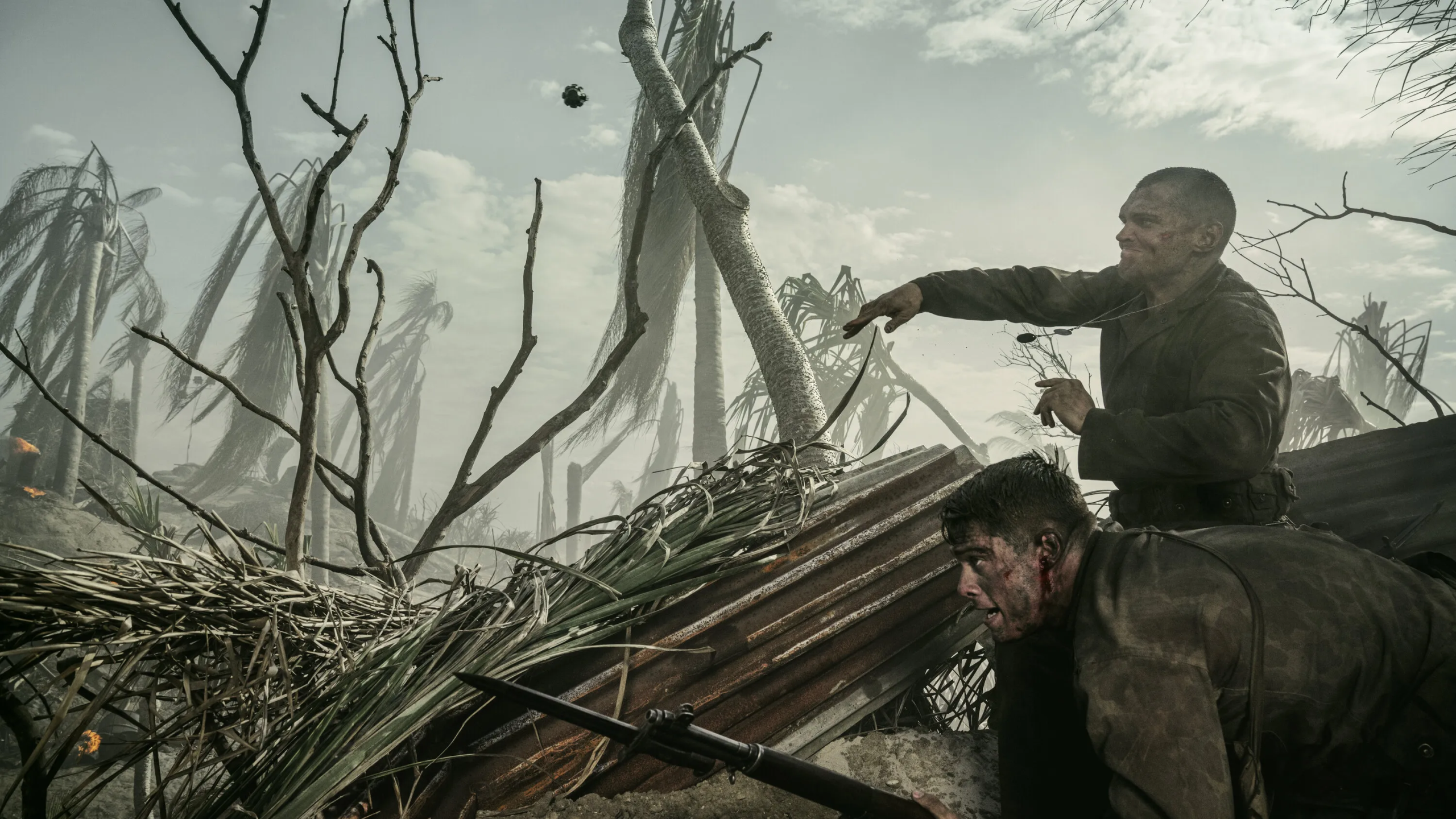
The title refers to a famous football game played between regiments of the U.S. Marines as a morale boost on the eve of the invasion of Okinawa during World War II. The game is so famous because it featured many of the best college players of the day who volunteered to fight. Had the film been centered more closely around this game, the logistics, the rivalries, the players, and the crowd, this could have been a good film. Instead, the film gives us a bit of background on four of the players and then gives us the kind of war film we’ve seen many times over, complete with thousand yard stares and loud carnage. The actual football game is late in the film and unfortunately for us, not the end of the film.
It feels like co-writers Peter Berg and Mark L. Smith wanted to say more. They wanted to elevate this story to a philosophical treatise on something. It’s vague here because it’s vague on the screen. It’s vague in the sometimes nonsensical dialogue the characters have in between bits of war. These times where they speak to one another it feels like machines attempting to put an emotion they’ve never felt into words, but failing to actually sound human. All the dialogue is either rote repetition that is heard in every war film or this strange philosophical nonsense.
The strangest bits of this come as the company sergeant, Wilkes (Dominic Bogart), is attempting to triage a wounded soldier as this soldier screams that he doesn’t want to die. For some reason Wilkes believes this is the perfect opportunity to have a rational discussion with this man about why this man is afraid to die. As Wilkes points out, the man has never died, so how does he know he doesn’t want to. Like many of these strange discussions, this one ends with a bullet.
If the rest of the film’s path made logical sense, these strange bits of dialogue would be just a weird blip, but the logic is off. It is linear, though, that much is sure, but it feels like there are leaps in the story that leave gaps behind it. The film feels chopped up in a way. There are conclusions to scenes, but you feel a bit jarred when it jumps to the next scene. It doesn’t help that cut into the film is archival footage that is the actual event that the filmmakers are recreating.
In one of these scenes, the filmmakers have actors imitating those people who performed USO shows with Bob Hope with footage of the actual Bob Hope show. To then have one of our characters having an emotional breakdown at the same time should be saying something more, but it just makes the reaction quite a bit more confusing. It feels like our hero’s brain is just as confused as ours at why we’re seeing these things simultaneously.
The Mosquito Bowl feels like it has big ideas. There are so many attempts it is making to be a film of big ideas. Yet, what it really needs to be is a film about how a football game is more than a football game when it makes you feel like a human being again. During the scenes of football before the war and during the Mosquito Bowl, there are tremendous parallels, but it’s the muddiness of everything in between that drags this film down.
We’ve seen war films that tell us “war is hell.” We’ve seen war films that espouse philosophical ideas about the nature of being. We needed to see a war film about how soldiers found peace and instead we have a cacophony of disjointed ideas that are sort of about the bonds of football and war. That is the film you will be frustrated you didn’t see, should you choose to watch The Mosquito Bowl.