



Director: Genki Kawamura
Writer: Kotake Create, Genki Kawamura, Hirase Kentaro
Stars: Kazunari Ninomiya, Yamato Kochi, Naru Asunuma
Synopsis: A man gets lost in an underground passage. He follows the “guide” through the passage, but one after another, strange things happen to him. Is this space real? Or an illusion? Will the man be able to escape the passage?
I’ll admit that I am uneasy in tunnels, underground walkways, IKEA stores, and anywhere I can’t tell where the exit is. The notion of temporal distortion in malls and casinos causes me anxiety. Places where people are moving but also stuck in a maze where left and right don’t seem to matter. Spaces that are meant to be passed through and navigated make me feel I’m Theseus moving in on the Minotaur but with no Ariadne to supply me with a red string so I can emerge again. Exit 8 is primarily set in an underground Japanese subway concourse that reconfigures itself as a maze bores directly into my subconscious tapping in on the primal fear of being buried alive. For that reason, Genki Kawamura’s video game adaptation is what I would consider a conceptual psychological horror par excellence.
The sound of Ravel’s ‘Bolero’ – a piece of music based on repetition – fills the ears of a morning subway traveler (Kazunari Ninomiya). In the crowded carriage, a woman carrying a baby is excessively berated by a passenger. No one steps in to stop him. The traveller. whose point of view we experience in first person at the start of the film, watches the scene happen and hears the yelling and the quiet distress of the baby’s mother. He returns to listening to ‘Bolero’ and avoiding calls from his ex-girlfriend.
When he disembarks and begins to head to his new job he finally answers the call. His ex-girlfriend (Nana Komatsu) acknowledges that she understands the relationship is over. However, she is currently at a hospital where she is trying to decide whether or not to terminate a pregnancy conceived when they were a couple. She wants to know his opinion, to help her decide. Mentally taking in something potentially life-changing the man, now known as The Lost Man, wanders the Exit 8 concourse without paying much attention. When he begins to notice he’s in a loop passing the same posters, lockers, and the Walking Man (Yamato Kochi) enough times to note something is very wrong. He’s also lost cell coverage and doesn’t hear what his ex-girlfriend is leaning towards: keeping the child or a termination. He needs to join her at the hospital, but he is stuck.
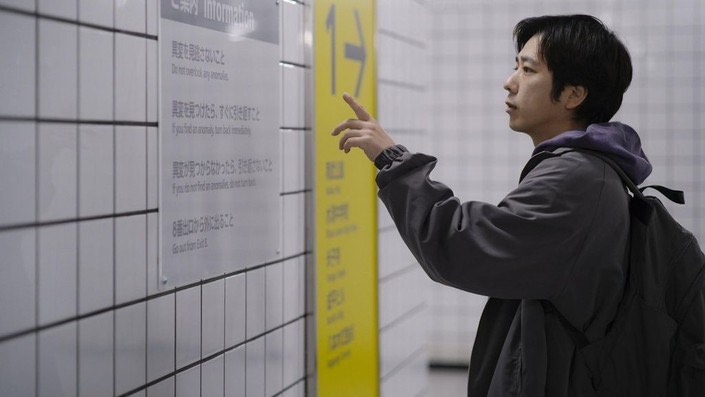
He eventually finds an information sign outlining the logic of his trap. Look for anomalies. If one is found (however minor), turn back. If there are none, move forward. He is on Level 0 with eight levels to go before he can emerge. However, no matter which level he is on, if he misses an anomaly, the concourse is reset, and he is at Level 0 once more. With his asthma being triggered by stress, the Lost Man might never reach the surface as time stretches and the underground concourse becomes an aggressive and hostile place.
“Dentist. Escher. Legal scrivener. Plastic surgery. High paying job. Subway etiquette,” the Lost Man counts the posters on the white tiled wall. The Escher exhibition poster features the work ‘Möbius Strip II (Red Ants)’ which is clearly a metaphor for the Lost Man and other works who daily take the crowded transport into their jobs. It’s also perhaps indicative of how the unknown power behind the concourse sees people — small, irrelevant, worker insects who attach themselves to a path and follow it unquestioningly. At one stage or another there are three humans who find themselves trapped. Without pity, it keeps a young child (Naru Asanuma) who ran away from his mother hoping she would look to find him, and the Walking Man who accompanied the child along the concourse until an error rendered him “not human.” When the Lost Man finds the Child he at first thinks he is an anomaly until he realises even a small soul can be trapped in a soulless place. A place which according to a young woman could be purgatory. She laughs cynically at the Walking Man and tells him that he has already put himself inside the space by every day going to a job that he hates as he tumbles into middle-age. An object warning to the Lost Man who perhaps still has a chance to be more than a drone.
Genki Kawamura and co-writer Kentaro Hirase understand the anxiety of living in stasis and becoming used to being led in a single direction. They also understand the emotional fear of unplanned parenthood and making a choice that fundamentally changes who and what you are. The concourse bleeds through the ceiling and walls, the lockers contain the sounds of screaming infants that it is impossible to set free. There is no cheating the system you have found yourself in no matter how deadening and repetitive it is. A recursive march through the underground thoroughfares of Tokyo where looking up is discouraged forms part of the capitalist unease – where does freedom and the individual exist? Even if one thinks they’re winning the game the game will morph and shift the goalposts so no matter what, the individual is always placed at a disadvantage.
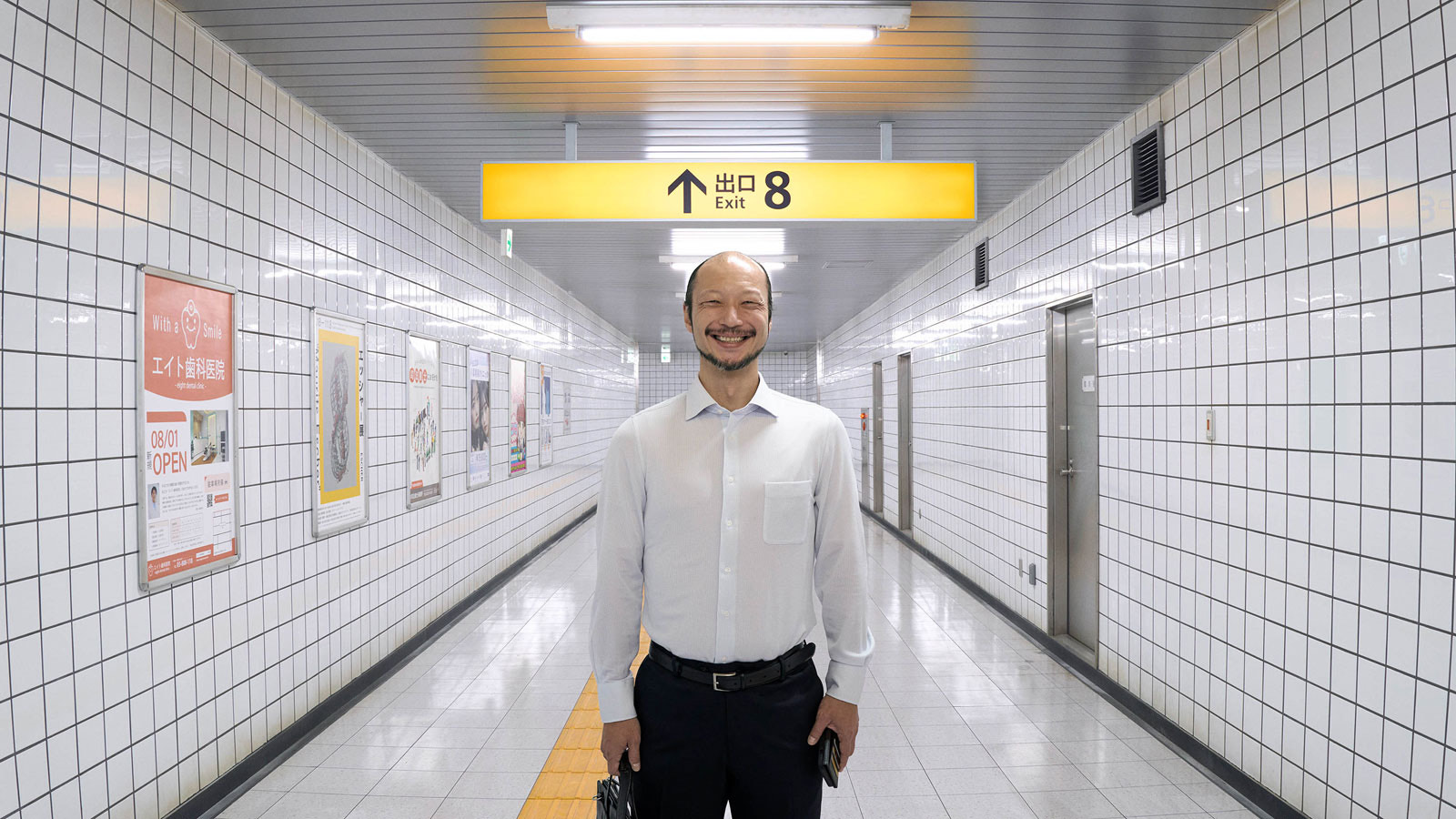
Exit 8 is an extraordinary feat of production design. Even before the Lost Man notices he is trapped, the claustrophobia of the subway and the liminal space where a familiar journey is halted is nightmarish. Exit 8 thrives on its maddening repetition and the broader implications that perhaps those who daily walk the white tiled halls are already dead. A minimalist and affecting horror that reaches into individual, national, and international disquiet. One of the best and most effective J-Horrors in years.