



Directors: Javier Ambrossi, Javier Calvo
Writers: Javier Ambrossi, Javier Calvo, Alberto Conejero
Stars: Guitarricadelafuente, Miguel Bernardeau, Carlos González, Milo Quifes
Synopsis: The intertwined lives of three men in three different eras, three lives intimately linked by sexuality and desire, pain, and legacy.
In the cinematic landscape, there’s a certain special touch or whirlwind of emotions that any epic or picture of grand proportions will try to stir within you. When you witness a film that wants to live up to such a grand promise, the end result can vary from something truly awe-inspiring that makes you feel as if you lived a whole life while watching it or a film that can start to wobble under the sheer weight of so much grand ambition. Many of the highlights and shakier elements of boundary-breaking film elements are within La Bola Negra, a film that’s undeniably towering in the scope of all the historical importance it wants to communicate while slightly struggling to find full coherence within the grandiose theatrics of its narrative structure. Like the sweeping nature of the beauty lying at the film’s center however, the intimate emotions hit just as much as the scale because Spanish writer/directors Javier Ambrossi and Javier Calvo (known as duo Los Javis) know how to blend the familiar with the new in said scale. The film is an ever enrapturing portrait of preserving both the artistry and history of queer identity no matter what the era. The importance of said art and stories outlasting us in the face of the ever revolving forms of repression that threaten to bury it, capturing the heartache and hope of never giving up on preserving the legacy of those whose love never wavered. The path is certainly wobbly to get there, but duo Los Javis craft a beautifully classical epic through such wondrous new lenses.
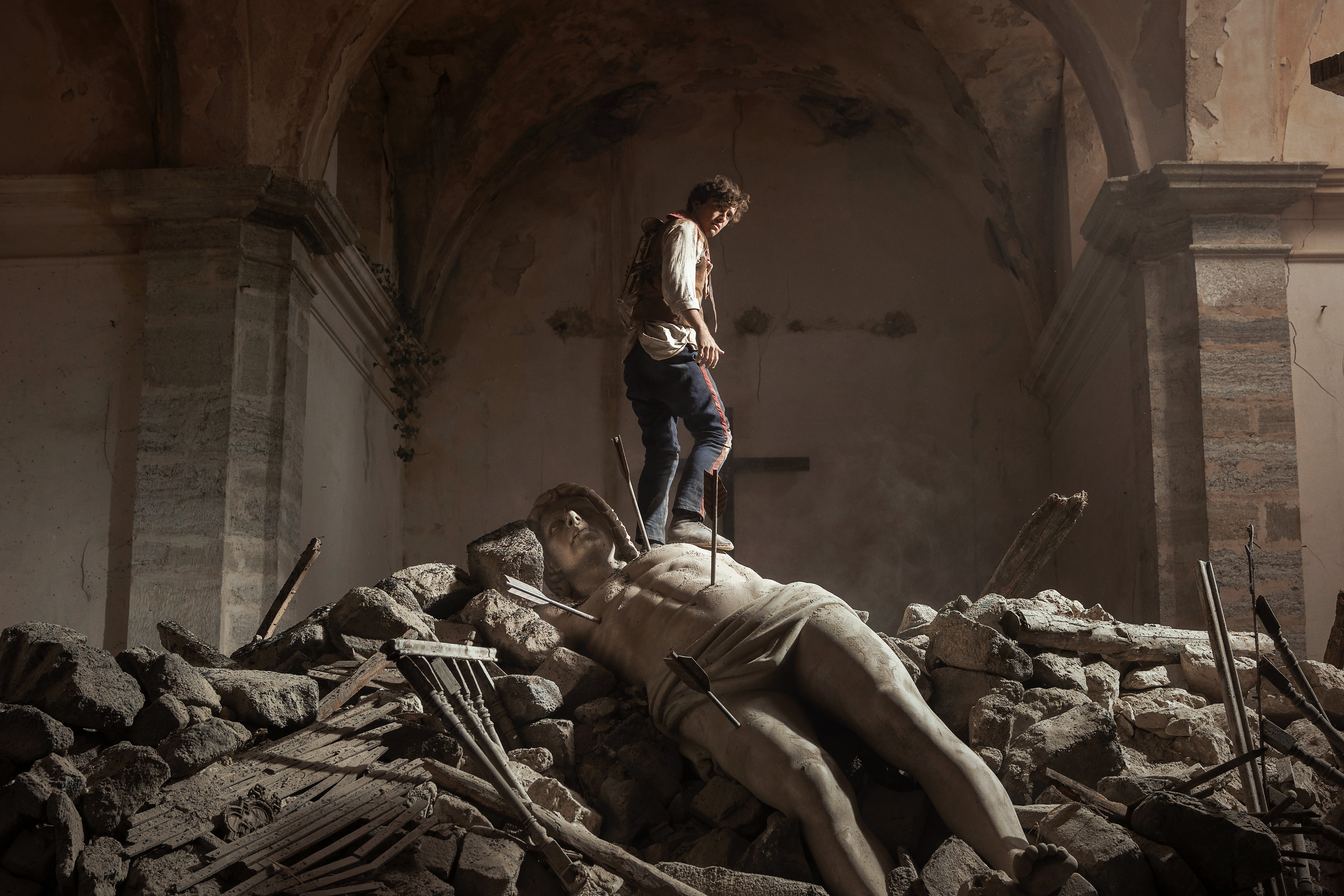
The story here is told within a non-linear structure within three distinct eras, cutting between the years/events of the Spanish civil war in 1937, pre the war in 1932, and the modern day of 2017. The 1937 vignette is what the film opens with following trumpet-player Sebastián’s (Guitarricadelafuente) Spanish village getting bombed and gunned down in horrific fashion by the fascist coalition that the Italian rebels have been fighting against. Despite his harrowing attempt to escape, Sebastián is captured by the fascists and forced to now serve for them. While there, he is set to keep watch of injured prisoner Rafael (Miguel Bernardeau) who acts as Sebastián’s awakening to queer thoughts and feelings that he tries to keep hidden under the regime.
The 1932 storyline is nearly the entire basis of the film’s title and play (by poet Federico García Lorca) it’s completing, “La Bola Negra (The Black Ball),” in which young Carlos (Milo Quife) has dreams of becoming a devout member of his father’s casino club but is denied membership via vote of picking of black balls because of the percolating rumors surrounding his sexual identity. Then jumping into the next century, the 2017 section revolves around Alberto (Carlos González), a former playwright and PhD student who now scrolls on his phone for Grindr hookups before receiving news of an inheritance from a grandfather he never knew he had that acts as the come together link between all three of these stories. What follows is an engrossing odyssey of sorts, connecting more than just the collective pain, repression, or fear of losing acceptance all three of these men have had to face in their own harrowing ways, but also the legacy that lies between them and their own identities.
From its opening sequence showcasing the nightmarish bloodshed and familial death Sebastián witnesses first hand, the scope of La Bola Negra’s craft is simply awe-inspiring and the way the film uses its beauty within the inner workings of its story is breathtaking. Los Javis make every jump between time periods breathe such extravagant life in cinematic splendor in a way that makes up for where certain aspects of the finer details in the non-linear writing can come up short. Sebastián’s segments always have a harsh quality to them, given the environment that he is now forced to reside in, but it only makes moments of splendor and tender beats between him and Rafael all the more intimate and delicate in their fleeting beauty. Carlos’ sections have an almost heightened quality to how they’re filmed –especially within a standout dance sequence– making for a proper distinct quality as the lyrical connection to the other two storylines acting as the visual representation of poet Federico García Lorca generation defining work.
Alberto’s section is the most contemporary since it mirrors a much more modern experience for a gay man but it also makes for such a great contrast between the other two men and their own varied reckonings of self-reconciliation. Each era feels lived in through its own distinctive elements and the ethereal work from Los Javis and their Director of Photography, Gris Jordana, acts as the ultimate canvas for the way in which the film sells the sprawling nature of its cinematic language within such a whirlwind of splendor.
The structure of the overall narrative itself is where things can get a tad more uneven and is when the film retains a somewhat equal amount of pros and cons. The non-linear format of narrative structure La Bola Negra uses to sell the weight of its sheer ambition isn’t a new form of storytelling (just ask Christopher Nolan), but it still remains a facet for undeniably fresh storytelling if you know how to spread the interspersed storytelling across such gargantuan runtimes.
For the most part, Los Javis and their editor Alberto Gutiérrez find the sweet spot in interweaving such grand material, but there does exist occasional clumsiness on the road to its enrapturing albeit predictable third act conclusion. There are certain moments, especially within its middle portion, where the film can really strain to reach for the inner connections between its stories leading to some stories lacking focus in comparison to others. In some ways, the story weaving can be jarring when we cut between narratives in a way that only feels like it exists to offer a few rather obvious connections that are weak on the basis of not having much depth to stand on if told through a plain linear format. Still, in spite of its clunkiness and occasional overwrought nature in wanting to wring emotion out of you through its cross-cutting, the monumental crescendo of every vignette coming together in the film still hits hard when the credits roll, acting as a beacon of passing on liberation in identity for the future while breaking through the bones of utter heartache.

Every performance in the film is simply aces, with each man beautifully conveying their collective struggle through such intimate interiority, but Guitarricadelafuente, in a first ever feature film performance, stands out as a true heart of the film surrounding his growing bond with Rafael in his section. Guitarricadelafuente portrays Sebastián with such affection at every moment as someone enraptured in a type of loving sensation he never thought was possible until he met Rafel. Guitarricadelafuente eyes convey the moments where he is completely silent in his reaction to barbaric occurrences around him, or endures the sorrows of an environment forcing his suppression with such a soulful nature that he remains the tender heart beating within the center of the film’s entirety.
Both Glenn Close and Penélope Cruz appear in the film in small roles but it’s a great example of a film getting great results out of sparse use of gifted performers. Cruz plays the extravagant singer known as Nené Romero who, in a performance for the troops in the war, acts as another touchstone in Sebastián discovering more of his identity and his love for theater. Close, as historian Isabelle Durand, looks to preserve more of Spain’s queer history and has such thoughtful conversations with Alberto in the modern storyline, where she speaks to a core sting in the film’s core in one minuscule moment, noting that history in itself is less about the facts touted about and more the importance of the people that they come from.
La Bola Negra is an undeniable achievement in both towering scale and ambition and while it can struggle under the weight of tackling such ambitions, it, in many ways, makes its showmanship of classical artistry all the more powerful in message and filmmaking prowess. Its poetic exploration of generational plights of preserving the artistry in both queer identity and Spanish culture is a wonder to behold and even when things don’t completely fit together, the scope is never any less enrapturing.