



Director: Hongchun Lan
Writer: Hongchun Lan, Leng Yang, Xuanxuan Zheng, Liyun Zhu
Stars: Li Sitong, Wang Yantong, Wu Shaoqing, Zheng Runqi, Wang Xiaohui
Synopsis: Xiaowei travels to Thailand to find his “billionaire grandfather” whose debt problems have kept out of contact, but he unexpectedly finds that the one who has been corresponding with his grandmother for years is not her husband.
“First bitter, then sweet.”
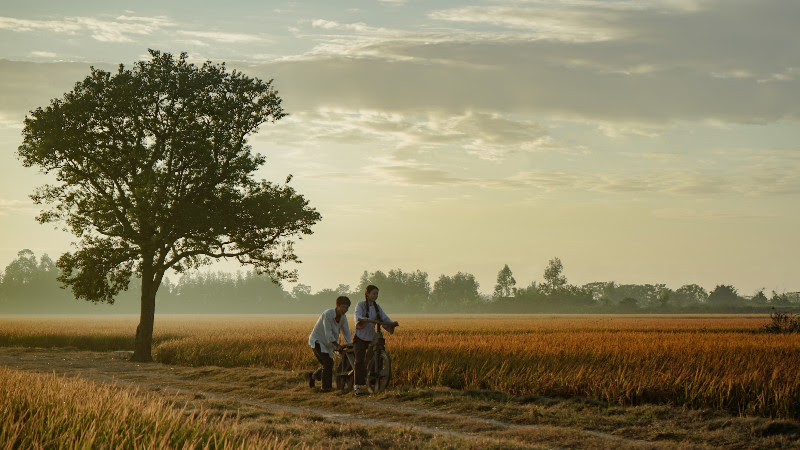
In looking back at life, and films, sometimes a simple, efficient statement truly does say it best. We can all be fooled by being prisoners of the moment. Human beings are often, for better or worse, emotional creatures that are ruled by our hearts. The problem with this, sometimes, is we are unable to see other possible explanations with our head once our heart has decided. How many times have any of us said, or thought, “Logically, I know…”? It can be difficult to recover from this, to teach ourselves that the story we have told is at best, incomplete, and at worst, completely false.
In Hongchun Lan’s film, Dear You, there is a truth shown at the beginning of the film that slowly unravels over the two hour runtime. The film opens in present day China, where Iap Sok-jiu (Wu Shaoqing), affectionately called ‘Ama’ by her grandchildren, is celebrating her 87th birthday. At the same time, her grandson, Hiau-ui (Zheng Runqi), who is in deep debt and decides to travel to Thailand to find his grandfather, who abandoned their family. His plan is to find a way to have him pay off his debts as money owed for time lost with his family. This is the accepted truth. Ten Bhakseng (Wang Yantong) fled when he was conscripted into the army, made his way in Thailand, found another wife, and fathered children. This is known because of a picture sent to Ama without a note of explanation. Understandably, she assumes he will never return and sets herself to her new life.
Hiau-ui, on arriving in Thailand, quickly finds out that not only did his grandfather not have a great deal of money (despite schools being named in his honor), but he also died many years ago. This, of course, ruins his plans, but it does open up the story to reveal itself in flashback. The script –from Hongchun Lan, Leng Yang, Xuanxuan Zheng, and Liyun Zhu – is structured in such a way that it allows an almost leisurely pace, despite some high drama. The naturalistic performances, paired with an impressive eye for detail in the recreation of these times and places, makes it nearly impossible to not be taken with the story surrounding it. Most especially the relationship between Bhakseng and Nam-ki (Li Sitong) stands out as truly impressive.
Their interactions, at first, have the highest amount of conflict and drama, but it never ends up exactly as one would expect. Plus, their distinct acting styles play as foils for one another. Bhakseng is brash and impatient, while Nam-ki is shrewd and patient. Li Sitong, especially, has a mastery of the material that carries the film in moments that could feel slow or missing connective material. If anything, these two almost make you wish that the entire film was about their back-and-forth. But Dear You is much larger and deeper than one relationship. At its essence, it focuses on the painfully slow passage of time and the bonds we form, even with strangers over great distance.

There are certainly minor characters that feel a bit standard or wasted, but that mostly serves to remind us of the work that our leads are engaged in. The film makes great use of the history of ‘Qiaopi.’ This was a practice in which Chinese people who were living abroad would send money home to support family and friends. They would send money, paired with a letter in a single envelope. These letters, which Bhakseng was sending to his wife, were the source of not only financial assistance, but great romance. Smartly, despite his reported betrayal, we, along with Iap Sok-jiu, are left swooning at his words. So much so, that it is hard to believe and understand what he did.
Dear You is a time and world spanning journey that, despite a few detours that affect the pace, is well worth traveling. It is a beautiful lesson in the fact that, despite what we think we know, things can change. We do not get to know every piece of the truth, and it is important to live a good life, even if we feel betrayed. It is because of these feelings, not despite them, that we should continue moving forward and helping others. Indeed, life can sometimes be sour. But in a long enough timeline, our life’s timeline, it can become sweet, if we search.