


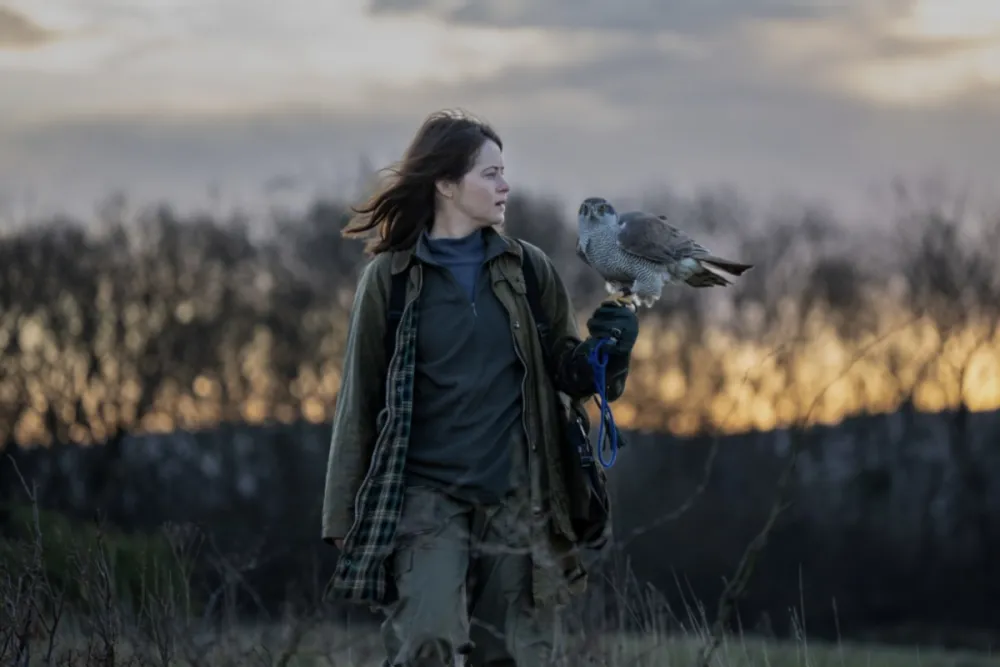
Director Philippa Lowthorpe and writer Emma Donoghue adapt Helen Macdonald’s 2014 award-winning genre-crossing memoir, H is for Hawk, for the screen with Claire Foy starring as Helen who comes undone after the death of her* beloved father, photojournalist Alisdair Macdonald (Brendan Gleeson) in 2007. H is for Hawk charts a year of Helen’s life where she gradually abandons academia and her fellowship at Jesus College, Cambridge University and becomes obsessed with her former profession, falconry, after buying a goshawk to train and hunt with.
Lowthorpe and Donoghue place their faith in Foy to give the audience a Helen they can understand without the lyrical language and authorial voice of Macdonald’s extraordinary book; instead relying on her performance and her interactions with “Mabel” the goshawk (played by two goshawks) which takes her out of the “human” sphere and into days of being wild.
Nadine Whitney spoke to Claire about her performance, trusting Helen’s vision, and how mental health and grief remain hidden topics too often.
Nadine Whitney: Claire, your depiction of clinical depression felt extremely raw in the film. How important is it to you to have honesty about mental health shown in the arts? Also, what did it take to feel like you were inhabiting Helen’s world?
Claire Foy: I think there should be honesty about it. I feel like we have an obligation and a kind of responsibility to be showing all different aspects of our lives in the most truthful way possible, and whilst also making wonderful bits of escapism and joy. I feel like we’ve got both kind of things. My feeling is if you’re going to show mental health struggles you’ve got to do it well and accurately because otherwise it diminishes the experience of millions and millions and millions of people.
It’s a very difficult thing to approach depicting mental health, because so often the struggle is internal and so often that the pain is internal. And that’s sort of a problem with clinical depression and anxiety and any sort of disorder is that from the outside, other people are often not able to see what turmoil people are in. It would be great if people had a little bit more awareness of that. And also, the awareness of it can seem like you’re doing quite well and you’re continuing and “Everything’s fine” because you’ve got a family and a house and a car and what is there to be worried about and all those sorts of things. I felt a huge weight of responsibility for that. Just also, because the way that Helen writes it is to me to be very, very accurate.
I was concerned that that’s not a particularly cinematic experience to watch. And so, it was a bit of a battle to figure out how to portray that. I think Helen’s an incredibly brave person. I don’t think they would admit that about themselves or think that they were. But I think it takes a huge amount of bravery to do things in such extremes. At such extreme levels.
I think that the love that Helen experienced for their father was indicative in the descent towards Mabel and how far they were able to kind of absorb themself into this wild creature. There’s a capacity to that which you think was quite self-harming. But I sort of find it really inspiring in a way to watch people go to the extremes of the human experience. And, and I really, I really felt such an admiration for her/them in the story that ability to totally absorb the self in that way. I don’t think there’s any cowardice. Because there’s no right or wrong way of doing it (grieving and dealing with mental health issues). I just felt such an affinity with that character for that reason. Helen’s kind of courage and bravery. It was an intimate experience that I hope could in any way help people to recognize whether someone around them, or they themselves, are going through the very acute experience of grief and to maybe be a little bit more aware that people are suffering all the time. It could be a day; it could be six months. It could be 12 years. Sometimes it never goes.
I think that we could just ask each other more about their mental wellbeing: “How are you? How did you deal with that?” And the answer might be, “Not very well, or I’m still not.” To ensure it is not a silent journey for people. It would be much better if it was one that we were all able to, like, take part in.
I think the relationship that Helen has with the goshawk is so unique. And Helen talks about it a lot in the book that. That we live lives as human beings with an absence of wildness. You know, we insulate ourselves from the reality of the world that we live in. And, you know, and suddenly you have this prehistoric wild animal in your house. There’s no real way of protecting. You know, you’re. That becomes your main focus and your main. Not obsession, but kind of like drive.
Reading Helen’s memoir, I had such huge admiration for what their father gave her. You know, the love of nature and the feeling of teaching them how to live in the world and how to engage in the world in such a special way because their father had so many vast interests and really took them along with them on the journey and, And a really close relationship. And that’s what I think the film’s really beautiful at, is. Is showing a positive parental relationship, which I don’t think you see often.
Helen addresses in the film and also in the memoir that the relationship with Mabel is very much about trying to remove her own humanity. Because being a human is what’s hurting her. Having feelings and connections and love is what’s damaging her. Because if she was a hawk who could soar up in the sky and look at it from a distance and have no emotional connection to anything that’s on the ground beneath them, she wouldn’t have to suffer and feel pain.
It’s a cerebral way of thinking about grief. But I do also think that’s indicative of Helen’s approach to it, which was to focus on something so totally and for it to overwhelm her.
Helen didn’t want to feel it and she didn’t want to have to. So, I think that that’s not dealing with the trauma at all, and that’s not helping you work through trauma either. And I think that really, you know, in my performance or in my mind, I think that the doing the eulogy at her father’s funeral becomes a moment of knowing you have to begin again, like, you have to start again. And I think that’s the beginning of a very, very long journey. But I don’t think you necessarily watch that journey in the film. I think you watch the descent, but I don’t think you necessarily watch the rebuilding.
I think it was a unique challenge. It was both really emotionally demanding and in a very, very specific way. It’s a very particular story of grief which isn’t necessarily what you know: which isn’t a cliche and also is quite raw. I found that to be quite terrifying but a really interesting kind of thing for me just purely as an actor to try and technically trying to get my head around and just the like the magnetic quality that Helen’s memoir has and Helen as a person has. I think, the sort of vulnerability and honesty that they showed in writing is very rare. I have huge respect for anybody who’s able to do that. And so, I knew it would take vulnerability of me to be able to portray it. I’d have to be that honest and open and not really try and hide from it.
*Helen Macdonald is non-binary and uses they/them pronouns, but in the film feminine pronouns are used.