



Australian actor Jacob Elordi gives a magnificent performance as Frankenstein’s creature in Guillermo Del Toro’s Frankenstein. Elordi is towering and touching as a new man whose creator, Victor Frankenstein (Oscar Isaac), despises, but later finds those who treat him with kindness in an unforgiving world.
Nadine Whitney had the opportunity to speak with Jacob about his process and what the creature has taught him.
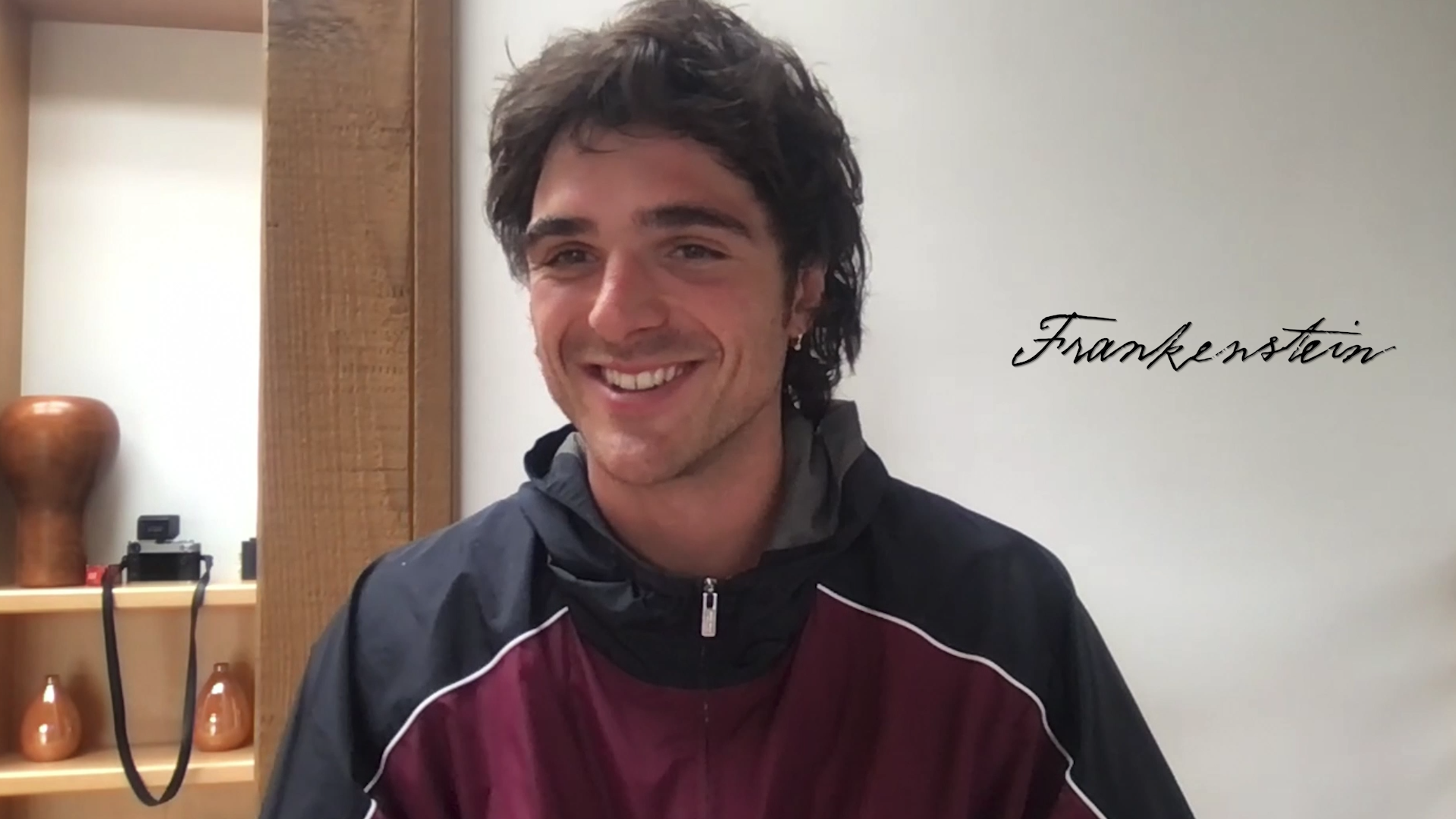
Nadine Whitney: Jacob, your physicality as the creature, and I like to call you the creation in this because I don’t think you’re even a creature. You’re too lovely to be called a monster of any kind. Your innate physicality and your way of moving is incredibly convincing as somebody who is new to this world but also has the remnants of a past world. Can you tell me about building up that physicality?
Jacob Elordi: Yeah. I only had about four weeks when I found out I was doing the movie. So, everything was condensed in this sort of pressure cooker. So, I don’t have the most tangible descriptive answer. It’s always gonna sound hoity toity, but it really felt like I was engaged in an artistic process that I’ve been cultivating since I first saw Pan’s Labyrinth when I was 14.
It felt like just opening. The idea of putting a mask on and going behind it gave me the freedom to sort of open myself up, really, and put my whole sort of life experience on screen. And because he’s the first man, his preconsciousness, the character itself gave me so much space to explore myself.
And so, Guillermo said this wonderful thing throughout this where he said the film is a fusion of his biography and Mary Shelley’s biography. And I do think that I bought into the physicality the idea of suffering, the question of why am I here? All of these things. I tried to say something physically when he’s pre-vocal, before he speaks. Like Guillermo says, with a great deal of thought and then there is like a tightrope act to it, because you can go too far into a caricature or something. So, it was balancing it and monitoring it and makings sure that it was deliberate.
Every jerk of each individual finger had a reason behind it. It wasn’t just a movement, as there’s a thought that’s not quite going through, or not quite delivering the way it needs to deliver. You know? All the little things and bits and pieces.
You don’t have to look too far into the world or into yourself, I think, to find great pain. I think we exist in cahoots with pain.
So, for me, it was just about the film and the role. And Guillermo’s approach to it gave me the opportunity to be as curious as I wanted to be about that pain and about suffering. And it allowed me to have the Milton Paradise Lost question. Why? Why am I here? Why did you make me? And I was given the opportunity to actually ask this kind of father. I got to explore that in Guillermo’s art.
The more I talk about it, the more I look back on it, the more beautiful the experience is. I’m understanding more and more things the more I answer these questions [about the creature]. It has been interesting for me.