After a flirtatious meeting with Miranda Jeffries (Mary Stuart Masterson) at Yale, Alex Finch (Robert Downey Jr.) remembers his past life as her late father, Louie Jeffries (Christopher McDonald). Alex renews his romance with the widowed Corinne (Cybill Shepherd), who has continued to idealize Louie for twenty-three years despite the love and support of Louie’s best friend Phillip Train (Ryan O’Neal). Phillip thinks Alex is an impostor, Alex must put off Miranda’s advances, and Corinne tries to explain to her therapist that she’s finally met someone – her dead husband in a new body.
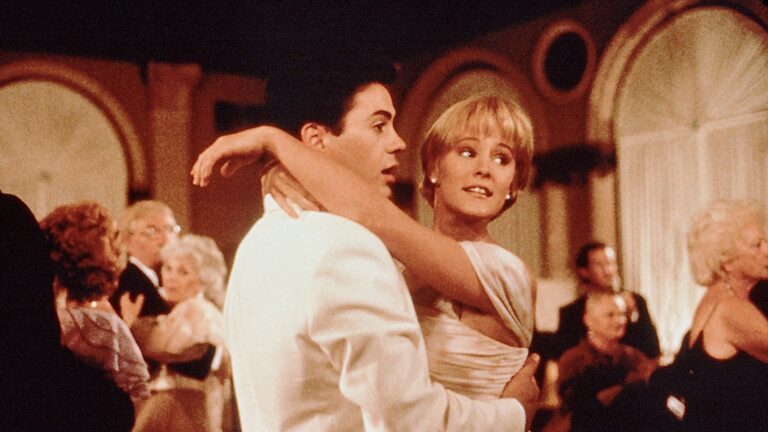
Emile Ardolino (Dirty Dancing) directs the 1989 crisscrossing romantic comedy Chances Are with wedded bliss, white lights, clouds, and humorous mistakes at the pearly gates leading to reincarnation, self-aware awkwardness, and multiple love triangles. Rather than today’s scandalous relations or laugh out loud juvenile gags; the preposterous framework is upfront; balanced by pleasant academia, newsrooms, and museums. The witty dialogue and ensemble chemistry carry the winks and perfectly timed chuckles as coincidental meetings and feelings that they have met before begat soft focus memories, familiar mannerisms, surprise knowledge, and bemusing realizations. A visit to the metaphysical shop provides kooky psychics who explain why the same souls circle each other, and Chances Are shrewdly uses its punchlines amid deeper concepts, underlying grief, anger, and sadness. Why should one care about a past life when the current one is such a struggle? Why open old wounds and make it harder to move on in the present? Chances Are is well filmed with choice zooms and up close shots accenting foreground actions and background asides during the wooing of wealthy donors at the exhibit and zany knock ’em dead dance sequences. However, the camera also knows when to stay still as the pillow fights and bedroom surprises escalate to kisses and switch-a-roos. Instead of weirdness, the heartwarming whirlwind only lasts a few days, and the well paced Chances Are doesn’t overstay its welcome. Corrupt judges, investigative reporters, and museum in peril clues bookend the revelations, bumps on the head, and weddings as Chances Are comes full circle.
Widowed but beautiful curator Cybill Shepherd (Moonlighting) has kept the memory of her deceased husband alive with his picture by the bed, in the car, and the refrigerator. She bakes him birthday cakes despite her therapist’s suggestion that she stop perpetuating this fantasy. Although Corinne is initially suspicious of Alex, a few secrets and memories prove that he is Louie – leaving her discombobulated, wearing odd shoes, and stripping down to her satin lingerie. She tells her therapist she’s ripe and ready to find love again, but can it really be with the twenty-two year old reincarnation of her dead husband? Christopher McDonald (Quiz Show) only appears as the deceased Louie early, but his ball of fire is an omnipresent character throughout Chances Are in flashes and photos – that is until Corinne is finally ready to let him go.
Of course, Corinne doesn’t approve of her daughter’s missing link boyfriends. She wants Mary Stuart Masterston’s (Some Kind of Wonderful) interning lawyer Miranda to find the perfect man, someone who meets her idealized version of Louie. Instead, Miranda encourages the late Ryan O’Neal (Paper Moon) as torch carrying Phillip to finally make his move on Corinne. Phillip says they feel like a family, just without a marriage or sex, and we want him to fight for Corinne as she and Alex grow closer. Robert Downey Jr.’s (Oppenheimer) likable, aloof Alex doesn’t initially know he’s the reincarnated Louie and woos Miranda when not living in his car. After failing to get a job at The Washington Post despite his clever delivery boy con to gain entry, Phillip takes him under his wing and sparks the past life flashbacks. Alex feels at home immediately and tries to tell Corinne the truth while fending off Miranda, and Downey perfectly balances the humor and seriousness within the same scene. Alex knows he has to make things right whether he is Louie or not, and this remains one of my favorite Downey performances.
The prerequisite Johnny Mathis staples accent Maurice Starr’s (Lawrence of Arabia) lovely score – excellent melodies that know how to be serious or bemusing without being intrusive – and the Oscar nominated power ballad duet “After All” by Cher and Peter Cetera tops off the eighties feel good sappy. Diegetic piano playing also confirms the character truths, letting the compelling romantic drama unfold in scene without any need for over-editing or post-production embellishment. “Forever Young” Rod Stewart pop cues likewise punctuate cinematic moments, and the stirring lyrics are more pleasing than our contemporary braaam braaam intense. Rather than the decade’s hip neon and excess, however, Chances Are looks classy with billowy sleeves, wispy frocks, ladies dress suits, hats, veils, white gloves, pearls, and Jackie O diamonds capturing the sixties reincarnation nostalgia. Smithsonian behind the scenes, Washington D.C. locales, and a fine, upscale townhouse invoke an elite, Camelot mood. Sure, the pink and white décor everywhere with prim floral wallpaper and hefty furniture is grandma sentimental, but the uncluttered, room to maneuver, bright interiors also feel refreshing compared to our 21st century onscreen dim. A vintage convertible Beetle, roll up car windows, big radios, horseshoe phones, and family picture frames anchor the fanciful what ifs, and for a $16 million budget Chances Are still looks quite good.
Instead of focusing on the fantastical bells and whistles, the romantic farce here remains charming thanks to the focused humor, ensemble interplay, mature dialogue, and sophisticated chemistry. The well done eighties meets sixties nostalgia doesn’t feel dated, and Chances Are gets better with repeat viewings. Today’s audience probably never doubts that all the eighties twee will work out in the end, but Chances Are is so delightful in getting there.