



The group of films by Joel and Ethan Coen, the Coen brothers, between 1987’s Raising Arizona and 1996’s Fargo are eclectic period pieces that only these two could come up with. The first is Miller’s Crossing, which masquerades as a straight forward gangster film, but is far more intricate. The third is The Hudsucker Proxy, which is a classic hapless Coen protagonist who finds himself in over his head as he invents a wildly popular toy, “you know… for kids.” The middle feature of these three is Barton Fink.
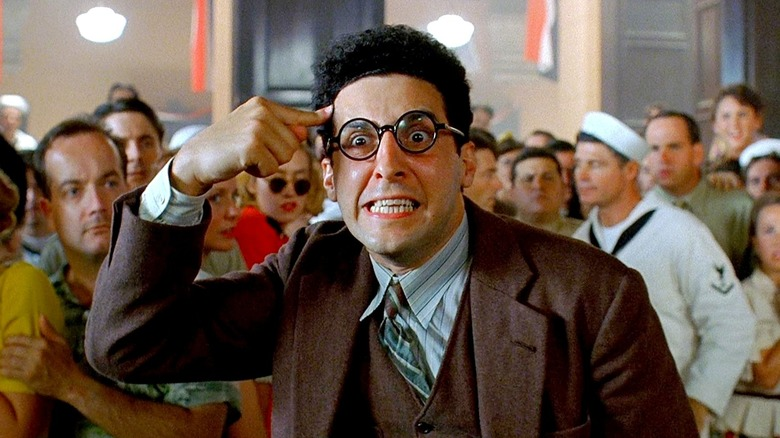
To describe what Barton Fink is really about is like trying to braid cooked spaghetti noodles. You get a few strands going, but there’s going to be another that slips your grasp and you have to start over. On paper, the film is very simple. A writer, Barton Fink (John Turturro) is simultaneously experiencing writer’s block and imposter syndrome as he attempts to write a screenplay.
Barton, like many screen depictions of a writer, has lofty ambitions. His are about the upheaval of theater to take the stories away from the perspective of wealth and privilege and bring it down to the common man. It’s his constant refrain that his work is meant to be viewed, enjoyed, and judged only by the people who live it every day. Yet, every common man he meets he talks down to as if he is their demi-god, meant to be the only vessel who can bring meaning to their lives. This is in stark contrast to the flighty wealthy people in New York and the motor-mouthed powerful people in L.A. who don’t listen or care what he’s about.
In his most intimate encounter, Barton is taken in by the idea of Charlie Meadows (John Goodman). Charlie, who is known by another name late in the film, is an avatar of the common man Barton purports to be the champion of. He sells insurance and “boy, [he] can tell you some stories.” He becomes Barton’s sounding board, confidant, accomplice, and eventually his inspiration. Barton’s instinct is to overpower Charlie who he sees as a sort of hayseed. Though Charlie, while biding his time, is able to get Barton to give into a little temptation. He gives Barton an offer without Barton realizing it. Charlie is emotionally overpowering him and breaking him down. Charlie is suddenly a friend Barton didn’t know he needed. Yet, it may also be that Charlie is the devil or some other supernatural force.
Is that lofty to equate Charlie with supreme evil? Not necessarily in the context of who we see Charlie become. Late in the film Charlie “ventilates” Barton’s captors and flames erupt from the walls of the Hotel Earle. Charlie screams that he’ll “show you the life of the mind” and venerates the man who is the equivalent of pure evil in human form. With these actions and the ones Charlie admits to in a speech to Barton as the flames grow, we can’t help but contemplate every action, motion and deed of Charlie and question the reality and sanity of Barton.
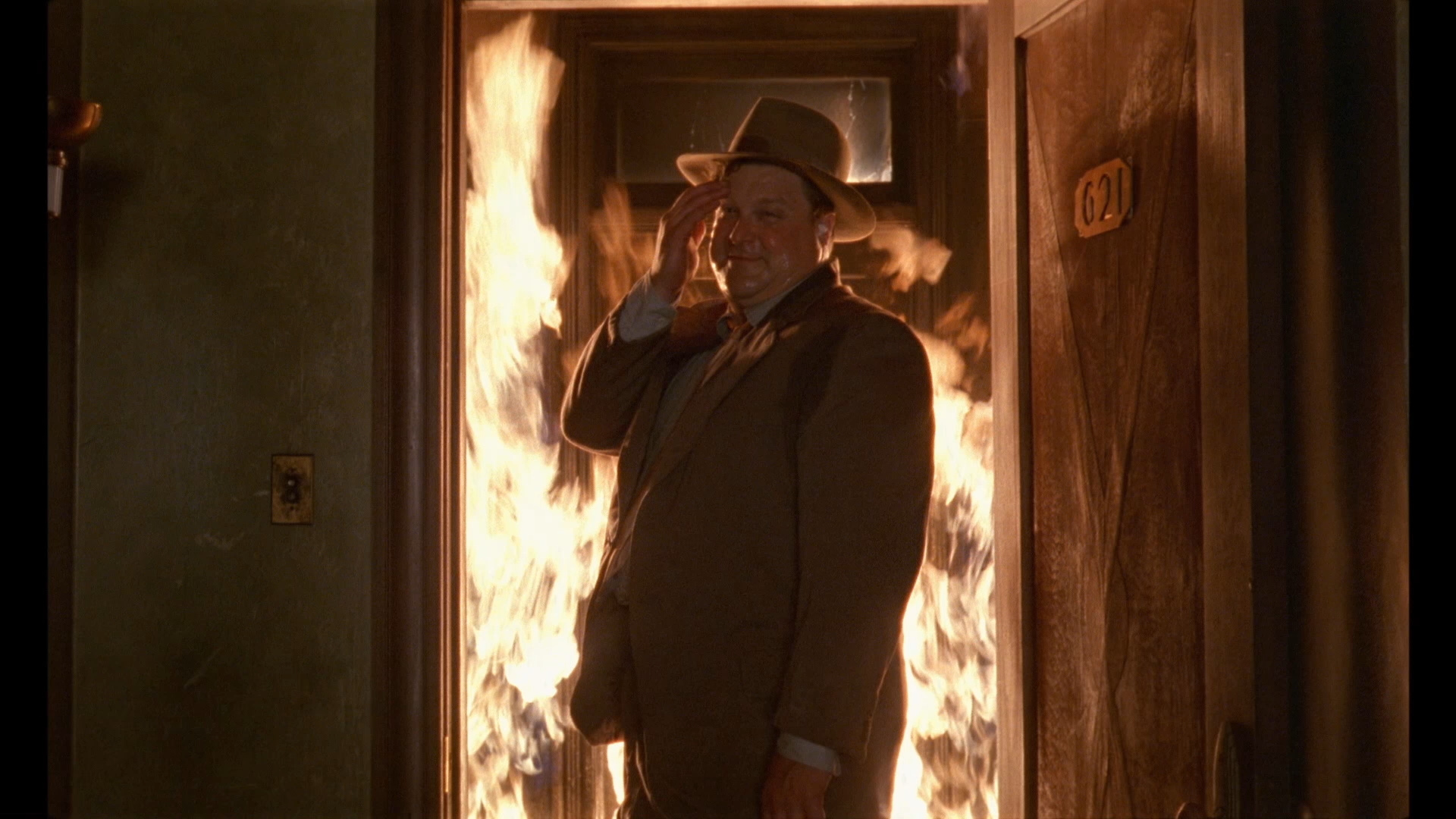
This is the brilliance of John Goodman’s performance. Goodman is a staple of many recurring actors the Coen brothers employ. He’s always a stand out, but more than anything, Barton Fink is a showcase of his immense talent, both physical and emotional. From his first scene, you can see the eventual truth of Charlie on Goodman’s face. There’s a split second as Charlie makes his decision on how he wants to play Barton. The look Charlie gives to Barton when he’s trying to get him to learn the basics of wrestling is all at once manic, enticing, and a threat. Goodman imbues his performance with little moments that show Charlie is much, much more than what he appears.
Barton Fink is one of the Coen brothers most enigmatic films. It has their signature wit, weirdness, and unpredictability wrapped into every frame of it. The film rewards the careful viewer and its many themes and metaphors are up for interpretation. Barton Fink isn’t a film for the casual fan, but for those that want to experience a nagging feeling like an unseen mosquito buzzing around a room that you aren’t even sure is there. Then, just as you forget about the mosquito, you see it and it changes your entire perception of reality.