


Directors: Zachary Wigon
Writer: Virginia Feito
Stars: Maika Monroe, Jason Isaacs, Thomasin McKenzie
Synopsis: In 1858, an eccentric young governess, Winifred Notty, arrives at the remote gothic manor Ensor House. As Winifred assimilates, staff begin to inexplicably disappear, and the owners wonder if something is amiss about this new governess.
There is something deliciously wicked about the premise of Victorian Psycho, a film that practically announces its intentions before the opening credits have even finished rolling. Set against the backdrop of Victorian England, Zachary Wigon’s latest follows Winifred Notty (Maika Monroe), an eccentric governess who arrives at a wealthy estate to look after two children, only for the household to discover that their newest employee might be considerably more dangerous than anyone could have anticipated. It’s an entertaining setup, one that leaves plenty of room for twisted humor, psychological horror, and some wonderfully macabre absurdity. Unfortunately, while Victorian Psycho has plenty going for it, particularly in its performances and visual presentation, it never quite reaches the heights its premise suggests it could.
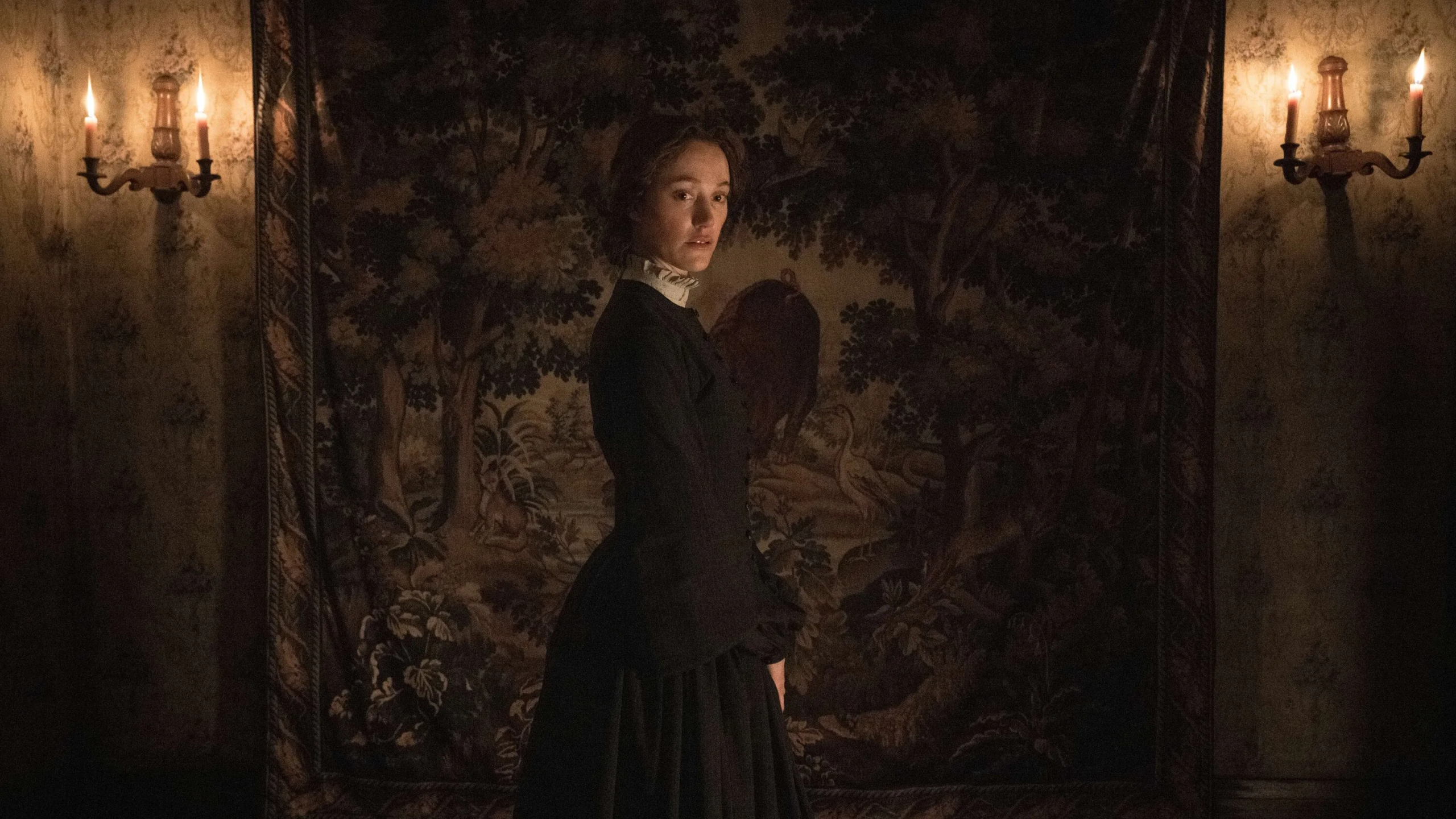
At the center of it all is Maika Monroe, delivering what is arguably the best performance of her career. Having established herself as one of the most recognizable faces in contemporary horror, Monroe gets an opportunity to step outside the familiar territory of the final girl and embrace something considerably more unhinged. As Winifred, she’s wonderfully strange, unpredictable, and occasionally downright hilarious. There’s a peculiar rhythm to her performance, from her mannerisms and unsettling expressions to the increasingly bizarre behavior that makes the character so fascinating to watch. Monroe completely disappears into the role, bringing an almost theatrical eccentricity to Winifred without losing the unsettling menace lurking beneath the surface. It’s a performance that demands attention every time she’s on screen, and even when the screenplay struggles to find its footing, Monroe never misses a beat. Quite frankly, she’s the film’s greatest accomplishment.
Visually, there’s also quite a bit to appreciate. Wigon brings an interesting sense of personality to the production, using unconventional camera movements, framing, and an increasingly disorienting visual language to complement Winifred’s deteriorating mental state. There’s a playful quality to the cinematography that works particularly well when the film leans into its more absurd moments. The production design also deserves some credit, creating an environment that feels appropriately suffocating, with the estate’s seemingly respectable exterior concealing something considerably uglier underneath. Ariel Marx’s score further enhances the atmosphere, adding an uncomfortable edge to moments that might otherwise feel almost too ridiculous to take seriously.
And that’s where things get a little complicated. Victorian Psycho seems caught between wanting to be a genuinely disturbing psychological horror film and a darkly comedic satire of Victorian society. Neither direction is inherently a problem, and there’s certainly an interesting film to be made by combining the two. However, the execution feels inconsistent. Some of the humor lands beautifully, while other moments struggle to find the right balance between being genuinely unsettling and simply ridiculous. The tonal shifts can be particularly distracting, making it difficult to determine exactly what kind of experience the film wants to deliver.
There’s also an interesting commentary buried within its narrative about class, gender, and the expectations placed upon women in a society built around wealth and social hierarchy. The Pounds family is hardly a representation of respectable Victorian aristocracy, and the treatment of those beneath them reveals plenty about the ugliness hiding behind their privileged existence. The film has something worthwhile to say about the relationship between those who hold power and those expected to quietly serve them. Unfortunately, these ideas rarely develop beyond their initial observations. There’s something worth unpacking, but the screenplay doesn’t always seem interested in digging particularly deep.
The supporting cast does its best to keep things entertaining, with Ruth Wilson and Jason Isaacs bringing plenty of personality to their respective roles. Thomasin McKenzie is another welcome addition, providing a different kind of energy that contrasts nicely with Monroe’s increasingly chaotic presence. There’s an interesting dynamic between the characters, although some of these relationships could have benefited from more development rather than relying so heavily on Winifred’s narration to move things along. At times, it feels as though the screenplay is explaining things that would have been considerably more effective if left to unfold naturally.
The final act also struggles to deliver the impact the film has been building toward. Without getting into spoiler territory, the eventual revelations are interesting enough, and there’s certainly an attempt to give the story a little more substance than its initial premise might suggest. However, the payoff doesn’t quite land with the weight it should. Considering how much the film builds toward its increasingly chaotic conclusion, the ending feels a little restrained, particularly when there’s so much potential for something considerably more daring.
Ultimately, Victorian Psycho is an entertaining but somewhat frustrating experience. There’s a wonderfully twisted horror-comedy hiding in here, elevated considerably by Monroe’s career-best performance and Wigon’s distinctive visual approach. Between its striking aesthetic, wicked sense of humor, and moments of genuine horror, there’s plenty to appreciate. The problem is that the screenplay never quite matches the ambition of everything happening around it. Its exploration of madness, class, and the expectations placed upon women feels underdeveloped, leaving a more interesting film buried somewhere beneath the surface. Still, Monroe makes the journey worthwhile, delivering a performance that deserves to be seen. A wickedly watchable little nightmare, even if it never quite becomes the beast it wants to be.