



Director: Miiku Sakanishi
Writer: Miiku Sakanishi
Stars: Tasuku Emoto, Moeka Hoshi, Yû Kashii
Synopsis: After his father-in-law breaks his leg, Yuta travels to a rural town in Kyushu to lend a hand at the photo studio he runs in this beautiful meditation on memory, time, and the power of images to connect people and family.
The opening of Memorizu, the debut feature from Miiku Sakanishi, takes the form of a static shot looking out the window of a ferry headed towards Kyushu. After a few seconds, the first of many cuts arrives, depicting a nearly identical image. The wide expanse of crashing waves and a foggy horizon remains; the only difference in each image is the random ferry passenger sitting just within frame next to the window. With each new cut, Sakanishi captures a variety of reactions: some look out into the great void, while others take photos. Others ignore the view entirely while they tinker away on their phone or laptop. This window is open to all passersby on the ship, and through this introduction, audiences of the film are instantly pulled into the role of an onlooker. We all see the same picture framed within the large window as we look out into the sea. But just because everybody is seeing the same thing doesn’t necessarily mean everybody is conjuring the same thoughts from that specific experience. Therein lies the meditative nature of Memorizu, a slice-of-life film which examines how we engage with the constant flow of time in relation to the people and places right in front of us. It won’t be the last time Sakanishi crafts this type of image.
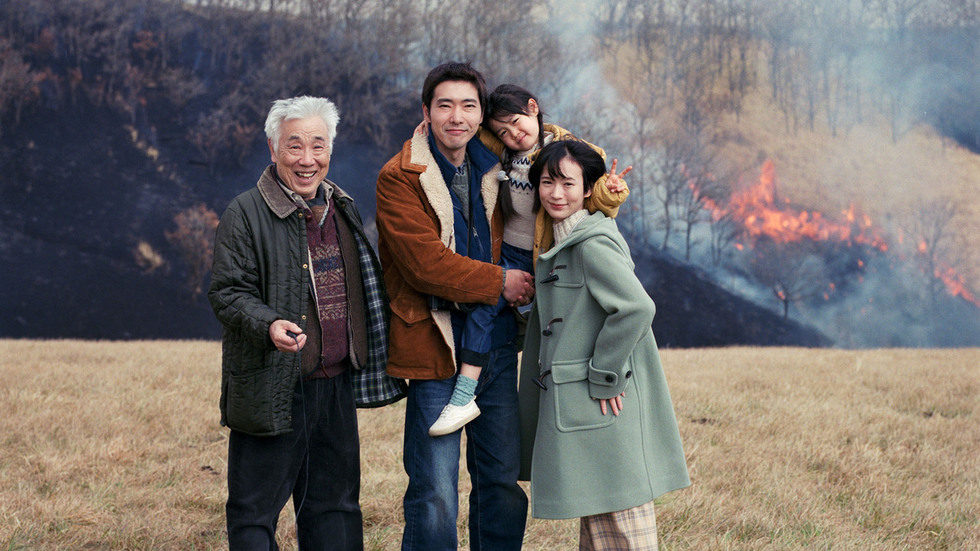
The frame-within-a-frame cinematography of this film becomes quite the repeated motif across its contemplative runtime. Sakanishi frequently relies on picturesque landscape shots featuring his central characters looking outwards, facing away from the camera. More often than not, these stagnant images feature background extras or production design choices which lend to the notion of external stories being witnessed devoid of context. As audiences and characters alike ponder what exactly the circumstances they’re witnessing are, it’s a reminder of stories existing beyond our own direct lives. Even still, they can undeniably have an effect on us in some way, shape, or form. This connective tissue between a person and a particular moment can be directly linked to how Sakanishi begins his film after what would typically be the inciting incident of a story.
We come to learn that Makoto (Issey Ogata) has fractured his leg. Unable to run his photo studio alone while going through a lengthy recovery period, son-in-law Yuta (Tasuku Emoto) travels from Tokyo to help out. This simple set-up is slowly revealed over time. While the table-setting of Memorizu can feel a bit drawn-out, it’s ultimately in service of the central themes running through the remainder of the film. Once Yuta and Makoto are working alongside one another, Memorizu begins to take on a reflective life of its own. With Makoto essentially being forced to slow down due to his injury and age, Yuta takes long walks and brings a nervous, yet exuberant, energy to the seemingly quiet, relaxed photography shop. Perhaps the film’s greatest narrative strength is the relationship between Yuta and Makoto; there’s few comedy set-ups more effective than a flustered young individual trying their best to impress a gruff in-law. Although Memorizu never veers into the territory of full comedy, it contains several moments worthy of chuckles, all of which do a great job of endearing the audience to these characters. In doing so, Sakanishi slyly imbues this story with the fleeting notion of memories being made while others are actively being lost.
Concurrently depicted alongside Yuta’s trip to Kyushu are his wife, Yuki (Moeka Hoshi), and young daughter, Hana, who remained in Tokyo. Their relationship is admittedly explored quite little in the film, leaving the scenes following Yuki and Hana to fall a bit flat. But there’s also something to be said about this lack of connection that’s baked into the text of the film. Sakanishi makes the primary form of contact between the couple largely take place via iPhone footage. Yuta will often pull his phone out to capture a photo or video of something that charmed him. It can be as innocuous as a sign post or something as visually striking as a woman biking down a path surrounded by massive fields enveloping the frame. Whenever Memorizu relies on this iPhone footage, many shots of which we see the characters actively capturing, it’s as if the audience too is watching these spontaneous moments with a sense of longing. It captures the feeling of noticing something that invokes the memory of a loved one quite wonderfully. There’s an aching quality permeating across all of Memorizu, due in large part to the cinematography. It’s a film which innately understands the power of capturing a specific image. More importantly, it’s a film that interrogates some of the many reasons as to why that power grabs hold of anybody with access to a camera. It’s quite fitting considering the film’s primary setting is that of Makoto’s photo studio.
With each new image captured by the characters either digitally or on film, these photos take on more than just the title of keepsake. They are moments frozen in time, specifically designed to remind us of somewhere, something, or someone. As cameras have become more ubiquitous in contemporary society, there’s something to be said about whether or not people have become conditioned to not allow a moment to exist solely outside the confines of a photo or video. Memorizu has a particularly great moment that comically criticizes exactly that notion. But it feels as if, almost pointedly, Memorizu avoids delving into that contemporary dilemma. Sakanishi appears far more interested in the distinct gift we have been granted: to be able to reflect on our memories through a physical, or digital, artifact. In a striking montage of sorts during the third act, we see specific moments captured on film having life breathed into them by way of harnessing memories that might have been otherwise lost. Our past is ultimately made up of the fleeting pieces of memories still held onto. The innate desire to crystallize moments through captured photography indicates just how badly we want to grasp whatever it is we still have left of something or someone. As time softens us all, we can take solace in the opportunities granted to us in order to reflect on a life lived with memories unearthed from the corners of our mind. Despite the methodical pace of Memorizu occasionally serving as a disconnect for its audience, its essential thesis remains everlastingly beautiful.
Memorizu celebrated its world premiere at the 2026 Tribeca Festival in the International Narrative Competition category.