


Director: Zack Snyder
Writer: Kurt Johnstad
Stars: Stuart Martin, Fra Fee, Jackie Kay
Synopsis: An ex-DEA agent searches South American mountains for his murdered diplomat siblings’ children, aided by a junkie photographer who saw the killers, confronting past demons as reality blurs in remote wilderness.
Is the camera an object of truth, or does it have the power to distort our conception of the world? This question lies at the heart of Zack Snyder’s long-gestating The Last Photograph, a project the director says has been in the works for almost twenty years, as he unveiled the film at the Toronto International Film Festival. Almost immediately after the screening, vitriolic responses from critics and audience members flooded social media, creating a strange disconnect as a Q&A was still underway with the director and cast, who were likely oblivious to the real-time reactions.
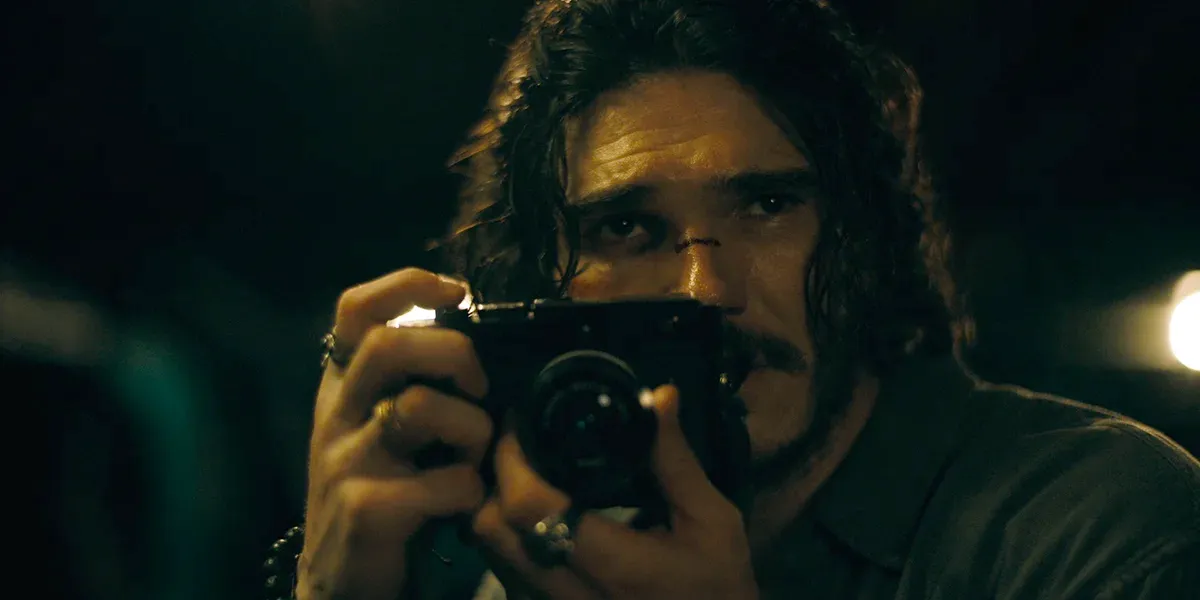
To be fair, The Last Photograph is Snyder’s clunkiest film. It presents many unwieldy ideas without actively developing them. Unlike his pre-director’s cut Rebel Moon diptych (or the theatrical cuts of Batman v. Superman: Dawn of Justice and Justice League), there’s no extended edition to further flesh out what’s on screen. The core relationship between Wallace (Fra Fee), a heroin-addicted war photographer who is still trying to numb himself to the horrors of the world, and Ethan Black (Stuart Martin), an ex-DEA agent who looks for his missing niece and nephew, also takes time to establish itself as thoughtful.
It’s also extremely violent. Snyder’s most violent film. Whereas he purposefully restrained himself within the studio system, the 60-year-old director no longer has any major studio to deal with and can finally deliver a vision at his most uncompromising. Perhaps that allowed him the freedom to go all in on violence and explicit sexual imagery, a shift that was most boldly perceived in Rebel Moon – Chapter One: Chalice of Blood. Audiences have to sit through endless sequences of torture, where women are brutally beaten, children are killed, and they are put in multiple harrowing situations that often feel excessive and gratuitous.
But is there a point to such senseless acts? The consensus across the John Bassett Theatre after its premiere might be, “No,” but it also offers an interesting treatise on our desensitized society, which no longer feels emotion when it sees real violence filtered through someone’s camera on a screen. Don’t get me wrong, The Last Photograph borders on exploitation, but one can’t say such torture is pointless when it’s mostly seen through the eyes of a disillusioned photographer observing a world where his subjective nightmares and the harsh nightmares of reality are blurred.
Butterflies recur visually as Wallace and Ethan travel across Colombia to find the missing children, in a story that owes a lot to John Ford’s The Searchers and Francis Ford Coppola’s Apocalypse Now. Of course, though, John Boorman’s Excalibur remains the ultimate reference for understanding Snyder’s visual gestures, as he continues to expand his conception of mythological artifacts through a disillusioned agent who will stop at nothing to find his niece. Bar none, the most thought-provoking sequence of the film occurs close to the end, where Ethan becomes the film’s myth, but, again, like all his ideas, doesn’t get expanded further than what is introduced.
It’s the most frustrating aspect of The Last Photograph, a movie that brims with enough thoughtful ideas to stimulate our minds, but doesn’t have the patience to develop any of them. The first forty minutes or so are dedicated entirely to “moody” storytelling, where Snyder presents images with tons of thematic resonance but rarely interiorizes the characters on parallel journeys that eventually coalesce into a spiritually charged arc that brings incredibly strong emotions to the forefront. It takes a while for those emotions to materialize, but once they do, it’s hard not to be swept away by Snyder’s knack for intensely arresting image-making, where each frame tells an intriguing story in its own right.
While smaller in scale than his superhero films or mythological epics, there’s a reason why Snyder is so far ahead of his contemporaries when crafting action, as small or as large as it can be. The gunfights of The Last Photograph rank high among some of the most emotive work of his career, even if the violence is at times horrific to look at. But the camera tells us things that our eyes cannot see, and the way in which Snyder, acting once again as his own cinematographer, points his device at senseless explosions or bodies being piled up, their faces shot, and bodies horribly mutilated. It’s a confronting experience to reckon with such violence, as the camera never ceases to capture these horrors, while never forgetting to highlight the beauty amid its desolation.
Is The Last Photograph an examination of Snyder’s own conception of images as he reaches a new stage in his life? One could absolutely interpret it this way, especially as he’s still continuing to be his own director of photography amid the flurry of negative comments Snyder has received since Army of the Dead. He doesn’t care, and likely never will, but his photography is actually a genuine improvement (or evolution) of his own craft. Snyder (mostly) ditches gratuitous slow-motion for an overabundance of soft-focus, which might be a deterrent if each frame didn’t feel so spiritually urgent. There’s a specific image of a horse attempting to cross a river that is fully embedded in my retina, and the entire flashback where Ethan attains total awareness ranks high in the pantheon of Snyder’s most striking images.
That’s why it’s so hard for me to entirely dismiss The Last Photograph. It’s not perfect, sure, but it contains enough of Snyder’s real humanism to overcome some of its most glaring flaws. To say the film is “racist” or “misogynist” is to completely miss what Snyder is actually saying about the images that he – and his photographer – capture. There might not be a salient point to be made about the violence itself, but the thing is: we’ve grown so numb to violence that it almost feels unimpressive when we actually see real acts of terror inflicted upon people when they appear on our screens. This isn’t an observation, but a fact. Snyder attempts to remind us of violence’s true horrific nature, as his photographer develops a strange fascination with beauty inside an environment that has lost all sense of hope.
In this case, Fra Fee delivers what is probably the most moving performance of his career, far more emotive than anything in the Rebel Moon franchise. He’s directed so wonderfully by Snyder, who seemingly sees a lot of himself in how Wallace perceives images. When you look back at Snyder’s oeuvre and begin with his first-ever major movie, Michael Jordan’s Playground, the fascination is seen loud and clear. That desire to create, to demonstrate that cinema still has the potential to move us and stun our souls, is still present almost thirty years later. Whenever I’m about to see a new Zack Snyder film, I always look back at one of the final scenes of his Michael Jordan video, where the NBA star dances in passionate glee to the music of Full Force. It’s possibly Snyder’s most exhilarating sequence before the grand finale of Man of Steel, because it reminds us what he can do with a camera, and how he sees the world through his own subjective lens.
The Last Photograph rekindles his relationship with an object he has complicated feelings about. He now needs to rethink what image-making should be, especially in an era that has lost the power to create frames that linger deep in our memories. It’s easy to reject a movie that tells us to look at cinema in a new way none of us are accustomed to, but it’s something Snyder enjoys doing. There’s doubt the movie will actively find distribution. It’s violent, deeply inaccessible, and confronts our ideals of what an image should achieve in ways I haven’t seen a filmmaker – let alone Snyder – do.
However, anyone with an open mind should probably give it a chance if it ever moves past the John Bassett Theatre. It probably won’t, but Snyder is showing no signs of stopping, as he’s set to helm a remake of John Carpenter’s Escape from New York shortly. Maybe this stint in fully independent, auteur-driven filmmaking has given him a new lease on why he chose to make movies and filter his own perception of the world around him, because, as he said while introducing the movies, he’s going to keep doing it until someone stops him. And even if someone dares stop him, he’s probably not going to…