


Director: Danny Boyle
Writer: James Graham
Stars: Jack O’Connell, Guy Pearce, Claire Foy
Synopsis: A group of misfits and visionaries had an idea for a new kind of news – one that would give the people what they want, and would change the face of the world we live in today.
Danny Boyle has cemented himself as one of the most ingenious filmmakers working today. So it feels like the perfectly ironic match made in heaven that he was chosen to create a biographical drama about Larry Lamb and Rupert Murdoch, the two people in charge of the downfall of the art of journalism. For large parts of Ink’s runtime, that proves to be an inspired choice, which makes Boyle’s egregious use of generative AI all the more baffling as he falls foul of the exact slop that he is tasked with portraying.
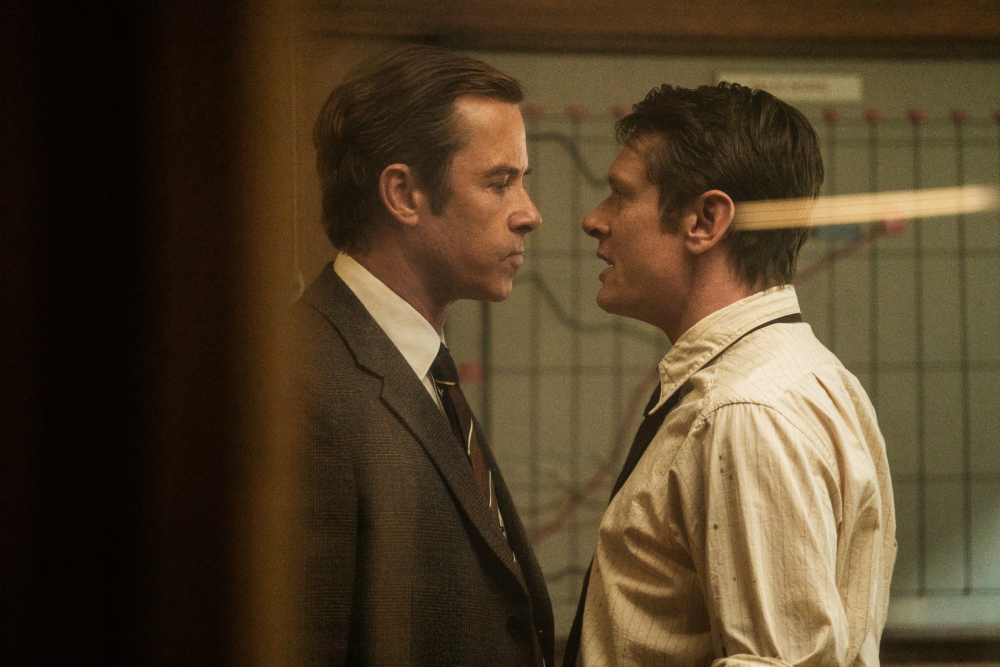
Set in 1969, Ink is based on the stage play of the same name and tells the true story of Rupert Murdoch’s (Guy Pearce) acquisition and transformation of The Sun, a failing tabloid that was the laughing stock of Fleet Street. In a bid to turn the fortunes of the paper around, Murdoch installs Larry Lamb (Jack O’Connell) as its new head honcho, encouraging him to do something bold and unconventional to attract a whole new audience of readers.
That sets in motion the now-infamous downfall of “real news” as Lamb assembles his team, headed up by Jules Davies (Claire Foy), who are dead set on achieving the highest possible sales figures no matter the cost. It’s at that very moment that they figure out they no longer have to feed readers the information they need and can instead focus on giving them what they want. Thus, the sex, violence, and at times outright lies that The Sun is infamous for were born.
For those expecting Rupert Murdoch’s story to take center stage, unfortunately, you’ll be slightly disappointed. Instead, the movie largely focuses on Larry Lamb and how he pioneered the trashy reporting that didn’t care for basic verification while becoming an early architect of the original clickbait headline. That’s shown to full effect with a brilliant montage featuring some of the most shocking examples that, as the film points out, The Sun clearly didn’t give Boyle permission to use. Within those thirty seconds, audiences get a sense of the sheer number of sensationalized headlines created to shift copies, with little concern for the lives they would go on to ruin.
In that regard, Boyle, alongside writer James Graham, captures just what an evil man Larry Lamb evidently was. Nothing would get between him and a story that would sell. It depicts him as a man willing to ruin the lives of those around him if it meant getting to the very top. That ruthlessness is captured superbly when Lamb goes against even those closest to him to publish stories that result in a crime that shocked a nation and led to mass walkouts at the paper.
For anyone who is aware of Rupert Murdoch, they will know he will stop at quite literally nothing to get what he wants. Whether that be involvement in phone-hacking scandals or using his publications to influence political voters, there’s seemingly no level he won’t stoop to. In that respect, Graham’s screenplay can feel somewhat generous in its portrayal of him. At times, it makes it seem like Murdoch cares about real stories and the consequences that could come from the reporting The Sun was putting out, which feels painfully ironic given his checkered history. Thankfully, even in these moments, the screenplay saves itself by showing that despite any moral objections Murdoch might have, he is willing to let virtually anything slide as long as the money keeps rolling in.
Boyle’s famous innovative filmmaking style is on full display throughout. The fantastic kinetic camerawork he is known for is here in abundance, with multiple shots likely to make for viral clips once the movie drops on Netflix. There are all the crazy close-ups and insanely inventive camera angles you would expect, making what could have felt like a routine biopic completely exhilarating. There are also these magical touches, with London made to look vibrant and colorful while the north of England is shown in black and white. It helps portray the drab nature and perceived difference between the two, particularly at that time. Boyle really is working at the very top of his game for almost the entire runtime.
That’s what makes the egregious use of generative AI all the more perplexing. Boyle has previously spoken about his refusal to work with real animals following a run-in with animal charities decades ago, so he uses AI to generate mice in the mailroom for his first infraction. It’s a shot that lasts a mere second, which begs the question of why it was included in the first place. The more bewildering use, though, and what is genuinely an eyesore, comes during the finale. When he could’ve simply used an actress to portray former Prime Minister Margaret Thatcher, he instead utilizes AI to generate her likeness and deliver one line. For most, it will go unnoticed, but for myself, as an eagle-eyed Brit, it quite frankly looked like flaming trash compared to the rest of the movie.
One thing that definitely isn’t up for debate, though, is the pitch-perfect casting of Jack O’Connell and Guy Pearce. O’Connell especially is coming off a career-high stretch that continues here. He begins by somehow getting audiences to root for him as he sets about contributing to the downfall of the news through his charm and charisma. But what is even more impressive is the way he’s able to transform into a whole other character at the snap of a finger. He becomes cold-hearted and utterly ruthless when it comes to taking down his rivals, delivering that transformation in a way that will send shivers up your spine.
Guy Pearce is just as compelling and, despite knowing what a terrible man Rupert Murdoch is, somehow gets you to feel somewhat bad for him at times. He has the necessary charisma that Murdoch must have possessed in his younger days to reach those positions of power and earn a seat at the table. Despite having a smaller role, Pearce is able to make every second he is on screen memorable. When the two are together, though, is where the film shines brightest, with Boyle allowing several scenes to breathe as the sharp dialogue and verbal jousts between them unfold.
Ink is undeniably entertaining and arguably even more than it should be given the subject matter it tackles. There’s enough here to give audiences nightmares about the state of journalism and the people who feed it to them, while also never telling them exactly how to feel. Boyle remains at the top of his game for the most part, despite his attempt to self-sabotage through unnecessary experimentation. One thing is for sure, though: Netflix is going to be very happy when it sees the inevitable streaming boost for this electrifying biopic.