


Director: Park Chan-wook
Writer: Park Chan-wook, Lee Kyoung-mi, Jahye Lee
Stars: Lee Byung-hun, Son Ye-jin, Park Hee-soon
Synopsis: After being unemployed for several years, a man devises a unique plan to secure a new job: eliminate his competition.
From Oldboy to Decision to Leave, Park Chan-wook is no stranger to telling stories that are, at once, incredibly engrossing and stylistically directed, as well as impactful in twisted, demented, or emotionally powerful ways. His works, even expanding to television in 2024 with HBO’s The Sympathizer, have often left a lasting impression on audiences, addressing real world, socio-political themes and commenting on aspects that continue to affect those around him, and bringing those into his projects. His latest effort, No Other Choice, is no exception.
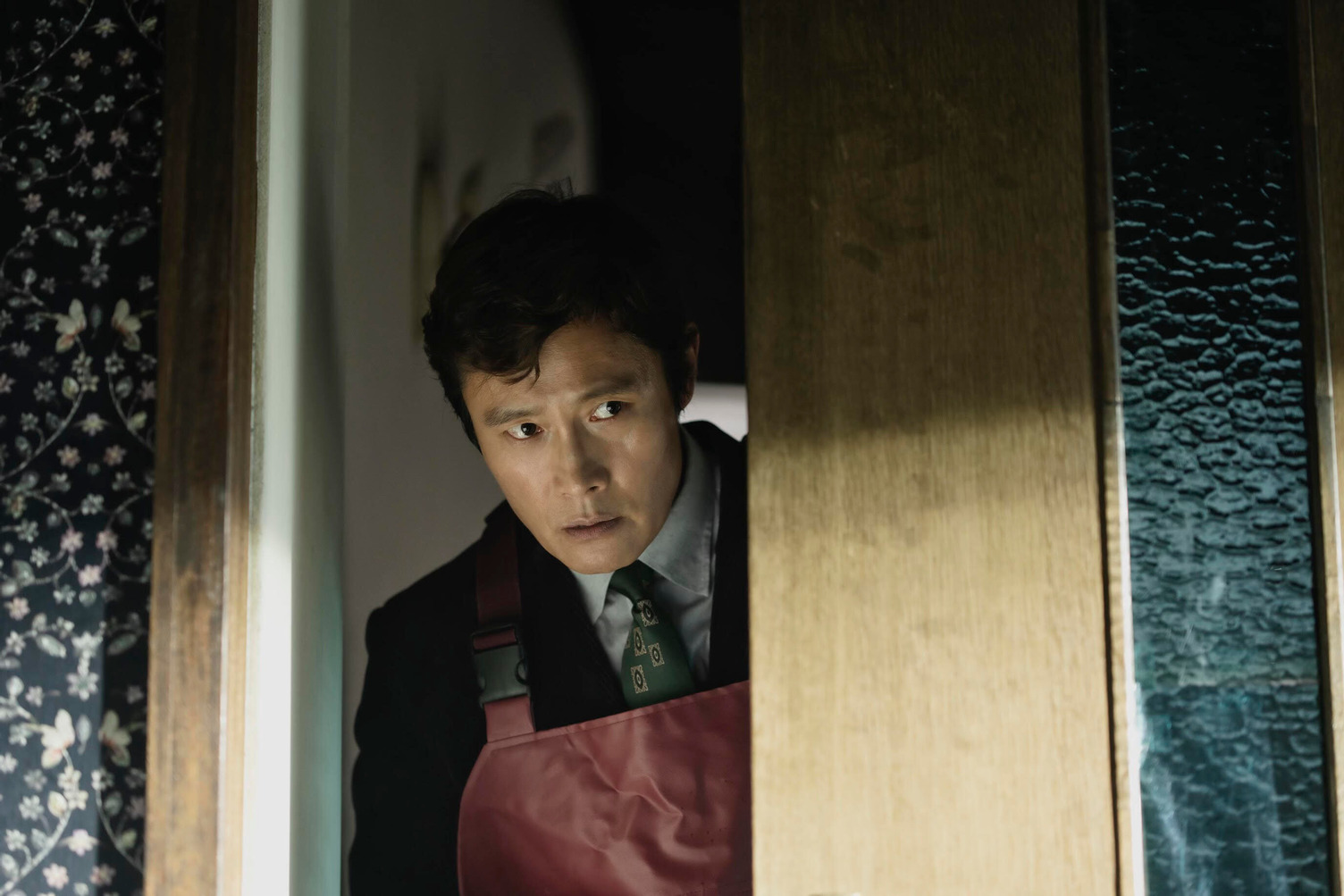
Man-soo (Lee Byung-hun), as shown by the movie’s opening minutes, has a literal picture perfect life: a well paying job in the paper industry, a beautiful house, his lovely wife Mi-ri (Son Ye-jin), two wonderful children, and their two dogs. Everyone is living blissfully and with a smile on their faces. Things change quickly, however, when he loses his job and the family’s main source of income dries up, effective immediately, leaving Man-soo wondering what happens next and his family having to potentially sacrifice everything to make ends meet going forward. When a position that would be perfect for Man-soo opens up, he devises a plan to knock out the people who are just as qualified from the competition and make sure he gets the job, which may mean he will have no other choice but to do something harsh if worst comes to worst.
No Other Choice has serious themes on its mind, as most Park Chan-wook features usually do, but it isn’t afraid to be funny and comically over-the-top when it wants to. As Man-soo begins to look into his potential competition and learn more about their lives, like with the borderline dysfunctional couple Gu Bummo (Lee Sung-min) and his wife Ah-ra (Yeom Hye-ran), the sequences that unfold are brilliantly directed and sharply written, practically to perfection, and extremely funny, particularly in a standout moment involving a blaring soundtrack playing while an argument takes place. But what makes No Other Choice ultimately stay with the audience is how its title becomes more and more ominous, starting at first as a darkly funny line when the loss of a job is concerned, and then turning into a line built on an inevitability, that something must happen because Man-soo has no other choice. This stellar balancing of tone and characterization is what lands the movie in the end.
Lee Byung-hun is extraordinary in the movie, channeling the fragility and desperation of Man-soo in every frame, and his want to grasp onto everything that made him so happy once more. He worries about not having enough work, he worries his wife might see him as lesser, he worries his kids will lose respect for him, but most importantly, he worries he’ll lose himself. When the going gets tough, it’s easy to understand why Man-soo is doing everything that he does and the extreme actions he may wish to take, while also lamenting the places he’s being pushed into because of a world that’s pushing against him. Lee’s performance, as well as Park’s storytelling, come together wonderfully, and the movie’s sledgehammer-like commentary (almost to a fault, particularly towards the final act) on jobs being replaced by machines and the advent of capitalism lands home.
Much like many of Park’s previous efforts, No Other Choice is a visually spectacular and uniquely framed feature, with Kim Woo-hyung’s cinematography yielding some of the most striking shots of the year. For a movie that is as bleak as it eventually gets, it remains incredibly vibrant and colorful until the final frame, and is backed by an energetic, even sometimes whimsical score from Jo Yeong-wook that elevates the darkly comic setting, along with Kim Sang-bum’s sharp editing that at 2 hours and 19 minutes, keeps the movie on its toes throughout, hardly missing a step. The production design, ranging from showcasing Man-soo’s love for plants and gardening to the framing of his family’s home, is immaculate, packed with little details that will make for interesting observations on repeat viewings.
Not much is being said about the back half of No Other Choice in this review, and for good reason. Much like Bong Joon-ho’s Parasite in 2019, it’s best to go into this movie knowing very little past its initial premise. Rest assured, the sequence of events that unfold once Man-soo really begins to look into his competition make for some of the best filmmaking of 2025, and one of the year’s best movies overall. No Other Choice once again proves that Park Chan-wook is a master storyteller who can subvert any expectations effortlessly, and one can only wonder how his next project will surprise audiences.