



Director: Jonatan Etzler
Writers: Rasmus Lindgren, Jess O’Kane
Stars: Saoirse Ronan, Jacob Anderson, Robert Emms
Synopsis: A struggling primary school teacher begins to make some questionable decisions after one of her students is injured.
If it weren’t painfully obvious enough already, teachers are wildly underpaid. It’s around this unfortunate dilemma that Jonatan Etzler’s Bad Apples revolves. But upon settling into the rhythms of this film, audiences might be shocked at just how demented the film turns out to be. With Saoirse Ronan at its center, some might expect a drama. And the film initially presents itself that way. But as it turns out, appearances can be quite deceiving in this film. The main exception to this is visible in Danny (Eddie Waller), the central child around which this film revolves. It’s not a stretch to imagine the consistent trouble he brings to a classroom purely by seeing how he glares at his fellow classmates or teacher, Maria (Ronan). This is confirmed by his upheaval of a school trip to an apple processing factory. Danny’s idea of a prank, or his curiosity with a tinge of maliciousness, wreaked havoc on their day away from the classroom. And upon returning to school, Maria is the one who gets chewed out for his actions. We expect the world from teachers. And we seem to have no issue with providing little in return through some form of showing gratitude. Upon begging the headmaster for additional resources, Maria is swiftly denied due to a lack of funding. It’s immensely frustrating, and if having Ronan at the center of the film wasn’t enough performance power to generate sympathy, then perhaps this authentic necessity being denied will be.
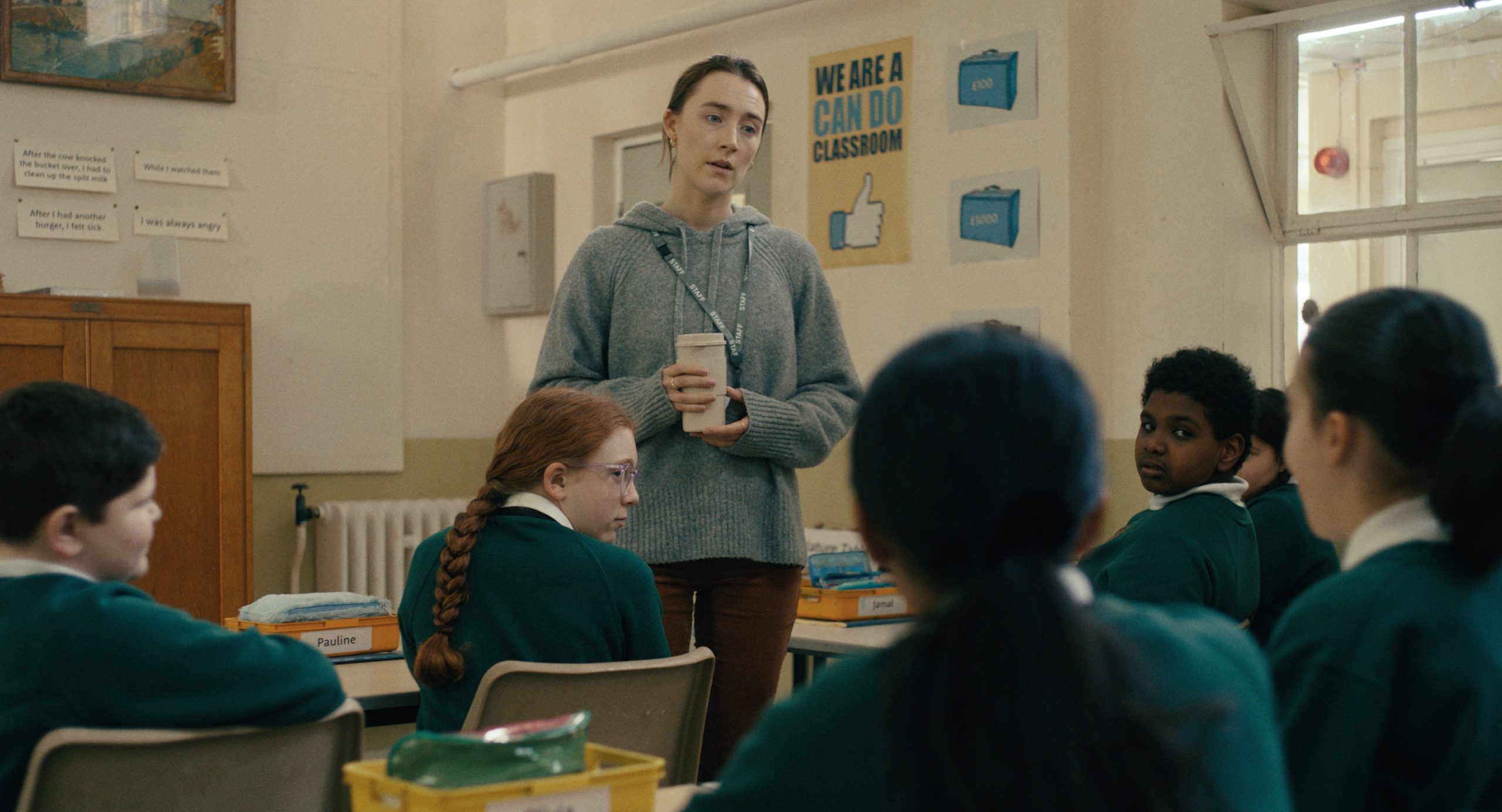
Danny’s behavior certainly works in favor of the film’s ultimate chosen tone. There’s such a rage he exhibits both inside and out of the classroom. One can imagine how much of a true fright it would be while knowing you have no ability or governance to do anything about it. These worries and frustrations Maria shares are further justified by an event early on in the film. After a failed classroom experiment, Maria hopes to rely on the classroom sweetheart for assistance. Maria enlists the adorable Pauline (a very sweet, very sly Nia Brown) to try and calm Danny down. At the very least, perhaps she’ll be able to forewarn Maria of any approaching disasters; this plan goes quite poorly for both parties. It has a shocking effect on the film, and places Maria into a bit of a spiral. Maria can only exist amidst the chaos for so long before disassociating, so imagine how Danny’s fellow students must feel? It’s this torment that leads to the inciting incident of Bad Apples.
After an attempt at dealing with Danny goes a bit too far, he winds up locked inside Maria’s basement. With such a shocking move that happens rather quickly, Etzler effortlessly shifts this film into quite the dark comedy. But as Maria prepares for things to spiral wildly out of control, it’s not difficult to notice the smirks and grins of her class as they realize Danny will not be in class for whatever reason. It’s this moral dilemma that Bad Apples hopes to explore further. A bad apple does indeed spoil the bunch. But is it fair to anybody to throw that bad apple away and ignore it entirely? Does a problem simply vanishing actually solve anything? Or does this solution just serve as temporary gratification? Unfortunately, as funny as the results of the scenario often appear, it doesn’t amount to much overall thematically. Bad Apples introduces several ideas that never feel meaningfully explored as either satire or drama.
As such, the film winds up resting in a lane that is often entertaining, but a bit hollow. For example, little is done to actually rile up the audience with a sense of how fundamentally the system has failed all parties involved. Danny’s anger stems from a very real place, and it’s largely glossed over before reverting to being a punctuation on the film’s punchline. This is a funny dark comedy, but when it comes to satirizing with a bite, it feels like there should be a larger take on the root issues. There’s nothing wrong with the humor throughout this film, where there’s admittedly a ton that progressively gets more deranged and silly. But Bad Apples does set up several thematic hooks without completely latching onto any. Still, just when it seems the film can no longer sustain itself under the weight of its own ideas or humor, Etzler takes an even sharper turn into the pitch-black comedy.
While never acting as an effective drama, this is a spry comedy that finds new ways to shock. Perhaps its wildest development is whether or not the demented idea at its center actually has a place within society. If the twisted solution Maria’s holding onto in the name of self-preservation actually works, how much should it be judged? It’s this question that both the audience, and several characters within the film, will ultimately reckon with. The needs of the collective are weighed against the needs of an individual, and the reactions depicted are as funny as they are damning. There’s a fascinating layer of cruelty on display within this film. Maria’s behavior is absolutely unhinged, but the active justification of it makes for a compelling watch at times. That Ronan can balance the possibility of her self-serving nature with her hopes of genuinely building a connection with her schoolkids is a testament to her skills as an actress. She can practically make any scenario here, no matter how delusional, understandable in some way. One might end up walking away from Bad Apples feeling a bit perplexed and underfed, but there’s some strong enough shocks and clever ideas amidst its runtime that make it well worth experiencing alongside a crowd looking to be surprised.
Bad Apples is celebrating its world premiere in the Special Presentations category of the 2025 Toronto International Film Festival.