Directors: Yuval Abraham, Rachel Szor
Synopsis: In secret conversations on the rooftops of Tel Aviv at night, the systems behind Israel’s calculated mass killing of Palestinian civilians in Gaza are revealed by the people who designed and operated them.
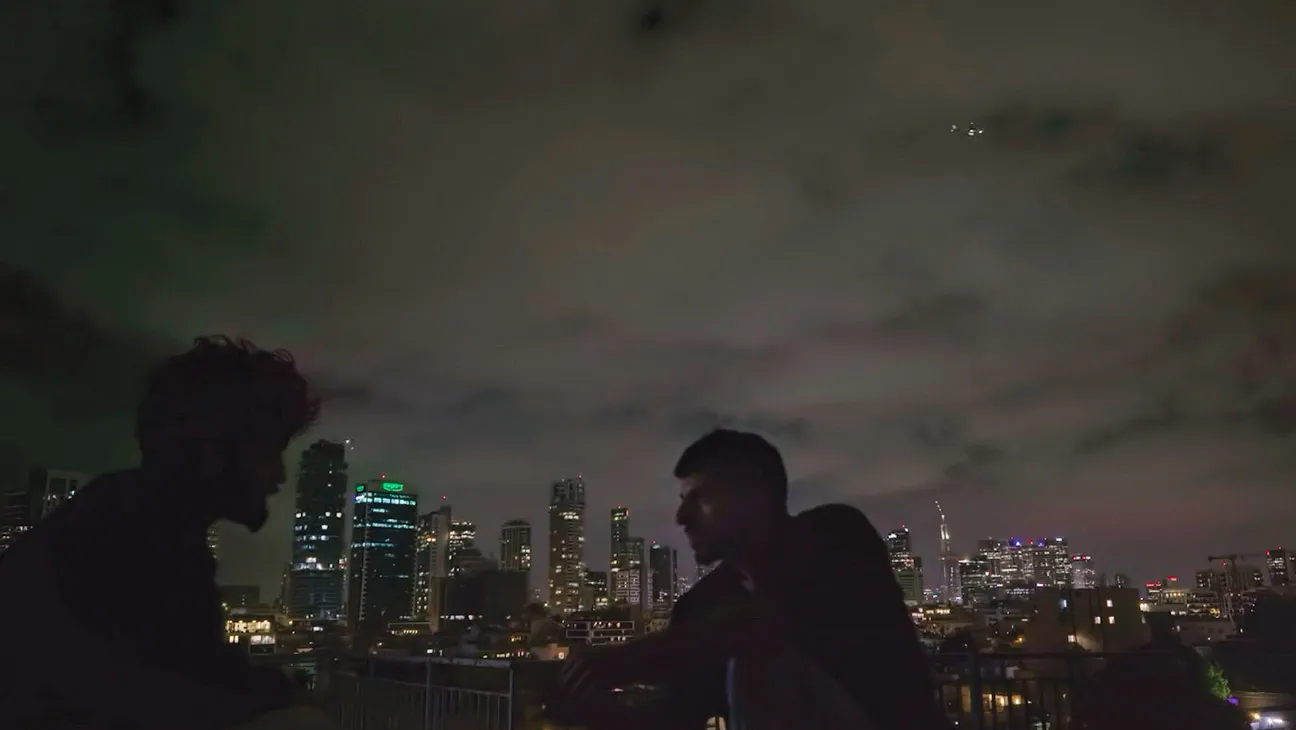
You may think that Naza, the title of Yuval Abraham and Rachel Szor’s documentary, is a rejiggering act, one that takes the Palestinian city of Gaza and swaps out its first letter for one that tends to begin words with sour connotations. “No,” “negative,” “null,” perhaps “nauseating.” In reality, it’s shorthand for nezek agavi, which translates directly as “collateral damage.” It is a Hebrew phrase often used in military jargon, typically in relation to those who are “unintentionally” harmed during targeted attacks, though in the context of Israel’s ongoing genocide in the West Bank, “unintentional” is hardly the word that comes to mind. As Abraham, sitting on the rooftops of Tel Aviv, secretly interviews 24 anonymous IDF sources, the word is used colloquially, tossed around like “food,” “water,” and “sleep” in effortless conversation from the latter side. “Ten NAZA” is said to note that 10 additional bodies would be found at the scene despite there only being one predetermined target in an air strike. “Naza” does not consider blood shed; the designation merely cares about numbers.
If it feels like the phrase “numbers game” is more appropriate, you may be occupying a place on the right side of history. A vital and harrowing follow-up of sorts to 2024’s No Other Land, the Israeli collective of Abraham and Szor – who co-directed the Oscar-winning documentary with Basel Adra and Hamdan Ballal, neither of whom are present here – return with a film that, while 15 minutes leaner, packs no less of a blow to the crevice of the soul that holds hope as its interviewees detail firsthand accounts of Israel’s defense tactics, those designed to decimate a country and its people with the lone goal of complete control. “Do you think it’s a genocide?” Abraham asks one subject, and his swift reply of “Yes, absolutely,” does nothing to ease the pain nor the fury. If anything, what he goes on to say only exacerbates the truth that what is happening in the West Bank is nothing short of villainous: He describes these strikes as “fun” and “enjoyable.” A game, indeed, and the bodies dictate the score.
No “review” of a film like Naza is bound to capture its power in full; of course, only the film itself is capable of doing so. What has added to the necessity of existence, however unfortunate, harmful, and misguided – though stronger words could be used – is the discourse surrounding its existence, from the droves social media sh*tposting bots that swooped in to criticize the filmmakers for receiving a 25-minute standing ovation (a record) at its Venice Film Festival premiere, with many noting that Abraham and Szor would be “profiting” off of the genocide of Palestine’s people with the film and that they should not be celebrated because they are Israeli. Before Naza’s New York Film Festival premiere on Sept. 26, the Israeli-American Council formed a protest in front of Alice Tully Hall and argued that the film “makes serious allegations about the IDF’s conduct in the Gaza Strip while ignoring findings and information that contradict its claims.” Variety posted five videos from the protest on Twitter; only one post was dedicated to the filmmaker’s comments at the film’s post-screening Q&A, and made sure to highlight that Abraham’s criticism was specifically of the U.S. government’s continued financial aid to Israel.
Furthermore, Israel’s prime minister Benjamin Netanyahu – a war criminal with multiple international arrest warrants from the International Criminal Court and other law enforcement organizations for his crimes against humanity – has called for Abraham and Szor to have their Israeli citizenship stripped in response to Naza. His decry most certainly comes as a response to the outcry from many of his supporters and confidants, but I’m curious if he’s screened the film or has an answer to the claims made about him within, many of which come from his own soldiers. Though he’d likely take a page out of President Donald Trump’s playbook and insist that the statements are doctored or “fake,” multiple sources – shrouded in darkness in the film to protect their identities – note that Netanyahu’s mission is for the total eradication of the Palestinian state, and that the prime minister himself once called for an order that would kill 500 civilians (“500 Naza”) in order to take out a single target. And what of the 1986 news clip included in the film in which Netanyahu, Israel’s permanent U.N. representative at the time, defined terrorism as the “systematic and deliberate” targeting of civilians for political goals? His guest spot on PBS’s “Firing Line” that year came in relation to the release of the book “Terrorism: How the West Can Win,” which Netanyahu edited; in it, he wrote, “The root cause of terrorism lies not in grievances but in a disposition toward unbridled violence.”
The interviewees in Naza don’t hide this fact in their candor, and the film’s structure is itself an outright refutement to any claims that the filmmakers made the film in an effort to peddle falsities to its audiences. (Though if you needed that clarification, we have bigger problems to address.) In fact, there isn’t much of a structure, not beyond the interrogations Abraham conducts and very occasional archival footage of mourning Palestinians and news clips. It would be more appropriate to describe Naza as filmed journalism rather than a journalistic film. The sparse nature of its composition – cutaways to moments of normalcy unfolding throughout the city that serve as heartbreaking juxtaposition to destruction; an absent score; and a sound design team that is merely there to enhance mumbled audio and explosions/alarms in the background – enhances its power. Furthermore, many of the findings detailed in the film were previously published in The Guardian, +972 Magazine, and Local Call, like how an AI called “Lavender” is programmed to find “likely” Hamas targets, though it is frequently incorrect. That we could have read up on Naza’s revelations ourselves effectively demonstrates how important it is for them to be repeated until the truth has sunk in.
Will that day actually ever come? The odds aren’t particularly favorable. But courageous work such as Naza is designed to make a dent, actively working to create change, and above all, is shedding a light on the incessant darkness that millions pretend doesn’t exist just because it attempts to live in the shadows. It is not a work of entertainment; it is not a project conceived with the intent of winning awards; it is a movie, but it feels wrong to call it by such a trivial word. It’s a living, breathing document of a documentary that details death, brutality, and hatred; all persisting because the prayers for it to end fall on more deaf ears than open ones. That truth is hard enough to swallow; what about those that are offered in the film, yet still labeled as responses manipulated by the “enemy?” Maybe it’s not the facts themselves, but that these are the people delivering them, concealed in the dark while bringing so much to light.
Naza had its North American Premiere at the 64th New York Film Festival. MK2 Films and The Guardian are self-distributing the film and releasing it in theaters starting Sept. 30.