



Director: Ben Rivers
Writer: Ben Rivers
Stars: Moon Guo Barker
Synopsis: Moon journeys through a world without adults, encountering a sage and translator in a mountain hut. She meets various people who share performances, films, and gifts while showing her different ways of life as she moves toward uncertainty.
Adaptations of the work of American novelist Don DeLillo don’t happen often, and when they do, they don’t come easy. It is related to DeLillo’s writing style and his multi-layered stories, which encompass numerous topics and social critiques simultaneously. His work is fragmented, yet layered with meticulous attention to language and sentence structure. That keen attention to detail is what fascinates me each time I open one of his books; it draws me into its array of beautifully encompassed sentence structures that I haven’t read in any writer’s work, outside of Thomas Pynchon and William Burroughs–both of whom I became interested in reading their work after seeing cinematic adaptations of ‘Inherent Vice’ and ‘Queer’ respectively.
You have to be a brave and bold storyteller to pick up one of DeLillo’s works and translate it into another medium. This is why the few adaptations of his novels have been made by filmmakers who have either experimented with genre (David Cronenberg with Cosmopolis, 2012) or played with the texture of language in their films (Noah Baumbach with White Noise, 2022). I have greatly loved the adaptations made so far, each one for its unique reasons. Cosmopolis blurred the lines between reality and simulation through a cold, urban landscape, presenting the world from the perspective of a paranoid financier whose empire is crumbling. Meanwhile, Baumbach had a beautiful yet haunting approach to the existential dread and anxiety induced by a technology-dependent and increasingly isolated society in “The Airborne Toxic Event” – it is a film that, to this day, I haven’t been able to shake off from my mind.
The latest adaptation from book to the big screen of a Don DeLillo project, Mare’s Nest (screening in the Concorso Internazionale at the 2025 Locarno Film Festival), an adaptation of Don DeLillo’s one-act play ‘The Word for Snow’ directed by Ben Rivers, gets a better grip on the tone and texture of the novelist’s writing technique and approach to language. Thanks to the author’s descriptive, haunting narrative, Rivers gets out of his comfort zone and makes his most adventurous, crafty film to date, implementing the staticness of his fragmentary documentary work covering the life of Jake Williams into the mystical, cold world of ‘The Worst for Snow’ that’s free of adults, and its monuments are slowly crumbling down.
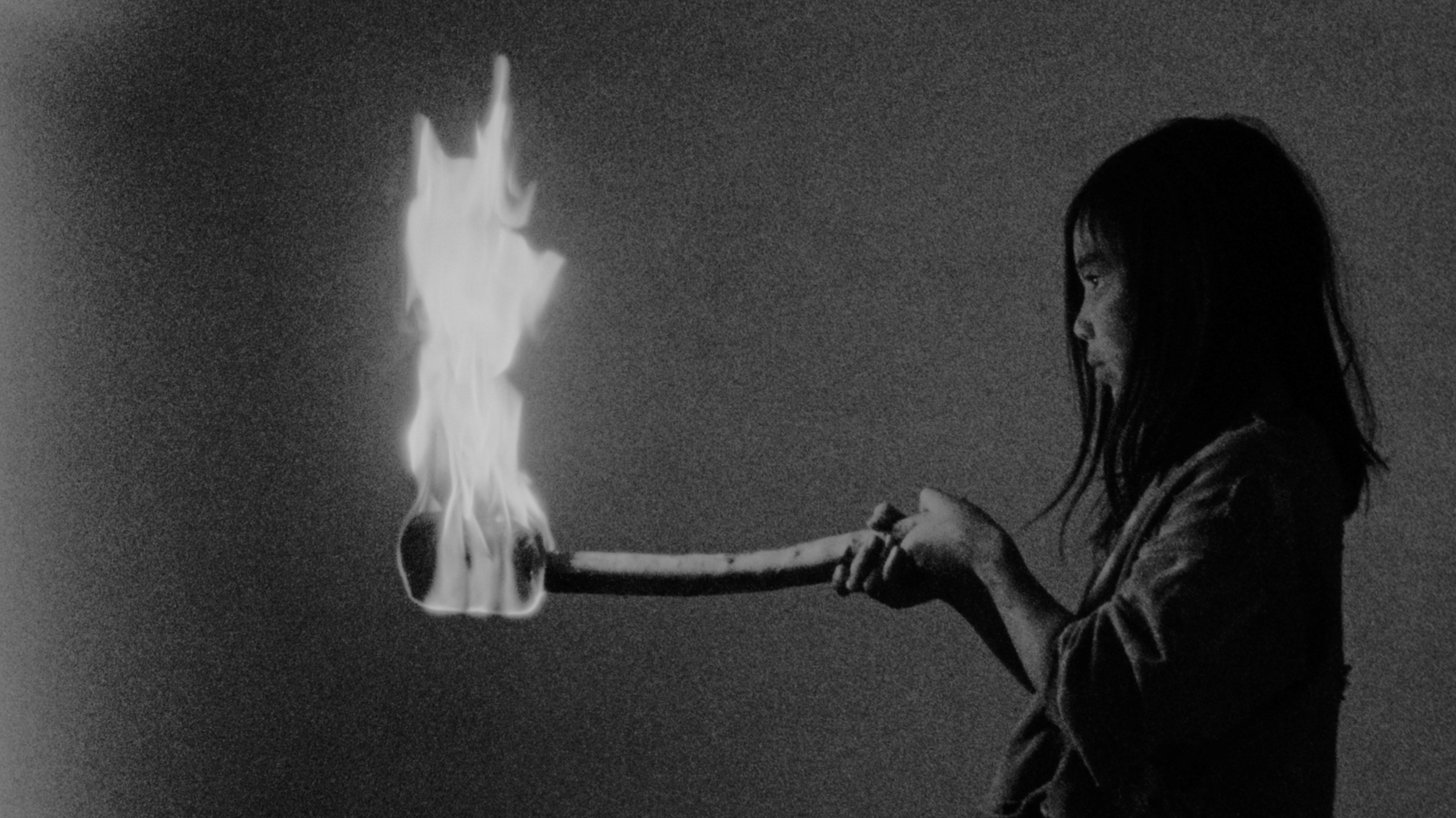
Mare’s Nest follows a child called Moon (Moon Guo Barker), as she travels a mysterious world populated only by children. The children in this world may be young in life, but are exceptionally astute and wise, often speaking in passages that recall a thousand lifetimes, like the History Men in Furiosa, who count tales of a land before them as records, recollections, and knowledge of the past has disappeared. They aren’t ordinary kids; these are the sole survivors of a post-apocalyptic event, induced by climate change, that destroyed the lands yet enriched their minds’ eyes. We explore this scenery via a pieced-together car, which Moon drives off to where her curiosity leads her.
Moon follows her instincts and the tingles in her spine to head towards a place of salvation in this wasteland, if there is such a place. It is curious to me that a few films released this decade have desert or wasteland settings treated as purgatories for the characters, with Mare’s Nest being added to the list of extraordinary pictures alongside the aforementioned Furiosa and Oliver Laxe’s Sirāt. Although these films are vastly different from one another, they share a common thread that ties them together. And that is how they utilize these landscapes, not merely as backdrops to their singular visual storytelling, but as mirrors of the characters’ fractured souls.
The dream-like encounters Moon has with the other boys and girls give Mare’s Nest a sense of wonder and imagination, becoming a more puzzling and vastly fascinating picture that one would like to dissect. Each conversation offers insight into the children’s mentality, exposing the roots of how this place came to be and how humanity, or what’s left of it, has become tethered to the coldness of the mystic, mysterious plains–dark shadows, thick fog, and dust storms all over the screen on occasions to hide the inhabitants in this version of an abyss. One of these encounters has a Shakespearean quality to it, where Moon meets three sisters, along with their translator, who interprets their speeches and observations.
This interaction reminds me of when Macbeth receives visits from the three witches (or the Weird Sisters), who sow seeds of ambition and thoughts of power in the mad king. While these sisters are not the evil forces placed by fate, like in ‘Macbeth’, they are a manifestation of a bigger, darker force lurking in this fantasy—the dangers of fractured connections and societal collapse. These are all lost souls wandering a world that is slowly losing its essence of humanity, embedded in dialogue and understanding. Mare’s Nest is not set in heaven or hell; it is a setting stuck in between the two. The grace of the former meets the malevolence of the latter. The two intertwine to create a place of both peril and vivacity. However, it is not entirely desolate or burdened by damnation.
There is an element of hope and aspiration forming within the backbone of Mare’s Nest, revealed throughout the passages, and the characters often reply to Moon’s questions. Since the film explores the importance of language as the bridge between the void and reality, Rivers treats his screenplay as both a lifeline and a labyrinth for us and the characters to navigate. Every exchange creates a text that feels both elusive and resonant. Its careful construction allows the screenplay to operate like a puzzle. The final image only emerges once the viewer has pieced together his thoughts and has pondered the weight of language. Rivers trusts his audience sufficiently to leave plenty of empty spaces and silences between one conversation and the next, never drowning the viewer in dialogue to interpret.
Even so, this is his most expressive picture. Most of his work relied extensively on silence; he often left images linger and placed dialogue in the backdrop. In this case, there is a clear division between the two, where Rivers constructs staggering images while delivering touching, thought-provoking lines that prompt us to question our realities, which have been plagued by isolation and despondency on our paths towards understanding and exchange. Mare’s Nest is a rarity. And Rivers has evolved into a storyteller who no longer needs to obscure his ideas behind abstraction alone. He does not sacrifice mystery with the embrace of clarity, crafting poetic and human cinema in the process.