



Director: Rachel Lambert
Writers: Rachel Lambert
Stars: Chris Pine, Jenny Slate, Abby Ryder Fortson
Synopsis: Noah’s settled life caring for his anxious daughter and medical practice is disrupted when his high school ex Rebecca returns. Their old spark remains, making them question if love deserves another chance.
An initial glance at Rachel Lambert’s Carousel might lead some to believe they’re in store for a light romantic comedy or a somber independent drama. And as the film begins to play out, the associated qualities of those genres do make themselves apparent. But Carousel also contains so much more. And perhaps this film’s most impressive quality is its fully assured refusal to ever rely solely on that exact familiarity. Lambert indicates an intentional reticence to protect her characters from the very outset. It takes a fair amount of time before audiences ever know the slightest thing about central characters Noah (Chris Pine) or Rebecca (Jenny Slate). Though it’s important to make clear that observation shouldn’t be taken as a claim that either of these characters’ interiority are underserved by the script. On the contrary, most of the characters throughout this film feel as if they’ve already experienced the moment in their lives which would make the perfect film. That’s to say that everything in Carousel feels as if it’s a coda by design. Noah and Rebecca have each experienced their fair share of life, and they’ve come out on the other side damaged, feeling alone, and keeping their guards all the way up. These reservations are what allow the romance and central drama of Carousel to play out so admirably. Even through the occasional narrative stumble, Lambert crafts something that’s difficult to pull your gaze away from and it remains largely distinct compared against films of a similar nature.
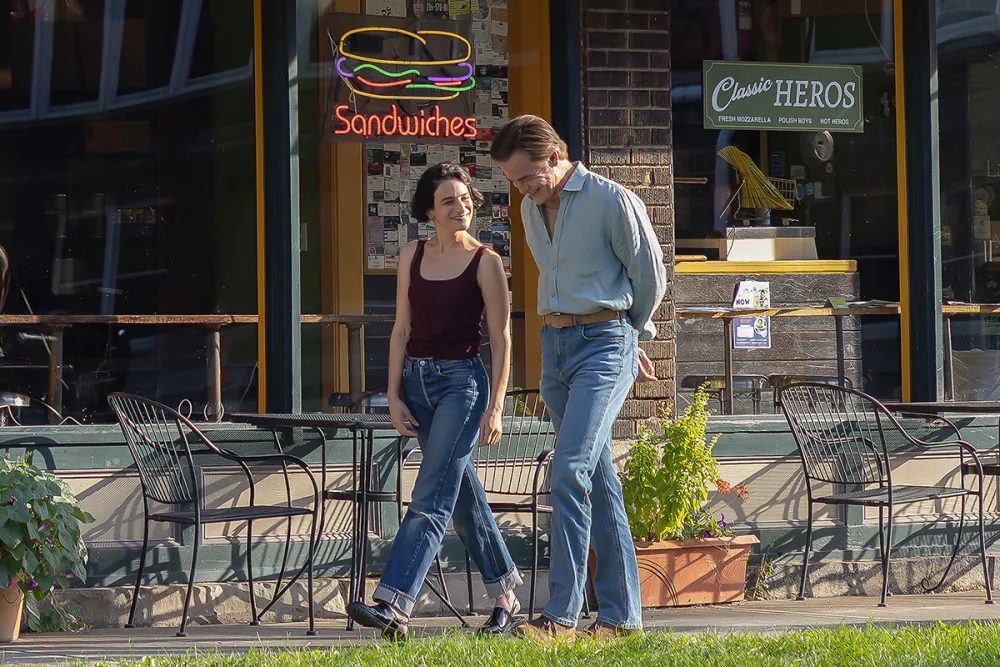
One key element to the transfixing nature of this film is its dazzling cinematography, shot by cinematographer Dustin Lane. The complete naturalism present in the performances and script extend to the visuals themselves. And it’s through the cinematography wherein the irony of this film largely reveals itself. Lambert and Lane expertly capture the beauty existing everywhere amidst the mundane. Noah and Rebecca are just too closed off to fully realize it, though they may occasionally catch glimpses of what lies beyond the pain that has sealed them off emotionally. The film opens with Noah taking his daughter, Maya (Abby Ryder Fortson), to school. Along the way, it’s clear Noah wants to make some sort of small talk, but is too reserved or unsure of how to reach out in the first place. It’s a shockingly brisk exchange to watch play out, especially from a movie star like Pine. So often beloved for his quick wit and classically cool charm, Pine and Lambert have formed a character that has believably exchanged a large majority of that charisma for something innately raw. Of course, Pine does still have charm when the film calls for it. Yet it’s more of a full-on dad charm that is largely relegated to funny bar chatter and sloppy dinners on the couch while watching basketball. It’s a joy to experience. And Lambert clearly built quite the trust between both key actors of this film, as Slate turns in an equally mesmerizing performance audiences likely won’t be expecting.
Known for her distinct delivery and brash comedic sensibilities, Slate handles this dramatic and withdrawn character turn incredibly well. It’s legitimately striking how clearly the pain Lambert imbues these characters with completely mutes the personas of both her very famous stars. This trust between actor and writer/director carries Carousel a long way, and it largely allows the most engaging sequences of the film to work so well. As the two rekindle their previous lives and relationship somewhere in the tone between hesitantly awkward and passionately excited, Lambert treats her audience with crumbs of the lives they once led. These moments of Noah and Rebecca dredging up the past are held on way longer than most films would ever be comfortable with. The editing style makes it so that all the awkward silences and despondent contemplations on what to say next stay part of the scene. There’s no escaping the discomfort, or the pain, these characters are expressing to one another. Some bits of honesty they can laugh off; others bring forth tears and held-back shouts from the feelings of isolation and betrayal. This patience can be found all across Carousel, allowing it to unfold similarly to how reality does. There’s no immediately apparent driving force, and while that can sometimes stall the film, its heights take great advantage of the excellent performances grounding it in these extended realistic moments.
A film largely made up of fragments, extended emotional setpieces aside, Carousel does indeed come together to form a larger picture. These glimpses into the internal lives of Noah and Rebecca offer a somber look at the consequences of fearing emotional fallout. Both of them would rather retreat within themselves then potentially face any pain again. Can anybody blame them? Lambert shows such empathy to these characters, and allows them the space to be fragile. Her script contains many realistic kernels of truth, largely spoken around until they come pouring out of her characters. Carousel is a quaint film that cuts deep in this regard. There’s rarely ever full-blown melodrama or exaggerated gestures that bring this romance into typical genre territory. And yes, it can often feel like the film is largely keeping its audience at a distance. But is that not the standard response for people suffering emotional turmoil? To shut everybody else out and be left hearing nothing but our own heartbeat, hoping for a sense of serenity amidst so much chaos and potential pain. The recurring motif of heartbeats in Carousel is tremendously effective, and it culminates in a moment that expertly pays off.
Two of the extended sequences in Carousel which make up the finale could both operate as dazzling short films. They complement one another so beautifully, and any steam the film might have lost along the way comes back in full force. Lambert takes her fly-on-the-wall directing style to new heights here, capturing a complete breakdown, but also complete vulnerability. Both of these emotions from her characters have rarely been captured so clearly as they are in the last 15 minutes or so of the film. The climax simmers with a realistic passion, captured in a wonderful slow zoom. In a single take, Pine and Slate just build unfathomable amounts of tension, and Lambert sends her audience out on the highest of notes. It’s a moment which makes it worth getting to know Noah and Rebecca a bit more over the course of 100 minutes. Much like those two looking for something greater than themselves, as a viewer going into any relationship or even a film, we just have to have faith that giving ourselves to something larger than we can fathom will turn out all the greater for us.
Carousel celebrated its New York premiere at First Look 2026.