



Directors: Jason Gerber, Sarah Blue Winslow Gerber
Stars: Chelli Look, Bridget Botchway Bradley, Jon Colon
Synopsis: Chelli Look, a leather bag artist, faces overwhelming grief after the murder of her sister. Chelli’s journey towards healing forces her to rediscover who she is as an artist, leading to a revelation that takes her in a new direction.
In telling the story of the life of Chelli Look, an artist best known for her work as a designer of handbags, directors Jason and Blue Gerber choose to center her development as an artist. This may seem like an odd choice, given the fact that her personal life could have so easily been sensationalized, but it allows for the creation of a more sensitive portrait of Look as a human being. Her struggle with the grief brought on by her sister’s murder at the hands of her brother-in-law is examined in considerable detail but the focus of the documentary is never entirely given away to this horrific tragedy. This ensures that it can function as more than simply a true crime portrait that revels in gory details and wallowing in the misery of others. It can instead function as a more fully rounded, three-dimensional study of the messiness of the mourning process when it expands its subject out to consider the professional life of one of the people directly impacted by this event.
The documentary also derives a considerable amount of its emotional power from the fact that it refuses to conform to standard ‘inspirational’ narratives. The approach taken to depicting Chelli’s efforts to channel her grief into art is surprisingly straightforward. Her pain is captured in a sensitive manner but the audience is not asked to linger on it in an exploitative fashion. One is left with the impression of a form of grief that, rather than dissipating over time as part of a reparative process, comes to be cyclical in nature. The subtler aspects of the mourning experience are presented here in matter-of-fact terms. Nothing is over-dramatized and Chelli’s experiences are not contrived to fit into a pre-conceived vision of what this form of suffering should look like. In this regard, a case is made for the unique potential of the documentary form. It is perhaps easier for artists working in this medium to diverge from the tightly scripted narratives that often play a central role in shaping classical Hollywood cinema productions. There is more room to portray a slippery, difficult to pin down emotional journey here.
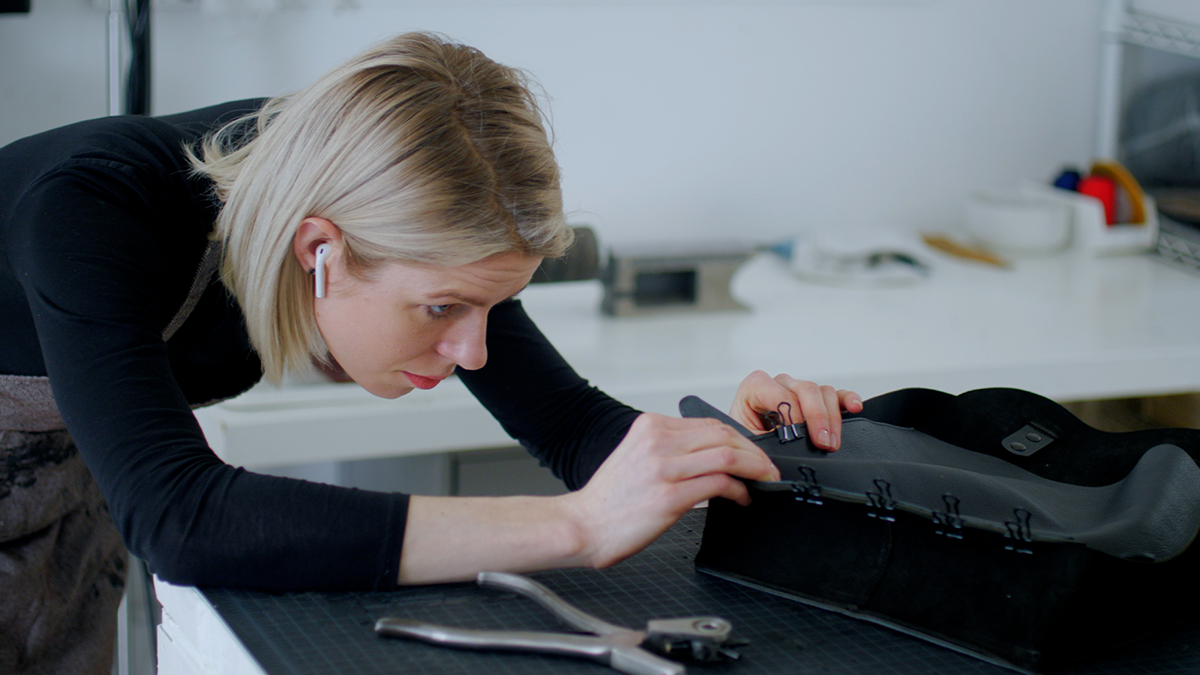
The muted emotional palette on display extends outwards to the visual style on display in scenes that focus on the design and construction of CHC leather goods. The bright, summery imagery on display offers us an optimistic vision of the act of creation. Rather than centering around the psychological strain that often results from this struggle, the film presents it as something that can be liberatory. This occurs, in part, because the subject of the documentary takes a constructive approach to her work and does not hold herself to any objective standards. For viewers who, like myself, were not aware of the ins and outs of the leather goods industry, there is also a fascination in getting a window into this highly exclusive sphere. Learning about the specifics of this very niche field is intriguing and, at times, the documentary even invites comparisons to the epic observational documentaries of Frederick Wiseman. In the same way that Menus-Plaisirs – Les Troisgros captured the nuances of day-to-day operations at fine dining restaurants in France, this documentary picks up on minute details that can completely alter one’s perception of an entire milieu. In size and scale, it is far more intimate than one of Wiseman’s sprawling, encyclopedic works but the interest in that which could otherwise be seen as insignificant is very much present in this film.
To a certain degree, the documentary could be said to be limited by the fact that it does fall back on certain conventions when inserting footage from interviews with associates of Look. These segments very commonly appear in documentaries of this sort but, to me, they represent a divergence from the more free-flowing, experimental passages of the film. The interviewees do provide valuable information about Look’s family history and how she first became interested in designing bags. However, I can’t help but feel that these observations could have been delivered in a more original manner. Massive innovations have been made in the past few decades when it comes to weaving firsthand accounts into documentary storytelling and it would have been interesting to see more of a deviation from well-established norms. In a work of art that is often striking for how it works to undercut convention and avoid hewing too closely to tradition, it is disappointing to see something that feels more tied to a previous era of filmmaking.