


Welcome to Following Direction, a new recurring series at InSession Film that charts the careers of directors through the lens of the themes commonly explored in their work. To kick things off, I’m taking a look at the mighty Christopher Nolan and his newest epic, The Odyssey, and how his career hasn’t just been about examining our relationship with time, but to our loved ones, and the lengths his characters are willing to go to return to them. (Warning: Minor spoilers for The Odyssey will follow.)
Perhaps you haven’t heard: Christopher Nolan has a thing for time. A concept and a constant, he treats a realm that is fundamental, yet unequivocally incomprehensible like a sandbox packed with sandcastle molds for him to build empires of varying time periods within. Perhaps because of this, many seem to think his films are puzzles. On the contrary, they are palindromes: stories that can be told the same no matter if you choose to travel backwards or forwards but always reach the same end point, where a man reckons with his place and the consequences of his actions. Like all great storytellers, he manages to sculpt living creatures lacking strict compositions with the grains beneath his feet; no kingdom is complete without a king, queen, and the subjects over which they rule, after all.. It was ultimately a given, then, foreseen by the Gods that the modern king of the blockbuster would select The Odyssey, the oldest story ever told, as his next conquest, a tale that not only contains beings of all shapes, sizes, and species, but lends itself rather nicely to the idea of how time cannot be turned back no matter how much plot armor we assume we possess, and what happens when it’s gone: To us, and to those we’ve left behind.
For as much as time – seconds, days, years, etc., whether viewed backwards or forwards – is Nolan’s most commonly cited preoccupation, man’s journey home to a world forever changed has been just as omnipresent in his films from the beginning. Specifically, has always had his eye on how the impact of missing or losing loved ones can alter the course of the character’s life forever, whether it’s something as simple as swaths of broken men being evacuated from a war-torn French beach in Dunkirk so they can return home to the arms of their families or as complex as the nightmare plaguing Memento’s Leonard Shelby (Guy Pearce), an amnesiac attempting to piece together the puzzle of his recent, traumatic past to find the men who bludgeoned his memories away before raping and killing his wife.
No one aside from those who Nolan holds closest will likely ever know where such dark fixations derive from given the director’s penchant for privacy. (Although who knows, maybe they haven’t the slightest, either.) He prefers things that way, after all. Most still refuse to believe that Nolan doesn’t own a cell phone or have an e-mail, but his privacy would never be put on trial due to how quickly any prosecutor would be laughed out of the courtroom. “I don’t want people to know anything about me,” he told The Hollywood Reporter’s Scott Feinberg in 2015. “The more you know about somebody who makes the films, the less you can just watch the movies … I actually don’t want people to have me in mind at all when they’re watching the films, genuinely.”
Of course, it feels that there should be more to that impenetrability, a catch-all reason that Nolan himself must surely one day explain in great detail. But what if he’s already done so, spilling his guts on the page and screen rather than in the trades or on a podcast? (Is Christopher Nolan familiar with podcasts?) Under Nolan’s Law, we may be forbidden from analyzing the man behind the camera while the picture is moving. But he never said anything about what we are or are not permitted to do once the reel has spun out. That’s what this new essay series is designed to do: To attempt a daunting but endlessly rewarding task. We will examine the motifs the filmmakers in question return to throughout their oeuvres, displaying dissectable connections to such ideas and offering us an opportunity to maybe, just maybe, bring us closer to their work and their core principles.
One of the things I love most about film as an artform is that it grants viewers the gift of not only witnessing someone’s vision come to life, but to hand over their hearts for us to hold.. No artist is ever not drawing on inspiration of some kind, and sure, they may simply feel called to a story because of taste or general interest, but where does that come from? I’m not a psychologist, so I won’t pretend to be one here, but cinema is a form – more than any other – where there is always more than meets the eye. (Note: “Eye.” You’re welcome, Cyclops.) I intend to look beyond, through time and space, to claim a better grasp on whatever it is the filmmakers I select for these pieces are searching for.
Odysseus (Matt Damon) is a man possessed by the things he can control. Or thinks he can, at least. Should we take his strongest detractors at their word, he’s a lot like Christopher Nolan in that way: A man of great power and responsibility, yet one who operates in a world of unpredictabilities. The fact that he repeatedly seems to maintain even a shred of governance over something so volatile is masterful in and of itself. So it may not come as a surprise to learn that The Odyssey is an enormous, epic triumph, a brilliant adaptation of a tale as old as time that looks even more inward than its original author may have ever imagined it could. Finally, a grand victory for the Woke Left.
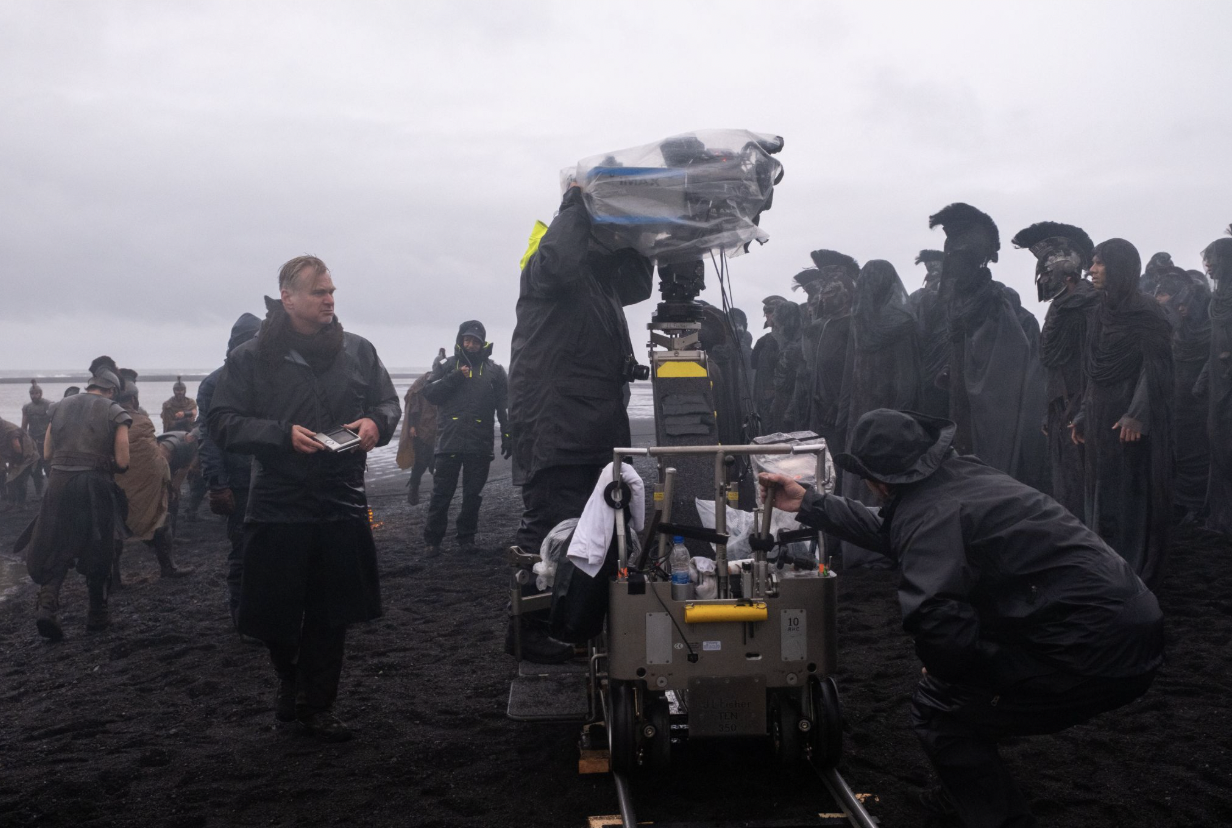
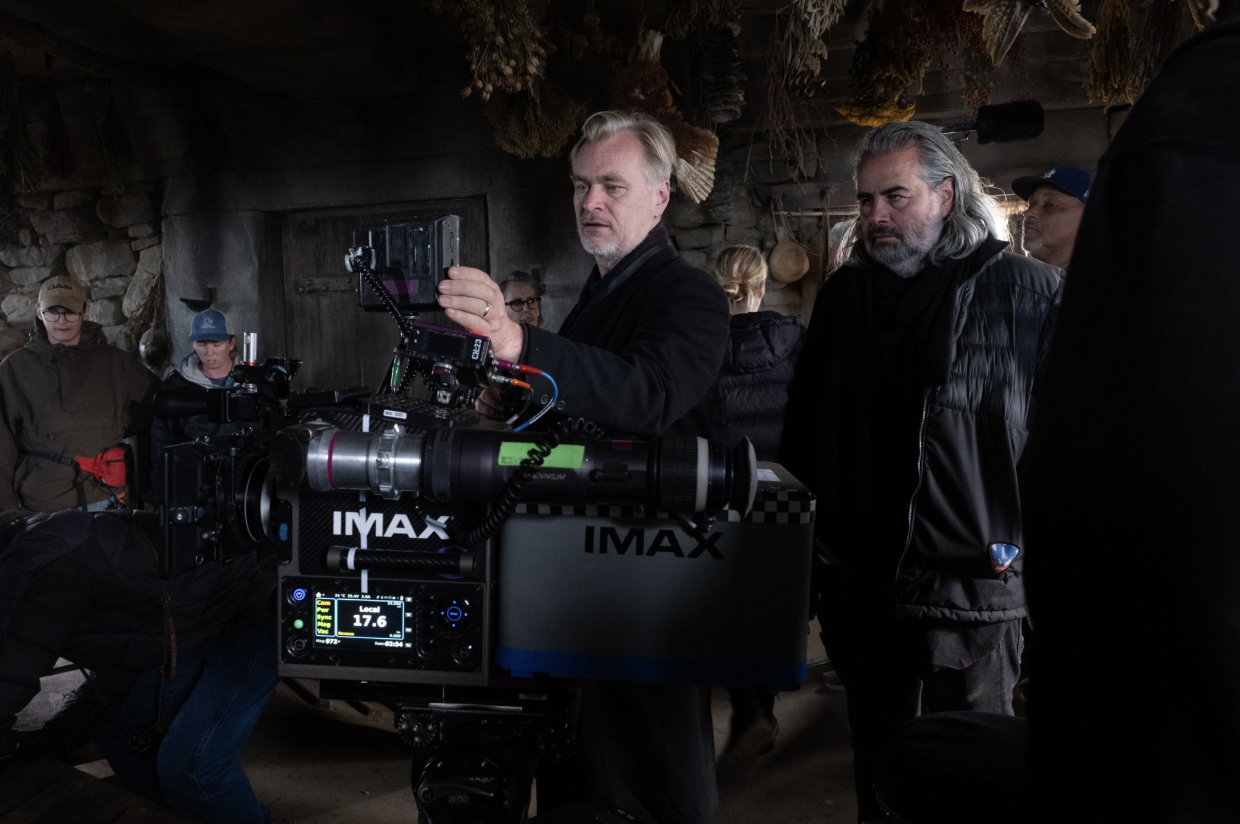
If Homer were to witness Nolan’s adaptation of his epic poem, all 172 minutes of it, he’d likely break out in a lethal batch of hives and find a band of Sirens to turn himself over to before the rash did him in. It might only take Ludwig Göransson’s most audacious score to date to accomplish that, in fact, but the scale of it – both in narrative terms and if seen in Nolan’s preferred IMAX/70MM film format, a wonder to behold that cinematographer Hoyte van Hoytema spares no expense in capturing – would do him no favors. It’s a faithful adaptation, but as is only natural for the form, liberties are taken. As he is wont to do, Nolan and his Oscar-winning editor, Jennifer Lame, let the story unravel in a non-linear structure, frequently shifting back and forth through time so as to fill in the gaps in everyone’s assumptions about our main character’s whereabouts. They treat The Odyssey like the manipulative nymph Calypso (Charlize Theron) treats Odysseus’ mind, as a sieve through which memories can escape when it is their turn to do so, only revealing themselves when our hero is ready, thus so are we.
“Who here has a story about Odysseus?” Menelaus (Jon Bernthal) shouts into a banquet hall after the Trojan War hero’s son, Telemachus (a best-ever Tom Holland), enters his kingdom in search of truth or rebuttal to the rumors about his father’s whereabouts. The stories that travelers are all too willing to tell tend to be just that: Rumors. Most of them provide his only child and beloved wife, Penelope (Anne Hathaway, predictably great) with no proof of life in either direction, yet their hope remains. One day, the King of Ithaca will return to his throne, reclaiming it from the many slimy suitors occupying his house (Robert Pattinson is tremendous as the particularly sniveling Antinous) and reuniting with those he left behind. His trusty swineherd Eumaeus (John Leguizamo, excellent) will regain his master; so, too, will the near-dead Argos, Odysseus’ hunting dog who has only managed to stay alive over the 20-year absence of his best friend on the prayer that he’ll give him one more pet before he wags his tail for a final time.
But it is Penelope and Telemachus that carry the greatest burdens. A wife without her husband; a boy without a father, unable to truly embrace manhood without a patriarchal hand dangling a lantern over his shoulder, lighting the way. Though the passage of time is certainly a constant throughout Nolan’s 13th feature film – certainly as it relates to the decades that have passed since Odysseus left his kingdom behind – it’s the thought of coming home to his family that plagues him most, the unknown of what will be there when he returns pulling him further from its once-safe harbors like a whirlpool dominating its sector of the sea. After he survives an encounter with the famed Sirens, whose song is known to entice even the strongest men to leap overboard and swim into their fatal clutches, he laments this very fact, telling his second in command, Eurylochus (a transfixing Himesh Patel), that their tune disclosed an uncomfortable notion:
“What you most want is what you most can’t have, and what you most can’t have is what you already had and lost. It sang of all the promises I couldn’t keep. And it told me I don’t really want to go home.”
Much like Nolan’s previous film, 2023’s Oppenheimer, his latest tells the story of a great man who took responsibility into his own hands only to learn of its consequences after it was already too late; a man who thought his choices could potentially destroy the world, yet never ran the calculations intentionally enough to prevent that from happening altogether. More than the “world,” however, it’s the destruction of the home he vaguely remembers that Odysseus fears most. Moments prior to the grand climax of the finest, the most stirring final act of Nolan’s career – one that also happens to feature the strongest single stretch of acting we’ve ever seen from Zendaya – a character considers why the godlike man at its center stayed away for so long:
“What if he knew that very night [in Troy] as he walked through fires of anarchy and pain, and in a daze of sweaty celebration to follow…What if he knew exactly what he’d done? Maybe he couldn’t bear to see the ruins of what he’d done anywhere, least of all his home?”
It’s this sentiment that drives The Odyssey – that and the idea that the power of a sacrifice is in the cost to the person making it – and has driven everything Nolan has made to this point. It’s only now that he has verbalized it in such a despondent way, as if in acknowledgement to the current state and impending future of our world, the one unfolding thousands of years after Homer’s. In the past, Nolan’s visions of family and of home have been akin to beacons. Try Inception on for size, should you dare: In a dream, Dom Cobb (Leonardo DiCaprio) stands on a building’s ledge as his wife Mal (Marion Cotillard) dangles from one out of reach, moments before she commits suicide in the hopes that it might free him from the guilt he feels in response to her death, his supplying her with the thought that her world wasn’t real, and his abandonment of their children. He once thought about calling out to their “beautiful faces” while in limbo, but deemed his efforts too little, too late. Yet not until May told him that they were “going home to [their] real children” did Cobb understand that it was written in the stars: “I did what I had to do to get back to my children,” he later recalls.
He did what he had to do. It’s a problem that all of Nolan’s men face, and from one time-bending thriller to the next, it remains. Interstellar may be the finest pre-Odyssey example of a story driven by man’s tortured impulse to get back to where he once belonged, with the relationship between Coop (Matthew McConaughey) and his daughter Murph (played as a child by Mackenzie Foy and as an adult by Jessica Chastain) residing in its heart. Planet-threatening forces cause a father to leave his daughter behind for “greater” responsibilities in the cosmos, that desertion fracturing their bond as time sits still for him and flies by for her. It is punishment for Coop to receive a video message from his little girl, suddenly all grown up, in which she begs for his return:
“You son of a bitch. I never made one of these when you were still responding because I was so mad at you for leaving. And then when you went quiet, it felt like I should live with that decision, and I have. But today is my birthday. And it’s a special one, because you told me… You once told me that when you came back, we might be the same age. And today I’m the same age you were when you left. So it would be a real good time for you to come back.”
Murph might understand what her father told her as he said goodbye all those years earlier – that “once you’re a parent, you’re the ghost of your children’s future” – but she’ll reject it until the cows come home because she refuses to let Coop exist as a ghost, convinced, not unlike Telemachus that her dad will be back someday. Interstellar’s odyssey just takes a bit longer than that of the man who takes his name from the journey. Coop makes it back in time for Murph to become their ghost. It’s a beautiful, emotional finale that serves as a counter to the silly insistence that Nolan lacks warmth. As Justin Chang wrote for NPR, “Nolan, whose style has often been dismissed as coldly intellectual, is one of our most emotionally driven filmmakers.”
Nolan’s first masterpiece, 2000’s Memento, proved his emotionality early on, and could theoretically be seen as his first attempt at cracking The Odyssey. At least its consideration for memory, anyway. As he slowly but surely gets his bearings on his shattered life, Leonard (the aforementioned Guy Pearce) realizes how pivotal it can be just to believe in a truth, confirmation be damned:
“I have to believe in a world outside my own mind. I have to believe that my actions still have meaning, even if I can’t remember them. I have to believe that when my eyes are closed, the world’s still there. Do I believe the world’s still there? Is it still out there?…Yeah. We all need mirrors to remind ourselves who we are. I’m no different.”
Those words exist among the greatest Nolan has written to date not only because it came so early in a storied career full of memorable monologues, but because they holistically weigh the past as an entity and its repercussions as a single unit. “If we can’t make memories, we can’t heal,” Leonard also notes, just as wisely and in spite of his pain. His wife may be gone, but to sit with grief is to remain captive. And how can man properly grieve – a process that concludes, of course, with acceptance – if he is incapable of seeing a short-term future in which one’s terrible past lacks as strong a grip as it once had? To borrow some words from Tenet that fit Memento’s bill, “What happened, happened.” As it had to; as it was always going to.
And who could forget about The Prestige? (Too many, far too often.) If there was ever a film tailormade for Christopher Nolan’s instincts, it would be one about magic, though what is to be taken away from that dazzling trick of a movie is somehow a bit more dour than the rest. (Another wife dies here.) Hoping to comfort Robert Angier (Hugh Jackman) after his wife drowns during an underwater stunt gone wrong, John Cutter (Michael Caine) tells the story of a sailor who nearly met a similar fate. He tells it twice, first claiming that the sailor said drowning felt like “going home,” only later revealing the truth: He actually said it was agony.
Much of The Odyssey takes place at sea. Odysseus and his men nearly drown on multiple occasions. On his inevitable journey back to Ithaca – WHOA, spoiler for a book you should have read in high school – he manages to evade Poseidon’s wrath and the agony that would surely come with it, washing ashore and meeting his invisible confidant, Athena, on the rocks. “Where am I?” he asks. “Don’t you recognize your own home?” she replies with a smile, and he springs out of his waterlogged stupor, eager to trudge to the mountaintop, to see the kingdom he had all but lost to the currents of time. If Calypso had her selfish way, Odysseus would have never made it back. But she freed him to try when the time came. “You weren’t ready to go home,” she proclaimed. Furious, he retorts, “I am now.” With some of her final words, Nolan writes for Calypso what he may have been writing for himself: “As I always knew you would be.”
It’s only fitting that this story should end with the beginning.
My “discovery” of Christopher Nolan is far from unique; I almost wrote here that it is likely a “discovery” that many mid-to-late 20-somethings share, but I stopped myself, recognizing that it’s probably similar to how the vast majority of people who have ever watched a movie came to know the then up-and-coming auteur’s name. (To those of you who saw Memento at the time of its theatrical run, you’re free to shudder.) Of course, it all began with 2005’s Batman Begins, the first entry in Nolan’s trilogy chronicling the origin and ensuing adventures of the Caped Crusader played by Christian Bale. I came of age during the Comic Book Movie Boom and was a Spider-Man kid, but Batman ran a close second, his air of mystery and fury serving as a shot to the spunky, teenaged chaser I foolishly downed before the burn rather than after. Batman Begins is one of my earliest moviegoing memories; my parents, reasonable but strict when it came down to what we watched, were not privy to the tone Nolan would run with. I didn’t care. What budding, seven-year-old cinephile would? The midnight images washed over me like a cap clouding an enemy’s vision in the heat of a battle lost before it began. I was transfixed, grappling hook, line, and sinker.
Arguments will be made until suns go up, down, and up again about whether or not Bale’s portrayal of Bruce Wayne is the lasting one, but few can reasonably be had about what Nolan (and David S. Goyer, his co-story author on all three of his Batman films) did with the character. Batman Begins charted, well, the beginnings of the superhero’s arc: fearing bats before flipping that terror on its head and using it as a symbol he’d levy on the criminal underworld, building the Batcave with the help of his trusty butler Alfred Pennyworth (Michael Caine) and his lone confidant at Wayne Enterprises, Lucius Fox (Morgan Freeman), and protecting Gotham by night as a result of the collective effort. The Dark Knight is the greatest superhero film ever made and contains the greatest supervillain performance ever put to screen, Heath Ledger’s Oscar-winning turn as The Joker; I recall being blissfully baffled by how a man so goofy could be so sinister, only to later grasp that the two qualities were masks for one another. The Dark Knight Rises – admired, then reviled, only to enjoy reclamation years after initial criticisms collapsed into the ether of the internet – was once the grandest thing I’d ever seen. Tom Hardy’s Bane voice was immediately added to the impression repertoire. It’s still there, but by request only.
Of course, what started as an obsession with vigilantes in leather getups quickly evolved into a fascination with scale. The silver screen was already gigantic; how did this guy manage to make it feel that much bigger? In the years that followed, I’d follow Nolan into battle time and again if only to feel that sensation once more, no matter the runtime, to watch his indelible images grow larger and more profoundly overwhelming in the best of times and the worst. I surely thought I was the only one who couldn’t understand Inception in 2010; I studied it like a textbook, and I still only sort of get it, but know that it doesn’t really matter, does it? Interstellar was the first film I ever saw in IMAX/70MM at the Cinemark Tinseltown in Rochester; the screen got even bigger then, and the guy from We Are Marshall became a star, to me, then and there. I wept during Dunkirk, all the way through its epic finale as my deepest depression reached its own next chapter in 2017. I found Tenet ridiculous, and saw it again three years post-release and saw what felt like a different film, a glorious, moving, and contemplative odyssey through the past, present, and future. And, like many others, I was bowled over by Oppenheimer, seeing it 12 times in the theater and plenty more at home over the course of just a few months, never enduring any exhaustion thanks to the chords of Göransson’s score, the relentless and intentional pace of Lame’s masterful editing, the titanicism of Cillian Murphy’s titular performance, and Nolan’s most audacious script yet. When it took home seven Academy Awards, I celebrated each like my team had just lifted a trophy.
Nolan Bros. far and wide know the feeling, and those who find Nolan Bros. exhausting roll their eyes whenever one of us does – *gestures wildly at the paragraphs above* – all of this. I’m not immune to either experience. There is both a level of pride and of wincing chagrin to subscribing to Nolan’s particular brand of storytelling, if only because his dissenters – or, at least, those who wish that the majority of Nolanites would dare to dream a little bigger (darling) and watch something not made on the grandest scale cinema has to offer – have plenty of valid points. Without limiting themselves, the recurring arguments reference his narratives being overtly complex for the sake of invention; his dialogue being muffled due to his reliance on startling sound design, not to mention it feeling unnatural and convenient for the screen or otherwise; that he can’t stop killing the wife.
Yet no filmmaker is perfect, even if one or two (or a few more) of the films they make come damn close to meeting that high bar. And as much as Christopher Nolan may come off as a perfectionist, quaffed hair and tailored suits and all, his films tell the opposite story. His are the stories of men whose imperfections define their journeys but not them as men. How could a man who is galvanized by a feeling as profoundly introspective as that ever be derided as “cold?” No, no, I won’t go back on my receipt of those assessments; what kind of a critic would I be if I did? And what kind of a filmmaker would Nolan be if he didn’t counter them head on, even if he’ll never publicly admit to doing so? I suppose he’d be the kind of filmmaker that fails where he so often thrives, telling the tales of odysseys in a nature that represents how he views time in all its stages. How the best stories are all the things you want them to be, yet all the things you’ve never wished for at the same time. How sometimes, however painful the experience, it’s best to let go of control in order to live. It’s only then that dawn will break over a darkened world, and that the escaping sun will shine brighter than it ever did before.