


We are in the heart of awards season, with Oscar nominations recently announced and the countdown to the annual ceremony officially underway. Multiple categories have sparked mainstream conversation, including the newly added Best Casting. But one competitive field that often flies under the radar is Best Animated Short.
This year, the category turns 94, making it one of the Academy Awards’ oldest honors, surpassing fields such as Film Editing, Original Score, and Original Song. That legacy alone makes it worthy of deeper discussion, especially as this year’s lineup proves to be one of the more competitive races in recent memory. Let’s take a closer look at the nominees for Best Animated Short Film and determine who stands the best chance of taking home the gold. Note: All five Oscar-nominated animated short films are available on YouTube and linked below.
Director: Florence Miailhe, Producer: Ron Dyens
Butterfly is a French biographical short inspired by the life of Alfred Nakache, a Jewish Olympic swimmer who reflects on both the beauty and trauma of his life, from childhood to senior age. The film employs a distinctive hand-drawn, pastel-painted animation style that is signature to Miailhe’s work. Its grainy, fluid textures evoke oceanic metaphors of love, memory, and loss, immersing the viewer in a deeply tactile experience. The short balances historical weight with emotional warmth, telling a mature story that carries the gentle spirit of a classic children’s book. It’s an evocative meditation on survival, identity, and healing in the shadow of the Holocaust.
Directors: Nathan Engelhardt and Jeremy Spears
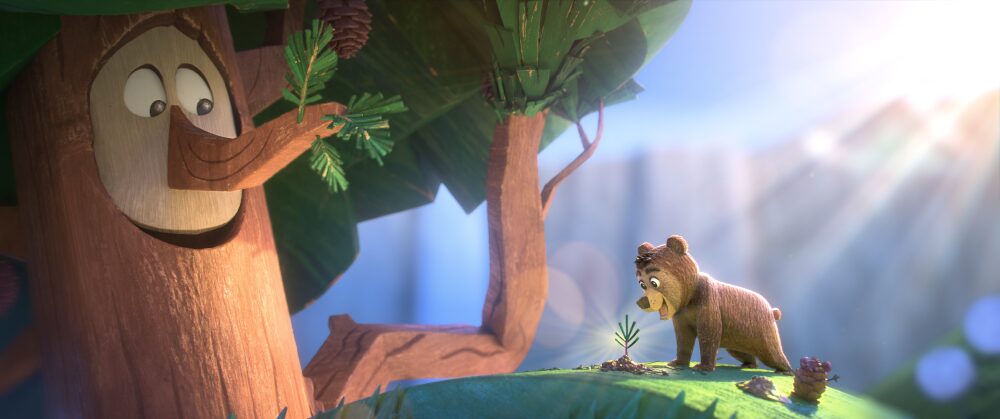
Forevergreen tells the story of an orphaned bear who is raised by an evergreen tree, only to place their bond in jeopardy through his reckless appetite for trash. Among the nominees, this United States production is the most traditionally accessible. Forevergreen is a non-dialogue, family-friendly 3D animated short built on a familiar emotional framework. While formulaic on the surface, Forevergreen distinguishes itself through a rigid, paper-crafted aesthetic and raw consequences. Its themes of gratitude, patience, and sacrificial love are clearly communicated without feeling hollow. The short’s closing quote from John 15:13—“Greater love has no one than this, that someone lays down his life for his friend”— serves as a fitting capstone, reinforcing its notions of emotional sincerity.
Directors: Chris Lavis & Maciek Szczerbowski
This Canadian stop-motion fable tells the haunting story of an abused girl gifted with supernatural tears, the poor boy who loves her, and the greed that ultimately corrupts good intentions. The choice of stop motion is well-suited to the short’s intentionally bleak, messy tone, reinforcing its themes of desperation and moral decay. The puppetry favors limited facial expressions and non-moving mouths, relying heavily on voice-over narration in an old-fashioned storytelling approach. Supported by striking art direction and sound design, The Girl Who Cried Pearls may be the most narratively daring of the nominees, particularly due to its ambiguous ending.
Director: John Kelly, Producer: Andrew Freedman
Retirement Plan follows Ray, a senior citizen who daydreams about all the adventures he’ll pursue once he finally retires. Sometimes playing it simple is the strongest narrative tool, and the short leans fully into that philosophy. Its minimal 2D animation reflects a life of routine and unfulfilled potential, contrasting sharply with the vibrant freedom Ray envisions. The dialogue is straightforward yet poetic, elevated by Domhnall Gleeson’s unforgettable vocal performance. Soft spoken, humorous, and quietly layered, the film becomes a moving reflection on time, longing, and the courage to embrace the extraordinary before it’s too late.
Director: Konstantin Bronzit
Representing Israel, Cyprus, and Russia, The Three Sisters centers on three women living on a remote island whose daily routines are challenged when they rent out a room to a stranger. While the short adopts a mildly experimental structure, its strongest asset lies in its visual conviction. Set entirely in one location, the film embraces a 2D storybook cadence filled with exaggerated physical comedy and unapologetic cartoon hijinks. Though it may lack the emotional depth of its fellow nominees, its technical craftsmanship and comedic timing are delivered with confidence and clarity.
Predicting Best Animated Short can be deceptively difficult. At times, the category follows clear frontrunners such as Pixar’s Bao at the 91st Oscars or The Boy, the Mole, the Fox and the Horse at the 95th. Other years, the race delivers genuine surprises, like In the Shadow of the Cypress overtaking the heavily favored Wander To Wonder at last year’s 97th ceremony.
While precursors like the Annie Awards, BAFTAs, and major festivals offer guidance, they aren’t foolproof. Even Dear Basketball won the 90th Oscars despite losing ground to more precursor-friendly shorts like Negative Space and Garden Party. With that in mind, any of this year’s nominees could take the victory.
That said, patterns still matter.
Given recent voting trends, The Three Sisters appears to face the most challenging uphill battle to win. Despite Bronzit’s having multiple nominations with a potential overdue narrative, the short lacks the emotional gravitas the category often favors.
The Girl Who Cried Pearls may face similar challenges. While stop motion once dominated this category in the 1990s and 2000s, recent winners suggest the branch now gravitates toward broader accessibility of evolved animation styles. Its darker tone and ambiguous ending may bottleneck its appeal to the Academy compared to its co-nominees.
That narrows the race to Butterfly, Forevergreen, and Retirement Plan. Butterfly carries thematic weight that the Academy often appreciates, but Best Animated Short has increasingly rewarded more universally uplifting stories. As a result, it may operate best as a dark horse contender, especially if you’re feeling risky to go for an underdog pick.
Ultimately, the race appears to come down to Forevergreen and Retirement Plan. If we’re talking safe prediction, Forevergreen takes the edge, combining technical ambition, emotional clarity, and a universally relatable message. Retirement Plan remains a strong alternative, but its restrained animation style could hinder its chances to win.