


The way that we talk about direction in awards spaces can sometimes be misleading. If you went purely by nominations, it feels like two categories are rewarded: big-budget spectacle and awards winners at festivals. And, at some level, this makes sense. The massive movies (The Odyssey, almost a lock for many nominations) do indeed have a high degree of difficulty. Christopher Nolan’s films certainly have a lot of moving parts and necessitate an incredibly steady hand at the helm. On the other hand, likely festival darlings (Fjord, Behemoth!) usually have a known cachet in arthouse circles. But great direction is more than these two categories, and it is time that the Academy realized this (or remembered it).
What about a relatively simple film that is structured well, has great performances, and is impeccably blocked and shot? I present to you Olivia Wilde’s expert direction of The Invite. This is a 2026 film that has been well reviewed but is mostly discussed in terms of its screenplay by Will McCormack and Rashida Jones. The writing is indeed quite sharp and incisive, but without Wilde’s control, it could easily devolve into utter chaos. Any time you feature a film that takes place in one location and focuses solely on conversational dialogue, you are in a danger zone. Not every director can live up to greats like Mike Nichols (Who’s Afraid of Virginia Woolf?).
Like Nichols’s work, The Invite is based on a play, though its road to the screen is a bit more complex. It was originally based on a stage production, Els veïns de dalt, written by Cesc Gay, and then turned into films in numerous languages. But any time a stage play is turned into a movie, the question of why always arises. Cinema is an inherently different form than live theater, so a director’s job is to find a way to make the work cinematic. Many directors ignore this and use static camerawork that captures the performances without any sense of kinetic energy.
Olivia Wilde, in a film featuring herself as a lead actress, dispels any doubt about her skill behind the camera with the exhausting (complimentary) opening scene between Angela (Wilde) and Joe (Seth Rogen), who are a married couple struggling emotionally. The pace of this scene and the heightened performances captured truly set the stage for the rest of the film, all before the opening titles. Additionally, the camera movement by cinematographer Adam Newport-Berra is just energetic enough. This makes the audience feel like part of the argument, rather than merely a fly on the wall.
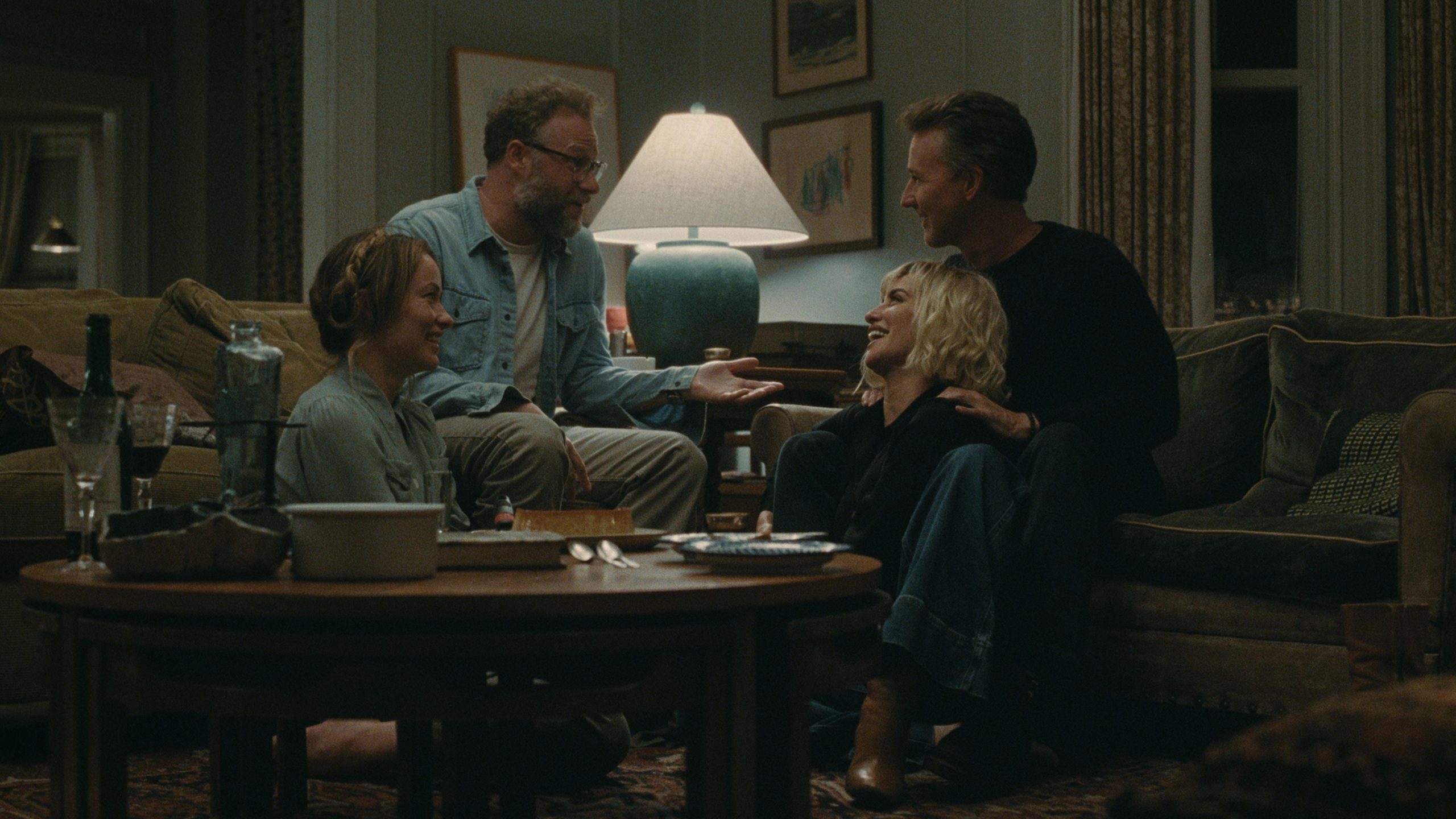
As mentioned earlier, the entire film takes place in one location, Joe and Angela’s apartment, as they invite their neighbors, Piña (Penélope Cruz) and Hawk (Edward Norton), for an impromptu dinner. This could very easily be a setup for stagnation. However, Wilde never fails to choose interesting angles and shot composition. Despite often shooting around corners or with walls and door frames in the way, the focus always manages to remain on the actors. It is never so showy as to distract, yet it is aesthetically engaging. This is a particular balancing act that can easily tip in either direction. As many directors do, Wilde also consistently uses mirrors. This could also easily detract from some of the image-making. Still, given that much of the film is about self-analysis, this is yet another stroke of brilliance from a directorial standpoint.
Most importantly, Wilde creates remarkable opportunities for her fellow actors in this chamber piece. Each of these characters seems lived-in and clearly has been given room to breathe by Wilde. A film like this is precarious in terms of the time spent with each individual. It cannot feel weighted in any one direction, and much of that comes from the direction (and the editing). Much has been made of Norton’s speech in the third act, and despite his usual excellence, this does not happen without Wilde trusting her actors. According to an interview with Wilde, Norton approached her, asking to tell a story from Hawk’s perspective without detailing what would be said. This atmosphere of trust and play that Olivia Wilde created is a part of direction not often spoken about. Some films are ruled with an iron fist, but films like The Invite work best with an organized freedom that many directors would not risk.
Olivia Wilde receiving a nomination for Best Director would be an inspired choice by The Academy. Not only does it highlight independent filmmakers (Wilde even paid out of her own pocket to use film rather than digital), but it would also reward a director who is at the top of her game. The Invite is a film where the director’s hand is always present, but is never so obvious that it feels excessive. There is room for subtlety in the Best Director race, and it is well past time that we reward a well-made film for adults that isn’t necessarily a festival darling or a massive production that makes a billion dollars. It is time to break the mold!