



Overwhelmed. Shocked. Saddened. Furious. Stunned. These are but a few of the emotions which may flow through an audience while watching Jafar Panahi’s It Was Just an Accident, part of the Main Slate at the 63rd New York Film Festival. But these emotions aren’t just a testament to the power present within Panahi’s Palme d’Or-winning film. These emotions are all integral to the very scenario Panahi has crafted with this masterful work of cinema. There are times in life where we can feel so much. It’s an overwhelming sensation as universal as knowing the sun will rise and set with each passing day. In such moments, our very personalities can warp as they’re overtaken by some of the primal driving forces of humanity. We might find ourselves focused on a singular thought: a painful memory or a rage-inducing reminder. It can be something that shakes us to our very foundation. One of the central questions presented in the script of It Was Just an Accident is just how much will we let such feelings affect us? In more succinct terms, what happens if we allow them to fundamentally change who we are as people? This question is given all the more weight by this being the first film Panahi has made since Iran lifted the ban on his filmmaking. Regardless, It Was Just an Accident was still made in secret, and Panahi’s script in particular serves as a testament to the power cinema can wield. Within words on a page, such a singular personal dilemma can translate into a universally understood thriller. It’s a marvel to watch unfold before your very eyes.
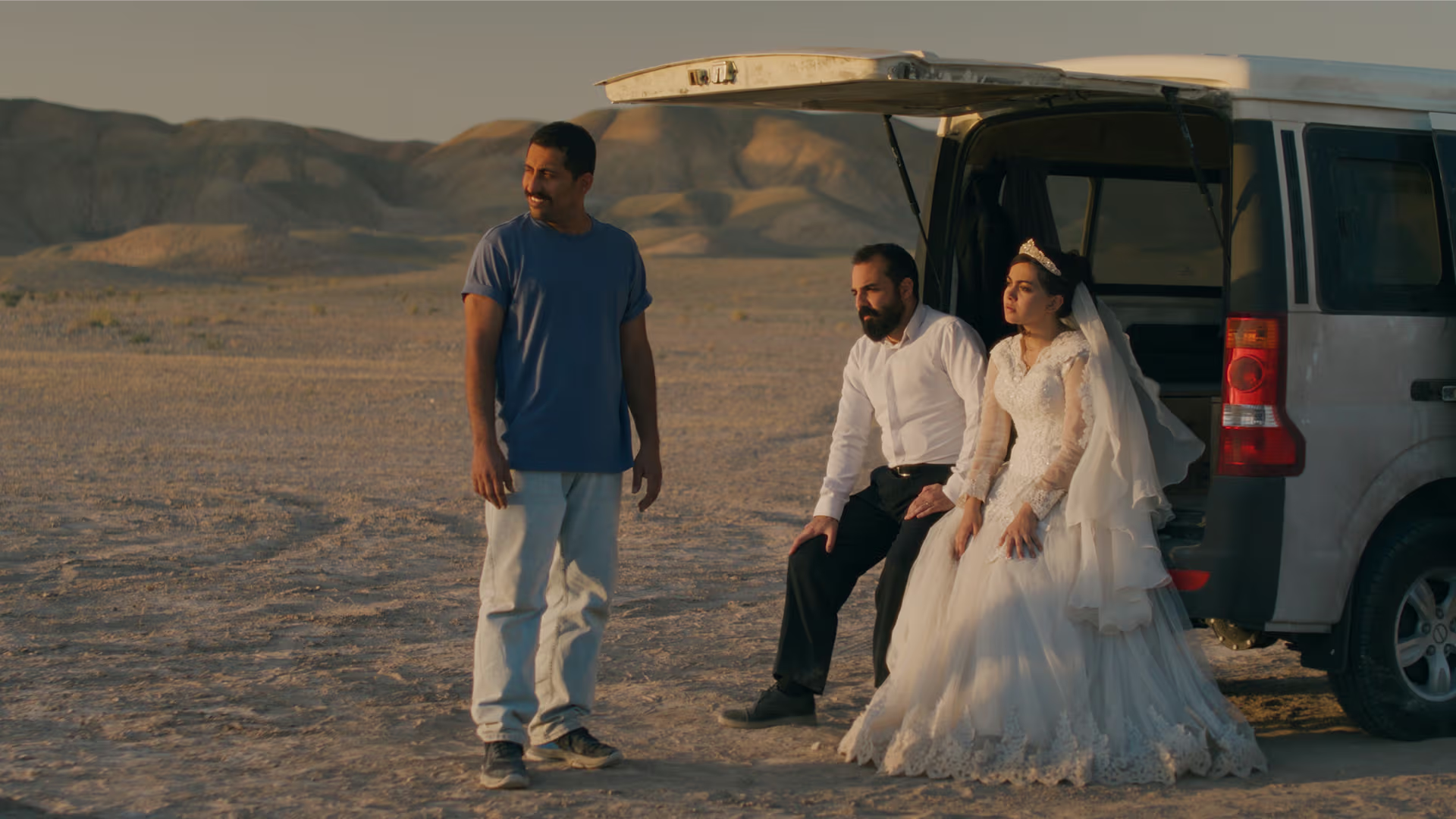
It Was Just an Accident is many things. Oftentimes, it’s operating as a supremely dark comedy. Much of the scenario Panahi has crafted is, at surface value, a comedy of errors of sorts. Vahid (Vahid Mobasseri) believes fate has brought him to the soldier that tortured him during imprisonment. This is only found out after the introduction, devoid of any context, subverts expectations. Without any anchor to ground us, Panahi keeps his audience on our respective toes as we try to get some semblance of understanding into what’s occurring. By the time we understand who Vahid is stalking in a not-so-nonchalant manner, it’s already too late: Vahid has him tied up and tossed into a hole. But before he can finish the job, an inkling of doubt seeps into his mind. And so Panahi halts the startling tension he so immediately created for a comedic set of interactions. Vahid gets sent from person to person, all of whom were also potentially tortured by this man, in the hopes of having his doubts alleviated. At face value, Panahi’s scenario is played for laughs. But it’s slyly toying with much more tragic undertones. And this subtext continuously bubbles up to the surface over the course of the film’s runtime. Many of the characters Vahid entangles within this kidnapping all have their own reactions to the potential of being brought face-to-face with the pain of their past. In this hunt for alleviating doubt comes not just a quest for confirmation bias, but it dredges up emotions which have startling implications for the very souls at the center of this story. That Panahi juggles such lofty emotional weight with the obvious and palpable thrill of whether or not they kidnapped the right man is one of this script’s sharpest, and most cinematic, features.
Beyond the tonal balance of It Was Just an Accident, another of its script’s most impressive feats is how effortlessly it allows each character their own distinct moment to shine; part of this is undoubtedly due to the impressive slew of performances. But the moral dilemma Panahi is grappling with through this imagined scenario is just staggering. Through the five central characters of It Was Just an Accident comes the opportunity for five varied emotional responses. Each one differs greatly, but the depths all seem to stem from the same source. In some instances, there is an immediate and blind fury unleashed on the film. In others, there’s an innate sadness. It’s not just for themselves, but for their country as a whole. Some characters want to merely put it all behind them and attempt to move forward. But the opportunity of potential vengeance before them toys with any semblance of peace which might have been found in the years since. Through Vahid, the moral quandary is grappled with in all sorts of ways. Panahi’s script is allowing himself the space to work through his own singular emotions. And in doing so, he is able to present his audience with a single question: is there any correct solution? Each emotional response is written with both respect and a validating hand. With such cruel and unjust punishments being doled out, can anybody be blamed for seeking vengeance and retribution however best they can? Panahi never presents his audience with an answer. He instead provides his audience with the question and allows us to ponder the possibilities. Yet all the while his script remains a tightly wound thriller until the film feels bound to snap under the pressure. Lucky for us, it never does. It instead finds a way to pivot entirely. In the extended penultimate scene and coda, Panahi finds one final method to keep his audience glued to their seat and shocked when the credits roll.
Comic elements find themselves entangled in the thriller aspects of It Was Just an Accident. The moral dilemma of these characters is always present. But in the end, Panahi chooses to close his script with a pair of equally haunted scenes. The first sees an extended one-take broken out into three monologues of sorts. They’re not traditionally delivered in any sense. The trio of warring voices are all breaking into the frame in the hopes of having their voices heard and their emotions felt. It’s a sequence wherein Panahi doesn’t allow his audience a moment to breathe. In the final scene, which immediately follows, Panahi does quite the opposite. And in doing so, he makes it so that we won’t want to breathe for even a moment. It’s a sequence best experienced within the context of the film, so it won’t be dissected here. But what can be said about it is this: for all the emotion and moral reckoning Panahi has packed into the words of his script, his ability to equally do the same without a word spoken or written is wildly impressive. Silence is universal in that what an audience is feeling during a moment of reflection is often far more powerful than anything that can be directly shown. There’s a universality to the unknown, and what provides us more of a quandary than that of wrestling with our own internal feelings? Panahi is making a direct statement on his own internal emotions while posing the question to his audience. It’s proof of a filmmaker who understands the power of cinema is in being able to connect with an idea or set of ideas more than anything else.
In this regard, the script of It Was Just an Accident excels. Some of the best screenwriting examples are those which imbue reality with a cinematic splendor, all the while never removing the real-world impact of such an emotional response. Panahi’s script, though rooted in the specificity of his living under an authoritarian regime, is written with a universal pen. It allows his ideas and emotions to transcend beyond language and personal experience, morphing into a cinematic vehicle which is bound to stun audiences whether they’re aware of the context surrounding the film’s creation or not. It’s a stellar example of mining personal experience in a way which breaks down any conceivable barrier of entry. It’s a human tale that anyone can relate to; and it’s told through an experience and a reckoning that Panahi is bravely grappling with.
It Was Just an Accident screened at the 63rd New York Film Festival as part of the Main Slate section.