


The 2010s were defined by Marvel Studios. Marvel was untouchable, and redefined our understanding of blockbuster entertainment. The cinematic universe was born and with each movie connected to one another, every Marvel movie became a massive success.
It’s fascinating to me how far Marvel has fallen in the 2020s – after Endgame, the magic of the Infinity Saga seems to have been lost. The plethora of Marvel television shows released on Disney Plus started a trend of Marvel becoming cinematic homework. The major film releases struggled to feel interconnected to one another – but also failed to truly stand on their own. Marvels’ Eternals is a fascinating example of this, because, for all the ways it attempts to shake up the MCU, none of its setups have seen any payoff in the 3 years since its release. The same can be said of Shang-Chi, of Ant-Man and the Wasp: Quantumania, and even Doctor Strange and the Multiverse of Madness. Something has changed in the Marvel superhero formula, wherein the films have become more and more codependent, but lacking the payoff required to reward the attentive audience member.
It seems that Marvel Studios has noticed this as well – and has begun to change the narrative around future Marvel projects. While Thunderbolts* was delayed due to the SAG-AFTRA strike of 2023, the script underwent substantial rewrites – all attempting to bring the magic of the golden years of the MCU back to the film. The marketing material for The Fantastic Four: First Steps has centered around the practical effects used to create the retro-futuristic sets and costumes. And of course, how could we forget the biggest change awaiting the MCU: The return of Robert Downey Jr. as Doomsday. The return of the MCU’s defining star, in the largest Avengers movie to date, all points to a future where every Marvel movie has to be the biggest movie in order to succeed. In light of this, I wanted to examine the smallest Marvel movie… and see if it held up.

Ant-Man was released in theaters on July 17, 2015, and followed Scott Lang (Paul Rudd) – an ex-convict attempting to reintegrate into society to visit his daughter, Cassie (Abby Ryder Fortson). Unable to hold a job, Lang is driven back into his former ways by his roommate and former cell-mate, Luis (Michael Peña). When the job goes wrong, Lang is sucked into the super-hero world by Hank Pym (Michael Douglas), the scientist that discovered a particle that allows any object to shrink to the size of an Ant.
The premise of Ant-Man is simple, and it’s, by far, the smallest Marvel movie in terms of scope. At no point is the entire city of Washington under threat from the villain, Daren Cross (Corey Stoll). While there is a heist in the film to prevent Hydra from procuring the yellow-jacket suit, the stakes are only as large as Lang not being detected. Ant-Man is similar to Mission Impossible in this way – the joy of the heist isn’t the extreme, world-ending stakes, but rather, the minute to minute complications which our protagonist encounters and must dispatch before succeeding in the heist.
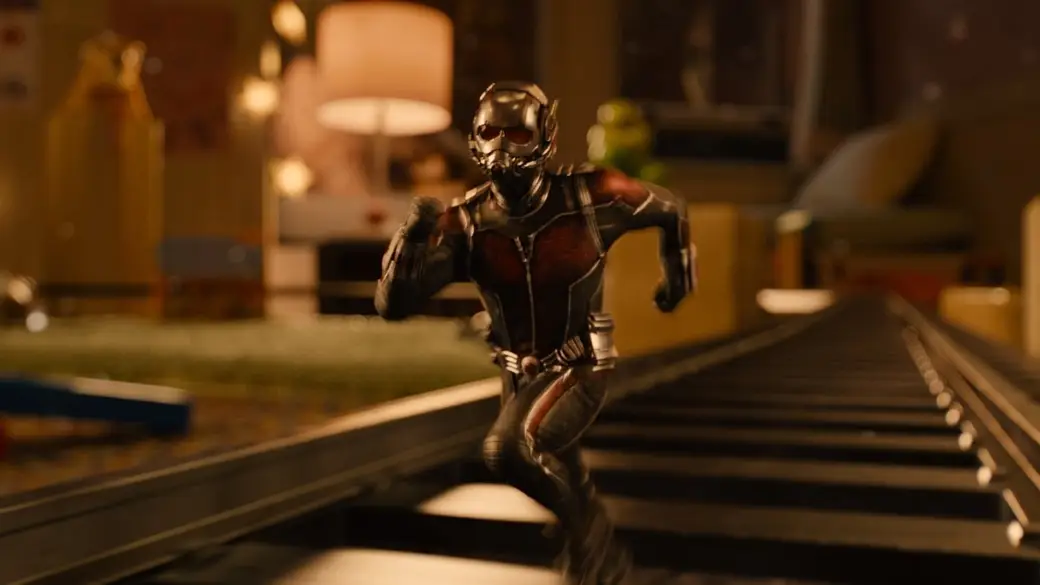
And when the film finally enters its third act, the action is as small-scale as a superhero movie has ever done. The yellowjacket threatens Scott’s world, Cassie, and the battle that ensues includes Thomas the Train toys, ants the size of dogs, and “Disintegration” by The Cure blasting out of a cellphone speaker. It’s comically small-scale in the MCU – and 10 years later, it still is one of my favorite Marvel movies to return to.
Ant-Man works because it understands its characters, and the genre it sits in. First, the film is filled with characters that are constantly in conflict with one another. This can be most obvious as it relates to the protagonist-antagonist relationship between Daren Cross and Scott Lang/Hank Pym. But that is only scratching the surface of these character dynamics, because Ant-Man thrives when the characters that are idealistically aligned are in conflict with one another. Take the relationship between Maggie (Judy Greer) and Scott. The ex-married couple has multiple moments in the film when they enter an argument – when Scott finds out that Maggie is engaged to a cop and when Maggie chastises Scott for crashing Cassie’s birthday. These characters are well written because the beliefs of the characters inform these arguments. This isn’t just true for Scott’s family, but of the entire cast. Hank Pym and Hope Pym (Evangeline Lilly) have arguments over how much to integrate Scott into their heist – and these arguments are covering the years of hurt between these characters as a result of the death of Janet (Hayley Lovitt), Hank’s wife and Hope’s mom.
All these character conflicts perfectly align with the film’s genre: a comedy-heist-superhero movie. In being a comedy, the tone of the film can continue to be upbeat and light despite the arguments that could drift into melodrama. Part of this comes from the absurdity of the film – Scott’s present to Cassie is a horrendous rabbit – and Cassie loudly proclaims “It’s so ugly I love it!”. When an Ant is accidentally hit with an enlarge disk, it grows to the size of a child – and a neighbor states “That’s an odd-looking dog”. The absurdity of the situation creates great comedy, and the train sequence in particular exemplifies this. The entire third act battle with the Thomas the Train Engine set is filmed using the filmic vocabulary of a real steam-engine chase. As Yellowjacket is standing on the tracks, the train is quickly approaching. We know what will happen next – the train will roll over Yellowjacket… and then the opposite happens, because it’s a toy train. The object comedy that comes from making small everyday objects extra large (but not overly threatening) is simple and well-utilized.
I’ve already discussed the strengths of Ant-Man being a heist movie above. Heist movies are defined by the overly complex plans, new and sudden obstacles that throw wrenches into the plans, and the characters walking the tightrope to succeed despite these obstacles.Ant-Man’s second act is all one great heist, which uses its obstacles to not only extend the plot, but challenge its characters to grow and wrestle with their beliefs about the world. Here, the relationship between Hank and Hope is stretched to its breaking point, and the drama between these characters once again is rooted in love and loss. It is a mirror to Scott’s own journey with Cassie, and once more highlights the importance of this mission to Scott’s own life.
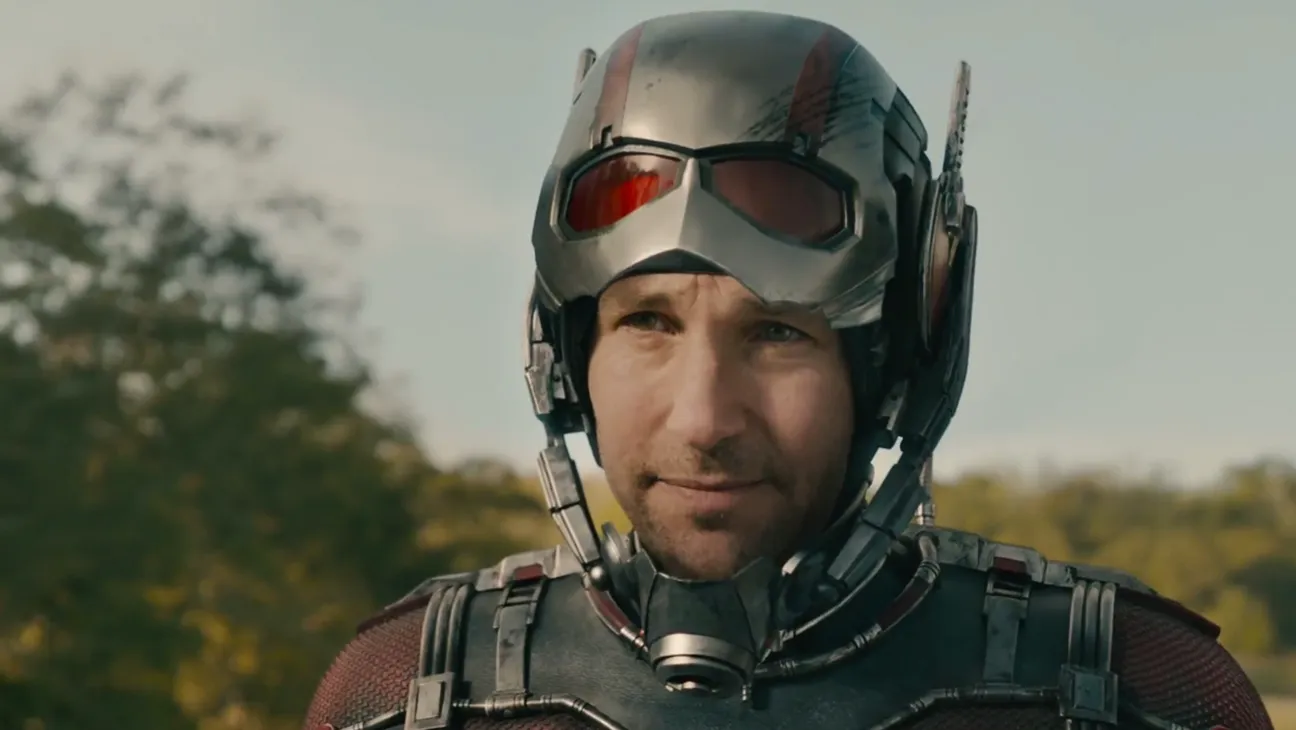
And lastly, Ant-Man is a super-hero movie. It’s got cool gadgets and suits, crazy pseudo-science and physics that break reality, and a cast of characters driven by good or evil. This final layer provides the glue that meshes everything else together: The relationship between Scott and Cassie. Superhero movies are movies about ordinary people doing extraordinary things – and Scott is that ordinary person who the audience can relate to.
Ten years later, Ant-Man is still one of the stronger stand-alone marvel movies. Ant-Man is a movie that is defined by its scale, and by its heart. It’s a movie that Marvel can still learn a few things from – notably, that going bigger in size doesn’t always make for a better movie.