


The Spotlight Shorts program at the 64th New York Film Festival featured quite the array of short films. Beautifully, in just under 90 minutes, the audience was able to be transported all over the world. From New York City to Iran, or China to Turin, even Japan, Colombia, and Panama, the audience was graced with the wonder of travel without ever needing to leave the movie theater. Also being shot across a variety of formats, each short film captured a distinct look which offered a ton of variety to the experience. That’s in addition to the array of stylistic and tonal choices present within each respective short film, making for an experience that constantly shifted yet always felt cohesive. This programming was compiled from this selection of short films in such a way that it immediately evokes a sense of true unity across each film. Each short film was made completely disparately from one another, yet there’s a cohesive through-line running through each one. It’s proof there are no limits to the potential power art can wield. The buzzy titles and larger premieres at a film festival are always understandably going to get a ton of attention. But experiencing short films such as these, where cinema is distilled down to its most essential elements, offers such a thrilling way to explore new avenues of the medium. With legendary filmmakers and those on the rise all participating equally across this program, the Spotlight Shorts speak to the past, present, and future of cinema with such refreshing optimism and a hope for greater connectivity and truth among its viewers.
South of Tehran
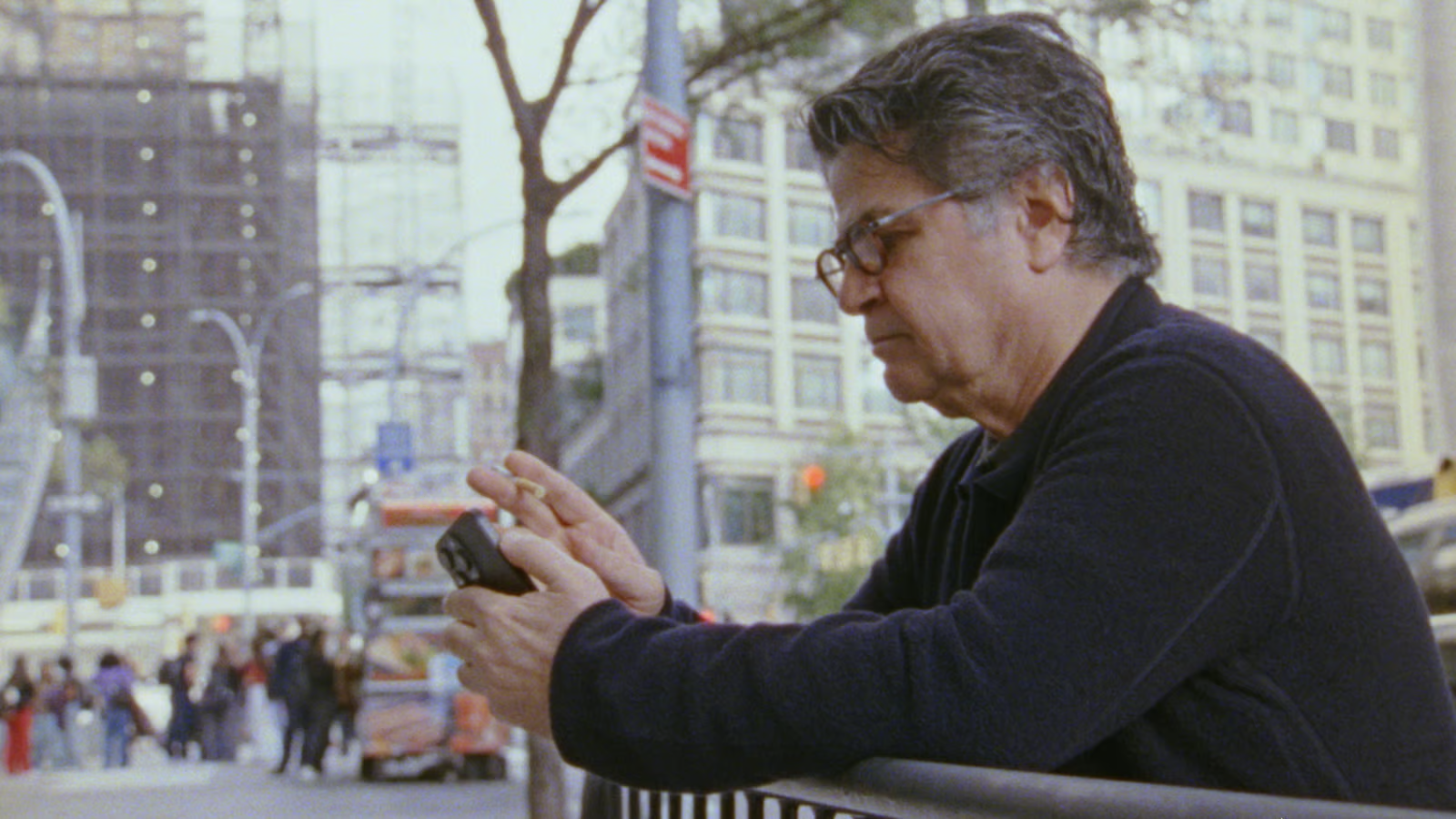
This film is a short directed by Kleber Mendonça Filho during the 63rd New York Film Festival. According to Film at Lincoln Center, it “is the first film in the new NYFF Encounters initiative, a commissioning program that invites a filmmaker in the lineup to create an original short during the course of the festival.” How fitting is it that something like this should exist? This first entry makes for such a touching endeavor. It contains 16mm footage of Jafar Panahi simply observing New York City alongside voiceover narration from his reflections on his youthful experiences with cinema. He notes how he would skip school and secretly travel to the southern part of Tehran to go to the movie theater, and the notable moments such adventures entailed. He described his world at the time as “a small world.” He later closes out the short film by noting that “you can never take cinema for granted.” There’s something so enriching in the realization that, through this obsession of Panahi’s with cinema at a young age, it has seemingly expanded his world tenfold. As he stands outside the legendary Alice Tully Hall, smoking a cigarette and taking pictures with a comically enthused fan, this 16mm footage embodies the liveliness that takes over the Upper West Side of Manhattan for the entirety of the festival. During the New York Film Festival, the “sacred inaccessibility” of films Panahi mentions from his youth due to a disregard for archiving on a larger scale is gone. What instead remains is a haven for cinephiles and filmmakers alike to exist directly amongst the art they cherish most, and revel in all the potential the medium has to offer its audience. As Mendonça Filho captures Panahi riding in a car driving around Manhattan, he also captures some of the great movie theaters of New York City. Though some may be shuttered, each location remains a testament to the ever-expanding opportunities cinema has to offer us. May it be a world that only ever grows for the rest of time.
Masao Adachi Takes a Passport Photo
Directed by Kamal Aljafari, this short film takes the shape of deeply observational cinema. Masao Adachi, a Japanese filmmaker, has been unable to get a passport due to his past involvement with revolutionary leftist groups in the 1970s. Director Aljafari and the great Neo Sora (serving as camera operator) follow Adachi along the process for his most recent, and perhaps final, attempt at receiving a passport. What then follows is exactly what the title promises its audience: a step-by-step process captured via plain observation. Aljafari and Sora simply let the camera roll. The camera is often placed in such a position that the viewer feels more like a fly on the wall within the cramped confines of a Japanese photography shop than we do watching a breezy documentary about the wonderful minutiae that makes up part of the human experience. The old woman who runs the shop is an absolute delight. She is so immensely charming, as is the complete inelegance of the technology and the process itself. And yet, it remains a vital piece of society that continues working on (until it comically doesn’t, leading to one of the funniest documentarian interjections I’ve seen in quite some time). Sora comes around in front of the camera to assist with technical difficulties, and the camera begins to pan slowly. It feels so authentically human; when we are simply sitting around waiting and our eyes begin to wander, seemingly within their own control and us not realizing how far our minds are seeking something unknown even to itself. Perhaps it’s indicative of an innate curiosity within each of us. This short documentary film embodies that curiosity, pointing a camera at a shop the likes of which so many of us are familiar with. Everybody is aware of a shop near them that we’ve passed dozens, if not hundreds, of times in our lives without ever having stepped foot inside. If this short reveals anything, it’s that perhaps we should walk through that door. Maybe there’s a wonderful tale waiting for us on the other side worthy of its own short film.
A Stolen Movie
Camilo Restrepo’s short film is stolen. It’s alright; the filmmaker admits to the theft and goes so far as to apologize to General Motors for doing so! If they’d like to pay the ransom fee, he’d be more than willing to return it to them. This sort of tongue-in-cheek humor is how audiences are introduced to Restrepo’s short, which is effectively him tinkering with footage from a 1961 GM promotional film titled Daring the Darién: The Gap Between The Americas. The original footage itself depicts a group of “expeditioners” in Chevrolet Corvairs attempting to cross one of the most dangerous and inaccessible stretches of land on the planet. What these people did is absolutely demented and is on full display. But Restrepo isn’t using this footage as a way to highlight some impressive feat most people won’t have ever heard about. He is instead narrating over this footage intent on letting his anger at the erased history of South Americans in Panama, Colombia, and ultimately beyond, be heard. He points out the complete hypocrisy of Americans plowing through the untouched natural beauty of the Darién Gap for nothing but ego and improving shareholder value, all the while making a trip that is commonly used for essential travel for migrants seeking refuge in Central or North America. This short film reminds its viewer that the media doesn’t always reveal the complete truth about what it’s depicting. People may not have turned to a car company’s promotional film as a means of learning more about the world around them, and yet, one can assume that somebody saw this upon its release and became mesmerized at the potential. This theft of Restrepo’s has a distinctly noble purpose: to reveal the true reality of history, reclaiming erased stories that would have otherwise been lost to ignorance, ambivalency, or outright antipathy. This short film embodies the qualities of punk, channeling the fundamental elements of the genre into cinema through its own grimy, distinct ways.
Torino Shadow
Jia Zhangke’s short film was commissioned by the Museo Nazionale del Cinema in Turin. Films like these can always be a bit of a gamble, but this experience feels like far more than a glorified ad. It instead offers a compact yet richly lived-in story about life and the essential task of granting ourselves the opportunity to live it fully beyond our own contained experiences. The film follows Ah Zhen (Zhao Tao), a restaurant owner in Guangdong who seems largely over the regular routine of her life. And yet, her interactions with just about every passerby on the street reveals a delightful personality which seems to prove vital to the make-up of her small town. Zhangke’s short very efficiently embodies the emotional and mental slump routines can lead us into. We can become desensitized to what the world has to offer, feeling disconnected from it entirely even though we are just as present within its workings as anybody. Even still, we can feel wholly isolated. Technology provides little solace, offering light distraction more than anything. There’s a great recurring bit involving doomscrolling short-form videos that offers something beyond just a chuckle. It may feel a bit underexplored, but the humor it provides offers just enough to think about technology’s place in our lives within the grand scheme of this short film. Ah Zhen is so preoccupied with her daily responsibilities and stressors as a restaurateur and mother that she has barely had time to pack for her upcoming trip to Turin. She feels the frustrating lack of help from her husband, who is working at his own restaurant in Turin to support his wife and daughter from afar. The ever-growing prevalence of technology slightly helps when it comes to facilitating the connections between a family separated by geography, but these moments are largely depicted as brief, unmemorable, and hollow.
And yet, they are attempts made in a world that forces us to put more and more on our plate until we can barely balance what matters most. Ah Zhen does make it to Turin, and speaks these frustrations aloud to her husband. They appear to fall on deaf ears as he simply has no solution to provide her. And so, guided by the wistful piano motif that occasionally rings throughout the short film, Ah Zhen allows herself to be guided by impulse alone. She ends up in the Museo Nazionale del Cinema after childlike curiosity beckons her there, and she stumbles upon an exhibit highlighting Nanni Moretti’s 1991 film, Caro Diario (Dear Diary). And all of a sudden, she is whisked away into memories of her own life which match what she’s seeing in this random film. Through a beautifully executed cross-cutting montage, Zhangke tenderly encapsulates the essential nature of cinema in particular. There is nothing more validating and freeing than seeing oneself in a piece of art. And with film, we can see every part of ourselves: our frustrations, our worries, our hopes, and so much more, all play out across the history of cinema. There’s perhaps no greater connecting force in the world of art. Language, time, and space itself can all be crystallized into a single film, eliminating any distance whatsoever between any two points across history or world geography. It’s a beautifully rendered notion, made all the more touching by Zhangke’s inclusion of various quotes from cinema history which equally invoke the notion of feeling seen in the films we have seen so many times.
Screening Room
The final short in this program was the latest “state” in experimental filmmaker Morgan Fisher’s 1968 Screening Room project. The rules of this ongoing project are simple. Within each specific “state” (or version) of Screening Room, Fisher will essentially provide a tour of a screening location. Although the essential trait of the project is this: these “states” can only be shown in the specific locations they were filmed. As such, this “state” will remain a hyper-specific short film that can only be seen in the Walter Reade Theater. Yet its actual depth, beyond just being a lovely black-and-white 35mm-shot tour of a great movie theater, is staggeringly potent. A project like this speaks to the larger connective tissue of film, and the necessity of movie theaters, in general. For anybody who has a local movie theater they have visited dozens, if not hundreds or thousands of times, the Screening Room project is for them should it ever screen in their respective home theater. Fisher’s project allows its viewer to take note of all the things we have become accustomed to over time, as is often the case with repetition. But why should we need a film to remind us to do this? Perhaps this project is meant to merely serve as the impetus to keep our hearts, minds, and eyes open the next time we go to the theater, allowing us to be moved by all the beauty that exists outside of that sacred space we love to visit so much. Fisher’s short is also just a beautiful rendering of what it feels like to walk into a movie theater. There’s a real magic to it. We see the seats as they have always been. The massive screen on a wall in front of us. The darkness that envelops us as the lights go down and the beautifully bright images that fight the shadows away. There’s such beauty in a space like a movie theater, no matter how simple it may be, and the Screening Room project remains an ever-evolving testament to their vital place in our lives.
The above short films were screened as part of the Spotlight Shorts program in the Spotlight section at the 64th New York Film Festival.