


Director: Nathan Fielder, Lance Oppenheim
Stars: Elizabeth Holmes, Nathan Fielder, Billy Evans
Synopsis: Thirty-four days before she’s sent to prison, notorious Silicon Valley founder Elizabeth Holmes invites a skeptical film crew to document her every move. What begins as an intimate portrait of an enigmatic felon becomes a mind-bending three-year journey into the abyss.
When Nathan Fielder was promoting the first season of his brilliant HBO show The Rehearsal in July 2022, he granted a rare interview to New York Magazine and appeared shirtless on the cover of its TV issue. The cover itself read “NATHAN FIELDER BARES ALL: The prince of cringe TV’s TIPS AND TRICKS for making everybody SQUIRM,” but of course, that’s just a great tease. What Lila Shapiro’s actual profile set out to do was to unpack what makes Fielder tick (both in reality and on-screen) and to take a peek behind the curtain of his own weaving – one that, when drawn open, unveils a master anthropologist with an awkward, invasive streak and lines of questioning that typically involve prolonged periods of silence and unblinking stares. Perhaps the most fascinating revelation of the piece is Fielder’s own quasi-admission that he’s an expert at crafting a narrative in an edit room, yet struggles to detail his own true narrative. “I think you can build a story for yourself and retroactively say, ‘Well, that probably was this.’ You’re looking for the logical connections,” he told Shapiro. “It’s nice to tell a story that way, but I don’t know if that’s always what’s happening.”
The notion that one’s story can be built – that a truth can be crafted in order to serve a mission, if you will – becomes that much more intriguing as Fielder’s feature filmmaking debut, You Can See Everything, unfolds and evolves over the course of three increasingly insane hours from within the waning orbit of none other than Elizabeth Holmes, the disgraced founder of Theranos. As she stared down an 11-year prison sentence for criminal fraud, Holmes and her life partner, Billy Evans, invited Fielder and his co-director Lance Oppenheim (Primetime) to document Holmes’ final month of freedom from their Del Mar beachfront rental beginning in 2023; for the last three years, Fielder and co. have been at work on the project in secret. It’s immediately clear why: What they uncovered truly has to be seen to be believed.
Which is not to say that You Can See Everything is an exposé by definition, nor that it is even a work of documentary at all. What Fielder’s film reveals itself to be is not an investigation, but an ever-transforming portrait of a person who has long-been considered a manipulator to end all manipulators despite her continued claims not only of innocence, but of lifelong honesty. Why Holmes defrauded investors of billions with her faulty invention – a miracle medical test that claimed to require just one drop of blood to test for anything and everything – is not the question on Fielder’s lips because he has never been a creative whose instincts have drawn him toward evidence that could be considered factual. Rather, the Nathan For You and Rehearsal creator descends upon Holmes and her family in the hopes that his presence may understand her psyche more concretely as opposed to “getting to the bottom of things.” The waters he treads may call for him to dive to its floor, but he has an innate ability to understand that what floats in between the surface and the harshest depths is where the clearest sense of reality lies in wait.
In other words, Fielder’s area of expertise is precisely where narratives are molded, and he spends his time with Holmes attempting to assess whether or not he is being actively manipulated or the woman herself has long been subjected to coercion herself. Could Sunny Balwani, Theranos’ second in command and Holmes’ longtime paramour, have been puppeteering their entire scam, forcing his boss and girlfriend to do the dirty work like a sacrificial chess piece en route to the ultimate checkmate? Is Holmes’ now-lover, the lanky and lacerative Evans, her newest captor, a man with financial goals even larger than his ego? It’s worth noting that Fielder wasn’t initially meant to play such a forward-facing role in the film, that he was initially meant to serve as a bystanding inquisitor, yet the duo in front of his camera continued to seek his opinion on their musings and missions to the point where he was drawn into their lives more intimately. When Fielder first appears on screen, he appears to be doing his usual thing: Pointing his eyes directly forward despite his head being tilted down, operating like a predatory observer until the moment to strike is just right. Yet it’s quickly apparent that the shtick has been dropped, and that a man best regarded for his inelegant curiosities has entered uncharted territory, one where playing a character simply won’t do.
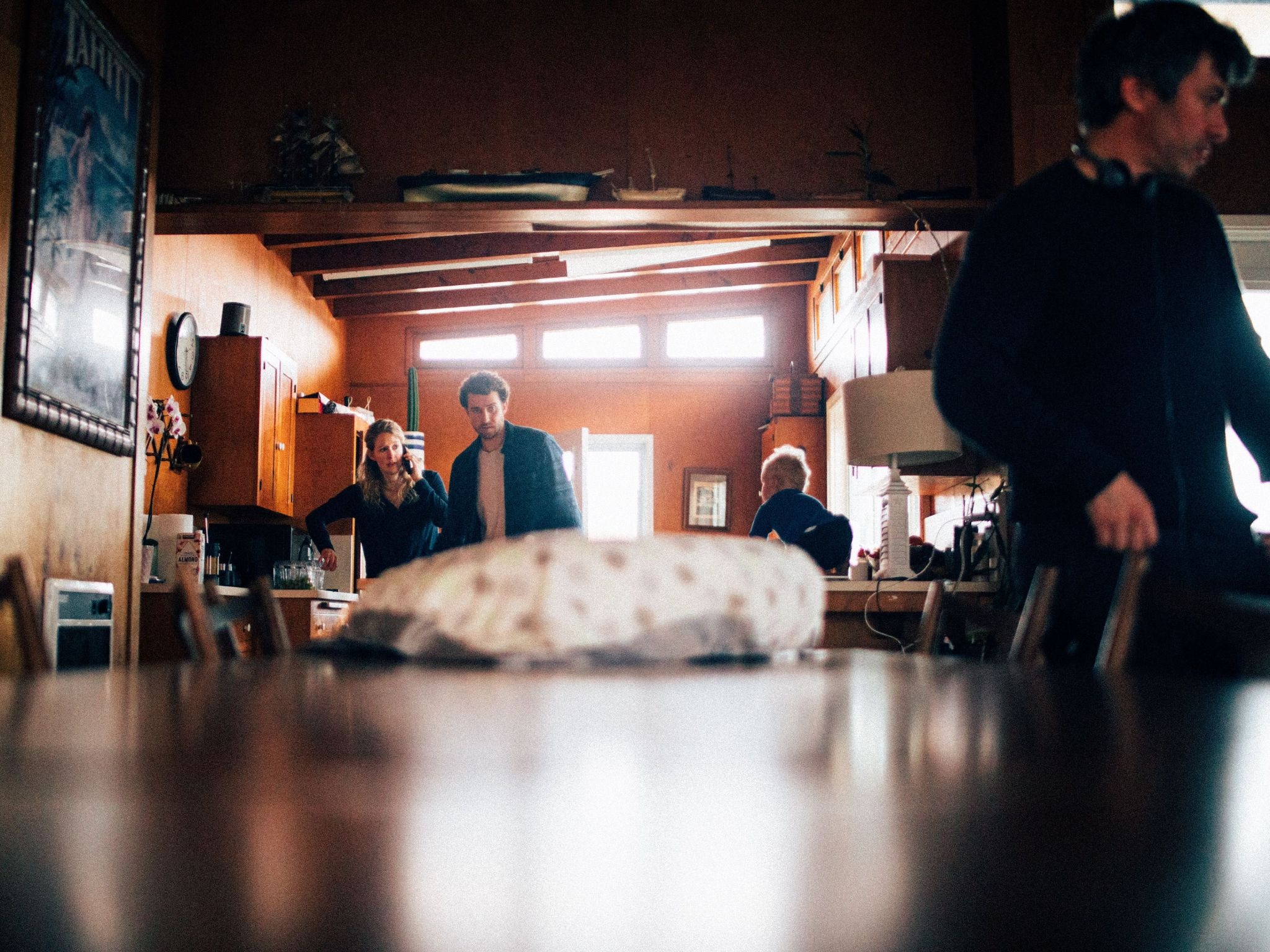
Such a shift in responsibility may sound performative in and of itself, especially given that Fielder’s whole deal has always been probing and discomfiting for the sake of entertainment. But by shedding some (if not all) of his trademark remove to endeavor to understand something/someone, he finds himself left with more questions and less of a grasp on who and what is real about his experience than ever before. In past projects, Fielder has maintained an aloofness designed to keep his subjects at arm’s length, a distance that lets him attain insights by way of observation. To merely observe here would allow for one entity’s tale to be delivered as gospel; that the filmmaker is unwilling to lie down and take it as such makes You Can See Everything a more honest feat than anything he’s done before.
He expresses insecurities about whether Holmes and Evans chose him to film their lives and hear their sides of the infamous story because of his lack of scientific knowledge. He struggles to communicate his curiosities properly not because they are falling on deaf ears, but because they are falling on ears that speak a language no one understands. In a defining moment of the film, the central couple reads a profile of Holmes in The New York Times, one where she is quoted as saying the likes of Amanda Seyfried (who portrayed Holmes in the Hulu show The Dropout) and Jennifer Lawrence (who reportedly dropped out of a movie in which she was cast as Holmes) were not playing her, but “a character [she] created.” Both Holmes and Evans insist that the former actually said “a character they created,” referring to the writers behind these dramatized versions of her story, and that there is recorded evidence of these interviews in their possession. But Fielder is baffled, as the duo declines to share said audio and/or transcripts, leading the documentarian to wonder what is correct and what is contrived. He offers that if Holmes didn’t say what the Times wrote, it shows that the public narrative about her has become so dominant that it is now accepted as truth; if she did say it, however, it shows that she has a pattern of not remembering the things she says, yet saying them to manufacture perception. All Holmes can do is nod. It seems as though even she isn’t certain.
You Can See Everything eventually flips its own process on its head, and it would be wise to avoid spoilers as best you are able, as the surprises in store are more than worth the wait. Yet its most resounding achievement is not at all in what it has sought to conceal, but what it struggles to reveal. The pleasures of what Fielder, Oppenheim, and perhaps even Holmes and Evans have conjured with this experiment exist in the questions it is sure to inspire, from the baffling and bizarre to the most foundational stumpers about our everyday behaviors. We’ve all lied at one point or another in our lives, but when deceit becomes a pattern, an impossible web is woven, and untangling one’s self from its sticky coating can either serve as a journey of discovery or a furious plunge into further uncertainty. You Can See Everything doesn’t free us and its makers from that snare, nor is it seeking to. Instead, it rewords its own thesis in a brilliantly, profoundly unanswerable way: Can you really ever see everything, or just what people want you to see?